Wikio - Top Blogs - Religion and belief

Tuesday, 9 June 2015

St Margaret's Barking


George Jack (1855-1931) architect, furniture-designer, wood carver, stained glass artist, and teacher, was an important contributor to the Arts and Crafts Movement. He trained as an architect in Scotland, and became a full-time assistant to Philip Webb in 1882. Through Webb, Jack was introduced to William Morris and from 1885 began to design furniture for Morris & Co. Subsequently he took up wood carving and plaster moulding.

From 1929-1936, the architect Charles Canning Winmill involved Jack in the repair and renovation of St Margaret’s Barking. By the time he worked on St Margaret’s, Jack was in his 70s and was quite ill. Despite this fact, his work for the church was admirable and included: the memorial window to the Hewitt family in the Lady Chapel, a pair of tall candelabra, decoration of the Chancel roof, a carved memorial tablet, eight carved figures on the Youth Chapel screen (Captain Cook, Elisabeth Fry, St Ethelburga, two Barking fishermen, Saint James, Saint John and Saint Nicholas), and the Fisherman’s window in the Youth Chapel.

Jack also enlisted the help of his daughter Jessie in painting the font cover at St Margaret’s. Jessie painted the existing wooden cover to a design by her father. The lettering around the rim says, ‘God hath given to us eternal life and this life is in his son’. Each segment is painted with a bird or butterfly on a mid-blue ground with gilding. This is the only known example of Jack’s daughter helping him with his decorative schemes. Sadly, his work at St Margaret’s was one of Jack’s last commissions, he died in December 1931.

From 29th April to 29th July 2006, the William Morris Gallery held the first exhibition solely devoted to George Jack. His name is familiar to many who are interested in Morris but most are not fully aware of the extent of his output. The exhibition aimed to bring this important artist to greater prominence and explored all aspects of his work. Exhibits were drawn from the archive held at the Gallery, which contains designs for work in plaster, furniture, woodcarvings, embroidery, letters and photographs, and from other collections. It is also brought to light the contribution of his wife and daughters.

St Margaret’s loaned three key works for the exhibition – two of the carved wooden figures from the Youth Chapel screen (Captain Cook and Elizabeth Fry) and the Font cover. As curate at St Margaret’s at that time, I liaised with the William Morris Gallery over these loans and said that: “George Jack’s work at St Margaret’s has been much loved since Charles Winmill’s renovation at the turn of the last century which introduced many artefacts from the Arts and Crafts movement into the church. Jack’s work here demonstrates his versatility and skill as a craftsman and has great local significance as memorials to Barking’s fishing industry and links with Captain Cook and Elizabeth Fry. This exhibition will highlight an under-appreciated aspect of the significant history that can be found at St Margaret’s.”

I also arranged that, during the Barking Festival, Amy Clarke (Curator, William Morris Gallery) gave a short illustrated talk on George Jack and tour of the church showing Jack’s work at St Margaret’s.

2005/06 was a year at St Margaret's where there was a particular focus on the arts. The year began with a Christmas gift from a local artist. For some years George Emmerson had been painting the church, churchyard and the ruins of Barking Abbey and, as he left the borough, presented the church with a book of these paintings. The book is filled with watercolours set in intricately painted borders and complemented by historical information and personal reflections. It is a beautiful reminder of the history of the Abbey Green site in which St Margaret’s is located and a record of one person’s response to that history.

Lent 2005 saw the unveiling of an original painting commissioned for the Youth Chapel at St Margaret’s. Early in the morning was unveiled by the artist Alan Stewart and dedicated by the Bishop of Barking. The painting depicts Christ cooking breakfast for his disciples by Lake Galilee after his resurrection, as told in John's Gospel chapter 21. Stewart has painted a black Christ surrounded by disciples of every ethnic origin to reflect the diverse congregation that currently worships at St Margaret's. Through its lakeside setting the pastel painting also links to the stained glass window in the Youth Chapel commemorating the fishing industry in Barking.

Early in the morning was joined in the Youth Chapel by the second artistic gift St Margaret’s received in 2005/06. During a study visit to their link parish of Kristinehamn in Sweden the Church was presented with an icon of Christ blessing the children by the Norwegian painter Kjellaug Nordsjö, who is widely considered the best contemporary icon painter in Scandinavia. This icon is a window into Christ’s inclusivity and gentleness and a sign of the welcome that the Church seeks to give to all who come to St Margaret’s.

----------------------------------------------------------------------------------------------------

Arvo Pärt - Silentium.

Via Cordis - The Way of the Heart


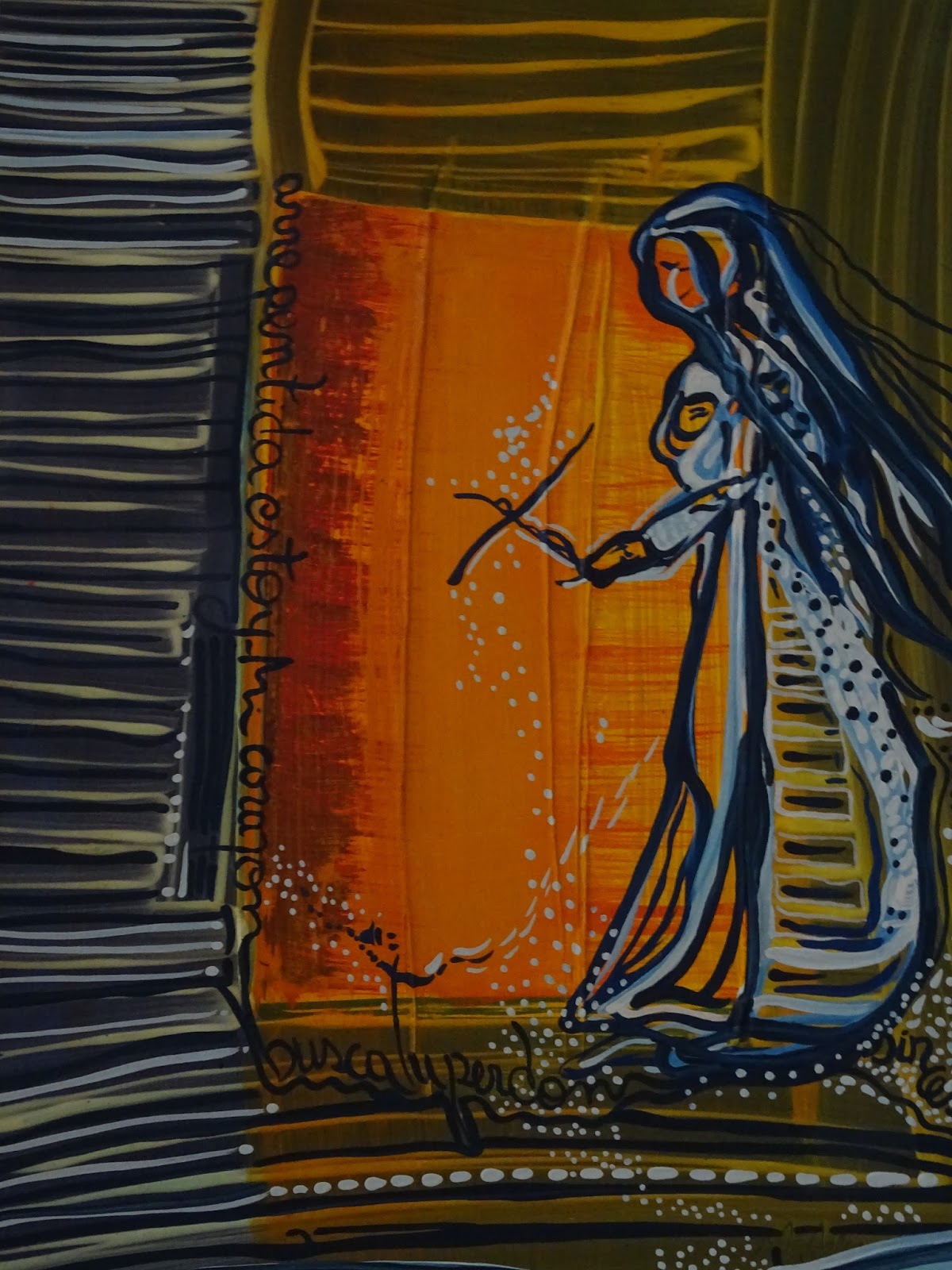
Via Cordis – The Way of the Heart: Paintings by María Inés Aguirre (MIA)
Monday 8th – Friday 26th June, 10.00am – 4.00pm. St Stephen Walbrook, 39 Walbrook, London EC4N 8BN.
Exhibition reception - Monday 15th June, 6.30pm. All are welcome.


Each painting, María Inés Aguirre (MIA) says, “is a solar flare of colours” where every colour is an emotion. The critic Pierre Restany identified the distinctive quality of MIA’s art as having its roots in her emotional life which then manifests itself in “the exuberance and spontaneity of her painting.”

MIA has spoken of risk and adventure, and the resulting spontaneity, as being key to her art. Her work fuses colour, music, emotion and nature in “a sun-burst of colour, of joy and imagination.”

As Michael Hutchinson-Uzielli has noted, this means that "Mia's paintings map her emotions and imagination, with colour, texture and sinuous lines depicting the landscape of her thoughts.” Her work is, therefore, cartography of the heart or soul, as she, herself, has suggested in selecting the title ‘Via Cordis: The Way of the Heart’ for this show.

MIA says the following words of Paul Klee, from 1918, describe her own creative process: “Everything around me dissolves and interesting works emerge as if of their own accord. My hand is entirely the instrument of a distant sphere. It isnʼt my head that is working, but something else, something higher, something somewhere more remote. I must have great friends out there – obscure, but also brilliant - and theyʼre all very good to me.”

MIA’s identification with Klee’s description of creativity as involving a sense of giftedness from a higher force helps us in understanding the emotional impact of her work more fully. As a result, we could either see the emotions she maps in her work as being divinely inspired or think that by following and depicting those emotions she taps into the divine.

Her work has connected with traditional religious iconography, although not with traditional outcomes. Her ‘Via Crucis’, ‘Via Lucis’ and now ‘Via Cordis’ exhibitions have engaged with the imagery of the ‘Stations of the Cross’, the ‘Path of Light’ and now the ‘Way of the Heart’. Through these series she has reflected on emotions provoked by the Passion of Christ while seeing that narrative as also representing the different moods of modern man.

These are works to contemplate as, through energy of line and brilliance of colour (that “sun-burst of joy and imagination”), they refresh the soul.

MIA studied Fine Art at the University of Tucumán (Argentina) and the Accademia di Belle Arti in Venice. She has exhibited in Europe, Asia and the Americas and has shows later this year in Hong Kong, France and Argentina. Her work stands out for its colour, energy and spontaneity. Her fascination with the connections between music and colour led her to become the first visual artist in residence at Steinway & Sons, London, where she transformed a Steinway Model D concert grand piano into 'Dancing Soul'. She is represented by ArtMoorHouse - Moor House, 120 London Wall, London, EC2Y 5ET. Tel: +44(0)7502211914. Email: info@artmoorhouse.com. Web: http://www.artmoorhouse.com/.

-----------------------------------------------------------------------------------------------------------

The Milgram Trio - Piano Trio in E minor Op 90 'Dumky'.

The Bridge: Exhibition launch


Last night the official launch and reception for The Bridge, a ground-breaking interfaith exhibition of premier and emerging visual artists, was held at St Martin-in-the-Fields. Speakers included: The Hon Nasser Kamel, Ambassador of Egypt, Revd Canon Paul-Gordon Chandler, Founder & President of CARAVAN, Most Revd Dr Bishop Mouneer Anis, Bishop of Egypt and Primate of Jerusalem and the Middle East, and Most Revd and Rt Hon Justin Welby, Archbishop of Canterbury. The St Martins Voices and Sami Yusuf sang.

The Bridge is an East-West travelling art exhibition organised and curated by CARAVAN, an interreligious and intercultural peacebuilding NGO. It showcases the work of 47 premier contemporary visual artists from 15 countries. Each artist has submitted one original work (created specifically for the exhibition) addressing the theme. The Bridge is an unparalleled gathering of international artists focusing on what they hold in common through their cultures and creeds: Christian, Muslim and Jewish.

The Bridge is at St Martin-in-the-Fields until 31 July.

-----------------------------------------------------------------------------------------------

Sami Yusuf - The Gift Of Love. 

Sunday, 7 June 2015

The Society of Women Artists 154th Annual Exhibition

Founded in 1855, the Society of Women Artists has had a unique history dedicated to promoting art by women. The Annual Exhibition at the Mall Galleries, showcases an eclectic mix of artwork in all media. The Society encourages variety and versatility and features some of the finest contemporary women artists from all over the world, thus sustaining a reputation for excellence.

Among the many artists included, I found the following of particular interest:

Bethany Milam is a Hampshire based Interdisciplinary Fine Artist, engaging with a broad range of media. Permeating through her diverse practice is an interest in the subconscious mind, fantasies and daydreams which are combined with a keen observation of everyday life. Included in the show is Milam's latest Graphite drawing, depicting a family friend in Salvation Army uniform selling the War Cry, is entitled 'Heart and Soul'. Milam has previously exhibited drawings of Street Pastors, including a portrait of her mother in her Street Pastor's uniform and a street scene which now features on the Street Pastors website. Of the latter she writes: 'While working on this drawing I had the story of the Good Samaritan running through my mind especially the passage: “Then Jesus said ‘which one of these three men do you think was a neighbour to the man who was attacked by the robbers?’ The expert on the law answered, ‘The one who showed him Mercy’ Jesus said to him then go and do what he did.”'

Sheila Vaughan, who is showing 'Angel' and 'Carer', is another to have painted a Salvationist previously. Vaughan says she loves 'working with faces and figures both realistically rendered and more abstractly rendered and oil pastel lends itself wonderfully to this end.' She quotes Gerhard Richter approvingly: "One has to believe in what one is doing, one has to commit oneself inwardly, in order to do painting. Once obsessed, one ultimately carries it to the point of believing that one might change human beings through painting. But if one lacks passionate commitment, there is nothing left to do. Then it is best to leave it alone. For basically painting is total idiocy".

Amanda Palmer asks whether the way we perceive the world is simply a case of what we see, or whether there is some other force at work? This question forms the starting point for her work and her own uncertainty about what the world really is and what it means. Her 'Deposition' features dolls and puppets. She explains that: 'Both toys and nature remind me of my childhood - a time of everyday magic, when each pencil, tin soldier, flower, or snail for that matter, seemed to have a magical aura about it. When the world was understood through religious beliefs and when anything seemed possible. Part of me longs to rekindle that sense of faith and wonder, and yearns for the paradisiacal, the beautiful and the magical. However, in the adult world of materialism, filled with war reports and media images of terror and devastation, how does one make sense of the world now? As instruments of many childhood games and make-believe stories, my old toys, along with natural forms, birds, insects and animals, have become the focus of my work as objects within a still life. I am interested in how, in an adult context, these can be used as vehicles for personification, interpretation, and as a catalyst for narrative. I often assemble the still lifes with reference to fairy stories, nursery rhymes, or religious artwork and draw from these as a way to try and resolve a cognitive dissonance between science and religion. '

Jessica Watson's work 'seeks to highlight the aspects of our lives we tend to sweep under the carpet, those grey areas we keep hidden for fear of ridicule.' She is 'interested in the personality traits we edit out, the ones which make us unique and our lives richer.' More than ever, she suggests, 'we are presented with a technological, polished version of life to aspire to by the media, and we have new opportunities to create our own presentation.' Watson's I'm not here just to catch you when you fall. Its my job to help you find the courage to jump is a personal response to her role as a parent; the 'constant conflict that exists between wanting to 'protect' and allowing the freedom to learn from experience.'

Narrative, contemporary artist Angela Brittain's 'colourful and exuberant paintings are full of movement and sometimes a little wit.' 'This year her work has started with a new series of wood panels about people and nature.' 'Inspired by life around her and the simple pleasure of seeing, feeling and responding - resisting labelling and simply painting from within, these paintings are alive with energy that is passed on.' 'A chance encounter of a man-made or natural set of colours working together has the ability to spark happiness or awe but only if the mind is receptive.' A strong influence on Brittain's work are 'the artists of the 1920's and 1930's such as Stanley Spencer and Edward Burra although recently she has been enjoying studying the neo-futurists like Daniel Schinasi.'

Christine Southworth takes 'an experimental approach to her print making.' Every picture she creates 'tells a story; often a sad one.' The theme for the etchings exhibited here is to 'show the plight of children who are caught up in war zones all over the world and to illustrate a need to protect the innocents.'

Congratulations to Zi Ling on winning the Rosemary & Company Art Prize for her watercolour of 'Steve'. Ling is a visual artist and theatre director. She has established herself as a painter, as well as creating numerous short films and visual installations.

-------------------------------------------------------------------------------------------

Zi Ling - Normal Love.

Saturday, 6 June 2015

Modest Fashion: Styling Bodies, Mediating Faith

Increasing numbers of women are engaging in the development and discussion of modest dressing; a movement matched by a growing media and popular demand for intelligent commentary about the topic. Modest Fashion: Styling Bodies, Mediating Faith edited by Reina Lewis, Artscom Centenary Professor of Cultural Studies, London College of Fashion, set out to meet that need. 

As a trend, modest dressing is spreading across the world, yet it is rarely viewed as 'fashion'. Studying consumers and producers, retailers and bloggers, Modest Fashion provides an up to the minute account of the art of dressing modestly - and fashionably. Leading scholars in the area, along with journalists, fashion designers, entrepreneurs and bloggers discuss the emergence of a niche market for modest fashion among and between Jewish, Christian and Muslim faith groups as well as secular dressers. Crossing creeds and cultures, analysing commentary alongside commerce, the book probes the personal and the political as well as religious, aesthetic and economic implications of contemporary dress practices and the debates that surround them.

-------------------------------------------------------------------------------------------

Violent Femmes - I Held Her In My Arms.

Exhibitions update

Hide and Seek, coincides with the publication of a monograph celebrating Eileen Cooper’s career, and presents drawings spanning almost 40 years. Cooper creates work that possesses a strongly poetic and distinctive vision, and the artist has been described as a ‘magical realist’. An accomplished painter and printmaker, Cooper’s practice has always been underpinned by drawing. This remarkable body of work illustrates how her distinctive imagery has developed through making drawings that explore such subjects as sexuality, birth, family, fecundity and creativity.

Cross-sensory perception quickens and multiplies in Smell of First Snow, Shirazeh Houshiary’s eighth exhibition at Lisson Gallery. Through painting, drawing and sculpture, Houshiary approaches the intangible and evanescent, articulating a metaphysical reality that lies beyond mere form and surface.

Peter Kennard is Britain’s most important political artist whose imagery has become synonymous with the modern protest movement. The first major retrospective of his work at the Imperial War Museum demonstrates how Kennard has consistently confronted issues in world politics and British governmental policy both at home and abroad, inspiring many of today’s politically-aware artists from Mark Wallinger to Banksy.

Marking thirty years since his first solo exhibition at Flowers Gallery, former official British War Artist John Keane presents a new series of paintings on the themes of power and conflict - Speaking Truth to Power at 21 Cork Street. Keane’s work has been engaged in a dialogue with unfolding news stories since the 1980s, travelling overseas to witness conflicts first hand. His work challenges received wisdom and explores alternative narratives to those exerted by the press - from his representation of the atrocities of war, to his portraits of the people made powerful by their place in and behind the media spotlight. The Wisdom of Hindsight is a retrospective of Keane's work at 82 Kingsland Road.

Zi Ling is a visual artist currently based in Beijing and London, working in watercolour, etching, short film and installation, who has work in the Society of Women Artists 154th Annual Exhibition at Mall Galleries. Following this show will be the New English Art Club Annual Open Art Exhibition 2015 which showcases the work of some of the finest figurative painters at work today, members’ paintings, drawings and original prints are shown alongside work selected from the open submission.

-----------------------------------------------------------------------
Lenny Kravitz - Let Love Rule.

Start:Stop - 96 Sacraments

Start your day by stopping to reflect for 10 minutes. Every Tuesday morning there is a rolling programme of work-based reflections at St Stephen Walbrook (39 Walbrook, London EC4N 8BN). Every 15 minutes between 7.30am and 9.15am, a 10 minute session of reflection begins. These sessions include bible passages, meditations, music, prayers, readings and silence. Drop in on your way into work to start your day by stopping to reflect for 10 minutes.

Bible reading

‘… whatever is true, whatever is honourable, whatever is just, whatever is pure, whatever is pleasing, whatever is commendable, if there is any excellence and if there is anything worthy of praise, think about these things.’ Philippians 4. 8

Meditation

The artist Paul Thek once wrote 96 Sacraments in one of his notebooks. By doing so, he celebrated everything around him and everything that was present to him, especially the small and everyday things.

The things he celebrated can seem banal but, as our reading, suggests it is a godly thing to do to develop an attitude or habit of looking for the good in what is around us, the people we meet and the things we do. St Paul suggests that we go through life looking for what is true, honourable, just, pure, pleasing and commendable. He suggests this because he is confident that if we seek these things we will find them.

I wonder, therefore, whether our view of our day and those we are with would change at all if we were able to simply to say, like Paul Thek, ‘Praise the Lord’ in respect of each thing we do, each person we meet and each place we go to.

Prayer

Walk to work. Praise the Lord.
Greet the receptionist. Praise the Lord.
Get in the lift. Praise the Lord.
Acknowledge others in the lift. Praise the Lord.
Exit the lift. Praise the Lord.
Greet colleagues. Praise the Lord.
Find your desk. Praise the Lord.
Sit at your desk. Praise the Lord.
Turn on the computer. Praise the Lord.
Open emails. Praise the Lord.
Read emails. Praise the Lord.
Compose and send emails. Praise the Lord.
Answer the phone. Praise the Lord.
Attend meetings. Praise the Lord.
Begin tasks. Praise the Lord.
Complete tasks. Praise the Lord.

As we praise you, Lord, this morning,
We recognise that the world you created
contains much that is true, honourable, just,
pure, pleasing and commendable.
Keep us looking for these things
in the ordinariness of life
and praising you when they are found.
And may that blessing of God,
Father, Son and Holy Spirit,
Rest upon you and remain with you always.
Amen.

---------------------------------------------------------------------------------------

Gungor - Doxology.