Wikio - Top Blogs - Religion and belief
Showing posts with label british museum. Show all posts

Wednesday, 31 August 2022

Artlyst - Hidden Depths: The Woman in the Window – Dulwich Picture Gallery

My latest exhibition review for Artlyst is on 'Reframed: The Woman in the Window' at Dulwich Picture Gallery:

‘It’s such a simple motif – a woman at or by a window – yet, as curator Jennifer Sliwka ably demonstrates in this show, is one that contains hidden depths. This exhibition concisely and clearly maps out the history of this motif, shows us several specific foci of its use over the centuries, while also exploring the extent to which this has been a motif of male artists reflecting the male gaze, before then highlighting ways in which female artists have subverted, used and critiqued the motif.

It is a significant achievement on Sliwka’s part to navigate across so much contested ground with such care and consideration, while delivering an exhibition that never fails to engage visually as well as intellectually. Alongside her consideration of the ‘woman in the window’ motif are also reflections on the nature of windows; not simply openings in walls but, as Sliwka notes, charged thresholds, sites of observation or communication, and signifiers of wealth or spiritual meaning. The layers of meaning explored in this exhibition are, as a result, significant and deep.

The exhibition identifies the key geographic locations, cultures and time periods for which the motif had a particular meaning and what this reveals about issues of gender and visibility. As such, it is instructive to view the exhibition alongside Feminine power: the divine to the demonic at the British Museum, which explores the representation of feminine power or desire in material form. In both, no simple answers are proffered to the issues raised but there is a wealth of imagery and ideas shared with which to engage.'

My other pieces for Artlyst are:

Interviews -
Articles -
-----------------------------------------------------------------------------------------------------------

The Innocence Mission - Look Out From Your Window.

Monday, 20 June 2022

Artlyst: Art Illuminating spirituality June 2022 Diary

My June diary for Artlyst has mentions for The Singh Twins at Firstsite, Chaiya Art Awards 2023, Peter S. Smith and The Woodpecking Factory at British Museum, Remembering Ervin Bossányi at The Liszt Institute, ASCHA's Georges Rouault symposium, plus the Visual Commentary on Scripture and Reframed: The Woman in the Window at Dulwich Picture Gallery. It's a very full diary!

For more on Chaiya Art Awards see:
For my interview with Ilona Bossanyi about her grandfather see - 
For my VCS exhibitions, see 'A Question of Faith' and 'Back from the Brink'.

My other pieces for Artlyst are:

Interviews -
Articles -
-----------------------------------------------------------------------------------------------------------

Eric Bibb - With My Maker I Am One.

Monday, 23 May 2022

Peter S. Smith, The Dalziel Woodpeckers, and Hans Rookmaaker


Peter S. Smith is currently showing work in RE Original Prints 2022 at the Bankside Gallery and also has a print called ‘Dalziel’s Apprentice’ in an interesting exhibition in the Print Room at the British Museum.

This intriguing new display, The woodpecking factory: Victorian illustrations by the Brothers Dalziel, highlights over 50 works engraved on wood by the Brothers Dalziel firm, illustrating literary and commercial work published throughout the Victorian period. Established in 1839, the Brothers Dalziel (one of whom was a sister – Margaret – a talented senior engraver) became the most successful wood-engraving company in Britain, employing dozens of engravers.

The Brothers Dalziel had enormous cultural power in Victorian Britain, shaping the way people visualised art, goods and ideas. Mostly the engravers made images after designs by draughtspeople, including major artists such as Frederic Leighton and John Everett Millais, and it's these artists who were widely credited and remembered. However, the process was collaborative and the skill of the craftspeople (affectionately known as 'woodpeckers') who engraved such illustrations was considerable.

‘Dalziel’s Apprentice’ is Peter's homage to those Victorian trade engravers and their apprentices who had to cut away all that white in order to make their prints emulate black pen and ink drawings!

Additionally, ‘The Big Picture’ magazine has a section about Hans Rookmaaker and asked Peter to write about him focusing on one specific aspect of his work. In his article Peter has focused on Rookmaaker's use of the term ‘Modern Art’ in the book Modern Art and the Death of a Culture. For more of Peter's reflections on the work of Rookmaaker see here and here.

In his article, Peter refers to Sixten Ringbom's The Sounding Cosmos. A Study in the Spiritualism of Kandinsky and the Genesis of Abstract Painting, a work on the mystical and theosophical themes in modern art. He argues that spiritual elements in modern art have been hidden in plain sight "because many of the institutional guardians of Modernism chose to overlook it" citing Waldemar Januszczak, who argued, in a 2021 article, "that the art historians and institutions of Modernism repeatedly ignored any idea that in Modernism there can be found religious or hermetic intentions" because of "a fear that it would sully the waters."

------------------------------------------------------------------------------------------------------------

Sarah Brown - I'm On My Way.

Monday, 10 May 2021

Artlyst - British Museum Spotlight Loan Crossings: Community And Refuge

My latest article for Artlyst highlights the British Museum Spotlight Loan Crossings: Community And Refuge tour. This begins at Coventry Cathedral, where it will be shown briefly alongside Jake Lever's 'Do the Little Things' installation:

"Curator Jill Cook says, “The Lampedusa Cross reminds us of all the histories that are lost and of the thousands of people who are not otherwise remembered ...

Neil MacGregor described how, “Kourbaj’s little convoy of matchstick figures stand for all migrants, anywhere, driven by fear, guided by hope.” ...

“In the face of increasing isolation and uncertainty,” [Lever] says, “I wanted to convey a sense of journeying with them and cherishing them from afar.” That impulse is one that would seem to be shared by all the makers contributing to this tour. Would that we all felt the same."

Jake Lever was recently interviewed as part of HeartEdge's 'Living God's Future Now' programme - https://www.facebook.com/506026059544325/videos/1076762322816164.

My recent piece for Artlyst on 'Keith Haring: Personal Spiritual Imagery' has been republished by ArtWay and can be read here.

My other pieces for Artlyst are:

Interviews -
Articles -
-----------------------------------------------------------------------------------------------------------

The Alpha Band - Rich Man.

Friday, 18 December 2020

Church Times review - Edmund de Waal: Library of Exile

My latest review for Church Times is of Edmund de Waal's Library of Exile at the British Museum:

THE wisdom of the world is found in words and images and held in containers of space and containers of thought. Edmund de Waal’s Library of Exile gives us architecture, art, and literature combined in one habitable installation, where the inside and outside provide different responses to human learning and creativity ...

Outside this temporary structure, we see destruction recorded; inside, we view, review, and remember; and, when removed, the memories contained in covers will revitalise and renew the rebuilding of a restored thought container.

In the Psalms, in de Waal’s “Psalm”, in this library, in all libraries, we still ourselves and “navigate the space between the silence of things and the silence of people”.'

Other of my pieces for Church Times can be found here.

--------------------------------------------------------------------------------------------------------

My Morning Jacket - Librarian.

Friday, 7 June 2019

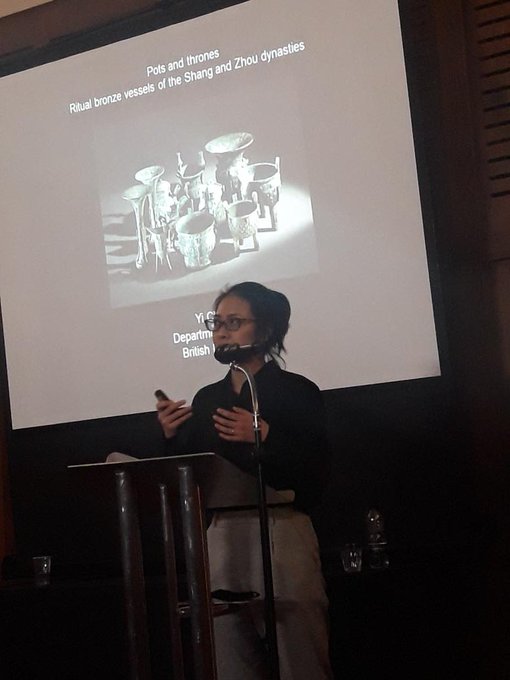
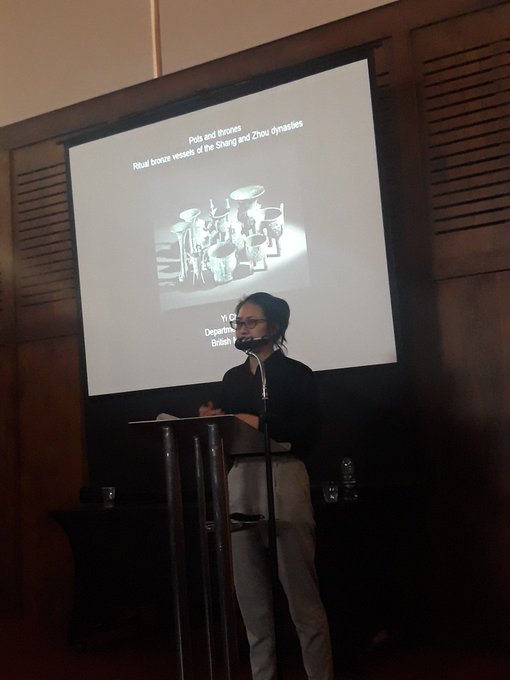
Pots and thrones: ritual bronze vessels of the Shang and Zhou dynasties

Image

Image

Image

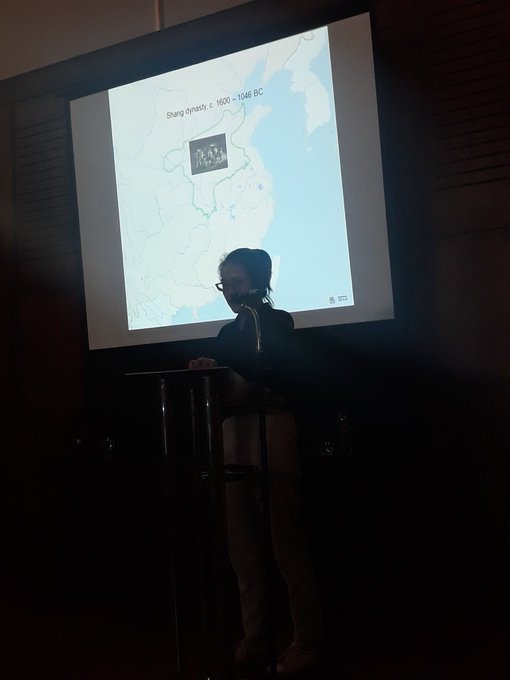
Last night at St Martin-in-the-Fields we heard Yi Chen speak on 'Pots and thrones: ritual bronze vessels of the Shang and Zhou dynasties.' This was the fourth in an occasional series of talks on different aspects of Chinese Art organised as joint events with our Chinese Congregations.

Yi Chen is Curator: Early Chinese Collections at the British Museum. Since it first opened in 1992, the China and South Asia gallery (Room 33) at the British Museum (of which the Early Chinese Collections are part) has helped millions of visitors experience its rich history through a plethora of objects, paintings, and sculptures. The gallery underwent a significant redesign and re-opened in November of 2017 with the content within the gallery being condensed and brought up to the present day. In addition to her work at the British Museum, Yi has spoken and written on aspects of Chinese Art from Late Neolithic to Bronze Age southern China through Buddhist Images on the theme of Pure Land to Fang Zhaoling, one of the foremost women artists of 20th-century China.

Tonight she focused on pots and thrones, ritual bronze vessels from the time of the earliest archaeologically recorded dynasty in Chinese history and opened up aspects of the growth and maturity of a civilization that would be sustained in its essential aspects for another 2,000 years. The rituals for which these vessels were used carried such an important social function, that it is possible to read into the forms and decorations of these objects some of the central concerns of the societies that produced them.

-----------------------------------------------------------------------------------------------

Fairport Convention - Who Knows Where The Time Goes.

Sunday, 12 February 2017

South Africa: the art of a nation

In his review of Martin Scorsese’s Silence, John Patterson comments that ‘Christianity is one of the Big B’s of violent colonial intrusion – Bullet, Bottle, Bacillus, Bible.’ (‘A test of faith’, J. Patterson, guide 31 Dec – 6 Jan 2017) This succinctly outlines the issues with which the curators of South Africa: the art of a nation have to grapple when it comes to exploring the influences later religions have had on South African art. They do so with rather more nuance, subtlety and grace than Patterson manages in his review.

As is the case with Shusaku Endo’s novel on which Scorsese’s film is based, artists in South Africa exploring aspects of religion have done so within their own culture and, as a result, what we view and discuss cannot simply be dismissed, as Patterson seeks to do, as alien poisons. The curators of South Africa: the art of a nation tackle these complexities from several angles. They showcase artworks indicative of indigenous beliefs as well as positive examples from later religions of engagement with the Arts, whilst also balancing confessional artwork with art which questions religion from within the belief system of the religions questioned.

This is the first major UK exhibition to use objects to tell the story of South Africa’s art heritage and history over 3 million years, including rock art images which often depict shaman (or spiritual leaders) entering trance-like states while dancing, giving them the power to heal the sick, overpower evil spirits and summon rain. This modest but astonishing exhibition includes some of the earliest known human artworks and iconic pre-colonial art from southern Africa. It also explores the impact of nonAfrican artistic influences and traditions from the 17th century onwards, showcases 20th century apartheid ‘resistance art’, and celebrates the contemporary art of post-apartheid transformation.

When the history of modern art in South Africa is examined, as here, the influence of Christian missionaries cannot be overlooked. Rasheed Araeen described Ernest Mancoba as ‘Africa’s most original modern artist’ and noted that ‘he enters the space of modernism formed and perpetuated by the colonial myth of white racial supremacy and superiority and demolishes it from within.’ Mancoba’s missionary training, however, was typical for ‘that magnificent generation’ (to use Mancoba’s own words) of ‘pioneer modern artists in South Africa that included Gerard Sekoto (a close friend and colleague of Mancoba) and George Milwa Pemba.’ ‘These artists were all, to a greater or lesser extent, educated and Christianised members of a small but influential African middle class that espoused the Victorian liberal values inculcated by their missionary training.’

Rather than highlighting the work of Mancoba, this exhibition shows the influence of the Evangelical Lutheran Church Art and Craft Centre at Rorke’s Drift, which together with Polly Street Art Centre and the Thupelo workshops, was ‘vitally important to the development of new artists.’ The legacy of these centres ‘lives on in South Africa’s contemporary art scene.’ (South Africa the art of a nation, J. Giblin & C. Spring, Thames & Hudson / The British Museum, 2016) Rorke’s Drift ‘became one of the most important institutions for black South African artists during apartheid,’ with Emma Dammann, Lionel Davis, BongiDhlomo, Avhashoni Mainganye, Philda Majozi, Kasigo Patrick Mautloa, AzariaMbatha, Elizabeth Mbatha, Gordon Mbatha, John Muafangejo, Sam Nhlengethwa, Anthony Nkotsi, Mpolokeng Ramphomane, Joel Sibisi, Paul Sibisi, Velile Soha and Vuminkosi Zulu all having taught or studied there. Works by Davis, Muafangejo and Nhlengethwa are all included within the exhibition, as are works from Helen Mmakgabo Sebidi and the Siyazama Project which utilize Christian imagery in the context of struggles with apartheid and HIV/Aids.

Rorke’s Drift was far from being a one-off however. Sister Pientia Selhorst of the Congregation of the Precious Blood as well as other Christian missions, including the Ndaleni Teachers’ Training College and Mariannhill Art School, all made their contribution towards the provision of access to opportunities for art education.

As a means of exploring the positive and negative legacies of Christianity in South Africa, the curators examine the work of Jackson Hlungwani and Willem Boshoff. Hlungwani was ordained in the African Zionist Church and founded New Jerusalem, a church at the site of an ancient hilltop settlement where he carved monumental wood sculptures of animals, warriors and Biblical figures. His Christ with football indicates the essential humanity of Christ, as a man for all peoples. Boshoff’s Bad Faith Chronicles skewer thirty-six very small baby dolls through the heart, like insects, labelled and displayed on a collector's chart. The labels bear the names of Old Testament nations who had lost their land and lives in ancient Israel. Below each collection is a Bible in an official South African language, opened at Psalm 111:6, which in an English translation reads: "He has given His people the power of His works, giving them the lands of other nations.” Boshoff’s work is ‘an angry response to the way in which Christian churches colluded with the apartheid regime, and to how the Bible was used to justify apartheid.’

Fiona Rankin-Smith has noted that ‘the immense and often unfathomable topic of faith is frequently debated in the public sphere in South Africa’, including its political history. The 2006 Figuring Faith exhibition that she curated provided multiple depictions of the symbols, people and places associated with belief. William Kentridge, whose work features in South Africa: the art of a nation, spoke at the opening of Figuring Faith saying that the works showed that ‘we are incurably en route’ between ‘a quotidian, every day reality and the world of mystery and transcendence beyond.’ This journey is ultimately what is depicted in South Africa: the art of a nation. The very activity of making the work’, Kentridge suggests, ‘involves the artist in a journey of going from what is known to what is glimpsed at, half understood and tentatively approached within the work.’ (Figuring Faith, ed. F. Rankin-Smith, Fourthwall Books, Johannesburg, 2006)    

--------------------------------------------------------------------------------------------------

Soweto Gospel Choir - Thina Simnqobile.

Thursday, 9 April 2015

Spokesperson for the silent throng of things made by the human hand

The Evening Standard has four pieces written in appreciation of Neil MacGregor following the announcement that he is to step down as Director of the British Museum. This is fitting because "he has popularised the extraordinary riches of the museum in such as a way as to make them part of an intelligible human story, accessible to the ordinary public."

Michael Prodger writes that MacGregor "sees no conflict between popularity and scholarship and instinctively grasps that the public wants information as much as entertainment."

Antony Gormley described MacGregor as "the spokesperson for the silent throng of things made by the human hand, heart and brain over all time. Like no other before him, he has helped us see, empathise and interpret the huge diversity of humanly made things, allowing us to understand what they are and the world from which they come."

I was pleased to see that his future projects "include working with the BBC and the museum on a new Radio 4 series on faith and society." His series 'A History of the World in 100 Objects' was, in part, an inspiration for my short story The New Dark Ages, which can be read using these links - Part 1, Part 2, and Part 3.

----------------------------------------------------------------------------------------------

The Band - Don't Do It.

Thursday, 4 August 2011

Exhibition reviews


Today I was fascinated to see, and a little underwhelmed by, Michelangelo Pistoletto's The Mirror of Judgement at the Serpentine Gallery.

Pistoletto is a leading figure in the development of both Arte Povera and conceptual art and this installation has had rave reviews, including the Guardian calling it "a beautiful and mind-expanding experience." As in much of his work, Pistoletti has here made use of religious concepts, imagery and phrases together with his repeated use of labyrinths and mirrors. He has written that "the mirror is the mediator between the visible and the invisible, carrying sight beyond it's normal possibilities" but has also stated  that the "image in the mirror is objective; there is no interpretation.”

Pistoletto argues that at "the beginning of our century, the avant-garde made art again autonomous." "Art ceased to be a symbol of religious and political power" and "actively takes possession of those structures such as religious which rule thought; not with a view to replacing them itself, but in order to substitute them with a different interpretative system, a system intended to enhance people’s capacity to exerting the functions of their own thought." This is where Pistoletto's labyrinth is intended to lead us. We move past symbols of four religions (a prayer mat, statue of Buddha, prayer stall, each before mirror, represent Islam, Buddhism and Christianity respectively, while a pair of large arched mirrors stand in for the Jewish Torah), to a central chamber containing a mirrored obelisk and the New Infinity sign (Pistoletto's symbol for the Third Paradise; a fusion between the first paradise in which terrestrial life is completely regulated by nature’s intelligence and the second Artificial Paradise which is developed by human intellect).

All this background information seems necessary in order to relate to Pistoletti's intent for this work; meaning that the work relies on a literary interpretation. The ambience at the Serpentine, at least as I experienced it, is not particularly contemplative as notices ban the touching of the work (due to its fragility), gallery attendants chat in corners, and there is no sense of the prayer objects inviting use. Visually, the concept is literal; mirrors judge us each time we use them and Pistoletto's installation doesn't alter that experience significantly without knowledge of the literary concepts that underpin the work.

Also at the Serpentine currently is this year's Gallery Pavilion designed by Peter Zumthor. Zumthor's pavilion as a "hortus conclusus", an enclosed garden, also relates to concepts of Eden or paradise. In Zumthor's essay about the pavilion, he begins by writing: "We come from nature and return to nature; we are conceived and born; we live and die; we rot or burn and vanish into the earth."

Out of Australia at the British Museum begins with the opposite; the wilderness inspired expressionism of the ‘Angry Penguins’ group of artists – Sidney Nolan, Arthur Boyd, Albert Tucker and Joy Hester. Arthur Boyd is a favourite artist and his prints do not disappoint formed, as they, through their fevered, passionate mark-making, echo the strength of the content. The exhibition includes an early work in Boyd's highly original Nebuchadnezzar series. Boyd and Tucker both address the passionate and predatory aspects of eroticism, something that also features in Eric Gill: public and private art, the other British Museum exhibition that I visited today. Gill combined sensuality and spirituality in images such Divine Lovers, which forms the centrepiece of this small review highlighting the wide range of his work. The effect that knowledge of the abusive element of Gill's sexual practice has on our response to the sensuality of his work is rightly noted but the primary focus is on his art and ideas.

-----------------------------------------------------------------------------------------

The Smiths - Cemetry Gates.