Wikio - Top Blogs - Religion and belief
Showing posts with label malevich. Show all posts

Saturday, 22 October 2016

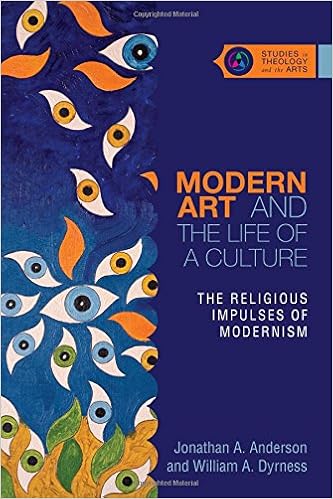
Modern Art and the Life of a Culture: The Religious Impulses of Modernism


As Jonathan A. Anderson and William A. Dyrness note in Modern Art and the Life of a Culture: The Religious Impulses of Modernism, I have for some time been arguing that, as Daniel A. Siedell suggested in God in the Gallery, "an alternative history and theory of the development of modern art" is needed, "revealing that Christianity has always been present with modern art, nourishing as well as haunting it, and that modern art cannot be understood without understanding its religious and spiritual components and aspirations." In my Airbrushed from Art History and Sabbatical Art Pilgrimage series of posts I have highlighted some of the artists and movements (together with the books that tell their stories) that should feature in that alternative history when it comes to be written.

In Modern Art and the Life of a Culture Anderson and Dyrness, part of IVP's Studies in Theology and the Arts, also argue that there were strong religious impulses that positively shaped modern visual art. Instead of affirming a pattern of decline and growing antipathy towards faith, the authors contend that theological engagement and inquiry can be perceived across a wide range of modern art—French, British, German, Dutch, Russian and North American—and through particular works by artists such as Gauguin, Picasso, David Jones, Caspar David Friedrich, van Gogh, Kandinsky, Warhol and many others.

Gregory Wolfe writes that this book provides a 'nuanced and sympathetic view of the religious aspects that truly did haunt modernism in the visual arts' noting that, after a couple of introductory chapters, 'the book moves into a sequence of historical surveys ranging from Van Gogh to Andy Warhol, with many stops in between.'

Dryness notes: 'Van Gogh is often recognized as a deeply spiritual artist, but usually he is pictured as having given up his childhood (Reformed) Christian faith. But closer examination shows this not to have been the case. Others, like Gauguin, who are largely regarded as irreligious, turn out to have had deep and formative experiences with (in this case) the Catholic faith. Still others, like Malevich, inherited sensibilities from their religious contexts which made deep inroads into their art. So there is no single story to be told.' 

Anderson says: 'The research for this book was full of surprises for me. The religious backgrounds of these artists, as well as the ongoing theological content of their work, are sometimes buried deep in the academic literature and primary sources, but once you begin to dig you find extraordinary things. Van Gogh was actually a fascinating theologian, and his paintings were theologically oriented all the way to the end. Mondrian completed his art training in the thick of the best neo-Calvinist thinking of the day. Until researching for this book, I hadn’t realized just how deeply Kandinsky was preoccupied with the book of Revelation. Warhol’s sharp social commentaries were oriented by his lifelong Catholicism. And so on: the surprises abound.'

--------------------------------------------------------------------------------------

Van Morrison - In The Garden.

Saturday, 8 May 2010

Airbrushed from Art History (17)

The roots of abstract art lie in attempts to better express the essence of the spiritual in art and, from a Christian perspective, such art has predominantly been understood from two opposite poles. Richard Davey expresses one pole well when he writes, in Stations: the new sacred art, that:

“For many artists in the 20th century abstract forms have become the most appropriate way through which faith can be expressed. Artists such as Kandinsky, Rothko, Natkin and Webb have utilised the emotional and expressive qualities of colour and line which offer a profound equivalent for the experience of God. Colour, line, texture and form create a unique visual narrative that is not dependent on words and intellectual concepts. Instead they connect directly with the viewer, generating an emotional response to the work.”

Conversely, however, abstract art can also be understood as saying that God cannot be definitively captured in any representational image. God is beyond representation and is always more than the images that are used to describe aspects of God’s reality. In this sense, abstract art has affinities with the ‘via negativa’ which constantly reminds us that God is not as we have experienced or perceived him to be. As a result, abstract can be equated with absence - the absence of representation equalling the absence of God – making abstract art the art ‘par excellence’ of a modernity which declared the ‘death of God.’

Theologian John Dillenberger, and his art historian wife Jane, were particular advocates of abstraction, knowing abstract expressionists such as Barnett Newman and Mark Rothko personally. They came to maturity in the mid-twentieth century, under the strong influence of Paul Tillich’s existentialist theology, and saw in abstract expressionism an inherently spiritual search — which had the virtue of leaving behind the exhausted religious iconography of Western art.

Wassily Kandinsky’s equation of abstract art with spirituality was signalled by the publication of his book Concerning the Spiritual in Art in the year that he painted his first fully abstract work. Concerning the Spiritual in Art argued that abstraction was the best means available to artists for depicting an unseen realm.

Yet in reaching this conclusion Kandinsky had to journey from representational art to abstract art. He began his career painting representational works and gradually removed all representation from his paintings until they were fully abstract. Therefore his way into abstraction was from representation and there is a story told about Kandinsky which illustrates this transition, although the story itself may be apocryphal. In this story Kandinsky entered his studio to be confronted by a glowing and emotive combination of colours and lines without any obvious subject. He saw what appeared to be a fully abstract painting and was struck by the intensity of emotion that it evoked. On closer inspection however he realised that the painting was in fact one of his landscapes which had been turned upside down.

So, Kandinsky’s first fully abstract works derived from representational images and it is possible to get a sense of how this occurred by comparing two paintings depicting soldiers; his representational St George and the Dragon and his semi-abstract Cossacks. We can get a sense of how he proceeded if we look at the representational image with blurred vision (perhaps because we have removed our glasses). Immediately, we lose our sense of what the figures in the image represent because we cannot see sufficient detail to recognise them but we can still see generalised patches of colour and the shape and direction of objects within the picture. It was this that Kandinsky painted. As he himself said: "I applied streaks and blobs of colors onto the canvas with a palette knife and I made them sing with all the intensity I could..."

Kandinsky sought to express in his initial abstract Compositions his belief in a coming catastrophe with spiritual consequences and because he began with a figurative image of disturbance, such as the Deluge, he was able to retain that same sense of disturbance in the combination of colour and form that he painted. Looking at his Composition VI, which we know derives from an image of the Deluge, we cannot, by looking at the painting, state that we can see a representation of the flood but we can talk in terms of a sense or feeling of conflict and impending doom that pervades the swirl of shapes and colours which form the painting. As in this instance abstract art often communicates most powerfully at the level of our emotions conveying to us a sense of a state of being – conflict or doom, peace or grace – without specifying a specific source for this sense or feeling or emotion.

Kandinsky then, despite his more esoteric spiritual beliefs and investigations, initially created abstract art by abstracting from apocalyptic biblical images. Composition V is an abstraction on the theme of the resurrection of the dead where it is possible to see glimpses of angels blowing their trumpets and the towers of a walled city. More than these vestiges of representational imagery however, the work conveys a sense of infinity as the context for resurrection.
Kandinsky used abstraction to express a sense of coming disorder but, if we look at the work of some Cubist artists we can see the opposite; use of abstraction as a spiritual search for a sense of order and harmony.

Many artists in the early part of the twentieth century were searching for the universal rules that underpinned works of art. The deconstruction of representational art that occurred through movements such as Impressionism, Expressionism, Cubism and so on was, in part, the attempt to discover these fundamental rules. While Expressionism and Fauvism were movements focusing primarily on effects of colour, Cubism was a movement that experimented with form. Cubism worked with the fundamental forms of cubes and circles, lines and curves and several Cubist artists came to locate in Christian Art the rules that they thought governed the use of these fundamental forms in art. One such artist is Albert Gleizes who positioned his shapes on the canvas in relation to the height and width of the canvas and then rotated them to create a spiralling movement within the painting that keeps the eye constantly moving from shape to shape.

His sense that the mathematical means for determining the positioning of forms within the frame of the canvas derived from that developed within Christendom during the ‘Dark Ages’ in Western Europe can be seen in the way that he uses these methods to create an image of, for example, Christ in Glory. These paintings are firstly harmonious spiralling combinations of line and colour which secondly indicate a sense of figures equating to traditional images of God. These emerge from the combination of forms and are revealed as eternally united by the continual rotation of shapes within the picture frame.

Similarly, in the catalogue of the From Russia exhibition, Yevgenia Petrova writes, of Kasimir Malevich that, “the quest for one of the 20th century’s most innovative creators for new themes and a new artistic language had its source in the realm of his religious notions.” In The Avant-Garde Icon Andrew Spira seeks to demonstrate how icons underpin the development of nineteenth and twentieth-century Russian art.

During this time new ideas grounded in a radical revolutionary secularism were providing a strong challenge to the values of a society steeped in religious, faith-based traditions. Great artists such as Malevich and Larionov offered an ambivalent response to their religious heritage. Whilst they rebelled against its stifling conservation and credulity, they were also profoundly influenced by its nationalist, populist, aesthetic appeal and, ultimately, its spirituality. Malevich in particular aimed to raise the status of contemporary art to that of icons. He pared his imagery and colour down to black on white, shape on background. He spoke of his Black Cross as an icon of the new time and hung it across the corners of a room in the space traditionally reserved for an icon in a home. His black shapes represent the weight and substance of humanity in the weightlessness and void of the universe.

Spira's argument is not that the Russian avant-garde from the Wanderers to the Suprematists (and Malevich, in particular) were Christians or that they painted icons but that their appreciation of icons, their creation and their meaning, affected the aspects of the development of their work, their artistic practice and their philosophical understanding of the meaning and value of their art. Spira notes that:"although evidence of [the] receptivity [of avant-garde artists] to icons is more hidden than evidence of their rejection of the Church and its trappings, it is arguable that the tradition of icon painting was integral to the shaping of their work. As with children who rebel against their parents but turn out to resemble them, the art of the avant-garde often showed striking similarities to icons in looks, mannerisms and even in deeper sympathies."

In his book God in the Gallery, Daniel Siedell argues that iconography has been an influence of the development of Modern Art citing Kandinsky, Malevich and Mark Rothko as his key examples. The contemporary icongrapher, Aidan Hart, has made the same claim citing Constantin Brancusi, Henri Matisse, Vincent Van Gogh and Cecil Collins, among others, in addition to those cited by Siedell.

Hart's argument has three main aspects. Firstly, positive comments made by these artists regarding key aspects of iconography. Secondly, the adoption in Modern Art of many of the main stylistic techniques of icongraphy such as flatness, inverse perspective, multi-point perspective, isometry, radience etc. Thirdly, the use of abstraction as a language to express objective metaphysical truth, the essence of things. Brancusi is Hart's key witness for his Rumanian Orthodox upbringing and practice and for his aphorisms on the role of the artist such as, "The artist should know how to dig out the being that is within matter and be the tool that brings out its cosmic essence into an actual visible essence."

Similarly, Mark C. Taylor wrote at the beginning of his Disfiguring: Art, Architecture, Religion:
"All of the major abstract expressionists were deeply interested in religion and actively incorporated spiritual concerns in their work. Moreover, such involvement with religion is not limited to postwar American art. From the beginning of modern art in Europe, its practitioners have relentlessly probed religious issues. Though not always immediately obvious, the questions religion raises lurk on or near the surface of even the most abstract canvases produced during the modern era.

One of the most puzzling paradoxes of twentieth-century cultural interpretation is that, while theologians, philosophers of religion, and art critics deny or surpress the religious significance of the visual arts, many of the leading modern artists insist that their work cannot be understood apart from religious questions and spiritual issues."

The Abstract Expressionists worked with contrasts of light and dark and were less concerned with form and more concerned with colour. Barnett Newman created glowing zips of colour and Mark Rothko windows or doors of light. In both there is a sense of light beyond, of an opening into the light of the divine. In both, however, something darker can also be found. Pamela Schaeffer has written:

“I found it especially fascinating to ponder some of the purer abstract works - such as the rich, dark, imageless canvases of Barnett Newman and Mark Rothko - in relation to the apophatic tradition in Christian mysticism. Masters of that tradition, sometimes called the via negativa, choose words like nothingness, darkness and obscurity to symbolize God, the wholly other Absolute who is unknowable by means of the intellect but approachable through love."

Rothko’s later paintings have often been understood as depictions of the absence of God and the darkness of the world; an impression reinforced by Rothko’s suicide on the day that the Tate received those paintings. Newman’s and Rothko’s somber, borderless canvases suggest deep silence and infinite void, yet somehow, too, evoke a sense of presence and mystery. Newman made no attempt to hide his spiritual interests. In 1943 he wrote, "The painter is concerned . . . with the presentation into the world of mystery. His imagination is therefore attempting to dig into metaphysical secrets. To that extent, his art is concerned with the sublime. It is a religious art which through symbols will catch the basic truth of life."

Roberto Balzarotti noted, in a lecture for the William G. Congdon Foundation, “the fact that in the same period (the 1960s) three eminent proponents of Abstract Expressionism – Mark Rothko, Barnett Newman and William Congdon – were working on painting cycles on a subject specifically Christian [i.e. the Rothko Chapel in Houston, TX, by Mark Rothko; the Stations of the Cross by Barnett Newman; and William Congdon’s painting], which was a truly unique circumstance, even more so given that they reached this common end following paths and motives that were absolutely different, and in any case completely independent from each other.”

Balzarotti also notes that Congdon was the only one who “adhered to a specific faith, Roman Catholic Christianity.” Congdon was a contemporary of Willem de Kooning and Jackson Pollock who painted in the style of the action painters and abstract expressionists while living and exhibiting in New York but then faded from view as he went abroad. After traveling the globe on a spiritual quest, he settled in Assisi, where he had a conversion experience and became a Roman Catholic. His most impressive paintings following his conversion are a series of over 150 crucifixes, which became more and more abstract over the years. He lived in an abandoned Benedictine monastery, while painting with bold strokes of colour and scale.

In An American Artist in Italy Rodolfo Balzarotti notes that Congdon compared his work to:
“that of his ‘brothers’ in Action Painting, painters like Pollock or Rothko. “I was born a painter in that same tremor, or thrill, of self-abandonment to the things simultaneously see and captured as the medium of painting itself, in which every appearance was already transfigured in the unpredictable miraculous birth of the image … the image, in the last analysis, of myself … there was a coincidence of rage, of having to erase a world in order to rip out of one’s innards as though giving birth the image of a new life.”

This led, Balzarotti notes, to “a phase of crisis and bewilderment, which seems to alienate him completely from the world that had been his until then.” After this phase, “Congdon began working intensely, accompanying his painting with a stringent reflection on what he was doing. His isolation, far from constituting a closing off, enabled him to let his language as an Action Painter evolve independently of what was happening on the public art scene in the 1970s and 1980s, increasingly conditioned by the phenomenon of the market, fashion, and the ephemeral.”

Jean Bazaine was a Catholic whose reading of Bergson was implicit in his abstract imagery of plunging, swirling forms. Bazaine was closely connected with the 'personalist' philosopher Emmanuel Mounier and his review Esprit which was at the forefront of debates between Catholicism, Marxism and a nascent existentialism before the Second World War.

Natalie Adamson writes that although his own painting would only make the transition from figuration to a fully “non-figurative” style between 1941 and 1944, Bazaine used his exhibition reviews for two significant press forums that were defined by their progressive Catholic outlook (the monthly journal Esprit and the weekly newspaper Temps présent) as a means of contributing towards the reinvigoration of the sterile, anachronistic formulas of art sacré in offering new, possibly non-realist, modes of representing spiritual experience.

It is as an inspired creator of works enriching the entire history of modern religious art, writes James Kirkup, that Bazaine will best be remembered, by believers and non-believers alike: the windows in the church at Asay (1943-47) in Savoie, the facade mosaics (1951) and windows (1954) of the church at Audincourt in the Jura (1954), the church of Villeparisis (1961) and a reception centre at Noisy le Grand (1955). Bazaine's vivid, dynamic works irradiating the sombre ambulatory and apsidal chapels of St Severin Paris are, according to Kirkup, one of the most wonderful series of stained-glass windows in France. These windows represent the seven sacraments of the Church, portrayed as essential forms from nature in all its glory and symbolising Water, Fire and Light, sacred emblems of Divine Grace. An appropriate biblical verse is inscribed beneath each.

Bazaine organised the clandestine, semi-abstract exhibition 'Twenty Young Painters of the French Tradition', held in defiance of the Nazis at the Galerie Braun in May 1941. This exhibition included The Lunatics (1938) by Alfred Manessier who became, in the 1950s, as Sarah Wilson writes, one of the most prominent painters of the School of Paris, a doyen of both 'lyrical abstraction' and the renewal of sacred art in France after the war. In the words of Werner Schmalenbach he was 'after Georges Rouault the only great painter of Christian art in our age':

“The 'Young Painters' combined the Cubist grid and Fauvist colour, the inheritance of Picasso and Bonnard, with semi-abstract, often religious themes; Charles Lapicque had pioneered the style with his Christ Crowned with Thorns as early as 1939. It was not until 1943, however, on a three-day retreat with the writer Camille Bourniquel that Manessier, then aged 32, experienced his profound religious conversion at the abbey of Notre Dame de la Trappe de Soligny (Orne).

The rigour of the Cistercian Trappist regime and the link between its services and the rhythms of days, night and the seasons were keenly felt by the increasingly ascetic artist. The monks' chant inspired perhaps his greatest early painting, Salve Regina, a work constructed with vertical slabs of singing reds, oranges and blues.

Manessier's works such as The St Matthew Passion (1948) continued to bring not only religious but liturgical and musical elements into purely abstract colour compositions. Titles invited readings of predominantly abstract works: in Barabbas (1952) a menacing purple circle approaches the sign for Christ - a crown of thorns - with explicit metaphorical intent. Both Manessier and Bazaine were influenced by a renascent Bergsonism: images of flux with diagonal axes in their work evoke floods of light and water, and are distinct from contemporary 'all-over' experiments in France and the United States.

In 1947, Manessier received a visit from Georges Rouault, who advised him to take up stained-glass design: from 1948 to 1950 Manessier worked on six windows for Saint Agathe des Breseaux, Doubs … Manessier has left his mark in stained glass in many beautiful churches in France and beyond, such as Saint-Pierre de Trinquetaille in Arles (1953), Notre-Dame de la Paix (Le Pouldu, Brittany, 1958), the Saint- Die cathedral (Vosges), and the convent of the Sisters of the Assumption, Rue Violet, Paris (1968-69), together with commissions in Basle, Fribourg, Essen, Cologne, Bremen and elsewhere.”

Bazaine and Manessier together founded the Association pour la Défense des Vitraux de France (the "Association for the Defense of France's Stained Glass").

Manessier wrote of seeking:

“a sort of transfiguration of the real which nourishes painting with a breath of the spirit. It's the passages between things which interest me. Something circulates amongst all forms of human experience ensuring a profound unity. I try to force myself to make that unity appear.”

Similarly, write Peter Serracino Inglott and Gino Gauci in Sacred Art in Malta 1890 - 1960, the “superb and profoundly conceived abstract work” of Alfred Chircop “wells up from a solidly Dominican formation and uncompromising following of the motto: contemplata aliis tradere.” To Dominic Cutajar, “Chircop's catharsis is tied to the cosmic transcendentalism popularised in Catholic intellectual circles by Teilhard de Chardin.”

Chircop’s paintings have been described as “outbursts of creative energy” which suggest “birth and growth, sprouting and blossoming.” “With their transparencies, quasi-magical overlaying of paint, outbursts of energy and light, and the impeccable workmanship through the wielding of the artist’s brush seemingly akin to lithe fingers caressing the strings of a harp,” writes Emmanuel Fiorentino in Alfred Chircop: Paintings 1999 – 2001, “they still manage to transfigure the core of their emotions away from any material grasp in order to let it ascend into the ethereal realm for which they offer intimations away from the crudeness of mortality.”

As a result, “the tenuous vision residing in his abstracts, consistently evolving throughout the greater part of his career, has come to tap the rarified stratosphere of a spiritual dimension, truly and justifiably lending them the epithet of landscapes of the spirit.”

Religious painting in Australia was quickened, writes Robert Hughes in The Art of Australia, by Eric Smith:

“Smith is a Catholic, and religious belief is the core of his art. His abstract work between 1956 and the present day records a continuous struggle to intensify religious experience through non-figurative techniques. The sacramental calm of his colour remained, but form became increasingly fragmented. The Moment Christ Died, 1958, is a slow explosion of flakes of colour, suggesting the separation of soul and body at the point of death. In Christ Is Risen, 1959, a figure emerges from an ecstatic flurry of energy; Smith’s human images seemed usually half-dissolved in light or blur of motion, and their bristling clusters of line were far removed from the solid, deliberate forms of earlier paintings,

By 1960 the breakdown of form was complete … The paintings with which Smith won the 1962 Helena Rubinstein Scholarship are, in some ways, a return to the structural concentration of his 1955 religious paintings. But their intensity is amplified by a more complex space and an increased poignancy of emotion, as in a gravely conceived Crucifixion, 1961 … Leaving aside the gold-leaf-and-angel merchants, there is no doubt that Smith is the first Australian artist to meet his religious impulses on a serious level of inquiry.”

Richard Kenton Webb is a contemporary British artist who has “a passion for the space; the essence of the place; a mirroring of emotion; and other abstract qualities of the land itself.” For him abstract art is about “a search for equivalents.” “As we investigate a place,” he writes, “there are many sensations that we register – the springiness of the turf underfoot, the roughness of the rock on your fingertips, the wind and rain or the scent of a rose in the morning. We can play down such sensations, but they are always there. So, how can we capture these ‘illegible’ impressions and record the non-rational, poetic associations that we experience as painters?” Abstraction provides the “different tempos, shapes, size, mood, colours and forms” needed to express how you feel about the view before you and go beyond the superficial or what is on the surface.

Mark Brooke has written that Kenton Webb’s paintings: "have a calm, assured sense of purpose. They are reduced to a stripped down essential. Colour with delicate variations. A word he often uses is "equivalent' to indicate the solutions open to the artist.... The carefully prepared canvas, often with lead white ground laid on in several coats, allows the paint when applied to seem translucent. The small intricate brush lines suggest the uneven, inconsistent and broken patterns of men's lives which somehow, when fused together, form a greater significant whole. Light will find its way through, if we can be still and see the colour.”

David Thistlethwaite writes: "Here are spaces to get into - real finite ones, where the early Creation is alone and quiet with its maker, and his Spoken Word beams intelligence and perspective into the uniformed waste - and pools of reflected gold hint at the beginnings of response.'

By contrast, Clay Sinclair is an artist who is fascinated with vibrant colour, symbolism and the potential to change. He has a unique way of painting ‘backwards’ on to perspex/ plexiglass which gives his paintings a stunning luminosity and purity of colour. He regularly uses text and loves to provoke with each piece he creates. The end results are stimulating and are often laced with a little humour. His inspiration primarily comes from observing the way we are and how we relate to each other and our environment. Issues of ego, relationship and society are themes that regularly appear and influence his work.

Sinclair says: “My paintings aim to be more than just wallpaper. I seek to create work that will engage, stimulate and provoke the viewer. By painting on perspex, my art is vibrant and luminous, but by frequently using text I force the art to be viewed as more than just an ascetic object.”

Leafa Janice Wilson notes the flawless finish and pure, unashamed colour of his works set within a geometric compositional structure:

“Where there is no physical texture on the surface, there is definitely an undulation created by different depths and colour temperatures that make these works operate effectively as highly textured and painterly works.

The colour throughout Sinclair’s works balances up the realism he provides us by the allusions to the recession and his seemingly apologetic approach to having to price his works. There is a certain intensity to the words permeating his works, which leads me to question if the absence of words would have made the same kind of visual impact on first glance … Sinclair’s keen eye for design and visual balance is reminiscent of beautiful urban images of city lightscapes.”

Makoto Fujimura's work combines traditional Japanese painting technique with a Western approach to abstraction. Born in Boston in 1960, Fujimura earned his B.A. at Bucknell, then went on to receive his Master of Fine Arts and Doctorate degrees from the Tokyo National University of Fine Arts and Music, where he studied the Japanese traditional technique of Nihonga. This technique uses ground minerals such as azurite, malachite and cinnabar mixed with animal hide glue applied to handmade paper. Western artists who have influenced his work include Mark Rothko and Jackson Pollock.

Kristen Frederickson, in an essay written for a 2004 exhibition of new paintings by Fujimura inspired and informed by T.S. Eliot's last poem, 'Four Quartets', wrote: "There is a component of these paintings that cannot be seen except by the naked eye: photographic representation is an inadequate translation, perhaps more for these works than most art. As the eye travels from one moment of the painting to another - from a glistening river of blue to teardrops of green, streaks of vermilion to a shimmering layer of gold leaf falling perilously across the surface - there is an element of utter abstraction and peace that belies the intense training and experience required to produce these paintings." Similarly, Fujimura has written, in 'Gravity and Grace': "We now begin to realize what we do is only temporary and indefinable. Incomplete gestures must be made, because reality beckons us to respond. Beauty, however peripheral, insists that we remain faithful to who we are, as we are."


In 'Beauty without Regret' Fujimura wrote: "The layers of azurite pigments, spread over paper as I let the granular pigments cascade. My eyes see much more than what my mind can organize. As the light becomes trapped within pigments, a "grace arena" is created, as the light is broken, and trapped in refraction. Yet, my gestures are limited, contained, and gravity pulls the pigments like a kind friend.


Every beauty suffers. A research scientist friend once told me that the autumn leaves are most beautiful on the trees by the roadside because they happen to be distressed by the salt and pollution. Every sunset is a reminder of the impending death of Nature herself. The minerals I use must be pulverized to bring out their beauty. The Japanese were right in associating beauty with death.

Art cannot be divorced from faith, for to do so is to literally close our eyes to that beauty of the dying sun setting all around us. Every beauty also suffers. Death spreads all over our lives and therefore faith must be given to see through the darkness, to see through the beauty of "the valley of the shadow of death".

Prayers are given, too, in the layers of broken, pulverized pigments. Beauty is in the brokenness, not in what we can conceive as the perfections, not in the "finished" images but in the incomplete gestures. Now, I await for my paintings to reveal themselves. Perhaps I will find myself rising through the ashes, through the beauty of such broken limitations."
-----------------------------------------------------------------------------------

Iona - Treasure.

Friday, 29 May 2009

Responses to 'Airbrushed from Art History?' (4)

I'm grateful to Richard Davey for engaging in debate on these issues and for the ideas, questions and challenges that inform his second response:

1. Do you think that a comprehensive survey is possible? I think that you are setting yourself up for a fall by an ambition that sets out to be comprehensive. It seems to me a narrow focus would allow you a better chance to realise your desire to be thorough and at the same time to raise the fundamental questions that you are seeking to address. By striving to be comprehensive you are either going to have to be so broad that your project will be full of holes, or you will never finish.

Clearly this is a real issue but one that faces anyone seeking to review a period of history or a particular movement over time. All the way through there are choices to be made about what to include and where and what to leave out and why. No history or art history is ever genuinely comprehensive, so the question is then how is it realistic or appropriate to be.

I think that a survey of the main movements within Modern and Contemporary Art showing Christian influences is eminently possible for the right person. The task is, after all, not significantly different from that of any other art history covering the same period, just coming with a different or relatively undeveloped perspective. I don't think that there is any one book or exhibition that has yet done this as fully as it could be done. Rosemary Crumlin's excellent catalogue and exhibition Beyond Belief: Modern Art and the Religious Imagination would be the fullest survey that I have found to date.

The task is feasible in part because there are now a number of books and exhibitions have examined particular aspects of Christian influences of different Modern Art movements. To my mind there is now a substantial mass of such material that it would be feasible and useful to have a book that systematically summarised this material and that that could best be done as an alternative art history of the period.

I come at this as someone who is fascinated both by the way in which artists express their faith (when they consciously have one) and also by the way in which the heritage and legacy of Christianity continues to inform and influence our culture showing itself in a huge variety of ways in the work of artists who would not claim to have faith in any organised religion or to have faith per se. Encountering such artists and their works is an ongoing pleasure and, it seems to me, one that others might share if an accessible and reasonably comprehensive introduction were to be written.

Having said all that, that is not what I am setting out to do. This series is part of a personal development project, not a book project. As part of my own personal discipline of reading to feed my faith, I will be reviewing and extending my reading on these issues and posting summaries as I have begun to do. Learning from that reading and from responses to the posts is my personal aim but if in the process the value and feasibility of such a survey becomes clear then so much the better.

2. What do you mean by Christian influences? This is such a simple statement and yet so problematic. Do you mean influences that come from culture that are specifically Christian i.e.. the use of Christian iconography? Do you mean the essential themes that lie at the heart of Christianity- but what are those, and can we say that an influence comes from active 'Christian' influence or from the residual Christianity that underpins western society? Do you mean the faith of the artist? Or is it your own Christian faith that is being read into Modern and Contemporary art?

By Christian influences I mean both the way in which artists who understand themselves as having a Christian faith express their faith through their work and wider artistic practice plus the effect that the Christian heritage of the West has on shaping and/or informing the work and practices of artists that do not claim Christian faith.

An example of the former would be Maurice Denis who understood his destiny from an early age to be that of a Catholic artist. Denis was prominent and influential in the avant-garde of his day as a Nabi and a Symbolist and as an artist working for a contemporary revival of Sacred Art. As a christian artist he had an influence on the development of both Modern Art per se and also on Modern Sacred Art. His life and work seem to me to beg the question as to what was it about his faith that enabled and equipped him to be part of those movements and to have the influence that he had within his day.

An example of the latter would be the argument put forward by Andrew Spira in The Avant-Garde Icon that the Russian avant-garde from the Wanderers to the Suprematists (and Kasimir Malevich, in particular) was heavily influenced by the Russian tradition of icon painting. Spira's argument is not that many of the avant-garde were Christians or that they painted icons but that their appreciation of icons, their creation and their meaning, affected the aspects of the development of their work, their artistic practice and their philosophical understanding of the meaning and value of their art.

I think that the above is relatively clear in terms of the various kinds of influence being claimed. I am not trying in these posts to unpack the complexities of those influences but am simply seeking to flag up artists and movement where I and others think they exist.

What is far more complex, and this is where I think your question leads, is how or whether there can be a definition of Christian, Religious, Sacred or Spiritual Art in Modern and Contemporary Art. There have been a number of different attempts to do so in terms of faith commitments, themes, practices etc. and a very interesting article could be written summarising, comparing and contrasting the various approaches suggested. I wonder whether holding the questions you pose in tension is the creative place to be, as opposed to attempting to tie the expression of Christianity in Contemporary Art to a particular definition or model.

3. Do you mean British, French, Italian, Spanish, American art. This may seem a strange point since so much contemporary and modern art transcends geographic borders, but I think this is important when addressing the subject of faith and Christianity, because in reality attitudes to faith are fundamentally different across these different contexts. American attitudes to Faith and Christianity are very different to British 'secular' attitudes, where faith is on the back foot. The recent American presidential elections highlight this with their strong influence of faith, whereas in the upcoming general election in Britain will faith feature, or will we once again have the Blair effect - where faith and public life don't mix? And then on the continent Christian art is often tied into a Roman Catholic spirituality and integration into liturgy that is fundamentally different to British Anglicanism.

I will be trying to flag up national differences where this seems appropriate and don't intend to restrict my reading and summaries solely to Western Art. I fully accept your point that national expressions of Christian faith can differ in character and emphasis and that this is a complicating factor in examining Christian influences. Examples would include the differences and continuities between art produced out of the French Catholic Revival and that produced by self-taught artists from the American South. Again, in terms of the art historical survey that I think could usefully be written, this is an issue that should be faced by all who attempt to write history but also one to which sensitive historians can respond. It is also as well an issue that could add spice to and provoke interest in such a survey.

You echo Taylor's criticism of Greenberg, but I don't have a problem with Greenberg's approach - why is that? I suppose I know that when I write on an artist I am aware that I am going to be addressing it from the starting point of my own world-view, and that my reading will be coloured by that. However much I try to be open to the full range of influences that may be found in artist's work I can never achieve a truly objective stance, I will always see a spiritual perspective and this will obscure some of the secular perspectives that may equally legitimately exist in it as well.

I agree that this is an issue for all in terms of our ability to understand deeply the worldview of another but the issue that Taylor is addressing is not solely about the response of the critic or viewer of the work. His point is that there are self-confessed spiritual preoccupations of the artists whose work Greenberg analyses which his criticism obscures. If this is so, and you seem to accept that part of the argument, then the question is whether this comes from an inability on Greenberg's part, because of his secular perspective, to understand these spiritual preoccupations (which is what you seem to be arguing and which would seem to me to call into question Greenberg's intelligence) or whether it comes from a more deliberate decision not to engage with these self-confessed preoccupations and, by implication, not to encourage his readers to engage with these preoccupations either.

That, I think, is what Taylor is arguing. I think that because these were self-confessed preoccupations of artists that Greenberg admired and promoted the conscious rather than unconcious decision not to engage is the more likely in this scenario.

If that is so, the result, for me, is that, to use your phrase, Greenberg is not fully showing respect for the work of art as an object itself made by an embodied human being for embodied human beings. When the embodied human being making the work of art says that spiritual preoccupations inform the work but these preoccupations are unaddressed in criticism then it seems logical to suggest that respect is not fully shown for, at least, the embodied human being who made it, if not the work itself.

Again, in your review of Traces du sacre your implicit criticism is based upon what I take as an objection to their position that argues that the secularization of society delivered artists from their subordination to the Church and that, as a result, the traces of spirituality found in both Modern and Contemporary Art are ones that stand outside of organised religion (and Christianity, in particular). I may not completely agree with the origin being secularisation but I think that they are fundamentally right.

The curators are entitled to their opinion and argument. Their argument has real validity but in making it they sometimes ignore and sometimes misrepresent artists and arguments that counteract their argument. I don't think that an argument is strengthened by ignoring or misrepresenting opposing views. I think strong arguments are those which take on board counter arguments and show why on their own terms the counter arguments are insufficient. If the curators of Traces du Sacré had understood the influence of the French Catholic Revival in broader terms that just the art sacré movement of Couturier and had engaged with the Christian influences on, for example, Kandinsky and Malevich as well as those influences that were non-Christian and had then shown that, while these movements and influences existed, other influences were broader and represented the mainstream of Modern Art developments, then I would not have been able to argue as I did. Again, it comes down to the respect that you wrote about in your first email. If a telling of the story of Modern Art ignores or misrepresents aspects of spirituality that were there for some artists and movements of the time then, it seems to me, that a lack of respect is being shown to those artists and movements and to that history.

In my many years of doing research in this area the majority of artists I have met say very early on 'I am not religious', and you have to accept this position. They are very rarely church goers and often stand outside organised religion. If I had used Church membership, or adherence to a specific organised religion as a criteria for inclusion I would have had a very limited pool of artists of a quality worth addressing. My reflection over the years is that for artists their engagement with their faith and spiritual impulse occurs within the loneliness of the creative process, whereas non-artists do so within the parameters of organised religious practice and membership. The artists I have met who have an incredibly deep faith and highly developed spiritual awareness support Linda Woodhead's arguments that faith in the UK is becoming increasingly implicit rather than explicit, something carried out privately rather than within the bounds of traditional associational religion. Cecil Collins was an artist of incredible faith, but very explicitly anti-religion.

Cecil Collins was an artist of incredible faith, but very explicitly anti-religion. His friend, David Jones, was also an artist of incredible faith, but very explicitly pro-religion. As above, while it may be true that the overall trend is towards faith expressed outside of the bounds of traditional associational religion, if that argument does not deal with the reality of those artists who continue to express their faith within the bounds of traditional associational religion then it is weakened to the extent that it is unable to do so. A part of what I am doing is to point out that there are actually rather more artists who express their faith within the bounds of traditional associational religion than is often assumed to be the case.

I remember Peter Eugene Ball's frustration and anger at being labelled a secret Christian by Keith Walker in his Images and Idols book. Peters' reaction was, 'I am not a Christian, and I know that I am not a Christian because I do not believe in the resurrection'. Yet Peter is a person of deep spiritual awareness and faith which shapes his life. Your comments about your friend Alan Stewart's reading of Andres Serrano bring this to mind. We should be honest in what we are doing. If we are doing theology through art lets say that, rather than trying to imply that our reading is necessarily implicit within the work. Is his reading true to the embodiment of the work? I think the work is what it is, an image of a crucifix suspended in a golden liquid, which we later discover is urine. That image says nothing more than that. The reading into that by the viewer is valid, but not embodied in the work. Similarly an image of the crucifixion is nothing more than paint pushed around a surface to make marks that depict a man on a cross. Any theological interpretation occurs in the viewer's mind not in the work. Paint cannot speak of resurrection, it can provoke emotions that can evoke a sensation of joy or despair etc, but resurrection etc and Christian theology are not emotions, they are concepts that are formed in the mind, constructs of theology. I actually am not certain that art can be 'Christian', it is the interpretation of the subject matter that is Christian.

Your argument here about works of art seems reductionist in the extreme and, to me, seems to contradict your statement in the earlier email about "respect for the work of art as an object itself made by an embodied human being for embodied human beings."

Embodied human beings making works of art are aware of and use (play with) the associations and emotions evoked by the materials and images used in the making. These associations and emotions are as much a part of the work of art as the materials and images (this is particularly so in conceptual and symbolist art, as both begin with the idea or concept) and are present whether the viewer or critic responds to them or not; in the same way that Biblical allusions exist in Shakespeare's plays whether contemporary students recognise them or not. In the same way in which Andrew Motion has argued regarding Shakespeare that our understanding and appreciation of the plays is reduced if we don't recognise the allusions, so our understanding of visual art that uses or plays with associations, emotions and ideas is diminished if we fail to respond. Again, the full work of art made by an embodied human being is not being fully respected or appreciated if these are not encountered.

As a result, I would differ from you in thinking that Christian concepts can be a part of an art work in being a part of the associations that the artist deliberately brings into play through the creation of the work, sometimes directly through imagery and sometimes implicitly through reference.

Having said that, I do think that the art work is an object in its own right once created and, as such, has a life beyond that which its maker consciously intended. Artists sometimes express this themselves when they talk about seeing more in the work as they live with it than they were aware of intending during its creation. For some, this is an indication of some sort of spiritual dimension or dynamic at play in the work.

Alan Stewart understands this sense of something more to also pertain to the viewer:

"An artist will of course set out to say something particular, but once their work becomes public, it assumes its own life. Therefore each fresh encounter will produce a new conversation between the art and the viewer, resulting in a whole host of possible interpretations, none less valid than the other. Appropriating our own personal meaning from another person’s work doesn’t diminish it, if anything it enlarges it. We might even want to say that in re-imagining and re-investing something with new meaning, we may in fact in some cases redeem it or re-birth it."

I agree with him that doing so enlarges the work and its significance. It also gives a creative role to us as viewers of art. However, I don't think that this means that anything goes in terms of interpretation. Interpretation, to have validity, has to fit with and follow the shape, texture, feel, colour, images, content, associations and emotions of the work itself.

So, I think that there are three different dynamics at play which overlap to some extent. The artist and his/her intentions in creating the work, the work itself as an object in its own right that is part of a network of intentional associations, and the viewer who is able to interpret the work in ways that may differ from the artist's intentions but must fit with the form, content and associations of the work itself.

I suppose I am interested in the faith that an artist has, and how this is unconsciously reflected in the sensibilities that ripple the surface of an art work. I remember being at an ACE event chaired by Marjorie Allthorpe-Guyton where she asked the panel does an artist have to have faith to use Christian iconography or work for the church. The answer has to be no, and that is important, but what gets hidden is the possibility that artists with faith may explore the subject differently and that this needs to also be recognised. But we don't want to ask about an artist's faith. We are too influenced by the de-humanising debates that Dan Siedell is currently discussing on his blog, where we are suspicious of allowing an artist's intentions into a work of art. But there is a difference for me between artists having specific agendas which they want to put into a work, and the influence of the integral world view that an artist brings into the creative process, often without conscious thought.

I think your statement that you are interested in "the faith that an artist has, and how this is unconsciously reflected in the sensibilities that ripple the surface of an art work" raises important assumptions which I would want to question. Underlying this seems to be the argument that, as Robert Goldwater says regarding the work of Bernard and Denis, conscious specific agendas are detrimental to the work while unconcious sensibilities benefit the work. This assumption can deteriorate into a simplistic good/bad measure of a work's validity and can lead to the use of traditional icongraphy and imagery from literature and religion being dismissed as literary rather than visual. I would question whether the assumption has any real validity because there seems no basis, other than the subjective, on which the critic can make a judgement as to whether the imagery, associations, emotions etc. in an art work are conscious or unconscious.

Where did this denigration of an artist's faith begin? I think one place we can discern it is in Art Sacre, and their belief that the quality of an artist is more important than their faith. We see this recapitulated in Sister Wendy and Keith Walker who both use artists for their fame rather than their faith.

I'm not really sure where this is coming from. The main argument of Art Sacre seemed to be the one that you made above (and with which I agree) i.e. that an artist doesn't have to have a faith in order to use Christian iconography or work for the church. I also agree that works using Christian icongraphy or made for the church by artists without faith would be likely to explore faith differently from artists with a faith. This could be about creative dissonance but I don't se that that then leads to the denigration of the faith of those artists who have a faith. This, I think, comes much more from an over-emphasis on the art work as an object in its own right. There are those, I think, who, in order to emphasis the significance of the art work as an object in its own right, seek to divorce it from its creator and his/her creative intentions. Where this is the case then the faith of the artist is deemed to be irrelevant. This, I think, is reductive and fails your test of fully respecting "the work of art as an object itself made by an embodied human being for embodied human beings."

Another question about the airbrushing for me is whether the airbrushing is about Christian influences themselves. Figurative art of a certain kind, abstract art of a certain kind, and other types of artistic practice and concern have also been airbrushed out. Beauty is treated with suspicion by art history and theory, the sublime has become secularised, mystery has been denigrated. Artists continue to address these themes but critical theory, which in the UK has been dominated by continental post-modern philosophy, finds them problematic. The visual has been denigrated by schools of art history and cultural theory dominated by philosophy, semiotics, psychology rather than visual aesthetics cf. Bourriaud's relational aesthetics which underpinned altermodern at Tate Britain recently. But artists exploring the spiritual tend to naturally explore these taboo territories of the sublime, beauty, wonder etc. I think art history ignores Christian influences not out of an anti-Christian agenda, but because the themes that underpin 'Christian' spiritual art, and that absorb artists intrigued by a spiritual world fall outside the themes that are dominant in the art world at present, where the world is a hyper-real, space of irony - something which is antipathetic to a perspective intrigued by transcendent possibilities.

This is interesting. Firstly, because here you are saying that airbrushing does occur whereas previously you argued that the issue was respect not airbrushing. Secondly, because I don't think I have argued (and certainly haven't intended to argue) that airbrushing of Christian influences happens because of an explicitly anti-Christian agenda. I agree with you that themes and mediums (such as, for example, figurative symbolism) which "absorb artists intrigued by a spiritual world" tend to fall outside of the themes and mediums that are dominant in the art world at present. I think too that, as you have argued previously, secularists are less likely to identify spiritual themes/imagery and, as a result, to ignore it. I also think that there is an historical issue which is the reality that Western Art was almost exclusively 'Christian' for a large part of its history and that its 'Christianness' in that period was heavily associated with illustrating the narratives of the faith. Because both of these are no longer the case, assumptions are made either that its influence has been lost altogether or that its influence only exists in figurative narratives.

An interesting challenge for those artists "intrigued by a spiritual world" would be to explore means of expressing their 'spiritual' themes coherently and with resonance in mediums which are dominant in the art world at present or to explore how Christian faith can be expressed in and through a world that is hyper-real and ironic. This latter challenge could well be one in which theologians and writers on the arts from a Christian perspective could give valuable support and ideas to artists. This, I think, is akin to Dan Siedell's intentions. The reverse would be to argue that the two are totally antithetical to each other and that artists "intrigued by a spiritual world" should continue to be counter-cultural even if this means being ignored by the present art world which would, I think, be closer to the position that Peter Fuller eventually took (although he had real success as well as opposition in presenting his arguments, including the value of the sublime, beauty, wonder etc., within the recently past art world itself). Which would you tend towards or should there perhaps be people of faith on both sides of the argument?

---------------------------------------------------------------------------------

Thea Gilmore - Red White and Black.

Tuesday, 5 May 2009

Airbrushed from Art History? (3)

Traces du Sacré was a significant exhibition both sociologically and artistically. Sociologically, because it recognised the re-emergence of religion in the 21st century and artistically, because it was a broad re-telling of the story of Modern Art through its spiritual influences.

The story that the Centre Georges Pompidou sought to tell began in the eighteenth century with what has been called the “disenchantment of the world,” caused by factors as diverse as the Reformation, the rise of capitalism, the ideals of the Enlightenment, the worship of Reason and the growth of the town. In Traces du Sacré this starting point was symbolized by Francisco Goya’s etching Nada. Ello dirá (Nothing. We Shall See) which depicts a dead body as simply that, decaying flesh with no hint or hope of anything beyond death.

The usual telling of the history of Modern Art, which rises from this context at the end of the nineteenth century with the development of Impressionism, is a secular story which sees Modern Art’s development progressing through a focus on the forms rather than the content of art and thereby excludes religion or spirituality as an element within the story. Traces du Sacré accepted that the secularization of society occurred and was reflected in the development of Modern Art but the radical shift made in this exhibition was the claim that this process of secularization did not mean the disappearance of metaphysical questioning from Modern Art. Instead, Traces du Sacré argued that art’s fundamental concern with the questions of who we are, where we come from, and where we are going was reasserted and re-energized in and through Modern Art.

In making this claim, the exhibition recognized three broad time periods within which the traces of spirituality it uncovered fell. The first considered ideas which dominated from the late nineteenth century to the 1930s including Romanticism, the death of God, and the Superman. The second focused on the intellectual environment following World War II with its sense of the end of history, the decline of Europe, and the development of spiritualities without God. The third was the contemporary world in which we are either seeing the return of religion or, at least, the decline of irreligion.

One of the main strengths and fascinations of Traces du Sacré was the sheer scale and breadth with which its thesis was taken up and explored. From Caspar David Friedrich and Odilon Redon to Damien Hirst and Bill Viola by way of Vassily Kandinsky, Kasimir Malevich, Pablo Picasso et al, 350 major works were displayed in 24 thematic sections, with contemporary works shown alongside the Romantic and Modern. The Centre Pompidou saw Traces du Sacré as a return to the tradition of major multidisciplinary exhibitions on which its reputation was originally based and argued that this was the first exhibition of its kind to be held in France as earlier surveys of the spiritual in Modern Art either did not travel to France or were restricted to one medium (e.g. the abstract), one source of inspiration (e.g. the occult) or one context (e.g. the Church).

The exhibition uncovered the exploration of spiritual themes within most of the major movements in Modern Art. The themes selected spanned the movements with, for example, pagan spirituality expressed in the theme of the mask being revealed in the Cubism of Picasso, the Expressionism of Emil Nolde and the Dadaism of Marcel Janco, among others. The exhibition was at its strongest when uncovering evidence of the contribution that spirituality made to the development of Modern Art movements. Sections exhibiting works from the De Stijl movement, for example, showed how theosophical ideas combined with scientific experimentation to create new artistic forms.

One of the issues, however, with an exhibition of this type is the extent to which the art becomes subordinate to the argument. The argument was essentially sociological; a documenting of secular spiritualities. The art was then viewed as emerging from these spiritual movements and specific works were selected to feature in the exhibition as evidence supporting the argument. Nevertheless, there remained much of interest when synergies did develop between art styles and emerging spiritualities allowing for their depiction and exploration through art. The room devoted to differing depictions of 'Homo Novus' provided one example, as did the critique of established religion found in the 'Offensives' section, where works by Francis Picabia and Max Ernst put religious belief and fervour into question.

In an exhibition of this type and title, one would anticipate encountering a strong strand of Christian spirituality but this was not actually the case. The argument made here was that the secularization of society delivered artists from their subordination to the Church and that, as a result, the traces of spirituality found in both Modern and Contemporary Art are ones that stand outside of organised religion (and Christianity, in particular). References in this exhibition to art within an ecclesiastical context were generally negative; the assumption being that the dogmatic purposes of religion sought to make art subservient.

To feature in this exhibition then, art that has some link to an ecclesiastical context had to demonstrate, in the eyes of the curators, an intrinsic spiritual function exceeding the dogmatic purposes that religion seeks to impose. Interestingly, the one room within the exhibition explicitly devoted to 'Sacred Art' also sought to articulate this argument. This section of the exhibition highlighted the work of Father Couturier, a Dominican friar, who was actively involved in the reconstruction of churches in France during the 1950s and who commissioned work from significant contemporary artists such as Le Corbusier, Fernand Léger, Henri Matisse and Germaine Richier. Couturier was convinced that it was from “the vitality of profane art” that a new Christian art would be born. Therefore he commissioned work from the best contemporary artists regardless of whether they professed faith or not. The curators argued that, via Couturier, the entry of contemporary art into the fold of the Church was as a distinctly secular endeavour.

The rigour with which this argument was applied to Modern Art throughout Traces du Sacré meant that the Christian faith of artists such as Maurice Denis and Georges Rouault, for example, was masked and hidden through the categories chosen for the exhibition. As a result, the essence and wellsprings of their inspiration were not fully apparent. Both featured rightly in the 'Sacred Art' section as both were commissioned by Couturier but, as ardent Catholic artists whose art was vitally informed by their faith, neither fitted the sacred from profane art argument that characterized that room.

Rouault also featured in the 'Homo Homini Lupus (Man is a wolf to Man)' section of the exhibition, where his oil on paper version of a Miserere etching gave this room its title. This section of the exhibition argued that the horrors of World War II negated pre-war expectations of the birth of the New Man. Yet Rouault’s Miserere et Guerre, from which this image derives, while conceived during and as a response to the war years, was also conceived as a prayer for the rebirth of humanity in and through Christ, and not as a secular Superman.

Not only were the Judeo-Christian influences of certain artists (including Mark Chagall, Alfred Manessier, Barnett Newman, Nolde and Paul Sérusier) masked by the exhibition’s categorization and argument but much that was significant in Modern Art which derived from Judeo-Christian influences was entirely absent.

The Roman Catholic influence on Modern Art, for example, can be briefly summarized as a case in point. Post-Impressionism and Symbolism was initiated and developed by artists who were often ardent Catholics. Through Denis, in particular, the effects of their influence were widely felt especially in Belgium, Canada, Italy, Russia and Switzerland. The French Catholic philosopher, Jacques Maritain, was an influential figure linked to artists such as Alexandre Cingria, Jean Cocteau, Otto Van Rees, Rouault, Albert Servaes and Gino Severini. Severini’s conversion and Catholic contacts then played a part in the development of a Futurist Sacred Art. Similarly, Albert Gleizes’ development of Cubism led to his return to Catholicism and, through his tutoring of Mainie Jellett and Evie Hone, to a strong strand of Christian spirituality featuring in the development of Irish Modern Art.

Just as the secular story of Modern Art excluded Judeo-Christian influences, the argument of Traces du Sacré had the same effect to the detriment of a full understanding of the impact that spirituality has had on the practice of Contemporary Art. Traces du Sacré provided ample evidence of the enduring and revived significance of spirituality in our secular culture but a broader, more inclusive, story of the traces of spirituality in the development of Modern Art remains to be told. It is to be hoped that the significance of this major exhibition was as a staging point on the journey towards the full telling of that tale.

---------------------------------------------------------------------------------

Violent Femmes - Jesus Of Rio.

Sunday, 22 February 2009

Iconic developments

I've had this weekend off which I've greatly appreciated. The weekend has included my brother-in-law's 40th birthday party but it began with presentations about and a visit to the Byzantium exhibition at the Royal Academy.

Both were organised by the Faith & Image group. Peter Webb and Graham Dixon gave interesting presentations on the background to the exhibition on Thusday evening with Webb focusing on the history and Dixon on the liturgy. Mark Lewis had arranged the exhibition visit that followed on the Friday morning.

What I found most interesting about the presentations and the exhibition itself was the sense of development. Iconic practice is often presented as an essentially unchanging tradition but this exhibition shows the way in which such practice developed from the integration of Roman imagery into Christian art and through the stimulous of iconoclasm to its theological underpinning.

The carved ivory work in the exhibition, for example, does not have the same degree of stylization as is found in the icons displayed and a greater degree of realistic representation. Later icons also in some instances reflect the influence of developments towards realism within the Western artistic tradition and show therefore that iconic practice can and does contain scope for variation and development, as can also be found in differing ways in some twentieth and twenty-first century iconic practice.

With this in mind it was also interesting to come across The Avant Garde Icon in the RA bookshop. This unusual treatment of the Russian avant-garde aims to offer original insights into the broad and complex unfolding of Russian art up to the 1950s. Beginning with an account of the movement's origins in about 1870, and concluding with the death of Stalin, Andrew Spira seeks to demonstrate how icons underpin the development of nineteenth and twentieth-century Russian art.

During this time new ideas grounded in a radical revolutionary secularism were providing a strong challenge to the values of a society steeped in religious, faith-based traditions. Great artists such as Malevich and Larionov offered an ambivalent response to their religious heritage. Whilst they rebelled against its stifling conservation and credulity, they were also profoundly influenced by its nationalist, populist, aesthetic appeal and, ultimately, its spirituality. Malevich in particular aimed to raise the status of contemporary art to that of icons.

Spira seeks to trace the course of this paradoxical dialogue between artists at the cutting edge of modernity and the rich, sacred and artistic traditions of the past, which then continued as communist designers adapted the popular conventions of icon painting to their own purposes after the Russian Revolution. The Avant-Garde Icon aims to throw a new light on the deeper meaning and significance of icons. It adds to art-historical debates around early twentieth-century art, whilst also catering to those who have a general interest in icons and in the stunning images produced in Russia throughout this tumultuous period.

This is a book that seems to deal with arguments also made by Daniel Siedell in God in the Gallery and iconographer Aidan Hart in articles published on his website. True iconic practice may only be possible within the theology and liturgy of Orthodoxy as Graham Dixon pointed out in responding to questions following his presentation but the influence of iconography on the development of Modern Art seems to be becoming equally well established and, if the arguments of Dan Siedell were to be accepted, could continue to be a significant influence on the development of Contemporary Art.

------------------------------------------------------------------------------------

Arvo Pärt - Bogoróditse Djévo.

Tuesday, 10 February 2009

Icons & Modern Art

In his book God in the Gallery, Daniel Siedell argues that iconography has been an influence of the development of Modern Art citing Vassily Kandinsky, Kasimir Malevich and Mark Rothko as his key examples.

Following up on this line of thought, I've been reading articles by the contemporary icongrapher, Aidan Hart, in which he makes the same claim citing Constantin Brancusi, Henri Matisse, Vincent Van Gogh and Cecil Collins among others in addition to those cited by Siedell.

Hart's argument has three main aspects. Firstly, positive comments made by these artists regarding key aspects of iconography. Secondly, the adoption in Modern Art of many of the main stylistic techniques of icongraphy such as flatness, inverse perspective, multi-point perspective, isometry, radience etc. Thirdly, the use of abstraction as a language to express objective metaphysical truth, the essence of things.

Brancusi is Hart's key witness for his Rumanian Orthodox upbringing and practice and for his aphorisms on the role of the artist such as, "The artist should know how to dig out the being that is within matter and be the tool that brings out its cosmic essence into an actual visible essence."

--------------------------------------------------------------------------------

Vigilantes Of Love - Glory And The Dream.

Thursday, 12 June 2008

Sociality & spirituality - reassociating the Arts & the Church (2)

Bell’s achievement, complemented and continued as it was by Walter Hussey, set the standard for Anglican engagement with the Arts but needs to be set in this context of the remarkable flowering of Christian culture that also occurred across Europe in the same period. Three recent exhibitions – Maurice Denis: Earthly Paradise, Piety and Pragmatism: Spirituality in Futurist Art and From Russia have shed new light on this phenomenon.

France incubated a flowering of Catholic culture which developed firstly through a literary revival spearheaded by the development of the Modern Catholic Novel. The movement blossomed when fervent young Catholics like Émile Bernard, Paul Sérusier, Maurice Denis and Georges Rouault played key roles in the development of Post-Impressionism, the Nabis, and Fauvism. Denis founded the Ateliers de l’Art Sacré or Studios of Sacred Art and went on to exert a particular influence on the development of religious art in Belgium, Italy and Switzerland. Denis became a major reference among Russian Symbolist painters within which the expression of a Russian Orthodox spirituality was most apparent. In the expressive abstraction of Kandinsky and the minimalist abstraction of Malevich, Russian spirituality for a short period led the Modernist stampede towards new artistic movements.

A later recruit to the Nabis, Jan Verkade, linked both Denis and Sérusier with the Beuron monastery in Southern Germany where Father Desiderius Lenz was the Benedictine theorist anticipating ideas associated with twentieth-century art. Sérusier and Denis were joined by Alexei von Jawlensky and Alphonse Mucha in admiring the theories of the Beuron School, while Verkade became an artist-monk at Beuron. Religious themes also featured strongly in the work of German Expressionist artists such as Emil Nolde and Christian Rohlfs.

Rouault helped theologian Jacques Maritain with the formulation of the ideas published in 1920 as Art and Scholasticism and, at their home in Meudon, Jacques and Raissa Maritain created a Thomistic study circle that influenced an increasing number of artists, writers, philosophers and theologians. Maritain played a significant role in the conversion to Catholicism of the futurist Gino Severini, the Dadaist Otto Van Rees and abstract art promoter Michel Seuphor.

Through Severini’s contact with the Futurist Fillia, Maritain’s movement for a renewal of sacred art influenced the development of Futurist Sacred Art while Severini, himself, left a legacy of sacred art in Swiss churches. In England, those involved with the establishment at Ditchling of the Guild of St Joseph and St Dominic, a Catholic community of work, faith and domestic life which included Desmond Chute, Eric Gill, David Jones and Hilary Pepler, were strongly influenced by Maritain.

A further Catholic artistic community formed around the cubist artist Albert Gleizes who tutored an international selection of artists and was hailed by some as having laid out the principles for a renewal of religious art. Two of Gleizes’ pupils, Evie Hone and Mainie Jellett, played a significant role in introducing Modern Art to Ireland and in produced a major body of Irish sacred art.

From the Ateliers d’Art Sacré came the Dominican, Father Marie-Alan Couturier, with a mission to revive Christian art by appealing to the independent masters of his time. Churches, he argued, should commission the very best artists available, and not quibble over the artists' beliefs.

Couturier put this belief into practice by attracting major artists such as Fernand Léger, Georges Braque, Henri Matisse, Marc Chagall, Jacques Lipchitz and others for the decoration of a new church of Assy in the south of France before going on to work with Matisse on the chapel for the Dominican nuns at Vence. In the years which followed, with Father Pie Régamey in the pages of the journal Art Sacré, he explained and further encouraged the breakthrough of twentieth century art that had been initiated in the decoration of Assy and Vence.

---------------------------------------------------------------------

Robert Plant & Alison Krauss - Sister Rosetta Goes Before Us.

Sunday, 8 June 2008

Upcoming exhibitions

Here are two exhibitions that I'm planing to visit before too long:
  • Following a journey that embraces the entire history of art in the 20th century, from Casper David Friedrich to Kandinsky, from Malevich to Picasso and from Barnett Newman to Bill Viola, Traces du Sacré at the Centre Pompidou investigates the way in which art continues to demonstrate, often in unexpected forms, a vision that goes beyond the ordinariness of things and how, in a completely secular world, it remains the secular outlet for an irrepressible need for spirituality.

  • In Reunited:Gwen John, Mère Poussepin and the Catholic Church at Birmingham's Barber Institute, the Barber’s own version of Gwen John's portrait of Mère Poussepin —one of the most popular paintings in the collection — is reunited with other versions of the picture. These are complemented by a series of drawings showing women, orphans and schoolgirls in church, as well as sketches of nuns, priests and a cardinal — and even the Pope himself. With loans from Amgueddfa Cymru — National Museum Wales, Tate and Southampton City Art Gallery, it explores the development of the artist’s portrayal of single female figures, the growing importance of her drawings from 1910 onwards, and the inextricable links between her work and her new faith.

--------------------------------------------------------------------------

Love - andmoreagain.

Monday, 17 March 2008

From Russia

From Russia is an exhibition about international relations. Titled From Russia, presumably because all the paintings on show come from Russian museums, it is famously the exhibition that was almost ‘not from Russia’ because of the worsening state of Anglo-Russian relations in the political fallout from the murder of Alexander Litvinenko. The exhibition itself tells a story of the effect that Modern Art developed primarily in Paris had on the art of Russia, culminating, through the work of Kandinsky and Malevich, in Russian artists temporarily leading the newest avant-garde movements. As a result the exhibition could have been titled ‘From Paris,’ as that is the main direction of the influence traced.

Although the exhibition has been publicised as a blockbuster show crammed with Modern masterpieces, it is actually an exhibition of greater variation and contrasts that the pre-publicity would have us believe. True, major works by Monet, Renoir, Van Gogh, Gauguin, Bonnard, Picasso, Matisse, Chagall, Kandinsky and Malevich are all being shown in this country for the first time and that is reason enough in itself to make a visit to this exhibition a priority. But alongside this retelling of the standard history of Modern Western Art movements, is another interesting and less well-known story; the development of Modern Art within Russia itself.

Curators are continually seeking new ways of retelling the story of Modern Art because of its box-office cache; in this instance by the exploration of its influence on national and regional art. This is pragmatic postmodernism; as the telling of a national art-story enables the showing of The Dance which in turn guarantees queues at the ticket office. While getting the crowds in is an essential element in planning a major exhibition, this does not mean that telling the national art-story is simply a hook on which to hang modern masterpieces. In this case, as in last year’s Piety and Pragmatism exhibition at the Estorick, a fascinating story emerges in which spirituality plays a significant role.

The brooding figure of Leo Tolstoy barefoot painted by Ilya Repin stands at the entrance to this exhibition. Repin was heavily influenced by Tolstoy’s treatise What is Art? in which Tolstoy argued that the task of art was advocacy of moral virtue and Repin’s image of the writer as prophet signals a contrast between the serious moral and spiritual content of Russian Art at the turn of the nineteenth century and the joie-de-vivre of French Impressionism with its light celebrations of the bourgeoisie at play. The story here is of the way in which Modern Russian Art comes to dress itself in the clothes of Modernism without losing its spiritual soul and thereby, in the expressive abstraction of Kandinsky and the minimalist abstraction of Malevich, for a short period leads the Modernist stampede towards new artistic movements.

The staging posts on this journey are both beautiful and mysterious. Mikhail Nestorov’s The Murdered Tsarevich Dmitry is a poignant lament for the lost spiritual soul of Russia. Mikhail Vrubel’s Six-Winged Seraph is a masterpiece of expressionist painting creating a Symbolist image designed to arouse Russian spirits from the trivia of the everyday to contemplation of the sublime. Nikolai Roerich’s landscapes, saturated with colour harmonies and represented here by Kissing the Earth, are meditations on the universality of the Russian soul. Natalia Goncharova’s naïve and monumental Peasants derive from a nine-part composition based on the Gospels celebrating the spirituality of the Russian people. Kuzma Petrov-Vodkin, in his Virgin of Tender Mercy to Evil Hearts, responds to the horrors of the First World War with a Virgin who looks on us the viewer with a tenderness borne of her own experience of suffering through the birth and death of Christ, as depicted in blue dream-like cubist images behind her. A similar combination of sorrow and strength through spirituality also pervades Marc Chagall’s The Red Jew. These are paintings as prophecy, increasingly using the techniques of Modernism, to address the Russian soul and a strong contrast to other works which draw more closely on the French-influenced exploration of form and colour that initially appeared free of such existential angst.

In the exhibition’s final room, this sense of artists calling out to a spirituality held in check finally finds release in the differing abstractions of Kandinsky and Malevich. Kandinsky abstracts from the folk art and fairy tales that featured in the art of Goncharova and Chagall to create paintings such as Composition VII on which colour explodes along lines of spiritual force. Malevich, by contrast, pares his imagery and colour down to black on white, shape on background. He spoke of his Black Cross as an icon of the new time and hung it across the corners of a room in the space traditionally reserved for an icon in a home. His black shapes represent the weight and substance of humanity in the weightlessness and void of the universe.

In the exhibition’s catalogue Yevgenia Petrova writes, of Malevich, “the quest for one of the 20th century’s most innovative creators for new themes and a new artistic language had its source in the realm of his religious notions.” This sense that Modernism was fed, in part, by “religious notions” is one that is only recently beginning to be explored and acknowledged in exhibitions such as Piety and Pragmatism and now From Russia. In this exhibition, the phenomenon is dealt with as being a purely Russian characteristic despite the influence of the Nabi's and, in particular Maurice Denis, on the French art that was purchased by the two principal Russian collectors, Sergei Shchukin and Ivan Morozov. The role of Denis and other Nabi's in developing a modern French sacred art is therefore overlooked and the opportunity to explore links between l'Art Sacré and Russian spirituality missed.

If one of the legacies of From Russia were to be a more widespread re-examination of the influence of spirituality on Modernism, then the impact of this exhibition could potentially equate to that which the legendary collections of French art assembled by Shchukin and Morozov, which form the heart of From Russia, had on the Russian art of their own day.

-----------------------------------------------------------------------------

Rachmaninoff Vespers - Rejoice, O Virgin.