Wikio - Top Blogs - Religion and belief
Showing posts with label calais. Show all posts

Saturday, 13 February 2021

Sabbatical Art Pilgrimage: Calais 2


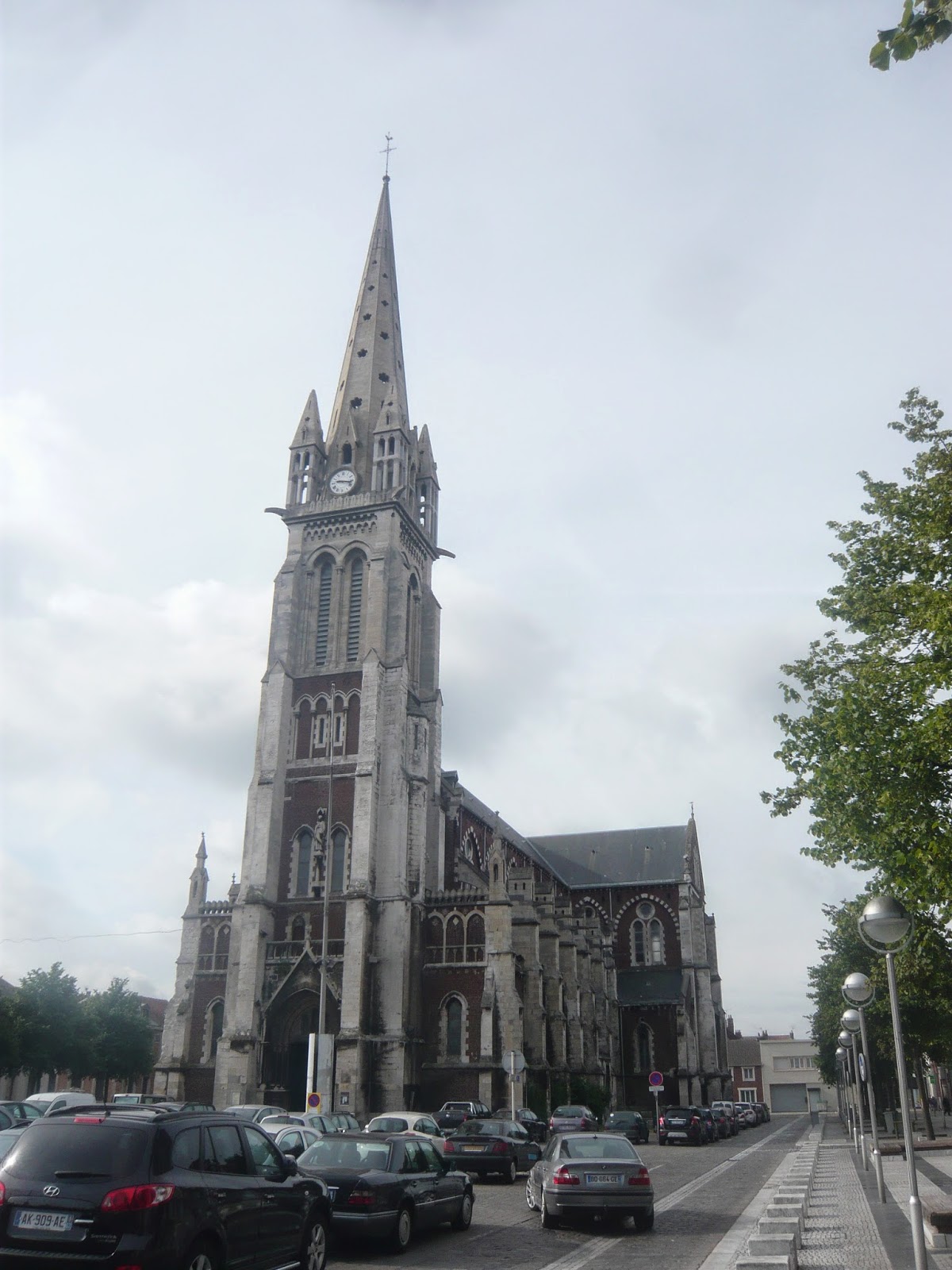
An exhibition based on the permanent collection at the Museum of Fine Arts in Calais helped identify Henri Lhotellier and Jean Roulland as two additional artists who have received church commissions. Roulland had work at the very first church - Hem - I visited on the European stage of my Sabbatical art pilgrimage (see http://jean.roulland.free.fr/jost_de_geest_fr.htm), while I have previously seen glass by Lhotellier in Boulogne (see http://lesamisdupatrimoinesaint-martinois.over-blog.com/article-27879532.html). He also has glass here in Calais, at l'Eglise Saint Pierre. See http://www.calais.fr/The-museum-of-fine-arts. I also found contemporary glass - this time by Gerard Lardeur at Notre-Dame de Calais. See http://www.vitrail-syndicat.com/evenem/inmem-gl.php.

-----------------------------------------------------------------------------------------------------------

Nick Cave - God Is In The House.

Sabbatical Art Pilgrimage: Calais


An exhibition based on the permanent collection at the Museum of Fine Arts in Calais helped identify Henri Lhotellier and Jean Roulland as two additional artists who have received church commissions. Roulland had work at the very first church - Hem - I visited on the European stage of my Sabbatical art pilgrimage (see http://jean.roulland.free.fr/jost_de_geest_fr.htm), while I have previously seen glass by Lhotellier in Boulogne (see http://lesamisdupatrimoinesaint-martinois.over-blog.com/article-27879532.html). He also has glass here in Calais, at l'Eglise Saint Pierre. See http://www.calais.fr/The-museum-of-fine-arts. I also found contemporary glass - this time by Gerard Lardeur at Notre-Dame de Calais. See http://www.vitrail-syndicat.com/evenem/inmem-gl.php.

------------------------------------------------------------------------------------------------------------
Bob Dylan - Tangled Up In Blue.

Monday, 26 December 2016

The Divine Image


The Divine Image by Hannah Thomas is at St Stephen Walbrook from 9 - 20 January (Mon - Fri, 10.--am - 4.00pm, except Weds, 11.00am - 3.00pm). The opening night reception will be on Monday 9 January from 6.30pm, all are welcome.

Hannah Rose Thomas is a twenty-four year-old British artist and recent Durham graduate in Arabic and History. Hannah has sold her paintings and received commissions since she was eighteen years-old to fund her humanitarian work in Mozambique, Sudan, Madagascar, and, more recently, in Jordan and Calais.

This special exhibition collects portrait works undertaken during Hannah’s time in refugee camps in Jordan, where she partnered with UNHCR and Relief International to organise art projects for children in the camps. Her most recent portraits are of refugees she has met while volunteering in the Calais ‘Jungle.’

Hannah’s intimate portraits seek to humanise the individuals forced to flee their homes, whose personal stories are otherwise shrouded by statistics. She draws inspiration from Islamic art and Arabic poetry, to celebrate the rich heritage of the Middle East, so often forgotten and overshadowed by war.

The title of the exhibition is inspired by a verse from William Blake’s poem The Divine Image:

For Mercy has a human heart
Pity, a human face:
And Love, the human form divine,
And Peace, the human dress.


Hannah is currently studying an MA at the Prince’s School of Traditional Art in London. Her next art project will be in Kurdistan, to assist with the rehabilitation of abducted young women from the Yazidi community.

Painting in Refugee Camps in Jordan

In April 2015, Hannah returned to Jordan to organise an art project for Syrian children living in the refugee camps, with the support of Relief International.

The first canvas painted in Za’atari camp was an expression of the children’s experience of war. After a number of groups of boys and girls had painted on it, the canvas had become an abstract chaos of splashes of red paint, dark colours and layers of the children’s drawings of tanks, soldiers, dead bodies, planes and destroyed homes. It is a small glimpse of all that the children witnessed in war-torn Syria.

However, many of the children confessed to Hannah that they did not want to think about or paint the war any more. Therefore the second canvas painted with the children was a vibrant expression of their memories of Syria. It was inspired by Islamic art and arabesque design, to celebrate the rich cultural heritage of the Middle East, so often forgotten and overshadowed by war.

After a couple of days at Za’atari, the art project moved to Azraq refugee camp, in the midst of a desolate desert wasteland on the Saudi and Iraqi border. The two canvases painted in Azraq are a reflection of the children’s daily life in the refugee camp. Hannah also painted a mural on one of the new school caravans.

The Diary of a Girl Away From Home

This is a tapestry created from paintings by Syrian girls living in Za’atari Camp this April. The most common image they painted was home, highlighting their longing for the war to end so that they can return to Syria. The Arabic poem is by a Syrian girl named Fatimah about her beloved home:

Take care of my house,
I left in it feelings of safety and security.
Don’t mess with my closet,
It has my clothes drenched with the smell of memories that no one else knows
And pieces of paper that have no value except to myself.
Don’t lift my pillow,
I hid under it my tears in times of sadness
And creatively created many dreams.
Don’t change the order of the books on my bookshelf,
On their pages notes I have written that no one will understand like I do.
As for my desk, don’t touch it,
But leave it with the mess I make while I study.
Please keep my traces in my beloved home,
I will be reunited with it soon.


----------------------------------------------------------------------------------------------

Victor Vertunni Family & Friends - Holy Thursday.

Tuesday, 15 March 2016

The suffering of Jesus through images and stories of today's refugees


The Stations is an artistic project reflecting on the Stations of the Cross and the suffering of Jesus through images and stories of today's refugees. The Stations is a photographic exhibition in the Foyer of St Martin-in-the-Fields until Sunday 10 April 2016.

The traditional ‘stations of the cross’ are a series of 14 images depicting the stages of Christ’s journey on Good Friday.

This unique photographic study by creative director Marksteen Adamson, in collaboration with Premier Christianity magazine, is a parallel journey retold through the lives and stories of the refugees he met and befriended in Calais, Lebanon and the UK.

Adamson reinterprets these stages of Jesus’ own experience of suffering and persecution as seen through the lives and stories of the refugees Adamson has met and become friends with during trips to Calais, Lebanon and within the UK.

This powerful exhibition seeks to reinterpret an ancient series of images that have spoken for centuries to those who have themselves experienced suffering. Christ’s journey of pain and sacrifice is a universal one played out in the suffering of people from different faith backgrounds and captured in stark and arresting ways through the stories of a modern humanitarian crisis.

---------------------------------------------------------------------------------------------------

Martin Smith, Cece Winans & Lakewood Choir - Fill My Cup.

Sunday, 27 July 2014

Windows on the world (302)


Calais, 2013

----------------------------------------------------------------------

Romanian Orthodox Chant - We Magnify Thee.   

Friday, 11 July 2014

Sabbatical art pilgrimage: Chapelle Sainte-Thérèse-de-l'Enfant-Jésus et de la Sainte-Face, Hem


I began the European leg of my sabbatical art pilgrimage with a mixture of excitement and trepidation. Excitement because, as Edward Knippers said of my plans, this is the start of a wonderful adventure. Trepidation because I am unsure as to whether my itinerary and the practical arrangements which I need to make as I travel will work out.

My journey does not have an auspicious start as, on the approach to Lille, I become part of one of the longest tailbacks it has been my misfortune to encounter. We are, however, mostly moving throughout many kilometres, albeit at a snail’s pace, and eventually reach the cause of the delay – a convoy of tractors filling the lanes and accompanied by the emergency and highways services. Why it was necessary for such a large group of tractors to be moving together I have no idea but the delay certainly increased my initial anxieties about the possible difficulties of keeping to my planned itinerary.

Eventually I arrive at Hem for my first visit not knowing for sure whether this first church, or those that I planned to visit subsequently, would be open. As the Chapelle Sainte-Thérèse-de-l'Enfant-Jésus et de la Sainte-Face has external sculptures and a mosaic over its entrance, I reasoned that the journey would not be completely wasted were the church to be locked. It is not and, as I travel on, it is only when I return to Calais that I find churches which are not regularly open.

The Chapelle Sainte-Thérèse-de-l'Enfant-Jésus et de la Sainte-Face was built in 1956 - 1958 with mosaics and windows by Alfred Manessier, sculptures by Eugène Dodeigne and Jean Roulland, and a tapestry of the Sainte-Face based on a painting by Georges Rouault which was made by the Plasse Le Caisne workshop. The architect was Hermann Bauer and the church has been described as “a fine example of art sacré after World War II.”

I had come to see the work by Manessier and did not realise prior to arrival that I would also see an image by Rouault, who is a favourite artist of mine. To enter the evocative space of this chapel and see not only Manessier’s amazing walls of stained glass but also the Rouault image was confirmation that, despite my anxieties about the unknowns in this great adventure, I was on the right path.

The combination of Rouault and Manessier is particularly appropriate as Manessier has been described, by Werner Schmalenbach, as 'after Georges Rouault the only great painter of Christian art in our age.' In 1947, Manessier received a visit from Rouault who advised him to take up stained-glass design. From 1948 to 1950 he worked on six windows for Sainte-Agathe des Bréseux (which I would see later on my pilgrimage) before promoting "the modern concept of stained glass architecture,” as found here, “rather than isolated stained glass windows."

Despite this the differences between them exceed the similarities. Rouault was a figurative expressionist who loved to paint circus players, prostitutes and judicial figures, as well as the iconic sainte face (holy face) of Christ. These were painted “as penetrating types of the misery of human existence” but with grace also seen as “divine meaning is given to human life by the continuing passion of Jesus Christ.” He summed up his vision in several studies entitled (quoting Virgil's Aeneid), ‘Sunt Lacrymae Rerum’ – ‘There are tears (of grief) at the very heart of things.’ The image of the Holy Face used for the tapestry, taken from a painting of 1946 which is now in the Vatican Museum, "focuses on the conquest of death by giving the face a serene expressionwith wide open eyes and by using calm harmonious colours."

Rouault was apprenticed to a stained glass maker and, as here, often used thick black outlines in his work, which were regularly compared to the lead lines in stained glass, yet he was only commissioned for stained glass in old age while Manessier, after taking Rouault’s advice, went on to create in excess of 70 windows.

Manessier, by contrast with Rouault, was a lyrical abstractionist who thought of stained glass less as a design than as “the simultaneous creation of a light-filled architectural unit, thought-out and created by the painter at one go.” Similarly concerned with suffering as was Rouault, he aimed to saturate his works with human feelings. For this to occur no resort to figuration was permitted, his goal being not to “portray a man in his state of suffering, but suffering itself”; “an attempt to translate this through the use of equivalent signs and colours.” “I start painting,” he stated, “when I feel a very close coincidence between the scene that I have before my eyes and my inner state. That relationship releases a creative joy which I long for and need to express.” As a result he sought “a new pictorial language” that would “fortify expression”. He wished to incarnate inner experience in visible form. As he put it, “More and more I want to express man’s inner prayer.” Abstraction was, for him, the means to achieve this desire; “The further I penetrated into non-figuration,” he said, “the more I approached the inwardness of things.” (Manessier, J. P. Hodin)

These approaches to his art developed from his experience while on retreat with the poet Camille Bourniquel at the Trappist monastery of Soligny in 1943. During the Salve Regina on the first evening he “felt profoundly the cosmic link between that sacred chanting and the world of nature all around, which thrust itself into the silence of the twilight.” It was the moment, he said, “when nature was appeased.” He saw in his mind songs rising and falling and thought that, if he “could succeed in grasping this inner light, this rhythm, this meaning,” he “could do more than render a visible image of it,” he “could give its essence.”

The concept of stained glass architecture - of a light-filled architectural unit – that we find at Hem is an attempt to recreate that experience for all who enter the space. Stained glass here is not windows, but walls. There is no narrative, instead a loose cubist concrete grid holds a great chromatic richness. The play of light and colour created in the space is redolent of the Carmelite spirituality of Thérèse of Lisieux, which was the inspiration for Manessier’s design. Stained glass here creates spiritual space, a sense of prayer and a glimpse of heaven.

Reflections on human suffering constitute the predominant theme of Jean Roulland’s work. In 1956 his discovery of Germaine Richier's works in the Dujardin Gallery in Roubaix was decisive in his definitive turn to sculpture which has led to his becoming chiefly known for his tormented lost-wax cast (cire perdu) bronzes. His expressive work shows no concession to the decorative aspects of sculpture in its relentless focus on the contorted anguish of human misery. Although I didn’t know it at this stage, I would see examples of these works when I returned to Calais at the end of the European leg of my pilgrimage. Roulland is a featured artist in Calais, at home and away, a series of exhibition spaces at the Musée des Beaux-arts de Calais which serve as an introduction to Calais, its artists and landscapes.

Roulland was collected by Philippe Leclercq, the wealthy manufacturer who had the Chapel at Hem built, and was commissioned to create a bust of Jean XIII and a processional cross (Christ de Procession). The processional cross shows the influence of Richier in that, as with Richier’s crucifix at Assy, Christ is made one with the cross and reduced to the most minimal representation possible. As with Richier’s work this has the effect of emphasising the sub-human state to which torture, torment and suffering reduce all who truly experience their pain and anguish. These works, as with the Sainte Face and Passion images of Rouault and the Crown of Thorns paintings of Manessier, are part of a strand of twentieth century art which equates the sufferings of the crucified Christ with that of the numberless victims found in a century characterised by persecution, torture and war.

Roulland and Eugène Dodeigne were close friends and fellow members of the Groupe de Roubaix, a group of friends who were artists characterized by their northern origins. Dodeigne has said that he views sculpture as a struggle against the material. His struggle may be sensed in the stressed and patterned surfaces of the Soignies blue limestone which he has sculpted since moving to Bondues in northern France in 1949. By contrast, his smaller Soignies forms, as here with his sculpture of St Thérèse, are highly polished. His work, in both monumental and modest scale conveys a mastery of the balance of volumes and lines of force.

For all that the works by Dodeigne, Rouault and Roulland make their distinctive contributions here in Hem, it is Manessier’s glass which sets the tone and creates the spirituality which informs this marvellous space. Rightly, when reviewing Manessier’s exhibition at the Venice Biennale in 1962 - for which he was awarded the international prize for painting (to date, the last occasion that a French artist has been awarded this prize) - Jacques Lassaigne wrote of Manessier’s “majestic orchestration of vibrant tonalities and pure rhythms.” Lassaigne also suggested that at various points in Manessier’s very rich career “a kind of pause of meditation and inner transformation” had “enabled him to transform the powerful impressions which he had received … into new means of evoking and glorifying secret presences. Reflecting now on my visit to Hem, those words seem to be an accurate description of the experience that I enjoyed there at this the first stop on my sabbatical art pilgrimage.

-------------------------------------------------------------------------------------------------

The Frames - Star, Star.

Saturday, 28 June 2014

Scenes from my European trip

Musee Maurice Denis


Ronchamp


Les Bresaux


Tavennes


Romont


Lourtier


Fionnay


Saint Gingolph


Mt Blanc


Sint-Martens-Latem


Calais


---------------------------------------------------------------------------------

Van Morrison - And It Stoned Me.