Brian Clarke says that stained glass ‘can transform the way you feel when you enter a building in a way that nothing else can!’[i]
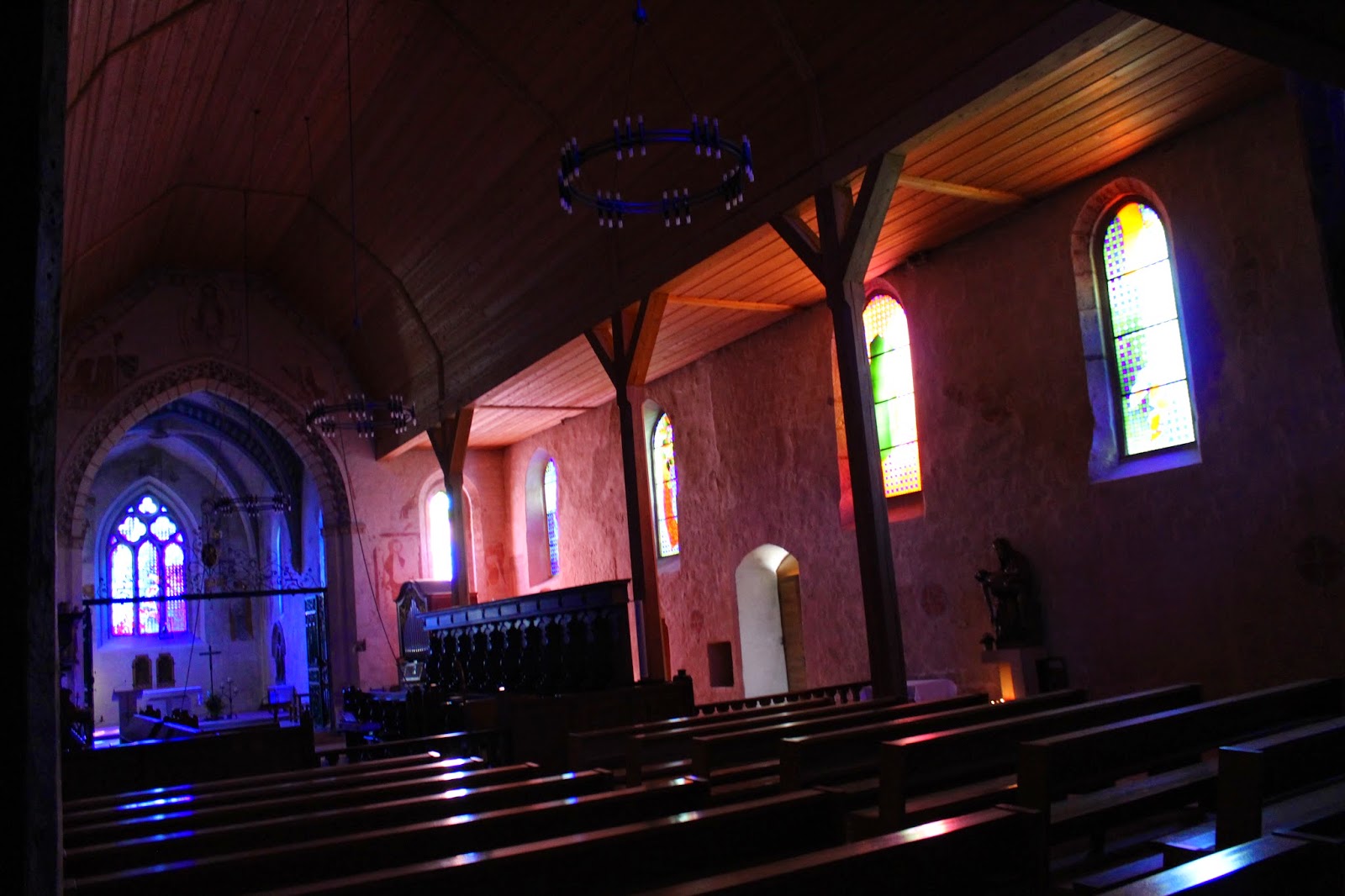
I would concur, especially after arriving at l’Abbaye de la Fille Dieu in Romont in time for a memorable service of Vespers followed by silent contemplation in the still onset of darkness falling. Tomas Mikulas, the architect on the restoration of this Cistercian Abbey, has stated that the overall goal of the restoration was to offer both nuns and visitors an ‘atmosphere conducive to meditation and prayer.’ Mikulas suggests that it is the ‘warm and vibrant atmosphere’ created by Clarke’s windows ‘with the changing light of day’ that ‘makes a decisive contribution’ to the space and to the restoration as a whole.[ii]
There are several reasons why this was a surprising outcome in this context. Early on in his career Clarke realised that he had to ‘shake off the ecclesiastical image’ of stained glass ‘if he was going to make any impact in the medium’: ‘I looked for opportunities in all kinds of public buildings and declined opportunities in the church. I fought for that and continue to fight for that. It's a lifelong pilgrimage.’[iii] Not only that, but within the Abbey a group of nuns actively opposed Clarke’s designs on the basis that they were too colourful for a Cistercian chapel. This group was concerned that the strong presence of the windows would overpower the building and that the colour of the windows would reduce the visibility of the murals (dating from the fourteenth, fifteenth and sixteenth centuries) which have been preserved through the restoration.
Mikulas insisted on Clarke and was supported by the Abbess, Mother Hortense Berthet, who ‘loved and encouraged’ the stained glass project. Mikulas writes that she was always far-sighted and, where others could be entrenched behind their ‘achievements and habits,’ she would always ‘promote and encourage projects and renewal.’[iv] The restoration work here, including Clarke’s windows, provides an object lesson in such projects due to the depth of understanding of the history and context developed by Mikulas; one involving listening, collaboration and perseverance in the service of a historic monument and a contemporary community of nuns. Ultimately, this has meant searching for the presence of Christ and the acceptance of others in the great Cistercian Trappist tradition.
His overall goal was the creation of a new and coherent building which was respectful of the buildings’ history while also servicing its use as a place of worship: ‘The colour of the windows is in relation to the path of the sun’s movement and to the nun’s daily liturgy and prayer – ‘starting from the mystical and blue morning in the sanctuary, to warm tones in the nave later in the day’ – and the glass chosen and developed for the windows, some hand-painted by Clarke, responds to the orientation of the building, with richly textured transparent glass in the east, south and west windows, and opaque glass in restrained colours in those that face north, which face onto cloisters and receive only weak natural light.’[v] Mother Hortense responded by saying: ‘I asked the artist before the creation of his stained glass that they carry a message of hope for those who come to share our prayer. I feel that my wish is wonderfully realized in this joyous, dynamic rise towards a future made all of light.’[vi]
At Vespers in l’Abbaye de la Fille Dieu there was a powerful sense of being caught up in a heavenly space and the great corporate song of heaven as the wondrous harmonies of unified plainsong responses combined with the mystical light of Clarke’s windows. Stained glass can transform the way we feel when we enter a building like l‘Abbaye de la Fille Dieu because, as Clarke has said, art brings ‘beauty and something of the sublime into the banality of mundane experience.’[vii]
My slowing down to look over a sustained period immersing myself in the world of this work was then aided by silence and the waning of the light. Just as Bill Viola’s videos, by their form, often encourage us to slow down, so, stained glass, paintings, sculptures and other forms of non-digital/performance art compel us, by their form, to silent contemplation.
‘Painting does not have anything to say’, writes T.J. Clark. Clark derives his obvious, though often over-looked, statement from John Ruskin: ‘I am with Ruskin in thinking that a picture is not by its very nature ideology’s mute servant, and has at its disposal kinds of intensity and disclosure, kinds of persuasiveness and simplicity, that make most feats of language by comparison seem abstract, or anxiously assertive, or a mixture of both.’[viii]
The peculiar advantages that painting’s muteness give it over the spoken or written word are, firstly, that ‘the ‘openness’ of the image can provide a space for the insubordinate, or at least the blessedly unserious’. This is of particular significance in ‘times of enforced orthodoxy (that is, most of the time)’. Secondly, it can make an imaginative wished for vision of history spellbinding, persuasive and concrete, while, at the same time, giving an awareness of the human, earthbound and matter of fact nature of that vision. This is of particular significance in times when ‘the main established metaphors and images look to be indelible, however often they are subjected to the fires of disbelief’.[ix] At the heart of Clark’s insight is the reality that in one image, without recourse to words or text, painting can create a new world which nevertheless continues to relate to this world.
Clark makes these points in a book where he writes, using many words, about images by Giotto, Bruegel, Poussin, Veronese, and Picasso. All of these have literary sources, knowledge of which many viewers bring with them to the paintings when seen. Painting’s separation from words and text is not, therefore, as complete as Clark seems to suggest. Additionally, contemporary art makes significant use of text and sound while retaining some of the qualities of which Clark writes. Despite this, the muteness of painting is, as Clark argues, worthy of remark and reflection.
George Pattison makes a similar point in reflections on Mark Rothko’s painting Black on Maroon: ‘Rothko confronts us with the question: ’But what do you say about it?’ The painting ‘tells’ us nothing: the burden of deciding how to see it is thrown back on us, the viewers – as Rothko explicitly says when he comments that he is equally open to his work being seen in a sacred or secular way. With regard to ‘what’ it means, the painting does not offer any determinate content or specific message. Instead, it opens up a field of pure possibilities, a ‘potential’ space that invites the co-creativity of the viewer.’[x]
Pattison commends slow waiting with the painting until it reveals what it is, in its essence. The muteness of the painting challenges us to do so and when we look for 15-30 seconds or read the label alongside without then looking again at the painting, it is a challenge that we duck.
The poet Ian Wedde comments on the value we accord to words suggesting that we think it perverse to be reticent. He asks whether there is a silence ‘not sullen or inarticulate, but respectful,’ a reticence ‘leaving space in which the words of others can be heard.’ He asks ‘what kind of art might such a space create’ and ‘what kind of art might create such a space?’[xi]
Richard Carter commends silence as the most spacious language available to us:
‘It is silence that offers space for our lives
Too big and complex to be contained or explained by
any words
It is the silence of God that gives a home
to all the hopes, the fears, the fragments, the layers, the
tangents, the tangles and the tearings
And in the silence God holds us, all of us, and tells us
‘You are mine.’
The light, the dark, the shadow,
the sun, the rain, the wind,
the rainbows of our lives
We seek to discover the silence of our God
at the very centre of all that we are
The living centre
that makes the fullness of our humanity possible
Silence is the only language spacious enough to include
everything.’[xii]
Carter argues that silent contemplative space is the ground of our being and, as such, has made it foundational to the sevenfold rule of life (silence, service, scripture, sacrament, sharing, sabbath, staying with) practised by the Nazareth Community at St Martin-in-the-Fields. Discovering silence is about creating space for meeting; a meeting in which we ‘let the sky in, the light in, the earth in, let prayer in’ and in which we are ‘open and naked before God, the immensity of the universe, the enormity of eternity.’ In silence we ‘rediscover our humanity and a world infused by God’:
‘We are always moving
So we don’t see
Always talking
So we don’t hear
Or we hear in snatches, or bites
But we do not listen to the heights or depths.
You are actually have to stop to see
To be still to notice
How often we walk through rather than being with
Walk past without offering time or space
Take the photo without realizing that the true camera is our
inner eye
We think we have to catch up with the world
Actually, we have to be still enough to let the world catch
up with us
And meet us in the still place
Our lives can be like fast trains rushing through a station
So fast you cannot read the signs
Only a flash of colour and blue of people and place
No time to notice
Or see the signs of God
Here and now
Stop
Be in the moment
Lest you miss it and let your mind and body race on
To further racing’[xiii]
Entering silence is a return to the ground of our being because, for all of us, seeing comes before words, as John Berger reminds us in Ways of Seeing: ‘The child looks and recognises before it can speak. But there is also another sense in which seeing comes before words. It is seeing that establishes our place in the surrounding world; we explain the world with words, but words can never undo the fact that we are surrounded by it. The relation between what we see and what we know is never settled … We never look at just one thing; we are always looking at the relation between things and ourselves. Our vision is continually active, continually holding things in a circle around itself, constituting what is present to us as we are.’[xiv]
As a result, Carter sees art as prayer:
‘I had not realised before, but art is a meditation
Because it is a deeper way of looking at the world
A way of seeing both light and shadow
Of observing the detail that escapes the glazed eye
And all the while seeing it through the context of your own
life and the context of the artist
Seeing is reciprocal
It is seeing the relationship between things and the
relationship with you
The proportion, the colour, the shape, the light, the energy,
the narrative, the life evoked
It is seeing how lines intersect and spaces open up
It is recognizing horizons
The sky above
The earth beneath
The still water in the foreground
It is seeing the tiers of life
It is standing and gazing
No longer my head in the focus but the panorama of life in
which I too am part
For I am the seer
It is breaking through the diatribe and seeing
Creation with all its seams of wonder.’[xv]
Following her conversion to Roman Catholicism in 1913, religious subject matter appeared in Gwen John's art in the form of paintings and drawings of religious figures, some historical and some contemporary. She also became an artistic observer of the religious life of the Catholic community in Meudon where she had made her home. However her depth of faith was primarily expressed through the practice of her art. She wrote of entering 'into art as one enters into religion' and the attention that she paid both to the subjects of her slowly evolving oil paintings and in the rapid sketches she made of local people in church seem to have equated with prayer for her. She viewed herself as a sensual creature unable to pray for any length of time but, inspired by the 'Little Way' of Saint Therese of Lisieux, which outlines how the smallest thing can be done in the name of God, wrote that she must be a saint in her work. What she could express in her work, she wrote, was the 'desire for a more interior life'.
In her art, John achieved a sense of quiet meditation on the beauty of everyday existence that sets her work alongside that of Jean-Baptiste-Simeon Chardin, Giorgio Morandi and Vilhelm Hammershoi. Ultimately for her, post-conversion, this sense of stillness and tranquillity derived from her prayerful attention to the holiness of each moment. She wrote of seeing ‘that God is a God of quietness’ concluding ‘and so we must be quiet’.[xvi] By this means, she truly became 'God's little artist ... a seer of strange beauties, a teller of harmonies’.
By depicting the silent interior life through rooms full of human presence but empty of human beings (domestic scenes or still life’s) or women seated alone in contemplation, she begins a ‘journey of wonder’ for us ‘and then leaves us to travel alone with our thoughts, to listen to the work and its setting rather like the words of a poem.’[xvii] Listening to the setting of the work brings us to reflection on its sources.
Explore
In 2010 for The Artist is Present, her performance piece New York’s Museum of Modern Art, Marina Abramovic sat, motionless and silent every day during museum hours for three months, directly opposite members of the public who queued to spend time in silent dialogue with the artist. This piece, which was about stillness, silent contemplation and being in the present, presented silence as a context for observation and reflection and a mode of communication.
During this piece the artist had the idea for the Marina Abramovic Institute which offers workshops designed to bring body and mind to a quiet state and events in quiet and non-hierarchical spaces with exercises designed to connect with oneself and others through observation.
Abramovic has listed her rules for artist’s regarding silence in a manifesto published as part of her memoir Walk Through Walls. See https://vimeo.com/72711715 for The Artist is Present and https://www.brainpickings.org/2016/11/30/marina-abramovic-artist-manifesto/ for the Manifesto. Another significant statement on art and silence is by Susan Sontag - http://www.susansontag.com/SusanSontag/books/stylesOfRadicalWillExerpt.shtml.
For paintings created in silence which retain the atmosphere of silence, look at the work of Celia Paul, as well as that of Gwen John. For many years Celia Paul’s mother used to climb the 80 steps to this studio in order to sit for her. She would arrive exhausted and out of breath but then would pray in silence as she sat for her daughter, the air being charged with prayer. Paul’s paintings are no less charged with prayer, as, although not conventionally religious, prayer, she says, is still in her bloodstream. A strong sense of peace emanates from her work as she juxtaposes direct observation with mysticism. The peace which emanates is hard won, as is the seclusion found within her studio amidst the complexities of the relations she paints. She paints peace, while painting in peace, despite the disruptions of guilt and grief that arise from her past; a new day, a new dawn is depicted undefined by the past.
‘Lighten our darkness, we beseech thee, O Lord’ is the prayer that would most readily characterise these pieces, as the emergence of light is often Paul’s subject, resolution and goal. A halo effect surrounds Paul’s features in Self Portrait with Narrow Mirror. The sun, hidden by a dominating dark central tree, streams rays of illuminating light on The Brontë Parsonage lit from without among sombre blues and greys. The light in Kate in White, Spring 2018 overwhelms and overawes spilling over and enveloping the sitter. Breaking, Santa Monica provides a word and image for the peaceful light which breaks through, emerging and emanating from her canvases. God is in the light which pierces the darkening gloom within these works. My Mother and God is 167.3cm of dark canvas stretched from the still image of her sitting mother praying, with those prayers calling forth the thin band of yellow light entering the space at the apex, apotheosis and apogee of the canvas.
To explore the silence of Celia Paul’s work go to https://www.victoria-miro.com/artists/186-celia-paul/.
Wonderings
I wonder what silence means for you in your circumstances.
I wonder what you hear when there is silence.
I wonder where you encounter silence most readily.
Prayer
God of creativity and rest, what might silence be for me? Nowhere is completely silent, yet there are moments and places where noise abates and where enduring existence is heard. Lead me to such moments and places in ways that work for me where I am and who I am. Amen.
Spiritual exercise
Set aside a specific time for silence, with additional time also available for prayer afterwards. During the silence write down all that you hear in that time and all that comes into your mind. After the time of silence is complete, embrace each thing on your list as a gift and about or for that thing whether as thanksgiving or intercession.
Art activity
Visit a gallery or museum and use headphones to block out surrounding noise as you view the artworks.
Visit a church when you know there will be few people there in order to contemplate the art and architecture in relative silence.
[i] http://www.mikulas.ch/photos/2013/Fille-Dieu/2013-06_vitraux_Fille-Dieu.pdf
[ii] http://www.mikulas.ch/hortense.htm
[iii] https://www.independent.co.uk/arts-entertainment/art/features/glowing-panes-brian-clarkes-stained-glass-windows-have-earned-him-global-recognition-and-the-papal-2093385.html
[iv] http://www.mikulas.ch/hortense.htm
[v] http://www.brianclarke.co.uk/work/works/item/347/5
[vi] http://www.brianclarke.co.uk/work/works/item/347/5
[vii] http://www.mikulas.ch/photos/2013/Fille-Dieu/2013-06_vitraux_Fille-Dieu.pdf
[viii] T. J. Clark, Heaven on Earth: Painting and the Life to Come, Thames & Hudson, 2018
[ix] T. J. Clark, Heaven on Earth: Painting and the Life to Come, Thames & Hudson, 2018
[x] G. Pattison, Crucifixions and Resurrections of the Image: Reflections on Art and Modernity, SCM Press, 2009, p.83
[xi] I. Wedde, ‘Where is the art that does this?’ in G. O’Brien ed., ‘Hotere: Out of the Black Window’, Godwit Publishing Ltd., 1997, p.9
[xii] R. Carter, The City is my Monastery: A contemporary Rule of Life, Canterbury Press Norwich, 2019, p.2
[xiii] R. Carter, The City is my Monastery: A contemporary Rule of Life, Canterbury Press Norwich, 2019, p.8-9
[xiv] J. Berger, Ways of Seeing, Penguin Books, 1972, p.7
[xv] R. Carter, The City is my Monastery: A contemporary Rule of Life, Canterbury Press Norwich, 2019, p.44-45
[xvi] T. Frank, Gwen John: Her Art and Spirituality - https://www.theway.org.uk/Back/461Frank.pdf
[xvii] L. Sutton in Be Still: PassionArt Trail 2016, PassionArt, 2016, p. 9
Click here for the other parts of 'Seeing is Receiving'. See also 'And a little child shall lead them' which explores similar themes.
---------------------------------------------------------------------------------------------------------
Simon and Garfunkel - The Sound Of Silence.