Wikio - Top Blogs - Religion and belief
Showing posts with label bishop of chelmsford. Show all posts

Wednesday, 3 June 2026

HeartEdge: Christ in the Stranger


It was great to be at St Martin in the Bullring today for the latest HeartEdge conference entitled 'Christ in the Stranger' with input from Bishop Guli Francis-Dehqani and Sam Wells. It was also great to catch up with HeartEdge and other friends that I hadn't seen in a long time.

The foundational conviction of HeartEdge is that God gives us everything we need but we need to be willing to receive it in the form in which God sends it. Matthew 25 and Luke 10 show us some of the forms in which God sends it – and both refer explicitly to the stranger. The conference focused on how congregations can most appropriately receive the gifts of God in the stranger and how in particular they may respond to the Christian-influenced voices in this country expressing hostility to migrants today.

The day also included interactive workshops on the HeartEdge 4 Cs. I contributed a workshop on 'Christ in Creatives'. The introduction to this workshop was as follows:

I want to talk today about dialogue with creatives as a means the kind of constructive and respectful relationship that the Church has discovered in the arena of interfaith dialogue. A conversation is only possible when all the conversation partners agree that each can say what they see, with the others listening before discussing synergies and differences. That foundation of respect and attention enables genuinely insightful conversations to occur. That, I think, is the primary aim for churches in engaging with creatives. When churches do this, they discover that conversation connects – with artists, with the Art world, with those who regularly view art and with the casual visitor (by enhancing the depth and variety of their experience in the space).

The artist and theologian Makoto Fujimura has advocated for a spirit of generosity that awaits genesis moments that have generative capacity when engaging with creatives. In describing such approaches, he arrives at the image of an estuary, where salt-water mixes with fresh, in a confluence of river and tidal waters.

An estuary is an environment not of protection but of preparation. Estuaries are a critical nursery area, for example, for young salmon, striped bass, and other fish that come downstream after hatching. Life in semi-protected estuarial wetlands during a critical period in their development readies these fish for life in the ocean. The purpose of estuaries is not so much protection as preparation. Each individual habitat strengthens its participants to interact with the wider environment, making for a diversity that is healthy enough for true competition.

Sam Wells has suggested that Fujimura’s image of an estuary offers a humble but intriguing reassessment of what the church thinks it’s doing when it engages with culture. One might say the church has long assumed it was the sea, to which every river led. Or it might be said to have identified with the pure water of the river, in contrast with the salty water of the sea. But the image of an estuary is helpful for a church regarding itself as a meeting place of human and divine, gospel and culture, timeless truth and embodied experience, word and world.

‘… the metaphor of a transitional place where cross-fertilisation can take place and creativity can thrive amid diverse conversation partners may be apt. Churches work hard to make themselves inspiring locations where people are drawn into a sense of the presence of God; but they can work equally hard to make themselves hospitable locations where people of varied backgrounds may gather in a spirit or mutual appreciation, generous regard and constructive challenge. The two purposes of church need not be mutually exclusive.’

Sam also shows how: ‘Art is a perfect example of how such an estuary space may flourish. A congregation may encourage art on three levels. One is the participatory: a local church may host an artists’ and craftspeoples’ group; it may take participants of all abilities; there’s no reason why it can’t host members of all faiths and none; perhaps each month a member of the group may be invited to exhibit their work in a valued and visible place, and be given the opportunity to write or speak about it.

Another is the aspirational: a competition might be held for an artefact to be placed permanently in the church building, tenders invited, donors sought, publicity encouraged, visitors attracted. Similar approaches might apply for temporary art installations.

A third level is the commercial. A church building might be a suitable venue for a display and sale of artworks; yet another host of new faces drawn in, conversations triggered, relationships made; and the church perhaps taking a 20% cut of all piece sold.

In a short time, a secluded, secretive space may be opened out to become a centre of community activity, energy, and creativity. Much the same principles and categories would apply for choral music or drama or literature. What’s needed is for a church to let go of the need for direct outcomes and linear trajectories and to let the Holy Spirit govern the interactions and catalyse its own surprises.’

This workshop was based on my case study on Churches and Cultural Programming which can be read by clicking here. I will be giving a talk on this topic at St Andrew's Wickford on Friday 17 July at 7.00 pm.

---------------------------------------------------------------------------------------------------------

Lizz Wright - Every Grain Of Sand.


Thursday, 7 May 2026

HeartEdge conference - Christ in the Stranger


Christ in the Stranger.  A HeartEdge Conference for Churches

Wednesday June 3rd 9.30am for 10am to 4pm
St Martins in The Bullring Birmingham

The foundational conviction of HeartEdge is that God gives us everything we need but we need to be willing to receive it in the form in which God sends it. Matthew 25 and Luke 10 show us some of the forms in which God sends it – and both refer explicitly to the stranger. The conference will focus on how congregations can most appropriately receive the gifts of God in the stranger and how in particular they may respond to the Christian-influenced voices in this country expressing hostility to migrants today.

Key Note Speakers 
Rt Revd. Guli Francis-Dehqani, Bishop of Chelmsford and
Revd Dr Sam Wells, Vicar of St Martin-in-the-Fields

Plus Inter-active workshops on the HeartEdge 4 Cs

The Fee for the day is £40 to include refreshments. You can bring a friend or colleague for just an additional £10 Subsidised places available on request from heartedge@smitf.org

More information at this booking link

https://www.eventbrite.co.uk/e/christ-in-the-stranger-a-heartedge-conference-for-churches-tickets-1984042421291?utm-campaign=social&utm-content=attendeeshare&utm-medium=discovery&utm-term=listing&utm-source=cp&aff=ebdsshcopyurl

Or contact heartedge@smitf.org

-------------------------------------------------------------------------------------------------------

Manchester Choral Scholars - In Remembrance. 

Wednesday, 25 February 2026

Art Trail: Bishop of Chelmsford's Lent and Holy Week Pilgrimage


This year, Bishop Guli Francis-Dehqani is walking the Barking Area Art Trail for her Lent and Holy Week Pilgrimage. The Pilgrimage is taking place on six days across Lent and Holy Week, starting on 25 February and concluding on 31 March.

This year's Pilgrimage started on Thursday 25 February with a 5 mile walk, starting at St Paul's Stratford and ending at St Bartholomew's East Ham, via St Michael & All Angels' Manor Park and St Barnabas Little Ilford. 

At St Paul's Stratford, the pilgrims are gathered in front of a striking wooden cross and matching altar front from the 1950s (both unattributed). From St Paul's, the pilgrims walked to St Michael and All Angels' Manor Park where they saw a sculpture of St Michael subduing the Devil, by Robert Crutchley, 1990. Onwards they went to St Barnabas Little Ilford to see the 1954 stained glass East Window, which has an image of Christ in Glory at its centre. The final stop of day 1 was St Bartholomew's East Ham. A stone cross (2007) on the exterior angled wall is by Nicholas Mynheer and represents St Bart's diverse congregation and community. They also saw John Bridgeman's sculpture 'The Family' (1983) which is situated on the south exterior wall of St Bartholomew's.

The Lent and Holy Week Pilgrimage resumes in Barking Deanery on 12 March.

The aim of the Barking Area Art Trail was to raise awareness of the rich and diverse range of modern and contemporary arts and crafts from the last 100 years which can be found within churches and, in particular, the 36 churches featured on the Trail. The significant works of art in these churches, taken collectively, represent a major contribution to the legacy of the church as an important commissioner of art.

These include past contributions by significant artists such as Eric Gill, Hans Feibusch, John Hutton and John Piper. In more recent years, churches continued to commission work by many important artists such as Mark Cazalet, Jane Quail and Henry Shelton together with other emerging artists who are now coming to prominence.

Work on the Art Trail was initiated by commission4mission, an arts organisation that encouraged churches to commission contemporary art, with the hope of increasing interest and stimulating engagement with the visual arts in the service of contemporary Christian faith.

A leaflet documenting the Art Trail, which was researched and developed by commission4mission member, artist and Fine Arts lecturer, Mark Lewis, publicised the Trail and provides information about the featured artists and churches. The leaflet included a map showing the churches featured on the Trail together with contact details, so that visits to one or more churches could be planned in advance.

Mark Lewis’ brief was to research commissioned art and craft in the Episcopal Area from the past 100 years. While stained glass is the dominant Ecclesiastical art form, he was also concerned to show a diversity and variety of media and styles within the selections made. He highlighted works such as the significant mosaic by John Piper at St Paul’s Harlow and the striking ‘Spencer-esque’ mural byFyffe Christie at St Margaret’s Standford Rivers. Churches with particularly fine collections of artworks included: St Albans, Romford; St Andrew’s Leytonstone; St Barnabas Walthamstow; St Margaret’s Barking; St Mary’s South Woodford;; and, the church chosen as the location for the launch event, St Paul’s Goodmayes.

The Trail was launched at St Pauls Goodmayes on Thursday 17th February by the Bishops of Chelmsford and Barking. At the launch event, The Rt. Revd. Stephen Cottrell, Bishop of Chelmsford, said: “I do not know what other art form could convey and hold the possibility of converging in so many layers. Not just do the visual arts comment on biblical narrative, but they illuminate it in a way that written or spoken forms cannot, being linear forms. Art opens windows on a set of concepts and ideas and brings them together. These windows offer a fresh perspective onto the faith we share, that other forms simply cannot.”

The Bishop of Barking stated that: “Our inspiration for understanding Christianity comes from the visual arts … The visual arts continue to be an important way of communicating our faith. Words are not enough to express the breadth, depth and height of what we want to communicate. It’s then that the visual arts express what we want to communicate.

God knew that: for centuries he relied on the words of the prophets and then he realized that he needed to send his Son to communicate in ways that words could not, the breadth, depth and height of his love. The word became flesh: the most beautiful living sculpture ever created – Jesus Christ.”

There are many interesting artworks to be found in the Diocese of Chelmsford; a fact I have been involved in highlighting previously through art trails in the Barking Episcopal Area - see here, here, here, here, here, here, here, here, here, and here. Most recently, I have included a listing of artworks to be found in the Basildon Deanery here and the Wickford and Runwell Team Ministry here and here. See also my post about artists in Broomfield - here. On the back of these and other sources of information, here is a partial listing of artists with work which can be found in churches within the Diocese of Chelmsford can be found here.

--------------------------------------------------------------------------------------------------------

Van Morrison - Hymns to the Silence.

Thursday, 6 November 2025

St Peter's Hutton: Stations of the Cross by Henry Shelton


This evening a set of Stations of the Cross at St Peter's Hutton created by Henry Shelton were dedicated by Bishop Guli Francis-Dehqani, Bishop of Chelmsford. Fr Andy Smith and Christine Thomas write: 'Henry's contemporary style, marked by its spare drawings and muted tones, complements the mid-20th-century design of St Peter's.' 

The Stations were prayed before being dedicated and a very special evening was rounded off by a reception at which Henry spoke about his work. A book of reflections and prayers to complement Henry's images is in preparation. Henry had previously created etched glass windows for St Peter's sister church, All Saints Hutton. 

This set of Stations also feature in Mark of the Cross, a book of 20 poetic meditations on Christ’s journey to the cross and reactions to his resurrection and ascension written by myself. The meditations are complemented by Henry's set of semi-abstract watercolours of the Stations of the Cross and the Resurrection.

Henry and I collaborated on two collections of images, meditations and prayers on The Stations of the Cross, Mark of the Cross and The Passion. These provide helpful reflections and resources for Lent and Holy Week. These collections can both be found as downloads from theworshipcloud.

The Passion: Reflections and Prayers features minimal images with haiku-like poems and prayers that enable us to follow Jesus on his journey to the cross reflecting both on the significance and the pain of that journey as we do so. Henry and I aimed in these reflections to pare down the images and words to their emotional and theological core. The mark making and imagery is minimal but, we hope, in a way that makes maximum impact. An example follows:

Jesus dies on the cross

The sun is eclipsed, early nightfall,
darkness covers the surface of the deep,
the Spirit grieves over the waters.
On the formless, empty earth, God is dead.

Through the death of all we hold most dear, may we find life. Amen.

All Saints Goodmayes, which has a set of Stations of the Cross by the artist Henry Shelton, has prepared a booklet of images, reflections and prayers based on these Stations. The reflections and prayers used are those that I wrote for 'The Passion'.

The set of Stations now at All Saints Goodmayes have previously been exhibited at York Minister, St stephen Walbrook, and Chelmsford Cathedral. The booklet comes with a Foreword by The Most Revd and Rt Hon. Stephen Cottrell, Archbishop of York: "At this most holy time, as we follow Jesus on His journey to the cross, Henry Shelton's contemporary images provide an evocative background against which we can place our deepest reflections as we contemplate the Passion of our Lord Jesus Christ, who by his death and resurrection delivered and saved the world."

Together, Henry and I formed commission4mission, an artist's collective that generated church commissions, exhibitions, events and resources. commission4mission was set up in 2009 and became a registered charity (Charity no. 1161109) in 2011. commission4mission ended its work at the end of March 2020. A summary of its work and achievements can be found here.

Henry Shelton was born and grew up in Stratford, East London. He joined West Ham church as a choir boy where he first became aware of the importance of Christian art. After leaving school he joined a London studio as an apprentice draughtsman developing his drawing skills in lettering and fine art. After 15 years of service he set up his own studio receiving many commissions to design for such clients as the Science Museum, Borough Councils, private and corporate bodies.

During this time he continued painting Christian art and after meeting Bishop Trevor Huddleston he completed a series of portraits of him which were exhibited in St Dunstan's Church, Stepney, where he was also confirmed by the Bishop.

Henry worked designing in studios across the world, including Hong Kong and the USA. His commissions include a large oil painting of the Ascension installed as an altarpiece in the Church of the Saviour, Chell Heath; the Millennium clock tower in Goodmayes, memorial etched glass windows in All Saints Goodmayes and All Saint's Hutton, paintings for the Chapel at Queen's Hospital Romford, Stations of the Crown of Thorns at St Paul's Goodmayes, and the Trinity Window at All Saints Goodmayes.

An interview that I undertook with Henry can be read here and here.

----------------------------------------------------------------------------------------------------------

Sunday, 24 March 2024

Holy Week & Easter Services


Wickford & Runwell Team Ministry: Holy Week & Easter Services


Holy Week (25-31 March)

Stations of the Cross and Night Prayer – 8.00 pm

St Catherine’s (Monday), St Andrew’s (Tuesday), St Mary’s (Wednesday)


Eucharist with footwashing – Maundy Thursday

(28 March), 8.00 pm, St Catherine’s (followed by The Watch)


Good Friday

Walk of Witness – begins from Our Lady of Good Counsel at 10.00 am

At the Foot of the Cross – 2.00 pm, St Andrew’s with The Rt Revd Dr Guli Francis-Dehqani, Bishop of Chelmsford and soloist Eva Romanakova


Easter Day (31 March)

Service of Light – 6.00 am St Mary’s, followed by breakfast

Eucharist – 9.30 am St Mary’s; Eucharist – 10.00 am St Andrew’s; Eucharist – 11.00 am St Catherine’s


Additionally, I will be speaking at Billericay Methodist Church Western Road as part of their Holy Week Midday Meditation Services on Monday 25 March, 12.00 pm.

-----------------------------------------------------------------------------------------------

Sunday, 21 May 2023

Glorify God and enjoy him forever

Here's the sermon that I shared at St Andrew’s Wickford this morning:

The Westminster Shorter Catechism is a catechism written in 1646 and 1647 by the Westminster Assembly, a synod of English and Scottish theologians and laymen intended to bring the Church of England into greater conformity with the Church of Scotland. It was intended to educate children and comes in the form of 107 questions and answers.

It asks first what is our chief end as human beings, in other words what is our purpose and meaning. The answer given is to glorify God and enjoy him forever.

That answer is essentially based on the prayer that Jesus prayed in Gethsemane, which begins with a prayer that both Jesus and God the Father be glorified as they are one and then says that eternal life is to be found in knowing God as Father and Son (John 17. 1-11).

So, let's reflect together on why we are here; both here today and why we come to church at all. Asked that question, we might give a range of answers that might include fellowship and friendship, refreshment and renewal, service and witness. Last year a number of you completed questionnaires asking, among other things, about church services. People said they want the churches to contribute to a sense of community, provide support for others and be centres for peace and prayer providing a sense of Christian presence. People’s best experiences of worship were in family-friendly services where there were plenty of other people, often at Festivals, and where they felt welcomed. A sense of closeness to God was seen as being the most important experience in worship, with music, prayers, the Eucharist and fellowship/belonging all contributing highly to this. Finally, people had a range of different preferences regarding styles of worship ranging from traditional to contemporary, and from one style to many.

Whatever we get personally and individually from being part of church, that is not the fundamental reason for being here or for our lives as Christians, which is to glorify God and enjoy him forever.

Understanding and taking on board that aim is transformative because it shifts our attention from ourselves to God. When we come to church and think about our involvement in church, it's easy to make it all about us and focus on the extent to which we enjoy the service and the time together or not and the extent to which we enjoy being with others here or not. However, if our chief end is to glorify God and enjoy him forever, then our responses to what is going on and to other people are not the main point. Church isn't all about us, it's all about God.

On this day when we hold our Annual Parochial Church Meeting and review what has happened here over the past year, the first question we should be asking is not about our own reactions and responses to what has happened - what did we enjoy and what did we dislike - but, instead, how was God glorified in what we did together and, also, in our individual lives. In other words, where has our main focus been and what have our priorities been over the past year; has our year been focused on ourselves or focused on God?

Next, we see Jesus' prayer setting out how we develop that focus on glorifying and enjoying God; that is to receive all he is giving us because all he has has been given to him by God. In receiving from Jesus, both his words and his Spirit, we are receiving from God himself.

Now, it is important here to pause and recognise that Jesus' experience here on earth was primarily one of rejection. People at the time, did not universally receive him or his message. He is described as the stone which the builders rejected that has then become the cornerstone.

It is easy to think that, because we've responded to Jesus, we're on the right side of that equation, but the church has a whole has regularly been guilty of rejecting others, in the same way that Jesus himself was originally rejected. Whether we are looking at church justifications for the slave trade or for apartheid or for the exclusion of women from church leadership or, today, our lack of welcome for the LGBT+ community, the Church, as a whole, has often rejected and excluded others and been blind to the reality that by doing so it has been rejecting Jesus all over again. There are always people on the edge of church who feel overlooked, marginalised and rejected and these are the very people that God calls us to be with as they are the gifts from God which have the potential to transform and renew us all; just as Jesus himself was rejected but became the cornerstone of faith.

In his prayer, Jesus calls us first to glorify God, then to receive the gifts he is giving to us and then to live together in unity, as God himself is united. His prayer is that we will be one, as God himself is one. Unity is not achieved by our own efforts, as we are all too easily frustrated by or annoyed with one another. Instead, it comes as we participate deeply in God, experiencing the love that exists and is exchanged within the Trinity, between Father, Son and Holy Spirit. The love that is continually exchanged within the Godhead overspills to us and draws us into that relationship of love so that we experience love and acceptance which enables us to then share love and acceptance with others. We have, in and of ourselves, the resources to do that but, if we are constantly receiving God's love and acceptance ourselves, then we have an endless supply of love and acceptance to give to others.

As we stop today to review the life of this parish over the past year, this prayer of Jesus, prayed in the most extreme of circumstances knowing he was about to die yet looking forward to all that his disciples would do and be in his name, is key to our reflections.

The key is not to start with ourselves, asking what have we enjoyed and whether our needs or wishes have been met, but instead to start with God; in what ways have we glorified and enjoyed God, what have we received from God, and how have we expressed our unity in God.

Beginning with these reflections enables us to travel well together, as Bishop Guli, the Bishop of Chelmsford, is encouraging us to do (see the Travelling Well Together booklet). The values that Bishop Guli commends to us are very similar as they begin with awareness of grace. So, we look firstly, not to ourselves, but to God, as God always provides the resources required for the mission of the church to continue. An awareness of grace engenders a spirit of thankfulness and enables us to notice what we have, rather than grieve for what we lack. Next, is a valuing of the small, the vulnerable and the marginal. Our calling is not to strain after worldly success, influence and power but to be a faithful and gentle presence and trust that God will use our conversations, encounters and all our efforts in ways we may never fully understand. Where there is growth we will rejoice and offer encouragement, whilst always remembering that God also treasures that which is small and fragile and we are invited to do the same. Then, there are kindness, mutual respect, gentleness and humility; virtues which are often underestimated and undervalued. They flow out of Jesus’ command that we should love one another. To embody them we need to practice them intentionally, treating others as we would want to be treated ourselves and assuming the best of one another. This will enable us to develop greater trust.

These latter virtues are to do with giving and sharing, something which is needed in order to keep our churches financially viable. Alongside, the Travelling Well Together booklet, we have also given you a leaflet explaining the new Parish Share scheme in the Diocese and the ways in which local Parish ministry is funded. If you would like to give regularly to support the ministry of this Parish and that of the Diocese, please think about joining the Parish Giving Scheme and, if you are a taxpayer, gift aiding your donations. Sharing financially in our mission and ministry is an important part of enabling us all to travel well together and thereby experience the oneness for which Jesus prayed.

We can be the answer to Jesus’ prayer, if we focus on glorifying and enjoying God, receiving from God, and expressing our unity in God. As we do so, let us allow awareness of grace to engender a spirit of thankfulness, value the small, vulnerable and marginal, and practice kindness, mutual respect, gentleness and humility towards others. Amen.

--------------------------------------------------------------------------------------------------------

Paul Simon - Seven Psalms.

Sunday, 30 April 2023

Travelling Well Together

Here's my sermon from this morning's joint service at St Mary's Runwell:

There's a very old joke about a child in Sunday School. A Sunday-school teacher asks the class of young children, "What is little and gray, eats nuts, and has a big bushy tail?" After a moment one child replies, "I know the answer's probably supposed to be Jesus, but it sure sounds like a squirrel to me."

Talking recently with our youth discussion group about the Bible, we were saying essentially that, that Jesus is both the way in to the Bible and what the Bible is all about. It's all about Jesus, as the Sunday school child had grasped.

That's what we get here in these parables from Jesus (John 10. 1-10). Jesus is both the gate to the sheep fold and the shepherd who brings the sheep in and out. It's all about Jesus, whether it's about beginning the Christian life as we join the flock and enter the fold or living the Christian life, as we go in and out of the sheep fold with Jesus in order to find pasture.

These parables give us picture of a part of the Christian life; that part that is about being together as a flock, receiving sustenance during the day when we are away from the fold and protection during the night when we are in the fold.

It's all about Jesus because he is the one who leads us to sustenance and who protects us with his body from evil. It's all about Jesus because Jesus is the image of the invisible God, the way we can come to see what God is actually like and feed on him by becoming like him, as well as the one who, by laying down his own life, enables us to find forgiveness and freedom from sin.

The point, in these parables, is that we travel well together; that we remain together and that we travel in and out of the sheep fold together.

Bishop Guli, the Bishop of Chelmsford, spent time at the beginning of her ministry in the Diocese travelling around the Diocese listening to people in it. As a result of her listening exercise, we have a document called Travelling Well Together, a document that is being given out today and also on Sunday 21st May, the day of our APCM, as it, as its title indicates, suggests ways or values for travelling well together as churches, parishes, a diocese, and as the pilgrim people of God.

The values are: Awareness of grace – as God always provides the resources required for the mission of the church to continue; Valuing the small, the vulnerable and the marginal - our calling is not to strain after worldly success, influence and power but to be a faithful and gentle presence and trust that God will use our efforts in ways we may never fully understand; Focusing outward - always called to look to the needs of those beyond the Church; Sustaining healthy rhythms - invited to live life in all its fulness; Kindness, mutual respect, gentleness and humility - virtues which are often underestimated and undervalued; Generously collaborative – a willingness to work well with others in a spirit of open honesty and transparency; Faithful, creative, courageous and open to the unexpected and surprising – faithful to the traditions we have received, whilst at the same time being open to the guidance of the Holy Spirit who continues to lead us into all truth. These are values that are all about Jesus, as he provides the template as well as the means for coming together, staying together and travelling well together.

We need to be focused on Jesus and on shared values at this time as we approach the APCM and the point that I have been with you for a year. We can look back on a year of development, a year in which seeds have been sown, some of which have already sprouted.

Our connections to the communities of Wickford and Runwell have grown, our profile in the wider community has developed, new initiatives like Unveiled, Quiet Days and the Parent and Toddler Group have helped in bringing that about. Some new people have joined, our youth discussion group has begun and we are preparing to run enquirers courses and wellbeing groups.

So, there are encouragements, but we are also at a critical time, a time when, rather than staying together and travelling well together, we could begin to pull apart and allow our differences as people and churches to pull us apart. The reality is that there are differences as well as commonalities in the way that we are as churches in our team and if we focus on the differences - one does this, while the other does that, or one has this, while the other has that - then we will pull in different directions and will pull ourselves apart.

The answer to it is to look to Jesus, rather than at ourselves. In Jesus, we see how God is one, although three; how the Father, the Son, and the Holy Spirit are each different persons with different roles, yet are constantly communicating with one another, constantly sharing love, and therefore constantly communicating and sharing love with us too.

The values that are shared in Travelling Well Together are the values of Jesus, which are the values of the Trinity, of God. They are what we need in order to be together as a flock, to travel in and out of the sheep fold together to find sustenance and to be protected.

To be in that place and to travel in that way is to look at Jesus, rather than ourselves, to follow in the footsteps of Jesus, rather than going our own way, and to feed on Jesus, rather than finding our own sustenance. It's all about Jesus, as the Sunday School child had come to realise. If we want to travel well together as a team and a parish, then we need to do the same, and reading and absorbing the values in this document will help us do that together. Amen.

-----------------------------------------------------------------------------------------------------------

Cat Stevens - Peace Train.

Monday, 13 February 2023

The Revd Jonathan Evens announced as the new Area Dean of Basildon

The following announcement was made earlier today by the Bishop of Chelmsford:

"Bishop Guli has announced that the next Area Dean of Basildon will be the Revd Jonathan Evens.

Jonathan is Team Rector of Wickford and Runwell where he has served since May last year. He previously served as Associate Vicar for Partnership Development at St Martin in the Fields in London. He succeeds the Revd Canon Jane Richards as Area Dean of Basildon following her appointment as Continuing Ministerial Development Advisor for the Barking Episcopal Area.

Speaking about Jonathan’s appointment, Bishop Guli said:

“I’m very pleased that Jonathan has agreed to take on this additional role as Area Dean of Basildon. He brings significant experience of parish ministry from his service at Wickford and Runwell and from his role working with a network of churches at St Martin in the Fields. I would also like to thank the Revd Canon Jane Richards for the support she provided to parishes in the Deanery during her time as Area Dean.”

The Venerable Mike Power, the Archdeacon of Southend said:

“It is good news for the parishes of the Basildon Deanery that Jonathan is to become their Area Dean. He will provide support, wisdom, ideas and considerable experience that will be of great benefit, I also want to take this opportunity to thank Jane Richards for her contribution as Basildon Area Dean and as Vicar at St Andrew’s with Holy Cross in Basildon. Please do join me in praying for both Jonathan and Jane in their new roles.”

Speaking about his appointment, the Revd Jonathan Evens said:

“I look forward to sharing with my colleagues in the Deanery in exploring what will support our wellbeing, enhance the flourishing our parishes, and further develop our mission. I am grateful for the support and encouragement of Bishop Guli as we all seek to travel well together in the Deanery, to have the experience of Simon Law and Michael Hall as Assistant Area Deans alongside me, and to be able to build on all that Jane Richards brought to the role and the Deanery.”

Jonathan will be supported by the Assistant Area Dean for Basildon, the Revd Simon Law, who is Rector of Pitsea, St Gabriel with St Peter, Nevendon and the Revd Michael Hall, Priest in Charge at St Mary Magdalene, Great Burstead with Ramsden Crays, who will also serve as Assistant Area Dean.

Jonathan will start in his role as Area Dean on Sunday 12 March, His licensing service will take place at 4.30 PM on that date at St Andrew's, Wickford."

------------------------------------------------------------------------------------------------------

Sunday, 20 March 2016

Dedication of Trinity Window, All Saints Goodmayes


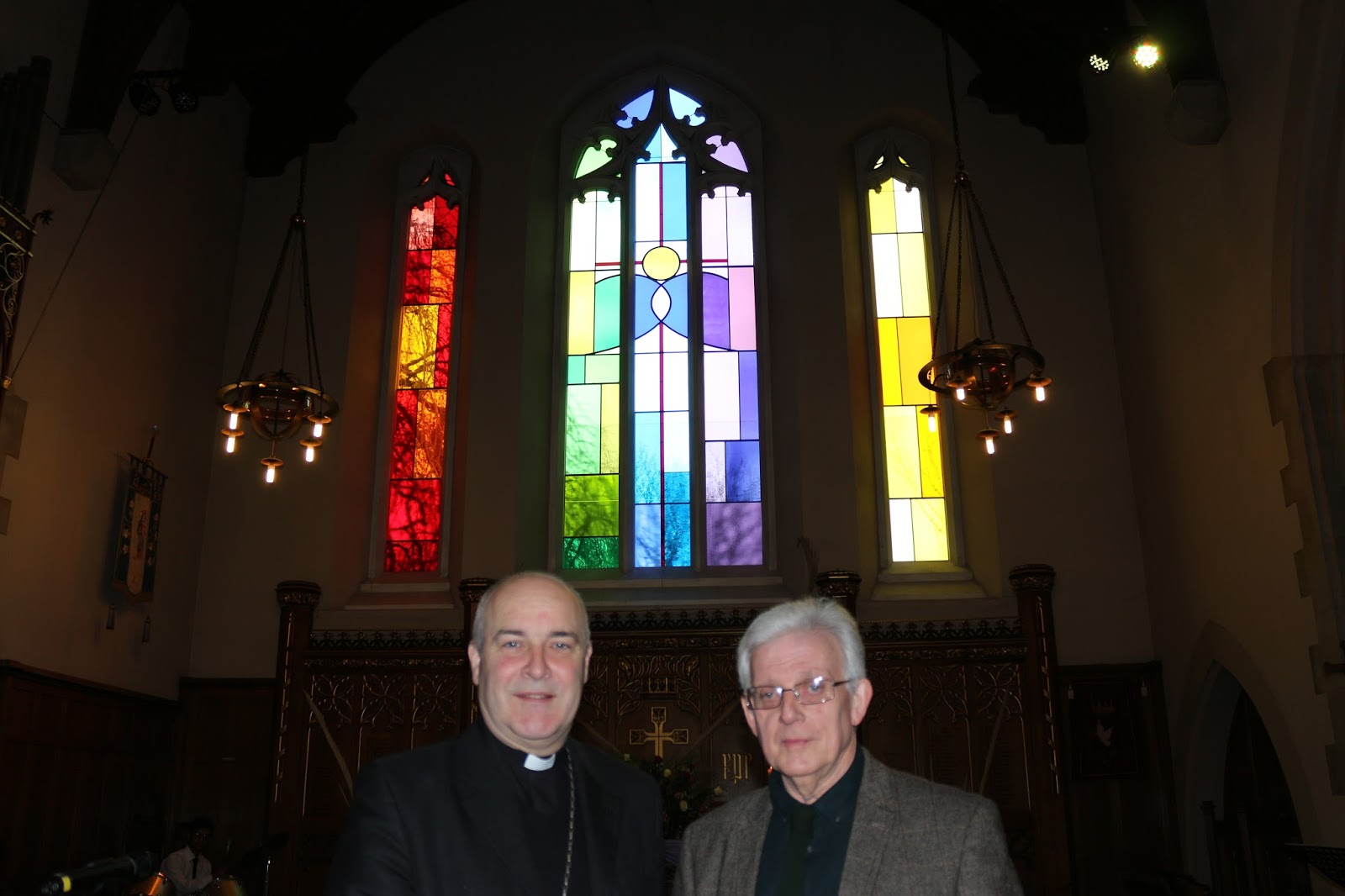
A service to commission and dedicate the newly installed “Trinity Window” as the East Window of All Saints Goodmayes, to commemorate a century of worship at the church, was held today. The Rt Revd Stephen Cottrell, the Bishop of Chelmsford, conducted the Service and dedicated the Centenary window.

Bishop Stephen said that it was lovely to be at All Saints Goodmayes for Palm Sunday and to dedicate their beautiful centenary window. He noted that the window encompasses all the colours of the liturgical seasons and reminds of God the Holy Trinity. He spoke of God's promise to open the window of heaven for us and led the congregation in praying that as the light shines through the many colours of the window, so our lives may show forth the beauty of God's manifold gifts of grace.

Bishop Stephen is a patron of commission4mission and the Trinity window at All Saints Goodmayes is the 13th commission completed by the group. The window was made and installed by Richard Paton to a design by Henry Shelton. Richard and Henry have previously worked together on commission4mission commissions at All Saints Hutton where they created two sets of etched glass windows.

Henry’s colourful abstract design for the three light East window features, in his inimitable minimal style, imagery representing the Holy Trinity. Henry is a member of the congregation and previously created etched glass windows for the Reindorp Chapel at All Saints.

The window commemorates the 100th Anniversary of the church and has been funded, in part, by donations from the congregation in memory of loved ones.

Richard Paton says: “The last few weeks has seen the making and fitting of a new East Window at All Saints Church, Goodmayes celebrating the church’s Centenary. This very colourful design by Henry Shelton symbolises the Holy Trinity depicted in just 3 lines. The space inside has been transformed from anonymous small square glass making a large space more intimate and warm.”

Richard Paton has over 20 years experience working with glass. When he is not creating works of art in glass, he teaches glass-making classes in the various techniques, passing on his tips, tricks and considerable knowledge to others. Also in 2015, using Craigie Aitchison’s final design, he made a window for the Prayer Chapel in St Martins in the Bull Ring and a 3 meter high stained glass window set into a light box hung on the wall of a North London Synagogue depicting an 11th Century poem visualised in a design by Michael Hall.

Richard graduated from Liverpool with a BA (Hons) in Fine Art in 1990 and was awarded an MA in Visual Culture at Middlesex University in 1998. He is a self-taught stained glass artist with 20 years in the trade who started Rainbow Glass Studios, based in Stoke Newington, North London, in 2001. In that time Richard has had hundreds of commissions which have required different techniques and designs to fulfil very diverse briefs. These range from corporate work to individual commissions from the rich and famous through to work in churches. The variety of glass techniques at his disposal uniquely puts him at an advantage to explore interesting and original work. He teaches regularly at his studio on weekday evenings and runs Saturday workshops for beginners. His work has been featured on TV and at the National Gallery. He is also on the committee for the Contemporary Glass Society who promote the work of glass artists.

Henry Shelton is a noted painter of religious art in a contemporary style. He trained as an apprentice draughtsman in a London studio developing his drawing skills in lettering and fine art. After 15 years he set up his own studio receiving many commissions from such clients as the Science Museum, borough councils, private and corporate bodies. He then worked designing in studios across the world, including Hong Kong and the USA.

Throughout this time and up to the present he has painted Christian art and his commissions include an Ascension installed as an altarpiece in the Church of the Saviour, Chell Heath; the Millennium clock tower in Goodmayes, and the memorial etched-glass windows in All Saints Church, Goodmayes, depicting events in the life of Jesus. In 2007 he had a one-man exhibition in York Minister of the Stations of the Cross. Most recently, he has completed commissions for St Luke’s Chapel in Queens Hospital Romford, a contemporary set of Stations of the Crown of Thorns for St Paul’s Goodmayes and etched glass windows for All Saints Hutton.

------------------------------------------------------------------------------------------

Tim Hughes - Here I Am To Worship.

Thursday, 31 December 2015

commission4mission's latest commission - East window, All Saints Goodmayes


commission4mission recently completed its 13th commission, an East window at All Saints Goodmayes created by Henry Shelton and Richard Paton. The window will be dedicated in 2016 by our patron The Rt Revd Stephen Cottrell, Bishop of Chelmsford.

The window was made and installed by Richard Paton to a design by Henry Shelton. Richard and Henry have previously worked together on commission4mission commissions at All Saints Hutton where they created two sets of etched glass windows.Henry’s colourful abstract design for the three light East window features, in his inimitable minimal style, imagery representing the Holy Trinity. Henry is a member of the congregation and previously created etched glass windows for the Reindorp Chapel at All Saints.

The window commemorates the 100th Anniversary of the church and has been funded, in part, by donations from the congregation in memory of loved ones.

Richard Paton says: “The last few weeks has seen the making and fitting of a new East Window at All Saints Church, Goodmayes celebrating the church’s Centenary. This very colourful design by Henry Shelton symbolises the Holy Trinity (God the Father, Jesus & the Holy Ghost) depicted in just 3 lines. The space inside has been transformed from anonymous small square glass making a large space more intimate and warm.”


Richard Paton has over 20 years experience working with glass. When he is not creating works of art in glass, he teaches glass-making classes in the various techniques, passing on his tips, tricks and considerable knowledge to others. Also in 2015, using Craigie Aitchison’s final design, he made a window for the Prayer Chapel in St Martins in the Bull Ring and a 3 meter high stained glass window set into a light box hung on the wall of a North London Synagogue depicting an 11th Century poem visualised in a design by Michael Hall.

Richard graduated from Liverpool with a BA (Hons) in Fine Art in 1990 and was awarded an MA in Visual Culture at Middlesex University in 1998. He is a self-taught stained glass artist with 20 years in the trade who started Rainbow Glass Studios, based in Stoke Newington, North London, in 2001. In that time Richard has had hundreds of commissions which have required different techniques and designs to fulfil very diverse briefs. These range from corporate work to individual commissions from the rich and famous through to work in churches. The variety of glass techniques at his disposal uniquely puts him at an advantage to explore interesting and original work. He teaches regularly at his studio on weekday evenings and runs Saturday workshops for beginners. His work has been featured on TV and at the National Gallery. He is also on the committee for the Contemporary Glass Society who promote the work of glass artists.


Henry Shelton is a noted painter of religious art in a contemporary style. He trained as an apprentice draughtsman in a London studio developing his drawing skills in lettering and fine art. After 15 years he set up his own studio receiving many commissions from such clients as the Science Museum, borough councils, private and corporate bodies. He then worked designing in studios across the world, including Hong Kong and the USA.

Throughout this time and up to the present he has painted Christian art and his commissions include an Ascension installed as an altarpiece in the Church of the Saviour, Chell Heath; the Millennium clock tower in Goodmayes, and the memorial etched-glass windows in All Saints Church, Goodmayes, depicting events in the life of Jesus. In 2007 he had a one-man exhibition in York Minister of the Stations of the Cross. Most recently, he has completed commissions for St Luke’s Chapel in Queens Hospital Romford, a contemporary set of Stations of the Crown of Thorns for St Paul’s Goodmayes and etched glass windows for All Saints Hutton.

-----------------------------------------------------------------------------------------

Moby - Almost Home.

Friday, 15 May 2015

Barking Episcopal Area Art Trail

To understand why an Art Trail like the Barking Episcopal Area Art Trail is needed it is necessary to know some of the background to the relationship between Christianity and the Arts in the 20th century.

After classical antiquity, ‘Christianity became the predominant power shaping European culture between the 13th and 19th centuries. Biblical texts, commentaries, and apocryphal stories inspired artists and patrons alike to create these objects of devotion ...’ and ‘to evoke the nature of ... sacred mysteries in visual terms.’

‘Artists and their advisors were faced with the challenge of suggesting, in visual terms, the nature of Christian mysteries – such as the visions experienced, or miracles performed, by the saints – as well as other profound theological beliefs and debates.‘

However, by the time Impressionism initiated modern art, art had already freed itself in many ways from the patronage of the Church and, as form not content became the primary focus of modernism, the developments of modern art led to an increasingly strained relationship between the Church and the visual arts.

Andrew Spira, writing in The Avant-Garde Icon, notes that ‘Avant-garde artists were passionate and vociferous in their denunciation of the credulity, passivity, manipulation and conservatism of conventional religiosity.’

Mark C. Taylor has noted that ‘the development of modern art follows an "inexorable logic" that leads from figuration and ornamentation to abstraction and formalism. The process of abstraction reaches closure when the work of art becomes totally self-reflexive and transparently self-referential ... Painting that is essentially about painting seems to leave little room for religious and spiritual concerns.’

Additionally, as Dan Fox has stated in frieze, ‘For most of the 20th century, art aligned itself with progressive rationalist secularity and radical subjectivity; the ideas that have fed into art come from modern philosophy, liberal or radical politics, sociology and pop culture rather than theology.’

Fox also writes that ‘It’s also a question of finance: the money that funds art doesn’t come from churches or religious orders like it did hundreds of years ago.’

Anselm Franke, head of visual arts and film at the Haus der Kulturen der Welt in Berlin, sums the situation up by saying that: ‘The historical break with religion continues. We would not think of hanging something that someone prays to in a museum ... Faith is incompatible with art end even destroys the sovereignty of art and the kinds of experiences we are looking for when we frequent art spaces.'

As a result, Dan Fox states, ‘contemporary artists who openly declare affiliation to Judaeo-Christian or Islamic religions are usually regarded with the kind of suspicion reserved for Mormon polygamists and celebrity Scientologists.’

Modern art looked, sounded and felt very different from the art that had traditionally been made for the Church, meaning that the Church avoided using modern art while many modern artists were excitedly exploring new ways of creating art and couldn’t see any connection between what they were doing and the styles of art which the Church continued to use. As a result, there was a whole segment of society – artists and art lovers – that were not being impacted by Christianity.

The Church has often not valued sufficiently the artworks it has commissioned; at times their significance has not been understood or shared, at other times the works have been controversial and may have been banned or not publicized as a result. Often the artworks have been regarded as subsidiary to the liturgy and have not been publicized in order that the focus of the faithful would not be deflected. ‘Christian Art’ has become a contested term and the Church has been unsure whether to continue to use it and, if not, how else to speak of its commissions. There has also been significant debate about the relative values of commissioning artists who are Christians and contemporary ‘masters’ who may not be Christians.

The Rt Revd David Hawkins, former Bishop of Barking and Patron of commission4mission, has said that, ‘There is a great need for the Church to re‐engage with the visual Arts. The Church has enjoyed a long and happy marriage with art in the past but in recent centuries has suffered something of a separation.’

Despite this sense of conflict and separation, there is a more positive story to tell of engagement between Christianity and the Arts. There has been a continuing engagement by the Church with contemporary art from the Post-Impressionists to the present day. This engagement has often been contentious and contested but it has nevertheless been a continuing relationship involving both mainstream artists with a Christian faith and church commissions undertaken by mainstream artists who have not professed the faith.

Mark C. Taylor insists that, ‘One of the most puzzling paradoxes of twentieth-century cultural interpretation is that, while theologians, philosophers of religion, and art critics deny or surpress the religious significance of the visual arts, many of the leading modern artists insist that their work cannot be understood apart from religious questions and spiritual issues.’

Benedict Read in his 1998 lecture to the Royal Society of British Sculptors noted that following the Second World War: ‘Churches were being repaired. New work was being installed in them. There was an expansion of church buildings with works of art in them … There is an alternative world there of the commissioning of art for specific purposes that, with no disrespect to established art historians, simply doesn't feature in our notion of cultural history in the post-war period.’

Read was speaking of the UK but a similar situation occurred in mainland Europe and in both settings, while the church building programme has slowed somewhat, the commissioning of contemporary art has not, meaning we have and are witnessing something of a renaissance of commissioned art for churches and cathedrals.

Key figures in initiating and then sustaining aspects of this renaissance in its initial phases included the artists Maurice Denis and Albert Gleizes, the philosopher Jacques Maritain, and the churchmen Bishop George Bell, Dominican Friar’s Couturier and Régamey, and Canon Walter Hussey.

Commission, a relatively recent exhibition at the Wallspace Gallery, and the Art + Christianity Enquiry monograph Contemporary Art in British Churches brought that story up-to-date. Artists featured in Commission included Tracey Emin, Henry Moore, Craigie Aitchison, Mark Cazalet, Stephen Cox, Chris Gollon, Shirazeh Houshiary, Iain McKillop, Rona Smith and Alison Watt.

The central argument of Contemporary Art in British Churches is that we are witnessing something of a renaissance of commissioned art for churches and cathedrals in this country. Paul Bayley argues that this upsurge of commissioning from the church sees many significant contemporary artists, such as those featured in Commission, creating art for church spaces. The approach underpinning this upsurge is synonymous with that of Bell and Hussey, Couturier and Régamey, who argued that ‘each generation must appeal to the masters of living art, and today those masters come first from secular art.’

The aim of the Art Trail is to raise awareness of the rich and diverse range of modern and contemporary arts and crafts from the last 100 years which can be found within churches and, in particular, the 36 churches featured on this Trail. The significant works of art in these churches, taken collectively, represent a major contribution to the legacy of the church as an important commissioner of art.

These include past contributions by significant artists such as Eric Gill, Hans Feibusch, John Hutton and John Piper. In recent years, churches have continued to commission work by many important artists such as Mark Cazalet, Jane Quail and Henry Shelton together with other emerging artists who are now coming to prominence.

Work on the Art Trail was initiated by commission4mission, an arts organisation encouraging churches to commission contemporary art, with the hope of increasing interest and stimulating engagement with the visual arts in the service of contemporary Christian faith.

The visual arts can contribute to the mission of the church by speaking eloquently of the Christian faith; providing a reason for people to visit a church; making a link between churches and local organisations and providing a focus around which local people can come together for a shared activity.

A leaflet documenting the Art Trail, which was researched and developed by commission4mission member, artist and Fine Arts lecturer, Mark Lewis, publicises the Trail and provides information about the featured artists and churches. The leaflet includes a map showing the churches featured on the Trail together with contact details, so that visits to one or more churches can be planned in advance.

Mark Lewis’ brief was to research commissioned art and craft in the Episcopal Area from the past 100 years. While stained glass is the dominant Ecclesiastical art form, he was also concerned to show a diversity and variety of media and styles within the selections made. He highlighted works such as the significant mosaic by John Piper at St Paul’s Harlow and the striking ‘Spencer-esque’ mural byFyffe Christie at St Margaret’s Standford Rivers. Churches with particularly fine collections of artworks included: St Albans, Romford; St Andrew’s Leytonstone; St Barnabas Walthamstow; St Margaret’s Barking; St Mary’s South Woodford;; and, the church chosen as the location for the launch event, St Paul’s Goodmayes.

The Trail was launched at St Pauls Goodmayes on Thursday 17th February by the Bishops of Chelmsford and Barking. At the launch event, The Rt. Revd. Stephen Cottrell, Bishop of Chelmsford, said: “I do not know what other art form could convey and hold the possibility of converging in so many layers. Not just do the visual arts comment on biblical narrative, but they illuminate it in a way that written or spoken forms cannot, being linear forms. Art opens windows on a set of concepts and ideas and brings them together. These windows offer a fresh perspective onto the faith we share, that other forms simply cannot.”

The Bishop of Barking stated that: “Our inspiration for understanding Christianity comes from the visual arts … The visual arts continue to be an important way of communicating our faith. Words are not enough to express the breadth, depth and height of what we want to communicate. It’s then that the visual arts express what we want to communicate.

God knew that: for centuries he relied on the words of the prophets and then he realized that he needed to send his Son to communicate in ways that words could not, the breadth, depth and height of his love. The word became flesh: the most beautiful living sculpture ever created – Jesus Christ.”

The Barking Episcopal Area Art Trail has inspired at least two similar initiatives. The Revd David New has created a leaflet as a guide to stained glass windows created by Thomas Denny for churches in the Three-Choirs area (Gloucester, Hereford and Worcester Dioceses).

David writes that: "Thomas Denny, born in London, trained in drawing and painting at Edinburgh College of Art. One day a friend asked him to consider creating a stained glass window for a church in Scotland (Killearn 1983). Thus began a remarkable career that has produced over 30 stained glass windows in Cathedrals and Churches of this country. Tom’s love for painting and drawing, especially the things of nature, is evident in his windows ... All of Tom’s windows express biblical themes and are conducive to silent meditation. Find a seat; feel the colours; give time for the details to emerge; reflect."

In addition, and also inspired by the Barking Episcopal Area Art Trail, Beat Rink is organizing an Art & Church Trail in Lucerne, in the context of a Christian conference, at the end of this year. Church leaders in this beautiful city are very excited about the concept and are currently working to develop their plans.

The web page for the Art Trail on the website for the Chelmsford Diocese also features new and additional works which could not be included in the original Trail. This includes:
  • Altar frontal by Anne Creasey at Christ Church Thamesview, Bastable Avenue, Barking IG11 0NG. Contact: Gerry Williams. Tel: 07914 676079 (http://www.christchurch-thamesview.org.uk); 
  • Graffiti Love, a mosaic by Viki Isherwood Metzler, and a Trinity sculpture incorporating a mosaic by Sergiy Shkanov can be seen in the community garden at St John's Seven Kings, St John's Road, Ilford IG2 7BB. Contact Churchwardens. Tel: 020 8598 1536 (http://stjohns7kings.org.uk/);
  • Holy Water Stoup by Mark Lewis at St Margaret of Antioch, Perth Road/Balfour Road, Ilford IG1 4HZ. Contact: Fr. Stephen Pugh. Tel: 020 8554 7542 (http://www.stmargaretilford.org.uk);
  • Life of St Augustine, cast concrete achitectural frieze by Steven Sykes at Holy Trinity & St Augustine of Hippo, Leytonstone, 4 Holloway Road, Leytonstone Ell 4LD. Contact: Revd Ian Harker. Tel: 020 8539 6067 (http://www.trinityleytonstone.org/indexnext.htm);
  • Nativity reredos with cross and candlesticks by Francis Stephens (a pupil of Martin Travers) at the Church of the Holy Innocents, High Beach IG10 4BF. Contact: Revd. Gill Hopkins. Tel: 01992 760492. (http://www.highbeachchurch.org.uk/); 
  • People praising God and giving grace received to others, sculpted oak panels by Jane Quail at St Paul's East Ham, Burges Road, East Ham E6 2EU. Contact: Rev. Merrin Playle. Tel: 020 8472 5531 (http://www.achurchnearyou.com/east-ham-st-paul/);
  • Restoration, a wood engraving by Peter S. Smith (a member of the Society of Wood Engravers) commissioned by St John the Baptist Leytonstone in 2011 to celebrate the completion of restoration work at the church. Church Lane/High Road, Leytonstone. Contact: Churchwardens. Tel: 020 8257 2792 (http://www.stjohns-leytonstone.org.uk/);
  • Stained glass including a window designed by Edward Burne-Jones at Ilford Hospital Chapel, 48 Ilford Hill, Ilford IG1 2AT. Contact: Fr. Martin Hawse. Tel: 020 8590 2098 (http://www.ilfordhospitalchapel.co.uk);
  • The Good Samaritan, engraved window by John Hutton at St George's Barkingside, Woodford Avenue/Gants Hill Crescent, Barkingside IG2 6XQ. Contact: Revd Benjamin Wallis. Tel: 020 8550 4149 (http://stgeorge-barkingside.co.uk/); and
  • Graphic art and banners by Caroline Richardson at the Church of the Good Shepherd, Collier Row (http://www.thegoodshepherd.co.uk/).
All of which demonstrates that the Church is engaged with the visual Arts and that the long and happy marriage with art that the Church has enjoyed continues to this day.

-----------------------------------------------------------------------------------------------

U2 & BB King - When Love Comes To Town.