Wikio - Top Blogs - Religion and belief
Showing posts with label nationalism. Show all posts

Tuesday, 21 July 2020

Searching for a kingdom yet to come

Here's the reflection I shared during today's lunchtime Eucharist for St Martin-in-the-Fields:

Micah's prayer for or prophecy of restoration for the people of Israel is set in a context of societal breakdown (Micah 7.14-15, 18-20). The chapter is headed ‘The Total Corruption of the People’ and Micah says, ‘there is no one left who is upright; … Their hands are skilled to do evil; the official and the judge ask for a bribe, and the powerful dictate what they desire; thus they pervert justice.’

Our newspapers essentially make similar reports on a daily basis, when we hear of Government contracts made, without tender, to companies with contacts to those who award the contracts and when the President of the United States will not state that he will leave power were he to lose the coming election.

Micah sees a society in which no one does good and where every household is divided. He says, ‘Put no trust in a friend, have no confidence in a loved one; guard the doors of your mouth from her who lies in your embrace; for the son treats the father with contempt, the daughter rises up against her mother, the daughter-in-law against her mother-in-law; your enemies are members of your own household.’

However, it is at that time that he says God will rescue and restore his people in a way that will amaze the nations. The God who pardons iniquity, passing over transgression and casts all our sins into the depths of the sea because he delights in showing clemency, is the one who Shepherds the people, the flock belonging to him, letting them feed in as in the days of old.

Jesus came to be the shepherd and restorer for which Micah had prayed but did so in ways that weren't anticipated. Micah prayed for a God that would show faithfulness to Jacob and unswerving loyalty to Abraham, as had been sworn to their ancestors from the days of old. His prayer was for a God of nationalism who would ensure that the nations would see and be ashamed so that they would come trembling out of their fortresses and turn in dread to the Lord, Micah’s God.

It is claimed that whereas the 20th Century was defined by the struggle between Capitalism and Communism, the 21st Century is being defined by the struggle between Nationalism and Globalism. In the 2016 presidential election the United States abandoned globalism and embraced nationalism. The UK has also sprouted new nationalist roots with our withdrawal from the European Union. As countries have begun to align under this new world order, we note the extent to which Nationalism means doing what is seen to be in a country’s self-interest, not the world’s self-interest. We are in the same place that Micah sought, where other nations stand in dread of our nation.

Jesus’ movement, however, was built not on family, tribe and nation but on pilgrims and travellers. When Jesus is told that his mother and brothers are standing outside, wanting to speak to him, he asks “Who is my mother, and who are my brothers?” Then, pointing to his disciples, he says, “Here are my mother and my brothers! For whoever does the will of my Father in heaven is my brother and sister and mother.” (Matthew 12. 46-50)

He does so in order to make clear that the basic unit of a nation, the settled family, is not the basis for his movement. Instead, his movement looks back to an earlier stage in the story of Abraham. The basis for Jesus’ people was that of Abraham the migrant, the itinerant traveller, the one who moves from one country to another, who knows no border or nation. Those who form Jesus’ family are those who travel, not those who settle, those who constantly search for a kingdom yet to come, a kingdom with no boundaries embracing Jew and Gentile, male and female, slave and free.

Micah’s prophecy can be interpreted in this sense as he says that Israel’s boundary shall be far extended and that, in that day they will come from Assyria to Egypt, from Egypt to the River, from sea to sea and from mountain to mountain. This is the gathering of the nations in harmony and in unity for which we should unceasingly pray and which Micah’s prophecy suggests will begin to be realised at a time when society is corrupt and every household divided. As our society and world seems increasingly divided, let us pray all the more for God to rescue and restore in a way that will amaze the nations.

----------------------------------------------------------------------------------------------------

John Tavener - Fragments Of A Prayer.

Monday, 20 April 2020

Coming alive to the Spirit

Here's the reflection I shared during today's lunchtime Eucharist for St Martin-in-the-Fields:

Yesterday, in the Inspired to Follow group, we were looking at an early Florentine image of God as creator depicted as an elderly white man with a long beard, which led us into a discussion as whether God is more accurately depicted as abstract essence, rather than a person with a gender and ethnicity.

Those two strands of thought can also be found here, too, in the distinction Jesus makes between flesh and Spirit (John 3. 1-8). His description of Spirit as being like the wind makes it clear that he is making a distinction between what is tangible, visible and known – the flesh – and what is intangible, invisible and unknown – the Spirit. It is easy to hear that distinction being made and assume that Jesus is saying there is a dualistic division between flesh and Spirit and we have to choose one over the other. Many people in the history of the Church have made just that assumption.

Yet that is to forgot the way in which John’s Gospel begins; ‘In the beginning was the Word, and the Word was with God, and the Word was God … And the Word became flesh and lived among us, and we have seen his glory, the glory as of a father’s only son, full of grace and truth’ (John 1.1, 14), Through the incarnation of Jesus, flesh and Spirit are united and made one. Jesus came into the world to unify flesh and Spirit, to show that the human and the divine can be held together and combined in one; the divine can be human and the human divine.

God was revealed in our humanity in order that we recognise divinity – the image of God - within us. That is what we see here in the distinction between our first birth from our mothers’ womb through which we begin to have experience of the tangible, the visible and the known, and a second birth through water and the Spirit by means of which we begin to acknowledge and recognise our experience of the intangible, the invisible and the unknown. Both are life experiences; the first is immediately apparent to us through our physical birth; the second is an awareness that has to be awakened in us – an awakening that comes unpredictably in line with the unpredictable movements of the Spirit, which blows where it chooses.

The distinctions made by Jesus in the Gospel of John between flesh and Spirit, below and above, darkness and light etc can help, however, in understanding what it is in us that prevents our coming alive to the Spirit. Stephen Verney, in his wonderful commentary of John’s Gospel called ‘Water into Wine,’ say that, when he makes these distinctions, Jesus is speaking about two different levels or orders to reality. What he means by this are different patterns of society, each with a different centre or ruling power. In the first, ‘the ruling principle is the dictator ME, my ego-centric ego, and the pattern of society is people competing with, manipulating and trying to control each other.’ In the second, ‘the ruling principle is the Spirit of Love, and the pattern of society is one of compassion – people giving to each other what they really are, and accepting what others are, recognising their differences, and sharing their vulnerability.’

These two orders or patterns for society are at war with each other and we are caught up in the struggle that results. Choosing our side in this struggle is a key question for us as human beings, the question being ‘so urgent that our survival depends on finding the answer.’ Verney writes that: ‘we can see in our world order the terrible consequences of our ego-centricity. We have projected it into our institutions, where it has swollen up into a positive force of evil. We are all imprisoned together, in a system of competing nation states, on the edge of a catastrophe which could destroy all life on our planet.’ He was writing in the 1980s, but could have been describing today’s nationalism.

It is that ego-centricity and self-centredness which prevents us from coming alive to the Spirit. It is a pre-condition of coming alive to the Spirit that we look away from ourselves in order to see God and others. Beyond this, there is a degree of unpredictability in our awakening to the Spirit which means that we may only be able to tell our personal stories of coming alive to that which is invisible, intangible and beyond our comprehension.

Here is my personal story of resurrection in the form of a meditation. I wonder what features in your story?

When I stand in snow on a mountain slope viewing a cobalt lake,
I come alive.
When the morning mist forms a white sea on the Somerset levels, islanding trees,
I come alive.
When my daughter nestles up and hugs me tight,
I come alive.
When my wife and I lie, skin touching, sweat mingling in the heat of summer and passion,
I come alive.
When a friend listens with understanding and without advising,
I come alive.
When I sing and dance in the echoes of an empty Church,
I come alive.
When words cannot express Your praise and I sing in tongues,
I come alive.
When I hear the rustle of angel’s wings above me in the eaves,
I come alive.

I come alive to endurance
when I see a hesitant smile form on the face of the Big Issue seller.
I come alive to pain
when I hear a friend’s story of depression and unanswered pleading.
I come alive to patience
when I see a husband answer again the question from his alzheimered wife.
I come alive to injustice
when the Metro contrasts Big Mac obesity lawsuits with African famine victims.
I come alive to suffering
when I see Sutherland’s Crucifixion and read Endo’s Silence.
I come alive to grief
when I remember the aircraft shattered and scattered across Kosovan heights.

I come alive
when I am touched and see and hear
the beautiful or broken, the passionate or poor.
The mystery or madness
of the Other in which God
meets and greets me
and calls forth the response
that is love.

----------------------------------------------------------------------------------------------------

King's X - It's Love.

Thursday, 1 September 2016

Brussels: Parlamentarium & EU Parliament Building

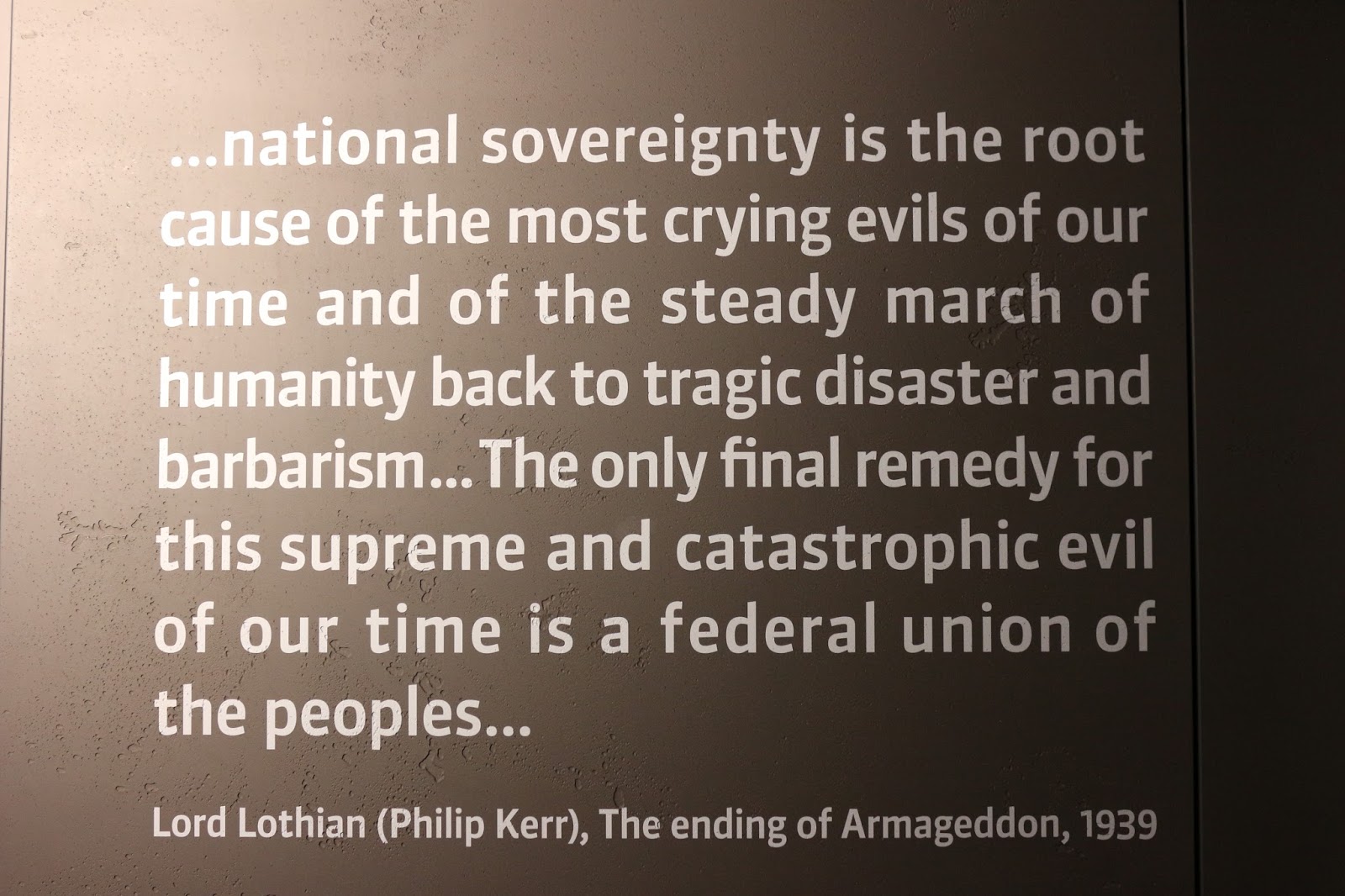
There are at least three great reasons for visiting Brussels at present. First, the city's cultural offer (more on that in a subsequent post). Second, support for its tourist trade following the airport bomb attack. Third, to show solidarity for the EU project in the light of the Brexit vote. In relation to the latter, these photographs from Parlamentarium, the European Parliament Visitors’ Centre, and of the European Parliament Building speak for themselves ...


-------------------------------------------------------------------------------------------

Kraftwerk - Trans Europa Express.