Wikio - Top Blogs - Religion and belief
Showing posts with label st teresa of avila. Show all posts

Sunday, 23 August 2020

Becoming the Body of Christ

Here's the sermon that I preached this morning at St Martin-in-the-Fields:

The challenges of the Covid-19 pandemic and the use of lockdowns to prevent its spread and impact have created a set of additional challenges and debates about doctrine and practice for the Church. This week our newsletter cover written by Susannah Woodd includes reflections on the opportunities and challenges of living as one church body, whether online or in person. This is at the heart of the challenges and debates within the Church, as they are about the extent to which virtual gatherings are either an opportunity for renewal or a fundamental change to central elements of being Church.

Some argue that Christianity is a material religion involving physical gatherings in particular buildings in order to physically eat bread and wine that has been consecrated in the time and place of that meeting. Where this is a key understanding people have sometimes protested at the closing of church buildings, undertaken a Eucharistic fast during lockdown, celebrated the reopening of their church buildings and pointed out that, because of the digital divide, there are many who cannot access virtual Church. Those who have seen lockdown as an opportunity for renewal have pointed out that many who, for a variety of reasons, cannot access physical services in physical buildings often can access virtual church. Some in this situation were already meeting in virtual churches before lockdown began but had been overlooked and ignored. Additionally, they have argued that because we cannot share physical bread and wine together in virtual churches, the wider purpose of our gathering – being formed into the Body of Christ in order to be the hands and feet of Christ in the world – has become more apparent to us.

The letter that St Paul sent to Christians in Rome was sent at a time that has some parallels to our own situation today. Those to whom he was writing would have experienced restrictions on their movements. The Jews among them had been expelled from Rome towards the end of Claudius’ reign as Emperor and would only recently have returned. Paul, although he wished to visit Rome, was unable to do so and could only share remotely by letter with the Christians there, most of whom he had not met. When he did get to Rome later, it was not because he had travelled there freely but because he had been arrested and sent for trial. He was also writing to people without church buildings, who were meeting and celebrating the Lord’s Supper in their homes.

Although Paul longed to meet with the Christians in Rome but was unable to do so, the technologies of his time did allow him to share with them and he used those technologies to do so. The early Church also realised that the benefit gained by hearing the stories of Jesus told by those who met him, could be expanded and shared if those stories were written down and shared. The experiences of hearing testimony in person and hearing letters or stories read were different and the way in which gathering of Christians were held changed as a result. Yet, we would not have known of Christ had those changes not been made. It’s potentially no different today, in relation to our use of new technologies.

The beginning of Romans 12 (verses 1—8 ) is the part of his letter where Paul writes about worship and what is interesting is that he doesn’t focus on their gatherings (what we might call services), instead he focuses on their service (by which he means their day-by-day living out of their faith). He does so by writing about bodies and minds, Christians and churches.

He begins with our bodies which are to be offered to God. This is about the ongoing, day-by-day offering of the whole of our lives to God. Eugene Peterson in ‘The Message’, his paraphrase of the Bible, describes this as ‘your everyday, ordinary life—your sleeping, eating, going-to-work, and walking-around life.’ We are called to live for God in all these aspects of life, 24-7, Monday to Sunday.

Doing so, is what Paul calls our worship and our service. So, worship is not described here in terms of a once a week gathering in whatever platform that takes place – actual or virtual – nor is it described in terms of daily gatherings or services. Instead it is described in terms of what results from those gatherings. That is, the Christian faith lived out in practice within our day-to-day lives. Were we to read further in this chapter, we would see Paul describing what that life looks like in practice; blessing those who persecute you, rejoicing with those who rejoice, weeping with those who weep, living in harmony with one another, and much more.

Paul describes this in terms of the central act of gathering for worship in the Jewish faith at that time; sacrifice. He says that to live in this way is to be a sacrifice. In doing so he changes the understanding people had about sacrifice. Throughout Jewish history up until this point sacrifice had meant dying. Animals were slaughtered and blood shed as the means of giving thanks for blessing and to atone for wrongdoing. Paul, by contrast, talks about being a living sacrifice. He does so, because Jesus had already become the ultimate sacrifice; a sacrifice that does not need to be repeated. As a result, a different understanding of sacrifice was required. The Lord’s Supper – the remembering, celebrating and then taking of Christ’s body and blood into ourselves – is about forming those who gather into a body that takes Christ to others in the way that he came to us. That is to embody faith, hope and love by being with others and bearing their burdens by making their concerns ours.

Paul is saying that to be with others and to wash their feet, as Christ did, is now worship, service and sacrifice; all in one. He sees our gathering together as resourcing this in two ways. First, in order to offer our bodies in this way, our minds must be renewed, and our gatherings provide a context in which that renewal can begin. Second, we need to identify our gifting or contribution or place within the body of Christ. The part that we, as individual Christians, have to play in this moment can only be found and followed together, in the community of the Church.

As human beings we are as likely to: build walls that shut some out as bridges that bring people together; gather in tribes, races and nations in order to protect ourselves against others as to gather as rainbow peoples, inclusive and diverse; and create laws and regulations making some pure and other impure as to eradicate notions of purity and impurity. As a result, we need renewal of our thinking to more fully and more consistently model Jesus’ radical welcome of all by being with all. Our gatherings, where we retell and re-enact the stories of Jesus, are where this renewal of our minds and thinking can begin and where we can be both encouraged and challenged along the way.

Jesus embodied – lived out – radical welcome. It is not enough to talk about, discuss or debate, radical welcome; to be real, to be experienced, understood and received by others, it has to be lived. As Jesus is now with us virtually, through his Spirit, it is in our coming together as those who follow in his footsteps that he is embodied in our day and time, in the here and now. As Teresa of Avila said, it is we who are his hands and feet, his eyes and ears, within our world. Christ has no body now, unless we form that body.

His body though, is always corporate. None of us, by ourselves, can fully embody Christ and, therefore, Paul says that each of us needs to identify our role or gifting within the Body of Christ; the part that only we can play in a particular moment and time. This identification cannot be done in isolation but must come with an understanding of the ways in which the organisation of our gatherings may empower some and disempower others. In our community here, we have seen the way in which interacting virtually has enabled some of our number to share their gifts and take their place more fully because aspects of our physical gathering – like crowds or noise – that had previously restricted involvement or engagement were removed during lockdown.

The depth of our welcome and inclusion is measured by the extent of our understanding of those who are most on the edge. The way Paul described this in writing about the Body of Christ to the church in Corinth was, using Eugene Peterson’s paraphrase again: ‘God designed our bodies as a model for understanding our lives together as a church: every part dependent on every other part, the parts we mention and the parts we don’t, the parts we see and the parts we don’t. If one part hurts, every other part is involved in the hurt, and in the healing. If one part flourishes, every other part enters into the exuberance.’

So where does all this leave us in relation to our current debates about the relative virtues of actual and virtual church? The places and ways in which we gather – whether actual or virtual - enable some to be included, while excluding others. In both settings we need to be more aware of those who are excluded, than those that are included. As Paul wrote about the different parts of the Body, the members of the body that are least noticed are those who are indispensable, and those least mentioned are to be treated with greatest respect.

Our worship and service is not so much about our times of gathering together but about our actions when we are not together. Our debates about actual and virtual gatherings will become more focused and more useful, the more they focus on the ways these gatherings form and fashion us to be the Body of Christ when we are not together but are still one Body. Our ability to be the Body of Christ in our generation, and at such a time as this, will only be realised as we prioritise our embodying of Christ over the varying and various ways in which we gather as Christians. As Susannah wrote living as one church body means continuing to rejoice in hope, being patient in suffering, and persevering in prayer together.

And where does it leave us in relation to our gathering today? The question for us today is, what offering of ourselves will we bring? Something we are laying down or something we are taking up? I appeal to you therefore, brothers and sisters, by the mercies of God, to present your bodies as a living sacrifice, holy and acceptable to God, which is your spiritual worship. Do not be conformed to this world, but be transformed by the renewing of your minds. Amen.

----------------------------------------------------------------------------------------------------

Thursday, 7 May 2020

Little Christs or just Christ-like?

Here's my reflection from today's lunchtime Eucharist for St Martin-in-the-Fields:

There is a fascinating debate in church circles about whether the term ‘Christians’ means ‘little Christs’ or not. It’s not a recent debate but is ongoing and reveals much about the presuppositions and underlying theology of those engaged in debate.

‘Christian’ was originally a term of derision towards those who followed Christ and, most probably, meant slave of Christ rather than child of Christ, which is the understanding from which the term ‘little Christs’ derives. It’s a debate that can seem rather pedantic as, in the Gospels and Epistles, we find Christ’s followers described as slaves, servants, children, brothers and sisters, friends, and heirs of Christ. No one image, name or phrase is actually sufficient to describe the relationship we have to Jesus.

Nevertheless, the idea that, as his followers, we are to become Christ-like or like Christ is calling that is clear in Jesus’ teaching and in the Epistles; regardless of whether the term ‘Christians’ means ‘little Christs’ or not. We see that idea throughout this passage (John 13.16–20).

The passage uses the imagery of servants and masters - I tell you, servants are not greater than their master – to say that servants do what their master asks of you. So, ‘If you know these things, you are blessed if you do them.’ As a result, whoever receives one sent by Jesus, receives Jesus (and thereby receives God). When we follow Christ, we are Christ-like in that we do the things that God asks us to do and in that we are his representative to others.

What is it that he asks of us? That is very simple. He speaks often of his commandments. The greatest commandment, he tells us, is to love the Lord your God with all your heart, and with all your soul, and with all your mind and to love your neighbour as yourself. Later, in his farewell discourse (of which today’s Gospel is a part), he says: ‘This is my commandment, that you love one another as I have loved you. No one has greater love than this, to lay down one’s life for one’s friends. You are my friends if you do what I command you. I do not call you servants any longer, because the servant does not know what the master is doing; but I have called you friends, because I have made known to you everything that I have heard from my Father.’

So, Christ’s commandment is simply that we love; love God, love others and love ourselves. He calls us servants here to place emphasis on his followers obeying this one simple commandment, but explains later that to do so makes us his friends, rather than his servants. So, we are like Christ, as servants, followers and, most of all, friends, when we love.

The second aspect of our Christlikeness in this passage is our representational role, so that whoever receives one whom sent by Christ, receives Christ himself. This was the great revelation that St Teresa of Avila received and which she shared so compellingly:

Christ has no body but yours,
No hands, no feet on earth but yours,
Yours are the eyes with which he looks
Compassion on this world,
Yours are the feet with which he walks to do good,
Yours are the hands, with which he blesses all the world.
Yours are the hands, yours are the feet,
Yours are the eyes, you are his body.
Christ has no body now but yours,
No hands, no feet on earth but yours,
Yours are the eyes with which he looks
compassion on this world.
Christ has no body now on earth but yours.

Learning to live St. Teresa’s prayer means looking for opportunities to bring God’s love to others, including small acts of compassion in our daily lives. Praying St. Teresa’s prayer can make us more aware of God’s compassion toward people we encounter each day. We can feel closer to God because we’re learning to see others through his eyes. Every day, we are challenged to look for opportunities to use our hands, feet, and whole body to show God’s love to everyone.

We do this, not so much by doing the exact same things that Jesus, but more by improvising in his Spirit. Jesus said in his farewell discourse that those who follow him will do greater things than him. This doesn’t mean great in terms of importance, it means great in terms of range and diversity. We can show love in ways that Jesus couldn’t as one man in the culture and country of his day. He also spoke in these farewell discourses of sending his Spirit to lead and guide us. His Spirit in us animates and inspires to learn from Jesus how to act toward those around us in his Spirit of love. So, inspired by his Spirit, we are Christ-like towards others when we relate to them in acts of improvised love. That is our calling as Christians, which makes us Christ-like, whether or not the name actually means ‘little Christs’.

Intercessions

God who hears the cries of your people, tune our ears to hear the cries of distress within your world. May our responses to individuals, organisations, governments and nations enable resources to be mobilised quickly and effectively to go where they are most urgently needed, to support the good administration and execution of response efforts worldwide and the curbing of misinformation that fear may take no hold in hearts and minds. We pray that the media may hear those suffering and give a voice to the voiceless, enabling people on the margins of our society – particularly those who are homeless and refugees - to be noticed and heard. We ask that they may hear and highlight unjust practices, investigating how people and organisations can take advantage of others away from public view. Bless all who craft words, sounds and images to promote justice, defend dignity, and celebrate beauty and truth as parts of your eternal creative process. Lord, in your mercy, hear our prayer.

God who sees all, numbering even the hairs on our heads, sharpen our eyes that we may see those in need and also the beauty and opportunity hidden in this season. Meet us in this season of fear, bewilderment, and loss. When our efforts seem tiny, show us the thousands who care about what we care about; when our skills seem insufficient, reveal to us the many who seek the same goal. Lift our gaze from what we miserably don’t have to what we wonderfully are, that in joy and wonder at your glory we may turn from emptiness and find fullness of life. We pray particularly for Christian Aid bringing awareness of need around our world that there might be abundant life for all. Inspire us with the vision of poverty over, and give us the faith, courage and will to make it happen. Lord, in your mercy, hear our prayer.

God who walked the length and breadth of Palestine to reveal the coming kingdom of heaven, bless all those travelling at this time to bring essential supplies of any kind to those in need. Support, strengthen, encourage, protect and enable those who are key workers at this time. We give thanks too for those using their daily walks to bring films of meditation in nature to those who are quarantined. Bless to us their reflections and the beauty that their films reveal. Lord, in your mercy, hear our prayer.

God, who holds the whole world in your hands, we pray for all those caring for others. Open the hearts of all to feel your compassion. Galvanize in us the act of continued giving. Bond us to our sisters and brothers in need. Comfort and heal the unwell, the bereaved, the lost. Strengthen the medical personnel and researchers. Bolster the resolve of governments and those with power to help. Open through this pandemic pathways to global partnerships and peace. Lord, in your mercy, hear our prayer.

Teach us, Lord, that every human being is made in your image and to respect people’s dignity; Teach us to listen to those who only have a whisper, a breath, and protect us from those who try to control our thoughts and speech; Teach us to see, feel, taste, and smell the injustices in this world and protect us from cynicism, sensationalism, and lies; Teach us to uncover the beauty of the hope, love, and renewal that blossom in the debris of conflict, greed and exploitation; Teach us to share the stories of those who gave us the privilege of becoming part of their lives; Teach us to turn our weapons of word and image into the ploughshares of peace and reconciliation. Lord, in your mercy, hear our prayer.

-------------------------------------------------------------------------------------------------

Emmylou Harris - Every Grain Of Sand.

Sunday, 24 December 2017

The Word himself was waiting on her word

Here is my sermon for the 10.00am Eucharist at St Martin-in-the-Fields this morning:

My grandson Joshua is two today. It is fascinating being part of the growth and development of a young child, particularly as a grandparent when you can remember what happened with your own children and also see the way in which, in this case, my daughter and son-in-law approach their role as parents. For several months now Joshua has been able to say ‘no’, often repeatedly and with much shaking of his head. He cannot yet say ‘yes’. Both are words of one syllable which one would expect that a child should find easy to learn, yet one is learnt early and the other much later. It may be, of course, that he has heard the word ‘no’ being said to him much more than he has yet heard the word ‘yes’!

‘Here am I, the servant of the Lord,’ said Mary, ‘let it be with me according to your word.’ Mary said ‘Yes’ to God. As we have already begun to reflect, there is much more to saying that simple one syllable word ‘yes’ than we might at first imagine.

The poet-priest Malcolm Guite describes the Annunciation as follows:

‘a young girl stopped to see
With open eyes and heart. She heard the voice;
The promise of His glory yet to be,
As time stood still for her to make a choice;
Gabriel knelt and not a feather stirred,
The Word himself was waiting on her word.’

Victoria Emily Jones has reflected that ‘When Gabriel came to Mary to tell her she would bear a son, she was at first troubled, afraid, guarded. How was it possible that she, being a virgin, could become pregnant? But with the angel’s words of reassurance and promise, she yielded to the divine plan …” This is known as Mary’s fiat (Latin for “let it be”)—her consent to become the mother of God—and it’s celebrated by the church as the moment at which God became flesh, setting salvation in motion.

Theologians have debated the nature of Mary’s fiat—whether she really had a choice in the matter. After all, Gabriel comes speaking in terms of what will happen, without mentioning any conditions. However, most believe in the criticality of Mary’s “yes,” of her willing bodily and spiritual surrender. Between the angel’s ‘Hail’ and Mary’s ‘Let it be’ was a moment of supreme tension, one that Luci Shaw explores in her poem ‘The Annunciatory Angel’:

‘… We worry that she might faint.
Weep. Turn away, perplexed and fearful
about opening herself. Refuse to let the wind
fill her, to buffet its nine-month seed into her earth.
She is so small and intact. Turmoil will wrench her.
She might say no.’’

Why might Mary have said ‘No’? In the same poem Luci Shaw suggests there was a ‘weight of apprehension’ at the Annunciation because what had to be announced would ‘not be entirely easy news.’ As a result, Alan Stewart, in an Annunciation monologue, has Mary say ‘I said yes to my God / And I have come to question those words / For I did not know where they would lead.’ Where they led was to an immediate future of gossip, rumours and insult from those who thought of Jesus as illegitimate and in the longer term to a life of gathering gloom, ultimately one of sorrowing and sighing before a stone-cold tomb after the experience of viewing her son’s torture and cruel death; which was like a sword piercing her heart.

And yet, although she did not know it and could not have articulated it, there is a sense that she accepted all this when she accepted the challenge that the angel Gabriel brought from God. It may also have been that for having Jesus as her son she was, like many parents, more than glad that she had said yes, accepting the trauma, the gossip, the exile, the insults that she might bear her child, the promised Saviour.

Mary could have said ‘No’ but her ‘Yes’ was a ‘Yes’ to new life, to growth, to new birth. Matthew Askey says that: ‘Mary ultimately said ‘yes!’ to life, and gave herself into the hands of God’s love, and this was something that resulted in the life of the most inspiring person who has ever lived, Jesus, and then the birth of the world-wide Church that followed. The Incarnation was predicated on the willingness of the teenage Mary to respond to God’s call.’ So, the Annunciation is the moment when the creator of everything finds a way into flesh and blood. And in doing that, the meaning of all life enters into full humanity.

That is what we celebrate at Christmas and continue to experience as we say ‘Yes’ to God, as ‘the meaning of life enters humanity still. The meaning of life desires us. Watches our movements and listens to our hopes. The meaning of life is a lover whose gentle fingers occasionally touch and startle us, asking if we can love back, but never using force on us ... waiting to be invited to love. The meaning of life is love. Something intangible by nature. Something that cannot be possessed, bought, or sold.

And at Christmas we celebrate the fact that God, the source of all love and meaning, has so desired humanity that He has taken the risk of becoming vulnerable to what we might do if His life is left in our hands. God, the meaning of life, desires you and me in a way that one of us would desire our partner.’ (The Late, Late Service)

The poet Noel Rowe captures something of this in his Annunciation poem when he writes:

‘The angel did not draw attention to himself.
He came in. So quietly I could hear
my blood beating on the shore of absolute
beauty …

my heart, my heart, was wanting him,
reaching out, and taking hold of smooth-muscled fire.
And it was done.’

He says, ‘I used a slightly eroticised image not to suggest their encounter was sexual, but to reimagine spirituality as passionate and creative, a poetic of desire.’ This has been the experience of Christian mystics throughout Church history; God as the incomprehensible mystery that embraces everything making the goal of human life that of losing oneself in this divine mystery in love. As Karl Rahner wrote: ‘When I abandon myself in love, then you are my very life, and your incomprehensibility is swallowed up in love’s unity. When I am allowed to love you, the grasp of our very mystery becomes a positive source of bliss.’

‘Love and desire are about creative union. About being open and receptive to the other, letting them be fully themselves, working for their pleasure, receiving their gifts to you. And when we're open to being God's partner, we find the mystery of meaning ...

You and I have this choice. A chance to respond to the touch of our lover and receive this union in our souls ... the centre of who we are. A choice to live life for the meaning of the moment, not just the thrill, and to turn from anything that promises a thrill and delivers meaninglessness. God is still in Flesh and Blood. Now God is flesh and blood in partnership and love, and like Mary we must say "Yes" to that partnership and discover the meaning of our own individual (and communal) lives.’

Malcolm Guite writes that in her ’open ‘yes’’, as she heard God’s call, Mary ‘spoke aloud for every living soul.’ So ‘every Christian after her seeks to become in some small way a God-bearer, one whose ‘yes’ to God means that Christ is made alive and fruitful in the world through our flesh and our daily lives, is born and given to another.’ Christ is carried by Mary, both in her womb and in her arms, in order that he can then carry us to God by means of his death of the cross. In turn, we carry him to others by means of our daily life and witness. As Teresa of Avila said:

‘Christ has no body but yours,
No hands, no feet on earth but yours,
Yours are the eyes with which he looks
Compassion on this world,
Yours are the feet with which he walks to do good,
Yours are the hands, with which he blesses all the world.’

Similarly, it is through his actions that little Joshua says ‘yes’ at present, while he is as yet unable to speak the word. He is constantly embracing new experiences and the love of family and friends, but does so through his actions rather than his words.

Mary said, ‘Here am I, the servant of the Lord, let it be with me according to your word’ and then lived that out despite the challenges she faced. Will you do the same by saying, as the chorus to ‘I, the Lord of sea and sky’ puts it: ‘Here I am, Lord. Is it I, Lord? / I have heard you calling in the night / I will go, Lord, if you lead me / I will hold your people in my heart’?

----------------------------------------------------------------------------------------------

Luci Shaw - The Cosmos.

Sunday, 7 February 2016

Inspired to Follow: Jesus Cleanses the Temple

Inspired to Follow: Art and the Bible Story is a programme of hour-long gatherings at St Martin-in-the-Fields over three terms covering the Biblical story from Creation to Apocalypse. It uses fine art paintings that can be found on St Martin’s doorstep as a springboard for exploring these two questions - What does it mean to follow Jesus today? How can I deepen my faith in God?

Today's session was entitled Jesus Cleanses the Temple and explored Mark 11 through ‘Christ driving the Traders from the Temple’ by El Greco. I gave the following reflection:
El Greco, which means 'The Greek', was born in Crete, which was then a Venetian possession. He “was trained as an icon painter … before he set about transforming himself into a disciple of Titian and an avid student of Tintoretto, Veronese, and Jacopo Bassano.”

He “moved to Venice in 1567, where he developed his intense, colourful Mannerist style” after first “mastering the elements of Renaissance painting, including perspective, figural construction, and the ability to stage elaborate narratives.” “He was in Rome in 1570 and studied the work of Michelangelo and Raphael.” “By 1577 he had settled in Toledo, Spain, where he lived the rest of his life, executing mostly pictures for local religious foundations.”

His art made a “radical assault on expected ways of depicting the body in space.” “He made elongated, twisting forms, radical foreshortening, and unreal colours the very basis of his art … [and] made these effects deeply expressive”.

In the face of the Protestant Reformation, “the Catholic church sought to reform its practices and reinforce belief in its doctrines. Spain put its vast resources … at the service of the church, and Toledo, because it was the seat of the archbishop, played an active role. The Council of Trent, which met in the mid-sixteenth century to clarify Counter-Reformation goals, explicitly recognized the importance of religious art. El Greco, whose patrons were primarily learned churchmen, responded with intelligent and expressive presentations of traditional and newly affirmed Catholic beliefs.” “In the 16th century the subject of [this painting] the Purification of the Temple was used as a symbol of the Church's need to cleanse itself both through the condemnation of heresy and through internal reform.”

“The most influential mystics of the Counter-Reformation were Spanish: Saint Teresa of Ávila, John of the Cross and [Ignatius of] Loyola.” Teresa and John both worked “for the reform of the Carmelite order to bring it back to its primitive roots.” They transmit “to us profound spiritual experience; experience that is shaped by the Word made flesh, the self-emptying of Christ on the cross and his exaltation in resurrection.” They draw on a mystical theology exploring “that hidden state of experiencing God without images or concepts.”

“El Greco's heightened experience in his paintings makes you wonder if he, too, underwent … [similar] contacts with the divine.” “The personality [or emotion] of El Greco's painting is [ultimately] what is irreducible about it … but is the energy that shudders through it love, or anger?” Let’s think about that question in relation to this painting?

“In the time of Christ, the porch of the Temple in Jerusalem accommodated a market for buying sacrificial animals and changing money. Christ drove out the traders, saying, 'It is written "My house shall be called a house of prayer"; but you make it a den of thieves.' (Matthew 20). This episode is known as the Purification of the Temple.”

Passover meant big business for Jerusalem-based merchants … Since it was impractical for those traveling from distant lands to bring their own animals, the merchants sold them the animals required for the sacrifices—at greatly inflated prices. The money changers also provided a necessary service. Every Jewish male twenty years of age or older had to pay the annual temple tax (Ex. 30:13–14; Matt. 17:24–27). But it could be paid only using Jewish or Tyrian coins … so foreigners had to exchange their money for acceptable coinage. Because they had a monopoly on the market, the money changers charged an exorbitant fee for their services (as high as 12.5 percent)." [F. F. Bruce, The Gospel of John (Grand Rapids: Eerdmans, 1983), 74].

“Watching in amazement as their Master dispersed the temple merchants, His disciples remembered that it was written in Psalm 69:9, “Zeal for Your house will consume me.” Jesus’ resolute passion and unwavering fervor was clear to all who saw Him. His righteous indignation, stemming from an absolute commitment to God’s holiness, revealed His true nature as the Judge of all the earth (cf. Gen. 18:25; Heb. 9:27).” (The Interpretation of St. John’s Gospel [Reprint; Peabody, Mass.: Hendrickson, 1998], 207)

In the picture, “The scourging figure of Christ stands exactly centre stage. The merchants and traders have been placed to the left, a group of Apostles to the right. A crowd divided [like this] into good and evil halves is liable to bring the Last Judgement to mind. Two stone bas-reliefs in the background reinforce the association of the traders with sin and the Apostles with redemption. The relief above the traders shows the expulsion of Adam and Eve from paradise, while the one above the Apostles shows the Sacrifice of Isaac, traditionally understood as a prefiguration of Christ’s own redemptive sacrifice on the Cross.”

“The figure of Christ … resembles a flame, and perhaps the painting as a whole should be understood in the light of mystical experience – not as a depiction of a physical act, but as an image of a spiritual state, the culmination of prayer and meditation, when the radiance of Christ suddenly floods in on the individual at the moment of illumination.” In the words of St John of the Cross, as “The Living Flame of Love.”

So we have a painting in which elongated, twisting forms, foreshortening and unreal colours are deeply expressive of energies and emotions which inform the fiery expression or reform of the faith, in both institutions and individuals. A painting which seems to depict prayer and meditation culminating in emotions and actions which seek to reform and renew but do so through judgement and punishment.

The painting and the story raise profound questions for us:

• Are love and anger separate emotions or can they be combined?
• Are love and anger primarily emotions or are they also shown in actions?
• Can loving actions include an element of violence?
• Should our passion for God and for the reform of the Church or society involve a degree of anger; in other words is a righteous form of anger possible?

The songwriter John Bell has described Jesus as “A Saviour without safety” who is “inspired by love and anger” in addressing injustice. His hymn wants us to be as “disturbed by need and pain.” Yet, living, as we do, in a time when religious extremism extends to acts of decapitation, we may worry that this kind of ‘righteous anger’ can easily lead to justifying the kind of atrocities perpetrated by ISIS or, through theories of ‘just wars’, to disproportionate or illegal military interventions by the West.

The painting and the story may not fully answer all these questions but they certainly bring them vividly to life. Passion is clearly expressed; but is it love or anger or both that is being shown? Discuss.

----------------------------------------------------------------------------------------

St John of the Cross - The Living Flame Of Love.

Sunday, 20 December 2015

The Revolutionary Magnificat

This is the sermon I preached at St Martin-in-the-Fields this morning:

At my first training weekend as a curate the then Bishop of Barking, David Hawkins, performed a handstand to demonstrate the way in which Jesus, through his teaching in the beatitudes, turns our understanding of life upside down. He was thinking of the way in which Jesus startles us as paradox, irony and surprise permeate his teachings flipping our expectations upside down: the least are the greatest; adults become like children; the religious miss the heavenly banquet; the immoral receive forgiveness and blessing. Bishop David's action turned our expectations, as curates, of Bishops and their behaviour upside-down at the same time that it perfectly illustrated his point.

Donald Kraybill wrote a classic book on the kingdom of God which used this same imagery as its title and defining metaphor. ‘The Upside-Down Kingdom’ shows how the kingdom of God announced by Jesus appeared upside-down in first-century Palestine and continues to look upside-down as it breaks into diverse cultures around the world today. That image and the visual metaphor of Bishop David’s handstand can just as easily be applied to the Magnificat, the song sung by Mary following her meeting with Elizabeth (about which we heard in today’s Gospel reading) with all of the great reversals contained within it; ‘He has brought down the powerful from their thrones, and lifted up the lowly; he has filled the hungry with good things, and sent the rich away empty.’ Turning upside-down, as in a handstand, involves a revolution and, because of its great reversals, the Magnificat has been called ‘the most beautiful and revolutionary hymn in the world’; one that ‘is redolent of theologically and politically destabilizing realities.’

In a Holy Week meditation I wrote a few years ago based on Jesus’ meeting with Pilate I explored similar revolutions to those articulated in the Magnificat by seeing Pilate as “representing / the oppressive, controlling / Empire of dominating power, / with its strength in numbers / and weaponry, / which can crucify / but cannot / set free” while Jesus represents “the kingdom of God; / a kingdom of love, / service and self-sacrifice / birthing men and women / into the freedom /to love one another.” Our choice is then: “The way of compassion or the way of domination; / the way of self-sacrifice or the way of self; the way of powerlessness or the way of power; the way of serving or the way of grasping; the kingdom of God or the empires of Man.”

Today, though, I want to focus briefly on relational revolutions deriving from this story. The first is that the Magnificat was sung by an obscure young Jewish girl who has become one of the most important figures in the global faith that is Christianity. This example of expectations being turned upside down is captured well by Malcolm Guite in his Sonnet for the Feast of the Visitation:

Here is a meeting made of hidden joys
Of lightenings cloistered in a narrow place
From quiet hearts the sudden flame of praise
And in the womb the quickening kick of grace.
Two women on the very edge of things
Unnoticed and unknown to men of power
But in their flesh the hidden Spirit sings
And in their lives the buds of blessing flower.
And Mary stands with all we call ‘too young’,
Elizabeth with all called ‘past their prime’
They sing today for all the great unsung
Women who turned eternity to time
Favoured of heaven, outcast on the earth
Prophets who bring the best in us to birth.

Mary has been given many titles down the ages but ‘the earliest ‘title’, agreed throughout the church in the first centuries of our faith, before the divisions of East and West, Catholic and Protestant, was Theotokos, which means God-Bearer. Mary is the prime God-Bearer, bearing for us in time the One who was begotten in eternity, bringing Jesus to us and, therefore, as woman and mother, the one who has been closest to God. Every Christian after her should “seek to become in some small way a God-bearer, one whose ‘yes’ to God means that Christ is made alive and fruitful in the world through our flesh and our daily lives, is born and given to another” (https://malcolmguite.wordpress.com/tag/mary/). Mary’s role, as Theotokos, challenges the patriarchy of the society in which she lived, as well as that of the Church throughout much of its history. 

Patriarchy is also challenged by another revolutionary aspect of Mary’s story and that is the Virgin Birth. The primary purpose of patriarchy is to assure the man of the legitimacy of his offspring.  “Patriarchy's investment in systems that ensure proof of authorial possession results from the necessity of overcoming male anxiety over the ultimate uncertainty of biological paternity. Although the woman always knows she is the mother - through her physical connection with the developing foetus - the man never knows for sure that he is the father, and thus has a high stake in maintaining a system by which he can claim paternal ‘ownership’.” (Amelia Jones, quoted in ‘Re-Enchantment’ - http://www.jameselkins.com/index.php/academic-books/234-the-art-seminar-series)

But, as we know, in the Nativity story Joseph is not the father of Jesus and does not know whether Mary has slept with another man or not. A different role is asked of Joseph from that of the Patriarch; that of being the guardian and foster-father of Jesus. So, Jesus' birth occurs outside of or at a tangent to patriarchal systems or structures. Jesus, himself, is a man who doesn’t marry and who has no physical offspring - the furtherance of his 'seed' is of no interest to him. His emphasis is on his followers as his family, rather than his blood and adoptive relatives. His death is for the entire family of God - all people everywhere – and he teaches that after the resurrection people will neither marry or be given in marriage.

As a result, the philosopher Thierry De Duve has suggested that the: “great invention, the great coup of Christianity”, resulting from the Virgin Birth, “is to short-circuit” patriarchal ownership and a “production line that fabricates sons” (‘Re-Enchantment’). Robert Song has argued that the advent of Christ changes our understandings of sexuality because there is a “fundamental shift in horizons brought about the resurrection.” In the resurrection life there will be no marrying or giving in marriage, Jesus says, and behind his thinking is the idea that where there is no death, there will be no need for birth or marriage. Subverting the patriarchal system through the Virgin Birth and removing the necessity for procreation through the resurrection opens up space in which to reimagine marriage, including the possibility of a greater diversity of relational and family structures in society characterised by faithfulness, permanence and fruitfulness. Robert Song calls these “faithful covenanted relationships”; committed relationships which are sexually active but non-procreative (https://durhamabbeyhouse.wordpress.com/2014/10/31/book-launch-robert-songs-new-book-on-same-sex-relationships/).

The anthropologist Daniel Miller in quoted in the current edition of ‘The Big Issue’ as saying that “Christmas is a festival that aims to make the family not just sacred but an idiom for society more generally, including the local community or neighbourhood but also the national family.” In Britain, he suggests, “we place considerable emphasis on re-establishing a version of the domestic at Christmas time, rediscovering a certain sentimentality for this idealised version of family life.” The article then notes that, of course, “this rose-tinted vision is a world away from the reality many people live through at Christmas” because we do not enjoy “such an idealised family festival.”

However, if we were to grasp the unconventional and non-idealised relationships which God chose to reveal himself and be incarnated through the birth of Jesus – a conception outside of marriage, a relationship on the brink of divorce, a foster-father, a birth in cramped and crowded circumstances, an immediate threat to life followed by refugee status – we might then understand the reality of incarnation; of God with us in the reality, not the ideality, of our lives.  

For Mary and Elizabeth to be caught up in events with such revolutionary implications - events which turn our understanding of societal norms for relationships upside down – was far from easy. “Behind Elizabeth and Zechariah's joy at the birth of their son John was the knowledge that they had lost an inconsolably long number of years to enjoy watching him grow up.” “At the edge of Gabriel's annunciation was the social stress that Mary would endure in a society where it was all about your embedded role in the community.” She was not believed, either by those closest to her and those who didn’t really know her. Engaged to Joseph when the annunciation occurred, as she was found to be with child before they lived together, Joseph planned to dismiss her quietly. He had his own meeting with Gabriel which changed that decision but, if the man to whom she was betrothed, could not believe her without angelic intervention, then it would be no surprise if disbelief and misunderstanding characterised the response to Mary wherever she went. And “lurking over Joseph's shoulder was the gossip that would nag him all his life, that he is merely the putative father of Jesus.” (W. David O. Taylor - http://artspastor.blogspot.co.uk/2013/12/the-annunciation-really-weird-story.html)

Bearing all this in mind, we can imagine how much Mary needed the moment of empathy and inspiration described in today’s Gospel reading because the experience of being the God-bearer involved such difficulty. We can imagine how important it was to her to be with a relative who not only believed her but was also partway through her own miraculous pregnancy. The relief that she would have felt at being believed and understood would have been immense and then there is the shared moment of divine inspiration when the Holy Spirit comes on them, the babe in Elizabeth’s womb leaps for joy, and as Elizabeth blesses Mary, Mary is inspired to sing the Magnificat. In the face of so much disbelief and lack of support, this confirmation that they were both following God’s will, would have been overwhelming.

We can learn much from Mary’s faith, trust and persistence in the face of disbelief, misunderstanding and probable insult. We can also learn from this moment when God gives her both human empathy through Elizabeth and divine inspiration through the Holy Spirit to be a support and strengthening in the difficulties which she faced as God-bearer. Our own experience in times of trouble and difficulty will be similar as, on the one hand, God asks to trust and preserve while, on the other, he will provide us with moments of support and strengthening.

As we have already heard Malcolm Guite suggesting, every Christian after Mary should “seek to become in some small way a God-bearer, one whose ‘yes’ to God means that Christ is made alive and fruitful in the world through our flesh and our daily lives, is born and given to another.” Mary bore Jesus into the revolutions of her day and time; revolutions which began with her bearing of Jesus and continued in and through his ministry, death and resurrection. We are called to bear Jesus into the revolutions of our own day and time; even bearing him in such a way that new revolutions begin.

Christ is born in each one of us as we open our lives to him and we then bear, carry or take him to others as our daily lives reveal aspects of his character and love to others. As Teresa of Avila said: “Christ has no body but yours, / No hands, no feet on earth but yours, / Yours are the eyes with which he looks / Compassion on this world, /Yours are the feet with which he walks to do good, / Yours are the hands, with which he blesses all the world. / Yours are the hands, yours are the feet, / Yours are the eyes, you are his body. / Christ has no body now but yours, / No hands, no feet on earth but yours, / Yours are the eyes with which he looks / compassion on this world. / Christ has no body now on earth but yours.” In this way, we bear him to others.

Malcolm Guite’s poem ‘Theotokos’ sums up some of the different ways in which Mary’s experience can speak to us and inspire us in the challenges we face as we go through life. In its final lines, it also suggests a possible response to those challenges and experiences:

You bore for me the One who came to bless
And bear for all and make the broken whole.
You heard His call and in your open ‘yes’
You spoke aloud for every living soul.
Oh gracious Lady, child of your own child,
Whose mother-love still calls the child in me,
Call me again, for I am lost, and wild
Waves surround me now. On this dark sea
Shine as a star and call me to the shore.
Open the door that all my sins would close
And hold me in your garden. Let me share
The prayer that folds the petals of the Rose.
Enfold me too in Love’s last mystery

And bring me to the One you bore for me.

-----------------------------------------------------------------------------------

Herbert Sumsion - Magnificat.

Thursday, 25 December 2014

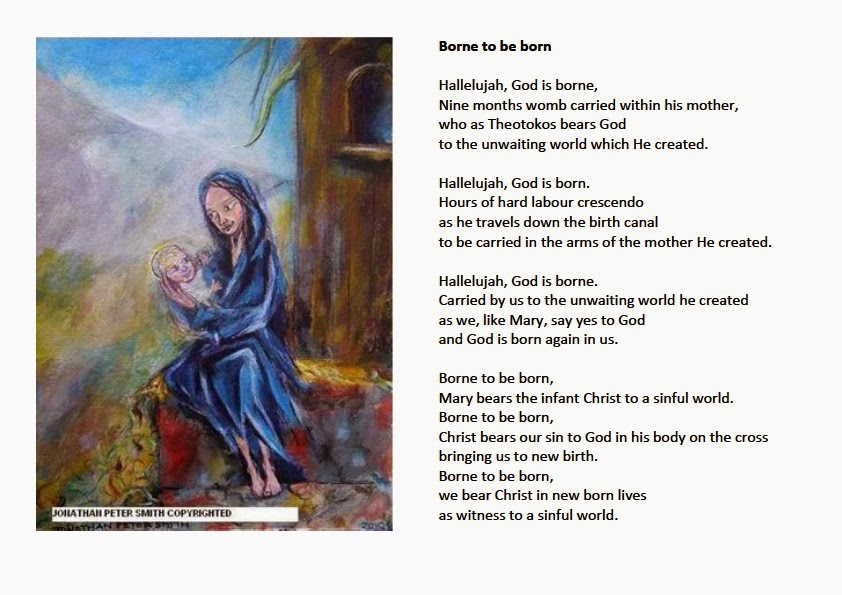
Borne to be born

'Borne to be born' handout with 'Mother and Child' by Jonathan Peter Smith - smithpeterjonathan@yahoo.co.uk

Ever since using a poem about Mary by Malcolm Guite while in Nazareth with the East London Three Faiths Forum, I have been reflecting on the first title given by the Church to Mary, ‘Theotokos,’ which means ‘God-bearer’.

Malcolm Guite says of Mary, ‘Mary has been given many titles down the ages and some Christians have disagreed with one another bitterly about her. But equally, in every age and every church she has been, for many Christians, a sign of hope and an inspiration. Her earliest ‘title’, agreed throughout the church in the first centuries of our faith, before the divisions of East and West, Catholic and Protestant, was Theotokos, which means God-Bearer. She is the prime God-Bearer, bearing for us in time the One who was begotten in eternity, and every Christian after her seeks to become in some small way a God-bearer, one whose ‘yes’ to God means that Christ is made alive and fruitful in the world through our flesh and our daily lives, is born and given to another.’

Mary bears or carries Jesus in her womb for nine months and is also borne or carried by her after his birth, as that is what mothers do with their new born children until they can crawl or walk. The idea that he is borne by her holds lots of potential for word play with the two meanings and spellings of the word. ‘Borne,’ as in carried, and ‘Born,’ as in giving birth. I’ve been trying to play with those words in writing a meditation on this theme which I’ll read to you later.

Once he becomes a man and can no longer be borne or carried himself, Jesus bears or carries us to God the Father by means of his sacrificial death on the cross. So, he is born(e) into the world in order to bear us to God.

In turn, we then bear him to others as he is born in each one of us as we open our lives to him and can then bear, carry or take him to others as our daily lives reveal aspects of his character and love to others. As Teresa of Avila said:

‘Christ has no body but yours,
No hands, no feet on earth but yours,
Yours are the eyes with which he looks
Compassion on this world,
Yours are the feet with which he walks to do good,
Yours are the hands, with which he blesses all the world.
Yours are the hands, yours are the feet,
Yours are the eyes, you are his body.
Christ has no body now but yours,
No hands, no feet on earth but yours,
Yours are the eyes with which he looks
compassion on this world.
Christ has no body now on earth but yours.’

In this way, we bear him to others.

So, Christ is carried by Mary, both in her womb and in her arms, in order that he can then carry us to God by means of his death of the cross. Finally, we carry him to others by means of our daily life and witness.

Here are those thoughts expressed in my meditation:

Borne to be born

Hallelujah, God is borne,
Nine months womb carried within his mother,
who as Theotokos bears God
to the unwaiting world which He created.

Hallelujah, God is born.
Hours of hard labour crescendo
as he travels down the birth canal
to be carried in the arms of the mother He created.

Hallelujah, God is borne.
Carried by us to the unwaiting world he created
as we, like Mary, say yes to God
and God is born again in us.

Borne to be born,
Mary bears the infant Christ to a sinful world.
Borne to be born,
Christ bears our sin to God in his body on the cross
bringing us to new birth.
Borne to be born,
we bear Christ in new born lives
as witness to a sinful world.

Are you humbled by the thought that God was born(e) by a human mother? Are you conscious of having been borne by Jesus to God? How are you bearing Christ to others, as his hands, feet, eyes and body in the world today? Are these responses something for which you pray and for which you are thankful today?

------------------------------------------------------------------------------------------

Malcolm Guite - Angels Unawares.

Monday, 24 November 2014

East London Three Faiths Forum Tour of the Holy Land: Day 6 (1)


During our visit to Mount Carmel I shared the following with the East London Three Faiths Forum group:

The Carmelite Order was founded by St Berthold in Palestine around 1154. Hermits, following the example of Elijah, adopted a solitary lifestyle on Mount Carmel. They lived in small cells near the spring called Elijah's fountain and practised shared solitude. After 1206 they asked the Patriarch of Jerusalem to draw up their way of life in a rule. This directs that they celebrate the eucharist daily and gather weekly to encourage and correct each other. Soon after they received their rule Jerusalem fell and they migrated to the West settling in Sicily, Italy, Spain, France and England.

Elijah was an inspiration to them as he was solitary figure on Mount Carmel, who challenged his people to chose one God. Elijah heard God as an unexpected whisper while on Mount Horeb and, as a result, what the Carmelites call Carmel is a way of life in which they try to be aware of the presence of God in the most ordinary, everyday things. Elijah also said, 'God lives in whose presence I stand', so Carmelites seek to recognise God in everyone they meet and serve.

St Teresa of Avila, who reformed the Carmelite Order in Spain in the late 1500's, said this, 'But here the Lord asks only two things of us: love of His Majesty and love of our neighbor. It is for these two virtues that we must strive, and if we attain them perfectly we are doing His will and so shall be united with Him. But, as I have said, how far we are from doing these two things in the way we ought for a God Who is great! May His Majesty be pleased to give us grace so that we may deserve to reach this state, as it is in our power to do if we wish. The surest sign that we are keeping these two commandments is, I think, that we should really be loving our neighbor; for we cannot be sure if we are loving God, although we may have good reasons for believing that we are, but we can know quite well if we are loving our neighbor.'

St Teresa spoke of prayer as sharing friendship with God. Their emphasis was on intimate communion with God as in this poem by St John of the Cross:

The Living Flame Of Love

Songs of the soul in the intimate communication of loving union with God.
O living flame of love that tenderly wounds my soul in its deepest center! Since now you are not oppressive, now consummate! if it be your will: tear through the veil of this sweet encounter!

O sweet cautery, O delightful wound! O gentle hand! O delicate touch that tastes of eternal life and pays every debt! In killing you changed death to life.

O lamps of fire! in whose splendors the deep caverns of feeling, once obscure and blind, now give forth, so rarely, so exquisitely, both warmth and light to their Beloved.

How gently and lovingly you wake in my heart, where in secret you dwell alone; and in your sweet breathing, filled with good and glory, how tenderly you swell my heart with love.

--------------------------------------------------------------------------------------

U2 - The Ground Beneath Her Feet.

Wednesday, 19 February 2014

Oxford Retreat House


I've had a wonderful couple of days on the retreat that my cell group share annually. There has been so much that we have shared over the years as we journey together, with the continued sense that God is walking with us.

This was the second occasion that our retreat has been at the Oxford Retreat House run by the Disclaced Carmelite Friars. 52 years ago, the Carmelite Order purchased Chilswell House, former home of Poet Laureate Robert Bridges. Since then, a community of Carmelite friars has followed a life of prayer and ministry in the spirit of St Teresa of Avila and St John of the Cross. Their life revolves around the times of liturgical and personal silent prayer each day.

All guests are invited to join in this prayer. The Retreat Centre has recently been
extensively refurbished and welcomes a wide variety of groups. Set in 17 acres of woodland, and overlooking the ‘city of dreaming spires’, the Centre has 27 rooms, 13 of which are twin. The Centre offers preached and guided retreats, as well as weekends on various Carmelite-related themes. The Retreat House is also available for private groups and retreats. We couldn't wish for a better setting for our group retreat.

------------------------------------------------------------------------------------------

Loreena McKennitt - The Dark Night Of The Soul.

Friday, 14 June 2013

R. B. Kitaj: Diasporist art

Diasporist art is the art of movement, change, migration, contradiction, dislocation and dissonance. R.B. Kitaj was both an artist and theorist of such art; writing two manifestos on the phenomenon and creating paintings which cleaved to his “own uncanny Jewish life of study, painting, unthinkable thoughts and near death …”

Because Kitaj’s childhood was spent in the US and much of his adult life in the UK, he was something of an outsider to both countries. Before becoming a student at the Royal College of Art, he travelled widely as a merchant seaman. Befriending the likes of David Hockney, Frank Auerbach, Lucien Freud and Francis Bacon, he spent the best part of 40 years in the UK as part of the self-titled ‘School of London’ before the death of his second wife Sandra Fisher, which he blamed on negative reviews of his Tate retrospective, led to a final move to Los Angeles where he was to die in his studio by his own hand.

Kitaj defined the Diasporist artist as living and painting in two or more societies at once. It therefore seems appropriate that this retrospective is split between two venues; the Jewish Museum in London and Pallant House in Chichester.

Many of the works displayed are multilayered in their form and meaning. As works intended to provoke conversation they require our eye to roam because of the difficulty in focusing on a single part of the image. When combined with written commentaries for his Tate retrospective (inspired by the dialogical nature of Midrash) this approach in part provoked the furious reaction of some critics to the exhibition. Kitaj, however, understood his intent in terms of Diasporism:

“Diaspora is often inconsistent and tense; schismatic contradiction animates each day. To be consistent can mean the painter is settled and at home. All this begins to define the painting mode I call Diasporism. People are always saying the meanings in my pictures refuse to be fixed, to be settled, to be stable: that's Diasporism …”

Juan De La Cruz equates the uncertainty about their role and impact felt by US soldiers in Vietnam with that felt by St John of the Cross when torn between his loyalty to the church and his involvement in the reforms of St Teresa of Avila. Kitaj’s skill as a draughtsman can be seen in the wavering pose and questioning features of the conflicted African-American soldier on a transport plane around which Kitaj has collaged the crude scenes of wartime abuses which are troubling the soldier’s conscience. His name tag is the clue to the creative dissonance Kitaj introduced into the work by linking the soldier’s conflicts to those of John of the Cross.

The Church is called to be a pilgrim people journeying in the tension of the now and not yet. As a result, we have much, potentially, to learn from Diasporist art and yet our frequent tendency is to bathe in a nostalgic yearning for days of ‘glory’ past in Christendom. Diasporism is for Kitaj an engagement with the outsider; not Jews alone, but also homosexuals, women, Palestinians, Afro-Americans, and many of the Modernist artists he so admired. Such inclusivism challenges our nostalgia revealing the hidden oppression and abuse which can accompany the accumulation of authority and power.

---------------------------------------------------------------------------------------------

Lou Reed - Strawman.

Thursday, 25 October 2012

Retreat reading


I'm just back from my annual cell group retreat (with fellow bloggers Sam Norton and Paul Trathen, among others) which this year took place at the Carmelite Priory at Boars Hill. Here are some of the highlights from my retreat reading which reflect our Carmelite setting:

"Applying the practice of the Übersichtliche Darstellung, then, to our 'mystical investigations', here we observe a process of watching or seeing the 'Form of Life' (Lebensform) through the 'language games' (Sprachspiele) that are employed. Our job is not to make mystical interpretations of certain Weltanschauungen but to present 'everything as it is'. The ontological questions no longer concern us. When Wittgenstein's approach is applied to the spiritual realm, its application is neatly summarized by Drury's remarks concerning The Tractatus:

For me, from the very first, and ever since, and still now, certain sentences from the Tractatus Logico-Philosophicus stuck in my mind like arrows, and have determined the direction of my thinking. They are these:

1. 'Everything that can be put into words can be put clearly'
2. 'Philosophy will signify what cannot be said by presenting clearly what can be said'
3. 'There are, indeed, things which cannot be put into words. They make themselves manifest. They are mystical'.
(Drury 1973:iv)

... Drury ... delineated the relationship between (1) the need to speak clearly - the Übersichtliche Blick of the philosopher, and (2) how this relates to the 'unsayable' and the 'mystical'. By delineating what can be said clearly we also delineate what cannot be said but can be shown. This ... is the role of the philosopher who investigates 'the mystical' ... 

the Wittgensteinian approach advocated here concentrates the mystic 'speech act' in it's overall communicative intent; that is, through showing as well as saying. This leads to the notion ... of the 'performative discourse of mystical speech'."

"... the Wittgensteinian move from Weltanschauungen to Weltbild under the Übersichtliche Darstellung - from mind/body Cartesian dualism to a post-enlightenment suspicion of the Cartesian 'I' - mirrors the strategies of 'mystical discourse'. The mystical strategies ... of unknowing and affectivity ... are held alike by the contemporary post-enlightenment discourse of Wittgenstein and the pre-enlightenment discourse of theologia mystica. That is, with the 'postmodern' critique of Cartesian dualism we return to a 'pre-modern' notion of self. Both discourses share similar strategies and ... for both 'style' is as important as 'content'.

Both Teresa and Wittgenstein ... are in their own ways inviting their readers to move 'out of the head' into embodied practices. This ... is the key 'transformational strategy' of both Ludwig Wittgenstein and the writers of the Christian tradition of theologia mystica:

A religious question is either a 'life question' or (empty) chatter. This language game, we could say, only deals with 'life questions'.
(Wittgenstein BEE 183:202)"

Peter TylerThe Return To The Mystical

"Mysticism is a protean term used to signify a variety of disparate phenomena from the sublime to the trivial, from the effusions of the God-intoxicated saint to the babblings of the hallucinogen-intoxicated addict. It runs the gamut from St Teresa's mansions of the soul to Timothy Leary's neural cocoon ... Although mysticism is a puzzle it should be kept in mind that its often exotic language and the bizarre phenomenon associated with it hinge on a single point: If God exists - and the consensus of the Mystics of the Book (that is, the followers of Judaism, Christianity, Islam) believe that He does - then God is the ultimate goal of human life. Moreover, He is a goal which humankind cannot attain by its efforts alone. Divine aid is necessary. The conviction that the beatific vision is grounded on God, the lumen gloriae of the theologians, delivered Christianity from becoming no more than another priggish intellectual sect or esoteric mystery religion ... It can be said that the mystic claims to be able to penetrate the carapace of the external world, view the beauty within, and ascend to its source, the "all-beautiful One" of St Augustine. That the mystic is directed towards this vision is often lost in the horrifying penances and bizarre exotica that glut their accounts." R. A. Herrera, Silent Music: The Life, Work, and Thought of St John of the Cross  

“I would still argue that everyone, no matter how confused or ill-situated in life, can have at least modest mystical experiences. They may be as simple as the beautiful stillness that settles at the sight of a sunset or a brief period of wonder at the birth of a child. Mysticism doesn’t have to be a life profession. Further, I think that much of our depression, anxiety, and addiction has to do with what John writes about: the soul’s need and longing for transcendence. This need is instinctual and unavoidable.” Thomas Moore, Foreword to M. Starr trans., St John of the Cross: Dark Night of the Soul

“God stripped Job naked and left him on a dunghill, vulnerable and persecuted by his friends. The ground was teeming with worms. Job was filled with anguish and bitterness. This was exactly when God Most High, he who lifts the poor man from the dunghill, was pleased to come down and speak with him face-to-face. This is when God revealed to Job the depths and heights of his wisdom, which he had never done in the time of Job’s prosperity.” St John of the CrossDark Night of the Soul

"Men invent means and methods of coming at God's love, they learn rules and set up devices to remind them of that love, and it seems like a world of trouble to bring oneself into the consciousness of God's presence. Yet it might be so simple. Is it not quicker and easier just to do our common business wholly for the love of him?" 

 "Nor is it needful that we should have great things to do. . . We can do little things for God; I turn the cake that is frying on the pan for love of him, and that done, if there is nothing else to call me, I prostrate myself in worship before him, who has given me grace to work; afterwards I rise happier than a king. It is enough for me to pick up but a straw from the ground for the love of God." 

"The time of business does not with me differ from the time of prayer; and in the noise and clatter of my kitchen, while several persons are at the same time calling for different things, I possess God in as great tranquility as if I were upon my knees at the blessed sacrament." 

Brother LawrencePractising the Presence of God 

--------------------------------------------------------------------------------------------------

Steve Bell - Kindness.