Wikio - Top Blogs - Religion and belief
Showing posts with label etched glass. Show all posts

Friday, 11 August 2017

St Martin's Bowness-on-Windermere


I enjoyed visiting St Martin's Bowness-on-Windermere recently. The following comes from their current website:

"Some of the unique features inside St Martin’s Bowness-on-Windermere are the decorative murals, the sixteenth century instructive sayings and the quotations from the Bible on the walls and the roof beams. The only remaining part of the original pattern of decoration is to be found above a window in the south aisle.

The appearance of the present church owes much to the 1870 restoration and enlargement under the architects Paley and Austin of Lancaster. The chancel was extended to the east, as the differing roof beams demonstrate, the tower was heightened and all the seating renewed. Most of the mural decorations (by a Mr Henry Hughes of Frith St, London) including two large paintings in the chancel, date from this time. They serve to relieve the bareness of the smooth re-plastered walls and pillars. The mural on the north wall of the Chancel depicts the Adoration of the Magi, that on the south wall, the Entombment of Christ.

The marble reredos behind the main altar incorporates mosaics, executed by Bell and Almond of London, depicting the symbols of the Gospel writers and the Passion. The reredos, and the whole chancel extension, were designed as part of the Victorian restoration by Paley and Austin.

The outstanding treasure of St Martin’s is the East Window which was so successfully restored in 1870 by Mr Hughes, under the supervision of the Society of Antiquaries, when the new chancel was built. The magnificent East Window contains some very fine stained glass, most of which dates from the 15th century. However, it is not all of this period. Some of the glass at the top is earlier, and the restoration of 1870 made good the damage believed to have been done by Cromwell’s soldiers. This included replacing the faces of the saints.

The history of the window is obscure but it is thought that the glass probably came from Cartmel Priory. The central theme is the crucifixion, flanked by a group of figures including St George (and the dragon), St Barbara, (also an early martyr to the truth) and St Katherine (patroness of learning and theology). In the medieval period, the prayers of these three so-called auxiliary saints were thought to be most effective in aid of the faithful. The supplicants shown kneeling below include Canons of Cartmel as well as various benefactors wearing their coats of arms. The earliest glass is at the top of the third light from the left; a representation of the Virgin and Child believed to date from 1260. In the Middle Ages the Virgin Mary was traditionally depicted in green (later replaced by blue). There is very little glass older than this anywhere in Britain. Surrounding the 15th century coat of arms of a Prince of Wales are many shields relating to north Lancashire families as well as the Prior of Cartmel (strongly suggesting the window’s origin). In the fifth light from the left, one of the seven shields bears what were believed to be arms of that branch of the Washington family (who had lands around the Warton area of Lancashire in the 1400s) and from whom the first president of the United States was descended.

Below the tower, you will see the Curwen Screen, installed in 2000. Magnificent etched glass panels designed by Sally Scott surmount the glass and wood base. The Angels & Music design depicting angels glorifying God through music reflects the theme of the surrounding wall.

At the base of the tower is the statue of St Martin. This carved wooden figure of the Saint shows him on horseback with a beggar, on foot, beside him. The Saint is dividing his cloak with his sword to give half to the beggar illustrating the best-known story of St Martin who became bishop of Tours in France and died in 400 A.D. The statue is probably of foreign origin and dates from the 17th century. It was returned to the church in 1915, having been removed for safekeeping during the 1870 restoration."

-------------------------------------------------------------------------------------------

Saturday, 10 May 2014

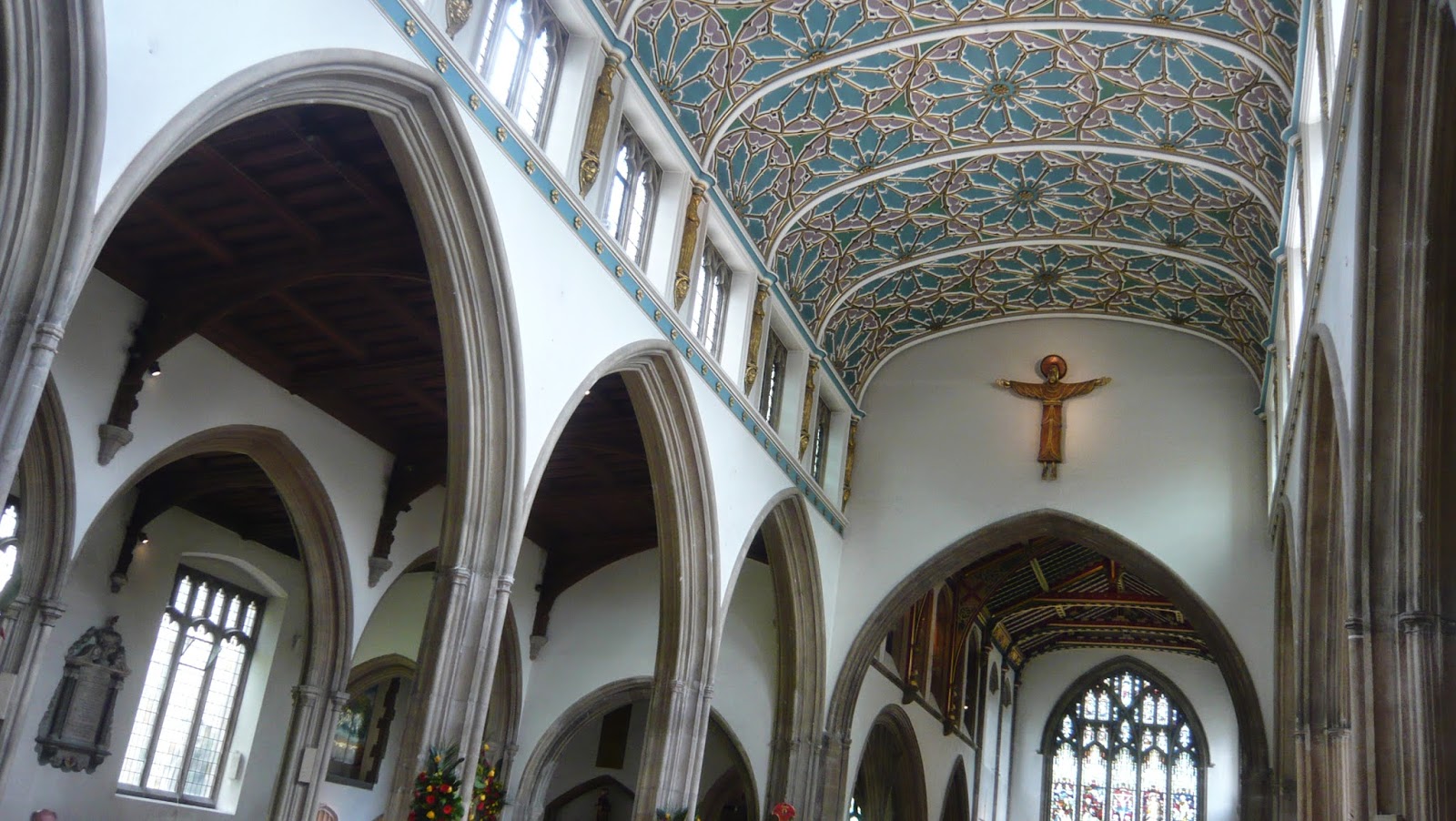
Sabbatical Art Pilgrimage: Chelmsford Cathedral


I began my sabbatical art pilgrimage in familiar territory as Chelmsford Cathedral is where I was ordained as a deacon. Since then I have attended many Diocesan services, organised exhibitions and events, and have also spoken in the Cathedral on several occasions. Despite its familiarity for me, Chelmsford Cathedral continues to surprise and entrance.

On this occasion I was one of nearly 700 worshippers from across Essex and East London communities who joined Her Majesty The Queen and HRH The Duke of Edinburgh for a service to celebrate the centenary of Chelmsford Diocese. The Rt. Revd. Stephen Cottrell, Bishop of Chelmsford, said in his sermon:

"We bring good news. We sing the song of him before whom every knee must bow, and yet whose
‘coming alongside us and moving ahead of us’ gospel means, paradoxically, that he is the one who
kneels before us, who comes, if you like, as a servant, a slave, washes our feet, offers broken
bread, wipes every tear from every eye, longs for us to know that we matter, that we are loved,
that we are precious to God. He is King of Kings and Lord of Lords, and yet, at the same time, he
is servant and shepherd. He is light in the darkest hour. Hope in the bleakest despair. A reason for

going forwards, when everyone else turns back. He is joy. He is peace. He is love itself."

Those paradoxes are imaged in the range of artwork commissioned for this church over the 100 years that it has been a Cathedral.


Peter Eugene Ball and Mark Cazalet are two names that we will encounter again on this sabbatical art pilgrimage as they are among those contemporary artists who have most frequently been commissioned by the Church in the UK. Ball is a sculptor who works with found objects, predominantly wood, which he then embellishes with beaten metals such as gold leaf. His Christ in Glory located high above the Nave with its outstretched arms is a welcoming image.


On a smaller scale and possessed of a still serenity are his cross and candlesticks for the Mildmay Chapel and his Mother and Child in St Cedd's Chapel. 


Cedd is the subject of Cazalet's engraved glass window in the St Cedd's Chapel and he also has a bit part in Cazalet's Tree of Life located in a blank window space within the North Transept and mimicking the mullions and tracery of the original window. The image of a single tree has been a recurring theme in Cazalet's work, influenced, as it is, by the sense of place found within the English Romantic landscape tradition. Cazalet's image of an Essex oak exemplifies lines written by his friend and fellow artist, Roger Wagner: "And that exulting love which made all things / Whose laughter is the ocean in a tree / That rustles like a thousand angels’ wings / Stirred by a wind no human eye can see."


Earlier commissions were no less significant however. Georg Ehrlich's sculpture The Bombed Child in St Peter's Chapel and his relief Christ the Healer are particularly affecting. The commissioning by the Church in the UK of work from artists who were refugees from the Nazi's will prove to be another recurring feature of this sabbatical art pilgrimage. Former Dean, The Very Revd. Peter Judd, said of The Bombed Child: "A mother holds her dead child across her lap, and the suffering and dignity of her bearing don’t need any words to describe them – that is communicated to anyone who looks at her."


John Hutton's Great West Screen at Coventry Cathedral is one of the most notable works of religious art of the 20th century in Britain. Here his etched window is an image of St Peter. Elsewhere in the Diocese Hutton's work can also be found at St Erkenwald's Barking and St George's Barkingside


The work of Thomas Bayliss Huxley-Jones also features elsewhere within the Diocese. His Woman of Samaria at St Peter's Aldborough Hatch and The Christ figure above the South Porch of St. Martin Le Tours church, Basildon are both fibreglass figures. At the Cathedral, Huxley-Jones' work includes a Christus in St Cedd's Chapel, a carving of St Peter on the south-east corner of the South Transept and 16 stone carvings representing the history and concerns of Essex, Chelmsford, and the Church. Similarly, in his sermon, Stephen Cottrell, spoke of "the faithful, tireless, tenacious, beautiful witness of Christian men and women continues to make a difference: in Chingford and Chelmsford, Harwich and Harlow, Becontree
and Basildon and Boxted, right across this complicated and glorious diocese."  


The number and variety of commissions which feature within this Cathedral mean that even in a packed service, such as that on May 6, when each worshipper will only see from their specific place within the space a very small proportion of the artworks within the building, they will, nevertheless, be able to view something of significance and depth to enhance their experience of worship. Among the range and variety of works to be seen - which include, among others, work in bronze, glass, steel, textiles, and wood - are finally a significant collection of contemporary icons many of which were created by nuns from the Community of St John the Baptist at Tolleshunt Knights.

Bishop Stephen concluded his sermon with these words: "In the midst of war, in the relative security of peace, in hardship and in plenty, in village, suburb and inner city, today we thank God for the church, which is the body of Christ, the sign of God’s loving presence and God’s eternal purposes for the world." The artworks found within this Cathedral Church are also signs of that loving presence and his eternal purposes for the world.

---------------------------------------------------------------------------------

John Ireland - Te Deum Laudamus.