Wikio - Top Blogs - Religion and belief
Showing posts with label greatest commandment. Show all posts

Wednesday, 1 October 2025

God comes first

Here's the sermon that I shared at St Andrew’s Wickford this morning:

Recently, we got an urgent call in the early hours of the morning as my mother-in-law was being taken to A&E as the paramedics thought her heart was failing. We had to get up and go to be with her and everything else that had been planned for that day had to be rearranged.

Thankfully, she has rallied somewhat and, while still being frail, is on the mend. Our experience of having to drop everything and go was similar to Jesus' response to potential disciples, which was one of absolute immediacy and urgency (Luke 9. 51 – end). In this passage Jesus challenges his actual disciples and his would-be disciples about what it means to follow him and be a disciple.

In speaking to would-be disciples Jesus is emphatic that God comes first. Before commitments to home and to family, God comes first. This is the practical implication and application of Jesus’ summary of the Law: “Love the Lord your God with all your heart, with all your soul; and with all your mind.” This is the greatest and most important commandment. The second most important commandment is like it: ‘Love your neighbour as you love yourself.’”

As one example, “The obligation to bury one’s father was regarded by many Jews of Jesus’ time as the most holy and binding duty of a son; but Jesus says that that is secondary to the call to follow him and announce God’s kingdom.” Jesus’ call cuts across family life and our traditional understandings of family. Here, even saying goodbye to your family before you leave seems to be criticised by Jesus!

Jesus is talking here to people who were wanting to be part of his itinerant ministry but, as we heard a couple of weeks ago, he also had followers who stayed in their homes and workplaces and who provided support for the team of disciples who were on the road. So, these words of Jesus don’t mean that every Christian should leave home and family in order to follow him but they do mean that wherever we are we must put God first in our lives.

Despite that I wonder how we might inject a similar sense of urgency into our service of God? Jesus knew that his time was short and that there was much to do in that short space of time. We follow God throughout our lives and therefore don't have that same sense of immediacy and urgency.

In the back of our minds we know that time is short and that we never know what lies around the corner. Often, we don't like to contemplate that reality but much of Jesus' teaching takes us into that space.

Jesus' call is that we put God first and make God central to our lives and our ministry. Love God with all your heart, soul, mind and strength. This passage asks us what we will leave, what we will drop in order to do that. Some things are too important to put off any longer.

There is no point pretending that any of this is easy. What Jesus says to his would-be disciples still strikes us today as extreme but he is doing is making clear the real choice for us; between putting God first or putting ourselves, our needs and commitments first. That is the choice and dilemma that faces us each day. If we are to be followers of Jesus, then we need to continually say to ourselves WWJD; What would Jesus do. May it be so for each one of us. Amen.

------------------------------------------------------------------------------------------------------

Wednesday, 6 March 2024

Fulfilling the Law

Here's the sermon I shared at St Andrew's Wickford this morning:

Jesus said, ‘Do not think that I have come to abolish the law or the prophets; I have come not to abolish but to fulfil’ (Matthew 5.17-20). What did it mean for Jesus to fulfil the Law? After all, he debated aspects of the Law, criticised the Pharisees for their interpretation, and excused his disciples from certain aspects of the Law.

The Law received by Moses introduced a system for the sacrifice of animals but also did two other things. First, in the Ten Commandments, it gave minimum standards for the maintenance of good relations within society – do not murder, do not steal, do not covet etc. Second, in the greatest commandment, it set love for God, others and oneself as the goal to which all the other laws, including those concerning sacrifices, pointed. The Law was given not that people became of obsessed with the keeping of its minutiae but that people moved from the base point of not harming others to the point or goal of the Law, to love God, others and oneself.

A helpful illustration for the way in which he wanted his disciples to learn to use the commandments is that of learning to drive a car. As part of learning to drive, we should quickly come to do most things ‘automatically’; changing gear, using the brakes, etc., and also develop the “virtues” of a good driver; looking out for other road users, not allowing ourselves to be distracted, etc. This equates to taking on board and applying the positive commandments (the ‘thou shalts’ which are primarily to do with respect for others). These are virtues for us to learn and practice in order that they then become second nature.

Then, continuing our driving analogy further, the Highways Agency also construct crash barriers which, if we don’t drive appropriately, ensure that damage is limited; and rumble strips, which make a loud noise on the tyre if we drift to the edge of the roadway. The negative commandment (the ‘Thou shalt nots’) are like those crash barriers and rumble strips. Ideally, we won’t need them because we will have learned to develop the virtues commanded by the Law and will drive down the moral highway appropriately. But the rules are there so that when we start to drift, we are at once alerted and can take appropriate action.

The Law, then, is there to keep us safe. The ‘Thou shalt not’s’ of the Ten Commandments are all to do with limiting the harm we do to others; do not murder, commit adultery, steal, bear false witness or covet. These are minimum standards of behaviour which enable society to function because respect and toleration exist. If we all abide by the Law, then we do not harm each other. That is good, but, by itself, it is not enough because the Law also wants us to learn to love one another. That’s where our learning the virtues – the positive commandments – comes in; but that can’t be simply about learning by rote or following the letter of the Law. To genuinely love we need to obey the spirit of the Law, not simply the letter of the Law.

Jesus taught that the heart of the Law is found in words from the Book of Deuteronomy: ‘Love the Lord your God with all your heart and with all your soul and with all your strength and with all your mind’ and, ‘Love your neighbour as yourself.’ The intent of the law is that we live well together. The best way in which to live well together is that we love; therefore love fulfils the intent of the law. But the law cannot legislate for love therefore we must go beyond the strict letter of the law in order that we truly love. On the basis of Jesus’ liberating teaching, St Augustine was able to write: ‘Love, and do what you will’ because when the ‘root of love be within’ there is nothing that can spring from that root, but that which is good.

To understand the way this model of learning and law works, another road based illustration is helpful; that of parents teaching their children the rules of the road. Take a moment to think back to when you were a very young child. To begin with the rules of the road are very restrictive; we would never cross a road without a responsible adult and would always cross at a crossing while holding someone’s hand. As we grew, however, we were taught new rules for crossing the road; for me, that was the Green Cross Code with Tufty – which taught us to stop, look and listen. Now, the aim was that I would begin to judge for myself when it was safe to cross the road. Eventually, the rules with which we began – don’t cross on your own, don’t cross unless you are at a crossing – are left behind because we have learnt how to cross the road safely using our own initiative; initiative meaning that we do ‘the right things without being told’.

We learnt to use initiative because we not only learnt the rules but also learnt to apply them in our lives and situations. From that point onwards, we are no longer restricted just to crossing the road at specific crossing places but can cross wherever we judge it to be safe to do so. So, we have gone beyond the rules by learning and applying the rules. In other words, we have found the true purpose of those rules which our parents enforced when we were young. In the same way, we need the Law to prevent harm but prevention of harm, by itself, does not guarantee good relations. For that, we need to genuinely love others and love takes us beyond the laws which prevent harm.

When we understand the purpose of the Law in this way, we are then able to improvise responses to situations not specifically covered by the Law on the basis of the virtues we have practised and the parameters which the Law sets.

Jesus is the supreme example of someone faithfully improvising on the basis of the true purpose of the Law. When the practices of his day would have prevented him from healing on the Sabbath, he went ahead and healed anyway. When the practices of his day discriminated in favour of husbands over wives, he taught a tightening of the Law in order to give added protection to women. When he was asked, ‘Who is my neighbour’, he told a story about love for those who are our enemies.

As we have heard, he was clear that he had not come to abolish the Law or the Prophets; instead he had come to fulfil them by enabling us to live according to the spirit of the Law, rather than the letter of the Law. He embodied everything the Law of Moses was designed to do, by embodying love in all its forms and depth; even to the extent of sacrificing his own life that we might live and love. As Jesus embodied the law of love himself, it is as we come close to him, loving him and learning from him, that we too can embody the law of love. Jesus is a person and a relationship and any law that doesn’t have that will end up becoming arbitrary but, with Jesus, the Law becomes truly loving and truly lively.

----------------------------------------------------------------------------------------------------------

Mike Scott - Bring 'Em All In.

Wednesday, 4 October 2023

Putting God first

Here's the reflection I shared at St Andrew's Wickford this morning:

In this passage (Luke 9. 57 – end) Jesus challenges his actual disciples and his would-be disciples about what it means to follow him and be a disciple.

In speaking to would-be disciples Jesus is emphatic that God comes first. Before commitments to home and to family, God comes first. This is the practical implication and application of Jesus’ summary of the Law: “Love the Lord your God with all your heart, with all your soul; and with all your mind.” That is the greatest and most important commandment. Love for others follows on from it, as we are then told to love our neighbour as we love ourselves.

Jesus is talking here to people who were wanting to be part of his itinerant ministry but, as we also know, he did have followers who stayed in their homes and workplaces and who provided support for the team of disciples who were on the road. So, these words of Jesus don’t mean that every Christian should leave home and family in order to follow him but they do mean that wherever we are, we must put God first in our lives.

As one example, “The obligation to bury one’s father was regarded by many Jews of Jesus’ time as the most holy and binding duty of a son; but Jesus says that that is secondary to the call to follow him and announce God’s kingdom.” Jesus’ call cuts across family life and our traditional understandings of family. Here, even saying goodbye to your family before you leave seems to be criticised by Jesus!

There is no point pretending that any of this is easy. What Jesus says to his would-be disciples still strikes us today as extreme but he is doing is making clear the real choice for us; between putting God first or putting ourselves, our needs and commitments first. That is the choice and dilemma that faces us each day. If we are to be followers of Jesus, then we need to continually say to ourselves WWJD; What would Jesus do.

That’s what Francis of Assisi did and today is the day when the Church remembers him particularly. Francis was born in Assisi in central Italy either in 1181 or the following year. He was baptised Giovanni but given the name Francesco by his father, a cloth merchant who traded in France and had married a French wife. There was an expectation that he would eventually take over his father's business but Francis had a rebellious youth and a difficult relationship with his father. After suffering the ignominy of imprisonment following capture whilst at war with the local city of Perugia, he returned a changed man. He took to caring for disused churches and for the poor, particularly those suffering from leprosy. Whilst praying in the semi-derelict church of St Damian, he distinctly heard the words: "Go and repair my church, which you see is falling down." Others joined him and he prepared a simple, gospel-based Rule for them all to live by. As the Order grew, it witnessed to Christ through preaching the gospel of repentance, emphasising the poverty of Christ as an example for his followers. Two years before his death, his life being so closely linked with that of his crucified Saviour, he received the Stigmata, the marks of the wounds of Christ, on his body.

At his death, on the evening of 3 October 1226, his Order had spread throughout western Christendom. It did so, in part, because of inspirational team talks from St. Francis, such as this one recorded in the Legend of the Three Companions:

'Calling together the six brothers, Saint Francis, since he was full of the grace of the Holy Spirit, predicted to them what was about to happen. “Dearest brothers,” he said, “let us consider our vocation, to which God has mercifully called us, not only for our own good, but for the salvation of many. We are to go throughout the world, encouraging everyone, more by deed than by word, to do penance for their sins and to recall the commandments of God. Do not be afraid that you seem few and uneducated. With confidence, simply proclaim penance, trusting in the Lord, who conquered the world. Because by his Spirit, He is speaking through and in you, encouraging everyone to be converted to him and to observe his commandments”.’

Like Francis and his followers, wherever we are and whatever we are doing, Jesus calls us to proclaim the kingdom of God by deeds and words. 

-------------------------------------------------------------------------------------------------------

Donovan - The Lovely Day / Brother Sun, Sister Moon.

Thursday, 4 June 2020

God desires love, not sacrifice

Here's my reflection given during today's lunchtime Eucharist for St Martin-in-the-Fields:

The scribe said to him, ‘You are right, Teacher; you have truly said that “he is one, and besides him there is no other”; and “to love him with all the heart, and with all the understanding, and with all the strength”, and “to love one’s neighbour as oneself”,—this is much more important than all whole burnt-offerings and sacrifices.’ When Jesus saw that he answered wisely, he said to him, ‘You are not far from the kingdom of God.’ (Mark 12.28–34)

Allow me for a moment to take you on a journey through the scriptures to explore the reasons why, in the kingdom of heaven, love for God, others and ourselves is much more important than offerings and sacrifices.

We begin where the Bible begins, in Genesis, with acts of human sacrifice made to appease the gods. People, often children, killed because, when trouble or tension arose in society, the belief was that, by sacrificing one or a few as a scapegoat, order would be restored by the gods for the many. That was the culture which Abraham was called to leave when he left Ur of the Chaldees to found a people that would become God’s people. As a way to create a decisive break with that culture, God took Abraham through a dramatic experience where it seemed that he was, as Abraham would have expected, demanding the sacrifice of Abraham’s firstborn son Isaac. At the very point of sacrifice, God made it clear to Abraham that he did not desire human sacrifice and provided an animal as an alternative. This became part of the founding story for the people of Israel, a people whose ritual sacrifices were of animals and not human beings.

If we then move forward in time, we can pause again for a moment at Mount Sinai and the giving of the Law to Moses. The Law received by Moses contained detailed instructions regarding the sacrifice of animals but also contained the commands quoted by Jesus and the Scribe in our Gospel reading. In addition to the system of sacrifice it introduced, the Law did two things. First, it gave minimum standards for the maintenance of good relations within society – do not murder, do not steal, do not covet etc. Second, in the greatest commandment, it set love for God, others and oneself as the goal to which all the other laws, including those concerning sacrifices, pointed. The Law was given not that people became of obsessed with the keeping of its minutiae but that people moved from the base point of not harming others to the point or goal of the Law, to love God, others and oneself.

We know that many paid lip service to the Law while ignoring it and others did become obsessed with following the minutiae of the letter of the Law and thereby missed the point of the Law. The prophets were the ones used by God to point this out to the people and their rulers. The message of the prophets can in many respects be summed up by these words from the prophet Amos through whom God said: ‘I hate, I despise your festivals, and I take no delight in your solemn assemblies. Even though you offer me your burnt offerings and grain offerings, I will not accept them; and the offerings of well-being of your fatted animals I will not look upon. Take away from me the noise of your songs; I will not listen to the melody of your harps. But let justice roll down like waters, and righteousness like an ever-flowing stream.’ Amos was essentially saying, ‘Love God, others and yourself.’

When God’s people ignored God’s messengers, God eventually took matters into his own hands and, in Jesus, showed us, by entering our world and being with us for 33 years, that what he desires is love and relationship. He longs to be with us and enjoy us for who we are, as we also enjoy him. That is the message of the incarnation. It is a demonstration of love.

Yet we still did not understand and, as we have been doing for millennia, made Jesus a scapegoat to excise us of our troubles and tensions, sacrificing him to relieve our fears and anxieties. The God who does not desire sacrifice became the ultimate sacrifice to show that once God has been scapegoated and sacrificed there is really nowhere else to go. There is now no god to be appeased because God does not desire sacrifice and God himself has been sacrificed. This is the end of sacrifice. The curtain was torn in the Temple at the point of Christ’s death because there was no longer any need for sacrifice and the system of sacrifice, the system that began at Mount Sinai, was itself ended in AD70 when, as prophesied by Jesus, the Temple in Jerusalem was destroyed.

‘The Kingdom of God is justice and peace, And joy in the Holy Spirit!’ Like the Scribe we have come close to that kingdom when we realise that God is one, and “besides him there is no other”; and “to love him with all the heart, and with all the understanding, and with all the strength”, and “to love one’s neighbour as oneself”,—this is much more important than all whole burnt-offerings and sacrifices.’ ‘God is love. Whoever lives in love lives in God, and God in them’ (1 John 4. 16). That is the story of scripture. That is the place to which all scripture leads. It simply remains for us to pray, ‘Come, Lord, and open in us the gates of your Kingdom!’ Amen.

----------------------------------------------------------------------------------------------------

GSNY Music - The Sun Will Rise.

Sunday, 4 March 2018

Fulfilling the Law

Here's my sermon from today's Eucharist for Schools Sunday at St Martin-in-the-Fields:

How do we know the right way to behave in any given situation? Rules or commandments, including the Ten Commandments, often seem to be the answer and every society or organisation, including our schools, needs a set of rules as a baseline for acceptable behaviours. Considering the place that rules or commandments have within our lives and faith and the models of learning associated with them is, hopefully, a useful exercise on Schools Sunday.

The Ten Commandments were the first commandments given to Moses for the people of Israel, but there were more which followed; 613 commandments altogether, which divide up into 248 positive commandments (the ‘Thou shalt's’) and 365 negative commandments (the ‘Thou shalt not's’).

However many rules or commandments there are, however, they can’t cover every possible situation we encounter in life. Do the Ten Commandments or the Law of Moses, for example, have anything to say about our use of social media, as social media didn’t exist when they were given? What should we do when we encounter a situation that isn’t covered by a rule or commandment? If we are completely rule-bound, then we are likely to freeze in that moment and won’t able to act because we don’t have the instructions we need. Equally, we could say that we can do whatever we like because there are no instructions covering that situation. And what do we do when life becomes more complicated than the simple rule we have been given. How should we honour both our father and mother, for example, when they are arguing among themselves and giving us contradictory advice or instructions?

The answer that the Pharisees gave in the time when Jesus was alive was to issue extra clarifications. The Pharisees took the 613 commandments in the Law of Moses and multiplied these commandments by creating detailed instructions about the ways in which each of these commandments were to be kept. Extra clarification sounds helpful, particularly if we like clear instructions, but Jesus criticised this approach as one which created the burden of not only trying to keep hundreds of commandments but also thousands of additional regulations. It is, in essence, the argument that people often make today about Health and Safety legislation!

Instead of trying and failing to cover each and every possible scenario that might possibly arise and instead of simply following rules to the letter in every situation, Jesus encouraged his disciples to learn how to apply the commandments to a range of different situations and he used stories – the parables he told – as scenarios or case studies about which they were to think.

A helpful illustration for the way in which he wanted his disciples to learn to use the commandments is that of learning to drive a car. As part of learning to drive, we should quickly come to do most things ‘automatically’; changing gear, using the brakes, etc., and also develop the “virtues” of a good driver; looking out for other road users, not allowing ourselves to be distracted, etc. This equates to taking on board and applying the positive commandments (the ‘thou shalts’ which are primarily to do with respect for others). These are virtues for us to learn and practice in order that they then become second nature.

Then, continuing our driving analogy further, the Highways Agency also construct crash barriers which, if we don’t drive appropriately, ensure that damage is limited; and rumble strips, which make a loud noise on the tyre if we drift to the edge of the roadway. The negative commandment (the ‘Thou shalt nots’) are like those crash barriers and rumble strips. Ideally we won’t need them because we will have learned to develop the virtues commanded by the Law and will drive down the moral highway appropriately. But the rules are there so that when we start to drift, we are at once alerted and can take appropriate action.

The Law, then, is there to keep us safe. The ‘Thou shalt not’s’ of the Ten Commandments are all to do with limiting the harm we do to others; do not murder, commit adultery, steal, bear false witness or covet. These are minimum standards of behaviour which enable society to function because respect and toleration exist. If we all abide by the Law, then we do not harm each other. That is good, but, by itself, it is not enough because the Law also wants us to learn to love one another. That’s where our learning the virtues – the positive commandments – comes in; but that can’t be simply about learning by rote or following the letter of the Law. To genuinely love we need to obey the spirit of the Law, not simply the letter of the Law.

Jesus taught that the heart of the Law is found in words from the Book of Deuteronomy: ‘Love the Lord your God with all your heart and with all your soul and with all your strength and with all your mind’ and, ‘Love your neighbour as yourself.’ The intent of the law is that we live well together. The best way in which to live well together is that we love; therefore love fulfils the intent of the law. But the law cannot legislate for love therefore we must go beyond the strict letter of the law in order that we truly love. On the basis of Jesus’ liberating teaching, St Augustine was able to write: ‘Love, and do what you will’ because when the ‘root of love be within’ there is nothing that can spring from that root, but that which is good.

To understand the way this model of learning and law works, another road based illustration is helpful; that of parents teaching their children the rules of the road. Take a moment to think back to when you were a very young child. To begin with the rules of the road are very restrictive; we would never cross a road without a responsible adult and would always cross at a crossing while holding someone’s hand. As we grew, however, we were taught new rules for crossing the road; for me, that was the Green Cross Code with Tufty – which taught us to stop, look and listen. Now, the aim was that I would begin to judge for myself when it was safe to cross the road. Eventually, the rules with which we began – don’t cross on your own, don’t cross unless you are at a crossing – are left behind because we have learnt how to cross the road safely using our own initiative; initiative meaning that we do ‘the right things without being told’.

We learnt to use initiative because we not only learnt the rules but also learnt to apply them in our lives and situations. From that point onwards, we are no longer restricted just to crossing the road at specific crossing places but can cross wherever we judge it to be safe to do so. So, we have gone beyond the rules by learning and applying the rules. In other words, we have found the true purpose of those rules which our parents enforced when we were young. In the same way, we need the Law to prevent harm but prevention of harm, by itself, does not guarantee good relations. For that, we need to genuinely love others and love takes us beyond the laws which prevent harm.

When we understand the purpose of the Law in this way, we are then able to improvise responses to situations not specifically covered by the Law on the basis of the virtues we have practised and the parameters which the Law sets.

Before I was ordained I worked for the Employment Service where I once interviewed an unemployed man who told me in the course of our interview that his marriage was breaking down. My role at the time was basically to refer him to either a training course or a job hunting programme. However, I did have a third option which involved alternative referrals, usually used when some form of voluntary work might help the person prepare for work. In this case, I decided that the man would be unable to focus on job hunting while his marriage was in crisis and, with his agreement, booked an appointment for him with Relate, marking that down as an outcome under our third category.

To some of my colleagues, my decision would have been entirely inappropriate as we were only there to place people into training or JobClubs. My view was that we were there to assist people into work and that where people’s personal circumstances mitigated against that happening, those issues needed to be addressed first. In this instance I was improvising a response to a situation that wasn’t specifically covered in the guidelines I had been given and tried to do so in a way that was faithful to the reason for being there i.e. to help people into work.

Jesus is the supreme example of someone faithfully improvising on the basis of the true purpose of the Law. When the practices of his day would have prevented him from healing on the Sabbath, he went ahead and healed anyway. When the practices of his day discriminated in favour of husbands over wives, he taught a tightening of the Law in order to give added protection to women. When he was asked, ‘Who is my neighbour’, he told a story about love for those who are our enemies.

He was clear that he had not come to abolish the Law or the Prophets; instead he had come to fulfil them (Matthew 5. 17) by enabling us to live according to the spirit of the Law, rather than the letter of the Law. He embodied everything the Law of Moses was designed to do, by embodying love in all its forms and depth; even to the extent of sacrificing his own life that we might live and love. As Jesus embodied the law of love himself, it is as we come close to him, loving him and learning from him, that we too can embody the law of love. Jesus is a person and a relationship and any law that doesn’t have that will end up becoming arbitrary but, with Jesus, the Law becomes truly loving and truly lively.

---------------------------------------------------------------------------------

Victoria Williams - What Kind Of Friend.

Wednesday, 7 December 2016

Rest in the law of love

Here is my sermon (based on Matthew 11. 28 – 30) from today's lunchtime Eucharist at St Martin-in-the-Fields:

A yoke is a wooden crosspiece that is fastened over the necks of two animals and attached to the plough or cart that they are to pull. It doesn’t sound like something which is light or easy to wear, so in what sense might Jesus be using this farming image to talk about rest for those who come to him?

Jesus would have been very familiar with ploughs and yokes as both are implements made by carpenters. Two animals, usually either oxen or donkeys, would wear the yoke and pull the plough guided from behind by the farmer. Their task was to break up the ground for sowing.

Jesus was speaking in a context where the Pharisees took the 613 commandments in the Torah – the Law of Moses – which were to do with all aspects of life - shaving, tattoos, clothing, work, food and drink, farming, money and so on – and multiplied these commandments by creating detailed instructions about the ways in which each of these commandments was to be kept. Keeping all of these additional rules was indeed a heavy burden for all who tried to do so.

Jesus, by contrast, taught that love was the fulfilling of the Law. Instead of keeping the endless detail of the regulations created by the Pharisees, Jesus said that we should simply love God, ourselves and our neighbours and that all the Law of Moses is actually designed to that end. This was liberating teaching which brought rest for those weighed down by the burden of trying to keep hundreds of commandments and thousands of additional regulations. On the basis of Jesus’ liberating teaching, St Augustine was able to write: ‘Love, and do what you will’ because when the ‘root of love be within’ there is nothing that can spring from that root, but that which is good.

I wonder whether you are ready to leave behind the heavy burden of rules and regulations in order to be accepted or justified and instead open your life to the liberating and restful law of love.

The oxen or donkeys undertaking the ploughing were guided by the farmer using the yoke. As they followed that guidance the yoke sat lightly on their shoulders and the ploughing proceeded apace. If they ignored the guidance of the farmer and pulled in different directions then the yoke would feel heavy and would chafe the neck causing sores or other injuries.

By using this image Jesus is arguing that we have choices about the way in which we live life. We can go off in our own direction pulling away from other people and from God but, when we do so, we are pulling against the way of life for which we have been designed and created. It is when we submit to God’s way of life – the law of love - that we find rest through being in the right place at the right time and living in the right way. When this happens we have a sense of everything coming together and fitting into place which is both profoundly satisfying and restful.

I wonder whether you are prepared to surrender control of your life to the one who created you in all your uniqueness and explore instead how to live in the way for which human beings were created; to live according to the law of love.

Finally, there is the task to which we are called. This image of pairs of oxen ploughing with the use of a yoke fits closely with the task Jesus gave to his disciples when he sent them out in pairs to go to villages and towns ahead of him in order to prepare people for his arrival when he would sow among them the seed of the Word of God.

He said, therefore, that this task - the role of a disciple – although it seems challenging to take up, is actually hugely rewarding as well as being restful in the sense that we are doing God’s will and it is God who does the work, not us. We read in Luke 10, for example, that the seventy disciples Jesus sent out in pairs returned from their mission with joy, saying, “Lord, in your name even the demons submit to us!”

I wonder whether you are prepared to undertake the challenging, yet strangely restful, task of a disciple of Jesus; that of preparing the ground by sharing the message of love, so that others might receive the Word of God? Jesus said: “Come to me, all you that are weary and are carrying heavy burdens, and I will give you rest. Take my yoke upon you, and learn from me; for I am gentle and humble in heart, and you will find rest for your souls. For my yoke is easy, and my burden is light.”

-----------------------------------------------------------------------------------------


Sunday, 18 October 2015

Start:Stop - The greatest commandment


Here is last Tuesday's Start:Stop meditation. The next Start:Stop will be at St Stephen Walbrook on Tuesday 20th October between 7.30 and 9.30am. Drop in for 10 minutes of quiet reflection on your way into work.

Bible reading

‘When the Pharisees heard that he had silenced the Sadducees, they gathered together, and one of them, a lawyer, asked him a question to test him. “Teacher, which commandment in the law is the greatest?” He said to him, “‘You shall love the Lord your God with all your heart, and with all your soul, and with all your mind.’ This is the greatest and first commandment. And a second is like it: ‘You shall love your neighbour as yourself.’ On these two commandments hang all the law and the prophets.”’ (Matthew 22: 34 - 40)

Meditation

There are 613 commandments in the Torah, which divide up into 248 positive commandments (Thou shalt's) and 365 negative commandments (Thou shalt not's). Jesus says that all these hang on the two commandments to love God and love our neighbour as ourselves.

A helpful illustration for the way in which these commandments work is to do with learning to drive a car. The idea is that you will quickly come to do most of the things “automatically”, changing gear, using the brakes, etc., and that you will develop the “virtues” of a good driver, looking out for other road users, not allowing yourself to be distracted, etc. This equates to taking on board and applying the positive commandments (the ‘thou shalts’ which are primarily to do with respect for others). But, going back to our driving analogy, the highways agency constructs crash barriers which, if we don’t drive appropriately, ensure that damage is limited; and rumble strips, which make a loud noise on the tyre if we drift to the edge of the roadway. “Rules” and “the Moral Law” are like those crash barriers and rumble strips. Ideally we won’t need them because we will have learned to develop the virtues commanded by the Law and will drive down the moral highway appropriately. But the rules are there so that when we start to drift, we are at once alerted and can take appropriate action.

The Law, then, is there to keep us safe. If we all abide by the Law – do not murder, do not steal - then we do not harm each other. That is good, but it is not enough. We also need to learn to love one another. That means doing more than the Law requires but to love in this way is also to fulfil the Law. That’s because, if the Law is about maintaining good relations between us, love becomes the fulfilment of the Law’s intent. This is why Jesus said the heart of the Law is found in these words: “Love the Lord your God with all your heart and with all your soul and with all your strength and with all your mind” and, “Love your neighbour as yourself.” The intent of the law is that we live well together. The best way in which to live well together is that we love, therefore love fulfils the intent of the law. But the law cannot legislate for love therefore we must go beyond the law in order that we truly love.

To understand the way this works, another road based illustration is helpful; that of parents teaching their children the rules of the road. To begin with, when children are very young, the rules of the road are very restrictive i.e. the child must never cross a road without a parent and must always cross at a crossing with the parent and while holding the parents hand. As the child grows, they are taught new rules for crossing the road; stop, look and listen. Now, the aim is that the child learns to judge for him or herself when it is safe to cross the road. Eventually, the rules with which we began – don’t cross on your own, don’t cross unless you are at a crossing – are left behind because the child has learnt how to cross the road safely using their own initiative. We are able to use initiative because we have not only learnt the rules but have also learnt to apply them in our lives and situations. At this point, we are no longer restricted just to crossing the road at specific crossing places but can cross wherever we judge it to be safe to do so. So, we have gone beyond the rules by learning and applying the rules. In other words, we have found the true purpose of those rules which our parents enforced when we were young. In the same way, we need the Law to prevent harm but prevention of harm, by itself, does not guarantee good relations. For that, we need to genuinely love others and love takes us beyond the laws which prevent harm.

Prayer

Law-giving God, we thank you for your laws which alert us when we begin to drift away from your way. We ask that as we encounter temptations within our workplaces to act in ways which deviate from your ways and standards, we will be alert to the warning signs you send our way.

Teach us to love you with heart, soul and mind and to love our neighbour as ourselves.

Enable us to maintain good relations within our workplaces by minimising scope for conflict or blame and by promoting respect for others. Enable us to go beyond minimum standards of behaviour by showing love to those with which we work.

Teach us to love you with heart, soul and mind and to love our neighbour as ourselves.

Loving God, you showed us what all-out love looks like when you sacrificed yourself for others. Enable us to love you and others with all our being and in word and deed. Help us to explore what that might mean in our workplaces.

Teach us to love you with heart, soul and mind and to love our neighbour as ourselves.

Blessing

Being alert to drift, maintaining good relations, minimising scope for conflict, promoting respect, loving with heart, soul and mind. May those blessings of almighty God, Father, Son and Holy Spirit, rest upon you and remain with you always. Amen.

---------------------------------------------------------------------------------------

Barrett Band - Your Love.

Thursday, 8 October 2015

Law & Love: The Greatest Commandment

Here is my sermon from today's Eucharist at St Stephen Walbrook (this sermon will shortly be available to listen to on the London Internet Church site):

“On these two commandments hang all the law and the prophets,” says Jesus (Matthew 22. 34 - end). What does he mean? What do laws about shaving, tattoos, clothing, work, food and drink, farming, money, and much more have to do with loving God, loving ourselves and loving our neighbour?

Jesus frequently attracted criticism, particularly from the Pharisees, for seemingly setting aside laws which they thought important but also said that “until heaven and earth pass away, not one letter, not one stroke of a letter, will pass from the law until all is accomplished” (Matthew 15. 8). So how did Jesus understand and relate to the Mosaic Law?

These verses and this saying are actually key to answering all these questions. By saying, “On these two commandments hang all the law and the prophets,” Jesus is arguing that all 613 commandments in the Torah, however much they may also be about shaving, tattoos, clothing, work, food and drink, farming, money or whatever, are fundamentally about love for God, for ourselves and for our neighbours.

The commandments divide up into 248 positive commandments (Thou shalt's) and 365 negative commandments (Thou shalt not's). In the Ten Commandments the Thou shalt not’s are all to do with limiting the harm we do to others; do not murder, commit adultery, steal, bear false witness or covet. These are minimum standards of behaviour which enable society to function because respect and toleration exist.

Tom Wright has a helpful illustration for the way in these negative commandments work. He says, “The illustration I sometimes use is that when you learn to drive a car, the idea is that you will quickly come to do most of the things “automatically”, changing gear, using the brakes, etc., and that you will develop the “virtues” of a good driver, looking out for other road users, not allowing yourself to be distracted, etc.; but that the highways agencies construct crash barriers and so on so that even if you don’t drive appropriately damage is limited; and also those “rumble strips”, as we call them in the UK, which make a loud noise on the tire if you even drift to the edge of the roadway.

“Rules” and “the Moral Law” are like those crash barriers and rumble strips. Ideally you won’t need them because you will have learned the character-strengths and will drive down the moral highway appropriately. But the rules are there so that when you start to drift, you are at once alerted and can take appropriate action – particularly figuring out what strengths need more work to stop it happening again.”

The other side of the equation are the positive commandments; the virtues in life which we are intended to quickly learn to do automatically. This is where we begin to engage with love and see that love and law can work together. Parents teach their children the rules of the road. To begin with, when children are very young, the rules of the road are very restrictive i.e. the child must never cross a road without a parent and must always cross at a crossing with the parent and while holding the parents hand. As the child grows, they are taught new rules for crossing the road; for me, that was the Green Cross Code - stop, look and listen. Now, the aim is that the child learns to judge for him or herself when it is safe to cross the road.

Eventually, the rules with which we began – don’t cross on your own, don’t cross unless you are at a crossing – are left behind because the child has learnt how to cross the road safely using their own initiative. Elbert Hubbard has said, “Initiative is doing the right things without being told.” We are able to use initiative because we have not only learnt the rules but have learnt to apply in our lives and situations. At this point, we are no longer restricted just to crossing the road at specific crossing places but can cross wherever we judge it to be safe to do so. So, we have gone beyond the rules by learning and applying the rules. In other words, we have found the true purpose of those rules which our parents enforced when we were young; which is that we learn to cross the road safely by ourselves wherever we are.

Jesus is essentially saying the same thing when he speaks about the Law. The Law starts by keeping us safe – do not murder, do not steal. If we all abide by the Law then we do not harm each other. That is good, but it is not enough. We also need to learn to love one another. That means doing more than the Law requires but to do that is also the fulfilling of the Law. If the Law is about maintaining good relations between us, then love is the fulfilment of the Law’s intent, and that is why Jesus said the heart of the Law is found in these words: “Love the Lord your God with all your heart and with all your soul and with all your strength and with all your mind” and, “Love your neighbour as yourself.”

---------------------------------------------------------------------------------------

Victoria Williams - Love.

Thursday, 18 June 2015

Start:Stop - Aligning values in the workplace


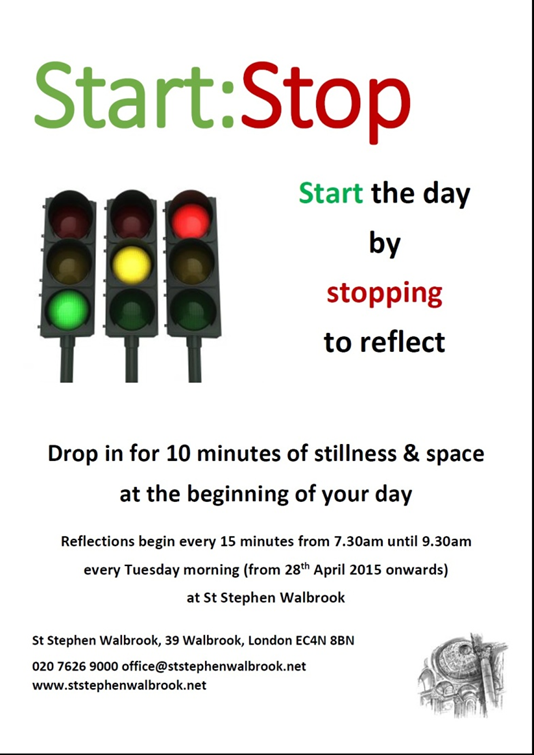
Start your day by stopping to reflect for 10 minutes. Every Tuesday morning there is a rolling programme of work-based reflections at St Stephen Walbrook (39 Walbrook, London EC4N 8BN). Every 15 minutes between 7.30am and 9.15am, a 10 minute session of reflection begins. These sessions include bible passages, meditations, music, prayers, readings and silence. Drop in on your way into work to start your day by stopping to reflect for 10 minutes.

Bible reading

... a lawyer, asked him a question to test him. “Teacher, which commandment in the law is the greatest?” He said to him, ‘You shall love the Lord your God with all your heart, and with all your soul, and with all your mind.’ This is the greatest and first commandment. And a second is like it: ‘You shall love your neighbour as yourself.’ On these two commandments hang all the law and the prophets.” (Matthew 22. 35 – 40)

Meditation

Research undertaken by Roffey Park in the past, claimed that nearly three-quarters of workers are interested in "learning to live the spiritual side of their values" and 53% are experiencing tensions between "the spiritual side of their values and their work".

Such tension comes when we feel that the values of our faith are not aligned with the values of our organisation. In this situation we feel compromised because we are either not able to be all out for God in our workplace – where we spend a significant majority of our time – or we are not able to give our full commitment to our work and, therefore, are not as fully motivated as we would otherwise be.

It is helpful that, in more recent years, organisations have set out their values and discussed with employees how these are applied in the workplace. That provides the opportunity to consider to what extent our faith values align with the values of our organisation. The closer the fit, the more we will feel able to bring our faith to work by living out our values.

God’s call on our lives is to love him with all that we have; heart, soul and mind. That necessarily means in the whole of our life, including our working lives. Assessing the extent to which our faith values fit with those of our organisation enables us either to give ourselves fully to our work - putting heart and soul and mind into our work because there is a good fit between our faith values and our organisation’s values – or to become aware where the sources of tension in our work and faith are, so we can either seek help in living with those tensions or seek work which provides a better fit and greater motivation.

Prayer

Lord Jesus, who shaped wood as a carpenter, who taught multitudes and who came to serve others, we lift up to you our work and the values which underpin it.

We pray for a good fit between the values of our faith and the values of our organisation. Help us to see where the points of connection of may be and as these are identified, may our motivation to serve you and others through our work increase and grow.

Lord, may we love you with heart, soul and mind as we put our heart, soul and mind into our work.

We pray for any who are experiencing tension between the spiritual side of their values and their work. We ask for confidantes to whom they can talk honestly and openly about those tensions and that ways to lessen those tensions will be found.

Lord, may we love you with heart, soul and mind as we put our heart, soul and mind into our work.

We ask for guidance as we seek to bring our faith to work by living out our values in the way we approach our work and relate to our colleagues and customers. May compassion and service characterise our dealings with others.

Lord, may we love you with heart, soul and mind as we put our heart, soul and mind into our work.

We pray that the way our organisations do business will benefit others, through the products or services we provide, the way these are delivered and their broader impact on society. Enable us to be a positive influence within our organisations by seeking to live out its values to the best of our ability.

Lord, may we love you with heart, soul and mind as we put our heart, soul and mind into our work.

May we love you, Lord God, with all our heart, and soul, and mind this week as we put heart and soul and mind into our work. May your values inform all we do, say and think within our workplace and in the rest of our lives. May that blessing of God, Father, Son and Holy Spirit, rest upon us and remain with us always. Amen.

---------------------------------------------------------------------------------------------

Ēriks Ešenvalds - O Salutaris Hostia.

Monday, 1 June 2015

Start:Stop - What is your work for?


Start:Stop
 our regular Tuesday morning opportunity at St Stephen Walbrook for City workers to start their day by stopping to reflect for 10 minutes has got off to a very encouraging start.

Every 15 minutes between 7.30am and 9.15am, a 10 minute session of reflection begins which includes bible passages, meditations, music, prayers, readings and silence. City workers are encouraged to drop in on their way into work to start their day by stopping to reflect.

Here is last week's reflection:

Bible reading

... a lawyer, asked him a question to test him. “Teacher, which commandment in the law is the greatest?” He said to him, “‘You shall love the Lord your God with all your heart, and with all your soul, and with all your mind.’ This is the greatest and first commandment. And a second is like it: ‘You shall love your neighbour as yourself.’ On these two commandments hang all the law and the prophets.” (Matthew 22. 35 – 40)

Meditation

What is your work for? This is an interesting question to ask because you are likely to get a different answer depending on the person you ask. To your CEO, the answer may be about the overall profitability of the organisation. To your line manager, it may be about the achievement of targets, while for those you live with it may be about the salary you bring home and the way it enables you to live. Your customers will give a different answer again. For them, you work will be about customer service, the service or product that you deliver to them.

What is your work for? There are different answers depending on who we ask. None of them are wrong. They are all in the mix and we need to address them all as we go about our business.

What is your work for? How would God answer that question? Judging by the answer Jesus gave to the question about which is the greatest commandment, where the answer he gave involved God, ourselves and others, he would see that there are different answers which all have validity. However, by including love of our neighbour in his answer he would certainly also want us to focus our thinking on the ways in which our work benefits others, whether individually (as customers) or more broadly (as a society) and prioritise those things in the way that we work.

Silent reflection

Prayer

Lord Jesus, who shaped wood as a carpenter, who taught multitudes and who came to serve others, we thank you for our work and those it benefits.

We pray for the profitability of the organisations within which we work and for appropriate returns to shareholders and stakeholders alike.

Lord, lead me as I work for you, myself and for others.

We pray for the setting and achieving of realistic targets which shape and build our organisations in meeting customer needs and delivering broader benefits to society.

Lord, lead me as I work for you, myself and for others.

We give thanks for the blessing of an income to provide for those we love and with whom we live. May we never take that blessing for granted.

Lord, lead me as I work for you, myself and for others.

We pray for our customers as we seek to meet their needs and serve them to the best of our ability. Keep the benefit of others at the forefront of our thinking as we go about our business daily.
Lord, lead me as I work for you, myself and for others.

May we love you, Lord God, with all our heart, and soul, and mind this week 
as we put heart and soul and mind into our work.
May our work be for you, for others and for ourselves
and may the outcome of our work be benefit for others, as well as ourselves.
May those blessings of God,
Father, Son and Holy Spirit,
Rest upon you and remain with you always.
Amen.

-------------------------------------------------------------------------------------------

Pēteris Vasks - The Fruit Of Silence.