Wikio - Top Blogs - Religion and belief
Showing posts with label following. Show all posts

Thursday, 30 April 2026

Receiving light and walking in light

Here's the sermon that I shared at St Andrew's Wickford yesterday:

At baptisms, we give each newly baptised person a lighted candle and say that God has delivered us from the dominion of darkness and has given us a place with the saints in light. Then we say, “You have received the light of Christ; walk in this light all the days of your life. Shine as a light in the world to the glory of God the Father.” We do this because Jesus said: ‘I have come as light into the world, so that everyone who believes in me should not remain in the darkness’ (John 12.44-end).

What does it mean that Jesus comes as light so we do not remain in darkness? The light of Christ is revelatory as it reveals the good and bad in our lives and communities. Light reveals those things that have been hidden so we can see their true nature; whether live-giving or life-denying.

Jesus is God fully revealed in human form, so shows us what God is actually like as well as revealing all that we, as humans, can become. We come into the light of Christ by comparing our lives to his. As we do so, inevitably we find that we fall short; that our capacity to do what pleases him (by living out all goodness, righteousness and truth) is less than his capacity for these things.

Jesus says to Nicodemus (John 3. 19 - 21): “This is how the judgement works: the light has come into the world, but people love the darkness rather than the light, because their deeds are evil. Those who do evil things hate the light and will not come to the light, because they do not want their evil deeds to be shown up. But those who do what is true come to the light in order that the light may show that what they did was in obedience to God.”

In other words, the light of Christ is all about comparisons and transparency. Jesus, through his life and death, shows us the depth of love of which human beings are really capable and, on the basis of that comparison, we come up well short and are in real need of change. In the light of Jesus’ self-sacrifice, we see our inherent selfishness and recognise our need for change.

Our reality, as St Paul so accurately states in Romans 7 is that we are divided people: “… what I want to do I do not do, but what I hate I do.” So, coming into the light of Christ initially reveals our fallibilities and failures to be Christ-like. God sees all and Jesus, in his ministry, was able to shine a light on the deepest recesses of the human heart. The Samaritan woman said of him: “Come see the man who told me everything I have ever done” (John 4. 29). With Jesus, nothing is hidden, everything is transparent; therefore, we need to change if we are to truly live in the light of his presence. As a result, if we are to be transparent in the light of Christ, we make our humble confession to Almighty God truly and earnestly repenting of our sins.

But the light of Christ does not just expose and make visible our fallibilities. Jesus came into our world as the Word of God to live a life of self-sacrificial love as a human being. He shows us what true love looks like and he shows us that human beings are capable of true love even when most of the evidence around us seems to point towards the opposite conclusion. In 1 John 5. 20 we read that “the Son of God has come and has given us understanding, so that we know the true God.”

When we learn what pleases our Lord (which is all goodness, righteousness and truth; or, as our confession says, intending to lead a new life by following the commandments of God, walking in his holy ways and living in love and charity with our neighbours) we are then illuminated by him and become a light to others. This is what Jesus means when he tells us to let our light shine before others, that they may see our good deeds and glorify our Father in heaven.

Just as with those newly baptised people receiving a lighted candle and being reminded that God has delivered us from the dominion of darkness and has given us a place with the saints in light, today we too hear Jesus say ‘I have come as light into the world, so that everyone who believes in me should not remain in the darkness.’ Like them, we have received the light of Christ and are called to walk in this light all the days of our lives. So, may we shine as lights in the world to the glory of God the Father. Amen.

---------------------------------------------------------------------------------------------------------

The Call - The Morning.

Wednesday, 1 October 2025

God comes first

Here's the sermon that I shared at St Andrew’s Wickford this morning:

Recently, we got an urgent call in the early hours of the morning as my mother-in-law was being taken to A&E as the paramedics thought her heart was failing. We had to get up and go to be with her and everything else that had been planned for that day had to be rearranged.

Thankfully, she has rallied somewhat and, while still being frail, is on the mend. Our experience of having to drop everything and go was similar to Jesus' response to potential disciples, which was one of absolute immediacy and urgency (Luke 9. 51 – end). In this passage Jesus challenges his actual disciples and his would-be disciples about what it means to follow him and be a disciple.

In speaking to would-be disciples Jesus is emphatic that God comes first. Before commitments to home and to family, God comes first. This is the practical implication and application of Jesus’ summary of the Law: “Love the Lord your God with all your heart, with all your soul; and with all your mind.” This is the greatest and most important commandment. The second most important commandment is like it: ‘Love your neighbour as you love yourself.’”

As one example, “The obligation to bury one’s father was regarded by many Jews of Jesus’ time as the most holy and binding duty of a son; but Jesus says that that is secondary to the call to follow him and announce God’s kingdom.” Jesus’ call cuts across family life and our traditional understandings of family. Here, even saying goodbye to your family before you leave seems to be criticised by Jesus!

Jesus is talking here to people who were wanting to be part of his itinerant ministry but, as we heard a couple of weeks ago, he also had followers who stayed in their homes and workplaces and who provided support for the team of disciples who were on the road. So, these words of Jesus don’t mean that every Christian should leave home and family in order to follow him but they do mean that wherever we are we must put God first in our lives.

Despite that I wonder how we might inject a similar sense of urgency into our service of God? Jesus knew that his time was short and that there was much to do in that short space of time. We follow God throughout our lives and therefore don't have that same sense of immediacy and urgency.

In the back of our minds we know that time is short and that we never know what lies around the corner. Often, we don't like to contemplate that reality but much of Jesus' teaching takes us into that space.

Jesus' call is that we put God first and make God central to our lives and our ministry. Love God with all your heart, soul, mind and strength. This passage asks us what we will leave, what we will drop in order to do that. Some things are too important to put off any longer.

There is no point pretending that any of this is easy. What Jesus says to his would-be disciples still strikes us today as extreme but he is doing is making clear the real choice for us; between putting God first or putting ourselves, our needs and commitments first. That is the choice and dilemma that faces us each day. If we are to be followers of Jesus, then we need to continually say to ourselves WWJD; What would Jesus do. May it be so for each one of us. Amen.

------------------------------------------------------------------------------------------------------

Sunday, 7 September 2025

Using all we have for God's praise and glory

Here's the sermon that I shared at: Luke 14. 25-33 (07/09/25, 10.30 am, St Mary’s Little Burstead this morning:

“Christ Jesus had equal status with God but didn't think so much of himself that he had to cling to the advantages of that status no matter what. Not at all. When the time came, he set aside the privileges of deity and took on the status of a slave, became human! Having become human, he stayed human. It was an incredibly humbling process. He didn't claim special privileges. Instead, he lived a selfless, obedient life and then died a selfless, obedient death—and the worst kind of death at that—a crucifixion.” (Phil 2:5-8 MSG)

One thing of which Jesus could never be accused is of not practising what he preached. When he taught that, “none of you can be my disciples unless you give up everything you have,” it was not as though there was anything that he himself was holding back. He gave everything that he had and was, holding nothing back.

He calls us to do the same. That is crystal clear in today's Gospel passage: “Those who do not carry their own cross and come after me cannot be my disciples … none of you can be my disciples unless you give up everything you have.” (Luke 14. 25-33)

These statements sound as though they are a problem for us as we think today about stewardship and following Christ. Jesus’ words are a problem for us because whatever we are currently giving and have given in the past, we are clearly not giving everything. So, are we really disciples at all or are we just playing at being Christians; compromising for our own comfort?

Jesus called his disciples to leave their jobs and families in order to follow him and to take nothing with them for their journey; “no stick, no beggar’s bag, no food, no money, not even an extra shirt.” Is that what Jesus is calling us to when he says, “give up everything you have”? However, when Paul writes to Christians in the new church at Corinth, he says exactly the opposite: “Each of you should go on living according to the Lord’s gift to you, and as you were when God called you.” This is the rule, he writes, that he teaches in all the churches and makes that a rule despite having left his home and given up everything he had to bring the good news to the Gentiles.

So, we can say from this that there may be two different types of calling for Christians; the call to leave everything that we have and to go wherever God sends us, and the call to stay where we are and go on living according to the Lord’s gift to us. Whether from choice or calling, most of us would seem to be currently in the latter group, while those like the missionaries we may support would seem to be in the former group.

But isn’t being in the latter group simply a soft option; following Christ without any real sacrifice? It is not intended to be, although it is possible for us to live like that. The key to staying where we are but still giving up everything we have is in Paul’s words, “to go on living according to the Lord’s gift to us.” What he means by that, is that everything we have is a gift to us from God, given not simply for our benefit, use and enjoyment but to share with others and to use for the glory and praise of God.

You see, we can view what we have as being ours to use to suit ourselves and as we wish or we can view what we have as belonging to God and for his use. Those are two very different attitudes which have very different outcomes and if we genuinely live with the latter attitude then we are also giving up everything we have although we don’t physically leave it behind.

The way it works is like this. We look at what we have and ask ourselves how God wants us to use what we have for his praise and glory. Let’s think about that for a moment in terms of ways in which we might give what we have.

We could think, for example, of our homes; how are they being used for the praise and glory of God? Some people, for example, might open up their homes by showing hospitality to others; they might host a homegroup or a tea afternoon or invite others for a meal or to stay with them for a time. Others, for example, may make a home in which their children can grow up to experience the love and freedom of Jesus for themselves. Others may be lowering the carbon footprint made by their homes through, for example, recycling, energy efficiency initiatives and growing as much of their own food as possible.

These are just a few examples of the difference that this approach to life can make in one area of our lives. This is not to say that only those who already doing some of the things I have mentioned are doing all that they can or that they are in some way better than others. Rather than making comparisons with others, what we are each called to do is to take a detailed look at what we have - time, talents, money, possessions, investments, work, relationships – and work out how we can offer them to God and use them for his praise and glory.

Doing that is what Stewardship is all about. We become stewards when we recognise that what we have has been gifted to us by God and we become good stewards when we use all that we have for his praise and glory. When we do so then, although we have not physically given away all that we have, we hold it and use it not for ourselves, but for God.

Sometimes, you will hear people in churches talk about giving particular amounts or proportions of our income to the Church; most commonly, a tithe or tenth, which is a proportion taken from the Law of Moses in the Old Testament. Measures like that can be helpful in terms of deciding how to divide up the money we have been gifted by God and how much we might give to support local ministry through a local church.

But fundamentally, Jesus says that everything we have is a gift from God. Nothing belongs solely to us for our own sole use. Everything is to be given up and used for the praise and glory of God. That is the challenge of Jesus’ words to his disciples and that is, therefore, why it is vital that we regularly review what and how we use what we have been given by God because our giving is never as generous and cheerful and willing and sacrificial as it could become.

“Christ Jesus had equal status with God but didn't think so much of himself that he had to cling to the advantages of that status no matter what. Not at all. When the time came, he set aside the privileges of deity and took on the status of a slave, became human! Having become human, he stayed human. It was an incredibly humbling process. He didn't claim special privileges. Instead, he lived a selfless, obedient life and then died a selfless, obedient death—and the worst kind of death at that—a crucifixion.”

As we remember and celebrate in communion all that Jesus gave for us, may we too cheerfully, generously and willingly give up everything we have for his praise and glory. Amen.

-------------------------------------------------------------------------------------------------

Eric Clapton - Let It Grow.

Thursday, 20 November 2014

East London Three Faiths Forum Tour of the Holy Land: Day 5


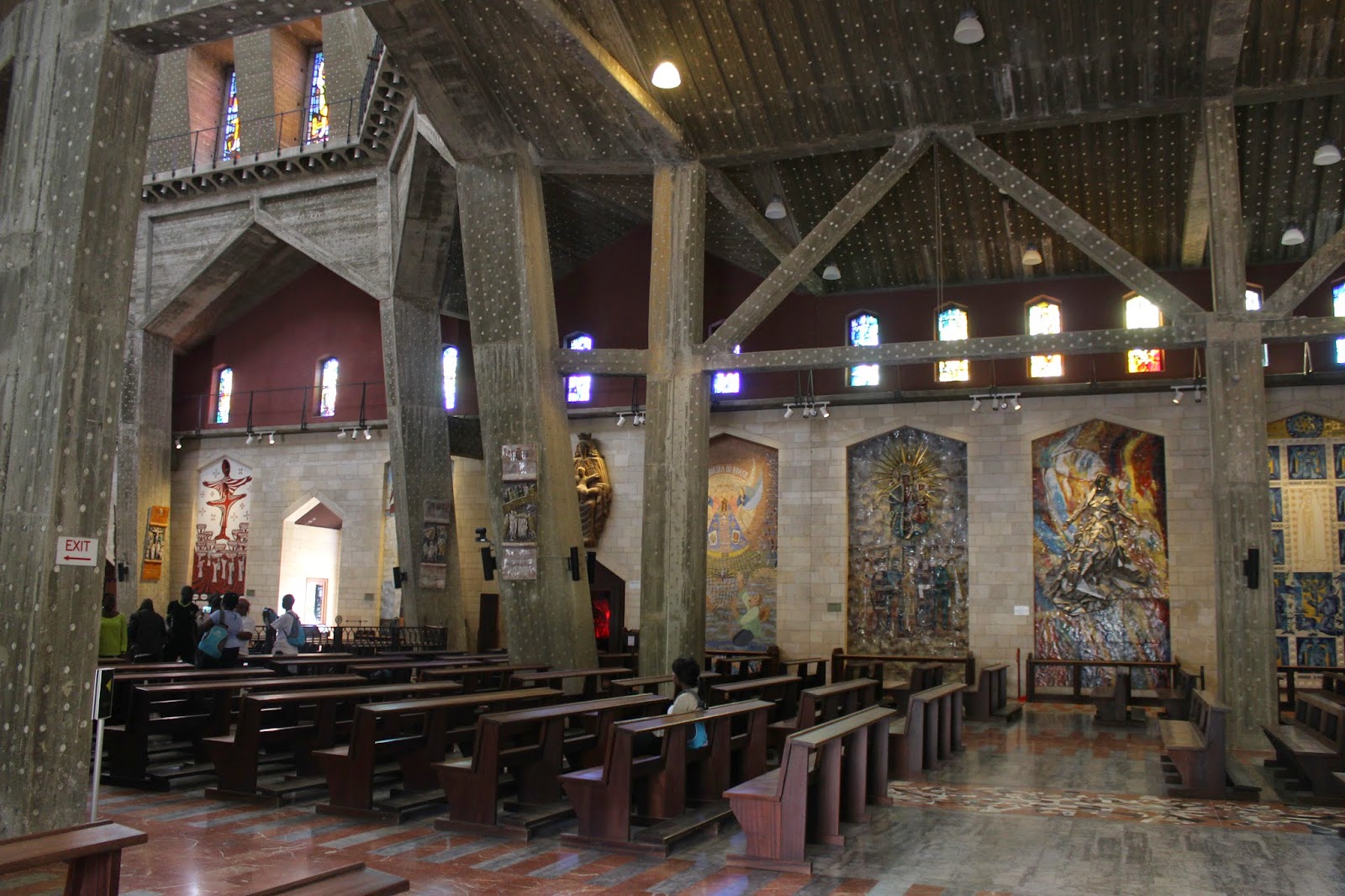
In Nazareth we had a discussion about the Christian and Muslim understandings of the Annunciation. I began my reflections with the apocryphal story of God asking other women to bear his son before Mary said 'yes'. Though apocryphal, this story highlights the importance and significance of Mary saying 'yes' to God, with all that that involved in terms of difficulty and heartbreak.

Mary was unmarried, young, and poor. The social circumstances of a young, poor, unmarried mother in first-century Palestine would have been difficult. This pregnancy would shape her future. It would have taken tremendous faith and courage to withstand the prejudice of her critics.

Additionally, her saying 'yes' to God led her, as Simeon prophesied (Luke 2. 22 - 38), to the heartbreak of the cross (as captured in this poem from 'The Passion'):

And a sword pierced her heart,
as the whip flayed his back,
as the cross made him fall,
as the nails pierced his wrists and feet,
as the spear pierced his side,
as she held the limp, lifeless adult body
she had once held, as a newborn babe, to her breast.

In my reflections I sought to highlight the human cost and challenge often involved in saying 'yes' to God (understood, in Islamic terms, as the central concept of submission to the will of Allah).

I ended with Malcolm Guite's sonnet entitled 'Theotokos':

You bore for me the One who came to bless
And bear for all and make the broken whole.
You heard His call and in your open ‘yes’
You spoke aloud for every living soul.
Oh gracious Lady, child of your own child,
Whose mother-love still calls the child in me,
Call me again, for I am lost, and wild
Waves suround me now. On this dark sea
Shine as a star and call me to the shore.
Open the door that all my sins would close
And hold me in your garden. Let me share
The prayer that folds the petals of the Rose.
Enfold me too in Love’s last mystery
And bring me to the One you bore for me.

--------------------------------------------------------------------------------------------

Aretha Franklin - Ave Maria.