Wikio - Top Blogs - Religion and belief
Showing posts with label m. west. Show all posts

Monday, 22 January 2024

'From Hong Kong to Wickford' artists


The autumn exhibition at St Andrew's Wickford was 'From Hong Kong to Wickford', a multifaceted pictorial display featuring composer and creator/director of combined-art works and projects Ho Wai-On's lifetime of interaction with UK and Hong Kong based artists/people that have resulted in many creative works. Click here to see a talk Wai-On gave at St Andrew's Wickford about her work.

This post provides additional information and links to some of those who contributed work to this unique exhibition and to some of their work:

Marcus West

Marcus West is a Cardiff based digital artist who utilises CAD software to create abstract artwork. He first began exhibiting his artwork in the early 1970’s at the University College Cardiff and has since gone on to exhibit a range of his projects at institutions across the UK, including London’s Victoria and Albert museum. Historic Tech have an excellent article giving an extensive summary of his career together with many examples of his work. 

Marcus writes: "I first exhibited in the early 1970's at University College Cardiff, as it then was: the exhibition consisted of a collection of geometrical images created with a mainframe computer controlling a plotting device - essentially a ball-point pen moving over the surface of a sheet of paper. 3 of my works dating from this era are in the Digital Art collection in London's Victoria and Albert Museum.

My work from the last decade has been particularly influenced by the artists Victor Vasarely and Bridget Riley. Unlike them, however, I create my work with the assistance of a computer, hence my description of my work as “computer-assisted art”. I imagine a form, express it in terms of the mathematical processes appropriate to create such a form, and I write a computer program to utilise these mathematical processes to place millions of carefully-selected points of colour upon a kind of virtual canvas within the computer‘s memory. Thus the images emerge from mathematical and geometrical first principles, entirely within the computer - I don't typically import photographs into the computer for subsequent manipulation. Finally, the images are transferred from this virtual to the tangible world by printing them using archive-quality inks and paper.

Since devising these techniques, working in this way has become something of an obsession, and I have created many families of works, each embodying a core theme which is then expressed in dozens or scores of carefully-crafted variants. Frequently, of course, this process of exploration will give rise to variants that go well beyond my initial imaginings, which is particularly satisfying.

One of my works 'Fibonacci Image with blue cells emerging from an orange background', was among the 25 shortlisted works in the 2015 Lumen Prize, an international competition for Digital Art.

More recently I have started to make more reference to real-world objects and have moved away somewhat from works that derive from pure geometry."

Marcus’ recent projects have been based around geometric images created using FreeCAD, an open-source general-purpose parametric 3D CAD modeller and building information modelling software with finite-element method support. His process is as follows: "I imagine a form, express it in terms of the mathematical processes appropriate to create such a form, and I write a computer programme to utilise these mathematical processes to place millions of carefully selected points of colour upon a kind of virtual canvas within the computer memory."

To go to his secure store where you can buy framed or unframed prints, and some other merchandise (cards, mugs etc) with his artwork on click here.

Juliet Chenery-Robson

Juliet Chenery-Robson is a visual artist and academic researcher with a strong interest in exploring the terrain that juxtaposes the visual arts and medical science. In 2015 she completed an AHRC funded, practice-led Photography PhD that focused on the visual representation of the invisible illness ME (Myalgic Encephalomyelitis). Adopting a participatory action research methodology, Juliet worked with ME sufferers to create visual and textual portrayals of sufferers’ illness experience. Since completing her PhD she has secured research and development funding, via EngageFMS (Patient & Public Engagement & Involvement), to explore the visualisation of chronic illness as part of an arts and medical science collaboration with Newcastle University’s Medical and Creative Arts departments. 

Background to her ME research: The chronically ill ME sufferer experiences invisibility on four interlinked fronts: physical, social, medical, and political invisibility. The main aim of the project was therefore to create work, in participation with ME sufferers, that could be used as a tool to raise awareness of ME’s invisibility and communicate an understanding of ME to public, art, and medical audiences. By exploring the many layers that constitute ME and by incorporating the personal view of ME sufferers—through a combination of photography, text, audio, SenseCam, family album photographs, and Google Earth images—the research tested different methods of using metaphor to visually represent ME’s invisibility. It has also helped provide ME sufferers with a ‘voice’ by which to communicate the many problems they face as they try to cope with a life that is disabled by ME.

Polly Hope

Polly Hope was a British artist, designer and author. Hope created artworks in a variety of mediums, including paintings, portraits, sculpture, textiles and ceramics. Examples of her artworks are in the permanent collection of the V&A.

Bryan Robertson wrote that: "Polly Hope works consistently as a figurative artist with a keen appreciation of abstract principles and she likes to move freely from one medium to another, from drawing to painting, from printmaking to photography, from making sculpture to designing and executing murals and other decorative commissions. She excels as an artist in all these disciplines and sometimes likes to blur the edges herself between different techniques ... 

Polly Hope has a strong decorative flair and in recent years she has completed some large-scale schemes: painted murals at the Barbican Centre London, ceramic murals and sculptures for the new Shakespeare's Globe theatre in London, as well as a fountain in Switzerland. The range and variety of her work is part of her strength - she has also recently completed all the drawings for a half-hour animated film and made a perfect sequence of vistas in watercolour of Hong Kong's islands and waterways - but it means that her identity as an artist sometimes eludes conventional assessment. For some years, for instance, she created a long sequence of stuffed soft sculptures, bringing whole aspects of classical sculpture, religious iconography and folk-art to new life with three dimensional stuffed, sewn, appliquèd, coloured and patterned figures: scenes and situations of tremendous wit and poetic verve, one of them neither a scene nor a situation but a richly detailed portrait of a well known English museum director with a love of gardening and cats: the man in his world."

In Wickford we showed Hope's portrait of Wai-On, which can be seen by clicking here.

Benson Wong

Belford Jewellery was first established in 1977 by Leung Kwok Ching and her brother-in-law Benson Wong. Belford started off as a passionate hobby of two art-loving owners commissioning designs for good friends and valued clients. Benson, being the youngest sibling in his family, had a natural talent in design at a very young age and a strong passion for all things beautiful. A fashion designer by training, he first gained exposure to the jewellery industry from spending time at his brother’s diamond wholesale company, and was captivated by the dazzling universe of diamonds and gemstones. He realized the endless possibilities he could create by combining the design skills he garnered during his studies in England with the colourful treasures of nature, thus began his love for jewellery design.

Throughout the years, Belford has endeavoured to unite functional art with quality craftsmanship, and with Benson as the forefront, their design team has won numerous awards for their inspiring jewellery designs, and the company has become an established brand name in the industry.

For 'From Hong Kong to Wickford', Benson provided prints of designs from his work in fashion to his jewellery designs. This included the “cyclic group” symbol he used to create a movable diamond pendant - see here.

Albert Tang

Albert Tang is an actor and model who has also trained in architecture and music. Wai-On writes: "I met Albert Tang during my first year at the Royal Academy of Music, At the time he studied piano privately with Peter Katin. He is multi-talented and we have a lot of common interests. When I had the idea for this multi-media work, 'Metamorphosis', I asked Albert to be the artistic director."

In the exhibition, we displayed Tang's 'Metamorphosis' designs and examples of his art works.

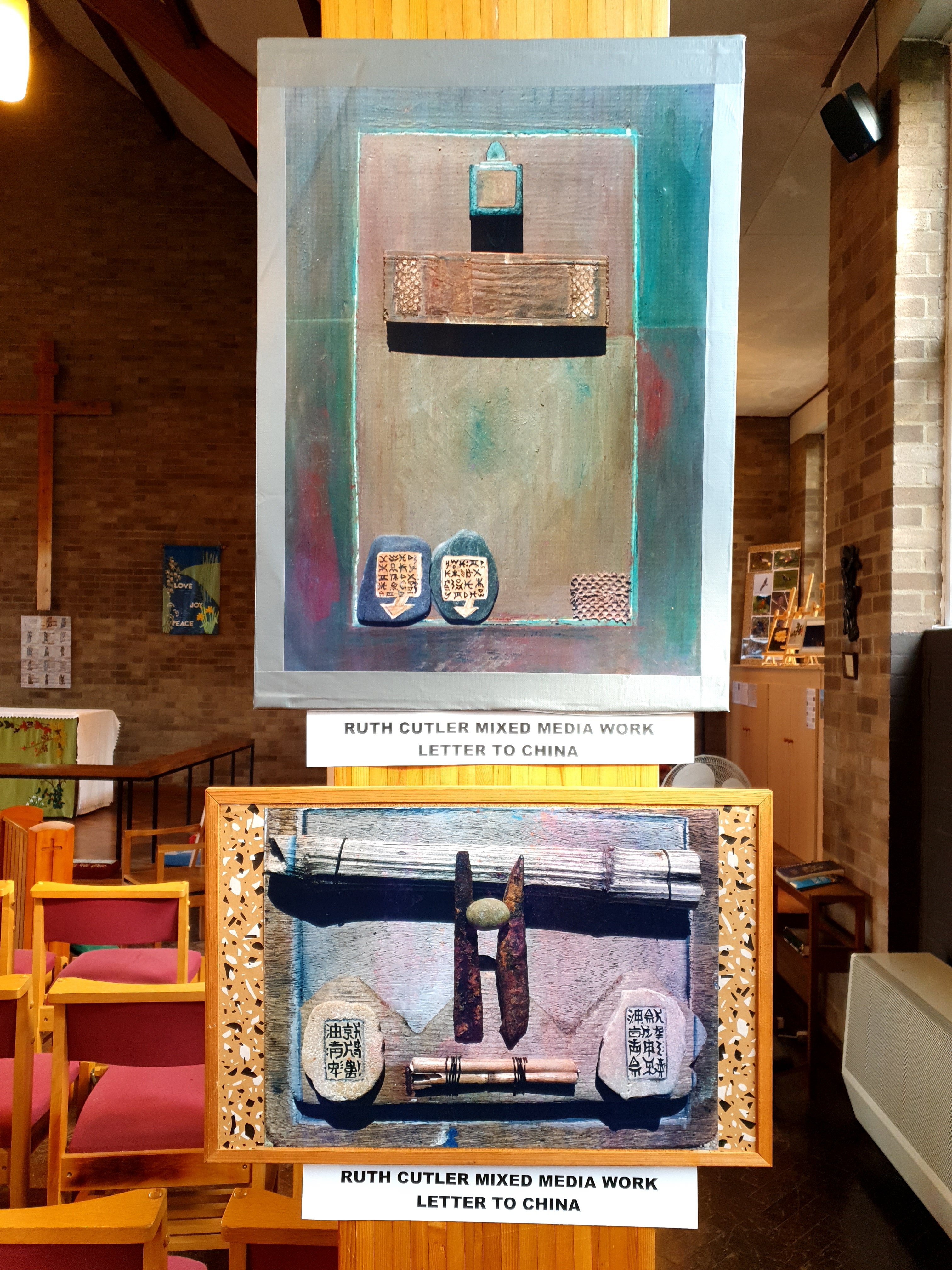
Ruth Cutler

Ruth Cutler has been described as Thanet’s greatest living-here artist. Her Sea Garden project in Ramsgate was crafted from local stones and plants and transformed a piece of wasteland.

We displayed prints of work by Ruth Cutler previously displayed in Wai-On's InterArtes events.
 
The exhibition also included poetry from David Tong, photographs of the Buddha by Kitty Kwan at Leshan Giant Buddha, Dazu Rock Carvings and Longmen Grottoes, photographs of Moon Festival Celebrations in London's China Town by Roy Reed, photographs of Hong Kong birds, photographs of Hong Kong by Clark Ainsworth, images by Wai-On's fellow students from , photographs by Ben Rector and Martin Singleton used in music videos created by Wai-On, and 'Blessed', a music video made on the retirement of a former Team Rector of the Wickford and Runwell Team Ministry using imagery from St Andrew's Wickford.

------------------------------------------------------------------------------------------------------

Ho Wai-On - Blessed.

Monday, 15 June 2015

Discover & explore: Faith


We had a very positive beginning to the 'Discover & explore' service series at St Stephen Walbrook. Among the comments made by those present were these:
  • 'Magnificent choir & organ'
  • 'Both the songs and the reflection were excellent' 
  • 'Beautiful music; the readings were long and meaty! The whole liturgy was good'
  • 'St Martin's Choral Scholars – wonderful tone & expressions'
Here is my reflection on the theme of 'Faith' from today's service:

On 15 June 1215 at Runnymede King John agreed to have Magna Carta, the ‘Great Charter,’ sealed. This event has later become recognised as one of the most important events in English history as it marked the road to individual freedom, parliamentary democracy and to the supremacy of law.

To mark this event, today, at Runnymede, there has been a national Magna Carta Foundation of Liberty ceremony, organised by the National Trust and Surrey County Council, and attended by 4,500 invited guests and VIPs from a cross-section of the community and around the world.

The City of London is the only place to be named in Magna Carta, in a clause guaranteeing "the City of London shall have all its ancient liberties by land as well as by water." It also played a fundamentally important role in the events leading to Magna Carta: Temple, in the west of the City, was where a posse of barons first confronted King John to demand a charter. The City was also later granted the right to appoint a Mayor (later known as the Lord Mayor), part of whose duties was to ensure the provisions of Magna Carta were carried out. As part of the 800th Anniversary celebrations of Magna Carta, the 1297 Magna Carta is currently displayed in the City of London’s Heritage Gallery.

Magna Carta starts as a religious document, concerned with the “health of the soul” of the King, and with the “honour of God,” and with the “exaltation of the Holy Church”. Dr Mike West notes that “Magna Carta established the freedom of the English church from state interference and this has grown to enshrine the rights of each individual to enjoy religious freedom”.

Magna Carta has led to Article 9 of the Human Rights Act, the right to freedom of thought, conscience and religion, which includes:

  • the freedom to change religion or belief;
  • the freedom to exercise religion or belief publicly or privately, alone or with others;
  • the freedom to exercise religion or belief in worship, teaching, practice and observance; and
  • the right to have no religion (e.g. to be atheist or agnostic) or to have non-religious beliefs protected (e.g. philosophical beliefs such as pacifism or veganism).

The process which took us from the Magna Carta establishing the freedom of the English church from state interference to the rights which we all have to enjoy religious and non-religious freedom ran through the period explored by paintings in the recent re-hanging of the Guildhall Art Gallery’s Victorian Collection. The mid-19th century, as is noted in the Gallery’s description of the theme of ‘Faith’, saw a “crisis of faith” brought about by new scientific developments, such as geological discoveries and Darwin’s evolutionary theory, although the majority of society continued to consider personal spirituality as a key component of life.

The debates which began in that period, and which never simply involved the binary oppositions of faith and science that feature in the usual popular commentaries on that period, continue into the present. These lead us firstly to value the freedom we have to hold either religious or non-religious beliefs. This comes with the recognition, identified primarily by Michael Polanyi, that all human knowledge, including that of science, is ultimately faith-based. This is so, because all knowledge relies on personal commitments which motivate our highest achievements and mean that we believe more than we can prove and know more than we can say. As Hebrews 11 expresses it, ‘Faith is the assurance of things hoped for, the conviction of things not seen.’ Secondly, for those who do hold religious beliefs, they lead us to value the place of doubt and debate in faith. The latter is well expressed by the statement at St Martin-in-the-Fields that the church exists to honour God by being an open and inclusive church that enables people to question and discover for themselves the significance of Jesus Christ.

As these understandings of faith and the freedom to believe are not universally applied, Dr Mike West, in exploring the legacy of Magna Carta, writes that, “Today it challenges faith communities to examine the part they might play in the development of a liberal democracy and to be part of the solution rather than part of the problem in international relations.”

-------------------------------------------------------------------------------------------

John Stainer - God So Loved The World.

Sunday, 10 May 2015

British Shared Values and Faith

The Muslim Community & Education Centre and Global One 2015 hosted an event today exploring shared values among faith communities in Britain. The event aimed to encourage meaningful and insightful conversation on the issue of shared values and faith in Britain, and brought together leaders and thinkers from Britain’s faith communities as part of a multi-faith discussion panel chaired by The Right Honourable Baroness Berridge which included Rabbi James Baaden, Imam Asharaf Salah and myself.

With the rise of religious discrimination and tension in the UK and around the world, proactive inter-faith dialogue is as important and relevant as ever. Faith communities in the UK face increasing challenges and yet provide invaluable resources in the form of education, guidance, social engagement and community support on local, national and international levels. In the run up to and aftermath of the general election British values have been constantly in the media spotlight with questions about what British values really mean and how they are compatible with major religions.

A 2014 study by Ipsos Mori revealed that Britons overestimate the proportion of Muslims in the country by a factor of four. These mass misconceptions become problematic when combined with biased perceptions of Islam leading people to feel threatened by the faith and its perceived incompatibility with British values. A similar study for Jewish Policy Research found that 28% of respondents felt anti semitism in the UK had increased a lot in the past five years; whilst 40% felt it had increased a little.

Faith communities’ participation in civil society is an important aspect of building strong cohesive communities. As participation is an indicator of how vibrant a civil society is faith participation can play an enabling and empowering role for many faith communities particularly those which are disadvantaged.

By bringing together religious, social and political leaders and thinkers The Muslim Community & Education Centre and Global One 2015 hoped to bring the discussion on shared values and faith to the forefront of British community life and find positive and achievable solutions to the problems faced by these communities today.

In my contribution to the debate I said the following:

This week my sermon at St Stephen Walbrook was based on James 1. 22, “be doers of the word, and not merely hearers.” This passage says that if we are hearers of God’s word and not doers, we are like those who look at themselves in a mirror and immediately forget what they were like. “A first century mirror was not the silvered glass one without which no bathroom is complete today. It was beaten bronze and gave a fuzzy image. If you wanted to be sure your face was not dirty a quick glance was not sufficient. You would need to peer intently, work out what was required, then go and find some clean water to do something about it. The same is true of the way we react to encountering God. The real blessing of the Christian faith does not lie in listening to sermons or reciting liturgies, but in dwelling on what is true until it transforms what we do. A genuine encounter with Jesus provokes action.”

The action it produces is, as the letter of James states, “care for orphans and widows in their distress.” Jesus said, in the Parable of the sheep and goats, that God’s judgement on us will be based on our actions; giving food to the hungry, drink to the thirsty, welcoming the stranger, clothing the naked and visiting those in prison. These actions are to be the end result of our faith. If our looking deeply into God’s word does not result in our doing these things, our faith is not genuine and we are not walking the walk as Christians.

One summary of those words from and thoughts based on the Christian scriptures would be the sentence known as the Golden Rule which appears in the scriptures of many faiths i.e. ‘Do to others as you would have them do to you.’

Let us bear these thoughts in mind, as shared values, as we think a little now about the contribution of Christianity to shared British values.

Julian Rivers has argued in ‘Religion and Law’, that:

“The political and legal implications of Christianity have been quite different from those of Judaism and Islam.” “Judaism and Islam manifested themselves as the law of an entire community organised around those faiths. So it makes sense to talk of Islamic or Jewish criminal law, family law, property law, law of contracts, charitable foundations and so on.” “Instead, under God, in Christianity, there are two authorities on earth, not one, and they are church and government. The sphere of church is characterised by salvific grace, by individual commitment, by freedom – so much so that the very concept of law might be out of place in the church (although Christian ecclesiological traditions vary considerably on that particular question). The sphere of government is characterised by judgement and coercion in the service of goods common to all of humankind. The tasks of government may be considered primarily in terms of restraining evil, or of coordinating human action in pursuit of the common good.”

He notes that, as a result, English law has been beneficially affected by Christianity” and summarises the argument of Lord Denning (Master of the Rolls 1962-1981) who, on his retirement as President of the Lawyers’ Christian Fellowship, published a pamphlet on this topic: “These included a belief in the importance of truth, requirements of good faith in statutory interpretation and contractual obligations, the development of the law of negligence, basic presuppositions of criminal law (such as the requirement to demonstrate that the accused had a ‘guilty mind’), the principle of government under law, the rise of social welfare legislation, and the centrality of a Christian conception of marriage.”

To this list Rivers adds the following:

“Modern commitments to political liberty and equality within the law emerged out of debates which were internal to Christianity; debates which were catalysed by the inescapably radical liberty and equality exemplified by Jesus and his disciples. Jesus is the model of the accountable public servant, using power for the good of others and conscious of his answerability to a higher tribunal. English nationhood owes more than a little to the example of Israel. Christianity also reinforced a commitment to authority, order and the rule of law.”

Dipti Patel has explored, in a paper on the religious foundations of Human Rights, approaches to understanding Human Rights based on the Judeo-Christian tradition. She writes that:

“The central understanding of the human being within the Judeo-Christian tradition starts with the idea that God was the creator of all things. He created man in his own image: ‘Let us make man in our image, after our likeness … So God created man in his own image, in the image and likeness of God he created him; male and female he created them.’ (Genesis 1:26-27, 5:1, 9:6). This supports the idea of rights that all enjoy by virtue of their common humanity. By virtue of reflecting the divine image, absolute worth is accorded to human beings. This gives all human beings a special status, a unique value, or ... his dignity. Therefore the human being has absolute and inviolable worth. A human being is not to be valued for what society can do with him, he is not a means to an end. Being created in God’s image is to be understood ‘in the sense of God bestowing dignity and honour upon man’. This is explained in Psalm (8:5) where it is stated ‘You have made him but a little lower than the angels, and have crowned him with glory and honor.’ This means that every human being is to be treated with love and respect.”

This is a shared understanding within the Judeo-Christian tradition, while the particular Christian perspective on this issue is that:

“In the New Testament, the Son of God, in the person of Jesus Christ, perfected divine regard for the human being. Through Christ humanity is freed from sin and as a result of the Fall, redeemed before God, and exists in a state of grace. So it is in Christ that the image of God, obscured and blurred by sin, is restored. The human being has supreme value with infinite worth; he is not a bearer of borrowed values. So the Christian understanding of human rights is entirely a function of the value divinely granted to humans through Christ. This is absolute and universal. The absolute value of a person pre-exists any social differences, all are seen as equal, and as a result the value is universal. All have sinned and fall short of the glory of God; they are justified by his grace as a gift, through the redemption which is Jesus Christ, who is to be received by faith (Romans 3:21- 25). The origin of human rights language in the Judeo-Christian tradition therefore starts with the idea of the creation of man in the image of God, and is therefore absolute, and the state of grace, which is universal. This is the reason why it is important to recognise the dignity of every human being regardless of any social differences. Dignity is inherent. Human rights law provides for a way to recognise the respect for dignity.”

One significant point in the development of Human Rights legislation and the history of Christian influence on British values which is being celebrated this year, is the signing of Magna Carta: “In 1215, after King John of England violated a number of ancient laws and customs by which England had been governed, his subjects forced him to sign the Magna Carta, which enumerates what later came to be thought of as human rights. Among them was the right of the church to be free from governmental interference, the rights of all free citizens to own and inherit property and to be protected from excessive taxes. It established the right of widows who owned property to choose not to remarry, and established principles of due process and equality before the law. It also contained provisions forbidding bribery and official misconduct. Widely viewed as one of the most important legal documents in the development of modern democracy, the Magna Carta was a crucial turning point in the struggle to establish freedom.”

Magna Carta starts as a religious document, concerned with the “health of the soul” of the King, and with the “honour of God,” and with the “exaltation of the Holy Church”. Dr Mike West notes that “Magna Carta established the freedom of the English church from state interference and this has grown to enshrine the rights of each individual to enjoy religious freedom. Today it challenges faith communities to examine the part they might play in the development of a liberal democracy and to be part of the solution rather than part of the problem in international relations.”

-------------------------------------------------------------------------------------------

Yusuf Islam - Peace Train.