Wikio - Top Blogs - Religion and belief
Showing posts with label pugin. Show all posts

Monday, 24 June 2019

Artlyst: Mat Collishaw Challenges Faith Perspectives With Ushaw Installation

My latest preview piece for Artlyst highlights a new commission from internationally renowned British artist Mat Collishaw which will see the artist create a site-specific installation that explores the themes of martyrdom and treason, worship and heresy at Ushaw, the former seminary in County Durham, from 5 July until 3 November:

'This work will continue Collishaw’s meditations on the alluring and the revolting, the familiar and the shocking, the poetic and the morbid. The installation will call attention to the beauty of Pugin’s work and the treasures held at Ushaw. Once again, the morality of his upbringing and the challenges of faith – both light and shadow – will seed his work.'

My other Artlyst articles and interviews are:
-----------------------------------------------------------------------------------------------------

Bill Fay - Omega Day.

Sunday, 14 October 2018

The Life, Art and Legacy of Charles Eamer Kempe


My most recent book review has been published by ArtWay and is of Adrian Barlow's Kempe: The Life, Art and Legacy of Charles Eamer Kempe (Lutterworth Press 2018).

'Kempe offers a radical revaluation of the life, work and reputation of Charles Eamer Kempe (1837–1907), one of the most remarkable and influential figures in late Victorian and Edwardian church art. Kempe's name became synonymous with a distinctive style of stained glass, furnishing and decoration deriving from late mediaeval and early Renaissance models. To this day, his hand can be seen in churches and cathedrals worldwide.

Drawing on newly available archive material, Adrian Barlow evaluates Kempe's achievement in creating a Studio or School of artists and craftsmen who interpreted his designs and remained fiercely loyal to his aesthetic and religious ideals. He assesses his legacy and reputation today, as well as exploring his networks of patrons and influence, which stretched from the Royal Family and the Church of England hierarchy to the literary and artistic beau monde. These networks intersected at Kempe's stunning Sussex country house, Old Place, his 'Palace of Art'. Created to embody his ideals of beauty and history, it holds the key to understanding his contradictory personality, his public and private faces.'

In the review, I state that: 'Kempe’s is a fascinating story of a self-made man in tune with his own era who built a brand able to endure for sixty years. In common with A.W.N. Pugin, William Morris and G.F. Watts, he also created a home which fully expressed his personal inspiration and vision and was considered a masterpiece in its day. In one volume Barlow tells Kempe’s story and that of his collaborators, assesses key works and considers Kempe’s legacy and reputation. He brings Kempe’s faith-full practice to life while arguing for the ongoing significance of work based on an unchanging belief that past styles of faith were the best expression for contemporary faith.'

------------------------------------------------------------------------------------------------

Edward Elgar - The Spirit Of The Lord.

Sunday, 13 July 2014

Sabbatical art pilgrimage: St Michael and All Angels Waterford


In 1919 designs by Harry Clarke for a two-light window, St Cecilia and a Listening Angel, commissioned for St Michael and All Angels Waterford were rejected by the Diocesan Advisory Committee (DAC) on the grounds that the design was out of keeping with the Pre-Raphaelite windows already in the church.

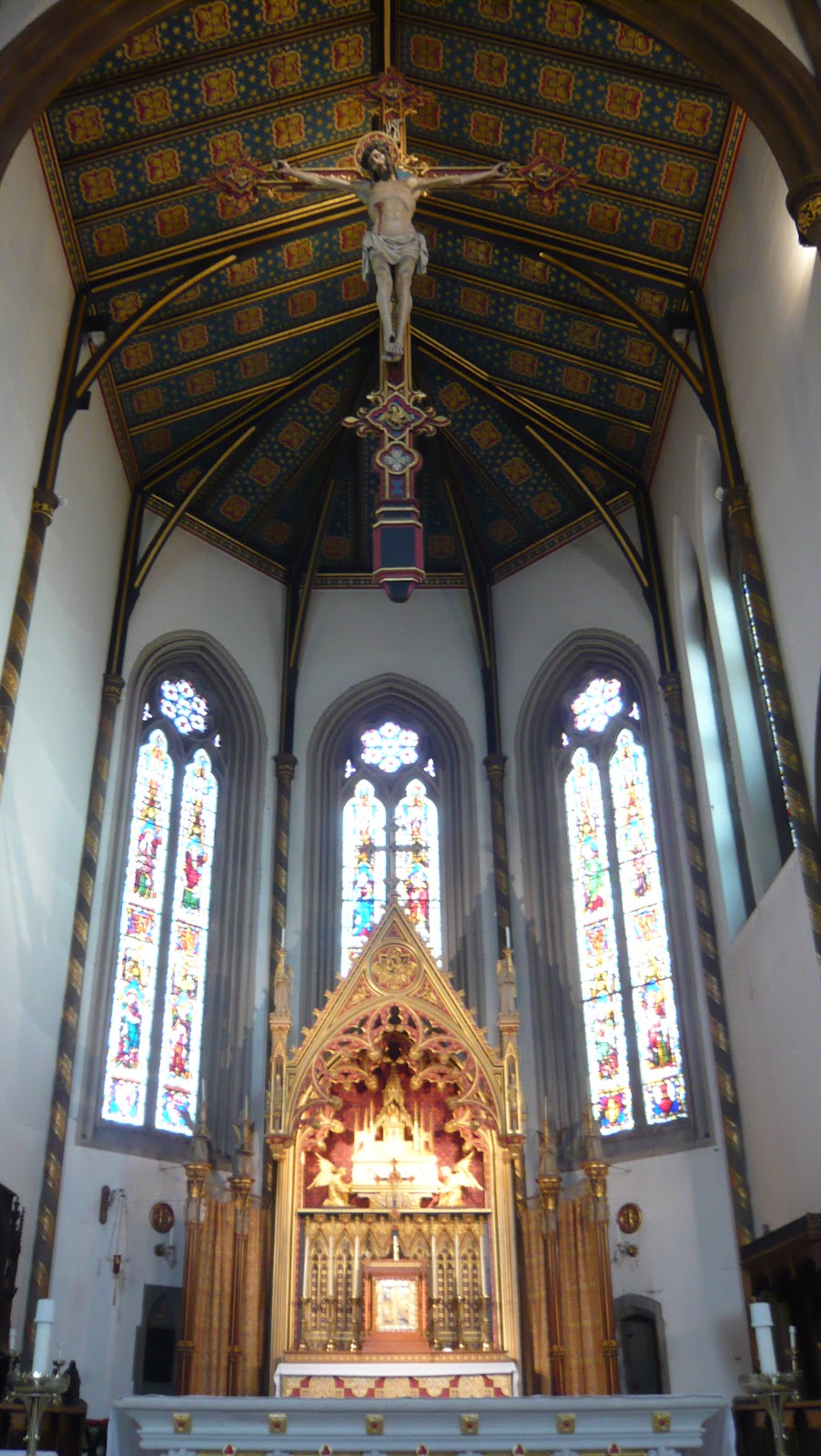
St Michael and All Angels is a minor gem of a Church which was consecrated in 1872, built in the style of Early English Gothic, and populated throughout with Pre-Raphaelite stained glass as well as mosaics from James Powell and Sons (the Whitefriars Studio). St Michael and All Angels, therefore, stands in a tradition which reflects a set of very English styles and influences.

Henry Woodyer, its architect, was a disciple of Augustus Pugin. Giles Worsley has written that Woodyer’s work is “predominantly muscular Gothic, in the spirit of A W N Pugin” and like Pugin “stems from his religious bent.” At its best, he argues, “there is an energetic vigour to his religious and secular work” and “a convincing vision of the Middle Ages, rich with colour and decoration.”

Augustus Welby Pugin - the architect, designer, writer, and theorist known as ‘God’s own architect’ - had a major influence on architecture and design throughout the English-speaking world well into the twentieth century. His importance lies both in his creation of the Neo-Gothic style and in his anticipation of many of the statements on design by John Ruskin which led to the formation of the Pre-Raphaelite Brotherhood, the work of Morris & Co., and the development of the Arts & Crafts Movement.

William Morris - poet, artist, philosopher, typographer and political theorist - was the greatest designer and one of the most outstanding figures of the Arts and Crafts Movement. In 1861, with a group of friends, he started the business Morris, Marshall, Faulkner & Co. which provided beautiful, hand-crafted products and furnishings for the home. Influenced by the ideas and writings of Thomas Carlyle and John Ruskin, the company revived many of the traditional arts which had been swept away by industrialisation including embroideries, tapestries and stained-glass.

In addition to the creation of new artefacts, Morris was also concerned about the preservation of art and architecture from earlier ages and so, in 1877, he and other notable members of the Pre Raphaelite brotherhood held the inaugural meeting of the Society for the Protection of Ancient Buildings (SPAB) in Bloomsbury. As founding members they were deeply concerned that well-meaning architects were scraping away the historic fabric of too many buildings in their zealous ‘restorations.’ When the DAC rejected Clarke’s design for St Michael and All Angels, they were in essence seeking to follow this strand of Morris’ thought; although whether he would have agreed with their decision is a moot point.

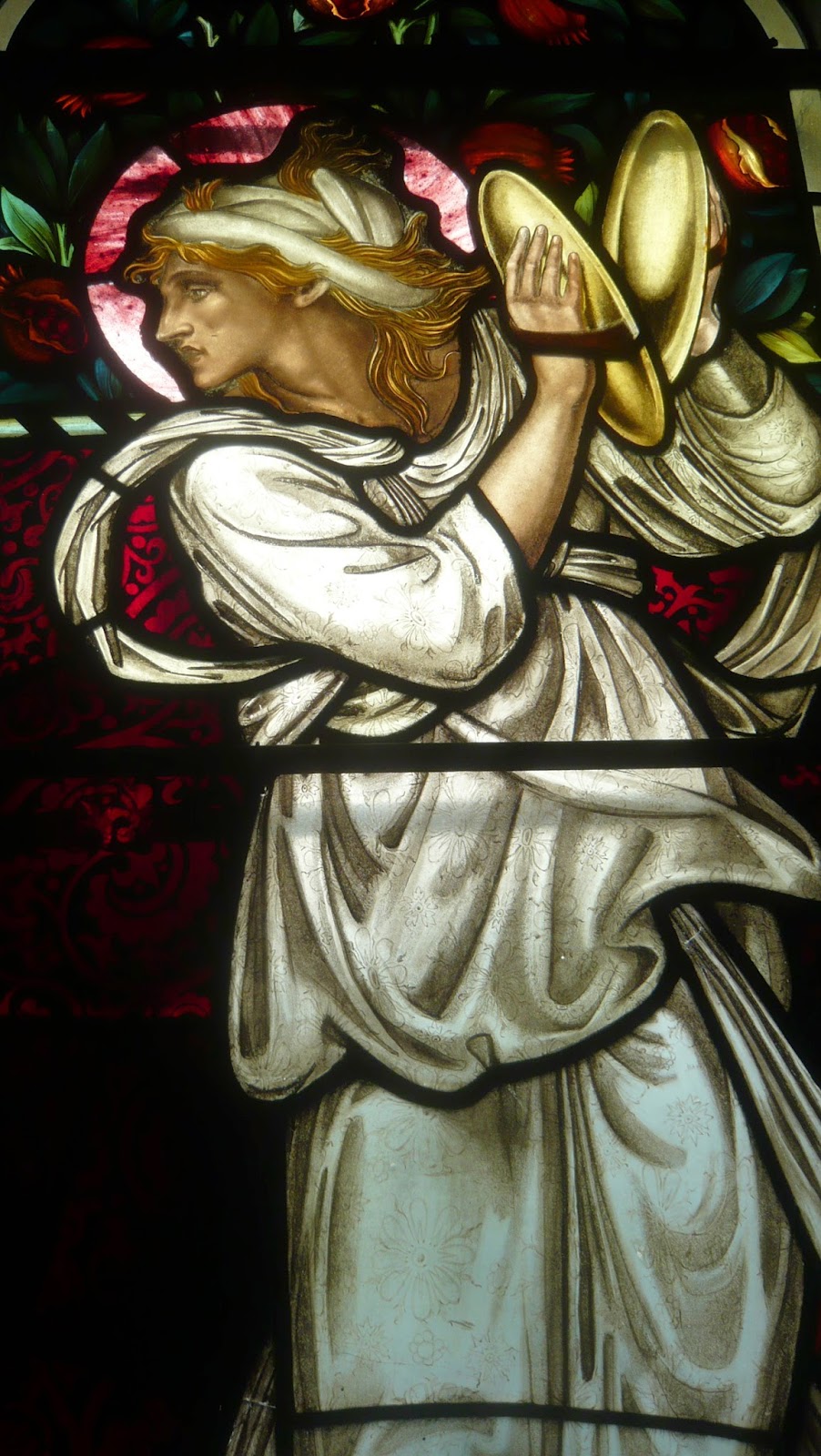
Many of the windows at St Michael and All Angels are by Morris & Co. and feature leading Pre-Raphaelites including Ford Madox Brown, Edward Burne-Jones, Morris, and, possibly, Dante Gabriel Rossetti. Later windows by Selwyn Image, Karl Parsons and Douglas Strachan are part of the same tradition and ensure that the feel of the building as a whole is cohesive. The third chancel window, which depicts the prophetess Miriam and was completed by Morris from a design by Burne-Jones, was included on a list of the 12 best stained glass windows in English churches as judged by photographer Lucinda Lambton.

The Whitefriars Company was a successful British glasshouse closely associated with leading architects and designers from the later portion of the 19th century onwards including Philip Webb who designed glass for William Morris. From 1876 James Crofts Powell ran the stained glass department which also developed mosaic techniques to the Byzantine standards of Ravenna. Powell’s opus sectile mosaics were tilted to deflect the light and gained sufficient credit to be used by William Blake Richmond in his work at St Paul’sCathedral. Whitefriars carried out the creation of the chancel mosaics at St Michael and All Angels to designs by J. P. Hutchinson.

Despite the beauty of the artwork and the building, it is not primarily the Pre-Raphaelite work that I have come to see here. The most recent of the windows, the 1929 St Cecilia and Angel by Karl Parsons, is described in the Church guide as being “especially beautiful when the summer evening sun shines through its vibrant colours.” Acid-etching and plating was used to create the enriched colour and texture found in this window. The window depicts St Cecilia, the Patron Saint of Music, and the music she has inspired on this occasion, which is included in the upper tracery section above the figures, is the fugue from Beethoven’s penultimate piano sonata.

Karl Parsons was pupil and assistant to Christopher Whall, who was an important member of the Arts and Crafts Movement, a leading designer of stained glass and a teacher at the Royal College of Art (RCA) and the Central School of Art and Design. In addition to his work in England, Whall also assisted in reviving the art of stained glass in Ireland. At the invitation of Edward Martyn, Whall, and his colleague Alfred Ernest Child, worked with Sarah Purser to set up a new school of stained glass in Dublin which was christened An Tύr Gloine (Tower of Glass), with a credo that “each window should be in all its artistic parts the work of one individual artist.’

Parsons, who also taught at the RCA and Central School was a craftsman of outstanding ability who worked from a studio at the Glass House Fulham; the centre for most stained glass designers during the first half of the twentieth century. He and Harry Clarke met in 1913, while Clarke was studying the craft and before he began work for his father’s glass workshop, the Clarke Studios, also based in Dublin. The two men remained close friends until Clarke’s death in 1931. The St Cecilia and Angel window at St Michael and All Angels, although “unmistakably by Parsons rather than Clarke” was based on Clarke’s rejected design and means that a trace of the rejected work is found in this church despite its perceived incongruity with the existing Pre-Raphaelite glass (Harry Clarke: The Life & Work, Nicola Gordon Bowe).

Among the many ironies of this story is the fact that Clarke has been described as “the last of the Pre-Raphaelites” and “played a major part in the Arts and Crafts movement in Ireland … as well as in the international stained glass revival which arose from the movement in England.” He “can also be seen as Ireland’s major Symbolist artist, whether in his illustrations or in his stained glass” (Gordon Bowe). Symbolism was also a wider international movement of which the Pre-Raphaelites were part. Therefore, the rejected design, while considered out of keeping with the Pre-Raphaelite windows already in the church, was actually part of a body of work that built on the foundation laid by the Pre-Raphaelites.

Clarke’s strange genius was to fuse “the Burne-Jones/Whall idiom” with “an eclectic and decadent Symbolism of medieval richness and Byzantine splendour” which was achieved by means of his having, as a young man, “absorbed Burne-Jones, [Aubrey] Beardsey, Charles Ricketts, Edmund Dulac, Kay Nielsen, the Glasgow School[Gustave] Klimt, the Japanese print, the Symbolists, and the Russian ballet.” As a result, “his art displays a wilful decadence and an ambivalent religious mysticism of medieval intensity which ranges from the sublimely beautiful to the grotesquely macabre, rarely found in the work of his Celtic peers.” (Gordon Bowe).

Similarly, James White has noted that Clarke “always carried the sensual-mystical conflict with him” - viewing “his drawings as an outlet from the religious subjects with which he was daily involved in his stained glass work” – and that, as a result, “few artists have been more concerned with the conflict of religion and sensuality.” His works are “uniquely imaginative creations” undertaken with remarkable technical skill meaning that “when he applied his minute and precise line to his process of plating and aciding he achieved an art form of extraordinary perfection.” Peyton Skipwith has suggested that by means of Clarke’s work, alongside that of Evie Hone at An Tύr Gloine, it was Ireland which revived the art of stained glass in the twentieth century (Gordon Bowe).

During his short life Clarke created 160 stained glass windows for churches and private patrons in Ireland, England, the United States and Australia. His unique style and technique combined rich colours with elongated figures that exude poise and grace. Deep blues and ruby reds were the hallmark of his work. As an illustrator of books, his five books for Harrap and Co show his genius in the area of graphic art. In England, work by Clarke is most easily seen at the Victoria & Albert Museum in London and the Stained Glass Museum in Ely.

--------------------------------------------------------------------------------------

The Blue Aeroplanes - Colour Me.

Friday, 1 June 2012

The Pugin Trail

My piece on Birmingham's Pugin Trail has been published in the current edition of the Church Times.

One strand of the Trail explores prints as an important vehicle by which Christianity was extended to and received by the wider community. Pugin used the work of Dürer, seem by him via prints, as inspiration for his own architectural and interior designs including furniture, tiles, wallpaper, and stained-glass windows.The influence that prints could have was also demonstrated by Pugin's own influence as his own name was made with the publication in 1836 of Contrasts, a book of satirical “before and now” etchings, through which he contrasted the glories of medieval architecture and its civilised society with the tired classical constructions that were the product of the degraded modern industrial city.

Rosemary Hill's God's Architect: Pugin and the Building of Romantic Britain provides an excellent introduction to the man and his work. The BBC documentary Pugin: God's Own Architect can currently be seen in i-player.

----------------------------------------------------------------------------------------

Bobby Womack - Deep River.

Thursday, 12 April 2012

Trailing Pugin in Birmingham


Over the last couple of days I've been following part of the Pugin Trail around Birmingham, taking in other sites along the way. 2012 marks the bicentenary of Augustus Welby Pugin (1/3/1812 – 14/9/1852), arguably the greatest British architect, designer and writer of the nineteenth century. A specially designed trail, highlighting the connections of Pugin and his friend John Hardman with Birmingham, is available from Birmingham's tourist information offices, museums and libraries as well as other key venues including St Chad’s Cathedral.

The Cathedral and Bishop’s House (originally opposite), and their interiors, were designed by Pugin. The cathedral is an internationally significant building, being the first Catholic cathedral to be built in the UK since the Reformation. The cathedral was built by George Myers (‘Pugin’s Builder’) and the original internal decorations and fittings were made by craftsmen who re-introduced medieval techniques of production: William Warrington, the chancel windows, 1841; John Hardman junior, the plate and, after 1845, several splendid windows; Herbert Minton, the floor tiles. Pugin’s magnificent rood screen was removed in a re-ordering, in 1967. The vestments were made by Lucy Powell and colleagues, to Pugin’s designs, many surviving to this day. Pugin, a collector of antiquities, also provided the Cathedral with some fine original medieval furnishings, acquired on his continental journeys, including the 15th century German Canons’ stalls and the pulpit. Beneath the Cathedral is a spacious Romanesque-style crypt containing several chantry chapels.

A delightful print display and trail ‘Pugin, Dürer and The Gothic’ runs at the BarberInstitute of Fine Arts until 24 June. Exhibits are from the Barber’s own collection and include a late medieval Brussels wood carving of Joachim and Anna, once owned by John Bernard Hardman; an early Netherlandish triptych of the Deposition, once owned by Pugin; a collection of eight prints and one drawing by Dürer, widely recognised as the greatest German Renaissance artist and a prime inspiration to Pugin, and a Pugin octagonal table on loan from King Edward’s School.

In 1838, Pugin persuaded his friend, John Hardman (1811-1867), to turn his Birmingham button-making business to making metalwork and later stained glass for his new churches.  The Museum of the Jewellery Quarter features a number Hardman pieces in its displays, and most of the techniques and processes demonstrated on the fascinating factory tour are exactly the same as used in the 19th Century by Hardman and similar metalworking firms. For the Pugin Bicentenary the museum is mounting a special exhibition on Pugin and Hardman which runs until January 2013.

Winterbourne House, also on the Pugin Trail is a rare surviving example of an early 20th century suburban villa and garden. The house was built in 1903 for John and Margaret Nettlefold, of Guest, Keen & Nettlefold. Designed as a small country estate the house boasted rustic outbuildings and large gardens. Both the house and garden follow the style of the Arts and Crafts movement with examples of local craftsmanship throughout.

I also visited the Ikon Gallery and was intrigued by Postcards From Japan - A Message From Tohoku Artistsa touring exhibition of A5 works by 22 artists from North East Japan marking the first anniversary of the devastating earthquake and tsunami that hit north east Japan on 11th March 2011. In the aftermath of the disaster, electronic means of communication largely failed, making the use of landlines, mobile phones and the Internet extremely difficult. The post office, however, was quickly up and running and in many cases the first opportunity to report news of survival to loved ones was by postcard. The exhibition is curated by Kate Thomson and Hironori Katagiri, who were working in Tohoku when the earthquake struck. Together the pair have voluntarily organised international exhibitions and projects to support recovery in Tohoku, encouraging local artists and their communities, and developing international cultural links. For more information visit  http://www.postcardproject.org/.

--------------------------------------------------------------------------------------------