Wikio - Top Blogs - Religion and belief
Showing posts with label prophecy. Show all posts

Saturday, 18 April 2026

International Times: Worlds of Creation and Destruction

My latest exhibition review for International Times is on 'William Blake: The Age of Romantic Fantasy' at National Gallery of Ireland:

'by showing Blake’s extraordinary works alongside paintings and drawings by his contemporaries - those he admired and those who he inspired – this exhibition reveals ‘how British art was taken in exciting new directions in this moment’. We also see the greatness of Blake’s vision and work afresh.

To fully understand this, however, we need to see that Blake’s visions were not simply romantic fantasy but were of spiritual reality breaking into the material world.'

For more on Blake see here and here.

My earlier pieces for IT are: an interview with the artist Alexander de Cadenet; an interview with artist, poet, priest Spencer Reece, an interview with the poet Chris Emery, an interview with Jago Cooper, Director of the the Sainsbury Centre for Visual Arts, a profile of singer-songwriter Bill Fay, plus reviews of: Joseph Arthur in concert; installations by Chiharu Shiota and Yin Xiuzhen at Hayward Gsllery, U2's 'Days of Ash', Mumford and Sons' 'Prizefighter' and Moby's 'Future Quiet'; 'Collected Poems' by Kevin Crossley-Holland; 'Lux' by Rosalía; 'Springsteen: Deliver Me from Nowhere'; 'Great Art Explained' by James Payne; 'Down River: In Search of David Ackles' by Mark Brend; 'Headwater' by Rev Simpkins; 'The Invisibility of Religion in Contemporary Art' by Jonathan A. Anderson; 'Breaking Lines' at the Estorick Collection of Modern Italian Art, albums by Deacon Blue, Mumford and Sons, and Andrew Rumsey, also by Joy Oladokun and Michael Kiwanaku; 'Nolan's Africa' by Andrew Turley; Mavis Staples in concert at Union Chapel; T Bone Burnett's 'The Other Side' and Peter Case live in Leytonstone; Helaine Blumenfeld's 'Together' exhibition, 'What Is and Might Be and then Otherwise' by David Miller; 'Giacometti in Paris' by Michael Peppiatt, the first Pissabed Prophet album; and 'Religion and Contemporary Art: A Curious Accord', a book which derives from a 2017 symposium organised by the Association of Scholars of Christianity in the History of Art.

Several of my short stories have been published by IT including three about Nicola Ravenscroft's EarthAngel sculptures (then called mudcubs), which we exhibited at St Andrew's Wickford in 2022. The first story in the series is 'The Mudcubs and the O Zone holes'. The second is 'The Mudcubs and the Clean-Up King', and the third is 'The mudcubs and the Wall'. My other short stories to have been published by International Times are 'The Black Rain', a story about the impact of violence in our media, 'The New Dark Ages', a story about principles and understandings that are gradually fading away from our modern societies, and 'The curious glasses', a story based on the butterfly effect.

IT have also published several of my poems, including 'The ABC of creativity', which covers attention, beginning and creation, and 'The Edge of Chaos', a state of existence poem. Also published have been three poems from my 'Five Trios' series. 'Barking' is about St Margaret’s Barking and Barking Abbey and draws on my time as a curate at St Margaret's. 'Bradwell' is a celebration of the history of the Chapel of St Peter-on-the-Wall, the Othona Community, and of pilgrimage to those places. Broomfield in Essex became a village of artists following the arrival of Revd John Rutherford in 1930. His daughter, the artist Rosemary Rutherford, also moved with them and made the vicarage a base for her artwork including paintings and stained glass. Then, Gwynneth Holt and Thomas Bayliss Huxley-Jones moved to Broomfield in 1949 where they shared a large studio in their garden and both achieved high personal success. 'Broomfield' reviews their stories, work, legacy and motivations.

To read my poems published by Stride, click here, here, here, here, here, and here. My poems published in Amethyst Review are: 'Runwell', 'Are/Are Not', 'Attend, attend' and 'Maritain, Green, Beckett and Anderson in conversation down through the ages'.

I am among those whose poetry has been included in Thin Places & Sacred Spaces, a recent anthology from Amethyst Press. I also had a poem included in All Shall Be Well: Poems for Julian of Norwich, the first Amethyst Press anthology of new poems.

'Five Trios' is a series of poems on thin places and sacred spaces in the Diocese of Chelmsford. The five poems in the series are:
These poems have been published by Amethyst Review and International Times.

-------------------------------------------------------------------------------------------------------------

Monday, 8 December 2025

Advent Meditation: The Prophets


Here's the meditation on The Prophets that I shared during Advent Night Prayer at St Andrew's Wickford this evening:

The prophets dreamed.
They dreamed of Bethlehem.
Of Bethlehem of Ephrathah, one of the little clans of Judah,
from whom shall come one who is to rule in Israel,
one whose origin is from of old, from ancient days.
When she who is in labour has brought forth,
then the rest of his kin shall return to the people of Israel
and he shall stand and feed his flock in the strength of the Lord,
in the majesty of the name of the Lord his God,
and they shall live secure, for now he shall be great
to the ends of the earth; and he shall be the one of peace.

The prophets dreamed.
They dreamed of a sign that the Lord himself would give.
The sign a young woman with child.
A young woman who shall bear a son.
A young woman who shall name that son, Immanuel.

The prophets dreamed.
They dreamed of a child.
A child born for us,
a son given to us;
authority rests upon his shoulders;
and he is named
Wonderful Counsellor, Mighty God,
Everlasting Father, Prince of Peace.
His authority grows continually,
and there shall be endless peace
for the throne of David and his kingdom
when he will establish and uphold it
with justice and with righteousness
from his time onwards and for evermore.

The prophets dreamed.
They dreamed of a shoot.
A shoot to come out from the stock of Jesse,
and a branch to grow out of his roots.
The spirit of the Lord would rest on that shoot,
the spirit of wisdom and understanding,
the spirit of counsel and might,
the spirit of knowledge and the fear of the Lord.
His delight would be in the fear of the Lord.
He would not judge by what his eyes see,
or decide by what his ears hear;
but with righteousness he would judge the poor,
and decide with equity for the meek of the earth;
he would strike the earth with the rod of his mouth,
and with the breath of his lips kill the wicked.
Righteousness would be the belt around his waist,
and faithfulness the belt around his loins.
The wolf shall live with the lamb,
the leopard lie down with the kid,
the calf and the lion and the fatling together,
and the little child shall lead them.
The cow and the bear would graze,
their young would lie down together;
and the lion shall eat straw like the ox.
The nursing child would play over the hole of the asp,
and the weaned child put its hand on the adder’s den.
They will not hurt or destroy
on all God’s holy mountain;
for the earth will be full of the knowledge of the Lord
as the waters cover the sea.

The prophets dreamed.
They dreamed of a star.
They saw him, but not then;
they beheld him, but not near.
They saw a star,
a star that would come out of Jacob,
and a sceptre that would rise out of Israel.

The prophets dreamed.
They dreamed of Egypt.
As, when Israel was a child, God loved him,
and out of Egypt he called his son.

The prophets dreamed.
They dreamed of the Temple.
The temple to which the Lord who is sought will suddenly come.
The messenger of the covenant in whom we delight,
the messenger is coming,
coming to be like a refiner’s fire and like fullers’ soap;
to sit as a refiner and purifier of silver,
and to purify the descendants of Levi
and refine them like gold and silver,
until they present offerings to the Lord in righteousness.
Then the offering of Judah and Jerusalem will be pleasing to the Lord
as in the days of old and as in former years.

The prophets dreamed.
They dreamed of people,
people who walked in darkness
seeing a great light;
those who lived in a land of deep darkness—
on them light has shone.

The prophets dreamed.
They saw from a distance and greeted their dreams.
They died in faith without having received the promises.
We are those on whom light has shone;
those who know the story of Mary and Joseph travelling to Bethlehem,
a census requiring Jesus’ birth in Joseph’s home town.
We are those on whom light has shone;
those who know the story of the sign given
in the child Immanuel, God with us.
We are those on whom light has shone;
those who know the story of the child born for us,
the Wonderful Counsellor, Mighty God,
Everlasting Father, Prince of Peace.
We are those on whom light has shone;
those who know the story of the shoot
coming from the stock of Jesse
on whom the spirit of the Lord did rest.
We are those on whom light has shone;
those who know the story of the star,
the star that led the Magi to worship Israel’s star.
We are those on whom light has shone;
those who know the story of Egypt,
where our Saviour fled and from where he returned.
We are those on whom light has shone;
those who know the story of the Temple,
where Simeon and Anna see salvation
in the young Christ unexpectedly come.

Therefore, since we are surrounded
by so great a cloud of witnesses and prophets,
let us lay aside every weight and the sin that clings so closely,
and let us run with perseverance the race that is set before us,
looking to Jesus the pioneer and perfecter of our faith,
the one from of old, from ancient days,
the son who is named Immanuel,
Wonderful Counsellor, Mighty God,
Everlasting Father, Prince of Peace,
the one on whom the spirit of the Lord rests,
the sceptre that rises out of Israel,
the one God calls his son,
the one who refines like gold and silver,
until we present offerings to the Lord in righteousness,
that our offerings will be pleasing to the Lord
as in the days of old and as in former years. Amen.

---------------------------------------------------------------------------------------------------------

G.F.Händel - The people that walked in darkness have seen a great light.

Thursday, 17 April 2025

Church Times - Book review: Messianic Commons: Images of the Messiah after Modernity by David Benjamin Blower

My latest book review for Church Times is on Messianic Commons: Images of the Messiah after Modernity by David Benjamin Blower:

"This book, which explores ideas of a reconciliatory and open messianic vision as opposed to a divisive and hierarchical vision, is ... particularly timely and prophetic, in a potentially terrifying age when nations increasingly seem to be embracing the spirit of the Antichrist rather than that of the coming Messiah."

Other of my pieces for Church Times can be found here. My writing for ArtWay can be found here. My pieces for Artlyst are here, those for Seen & Unseen are here, and those for Art+Christianity are here.

---------------------------------------------------------------------------------------------------------

David Benjamin Blower - The Soil.

Friday, 18 February 2022

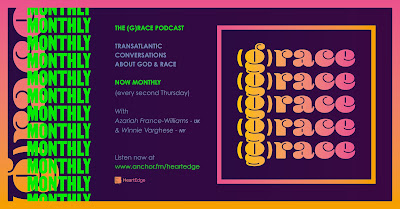
New Grace podcast

"Prophetic and fearless... and deep solidarity..." Azariah and Winnie on Recent Loss and Remembering

Grace Podcast

Winnie Varghese and Azariah France-Williams on recent deaths and loss, remembering bell hooks; "She uses her grandmother's name... and doesn't capitalise her name... she decides to stand away from the institution that grant honour in different ways..."; Desmond Tutu, "his always outspoken support for LGBTQ people... his prophetic and profound commitment to justice, in ways that aren't what your PR consultant would recommend..."; and Harold Lewis, "Prophetic and fearless... and deep solidarity...", "He organised all of the funds... when our church still doesn't have that will, that bite, to provide what's necessary for people to flourish and thrive."

Talking about life, death and remembering "You note the lives of these icons and wonder if we're doing them justice, if there is another generation emerging in the same way..."

Listen to the Grace podcasts here.


--------------------------------------------------------------------------------------------------------------


Tuesday, 21 July 2020

Searching for a kingdom yet to come

Here's the reflection I shared during today's lunchtime Eucharist for St Martin-in-the-Fields:

Micah's prayer for or prophecy of restoration for the people of Israel is set in a context of societal breakdown (Micah 7.14-15, 18-20). The chapter is headed ‘The Total Corruption of the People’ and Micah says, ‘there is no one left who is upright; … Their hands are skilled to do evil; the official and the judge ask for a bribe, and the powerful dictate what they desire; thus they pervert justice.’

Our newspapers essentially make similar reports on a daily basis, when we hear of Government contracts made, without tender, to companies with contacts to those who award the contracts and when the President of the United States will not state that he will leave power were he to lose the coming election.

Micah sees a society in which no one does good and where every household is divided. He says, ‘Put no trust in a friend, have no confidence in a loved one; guard the doors of your mouth from her who lies in your embrace; for the son treats the father with contempt, the daughter rises up against her mother, the daughter-in-law against her mother-in-law; your enemies are members of your own household.’

However, it is at that time that he says God will rescue and restore his people in a way that will amaze the nations. The God who pardons iniquity, passing over transgression and casts all our sins into the depths of the sea because he delights in showing clemency, is the one who Shepherds the people, the flock belonging to him, letting them feed in as in the days of old.

Jesus came to be the shepherd and restorer for which Micah had prayed but did so in ways that weren't anticipated. Micah prayed for a God that would show faithfulness to Jacob and unswerving loyalty to Abraham, as had been sworn to their ancestors from the days of old. His prayer was for a God of nationalism who would ensure that the nations would see and be ashamed so that they would come trembling out of their fortresses and turn in dread to the Lord, Micah’s God.

It is claimed that whereas the 20th Century was defined by the struggle between Capitalism and Communism, the 21st Century is being defined by the struggle between Nationalism and Globalism. In the 2016 presidential election the United States abandoned globalism and embraced nationalism. The UK has also sprouted new nationalist roots with our withdrawal from the European Union. As countries have begun to align under this new world order, we note the extent to which Nationalism means doing what is seen to be in a country’s self-interest, not the world’s self-interest. We are in the same place that Micah sought, where other nations stand in dread of our nation.

Jesus’ movement, however, was built not on family, tribe and nation but on pilgrims and travellers. When Jesus is told that his mother and brothers are standing outside, wanting to speak to him, he asks “Who is my mother, and who are my brothers?” Then, pointing to his disciples, he says, “Here are my mother and my brothers! For whoever does the will of my Father in heaven is my brother and sister and mother.” (Matthew 12. 46-50)

He does so in order to make clear that the basic unit of a nation, the settled family, is not the basis for his movement. Instead, his movement looks back to an earlier stage in the story of Abraham. The basis for Jesus’ people was that of Abraham the migrant, the itinerant traveller, the one who moves from one country to another, who knows no border or nation. Those who form Jesus’ family are those who travel, not those who settle, those who constantly search for a kingdom yet to come, a kingdom with no boundaries embracing Jew and Gentile, male and female, slave and free.

Micah’s prophecy can be interpreted in this sense as he says that Israel’s boundary shall be far extended and that, in that day they will come from Assyria to Egypt, from Egypt to the River, from sea to sea and from mountain to mountain. This is the gathering of the nations in harmony and in unity for which we should unceasingly pray and which Micah’s prophecy suggests will begin to be realised at a time when society is corrupt and every household divided. As our society and world seems increasingly divided, let us pray all the more for God to rescue and restore in a way that will amaze the nations.

----------------------------------------------------------------------------------------------------

John Tavener - Fragments Of A Prayer.

Friday, 28 June 2019

Review: To See Clearly: Why Ruskin matters

My latest piece for Church Times is a review of  To See Clearly: Why Ruskin matters, by Suzanne Fagence Cooper.

In this exquisite book, 'Suzanne Fagence Cooper gives a masterclass in how to write well about a subject who was as expansive as she is concise and as florid as she is focused, while sensitively — even poetically — summarising the many insights imparted by her subject.

Her focus is on John Ruskin’s belief that sight is fundamental to all insight, whether poetry, prophecy, or religion. So, this is a book about a purveyor of words who encourages in those who listen or read the discipline of attentive looking.'
Earlier this year I reviewed, also for Church Times, “John Ruskin: The Power of Seeing” at Two Temple Place:

'Ruskin was a man of many words, who believed that, through drawing, one had the power to say what could not otherwise be said. He built his reputation on the power of his words as an art critic, author, and lecturer, but his subject was the power of seeing, because, for him, the teaching of art was “the teaching of all things”. He believed that the “greatest thing a human soul ever does in this world is to see something, and tell what it saw in a plain way”. “To see clearly”, he said, “is poetry, prophecy, and religion — all in one.”

Art, then, is an expression of “the love and the will of God” to which we gain access primarily by looking closely at the splendour of nature.'

Click here to also read the earlier review.

----------------------------------------------------------------------------------------------

Antonio Vivaldi - Gloria.

Love is all we need

Here's a brief meditation summarising 1 Corinthian 13 that I wrote for a recent wedding I was privileged to lead:

No words have meaning without love.
No prophecies have power without love.
No understanding comes without love.
No faith is true without love.
No gift is shared without love.
No sacrifice is real without love.

Love is giving and not taking.
Love is receiving and not insisting.
Love is waiting and not rushing.
Love is bearing and not discarding.
Love is kneeling, washing,
anointing, serving.

Love is words in action.
Love is birth, life, death.
Love is the alpha and omega,
the beginning and the end.
The centre and the core,
the heart.
Love is our one achievement.
Love is all. Love is all we need.

-------------------------------------------------------------------------------------------

Victoria Williams - Love.

Friday, 13 October 2017

Prophetic voices calling from the edge


Vox pop interviews given by participants at Prophets & Seers: Calling from the Edge, the 2016 conference on Disability and Church, organised in partnership between St Martin-in-the-Fields and Inclusive Church. Participants shared their message to the Church.

Here is my Thought for the Week for the Parish Newsletter at St Martin-in-the-Fields:

“My weakness and my weariness can be something like a gift.”

“It is really important to have a chance to tell our stories, hear them underpinned by theology and find out how they can – or should – influence wider public policy.”

“We need to move on from welcoming disabled people as an act of grace and see them as whole people with as much right to be there as anyone else.”

“Disabled people are not so much a pastoral problem as a prophetic potential. We need to ask not how the church can care for disabled people but to ask what is the prophetic message of the church in our culture and how disabled people can make a unique contribution to that renewal.”

“Our disabilities don’t necessarily detract from how whole we are, please don’t presume we need to be healed or that we have nothing to contribute – everyone has gifts to give.”

These quotes come from ‘Calling from the Edge’, a beautifully produced booklet celebrating the first five disability conferences that have been held as a partnership between St Martin-in-the-Fields and Inclusive Church. In the booklet you will find stories and reflections that tell the story that underlies this significant series of conferences. We are launching this booklet during a weekend of events that includes the sixth conference in the series, in which we are exploring what being disabled says about God and what the stories of disabled people tell us about God’s story.

All this is predicated on the basis that nothing should be said about us without us and, as a result, that the conference is organised by and for disabled people. The prophetic voices we hear emanating from the conference and booklet are, rightly, challenging for the Church but, as Sam Wells says in his Foreword to the booklet, we need to recognise the sin of how much we have rejected in the past, and celebrate the grace that God gives us back what we once rejected to become the cornerstone of our lives. That’s what prophetic ministry means.

----------------------------------------------------------------------------------------------

St Martin's Voices - Gloria.

Tuesday, 16 April 2013

Teilhard de Chardin, Paolo Soleri and Bill Fay

I was interested to read the following in the Guardian's obituary for Paolo Soleri:

'Strongly influenced by the Jesuit palaeontologist and philosopher Pierre Teilhard de Chardin, Soleri spoke in a hypnotic language of his own making, dotted with strange cosmic terms such as the "omega seed" and "miniaturisation-complexity-duration". He expounded his vision in a book, The City in the Image of Man (1969), a spellbinding work filled with intricate drawings of fantasy cities – from floating communes to canyon-like structures and teetering towers built on top of dams. It was a thrilling futuristic prophecy for droves of 1970s students, whom the guru Soleri entertained on a packed lecture circuit, but one that quickly became anachronistic in the consumerist 1980s.

With environmental Armageddon back on the agenda once again now, might there be a viable future for Arcosanti and Soleri's principles of arcology after all? "Materialism is, by definition, the antithesis of green," he told the Guardian. "We have this unstoppable, energetic, self-righteous drive that's innate in us, but which has been reoriented by limitless consumption. Per se, it doesn't have anything evil about it. It's a hindrance. But multiply that hindrance by billions, and you've got catastrophe."'

Bill Fay was also profoundly influenced by Teilhard de Chardin:

"Shortly after his debut was released, Fay stumbled across an old biblical commentary and quickly developed a fascination with the books of Daniel and Revelation. With the Vietnam War still escalating and the Kent State massacres in the headlines, the dark, apocalyptic tone of the ancient prophetic literature seemed disturbingly relevant. About this same time, Fay also began reading the writings of Pierre Teilhard de Chardin, a mid-twentieth century Jesuit, scientist, and philosopher, who believed that all of reality, both human and non-human, is rapidly evolving toward an eternal state of unity and peace. The earth’s present travails (war, poverty, injustice), however overwhelming they may seem, are really the birth pangs of the coming paradise—evidence of both the deficiencies of our current existence and the imminence of the world to come.

Armed with these new intellectual resources, Fay fashioned a second recording that was darker and more desperate but ultimately more hopeful than the first. Time of the Last Persecution is dominated by Fay’s vision of the coming apocalypse, vividly described in songs like “’Til the Christ Come Back,” “Plan D,” and the bleak, bombastic title cut. Fay’s eschatology on the recording is a far cry from the Us-vs.-Them cynicism of religious orthodoxy, in which the chosen people are eternally rewarded while the rest of us are cast into a bottomless lake of fire. For Fay, as for Teilhard before him, deliverance is deliverance for all (hippie and soldier, young and old, human and non-human) from the structures and institutions that oppress and alienate us. And the coming of the messiah signifies that all of reality—however senseless it may now seem—ultimately has value and significance. “The album was a commitment,” Fay recently explained, “albeit a reluctant one at first, to the belief that there will be, and has to be at some point, some spiritual intervention in the world.”' 

----------------------------------------------------------------------------------------------