Wikio - Top Blogs - Religion and belief
Showing posts with label collins. Show all posts

Friday, 12 February 2021

Seeing is Receiving: The art of contemplation (8)

7. Sparking

A tale of two churches is central to the story that I sought to tell through my sabbatical art pilgrimage. The two churches are Notre-Dame des Alpes in Le Fayet and Notre-Dame de Toute Grâce on the Plateau d'Assy. Both are only kilometres apart in the French Alps and were built by same architect in a similar style yet they represent different stages in the sparking of inspiration from the Holy Spirit that led to the twentieth century’s revival of sacred art.

My sabbatical art pilgrimage involved visits to significant sites connected with the renewal of religious art in Europe during the twentieth century. In Europe I visited sites connected with the artists surrounding Maurice Denis, Jacques Maritain, Albert Gleizes and Marie-Alain Couturier, while, in the UK, I primarily visited sites which highlighted the influence of the innovatory commissions undertaken by George Bell and Walter Hussey. These were they that were primarily responsible for the sparking of inspiration in church commissions in this period of time.

At the beginning of the twentieth century modern art looked, sounded and felt very different from the art that had traditionally been made for the Church. This meant that the Church tended to avoid using modern art while many modern artists were excitedly exploring new ways of creating art and often couldn’t see any connection between what they were doing and the styles of art which the Church continued to use.

As a result, a whole segment of society – artists and art lovers – was not being impacted by Christianity. Denis, Maritain, Gleizes, Couturier, Bell and Hussey made it their life’s work to reconnect the Church with modern art. The key debate that they had, through their actions and writings, was whether the sparking of inspiration was best done by artists who were Christians and who primarily focused their work on church decoration or by artists who were reckoned to be contemporary masters, regardless of whether or not they practised the faith.

It was that debate which was played out through the commissions for the churches at Le Fayet and Assy. The decoration of St. Paul Grange-Canal in Geneva by Denis, Alexandre Cingria and others in 1913 – 1915 served as a manifesto for the renaissance in modern sacred art that they and others facilitated. This led to the founding in 1919 of the Ateliers d’Art Sacré in Paris by Denis and Georges Desvallières as well the Group of St Luke and St Maurice in Switzerland by François Baud, Cingria, Marcel Feuillat, Marcel Poncet and Georges de Traz. Both groups produced significant work for many churches in subsequent years.

In 1935 the Group of St Luke secured the decoration of the new church of Notre-Dame-des-Alpes by means of a tender process assessed by Maritain, the Catholic art critic Maurice Brillant and the director of the Ecole des Beaux Arts in Geneva, Adrien Bovy.[i] The process and the resulting work was a showcase for the renaissance of sacred art in which Denis, Maritain and Cingria had played key roles. It was this stage of the revival that was later challenged by the commissions selected for Notre-Dame-de-Toute-Grâce.

Although he trained at the Ateliers d’Art Sacré and worked on schemes of stained glass with its artists, together with his fellow Dominican Friar Pie-Raymond Régamey, Couturier argued in ‘L’Art sacré’, the journal which they jointly edited, that ‘each generation must appeal to the masters of living art, and today those masters come first from secular art.’[ii] Couturier worked with the parish priest at Assy, Canon Jean Devémy, on commissions for the church at Assy.

Initially their commissions were within the earlier phase of the renaissance of sacred art as sparked by the Holy Spirit. On the basis of his work at Le Fayet, Devémy selected Maurice Novarina as architect for Assy. As at Le Fayet, Novarina used his regional style with a chalet-style pitched roof and locally sourced materials. Initial commissions for the nave windows went to artists who had been active in modernist Church decoration before the war but Couturier then moved on to commission Pierre Bonnard, Marc Chagall, Fernand Léger, Jacques Lipchitz, Jean Lurçat, Henri Matisse, Germaine Richier and Georges Rouault.

William S. Rubin noted that this ‘radical aspect’ of Couturier’s plan proved deeply controversial as commissioning modern ‘masters … from secular art’ meant that ‘Side by side with works of the pious Catholic Rouault one saw those of Jews, atheists, and even Communists - a revolutionary situation that struck the keynote of a new evangelical spirit ...’ As a result, ‘Even before its dedication in 1950, the church had become the center of an increasingly bitter dispute which was to cause a marked rupture between the liberal and conservative wings of the clergy and laity during the following years.’[iii]

Despite the controversy caused Couturier’s approach to commissioning sparking inspiration for others and has become part of the commissioning landscape for churches. In England, Bishop Bell sought ‘ways and means for a reconciliation of the Artist and the Church’ while Hussey made it the great enthusiasm of his life and work ‘to commission for the Church the very best artists.’ Both experienced opposition and criticism but at St Matthew’s Northampton, St Michael and All Angels Berwick and Chichester Cathedral enabled commissions by a range of contemporary masters.

My visits to these and other churches confirmed for me the continuing value of commissions made at both stages of the twentieth century renaissance in sacred art. Both churches, Le Fayet and Assy, contain artworks which speak powerfully and movingly of the Christian faith and therefore also inform the spirituality of those who see them. Significant work was done throughout the twentieth century both by artists who were Christians and who primarily focused their work on church decoration and also by artists who were reckoned to be contemporary masters, regardless of whether or not they practised the faith. This continues to be the case in contemporary church commissions and, as a result, one of the lessons we can learn from the twentieth century revival of sacred art and its sparking of inspiration is that debate which sets ‘Christian’ artists against secular masters is unnecessary.

Churches need encouragement and validation to commission challenging and innovative work from either group of artists because the sparking of inspiration by the Holy Spirit derives not from our alignment with statements of belief but from the sharing of our contemplative seeing. As we have been reflecting through this book, this is based on slowing down in order to sustain silent looking by immersing ourselves in the world created by the work combined with reflection on sources. It is this that enables a positive cycle of creativity by sparking inspiration from the Holy Spirit.

Jesus’ disciples spent three years not understanding what he was saying and doing before running away, deserting and denying him at the crucifixion. Then the Day of Pentecost happened and the coming of the Holy Spirit was the moment when it all came together for them, when they finally understood and both knew their part in God’s plan and could begin to play it.

When the Spirit came they could speak in languages they had never learned and were understood, they could explain the scriptures although they were uneducated and their explanations made sense. They could proclaim Jesus as Lord and Christ and people responded to their challenge, and they knew how to structure and organise the new community that grew around them in response to their message. All that Jesus had said to them and done with them suddenly made sense and was useful to them because the Spirit had come and brought clarity and revelation. That is what Jesus had promised them would happen. That is the work which the Holy Spirit comes to do in our lives. Jesus told the disciples that when the Spirit came he would lead them into all truth. In other words, they would have that experience of inspiration being sparked; of revelation, of clarity, of things making sense, coming together and connecting.

This is an experience that is common to artists. Written In My Soul is a series of interviews with some of the most well-known singer-songwriters from the 1950s onward. Many of these great artists – Bob Dylan, Neil Young, Van Morrison and others - felt that their songs were given to them in moments of revelation, that their songs were already written and ‘came through them as though radio receivers – without much conscious effort or direction.’[iv]

That is an experience of the Spirit coming, although often not recognised as such. It has also been my experience, both in creating and preaching. I will often reflect or meditate on an experience, a song, an image, a Bible passage, by putting it in my mind, carrying it around in my mind over several days or weeks, reminding myself of it from time to time and just generally living with it for a period of time. When I do so, then I find that, at some unexpected moment, a new thought or idea or image will come to me that makes sense or takes forward the experience or song or image or passage on which I had been reflecting.

This is not just something for artists or even for preachers, it is something that can happen for us all; not just in major life-changing moments of revelation but also in a series of minor everyday epiphanies. Corita Kent writes that there is ‘an energy in the creative process that belongs in the league of those energies which can uplift, unify, and harmonize all of us.’ This energy or spark or inspiration, ‘which we call “making,” is the relating of parts to make a new whole.’[v]

If done well, this sparking of creativity gives rise to a sparking of response: ‘… the work of art gives us an experience of wholeness called ecstasy – a moment of rising above our feelings of separateness, competition, divisiveness “to a state of exalted delight in which normal understanding is felt to be surpassed” (Webster’s).’ This is as we should expect, as the ‘very word imagination implies that you are into territory no one has ever been to before.’ As a result, ‘a rigid discipline that demands one “right” way is confining and limiting.’[vi]

There is a third spark that precedes those describes thus far. Kent says that new ideas ‘are bursting all around and all this comes into you and is changed by you.’[vii] We are all each other’s sources and anything that comes our way, including the work of artists, ‘is a place for starting’.[viii] Contemplative prayer or reflection enables us to see and grasp these inspirations as they burst around us. Sparks of inspiration and creativity come to us in this way because, as Anaïs Nin notes, there are ‘very few human beings who receive the truth, complete and staggering, by instant illumination.’ Instead, we ‘acquire it fragment by fragment on a small scale, successive developments, cellularly, like a laborious mosaic.’[ix]g

The acquiring of fragments and creative linking of these to form a mosaic as commended by Kent and Jan Steward via Nin may remind us of Betty Spackman’s approach with ‘A Creature Chronicle’. Another artist inspired to create in this way, as a means of mirroring or depicting the contemplative creative process itself, was Marc Chagall. Chagall’s art is one that connects and reconciles disparate images of Bible, experience, history, memory and myth on the canvas through colour and composition. In his work Chagall links up different, unusual and unlikely images in a way that makes visual and emotional sense; in a way that communicates his love of his home, his world, his people, its sights, sounds and smells. He succeeds in ‘achieving a pictorial unity through the yoking of motifs taken from different realms of given reality.’[x] He reconciles emotions, thoughts, and reminiscences with lines, colours and shapes to create harmonious, meaningful paintings. Walther and Metzger have suggested that ‘no other twentieth century artist had Chagall's gift for harmonising what were thought to be irreconcilable opposites.’[xi] That was actually far from being the case, yet the fact that this might seem so is to recognise the lack of awareness and understanding shown to the art of contemplation in modern and contemporary art by critics and the Church alike. This has been to the wider detriment of society and has meant that some artists using the approaches described in this book have been under-appreciated in regard to recognition and, in other respects, as to intent.

The approaches to creative and Spirit-inspired sparking of these artists have synergies with the approaches of David Jones in The Anathemata and T. S. Eliot in The Waste Land. What these poets did in constructing a whole from fragmentary materials is also essentially similar to the form and construction of the Bible itself. Writer and minister, Mike Riddell has described the Bible as 'a collection of bits' assembled to form God’s home page while the Anglican priest Mark Oakley used a more poetic image when he wrote that the Bible is 'the best example of a collage of God that we have.' Riddell continued by saying that, 'what holds all these bits together is the fact that they somehow represent the continued involvement of God with the world in general and humanity in particular.'[xii] Oakley suggested that 'held together, they form a colourful and intriguing picture that draws us into its own landscape' and enables Christians to 'glimpse something of the divine being and his life in the world' and find 'a vocabulary for the Christian life.'[xiii]

What also holds them together is the Spirit-inspired sparking of creativity in creating and linking fragments of meaning that we have been exploring through the work of Chagall, Eliot, Jones, Kent and Spackman. It may be that it is this form of inspiration to which the Bible itself wants to point us when, in 2 Timothy 3.16, we read that ‘All scripture is inspired by God.’ Sparks of the Spirit – the inspiration of God – come not in one fully realised and systematised creation but fragment by fragment, to be creatively linked and held together in a collage of revelation.

This place of renewed inspiration, creativity and revelation is reached by means of learning to see as opposed to merely looking. The ways of learning to see that we have explored enable us to genuinely pay attention by slowing down, sustained looking, surrendering ourselves to art by immersing ourselves within it, staying with the silence inherent in much art, study of sources, the sharing of experiences, and an openness to inspiration, the sparking of the Spirit. In learning to use these ways of paying attention we are opening the gift the artist offers of sharing with us the mindful and prayerful act of seeing; to spend time noticing, looking intently and making careful observation in order to make material from their thoughts and ideas. With these ways of seeing in place, we can now see that there is beauty in all art and life as seen through the concept of sacrament, of heaven in the ordinary, including the artefacts of art. It is this that we contemplate. It is this to which we pay attention. It is this that is prayer.

Explore

Chagall's unitive vision finds echoes in the work of some of his peers and has been taken up, responded to and developed by other later artists.

Cecil Collins, in painting fools and angels found a means of depicting divine and human action and response. Collins viewed art as ‘an interpenetration between worlds, as a marriage of the known with the unknown’. In art, he said, the ‘imagination searches out and prefigures the mysterious unity of all life’. As a result of this metaphysical purpose and exploration ‘a picture lives on many different levels at once, it is an interpenetration of planes of reality, it cannot be analyzed or anatomised into single levels because one level can only be understood in the light of others. The reality or interior life of the picture can only be realised as a total experience.’[xiv] That total experience in Collins' work is unitive experience; whether this is the attempt at reconstituting the world that is Images in Praise of Love or the complex combination of symbol and structure that hymns the marriage union and reconciles masculine and feminine qualities in The Artist and His Wife.

Collins was also preoccupied by our expulsion from the Garden of Eden and our longing to return; in itself a reconciliation. This is a theme that was also taken up by Norman Adams. Adams' produced a questioning, probing work based on the expulsion and inspired by Paul Gauguin's Where do we come from? Who are we? Where are we going? An everyman figure is on a sloping pathway which he could be ascending or descending. Above him is a mass of blooming flowers, below a confused, muddy zone of swirls and scraping. His predicament poses the question to us as viewer, are we returning to Eden reconciled to God or descending into confused self-interest? The religious subject matter of Norman Adams' paintings provides him with geometry, a structure of lines and circles that allows his complex colours, his masterly and distinctive use of watercolour, to work their magic.’[xv] For Sister Wendy Beckett this ability of Adams' suggests that a mystical sense of oneness is making itself visible in his work.[xvi]

John Reilly was as strong and explicit as Collins in setting out his intentions: ‘My paintings are not concerned with the surface appearance of people or things but try to express something of the fundamental spiritual reality behind this surface appearance. I try to express in visible form the oneness and unity of this invisible power, binding all things into one whole.’[xvii] Using lessons learnt from Orphism and Rayonism he constructed a pattern of rippling rays emanating from a central source of light. Within this structure he set objects and figures composed of abstract shapes and colours that are indicative of their spiritual qualities. A painting like No Parting includes natural formations, animals, human figures and plants held together, underpinned, in eternal circulation by the central point, which some may see as a pictorial device structuring a work of beauty and others as symbolic of God. In Universal Power - The Fourth Day of Creation we are shown a snapshot of creation, of the first reconciliation of shape and form. As Reilly's abstract shapes spiral out from the central point they coalesce into those same fundamental, elemental shapes of bird, plant and human life.

For David Jones reconciliation comes through the tangle of associations and allusions triggered by words and images. Caroline Collier has noted his ‘fondness for entwinings, for complications, interrelationships, layers and correspondences.’[xviii] We see this most clearly in his use of line but, as Nicolette Gray notes in her comments on Curtained Outlook, the level of unity achieved throughout his work is much greater than simply this alone:

‘The artist has woven a complex of components into a new unity. The verticals of the window-frame, the windows and balustrade of the house outside, and of the jug on the table, are counterbalanced by the horizontal of the sill and the balcony, and by the outward-moving diagonals of the table, the toothbrush and box lid, and the downward-moving lines of the house. Movement runs throughout the composition - there is not a single straight line, not a flat wash of colour. The sudden accents of colour/tone/drawing pick up the movement of the composition. The drawing itself is part soft pencil, part brush drawing in colour, here sketchy, there emphatic. All the elements are worked together: form and content have been reconciled, unity combined with movement.’[xix]

Giles Auty, in writing of Norman Adams, noted that he belongs ‘to a relatively small tradition of painters whose outlook is positive’: ‘An affirmative vision such as his is especially rare in the modern art of the West, artists preferring to shelter more frequently behind masks of disillusionment and cynicism. Indeed, such negative views of life have the additional bonus of being perennially in fashion, the large black-humoured painting sharing something of the timeless chic of the little black dress.’[xx] The tradition of affirmative, unitive, figurative art may be small yet it remains significant, if undervalued.

Wonderings

I wonder if you can recall a moment when something new was sparked in you.

I wonder if you can remember what led to that sparking and how it felt.

I wonder what you did with that new something.

Prayer

Creating God, for whom creation is your prayer, may I see creativity as noticing and naming, letting all things be by attending to them for your sake and to see your goodness; that all may be well and all manner of thing be well. Amen.

Spiritual exercise

Take the phrase ‘Through the veil’ and ruminate on it in your heart and mind. Create a list in whatever way you wish of all that this phrase brings to mind for you. Use your list to begin a creative project of whatever kind you wish entitled ‘Through the veil’.

Art actions

View John Reilly’s work at http://thejohnreillygallery.co.uk/index.htm.

Watch the documentary ‘Bill Viola: The Road to St Paul’s’ which follows the world’s most influential video artist Bill Viola and his wife and close collaborator Kira Perov over a twelve-year period as they undertake and complete the installation of their two permanent video works, Mary and Martyrs, in St. Paul’s Cathedral.
 

Click here for the other parts of 'Seeing is Receiving'. See also 'And a little child shall lead them' which explores similar themes.


[i] L. Mamedova, ‘L’église Notre-Dame des Alpes à Saint-Gervais-le Fayet : une collaboration entre un architecte savoyard et un artiste genevois’, Publié dans L. el-Wakil et P. Vaisse, Genève-Lyon-Paris. Relations artistiques, réseaux, influences, voyages, Genève, Georg, 2004 - http://www.okam-design.com/lada/files/Fayet-article.pdf

[ii] M-A Couturier, ‘What Assy Teaches Us’ in Sacred Art, University of Texas Press, 1989, p.52

[iii] W.S. Rubin, Modern Sacred Art and the Church of Assy, Columbia University Press, New York & London, 1961

[iv] B. Flanagan, Written In My Soul, Omnibus Press, 1990, p. xii

[v] C. Kent & J. Steward, Learning by Heart, Allworth Press, 2008, p.5

[vi] C. Kent & J. Steward, Learning by Heart, Allworth Press, 2008, pps.90-91

[vii] C. Kent & J. Steward, Learning by Heart, Allworth Press, 2008, p.50

[viii] C. Kent & J. Steward, Learning by Heart, Allworth Press, 2008, p.48

[ix] Cited in C. Kent & J. Steward, Learning by Heart, Allworth Press, 2008, p.94

[x] Ingo F. Walther and Rainer Metzger, Marc Chagall 1887 – 1985: Painting as Poetry, Taschen, 2000, p. 20

[xi] Ingo F. Walther and Rainer Metzger, Marc Chagall 1887 – 1985: Painting as Poetry, Taschen, 2000, p. 89

[xii] M. Riddell, God’s home page (Oxford: The Bible Reading Fellowship, 1998), pps.24 & 25

[xiii] M. Oakley, The Collage of God (London: Darton, Longman and Todd Ltd, 2001), p.21

[xiv] Writings and statements by the Artist, Cecil Collins A Retrospective Exhibition, Judith Collins, Tate Gallery, 1989

[xv] M. Walters in ‘Images of Christ’, Modern Painters VI/2

[xvi] Sister W. Beckett, ‘Norman Adams’ in Modern Painters IV/1

[xvii] J. Reilly, ‘Introduction’ in The Painted Word: Paintings by John Reilly, Cross Publishing, 2008

[xviii] Caroline Collier, ‘Under the Form of Paint ...’ in David Jones: Paintings. Drawings. Inscriptions. Prints., The South Bank Centre, 1989

[xix] N. Gray, The Paintings of David Jones, Lund Humphries Publishers Ltd, 1989

[xx] G. Auty, ‘An Affirmative View’ in Norman Adams, R.A., Christopher Hull Gallery, 1991


----------------------------------------------------------------------------------------------

Bob Dylan - Every Grain Of Sand.

Saturday, 6 May 2017

Sabbatical Art Pilgrimage: Latest ArtWay Report

My latest Church of the Month report for ArtWay focuses on Chichester Cathedral:

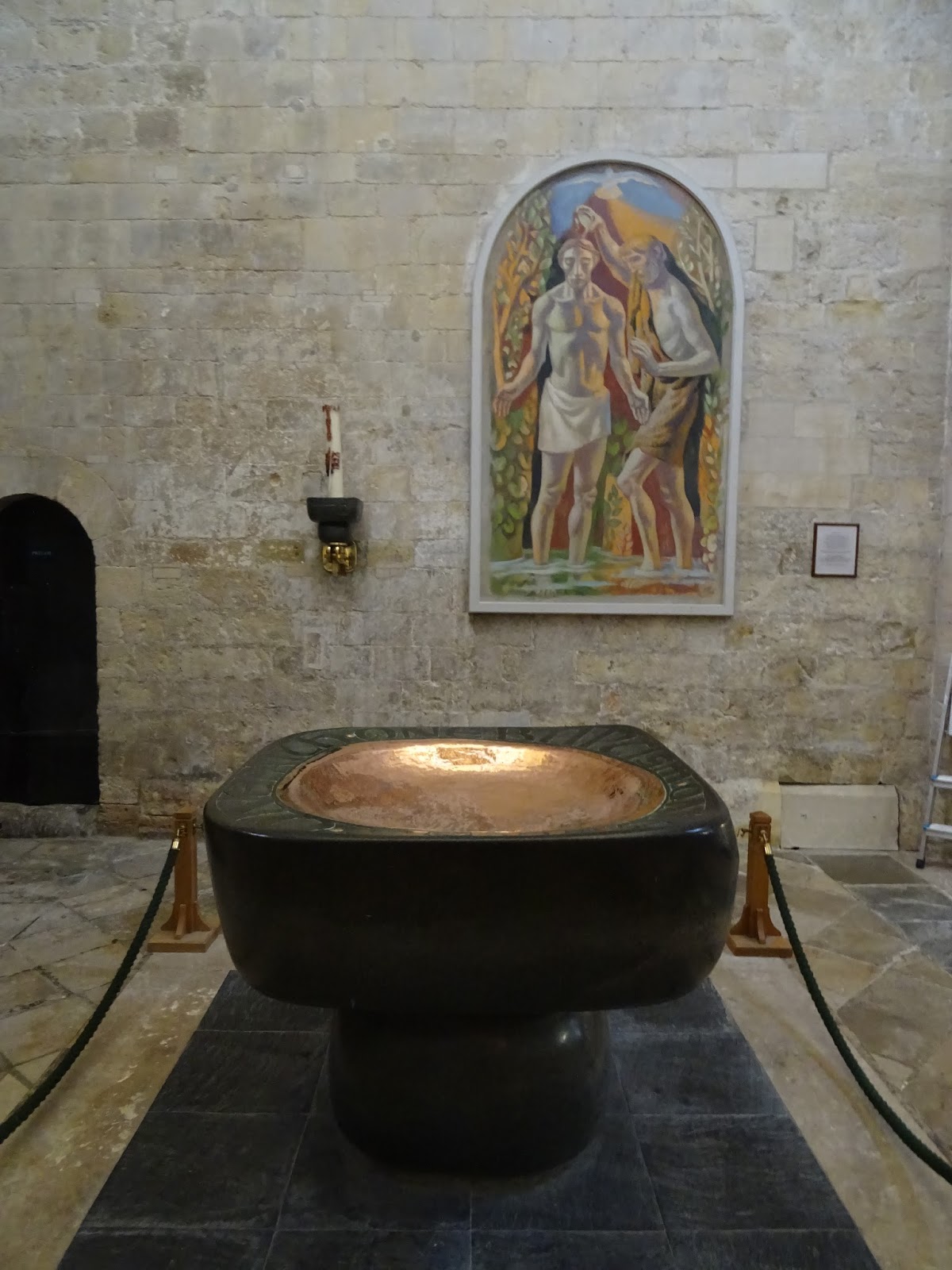
'... the mix of commissions at Chichester Cathedral—from the “riot of colour and symbol” in the Piper tapestry to the glow of Hans Feibusch’s tender Baptism, the harmonious whole that is the Icon of the Divine Light by Cecil Collins to the fractured energies of Ursula Benker-Schirmer’s tapestry for the Shrine of St. Richard—genuinely invigorate and beautify the cathedral while introducing variety and intrigue into the experience of visiting and worshipping here. Tourists are encouraged to do both during their visit by prayers on the hour and use of the leaflet “A Spiritual Tour of Chichester Cathedral,” which has been designed to help people pray as they walk around the space.'

This Church of the Month report follows on from others about Aylesford Priory, Canterbury Cathedral, Chapel of St. Thérèse of the Child Jesus and the Holy Face, Hem, Chelmsford Cathedral, Coventry Cathedral, Église de Saint-Paul à Grange-Canal, Lumen, Metz Cathedral, Notre Dame du Léman, Notre-Dame de Toute Grâce, Plateau d’Assy,Romont, Sint Martinuskerk Latem, St Aidan of Lindisfarne, St Alban Romford, St. Andrew Bobola Polish RC Church, St Margaret's Ditchling and St Mary the Virgin, Downe, and St Paul Goodmayes, as well as earlier reports of visits to sites associated with Marian Bohusz-Szyszko, Marc Chagall, Jean Cocteau, Antoni Gaudi and Henri Matisse.

----------------------------------------------------------------------------------------------

Karl Jenkins - The Armed Man.

Saturday, 23 January 2016

Fraser, Tolstoy, Dostoevsky, Collins & Houtheusen: The fool sees things the wise person never can

Giles Fraser had a great comment piece in yesterday's Guardian about Tolstoy and War and Peace:

"Tolstoy believed there was quite a lot to be said for foolishness, here goes: all Christians are fools. Politicians can’t allow themselves to look or behave like fools. Therefore, politicians cannot be Christian ...

Tolstoy reminds us that to be a Christian is to be a fool and a social outcast, that anyone who wishes to follow Christ has to be prepared to die as an enemy of the state, nailed to the cross. It’s a little bit more than a few verses of Shine, Jesus, Shine on a Sunday morning ...

the fool sees things the wise person never can."

Jim Forest reminds us that, "In Leo Tolstoy’s memoir of his childhood, he fondly recalls Grisha, a holy fool who sometimes wandered about his parent’s estate and even came into the mansion itself without knocking on the door. “He gave little icons to those he took a fancy to,” Tolstoy remembered."

In an article for the Financial Times, Harry Eyres writes:

"The holy fool, or fool for Christ, is a key figure not just in Orthodox religion but in Russian culture. Holy fools are disruptive; they go around half-naked, act as Robin Hoods, taking from the rich and giving to the poor; and, as Sergey Ivanov writes in Holy Fools in Byzantium and Beyond (2006), they “provoke outrage by [their] deliberate unruliness” ...

The figure of the holy fool appears repeatedly in the novels of Dostoevsky. There are “true” holy fools, such as Elder Zosima, the inspired preacher in The Brothers Karamazov, and Bishop Tikhon in The Devils; there are also false holy fools, such as Semyon in the same novel. But the most fascinating holy fool of all may be Prince Myshkin, the hero of The Idiot, who is never explicitly named as such. Myshkin represents Dostoevsky’s attempt to portray “a positively beautiful man”; naive to the point of gullibility, emotionally empathetic and open, Myshkin ends up ruining the lives of the two women he loves. Perhaps Dostoevsky’s point is that in a thoroughly corrupt society even attempts to do good are bound to come to grief."

The Fool became a major theme and life focus for the mystical painter, Cecil Collins. For Collins, the Fool represents “innate, inviolate, primordial innocence which sees clearly” with our purpose in life being to recover that direct perception; the vision of the Fool. The Fool “is interested … in love and its manifestation in that harmony and wholeness which we call beauty” but because he is in “a state of creative vulnerability and openness” the Fool “is easily destroyed by the world.”

See also my ArtWay article entitled The Spirituality of the Artist-Clown. The significance of the clown in the life and work of Albert Houthuesen.

----------------------------------------------------------------------------------------------

The Rolling Stones - Fool To Cry.

Saturday, 22 August 2015

Chichester Cathedral: a reconciliation of the Artist and the Church


One of the distinguishing features of Chichester Cathedral, is the use of modern works of art to invigorate and beautify the cathedral. This idea, initiated by Bishop George Bell in the early 1950s, was largely put into effect by Walter Hussey during his deanship between 1955-77.

On 27th June 1929, the day he became Bishop of Chichester, George Bell famously expressed, in his enthronement address, his commitment to a much closer relationship between the Anglican Church and the arts:

‘Whether it be music or painting or drama, sculpture or architecture or any other form of art, there is an instinctive sympathy between all of these and the worship of God. Nor should the church be afraid to thank the artists for their help, or to offer its blessing to the works so pure and lovely in which they seek to express the Eternal Spirit. Therefore I earnestly hope that in this diocese (and in others) we may seek ways and means for a reconciliation of the Artist and the Church—learning from him as well as giving to him and considering with his help our conception alike of the character of Christian worship and of the forms in which the Christian teaching may be proclaimed.’

The concluding sentence of the rationale that Canon Walter Hussey, Dean of Chichester Cathedral, provided for Marc Chagall as a brief for his stained glass window at the Cathedral based on Psalm 150 read as follows:

‘… it has been the great enthusiasm of my life and work to commission for the Church the very best artists I could, in painting, in sculpture, in music and in literature.’

Between these two statements, both in terms of concept and commission, lie many of the works still to be seen in the cathedral. These include:
Paintings:
Tapestries:
Stained glass:
  • a window by Marc Chagall, based on the theme of Psalm 150 '...let everything that hath breath praise the Lord' (1978). 
Embroideries:
  • a panel behind the bishop's throne designed by Joan Freeman (1993), and hassocks in the Presbytery designed by Sylvia Green (1995), were all were worked by members of the cathedral's Seffrid Guild. 
Cast aluminium:
  • All by Geoffrey Clarke - candlesticks and communion rails in St Mary Magdelane's Chapel (1960-62); Pulpit (1966); Lectern (1972).
Stone:
  • Font - polished polyphant stone and beaten copper by John Skelton (1983) 
  • Altars - in the retro-choir, St Mary Magdalene's chapel and the high altar by Robert Potter. 
Sculptures:
  • 'Virgin and Child' by John Skelton (1988)
  • 'Christ in Judgement' by Philip Jackson (1998). 
  • 'The Refugee' by Diana Brandenburger has been loaned to the Cathedral in memory of George Bell, as he was a "Champion of the oppressed."
  • Outside the cathedral, a magnificent statue of St Richard by Philip Jackson, a gift from the Friends of the cathedral to mark the Jubilee. 
---------------------------------------------------------------------------------------------

Leonard Bernstein - Chichester Psalms.

Monday, 15 June 2015

Art as Gift


Here are my reflections on 'Art as Gift' as given today at the exhibition reception for María Inés Aguirre's 'Via Cordis - The Way of the Heart' exhibition at St Stephen Walbrook:

‘Had a song delivered
Through my door today
From an unknown sender
Far away

Had a song delivered
Through my ears today
Through the chords on this piano
That I play

Who is the sender?
I'd really like to know.

I wanna say thank you
To the unknown sender far away.’

Singer-songwriter Bill Fay asserts that songs aren't actually written, but found. "Music gives," he says, and he is a grateful receiver. It makes him wonder, as we have heard, ‘Who is the sender?’

Some years ago I read a book called Written In My Soul, a series of interviews with some of the most well-known singer-songwriters from the 1950s onward, and was struck by the extent to which these great artists – Bob Dylan, Neil Young, Van Morrison and others – felt that their songs were given to them in moments of revelation, that their songs were already written and ‘came through them as though radio receivers – without much conscious effort or direction.’

MIA has identified similar words of Paul Klee as describing her own creative process: “Everything around me dissolves and interesting works emerge as if of their own accord. My hand is entirely the instrument of a distant sphere. It isnʼt my head that is working, but something else, something higher, something somewhere more remote. I must have great friends out there – obscure, but also brilliant - and theyʼre all very good to me.”

What these artists and musicians are describing is a sense of art as gift. On a practical level, there are several different ways in which this experience can occur. The practices of the visionary artist Cecil Collins are instructive in this regard as they cover much of the relevant territory.

Collins said that he had ‘two ways of working’ and that he ‘alternated between these at different periods of his life.’ His first method was to ‘reflect on a particular vision within his imagination, often down to the smallest details.’ Because he had the ‘faculty of inner sight of the painting,’ it was ‘rare for him to make any preliminary studies beyond a rough sketch in pencil.’ In this, he was similar to William Blake who, when asked by a lady, amazed at his detailed description of a pastoral scene he had recently witnessed, where he had seen it, replied, “Here, Madam,” while touching his forehead. Stanley Spencer was another visionary artist to whom the vision of the painting was given first in his imagination before transferring this vision whole to canvas using under-drawing based on a grid. This method can be clearly seen in Spencer’s unfinished painting of ‘Christ preaching at Cookham Regatta’ which is at the Stanley Spencer Gallery in Cookham.

When Cecil Collins did not know what he was to paint but nevertheless had a strong impulse to do so, he would use a process he called ‘the Matrix.’ He would choose two complementary colours, then, with his eyes shut he would paint a number of brush strokes. He would then open his eyes and consider the marks on the paper or canvas. As he looked images would suggest themselves and he would select and paint the one that he wished to impose as the predominate image. The point of the Matrix was to ‘penetrate deeper into the creative imagination so that it is that which speaks to the artist and not the shallower levels of the mind ... The Matrix ... stands for all the hidden desires of the soul.’

This process of being led by the marks one makes on canvas or paper is also experienced by artists in terms of a sense of gift. In this instance, rather than being given the image whole, the artist is led to the image by the mark making process itself. MIA has, I think indicated that she may use a similar approach, in speaking about the emotions inherent in colour and line. As Michael Hutchinson-Uzielli has noted, ‘Mia's paintings map her emotions and imagination, with colour, texture and sinuous lines depicting the landscape of her thoughts.’ By following and depicting the emotions of colour and line the painting is gifted to her and she taps into the divine.

Another phrase which has been used to describe this process is ‘truth to materials’, a phrase that emerged from the Arts and Crafts Movement, through its rejection of design work (often Victorian) which disguised by ornamentation the natural properties of the materials used. The phrase has been associated particularly with sculptors and architects, as both are able to reveal, in their way of working and in the finished article, the quality and personality of their materials; wood showing its grain, metal its tensile strength, and stone its texture. Henry Moore, for example, whose altar is central to this space wrote that, "each material has its own individual qualities … Stone, for example, is hard and concentrated and should not be falsified to look like soft flesh … It should keep its hard tense stoniness." Such artists search stones or wood which of their own creative potentialities. In these cases, the sculpture is gifted to the artist by the materials they use and their sculptures retain the personality and characteristics of these materials even at the same time as they may be transformed into characters and forms of myth and metaphor.

In a Christian context, such experiences and approaches can be described as experiences of the Holy Spirit inspiring or coming on the artist. Certainly that has been my experience both in creating and preaching. I will often reflect or meditate on an experience, a song, an image, a Bible passage, by putting it in my mind, carrying it around in my mind over several days or weeks, reminding myself of it from time to time and just generally living with it for a period of time and when I do that then I find that, at some unexpected moment, a new thought or idea or image will come to me that makes sense or takes forward the experience or song or image or passage on which I had been reflecting. To my mind that is the Spirit coming and making connections, bringing clarity, making sense.

I have written about this experience of art as gift in a poem entitled ‘The Mark’:

Begin, begin,
let something be.
Make a blot,
a dash, a stroke.
Make your mark.
Obliterate the anonymity
of the white-blank page.
Intervene
in the seeming
infinite abyss
of nothingness.
From nothing
to something
by means of
mark-making.
Creation waits
to be discovered,
uncovered,
never fully conceived,
growing through
relating.
Follow the trail,
the sign,
one mark
at a time
to a novel,
a poem,
a painting.
Begin, begin,
in the beginning
is the word,
the mark,
the world.

-------------------------------------------------------------------------------------------

Michael McDermott - The Silent Will Soon Be Singing.

Saturday, 26 July 2014

Sabbatical art pilgrimage: Chichester Cathedral


‘… it has been the great enthusiasm of my life and work to commission for the Church the very best artists I could, in painting, in sculpture, in music and in literature.’

This was the concluding sentence of the rationale that Canon Walter Hussey, Dean of Chichester Cathedral, provided for Marc Chagall as a brief for his stained glass window at the Cathedral based on Psalm 150. This window was the conclusion to the remarkable series of commissions by Hussey; firstly at St Matthews Northampton and then at Chichester Cathedral.

Bishop George Bell strongly supported the appointment of Walter Hussey as Dean of Chichester Cathedral to take forward the commissioning programme he had initiated there as part of his wider programme to reinvigorate the Church’s patronage of the Arts. Other Anglican clergy such as Vincent McKenna, Moelwyn Merchant and Bernard Walke played their part in this work of reinvigoration but it is Hussey’s commissions of William Albright, W.H. Auden, Leonard Bernstein, Benjamin Britten, Chagall, Cecil Collins, Gerald Finzi, Henry Moore, Norman Nicholson, John Piper, Ceri Richards, John Skelton, Graham Sutherland, Michael Tippett and William Walton which stand out, in the fields of literature, music and the visual arts, as truly significant in their own right and for the reinvigoration of the Church’s patronage of the Arts. For his commissions at St Matthews and Chichester Cathedral, Kenneth Clark memorably described him as 'the last great patron of art in the Church of England.'

Peter Webster notes that while ‘the period from the mid-1960s onwards’ in fact saw an ‘upsurge in commissioning activity’ and that, ‘emboldened by the examples of Chichester, and Coventry Cathedral, authorities in cathedrals and in newly built parish churches began to commission new works of art for those buildings,’ ‘it was also the case that the high-water mark of the Church’s engagement with the leaders in British art had in fact already been reached:’

‘Never again in the twentieth century was the Church to achieve the same contact with artists of the stature of Henry Moore and Graham Sutherland, and indeed Hussey’s commissions as he neared retirement were of his own generation or older. The art world became more and more fragmented, with a bewildering variety of styles, each developing according to its own particular internal logic. The church continued to commission contemporary art, but now of certain styles amongst the many. Generally, commissions were confined to figurative art, since the task of interpreting abstract work in a Christian way presented considerable challenges. It had been the vision of men like Bell and Hussey that the church should position itself in the mainstream of the nation’s life, including its art. There had now ceased to be a clearly visible mainstream in which the church could position itself.’

This more difficult terrain to negotiate is, perhaps, indicated by the repeated refusal of permission from the Cathedrals Fabric Commission for England (CFCE) for the application made by the Chapter of Chichester Cathedral to commission Jaume Plensa's Together for installation in the Cathedral as the Hussey Memorial Commission. The grounds for rejection in this case are to do with the perception of significant change in the character of the space above the Arundel Bell Screen as a result of the installation.

New commissions in settings where there is existing artwork/architecture have to take into account issues of harmonisation or dissonance i.e. to what extent will the new commission be integrated with whatever is already there or by being dissonant raise questions about what is already there. Artworks integrated within the life and architecture of a church are not viewed in the same way as works within the white cube of a gallery space and this needs to be understood and handled with sensitivity during the commissioning process. The result can be a sense of overall integrity and harmony within a space which holds great variety and diversity and where this occurs the whole and its constituent parts image something of the Trinitarian belief – the one and the many - which is at the very heart of Christianity.

In my view the commissioning process at Chichester and the artist himself have fully taken these issues into account in their proposal and the CFCE’s decision is deeply disappointing for all involved with this commission. The impasse demonstrates that commissions for churches continue to have significant potential for controversy. Having visited on my sabbatical art pilgrimage several churches associated with commissions perceived to be controversial at the time of their installation, such as Albert Servaes’ Stations of the Cross, Henry Moore’s Madonna and Child and Germaine Richier’s Crucifix, it seems to me that controversies of modern art, whether the reception of the works themselves or that of their challenging content, are, with time, resolved as congregations live with the works and learn to value the challenge of what initially seemed to be scandalous.

Certainly, the mix of commissions here - from the ‘riot of colour and symbol’ in the Piper tapestry to the glow of Hans Feibusch’s tender Baptism or from the harmonious whole that is the Icon of Divine Light by Cecil Collins to the fractured energies of Ursula Benker-Schirmer’s tapestry for the Shrine of St Richard – genuinely ‘invigorate and beautify the cathedral’ while introducing variety and intrigue into the experience of visiting and worshipping here. Tourists are encouraged to do both during their visit by prayers on the hour and use of the leaflet ‘A Spiritual Tour of Chichester Cathedral’ which has been designed to help people pray as they walk around the Cathedral.

Hussey believed that ‘True artists of all sorts, as creators of some of the most worthwhile of man’s work, are well adapted to express man’s worship of God.’ When this is done consciously, he suggested, ‘the beauty and strength of their work can draw others to share to some extent their vision.’ This thought underpinned his brief to Chagall for the window based on Psalm 150 and titled The Arts to the Glory of God which takes as its theme ‘O praise God in his holiness … Let everything that has breath praise the Lord.’

Charles Marq, Chagall’s collaborator on his windows, wrote: ‘The triumphal quality of this chant is expressed by the dominance in the composition of the colour red (red on white, on green, on yellow), broken by a certain number of green, blue and yellow blobs. This is the first time that Marc Chagall has conceived a subject composed entirely of small figures; it is the people in festive mood glorifying the Lord, exalting his greatness and his creation.’ The work, he suggests, communicates a ‘message of glory and praise.’ (Chagall Glass at Chichester and Tudeley, Ed. By Paul Foster, Otter Memorial Paper No. 14)

Hussey, who had shown an interest in the arts, music, drama, painting and sculpture from his school and university years and who in his entry in Who's Who gave his sole recreation as ‘enjoying the arts,’  ‘acquired animportant and varied collection of his own’ which, on retirement, he offered to leave ‘to the city which he had done so much to promote as a centre of the arts:’

‘Like many others he was concerned about the neglect into which Pallant House, a fine example of eighteenth-century domestic architecture, had fallen and, as Dr KME Murray wrote 'his generous offer...was made deliberately as a means of securing the restoration of the house and its opening to the public'. In 1982 Hussey was present at the official opening of the house and saw his paintings and other works of art displayed in the same informal domestic setting as they had been at the deanery where he had taken so much pleasure in showing them to friends and strangers alike.’

Pallant House, which has been described as ‘a jewel of a gallery’ and as ‘one of the most important galleries for British modern art in the country,’ is now home to a Collection of British Modern art frequently described as one of the best in the UK. with important works by Gino Severini , Ivon Hitchens, Henry Moore, John Piper, Graham Sutherland, Patrick Caulfield, Michael Andrews, Peter Blake and Richard Hamilton.

Bell and Hussey also supported the development of a nationally significant collection of mid-20th century British art by the Otter Gallery which forms an integral and vital part of the University of Chichester. This gallery is home to an extensive collection of art that includes works across all disciplines. It offers a welcoming and accessible space for art to both its immediate community of staff and students and diverse audiences beyond. Core to the gallery's mission is its original intention to place art at the heart of people's lives. By 2020 the Gallery intends to be a stimulus for research and learning, exploring new perspectives and insights through practice, display interpretation and engagement.

The collection was started in 1947 when Eleanor Hipwell, head of art for the Bishop Otter College, acquired three paintings from an exhibition held at the Victoria and Albert Museum in order to display them in the University. Shortly afterwards, Miss K E Murray was appointed as a new Principal. Along with Eleanor Hipwell's successor, Sheila McCririck, Miss Murray pursued a determination to develop a collection of contemporary art that would inspire and inform the students of the University. The acquisition of quality work with inadequate monetary resources was a demonstration of Miss Murray's persuasive persistence. The support of Bell, who was Chairman of the Bishop Otter College Council, and Hussey was vital in helping to promote acceptance of an acquisitions policy that included controversial and challenging pieces such as Patrick Heron's Black and White.

I visited while a selection of the permanent collection was on display. Connected Collections enables visitors to explore and contemplate the various aesthetic, historical, stylistic and social juxtapositions between diverse yet inter-linked artworks and their makers, inviting further connections and new discoveries of their own. Among the ceramics on display, comparisons can be made between makers such as Alison Britton, Michael Cardew, Ewen Henderson, Bernard Leach, Eric James Mellon and Lucie Rie, while oil paintings, watercolours and prints by artists including Elizabeth Blackadder, Sandra Blow, Mary Fedden, Terry Frost, Graham Sutherland and Alfred Wallis serve to highlight just some of the connecting themes between two and three dimensional works.

On visiting I was surprised to discover that the collection also includes Jean Lurçat’s altarpiece tapestry The Creation in the College’s Chapel and Geoffrey Clarke’s aluminium sculpture of The Crucifixion above the Chapel’s entrance. Lurçat’s altarpiece here is a vast improvement on that at Notre-Dame de Toute Grâce du Plateau d'Assy which is entirely lacking in the menace required for a tapestry focused on apocalyptic imagery. This tapestry has been temporarily replaced by screenprint produced by students and inspired by the tapestry. In this work the accent is on beauty and wonder in a towering conception where seeds and birds soar in heightened colours.

Clarke’s sculpture, attached to the gable of the chapel immediately over the entrance door, ‘incorporates the figures of the two thieves who were crucified alongside Christ.’ The sculpture also ‘holds a nugget of glass, a symbol of the eye of God.’ Clarke has used words such as ‘illumination; inspiration; light; kindling of mind and spirit; vision’ to describe the work and was commissioned to create this piece after completing commissions for the Cathedral.

Also alongside the Chapel is John Skelton tau cross entitled Axis Mundi. Skelton created this work while in residence at Bishop Otter College. The vertical block represents life and the horizontal represents the after-life. Both sculptures feature on a sculpture trail around Chichester - http://www.publicsculpturesofsussex.co.uk/files/Chichester-Sculpture-trail.pdf.

While it is true that, Peter Webster notes, Hussey’s mode of patronage, which ‘depended on a discerning patron, authoritative critic and notable artist working in tandem, disseminating new art downwards to a grateful if uncomprehending public’ was a way of working which was, by the time of his retirement, ‘no longer fit for purpose,’ it had nevertheless accomplished significant achievements across a wider field than church commissions alone and had made a major contribution to reinvigorating the Church’s patronage of the Arts.


---------------------------------------------------------------------------------

Leonard Bernstein - Chichester Psalms.