Wikio - Top Blogs - Religion and belief
Showing posts with label abstract expressionism. Show all posts

Friday, 4 July 2025

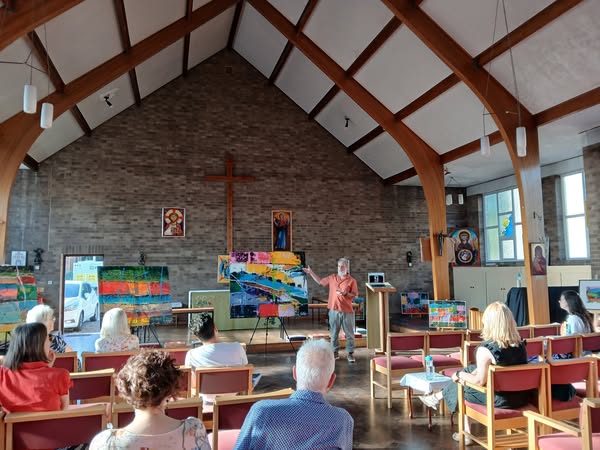
Unveiled: An Evening with Neil Tye


For the last 25 years Neil Tye has been working professionally, as a physical visual theatre performer, instructor, teacher, and installation artist, and has taken his performances, and teaching skills around the world. At Unveiled tonight, we heard stories about his music, performance, and painting.

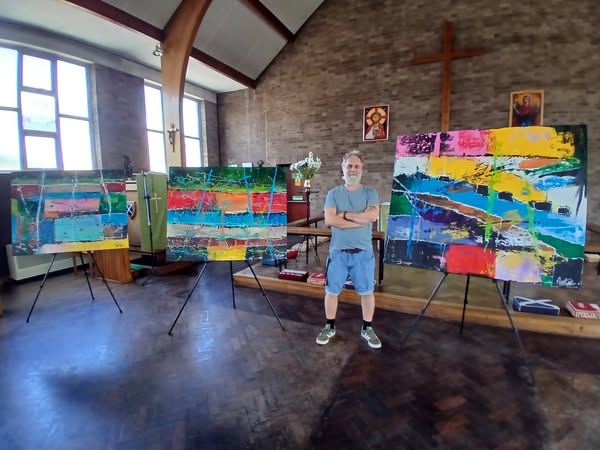
He had examples of paintings and a sculpture from two recent series. He spoke of his current series as follows:

'These paintings were born from a simple encounter. A visitor wandered into my studio, drawn first by colour, by shape, by the unspoken language of image.

What began as casual conversation about my art soon deepened, the lines between art and life quietly dissolving. Before long, they were sharing their joys and wounds, their quiet sorrows, their unguarded hopes.

It always stirs me how a canvas, streaked with pigment and possibility, can open hearts wide. How abstraction, unburdened by logic, slips past the mind and speaks straight to the soul. A silent painting, yet somehow, it listens and replies.

After they left, their words lingered like incense. And I, stirred by something sacred, picked up the brush. Each mark led to the next a choreography of colour, a prayer in movement.

When I stepped back, the painting looked back at me. I saw layers like life itself layers of ache and ascent, of hope tangled with hurt. But what caught my eye most were lines piercing through the forms, bold and unwavering. They whispered of Christ, not with fury, but with grace. Not to judge, but to heal.

Through every shape, He moves breaking through the clutter of our days with quiet, radiant mercy.'

Artist Statement

Neil’s artistic practice is grounded in an intuitive and process-driven approach, wherein the act of painting itself dictates the final composition. Rather than adhering to predetermined concepts, he engages with the canvas through spontaneous mark-making and gestural forms, allowing the work to evolve organically. While his initial engagement with a piece may be sparked by a particular colour or shape, it is the dynamic interplay of movement, texture, and form that ultimately guides its development.

By embracing spontaneity and fluidity, his work exists at the intersection of abstraction and interpretation, inviting viewers to engage with the imagery in a way that is both personal and open-ended. Through this interplay between process and meaning-making, Neil`s paintings function as both intuitive expressions and conceptual explorations of movement, memory, and transformation.

About the artist

Neil Tye (b. 1963, London UK) is a Denmark-based artist with a background in both visual arts and physical theatre. Initially working as a performer and educator in physical theatre, he transitioned into visual expression 15 years ago. He holds an MA in Professional Practice from Middlesex University, London, and has exhibited, performed, and taught extensively across Europe and beyond. His exhibitions include venues such as the arts and culture centre Spinderihallerne (Denmark), the arts centre Banco de Nordeste (Brazil), and The Post Houston TX (USA), among others.

Drawing from his multidisciplinary background, Neil’s work explores movement, form, and storytelling through visual mediums. He continues to create from his studio M10 in the Art zone area here in Spinderihallerene.


Tomorrow, 'Make Space for God' is a day of creativity and inspiration led by Anja and Neil Tye, the visionary leaders of "Art Encounter" from Denmark, at Miracle House, Silva Island Way, Wickford from 10.00 am - 4.00 pm.

Art Encounter is an international arts ministry under Rescue Team which is run by married couple Neil and Anja Tye who are based in Denmark.

Neil and Anja are trained artists, and have been using their artistic skills as artist missionaries for many years. They have worked with different Christian organisations and churches from around the world such as Creative Mission in Sweden, Creative Arts Europe in Belgium, YWAM Costa Rica, Circus Victory Brazil, Ad Deum Dance Company USA, Iris Ministries Brazil, Acts Academy International Bible College, to Euroclass youth Mission boarding school in Denmark.

Art Encounter communicates the Gospel by using the arts, from dance, theatre, creative writing, and the visual arts and painting in various settings both in Denmark and around the world.

---------------------------------------------------------------------------------------------------------

Resurrection Band - Colours.

Saturday, 10 May 2025

Unveiled: An evening with Neil Tye


An evening with Neil Tye
Friday 4 July, 7.00 pm
St Andrew’s Church, 11 London Road, Wickford SS12 0AN


For the last 25 years Neil Tye has been working professionally, as a physical visual theatre performer, instructor, teacher, and installation artist, and has taken his performances, and teaching skills around the world. Hear stories about his music, performance, and painting.

Part of ‘Unveiled’, the Friday night arts and performance event at St Andrew’s Church

Artist Statement

Neil’s artistic practice is grounded in an intuitive and process-driven approach, wherein the act of painting itself dictates the final composition. Rather than adhering to predetermined concepts, he engages with the canvas through spontaneous mark-making and gestural forms, allowing the work to evolve organically. While his initial engagement with a piece may be sparked by a particular colour or shape, it is the dynamic interplay of movement, texture, and form that ultimately guides its development.

By embracing spontaneity and fluidity, his work exists at the intersection of abstraction and interpretation, inviting viewers to engage with the imagery in a way that is both personal and open-ended. Through this interplay between process and meaning-making, Neil`s paintings function as both intuitive expressions and conceptual explorations of movement, memory, and transformation.

About the artist

Neil Tye (b. 1963, London UK) is a Denmark-based artist with a background in both visual arts and physical theatre. Initially working as a performer and educator in physical theatre, he transitioned into visual expression 15 years ago. He holds an MA in Professional Practice from Middlesex University, London, and has exhibited, performed, and taught extensively across Europe and beyond. His exhibitions include venues such as the arts and culture centre Spinderihallerne (Denmark), the arts centre Banco de Nordeste (Brazil), and The Post Houston TX (USA), among others. Drawing from his multidisciplinary background, Neil’s work explores movement, form, and storytelling through visual mediums. He continues to create from his studio M10 in the Art zone area here in Spinderihallerene.

'The things we carry'

Following its initial display at Spinderihallerene in April, Neil's latest exhibition 'The things we carry' will be shown at Redbud Arts Center, Houston, from 7 - 28 June. This is a collection of mixed media works that centre around the nature of human connection. To mark the opening, Redbud Arts Center will host a special one-night performance by the internationally acclaimed Ad Deum Dance Company. The performance, inspired by themes from Tye's exhibition, will weave movement, storytelling, and live interaction with the artwork, offering audiences a multidisciplinary experience that bridges visual art and contemporary dance.

Neil says of the exhibition: "The title of this exhibition was inspired by reflections I had while creating my recent body of work. The first thought centres on the fundamental nature of human connection—we are not meant to navigate life alone. We rely on one another for support, understanding, and encouragement, whether through conversation, shared experiences, or emotional upliftment. The second thought arose from one particular painting, which evoked the image of an overloaded truck. This visual metaphor led me to consider how, in life, we accumulate and carry various burdens—emotions, worries, frustrations, memories, secrets, hopes, and dreams. These intangible yet weighty elements can become overwhelming, making it evident that we cannot bear them alone. At times, we must find ways to release or share these burdens, but this raises important questions: Where do we turn for relief? To whom do we entrust our heaviest thoughts? And how can we cultivate a sense of communal support to help lighten the loads we all inevitably carry?"

----------------------------------------------------------------------------------------------------------

Josh Garrels - May You Find A Light.

Saturday, 5 March 2016

Walbrook Art Group Talks


The Walbrook Art Group spans the e-congregation of the London Internet Church and the St Stephen Walbrook community bringing both together. Twice a year people gather at Walbrook for a presentation on artists and faith and make visits to galleries, artist studios etc to reflect further on the connections between art and faith. Talks this Lent have been given by: Revd Stephen Baxter, Lynda Keen, Sarah White and Dharshan Thenuwara.

Last Wednesday Alan Everett and I both gave talks to the group. Alan spoke about his 'Foundations of the City' exhibition in terms of its origin in his recent sabbatical and inspiration gained from 'The Dream of the Rood'. I gave a brief summary of modern sacred art in order to give a context for the viewing of Alan's exhibition. 

In relation to Alan's work I said the following: In inviting Alan Everett to exhibit here I was engaged by the organic nature of his work as he combines the deliberation of his rhythmic mark marking with the more random effects of drips and splashes; all cohering through his overall perception of the evolving work. Nicholas Cranfield, too, has noted that Alan Everett’s “technique is to bring some definition to a range of splashed and thrown paint that explodes into shapes, some more legible than others, making marks that appear both out of focus and out of time and yet never stray far from the first idea.” This brings the work of the Abstract Expressionists, and Jackson Pollock in particular, to mind. Nicholas Cranfield also sees that "There is something Mark Rothko-like in the way that the artist has explored the contrast between the coloured shape of the cross and the stark background of unrelenting darkness.” As a result, Alan seems to be engaged with that non-representational sense of the divine which has links to the idea of art as a window into the divine.

At 1.00pm on Wednesday 9 March and Saturday 12 March Art Group member Dharshan Thenuwara is offering tours of the outside of William Morris' Red House and garden. The tours will last about an hour and a half and will cost £3.00 a head. This does not include admission to the house.
-----------------------------------------------------------------------------------------------

M Ward - Confession.

Saturday, 22 August 2015

Airbrushed from Art History: Ben Shahn and American Expressionism

In Common Man Mythic Vision Stephen Polcari compares and contrasts the work of Ben Shahn with his postwar American art peers:

'During and after World War II, whether one was a Social realist like Ben Shahn and the WPA artists, a Regionalist like Thomas Hart Benson, an Expressionist like Rico Lebrun, Hyman Bloom, or Abraham Rattner, or an Abstract Expressionist like Mark Rothko, Jackson Pollock, and Willem de Kooning, most American artists engaged the principal crisis of their time: the survival of the nation and of humane civilisation.'

'Shahn ... reshaped his style with new subject matter, a more universal outlook, and a new artistic language of symbolic emotion ... his adoption of a new mythic and allegorical language was only one of the ways he contributed to a new American approach to art; particular expressive themes were another ... With works such as Sound in the Mulberry Tree, 1948, with its Hebrew lettering and biblical verse, Maimonides, 1954, which evoked the medieval Jewish sage, Third Allegory, 1955, with its shofar and prayer shawl, and The Parable, 1958, with its drowning or emerging patriarch, Shahn sought to express universal truths. Yet, these works undoubtedly reflect Shahn's new appreciation for the heritage that he had restrained in his early work. The Holocaust brought forth a renewed identification with, and need for reaffirmation of, Shahn's Jewishness ...

fellow radical painter Philip Evergood was also moved to depict the effects of the war in mythic and symbolic language. Evergood's The New Lazarus, 1927 - 54, conflates his typical Social Realist edginess with a mythic biblical image of the evils of war and death, and the hope that these horrors will be redeemed by resurrection ...

Benton Murdoch ... Spruance's Souvenir of Lidice ... depicts three men nailed to crosses - in other words, a modern Calvary. This contemporary crucifixion was inspired by the Nazi slaughter slaughter of the citizens of Lidice, Czechoslovakia ... Spruance followed his war work with a further use of this symbolic language. it is reflected in works of 1943 such as Riders of the Apocalypse with its air war; Pietà - From the Sea showing Christ as a dead seaman; and Epiphany, in which the stars of social reconstruction imagery ... appear in a new context ...

With America's entry into the war, Benton altered his approach, now using biblical imagery to address America's political needs. In 1942, he produced a suite of paintings called the Year of Peril ... the series narrated the war in terms of biblical images and themes ...

The expressionist Abraham Rattner ... painted the subject of lamentation several times. In his Lamentation, 1944, and Pietàs, 1945 and 1949, Rattner created a compact emblem of sorrow ... Although the war is not explicitly represented, it was implicitly understood in the frequent depictions of the crucifixion by Rattner and other artists ...

Lamentation was the formative idea of the Entombment paintings, the largest series in the early work of the Abstract Expressionist Mark Rothko ...

Rico Lebrun employed bestial imagery when he represented the dumb soldiers surrounding Christ as horned and armored animals in The Crucifixion, 1950 ...

Although a Jew from the Baltic like Shahn, the expressionist Bloom was a Boston artist and much more devoted than Shahn to visionary, nightmarish imagery, born of the study of Dürer's allegories, and to the work of Rouault (like Rattner and Spruance), Bresdin and Soutine ...

During the 1940s and 1950s, many artists were engaged in representing their personal responses to history ... Shahn joined these artists in coming to terms with history through allegory, myth and tradition.'

-------------------------------------------------------------------------------------------

Joanne Hogg -  I Heard The Voice Of Jesus Say.

Sunday, 26 July 2015

Joseph Cornell: Aesthetic experience as a manifestation of spirit

'From a basement in New York, Joseph Cornell channelled his limitless imagination into some of the most original art of the 20th century.' 

'Wanderlust at the RA brings together 80 of Cornell’s most remarkable boxes, assemblages, collages and films, some never before seen outside the USA. Entirely self-taught, the independence of Cornell’s creative voice won the admiration of artists from Marcel Duchamp and the Surrealists, to Robert Motherwell and the Abstract Expressionists, with echoes of his work felt in Pop and Minimalist art.

Wanderlust is a long overdue celebration of an incomparable artist, a man the New York Times called “a poet of light; an architect of memory-fractured rooms and a connoisseur of stars, celestial and otherwise.”'

When he was in his twenties, Joseph Cornell learned about Christian Science and became a devout follower of the religion, as he believed it had cured him of recurring stomach ailments.

Richard Vine notes that 'the teachings of Christian Science and membership of the Christian Science church "provided Cornell ... with a clarity essential to his sanity and his art - the certainty, despite everyday trials and confusions, of ultimate cosmic harmony within the all-encompassing Mind of God."'

Sandra Leonard Starr writes that Cornell 'begins with the finite reality of the object, proves the unreality of it and our seeing it as such, and arrives at a statement of aesthetic experience as a manifestation of spirit.'

----------------------------------------------------------------------------------

Al Green - How Great Thou Art.

Thursday, 10 May 2012

William Congdon - The Sabbath of History

This comes from the latest ImageUpdate:

"If you are going to be anywhere in the vicinity of New Haven, Connecticut between now and September 16, you owe it to yourself to get to the Knights of Columbus Museum. The goal of your visit is an art exhibition of paintings by William Congdon, accompanied by excerpts from "Meditations on Holy Week" written many years ago by Joseph Ratzinger (now known as Benedict XVI).

There is an utterly fascinating story behind this show. Though he is all but forgotten now, Congdon was one of the rising stars of the art world in the mid-twentieth century, associated with Abstract Expressionism and the action painting of Jackson Pollock. To quote the exhibition materials: "His first one-man show, at the Betty Parsons Gallery in 1949, was lauded by reigning art critic Clement Greenberg who credited his paintings with having 'real painterly emotion.' In 1951, he was profiled in LIFE magazine and heralded as 'A Remarkable New U.S. Painter.'" Then he more or less disappeared from the art scene.

What happened? Among other things, Congdon moved to Italy, converted to Catholicism, and joined the Catholic lay movement, Communion and Liberation. Though he abandoned the art world, Congdon continued to paint—and his conversion did not induce him to abandon his cutting-edge style. His semi-abstract paintings were often crafted with an impasto knife, a method that created dramatic gestures and incised expressive lines within the work. His early subjects were largely urban and conveyed a sense of modern alienation and isolation, but after his conversion he turned increasingly to landscapes and religious subjects.
Congdon's rendering of traditional biblical scenes was always probing and creative, never falling back on cliché or sentimentality. The pairing of his works with texts by Ratzinger makes sense for a number of reasons, including Ratzinger's close friendship with the founder of Communion and Liberation, Luigi Giussani.

IMAGE published an essay on Congdon's work by art critic Peter Selz way back in issue 14, which we've put in its entirety on our website. This is an artist whose reputation deserves to be much greater than it is, so please spread the word.

Learn more about the exhibition here. Read Peter Selz's essay from IMAGE issue 14 here. Visit the Congdon Foundation website here."
-----------------------------------------------------------------------------------------------
Jan Gaberak and the Hilliard Ensemble - Parce Mihi Domine.