Wikio - Top Blogs - Religion and belief
Showing posts with label Bethlehem. Show all posts

Friday, 25 December 2015

Christ, the ending and beginning of all our journeying

This is my sermon from Midnight Mass at St Stephen Walbrook:

Journeys feature heavily in the Christmas story. There are the physical, geographical journeys of Mary and Joseph from Nazareth to Bethlehem to register in the census, the rather shorter journey of the Shepherd from the hills surrounding Bethlehem to the manger itself, the lengthy journey of the Magi following the star via Herod’s palace to the home of Jesus, and the journey of Mary, Joseph and Jesus to Egypt following the Magi’s visit.

Then there are the emotional and life journeys that the characters in the story make. For Mary the journey of pregnancy and birth following her submission to God’s will at the Annunciation; the journey of carrying God himself in her womb for nine months while enduring the disapproval of her community. For Joseph, there is the journey from what was considered right in the community of his day – a quiet divorce – to the realisation that to do God’s will meant standing by Mary despite the local disgrace and scandal.

All these journey’s, and others, bring us to the birth of Jesus; the birth of the new thing that God was doing in the life of our world and the new thing that he was doing in the lives of these people. What can we learn from their journeys that will help us in our own life journeys?

None of their journeys were easy. Even those with shortest journey, such as the Shepherds, risked disapprobation and even the loss of their livelihood, for leaving their sheep to worship Jesus. The Magi, no doubt, had a lengthy and uncomfortable journey not knowing exactly where they were going and nearly being seduced by Herod into contributing to the death of the child they sought. But for Mary and Joseph their journey was most difficult; the worries of carrying a full-term baby in the full glare of public disapprobation, an uncomfortable journey just prior to birth, and the pain of birth in an unsuitable and uncomfortable environment far from home.

God does not promise us that the experience of being part of the new thing that he is doing is ever easy but imagine the joy and wonder of the moment that Jesus is born, when Mary holds this precious, promised child for the first time, when the Shepherds come bursting in with their tales of Angels singing glory to God and the Magi come bearing their gifts, and all who come, come to worship the child that she holds. No wonder the story tells us that she pondered or treasured these things in her heart.

This child, both God and human being, was born to save humanity for our sins. God’s new act to rescue a fallen humanity; God doing a new thing in our world to demonstrate his love for each one of us.

Like the shepherds and wise men, we have journeyed tonight to celebrate this birth. Our physical, geographical journeys may, like those of the Shepherds have been short, but the life journeys that have brought us here tonight may well have been lengthy and hard. Like Mary and Joseph, those journeys may have involved disapprobation or scandal, the worry and pain of birthing and caring for children, like the Shepherds our life journey may have risked our livelihoods or like the Magi have involved a lengthy search for truth that has included looking in and leaving the wrong places.

However we have come tonight, the possibility remains for us to experience the new thing that God has done in our world through the birth of his son, Jesus. The good news about which the Angels sang on that first Christmas night was peace on earth, goodwill among human being; a peace that comes as human beings receive forgiveness from God for all the wrong and torturous journeys we have had, the actions and decisions that have hurt us and hurt others. We know now that we can be forgiven because God has come, as a human being, to be with us, to experience all that human life involves and, ultimately to die to save us from our sins.

This is the new thing that God has done in our world. It is this that came to birth at Bethlehem. It is this to which all our journeys lead. Will we, with Mary, Joseph, the Shepherds and the Magi, this Christmas kneel and worship this child, Jesus, God with us, the Saviour of our world, the ending and beginning of all our journeying?

--------------------------------------------------------------------------------------

Franz Schubert - Mass No.3 in Bb Major, 2. Gloria.


Thursday, 18 December 2014

Christ overlooked at Christmas

This was the homily that I gave at the Service of Nine Lessons and Carols by Candlelight which we held at St John's Seven Kings last Sunday evening:

It may sound an odd thing to say at a service attended by a large number of people, but Jesus has always been overlooked at Christmas. Think about the Christmas story for a moment; Jesus spent his first night sleeping in an animal’s feeding trough because there was no room for him in the guest room of the home in Bethlehem where his family were staying, the Shepherds needed a fanfare of angels before they knew of his birth, while the Wise Men looked for him in a palace when he was actually to be found in an ordinary home. So it is no surprise that today many people still overlook the person at the heart of Christmas in the busyness of life and Christmas preparations and others overlook him by creating supposedly PC festivals like Winterval.

Jesus has always been overlooked at Christmas but one of the reasons for that is that he came to be one of us, God with us, which is what the name Emmanuel means. Born in an obscure village, working in a carpenter’s shop, never writing a book, never holding an office, never having a family or owning a house, never going to college, never travelling two hundred miles from the place where he was born. He did none of the things we usually associate with greatness. He is God become an ordinary person just like us. And therefore he is easy to overlook.

But just as the Shepherds and Wise Men did seek him out and find him, those who genuinely look for Jesus this Christmas will find him. And if you are prepared to seek him out, you will find that Jesus is the greatest gift that any of us can receive, both at Christmas and any other time in our lives.

As you listen to the story of Jesus’ birth tonight, the story will have meaning as you take it to heart. The 17th century German mystic, Angelus Silesius, warns us:

Though Christ a thousand times
In Bethlehem be born
If he’s not born in thee,
Thou art still forlorn.

If Christ is not born in you as you listen and sing, this time together will be pleasant but not life changing. But if Christ is born in you then the whole story will be transformed. It will become your story. You will be able to say:

Christ born in a stable
is born in me.
Christ accepted by shepherds
accepts me.
Christ receiving the wise men
receives me.
Christ revealed to the nations
be revealed in me.
Christ dwelling in Nazareth
You dwell in me.

-----------------------------------------------------------------------------------------

Steve Bell - Magnificat.

Sunday, 7 December 2014

Christian Aid Partnership Project sermon


Israel and Palestine are places of contrasts. Three of the world’s religions claim holy ancestry here. Christians, Jews and Muslims worship alongside one another as signposts which point to church, mosque and synagogue in Acco or Acre indicate. The view of the skyline in Nazareth shows the dome of the Greek Roman Catholic Church alongside the minaret of the White Mosque. Both claim to be built on the site of the original synagogue in Nazareth. In Hebron, at the Tombs of the Patriarchs and Matriarchs, a mosque and synagogue are located within the same building.

All of this worship is centred on Jerusalem and on the Old City in particular. Jews worship at the Western Wall, the remains of the Temple built by Herod, Christians walk in the footsteps of Jesus on the Via Dolorosa to the Church of the Holy Sepulchre and Muslims pray at the Al-Aqsa Mosque and the Dome of the Rock on the Temple Mount.

All this was occurring during our recent visit to the Holy Land made as part of a tour organised by the East London Three Faiths Forum. However, as we travelled we were also inevitably aware of various signs of tensions between the faiths and tensions within the faiths such as, for example, the ladder on a ledge outside the Church of the Holy Sepulchre left where it is as it cannot be moved without the agreement of all the denominations represented in this church.

Bullet holes in street signs indicated past conflicts, as did war memorials and live mines in the Golan Heights. There were armoured vehicles outside our hotel in Jerusalem and at the Tombs of the Patriarchs in Hebron. A missile launcher was located above the Garden Tomb in Jerusalem and soldiers were on the streets in the Old City and in Hebron.

To reach Bethlehem we passed through the security wall or separation barrier which Israel began building in 2002 to cut itself off from the Occupied Palestinian Territories. This was justified as a response to violence and has stopped most of the suicide bombings which were then occurring regularly. The barrier has exacerbated the humanitarian crisis facing the Palestinian people, has annexed land and divided communities but, most of all, has come to symbolise the divide between the two peoples at the heart of the Middle East crisis.

Movement within – and in and out of – the West Bank is controlled by 540 Israeli checkpoints, roadblocks, earth mounds and gates, plus an average 100 ‘flying checkpoints’ on Palestinian roads every week. Checkpoints, roadblocks, the separation barrier, earth mounds and a Kafkaesque permit system are the daily reality for Palestinians. The Gaza Strip is largely cut off, while obstacles in the West Bank have created isolated enclaves that sever economic ties, separate communities and deny Palestinians access to some fifty per cent of the land.

In the West Bank, illegal Israeli settlements take up Palestinian land and water resources and create restrictions on movement that impede Palestinian access to education, healthcare and employment, as well as restricting the economy – all contributing to poverty.

In Acco we saw these ‘Not for Sale’ signs in an Arab area of the City. Our guide explained that the Orthodox buy homes in Arab or secular Israeli areas and then begin to impose the Mosaic Law in ways that eventually force the original occupiers of the area to move out. Arab and secular Israeli’s have, therefore, begun making agreements in their communities not to sell to Orthodox families.

At least 65 per cent of Palestinians were living below the poverty line in 2007, compared to 54 per cent in 2005 and 20 per cent in 1998. As we walked through the Old City in Hebron relative levels of poverty were clear when compared with similar markets elsewhere.

The confiscation of land, the expansion of Israeli settlements and the building of the separation barrier all create facts of the ground which exacerbate poverty and undermine the whole notion of a viable Palestinian state.

Our tour of the Holy Land ended at Yad Vashem. Established in 1953, as the world center for documentation, research, education and commemoration of the Holocaust, Yad Vashem safeguards the memory of the past and imparts its meaning for future generations.

The Holocaust was the murder by Nazi Germany of six million Jews. While the Nazi persecution of the Jews began in 1933, the mass murder was committed during World War II. It took the Germans and their accomplices four and a half years to murder six million Jews. Most of the Jews of Europe were dead by 1945. A civilization that had flourished for almost 2,000 years was no more.

The survivors, dazed, emaciated, bereaved beyond measure, gathered the remnants of their vitality and the remaining sparks of their humanity, and rebuilt. They never meted out justice to their tormentors – for what justice could ever be achieved after such a crime? Rather, they turned to rebuilding: new families forever under the shadow of those absent; new life stories, forever warped by the wounds; new communities, forever haunted by the loss. As a quote displayed at Yad Veshem states, ‘From among the horror grew another morality, another love, another compassion. These grew wild – no one gave them a name.’

So, just as we must denounce the sufferings of the Holocaust, we must also denounce the sufferings for Palestinians which have followed the political response to the Holocaust, the establishment of the state of Israel.

As a group of Christians, Jews and Muslims travelling harmoniously to tour our holy sites together, the East London Three Faiths Forum is a sign that peace and understanding across the faiths can be achieved. We pray therefore not for Arab or Jew, for Palestinian or Israeli, but pray rather for ourselves, that we might not divide them in our prayers but keep them both together in our hearts.

Christian Aid has been working with the poorest people in the region since the early 1950s, when they first provided help to Palestinian refugees. Today they are working with more than 20 Israeli and Palestinian organisations to protect human rights, access to services and resources, and to build peace based on justice for all.

This includes a project which has provided Palestinian families with video cameras, as well as surveillance cameras for those under threat from the settlers breaking into their homes and physically and verbally abusing them. To protect one family, a Christian Aid partner built a metal ‘cage’ around their home to protect them from physical abuse. The mother says; ‘The camera makes life better for us, it stops the settlers. For example, if I film them, they are more careful, or they run away.’

In Lebanon and the West Bank, there are approximately 500,000 people living with disabilities. Practical difficulties, discrimination and outdated attitudes towards people with disabilities prevent them from fully participating in society and the workplace. The Christian Aid partnership project which we have been supporting here at St John's Seven Kings, delivered in partnership with the Lebanese Physically Handicapped Union (LPHU) and the East Jerusalem YMCA, is directly benefiting 30,000 people living in Lebanon and the West Bank over its three-year lifetime. Its wider impact will improve prospects for many thousands more and continue to make a difference into the future. The money we are donating to this project helps to: provide training and careers guidance for people living with disabilities; improve job prospects for people living with disabilities; improve working conditions, including workplace adaptation; increase awareness of issues people living with disabilities face – particularly among employers; and improve the laws that protect the rights of people living with disabilities. The EU is match funding this project three times over – meaning that the £5,000 we are raising will transform into £20,000 for people living with disabilities in Lebanon and the West Bank. Today was our final opportunity at St John's Seven Kings to give towards this project.

The Palestinian-Israeli situation today shows the futility of violence, where endless repression and resistance feed off each other. As Banksy's powerful images in Bethlehem suggest, in the Middle East the dove of peace has to wear a bullet-proof vest. From this cycle of repression and violence, conflict and provocation, come the bitter fruits of poverty. Action – including the support of projects like the Christian Aid partnership project - is urgently needed to break this cycle of diminishing hope.

As Naim Ateek, director of the Sabeel Ecumenical Liberation Theology Centre in Jerusalem, has said: ‘Both nations must “do justice, love mercy and walk humbly with God”. Once those biblical demands of justice have been satisfied, a good measure of peace will be achieved. The result will then be a new and deeper security enjoyed by all throughout the land.’ So may we pray, as Psalm 122 encourages us, for the peace of Jerusalem, recognizing its impact throughout Israel and Palestine and on all who view it as a holy city.

A prayer for justice and peace in the land of the Holy One: Living Lord, ignite in us a passion for justice and a yearning to right all wrong. Strengthen us to work for peace in the land we call Holy: for peace among Jew, Christian and Muslim, for reconciliation between communities, for harmony between faiths. Inspire us to act with the urgency of your quickening fire, for blessed are the peacemakers they shall be called the children of God. (Ramani Leathard, Trustee, Amos Trust)

----------------------------------------------------------------------------------------

Christmas message

I write this having just returned from the Holy Land (as part of a trip organised by the East London Three Faiths Forum) and, therefore, having recently visited Bethlehem.

To reach Bethlehem today it is necessary to pass through the separation wall which the Israeli Government erected in 2002 between Israel and the West Bank. The Israeli West Bank barrier is a 400-mile long network of high walls, electronic fences, gates and trenches which Israel claims has stopped suicide bombings and the Palestinian's claim has annexed large tracts of land.

A Christmas card depicts the Holy Family unable to reach Bethlehem because they have been stopped by this wall, while a Nativity set has been produced with the wall running through it separating wise men and camels from the crib. Although tourists and pilgrims continue to visit the Church of the Nativity in Bethlehem in their thousands on a daily basis, it seems that we have not heard the message which the angels sang before Jesus’ birth of peace on earth.

Steve Turner's poem ‘History Lesson’ says:

‘History repeats itself.
Has to.
No-one listens.’

It is one thing to celebrate Christmas and another to visit Bethlehem itself but what really matters is to hear the song of peace that the angels sang announcing Jesus’ birth as the Prince of Peace. He came, through his death on the cross, to remove walls of separation between human beings and to return all people to relationship with God. It is only when we know this peace, which passes understanding, in our hearts, minds and relationships that we have truly taken on board the Christmas message.

Jesus, through his birth, life, death and resurrection, calls us to be peacemakers. It is, therefore, appropriate that St John’s Seven Kings has been fundraising over the past two years for a Christian Aid Partnership Project which supports people living with disabilities in Lebanon and the West Bank through new employment or business opportunities. These are provided by the Lebanese Physically Handicapped Union and the East Jerusalem YMCA. This project seeks to work across divisions to provide help to those most in need and we need a final fundraising push this Christmas to complete our support of this project.

It may be that contributing to this project will be your way of hearing afresh the Christmas message of peace on earth.

-----------------------------------------------------------------------------------

Steve Bell - Magnificat.

Sunday, 30 November 2014

Advent reflection


Israel and Palestine today are lands of contrasts, where past and present are juxtaposed in contrasts which are sometimes incongruous and sometimes profound. This lithograph shows a view of Jerusalem from approximately 1890 and shows the essentially rural nature of the area surrounding the Old City at that time.

Nazareth is now a large city, where once, at the time of Christ, it was an obscure village. The Basilica of the Annunciation is a modern Roman Catholic church built on the foundations of an earlier Crusader church. The church has been built over the excavated remains of buildings from the settlement of Jesus’ day and incorporates into this modern building the ancient Grotto of the Annunciation.

At Bethlehem the Church of the Nativity stands alongside a busy central square. Bethlehem is a town relient on tourism, where its holy sites are alongside the food outlets, accommodation and souvenir shops which tourists require and which support the local economy.

The Basilica of the Annunciation straddles and shields remains from ancient Nazareth. At the centre of this modern church are remains of earlier churches and the ancient Grotto of the Annunciation which is thought to be the location where the Annunciation occurred. At the heart, therefore, of the tourist trails and visits there is worship, piety and devotion.

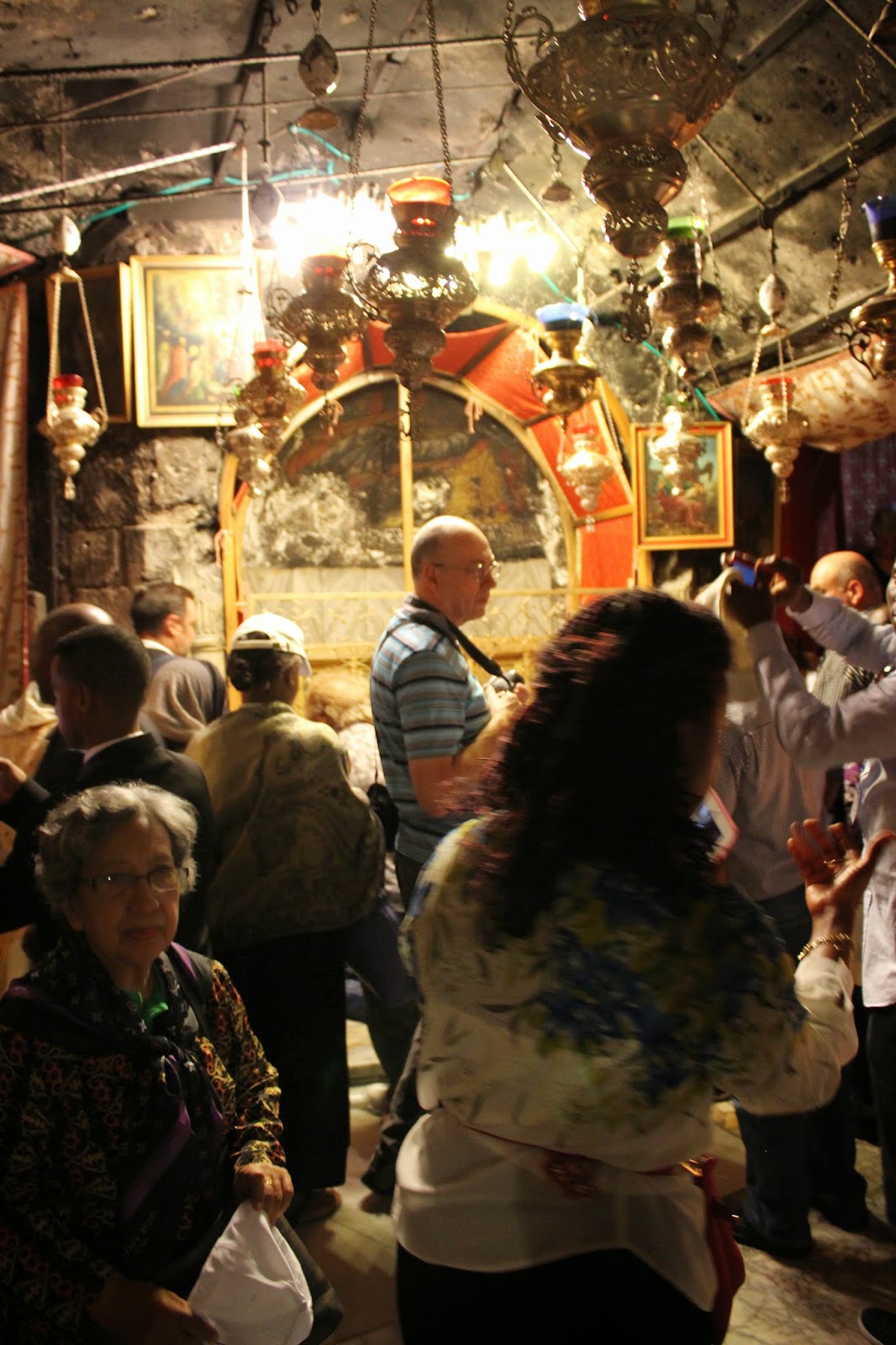
The same mix is found in Bethlehem, where tourists and pilgrims can queue for two hours or more to see or to kiss the site that is traditionally thought to be the location of Christ’s birth and the site of the manger. Among the busyness of this crowded space people kneel in devotion to worship Christ.

The humble events of Jesus’ conception and birth have proved inspirational, spreading around the world, bringing millions to the holy sites and leading to the creation of great art and architecture. The Basilica of the Annunciation is a stunning example of modernist architecture which is sensitive to the site and which enhances worship. Artworks in mosaic, stained glass and stone have been collected there from around the world to tell the story of the Annunciation in a truly global fashion.

I was privileged to see these images as part of the East London Three Faiths Forum's recent Tour of the Holy Land. While in Nazareth with this group, I read the following sonnet about Mary as part of our experience of seeing and reflecting on these sacred sites.

The poet, Malcolm Guite, says of Mary: ‘Mary has been given many titles down the ages and some Christians have disagreed with one another bitterly about her. But equally, in every age and every church she has been, for many Christians, a sign of hope and an inspiration. Her earliest ‘title’, agreed throughout the church in the first centuries of our faith, before the divisions of East and West, Catholic and Protestant, was Theotokos, which means God-Bearer. she is the prime God-Bearer, bearing for us in time the One who was begotten in eternity, and every Christian after her seeks to become in some small way a God-bearer, one whose ‘yes’ to God means that Christ is made alive and fruitful in the world through our flesh and our daily lives, is born and given to another.’

You bore for me the One who came to bless
And bear for all and make the broken whole.
You heard His call and in your open ‘yes’
You spoke aloud for every living soul.
Oh gracious Lady, child of your own child,
Whose mother-love still calls the child in me,
Call me again, for I am lost, and wild
Waves surround me now. On this dark sea
Shine as a star and call me to the shore.
Open the door that all my sins would close
And hold me in your garden. Let me share
The prayer that folds the petals of the Rose.
Enfold me too in Love’s last mystery
And bring me to the One you bore for me.

-------------------------------------------------------------------------------------

Malcolm Guite & Steve Bell - The Singing Bowl & Birth Of A Song.

Thursday, 13 November 2014

East London Three Faiths Forum Tour of the Holy Land: Day 3


Simon Hill led a communion service on Masada during which I shared the following thoughts on the incarnation, reflecting on the significance of our previous day's visit to Bethlehem and the Church of the Nativity:

Jesus was born to be Emmanuel – God with us. That is what the incarnation, “the union of the human and the divine in the life of a humble Jewish carpenter,” is all about. As John 1. 14 says, in the contemporary translation of the Bible called The Message: “The Word became flesh and blood and moved into the neighbourhood.”

Through Christ’s birth, God has entered our world and moved into our neighbourhood. In Christ, God has identified with us by becoming one of us. The entire movement of the Bible - from God walking with Adam and Eve in the Garden of Eden, through God having a tent (the tabernacle) and then a house (the Temple) so he could live with the Israelites - leads up to this moment in history when God becomes flesh and blood and enters our world. That is why Jesus is also called Emmanuel which means God is with us.

What does it mean for God to be with us in the way? It means that God becomes one of us. He becomes a human being experiencing the whole trajectory of human existence from conception through birth, puberty, adulthood to death including all that we experience along the way in terms of relationships, experiences, emotions and temptations. Rowan Williams has said that: "Jesus, the Son of God, … knew what it meant to be without wealth, he knew what it meant to grow up disadvantaged, he knew what it meant to turn to God in prayer, faith and hope.”

Through his incarnation and nativity Christ comes into the messiness of human life, as a human being, to experience all that we experience for himself. The betrayals, dismay, distress, depression, illness, pain, insanity, loss of hope, loneliness, homelessness, danger and despair that many of us experience at periods in our lives and which some experience as their everyday life. Christ comes to understand all this and to bear it on his shoulders to God, through his death on the cross, in order that, like him, we too can rise to new life and ascend to the life of God himself. “Lord, who came down to share our plight / Lift them into your love and light.” This is the hope held out to us through the birth of Jesus in Bethlehem; that he was born into poverty, exile, danger, stigma for our sake, in order to reach out to and rescue us.

God, in Jesus, “had to become like his people in every way, in order to be their faithful and merciful High Priest in his service to God, so that the people's sins would be forgiven. And now he can help those who are tempted, because he himself was tempted and suffered” (Hebrews 2. 17 & 18). “... we have a great High Priest who has gone into the very presence of God — Jesus, the Son of God. Our High Priest is not one who cannot feel sympathy for our weaknesses. On the contrary, we have a High Priest who was tempted in every way that we are, but did not sin. Let us have confidence, then, and approach God's throne, where there is grace. There we will receive mercy and find grace to help us just when we need it” (Hebrews 4. 14 – 16).

This is the wonderful result of love coming down at Christmas - of Christ’s nativity and incarnation – we can have confidence to “approach God's throne, where there is grace. There we will receive mercy and find grace to help us just when we need it.” Lord, who came down to share our plight, lift us all into your love and light.

-----------------------------------------------------------------------------------------------

John Rutter - Love Came Down At Christmas.


Wednesday, 12 November 2014

East London Three Faiths Forum Tour of the Holy Land: Day 2


Here is a meditation which I wrote while preparing for the East London Three Faiths Forum Tour of the Holy Land. The starting point for the meditation was the title of a song on the latest album by Deacon Blue:

Bethlehem begins.
Here, human hands hold God for the first time.
Here, God is fed from a human breast for the first time.
Here, God is struck on the back,
takes his first breath, utters his first cry.
Here, heaven and earth are rejoined.
Here, humanity is taken into the Godhead.
Here, God becomes vulnerable.
Here, God experiences created life.
Here, God enters his creation.
Here, God moves into our neighbourhood,
Becomes one with human beings.

In a place of forced migration,
Where no room could be found
For a pregnant woman
whose baby was not the child of her betrothed,
In less than ideal circumstances
Here begins peace on earth
Goodwill to all.
Salvation is birthed and named
The King of the Jews is sought and found,
The Messiah is recognised and praised.

Here the dividing wall
Between Jew and Gentile,
Male and female, slave and free,
Begins to be removed.
Here begins salvation, redemption,
Restoration for one and all.
Reconciliation between
the human and divine.

-----------------------------------------------------------------------------------------

Deacon Blue - Bethlehem Begins.