Wikio - Top Blogs - Religion and belief
Showing posts with label god's architect. Show all posts

Friday, 30 May 2025

Seen and Unseen: The late Pope Francis was right – Antoni Gaudi truly was God’s architect

My latest article for Seen and Unseen is entitled 'The late Pope Francis was right – Antoni Gaudi truly was God’s architect' and explores how sanctity can indeed be found amongst scaffolding, as Gaudi’s Barcelona beauties amply demonstrate:

'In welcoming the news that Gaudí had been declared Venerable, Cardinal Juan José Omella, Archbishop of Barcelona, said “It is a recognition not only of his architectural work but something more important.” He continued: “He is saying you... amid life's difficulties, amid work, amid pain, amid suffering, are destined to be saints.” Ultimately, he notes, “Gaudí’s life and work show us how beauty and holiness can transform the world” as they include the “recognition that sanctity can be found amid scaffolding, suffering, sublime obsession.”'

For more on Antoni Gaudí see here and here

My first article for Seen and Unseen was 'Life is more important than art' which reviews the themes of recent art exhibitions that tackle life’s big questions and the roles creators take.

My second article 'Corinne Bailey Rae’s energised and anguished creative journey' explores inspirations in Detroit, Leeds and Ethiopia for Corinne Bailey Rae’s latest album, Black Rainbows, which is an atlas of capacious faith.

My third article was an interview with musician and priest Rev Simpkins in which we discussed how music is an expression of humanity and his faith.

My fourth article was a guide to the Christmas season’s art, past and present. Traditionally at this time of year “great art comes tumbling through your letterbox” so, in this article, I explore the historic and contemporary art of Christmas.

My fifth article was 'Finding the human amid the wreckage of migration'. In this article I interviewed Shezad Dawood about his multimedia Leviathan exhibition at Salisbury Cathedral where personal objects recovered from ocean depths tell a story of modern and ancient migrations.

My sixth article was 'The visionary artists finding heaven down here' in which I explored a tradition of visionary artists whose works shed light on the material and spiritual worlds.

My seventh article was 'How the incomer’s eye sees identity' in which I explain how curating an exhibition for Ben Uri Online gave me the chance to highlight synergies between ancient texts and current issues.

My eighth article was 'Infernal rebellion and the questions it asks' in which I interview the author Nicholas Papadopulos about his book The Infernal Word: Notes from a Rebel Angel.

My ninth article was 'A day, night and dawn with Nick Cave’s lyrics' in which I review Adam Steiner’s Darker With The Dawn — Nick Cave’s Songs Of Love And Death and explore whether Steiner's rappel into Cave’s art helps us understand its purpose.

My 10th article was 'Theresa Lola's poetical hope' about the death-haunted yet lyrical, joyful and moving poet for a new generation.

My 11th article was 'How to look at our world: Aaron Rosen interview', exploring themes from Rosen's book 'What Would Jesus See: Ways of Looking at a Disorienting World'.

My 12th article was 'Blake, imagination and the insight of God', exploring a new exhibition - 'William Blake's Universe at the Fitzwilliam Museum - which focuses on seekers of spiritual regeneration and national revival.

My 13th article 'Matthew Krishanu: painting childhood' was an interview with Matthew Krishanu on his exhibition 'The Bough Breaks' at Camden Art Centre.

My 14th article was entitled 'Art makes life worth living' and explored why society, and churches, need the Arts.

My 15th article was entitled 'The collective effervescence of sport's congregation' and explored some of the ways in which sport and religion have been intimately entwined throughout history

My 16th article was entitled 'Paradise cottage: Milton reimagin’d' and reviewed the ways in which artist Richard Kenton Webb is conversing with the blind poet in his former home (Milton's Cottage, Chalfont St Giles).

My 17th article was entitled 'Controversial art: how can the critic love their neighbour?'. It makes suggestions of what to do when confronted with contentious culture.

My 18th article was an interview entitled 'Art, AI and apocalypse: Michael Takeo Magruder addresses our fears and questions'. In the interview the digital artist talks about the possibilities and challenges of artificial intelligence.

My 19th article was entitled 'Dark, sweet and subtle: recovered music orientates us'. In the article I highlight alt-folk music seeking inspiration from forgotten hymns.

My 20th article was entitled 'Revisiting Amazing Grace inspires new songs'. In the article I highlight folk musicians capturing both the barbaric and the beautiful in the hymn Amazing Grace and Christianity's entanglement with the transatlantic slave trade more generally.

My 21st article was entitled 'James MacMillan’s music of tranquility and discord'. In the article I noted that the composer’s music contends both the secular and sacred.

My 22nd article was a book review on Nobody's Empire by Stuart Murdoch. 'Nobody's Empire: A Novel is the fictionalised account of how ... Murdoch, lead singer of indie band Belle and Sebastian, transfigured his experience of Myalgic encephalomyelitis/chronic fatigue syndrome (ME) through faith and music.'

My 23rd article was entitled 'Rock ‘n’ roll’s long dance with religion'. The article explores how popular music conjures sacred space.

My 24th article was an interview with Alastair Gordon on the artist’s attention which explores why the overlooked and everyday capture the creative gaze.

My 25th article was about Stanley Spencer’s seen and unseen world and the artist’s child-like sense of wonder as he saw heaven everywhere.

My 26th article was entitled 'The biblical undercurrent that the Bob Dylan biopics missed' and in it I argue that the best of Dylan’s work is a contemporary Pilgrim, Dante or Rimbaud on a compassionate journey.

My 27th article was entitled 'Heading Home: a pilgrimage that breaks out beauty along the way' and focuses on a film called 'Heading Home' which explores how we can learn a new language together as we travel.

My 28th article was entitled 'Annie Caldwell: “My family is my band”' and showcased a force of nature voice that comes from the soul.

My 29th article was entitled 'Why sculpt the face of Christ?' and explored how, in Nic Fiddian Green’s work, we feel pain, strength, fear and wisdom.

My 30th article was entitled 'How Mumford and friends explore life's instability' and explored how Mumford and Sons, together with similar bands, commune on fallibility, fear, grace, and love.

-----------------------------------------------------------------------------------------------------

Iain Archer - The Acrobet.

Monday, 28 April 2025

Antoni Gaudí: The Venerable mystic master of Catalan Modernism


The Vatican recently announced that the mystic master of Catalan Modernism, Antoni Gaudí, long known as “God’s architect,” has officially been declared Venerable by the late Pope Francis, the first formal recognition of his “heroic virtues” by the Catholic Church. This decree nudges the visionary designer of Barcelona’s Sagrada Família closer to sainthood—a campaign in the making for over two decades.

Following a visit to Barcelona to see many of Gaudí's buildings, I wrote two pieces for ArtWay about him. See here and here:

"Gaudí is the great sculptor who utilises natural form in his work both for utilitarian and aesthetic reasons. He described nature as ‘the Great Book, always open, that we should force ourselves to read’ and, as [Robert] Hughes recognised, thought that ‘everything structural or ornamental that an architect might imagine was already prefigured in natural form, in limestone grottoes or dry bones, in a beetle's shining wing case or the thrust of an ancient olive trunk.’

As a result first and overall impressions of his work are ones of exuberance and abundance characterised by the sinuous, sensuous curves and colours of his works. Whether we are encountering the shifting sea-like blues of the Casa Batlló, the abstract collage of the wave-like trencadis bench at Park Güell or the whirlpool-like undulations on the ceiling at Casa Milà, Gaudí's work possesses an ecstatic sense of natural beauty."

-------------------------------------------------------------------------------------------------------

The Oh Hello's - Soldier, Poet, King.

Sunday, 11 May 2014

ArtWay meditation: Antoni Gaudi

My latest meditation for ArtWay is on the work of Antoni Gaudi. In the meditation, I say:

Gaudi "described nature as ‘the Great Book, always open, that we should force ourselves to read’ and thought that ‘everything structural or ornamental that an architect might imagine was already prefigured in natural form, in limestone grottoes or dry bones, in a beetle's shining wing case or the thrust of an ancient olive trunk’ ...  first and overall impressions of his work are ones of exuberance and abundance characterised by the sinuous, sensuous curves and colours of his works. Whether we are encountering the wavelike benches at Park Güell or the decorations on the roof of the Sagrada, Gaudí's work possesses an ecstatic sense of natural beauty."

-----------------------------------------------------------------------------------------------------------

Van Morrison - Be Thou My Vision.

Wednesday, 23 October 2013

Antoni Gaudí - God's Architect

My latest travelogue piece for ArtWay concerns Antoni Gaudí and covers visits to the Sagrada Familia and Colonia Güell Crypt:

"Gaudí is the great sculptor who utilises natural form in his work both for utilitarian and aesthetic reasons. He described nature as ‘the Great Book, always open, that we should force ourselves to read’ and, as [Robert] Hughes recognised, thought that ‘everything structural or ornamental that an architect might imagine was already prefigured in natural form, in limestone grottoes or dry bones, in a beetle's shining wing case or the thrust of an ancient olive trunk.’" 

-------------------------------------------------------------------------------------------

Duke Special - Why Does Anybody Love?

Sunday, 11 August 2013

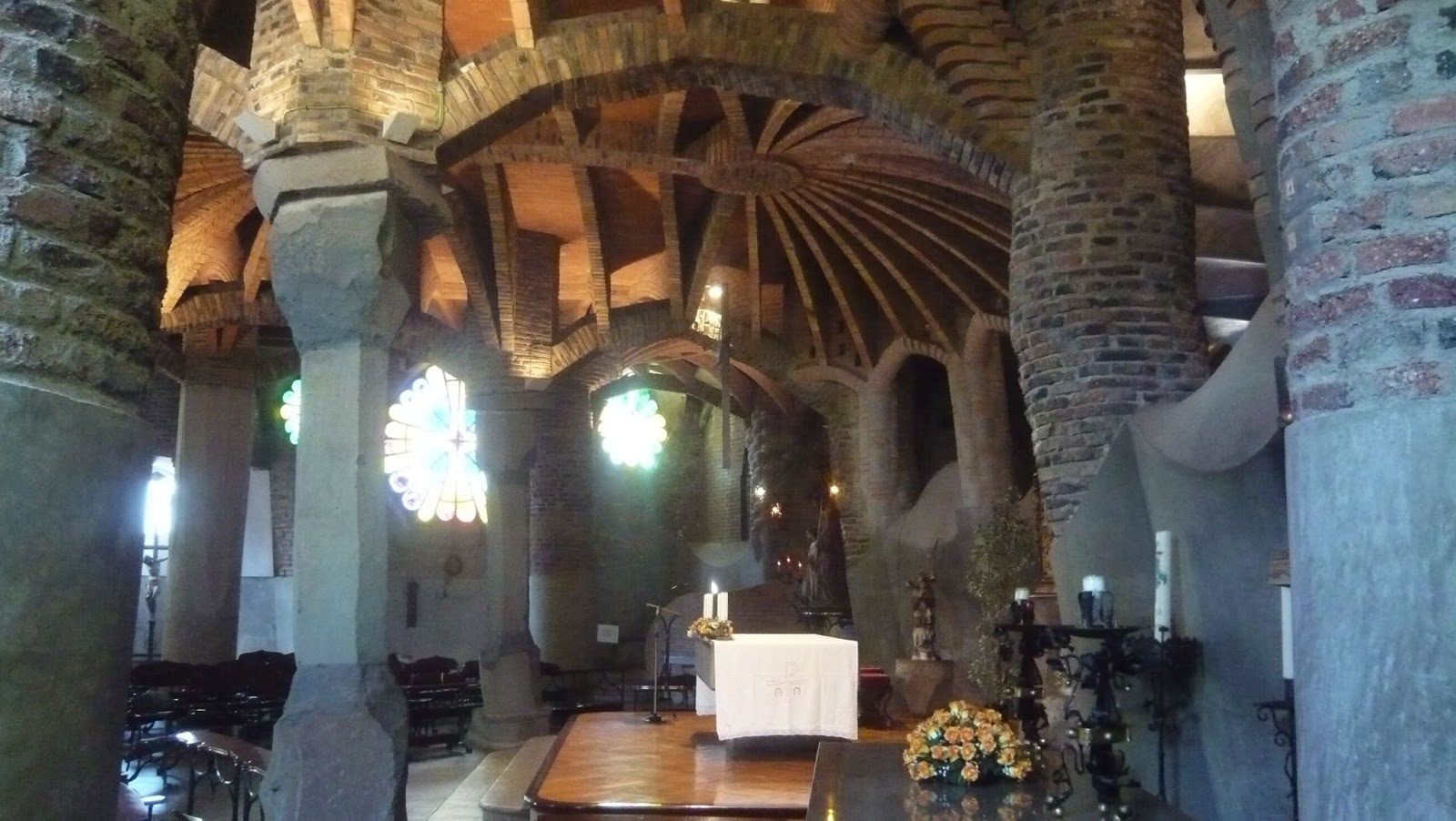
Colonia Güell and Gaudí's Crypt


The construction of Colonia Güell began in 1890 at the initiative of the entrepreneur Eusebi Güell in his textile estate of Santa Coloma de Cervelló. Construction of the factory began in 1890. A mere year later the first building was completed and the steam machine dedicated to spinning was started. Afterwards, the rest of the buildings, each aimed at drying, tinting, etc in order to complete cotton’s process of transformation. Each of the buildings that made up the factory had a different role in the process of transforming cotton into fabric. A set of rails and cartwheels were installed throughout the factory in order to facilitate the transportation of materials between the aforementioned buildings.

The factory of the Colonia Güell was its central nucleus and raison d’etre. Dedicated to the production of several types of cloths, its main difference with other textile factories of the time was that it used coal in lieu of hydraulic energy.

Industrial colonies where conceived as a socioeconomic organization whose main goal was industrial productivity. The mill took up most of the time of the men and women of the colony, for them it was the guarantee of having a regular income in times of economic scarcity. In contrast to most industrial colonies in Catalonia, Güell worked to improve the social conditions of his workers and applied his cultural patronage in the Colonia, providing it with cultural and religious facilities of a modernist design which were developed by different architects, most notably Antoni Gaudí to whom he entrusted in 1898 the building of the church.

Over the next few years, Gaudí carried out various preliminary studies which culminated in a model which was placed in a pavilion located in the hill were the building would later be erected. The construction of the temple began in 1908. However, the ambitious project which foresaw a church with two naves, lower and upper, topped by different towers and a 40 meters high central dome would remain unfinished. In 1914 the Güell family decided to stop financing the church and Gaudí abandoned the project. In November 1915 the bishop of Barcelona consecrated the lower nave, the only one to have been built, which made the church be popularly known as the crypt.

During the textile crisis of 1973 the mill ceased its production which had a big social impact in the Colonia. Over the next few years, the property was sold; the mill was divided and sold to different companies, the houses to their inhabitants and the facilities and land to the public institutions.
In 1990 the Colonia Güell was declared 'Heritage of Cultural Interest' by the Spanish government and the protection of some of its most relevant buildings was established. The Crypt was declared a  World Heritage Site by UNESCO in 2005.

Visitors can still walk around the industrial Colonia and visit Gaudí's church, all the while observing beautiful, singular buildings created by modernist architects.

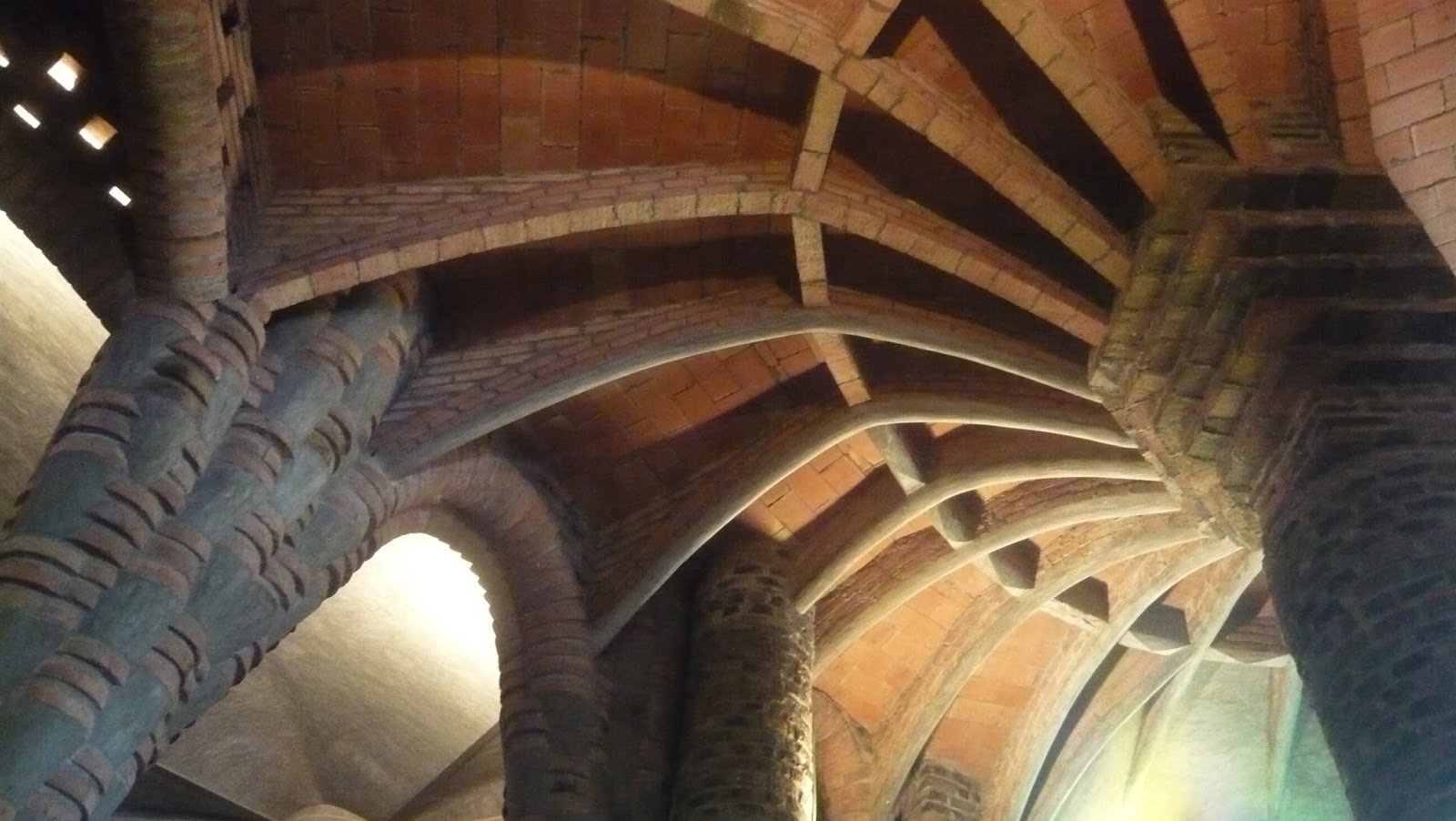
The Crypt of Colònia Güell is a culminating point in Gaudi's work including for the first time practically all of his architectural innovations. He stated that without the large-scale experiments he undertook there, he would not have dared apply those same geometries to the Sagrada Familia. It is the place where, according to Japanese architect, Arata Isozaki, he ‘overcame all established limits regarding shapes.’


--------------------------------------------------------------------------------------------

Gungor - Beautiful Things

Wednesday, 31 July 2013

One of the world's most sublime architectural spaces


I've been re-watching Robert Hughes' Antoni Gaudi: God's Architect, from his Visions of Space series, in which he examines the legend of Antoni Gaudi, whose buildings have left an indelible mark on the city of Barcelona. Despite his austerely religious lifestyle, Gaudi's innovative genius created some of the most soulful and expressive buildings ever seen.

Hughes noted that the country round Tarragona, where Gaudi grew up, is archetypally Mediterranean, hard stony country where almond trees and olives flourish in the unforgiving soil:

'Growing up there, Gaudí developed a passionate curiosity about its plants, animals and geology. Nature, he said later, was "The Great Book, always open, that we should force ourselves to read". Everything structural or ornamental that an architect might imagine was already prefigured in natural form, in limestone grottoes or dry bones, in a beetle's shining wing case or the thrust of an ancient olive trunk.

He never ceased to draw on nature. Each paving-block of Passeig de Gracia features a starfish and an octopus, originally designed for the Casa Batlló. Turtles and tortoises support the columns of the Nativity facade of the Sagrada Familia, which also has 30 different species of stone plant copied from the vegetation of Catalunya and the Holy Land. Mushrooms become domes, or columns of the Casa Calvet. Gaudí was particularly fond of mushrooms. Most Catalans are, yet Gaudí not only perceived in them a possible origin of the column and capital, but also used a fong, a poisonous amanita mushroom, for one of the ceramic entrance domes of the Parc Güell. The columns of his masterpiece the Güell Crypt are a grove of brick trunks, sending out branches - the ribbed vaults - that lace into one another.'

Similarly, Stephen Crittenden writes:

'"NOTHING IN the world has been invented," Gaudí once said. "The act of inventing consists in seeing what God has placed before the eyes of all humanity." In a small room in the Sagrada Familia's cloister, a permanent exhibition, Gaudí & Natura, offers a key to interpreting all this wonder by revealing the building's "deep structure."

The exhibition's curator, Jordi Cussó i Anglès, was for 50 years the head model-maker in the Sagrada Familia workshop. A naturalist who played a leading role in researching and restoring Gaudí's smashed plaster models, using superb graphics he shows how it was from Gaudí's intense study of the natural world, and especially the plants of his native Catalunya, that the architect distilled the complex geometrical shapes — paraboloids, hyperboloids and conoids — that he used in the church. The cone of the Mediterranean cypress becomes the distinctive five-armed cross Gaudí uses on top of many of his spires. Seashells inspire spiraling stairwells. An undulating rooftop imitates the curved surface of a leaf. The slender branching columns of the Sagrada Familia's nave imitate the cross-sections of tree-trunks and the patterns of plant growth.'

While Hughes considered that the Sagrada Familia (or, to give its full name, the Expiatory Temple of the Holy Family) is beyond rival the best-known structure in Catalonia and 'is to Barcelona what the Eiffel Tower is to Paris or the Harbour Bridge to Sydney: a completely irreplaceable logo,' it was the Church of Colònia Güell that he considered to be Gaudi's true masterpiece. Gaudi 'started thinking about the design in 1898. The first stones were laid in 1908. Eusebi Güell died in 1918. By then, the crypt was almost finished, but there was not much above ground. What we have now is only a fragment of a dream. And yet its logic of construction, its sheer blazing inventiveness, removes it from the domain of fantasy and creates one of the world's most sublime architectural spaces.'

--------------------------------------------------------------------------------------------

Barcelona - Come Back When You Can.