Wikio - Top Blogs - Religion and belief
Showing posts with label springsteen. Show all posts

Monday, 24 November 2025

International Times: 'A Deep Dive' - 'Springsteen: Deliver Me from Nowhere'

My latest review for International Times is on Springsteen: Deliver Me from Nowhere:

'The synopsis of ‘Springsteen: Deliver Me from Nowhere’ is essentially to be found in lines from an early Bruce Springsteen song, ‘Darkness on the Edge of Town’:

Well, everybody’s got a secret, Sonny
Something that they just can’t face
Some folks spend their whole lives trying to keep it
They carry it with them every step that they take

‘Til someday they just cut it loose
Cut it loose or let it drag ’em down
Where no one asks any questions
Or looks too long in your face
In the darkness on the edge of town

What Springsteen initially can’t face is his troubled relationship with his troubled father. In the film he is told this to his face by his girlfriend Faye (a composite character, rather than an actual person). Eventually, he leaves New Jersey – his hometown, which triggers memories for him all the time he remains there – and through talking therapies gains necessary understanding of his mental health challenges, including greater understanding of and an improved relationship with his father.'

My earlier pieces for IT are: an interview with the artist Alexander de Cadenet; an interview with artist, poet, priest Spencer Reece, an interview with the poet Chris Emery, an interview with Jago Cooper, Director of the the Sainsbury Centre for Visual Arts, a profile of singer-songwriter Bill Fay, plus reviews of: 'Great Art Explained' by James Payne; 'Down River: In Search of David Ackles' by Mark Brend; 'Headwater' by Rev Simpkins; 'The Invisibility of Religion in Contemporary Art' by Jonathan A. Anderson; 'Breaking Lines' at the Estorick Collection of Modern Italian Art, albums by Deacon Blue, Mumford and Sons, and Andrew Rumsey, also by Joy Oladokun and Michael Kiwanaku; 'Nolan's Africa' by Andrew Turley; Mavis Staples in concert at Union Chapel; T Bone Burnett's 'The Other Side' and Peter Case live in Leytonstone; Helaine Blumenfeld's 'Together' exhibition, 'What Is and Might Be and then Otherwise' by David Miller; 'Giacometti in Paris' by Michael Peppiatt, the first Pissabed Prophet album; and 'Religion and Contemporary Art: A Curious Accord', a book which derives from a 2017 symposium organised by the Association of Scholars of Christianity in the History of Art.

Several of my short stories have been published by IT including three about Nicola Ravenscroft's EarthAngel sculptures (then called mudcubs), which we exhibited at St Andrew's Wickford in 2022. The first story in the series is 'The Mudcubs and the O Zone holes'. The second is 'The Mudcubs and the Clean-Up King', and the third is 'The mudcubs and the Wall'. My other short stories to have been published by International Times are 'The Black Rain', a story about the impact of violence in our media, 'The New Dark Ages', a story about principles and understandings that are gradually fading away from our modern societies, and 'The curious glasses', a story based on the butterfly effect.

IT have also published several of my poems, including 'The ABC of creativity', which covers attention, beginning and creation, and 'The Edge of Chaos', a state of existence poem. Also published have been three poems from my 'Five Trios' series. 'Barking' is about St Margaret’s Barking and Barking Abbey and draws on my time as a curate at St Margaret's. 'Bradwell' is a celebration of the history of the Chapel of St Peter-on-the-Wall, the Othona Community, and of pilgrimage to those places. Broomfield in Essex became a village of artists following the arrival of Revd John Rutherford in 1930. His daughter, the artist Rosemary Rutherford, also moved with them and made the vicarage a base for her artwork including paintings and stained glass. Then, Gwynneth Holt and Thomas Bayliss Huxley-Jones moved to Broomfield in 1949 where they shared a large studio in their garden and both achieved high personal success. 'Broomfield' reviews their stories, work, legacy and motivations.

To read my poems published by Stride, click here, here, here, here, here, and here. My poems published in Amethyst Review are: 'Runwell', 'Are/Are Not', 'Attend, attend' and 'Maritain, Green, Beckett and Anderson in conversation down through the ages'.

I am among those whose poetry has been included in Thin Places & Sacred Spaces, a recent anthology from Amethyst Press. I also had a poem included in All Shall Be Well: Poems for Julian of Norwich, the first Amethyst Press anthology of new poems.

'Five Trios' is a series of poems on thin places and sacred spaces in the Diocese of Chelmsford. The five poems in the series are:
These poems have been published by Amethyst Review and International Times.

-------------------------------------------------------------------------------------------------------------

Bruce Springsteen - Atlantic City.

Saturday, 26 December 2020

Top Ten 2020

This is the music, in no particular order, that I've most enjoyed listening to in 2020:

Bruce Springsteen - Letter To You: '... you just need to turn it up really loud on a long, fast drive through a heartbroken summer night to hear Springsteen for the damaged hero he is. But that ensemble euphoria does work best live, when the bass is rattling through the blood and bones of hundreds of collected humans. The live recording of this record really helps deliver that communal feeling. They feel so present and close that listeners might feel they’re violating the pandemic rules. They rollick through the “Janey Needs a Shooter” and the Dylanesque “Song for Orphans”, both of which Springsteen wrote back in 1973. But it’s the new material that really catches fire. The band blaze through “Ghosts” and “Last Man Standing”, with “House of a Thousand Guitars” soaring above the lot. Driven by the supple rise and fall of a hymnal piano melody, the song is a commentary on songwriting. Springsteen, who’s been wonderfully frank about his lifelong struggle with depression, expresses solidarity with other writers “bitter and bored” who “wake in search of the lost chord”. As the champion of the working Americans who’ve been sold out by the Trump presidency, he delivers a verse on “the criminal clown” who has “stolen the throne”. But he offers the communion of music as a way to rise above and beyond material misery.'

Bob Dylan - Rough and Rowdy Ways: '“I sing the songs of experience like William Blake,” Bob Dylan growls, introducing his 39th epistle on the follies, frustrations and secret strengths of a species at war with itself, “I’ve got no apologies to make.” He’s the rebel poet, approaching twilight, laying out generations of hard-earned wisdoms with no punches pulled and no regrets. At 79, following a trio of covers albums of American standards largely associated with Sinatra, you might expect Dylan to make a world-worn and contemplative sort of record, but one that had little left to say. Instead, with ‘Rough And Rowdy Ways’, he’s produced arguably his grandest poetic statement yet, a sweeping panorama of culture, history and philosophy peering back through assassinations, world wars, the births of nations, crusades and Biblical myths in order to plot his place in the great eternal scheme. Rough? Perhaps, but it certainly has the warmth and lustre of the intimate and home-made. And rowdy? Dylan’s sure been rowdier ... Instead he requires of his band just a series of soft and simple canvasses, woven largely from gentle spiritual, lustrous country, Southern blues or gothic Americana – often resembling enclosed, traditionally structured atmospheres rather than songs – onto which he can project his sprawling literary visions of death, degradation and the horrors of history.'

Deacon Blue - City Of Love: 'They continue to conjure anthems that celebrate love, work, faith, hope, going out, and coming home ... we find Ricky Ross writing from a more personal – and maybe more vulnerable – viewpoint than before. City of Love seeks out the quiet moments, far from the bombast. From the solace of shared candle-light (the glorious, Fleetwood Mac-invoking 'In Our Room') to the solitude of nature (the gospel-rock of 'A Walk In The Woods'), it is poignant, pensive, yet never maudlin. If 'Intervals' stunning, astral pop reminds us of the ticking clock ('so little time'), then the swoon-inducing soul of 'Come On In' urges us to make the most of our days, and nights.'

Sufjan Stevens - The Ascension: Stevens 'felt inspired to create a whole record that examined the world he was living in, questioning it when it felt wrong and “exterminating all bullshit“. The sprawling results of this personal interrogation, which play out over a glitchy 80 minutes, serve as a powerful dissection of modern humanity. Filled with universal anguish and anxieties, ‘The Ascension’ ... takes a weary look at the outside world and out comes a deep sigh ... anxious instrumentals echo the album’s uneasy outlook and fear of the future, and when they combine forces it often makes for an astonishing listen. The world is pretty shitty at the moment and it’s easy to feel helpless, but as the horror show that is 2020 continues to rumble on, ‘The Ascension’ is yet another ample soundtrack to rage-dance to.'

Gregory Porter - All Rise: 'It’s not all just about that great voice. Gregory Porter also has a mighty generosity of spirit, plus empathy, warmth and optimism. And he has gathered a superb team around him to make a strong album with plenty of scale and depth ... All these contributions weave around Porter himself and strengthen what he does. The singer has written of “Revival Song”, written in memory of Freddie Gray, the 25-year old who died in police custody in Baliimore in 2015: “It’s about finding your source of strength to bring you back to seeing who you truly are so that you can be restored to the giant that you are.” That is what Gregory Porter, with help from some fine musicians has achieved with All Rise in 2020.'

Michael McDermott - What In The World: 'Chicago born McDermott’s poetic reflections on the parlous predicament of American politics and humanity in general always repay closer investigation, and “What in the World..” must rank as his most compelling offering to date. The Dylanesque title track points an accusing finger at the inhumanities perpetrated by the Trump regime via a tumbling flood of memorable lyrical images, contrasting beautifully with the much more low key charms of “Positively Central Park” and “New York,Texas,” a subdued gem strongly reminiscent of “Nebraska” era Springsteen at his brilliant best.'

Scott Stapp - The Space Between the Shadows: 'This album is powerful, it is beautiful and I can guarantee that every person reading this will be able to relate to the lyrical content throughout…we have all fought our demons to one extent or another but Scott has laid his soul bare and I am sure he is a very different man from the one prior to writing and recording The Space Between the Shadows. The album title tells a story of its own and although this is as dark as hell it is also full of light, hope and redemption. Scott Stapp is back and I lay odds he is better, stronger and much wiser than before.'

Bill Fay - Countless Branches - 'Countless Branches is the third of Fay's later-period albums, following Life Is People (2012) and Who Is the Sender? (2015). It might just be the best, too. It's palatable and concise, comprising ten tracks with bonuses pushing the total to 17. An incorrigible grouch might bridle at these guileless, gently philosophical songs, but they're delivered with such obvious sincerity that the rest of us will be charmed. As ever, Fay focuses on the search for meaning and substance in everyday life.'

Buddy & Judy Miller - 'Breakdown on 20th Avenue South': '... out of the ashes of loss, abandonment and melancholy, the songwriter has emerged like a phoenix for the sizzling Breakdown on 20th Ave. South (New West Records), the couple’s first duet record since 2009’s Written in Chalk. As much a testament to faith and forgiveness as it is a pulsating chronicle of a marriage beset by physical and emotional challenges, the album, which takes its name from the Music Row-adjacent street on which the couple resides in Nashville, ranks among the year’s finest.' 

The Innocence Misson - 'See You Tomorrow': Don Peris says, “There is a longing there to be transformed and a hopeful expectation that it is possible,” he explains. “I find joy, or a similar type of joy, in all of the songs,” he concludes. “A humble recognition of challenges and hardships, the acknowledgment and comfort in knowing that they are both personal and universal, and the expression of light and hope.” 'Focusing on the world that exists within our own heartbeats, The Innocence Mission has created a disc that finds truth in the connections binding us to each other. See You Tomorrow radiates a sense of love and warmth to help us through moments when those same commodities may be in short supply.'

My previous Top Ten's can be found here - 2019, 2018, 2017, 2016, 2015, 2014, 2013 and 2012.

---------------------------------------------------------------------------------------------------------

Monday, 30 December 2019

Top Ten 2019

This is the music, in no particular order, that I've most enjoyed listening to in 2019:

Kiwanuka by Michael Kiwanuka - 'Kiwanuka is a contemplative song cycle intended to be listened to in one extended sitting ... At the core is Kiwanuka’s inner battle between anxiety, self-doubt, spirituality and wisdom, which is then set against racism and rueful glances at the state of the world ... for all its melancholy, Kiwanuka is never downbeat. There are moments – such as the “Time is the healer” gospel choir in I’ve Been Dazed, or hopeful closer Light – when positivity bursts through with such dazzling effect you want to cheer. Kiwanuka is a bold, expansive, heartfelt, sublime album. He’s snuck in at the final whistle, but surely this is among the decade’s best.'

Ghosteen by Nick Cave and the Bad Seeds - 'Ghosteen drips melody like the permanent rain. It oozes emotion from a heavy heart. It embraces the frailty of the human soul. It’s full of poetry and images that switch sometimes from the time honoured embrace of Elvis and Jesus and the icons and articles of faith whether they are god or rock n roll to a yearning deeply soulful of a very personal heartbreak with a powerful honesty and lyrical nakedness reflecting a genuine darkness and intimate honesty that is a step deeper into the personal and the intimate that is compelling and hypnotic and with an almost ambient atmospheric music to match.'

Thanks for the Dance by Leonard Cohen - Thanks for the Dance 'Opener Happens to the Heart reflects on [Leonard Cohen's] career with trademark humility: “I was always working steady, I never called it art. I got my shit together, meeting Christ and reading Marx” ... Like those of Marvin Gaye and Prince, Cohen’s oeuvre sought to reconcile the spiritual and the sensual, which both feature heavily again ... As the pace slows to a transcendent crawl and backing vocals form a heavenly choir, The Hills mocks his ageing body (“The system is shot / I’m living on pills”) and the stunning The Goal finds him “almost alive” and “settling accounts of the soul”. The last poem he recorded, Listen to the Hummingbird, implores us to find beauty in God and butterflies: “Don’t listen to me.” And, finally, there is a vast, empty silence, and he is gone.'

We Get By by Mavis Staples - 'Over half a century after her voice was at the forefront of America’s civil rights era, Mavis Staples is still crying out for Change. The bluesy backbeat opening track of her 12th studio album confronts recent shootings in the US before she concludes, brilliantly, “What good is freedom if we haven’t learned to be free?”... It’s not hard to guess the subject of such pointed lines such as “Trouble in the land. We can’t trust that man.” Elsewhere, there are songs of loss, need, faith and devotion.'

Hotel Last Resort by Violent Femmes - 'More than three decades on from their 1983 debut, Violent Femmes have dished up another audio delight of front-porch folk ... The band’s juvenile charisma imbues every lyric, from a biblical satire in Adam Was a Man to humble love song Everlasting You, but Paris to Sleep is the heartbreaking hero: “Losing lost love is not worth losing for.” Deeply intuitive with a sprinkle of absurdity, the Violent Femmes’ new recipe is pure joy.'

Jaimie by Brittany Howard - 'Jaime is named after Howard’s sister, who taught her to play piano and died of cancer when she was eight years old – but “the record is not about her”, she said in a recent interview. “It’s about me.” A platter of psychy soul, gospel and funk, with melodies that tap and jitter like Morse code or pour out like silky caramel, Jaime is about tragedy, sexuality, religion, racism and poverty – all things with which Howard is uncomfortably familiar.'

Love & Revelation by Over The Rhine - 'Love & Revelation, an album of loping ballads and probing lyricism that addresses grief, loss and what it means to be an American in a conflicted country. “Let You Down” is a devastating promise to never abandon someone, with the understanding that inevitably they will do just that. “Betting on the Muse,” inspired by the writer Charles Bukowski, wrestles with finding a life’s second act after a person peaks. And “Los Lunas” is a haunting poem about a tearful drive to reckon with saying goodbye ... “The very first words you hear on the project are ‘I cried,'” says Detweiler, citing the opening lyric. “When I told my 87-year-old mother about it, she said that sounds like the Psalms.” But Love & Revelation, and the band itself, is ultimately about restoration and perseverance.'

High as Hope by Florence + the Machine - 'Welch reinforces her magnificent emoting with contemplative, intimate lyrics; the musician beckons people into her interior world with no hesitation and no cushion. “The show was ending, and I had started to crack,” Welch trills to open the album, her voice dominant above barely perceptible chords. “Woke up in Chicago and the sky turned black.” Despite that initial ominous note, High As Hope soon evolves into a treatise on what it means to embrace second chances, while trusting other people—and, more important, yourself. The cello-burnished “100 Years” exhibits a healthier approach to love and faith (“Give me arms to pray with instead of ones that hold too tightly”) while “Grace,” written as a mea culpa to Welch’s younger sister, asks forgiveness for youthful indiscretions.'

Western Skies by Bruce Springsteen - 'Western Stars ... is populated by characters past their best – the title track’s fading actor, reduced to hawking Viagra on TV and retelling his stories for anyone who’ll buy him a drink; Drive Fast’s injured stuntman recalling his youthful recklessness, the failed songwriter of Somewhere North of Nashville and the guy glumly surveying the boarded-up site of an old tryst on Moonlight Motel – all of them ruminating on how things have changed, not just for the worse, but in ways none of them anticipated.'

Three Chords and the Truth by Van Morrison - 'There’s a warmth here that recalls his ’90s highwater marks, Hymns to the Silence and The Healing Game, and connects even farther back in time to 1971’s Tupelo Honey, which balanced the charms of domesticity with R&B raves ... “It’s called ‘the flow,’” Morrison said in a recent interview, detailing his optimal conditions for making music. “I don’t know the mechanics of how that works. I just know when I’m in it.” “The flow” makes Three Chords and The Truth a deeply pleasurable listen, but it’s the moments where Morrison sounds less settled that carry the most weight. The album’s third song, “Dark Night of the Soul,” never wanders as far out as epics like “Madame George” and “Listen to the Lion,” nor does it match spaced-out gloss of his ’80s albums with trumpeter Mark Isham, but it’s gripped by the same existential fervor. Its mellow heat has a lot in common with 1997’s “Rough God Goes Riding,” a gentle midtempo cut with apocalyptic visions hiding in plain sight. Revisiting the 16th-century Christian mystic St. John of the Cross’ poem about the unknowability of God, one he’s sung about a number of times before, Morrison showcases the way his twilight years haven’t dimmed his yearning for growth, his desire for a deeper understanding.'

My previous Top Ten's can be found here - 2018, 2017, 2016, 2015, 2014, 2013 and 2012.

------------------------------------------------------------------------------------------------

Violent Femmes - Everlasting You.

Saturday, 10 September 2016

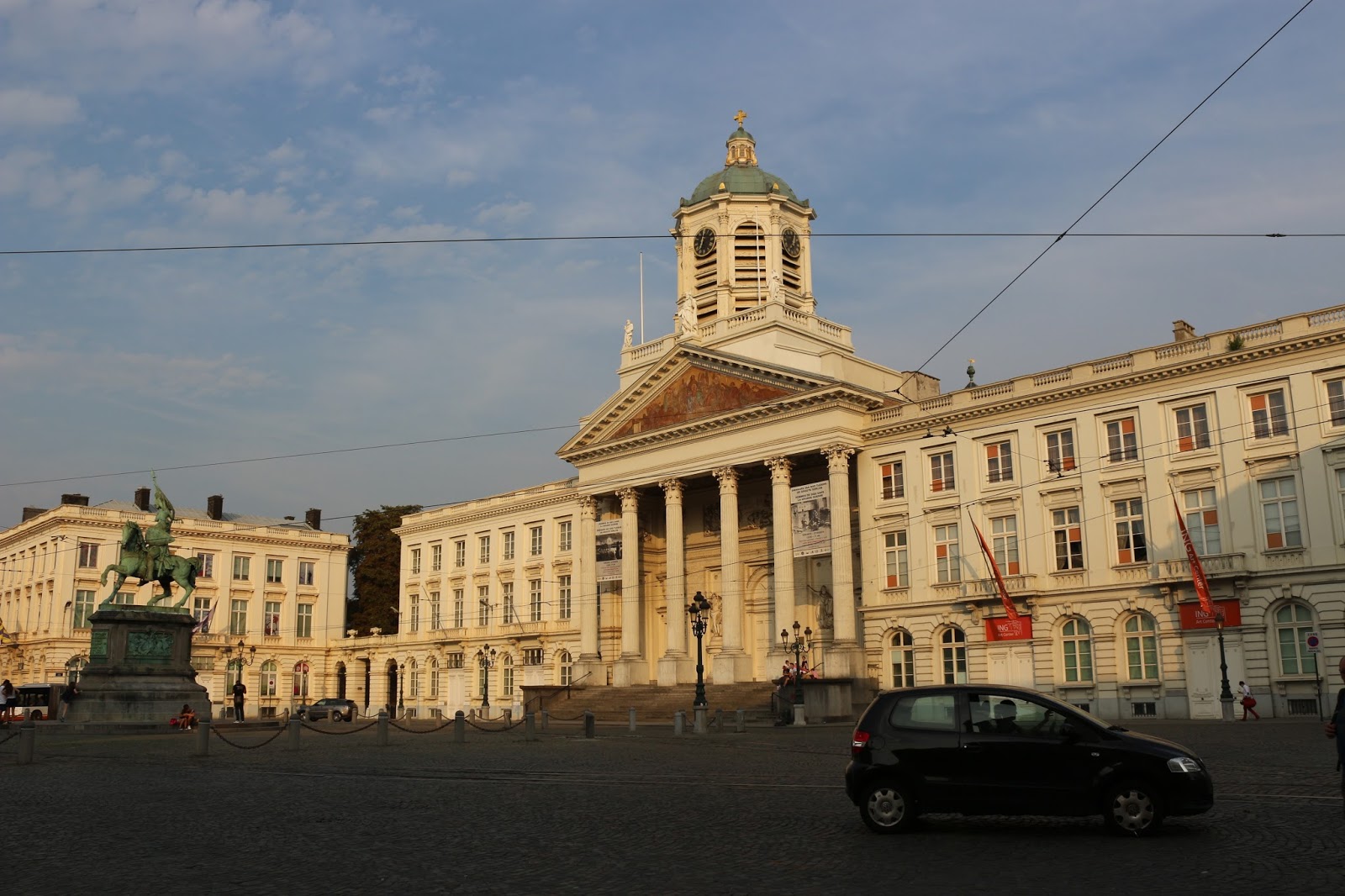
Scenes of Brussels


-------------------------------------------------------------------------------------------

Jacques Brel - Ne Me Quitte Pas.

Thursday, 18 December 2014

I find men and women struggling to answer the deepest questions we can ask freeing

'I find men and women struggling to answer the deepest questions we can ask freeing.' So said Bruce Springsteen when interviewed about his tastes in literature. I found this interview via 'The Imaginative Conservative'.

Springsteen spoke about the way that Flannery O’Connor, James M. Cain, John Cheever, Sherwood Anderson and Jim Thompson contributed greatly to the turn his music took around 1978-82:

'They brought out a sense of geography and the dark strain in my writing, broadened my horizons about what might be accomplished with a pop song and are still the cornerstone literally for what I try to accomplish today ... the short stories of Flannery O’Connor landed hard on me. You could feel within them the unknowability of God, the intangible mysteries of life that confounded her characters, and which I find by my side every day. They contained the dark Gothicness of my childhood and yet made me feel fortunate to sit at the center of this swirling black puzzle, stars reeling overhead, the earth barely beneath us.'

-------------------------------------------------------------------------

Bruce Springsteen - Reason To Believe.

Tuesday, 11 December 2012

The 10 albums that I've enjoyed most in 2012

Here are the 10 albums (in no particular order) that I've got hold of and enjoyed the most in 2012:

Taken from the Latin and literally meaning 'within the walls', Intra Muros is the album of "spooky" Christian music Bryan MacLean was completing at the time of his death. Due to 'the great strength of songs like the amazing Love Grows In Me and My Eyes Are Open', Intra Muros 'stands as fine testament to the ability of a great songwriter.'

The darkness, loss and wandering that suffuse Babel is fused with the transcendent sound and anthemic choruses that Mumford and Sons conjure up with banjo, double bass, guitar, keyboards and vocals.

The Bob Dylan of Tempest, 'A Hard Rain's A-Gonna Fall' and so many other songs, is the faithful watchmen who sees the storm of the apocalypse on the horizon and who warns his people before it is too late. Tempest is, therefore, a profoundly religious album.

Bill Fay’s songs on Life is People are simply astonishing - simple and melodic yet with unusual imagery and insights delivered with gravity and grace. 'Cosmic Concerto (Life Is People)' is a highlight from a collection of stand-out tracks; a celebration of the miracle of ordinary life, the infinite variation in each human face, which stirs his soul.

The Laughing Stalk - Woven Hand’s David Eugene Edwards says, 'The myths of our country are in the songs. The untold stories and gaps in history books are in the songs – our recollection is preserved in this music. Those songs as well as the stories that my parents told me, the bible and the books I read, all this is the foundation of my imagination of America.'

The fluid, flowing lines of Aradhna’s Namaste Saté possess the something more that comes from an ability to inhabit and then transcend the spirit of your sources.

Wrecking Ball is a masterful summation of Bruce Springsteen's strengths and an inspirational call to real hope in the face of genuine despair. The album is propelled forward by the anger of its storytelling songs before seguing through 'Wrecking Ball' into songs of hopeful fortitude for which Springsteen appropriates the language of faith and the imagery of the Bible.

Home Again - Michael Kiwanuka, who has been compared to Bill Withers and Al Green, has an "honest, unpretentious and raw style" that "is straight to the matter, unspoilt soul music at it’s best." Alexis Petridis wrote that "Kiwanuka addresses The Lord with such frequency that you picture Him hiding behind the sofa and pretending to be out. At first, it just sounds like a lyrical tic, but by the time you reach I'm Getting Ready – "to believe" – it's pretty clear that it runs substantially deeper than that."

One of the things I love most about the work of Leonard Cohen is his self-deprecating humour. There is real self awareness and humility on Old Ideas combined with the distance and irony of setting many of the lines ostensibly about himself in the third person. Leonard the man speaks to Leonard the persona. All performers seem to need to create a stage persona that is in some way separate from the reality of who the person actually is. On this basis, ‘Going Home’ is to do with the experience of leaving the stage in order to experience reality - "Going home / Behind the curtain / Going home / Without the costume / That I wore."

Gungor’s Ghosts upon the Earth is a set of songs for the jaded in which the phrase "fearfully and wonderfully and beautifully made" sums up much of what is experienced on this album. "All praises to the one who made it all and finds it beautiful". Michael Gungor writes, "As the various vocal parts circle the listener’s head when the band’s last chord fades out, one can imagine hearing the voices of all of these elements of creation (moon, sun, earth, wind, etc.) singing the praises of their creator."

------------------------------------------------------------------------

Woven Hand - As Wool.

Wednesday, 3 October 2012

Babel - the sound of transcendent music

Second albums are tricky affairs and, despite three years of preparation, Mumford and Sons' Babel is no exception.

One issue is that what surprised on the first album is now familiar territory when it comes to the second. Hence, in part, the plethora of comments in reviews that Babel is Sigh No More part II. That is only partly the case. Negatively, there is no equivalent surprise on Babel to the shock of Sigh No More's opening lines, 'Serve God, love me and mend ...' which set up the then unfashionable combination of driven folk strumming with spiritual insight which characterised that album. Babel retains the use of religious language but has less to offer in the way of those insightful aphorisms, couplets and verses which leapt out of so many of the songs on Sigh No More. This, combined with its relentlessly first person narratives, means that Babel, although consistently using the imagery of darkness and light, has less contrast, less light and shade, than Sigh No More.

Babel is generally a darker album with its repeated themes of leaving, loss and wandering set primarily in first person strained romances. That is not the full picture however as several of the songs seem both more powerful and more logical as addresses to God rather than a human lover. I'm thinking here particularly of 'Hopeless Wanderer' - a prayer for constancy having found the right road - and 'Below My Feet' - a prayer for ongoing learning and service having received the message from Jesus that all is well.

The darkness, loss and wandering that suffuse Babel is then fused with the transcendent sound and anthemic choruses that Mumford and Sons conjure up with banjo, double bass, guitar, keyboards and vocals. In this way the songs, despite their content, provide Mumford Moments - what the Urban Dictionary describes as moments when you become really engrossed with and entranced by the transcendent music of Mumford and Sons bringing on a feeling of euphoria or spirituality. The essence of Mumford and Sons' sound and success is this sense of transcendence which they create  The restlessness of which they write is the precursor to the search for participation in something greater than they know. That is transcendence and their euphoric music achieves this even when the words they sing focus more on restlessness than rising. The religious language they use and the spiritual insights they bring serve to ground this transcendent sound in the search for something more so that their songs are not simply motivational or exhortatory but instead sound and sense are one and the same.

Written Pre-Mumfords, these words from Bill Friskics-Warren in his book I'll Take You There: Pop Music and the Urge for Transcendence are nevertheless relevant:

'Records that articulate an urge for transcendence, and a great number of them do, are not pegged as easily as the bins of retailers might suggest. Less the domains of genres like rock, soul, and rap, they might more appropriately be termed "transcendental music" - music that, regardless of stylistic signature or marketing niche, points beyond itself, urging listeners to look past the mundane and to see themselves and their striving in a new light. Those who make transcendental music understand how this works only too well. They typically have had their worlds opened up in much the same way. Johnny Cash, who struggled, as he sang, to "subdue the beast within," was drawn to the existential conflict in the songs of Bob Dylan and Kris Kristofferson, just as Dylan and Kristofferson were enthralled by the work of the Beat Poets and the French symbolists before them. Al Green, a soul singer who eventually became a preacher, identified with the spiritual desolation of Hank Williams's "I'm So Lonesome I Could Cry." Polly Harvey, a post-punk, art-school dropout from rural England, sought cathartic renewal in the blues, much as her Irish counterpart Van Morrison first did some thirty years before her.

Records of a transcendental bent, those made by people trying to get higher - and often, to take us there as well - are not peripheral to the history of popular music; they lie at the heart of it. The restlessness that they express often speaks to people as profoundly as what they hear in church or at their mosque or synagogue - more profoundly at times, especially lately, as many wrestle with questions of providence in our seemingly more volatile world. Countless people in the United States, for example, looked to Bruce Springsteen and his album The Rising for comfort and insight after the attacks on the World Trade Center and the Pentagon in 2001. In today's post-Christian milieu - a world defined increasingly by multiculturalism and globalization - pop music frequently serves as a substitute for conventional religious observance, or at least provides spiritual clarity and guidance where it might be lacking. Pop music has for decades possessed the power, much as liturgies and sacred music have for centuries, to transport the human spirit and serve as a vehicle for the transcendence we seek.'

-----------------------------------------------------------------------------------

Mumford and Sons - Below My Feet.

Monday, 30 April 2012

Real hope in the face of genuine despair

On Wrecking Ball Bruce Springsteen combines the classic sound of the E Street Band with that of the Seeger Sessions Band. He combines hard times stories of recession hit working people with the language of hope and aspiration in the midst of hard times found in gospel music and spirituals. He even manages to combine folk, gospel and rap within one song ('Rocky Ground') without sounding a false note. He repeats the trick he pulled off with 'Born in the USA' of writing a patriotic sounding song which questions the unthinking patriotism of those who don't appreciate the irony ('We Take Care Of Our Own'). The album is propelled forward by the anger of its storytelling songs before seguing through 'Wrecking Ball' into songs of hopeful fortitude for which Springsteen appropriates the language of faith and the imagery of the Bible. Wrecking Ball is a masterful summation of Springsteen's strengths and an inspirational call to real hope in the face of genuine despair.  

------------------------------------------------------------------------------------

Bruce Springsteen - Rocky Ground.

Friday, 27 May 2011

Zion: the embodiment of yearning

Great quote from Laura Barton in today's Guardian as conclusion to a piece about a recent Josh T. Pearson concert. She writes that in her favourite moment in the show, Pearson segued into a cover of the Melodians' song Rivers of Babylon, and restored to it a little of the lyrical grace once stolen by Boney M. This cover version seemed to throw the rest of his performance into a kind of relief, to draw together his own trailing, long-hemmed songs and bind them with this idea of Zion, this embodiment of yearning.

Her reflection on the idea of Zion shows the continued impact of Biblical imagery and ideas today together with an understanding of, in the words of George Herbert, "heaven in ordinairie":

"I thought too about how Zion crops up occasionally in rock'n'roll, in reggae hits and Lauryn Hill songs, as a specific and deliberate reference. "Now the joy of my world is in Zion," Hill sings. But I think we can find it elsewhere, in less obvious places, too: seeping into all those stories of desire and escape and belonging, into all those tales of getting out of town and hitting the road and finding true love, unearthing great passion; into the "wire" and "velvet rims" of Springsteen's Born to Run, or the "honey" of Bob Dylan's I Want You, or Edward Sharpe's plaintive "home is whenever I'm with you"; we find it there, this dirty, commonplace Zion, in all these songs that speak of the great unmeetable yearning of the soul."

--------------------------------------------------------------------------------

Josh T. Pearson - Sweetheart I Ain't Your Christ.

Saturday, 31 January 2009

Working on a dream

An interesting review of Bruce Springsteen's new album Working On A Dream has been posted on the London Institute for Contemporary Christianity's website.

Andrew Cupples concludes: "There is something profoundly biblical about Springsteen wrestling with life in all its complexity. Christians are not released from this struggle; rather, they are compelled to embrace it. To have life to the full means bringing the whole of life under the lordship of Christ now – this is our kingdom of days."

-----------------------------------------------------------------------

Bruce Springsteen - Working On A Dream.

Tuesday, 20 May 2008

Retail therapy

Just back from Lakeside. Not my usual haunt but I enjoyed a bit of retail therapy after what has been a fairly draining start to the week for various reasons. Came home with Candi Staton's His Hands, Springsteen's Seeger Sessions and Peter Gabriel's Hit; all from the Border's sale.

While in Waterstone's, I was skimming through the Lion Companion to Christian Art when I can across references to four artists - Charles Milcendeau, Henry Simon, Ben Boutin, and Rémy Le Guillerm - which, although uncited, can, I think, only have been gained via my review of Humour et Critique dans l'art d'aujord'hui published in Art & Christianity 48. The artists are not among those who would normally appear in a survey of modern Christian Art as, with the exception of Henry Simon (a regional, as opposed to a national or internationally artist), they do not have major bodies of religious works or commissions. In addition, the works described in the book by these artists are those highlighted in my review and the details given about the works and artists are similar to those in the review.

While the Companion seems to be a generally comprehensive survey of visual arts created by artists regularly using Christian imagery or gaining Church commisions, I was surprised by the relative absence of acknowledgement given to those playing key roles in the visual art produced as part of the French Catholic Revival. Little mention seemed to be made of the works and influence of Maurice Denis and Albert Gleizes or of the artistic circle that gathered around Jacques Maritain.

----------------------------------------------------------------------

Candi Staton - His Hands.