Wikio - Top Blogs - Religion and belief
Showing posts with label repentance. Show all posts

Sunday, 23 March 2025

No league tables for sin

Here's the sermon that I shared this morning at St Catherine's Wickford:

Do you remember the story Jesus told of the Pharisee and tax collector praying in the synagogue (Luke 18. 9-14)? The Pharisee prayed, ‘God, I thank you that I am not like other people: thieves, rogues, adulterers, or even like this tax collector’. The tax collector prayed, ‘God, be merciful to me, a sinner!’ Jesus said that it was this man that went down to his home justified, rather than the other. The prayer of the tax collector opened him up to reality – the reality of who he really was – while the prayer of the Pharisee was an exercise in unreality because it was designed to make him look better than he was by comparison with others.

In today's Gospel reading (Luke 13: 1-9), something similar is happening as the story told to Jesus about the Galileans was supposed to demonstrate that their sins had been particularly bad. The belief, at the time, was that bad ends or outcomes were equated to severity of sin. This carried over into experiences in life perceived to be particularly difficult, such as disability. People attempted to identify the particular sin in someone's life that had resulted in the disability, as when Jesus was asked whether it was a man's own sin or that of his parents that had caused the blindness experienced by a man who met Jesus (John 9. 1-12). Jesus said that his blindness was nothing to do with sin at all.

These stories show the extent to which we can come to think of God as a kind of old-fashioned headteacher keeping a record of our sins on a chalkboard and marking some sins as particularly reprehensible and, therefore, deserving of greater punishment. Sometimes we think of God in this way because, like the Pharisee, we want to say ‘I'm alright, Jack!’ meaning it's other people that are the problem and, sometimes, we do it because, like those in the other two stories, we want to identify particular sins done by particular people as being particularly bad.

Jesus is having none of it. God doesn't keep league tables for sins, the challenges we face in life are not punishments inflicted on us by God for particular sins, and we all are sinners. The fact that we are all sinners is the fundamental reality that we need to face and all attempts to grade sins are simply distractions and deflections from facing that core reality.

Lent is an annual opportunity to reflect on that reality. That's why, on Ash Wednesday, at the beginning of Lent, the sign of the cross is marked on our foreheads and we are told to turn away from sin and be faithful to Christ. The prayers and practices of Lent exist to open us to reality. Their words of penitence urge us to face the truth about our sins and their impact on others.

We receive the sign of the cross because it is the sign of God's enduring love for us, despite our sin which nails his Son to the cross. It is because God's love for us is deeper than the effects of sin that we can turn to him and know forgiveness and live changed lives.

That is the point of the parable that Jesus tells in response to those who come to tell him about the Galileans. In the story, the vineyard owner wants to get rid of the fig tree which is not bearing fruit, but the gardener says to give it another chance.

The imagery of trees and fruit was regularly used by Jesus in his teaching. His followers are chosen and appointed to bear fruit, so fruitfulness is the overall aim and he tells and enacts parables of fig trees which don’t bear fruit being given further opportunities to become fruitful.

So, God is the one in this story wanting to give the barren tree a new opportunity to flourish. That is what Jesus wants for our lives and what he endured the cross to show; there are no depths to which God will not go to enable us to turn from our sins and be faithful to him. And that means, too, that there is no league table of sins with some being worse than others. We are all sinners and are all in need of the second chances that God provides to turn from our sin.

How do we do this? Like the fig tree which if it doesn’t bear figs is not being fruitful in the way it was created to be, so we need to become authentically the people that God created us to be. David Runcorn argues that if “we define sin solely in terms of wrong actions or thoughts, we trivialise it [and] our diagnosis does not go deep enough.” He says that the Pharisees trivialised sin in this way by being pedantically obsessed “with external standards of behaviour” and that that is why “Jesus furiously castigated and mocked the religion of his day.”

Runcorn says that “who we are always comes before what we do” and that “our choices, desires and actions … always flow from our sense of personal identity.” This means that “our deepest need is not primarily to stop doing or saying bad things” because the power and significance of sin “lies not so much in what we are doing or saying, but in who we think we are.” Real sin, Runcorn argues, is insisting on being what we are not; the desire for a life other than the one God intended human beings to live.

We can, of course, make the decision to live the life that God intended human beings to life at any point and at any time in our lives, but, I wonder, how we are using this Lent to reflect on our own sinfulness, rather than that of others, and also are making this Lent a time to turn back to God and be faithful to Christ. May that be our intent and activity this Lent and always. Amen.

--------------------------------------------------------------------------------------------------------

Sunday, 10 December 2023

Raising up and tearing down

Here's the sermon that I shared this morning at St Mary's Runwell:

Picture a massive road building project cutting through hills and valleys to create a new straight, level road. The vision from Isaiah (Isaiah 40: 1-11) that John the Baptist quotes in our Gospel reading (Mark 1: 1-8) is one that seems to require bulldozers. It reads like the specification for a new motorway or by-pass. “Get the road ready … make a straight path for travel.” “Every valley must be filled up” and “every hill and mountain levelled off.”

John the Baptist uses this image to describe his role in preparing for the coming of Jesus. His aim is for the whole human race to see God’s coming salvation. The idea is that everything that would obscure or obstruct sight of God’s salvation would be torn down or raised up so that throughout the entire world there would be no obstacle able to prevent people from seeing God’s salvation. Everyone should be able to see Jesus because there would be nothing impeding our view; no mountains blocking our vision and no valleys from within which we would be unable to look out. The purpose of John the Baptist’s ministry was that everyone should clearly see who God is and what God does. Picture a vast flat expanse across which the light of Christ can be seen from wherever you stand and you will get the intended idea.

The purpose of this road building project – in other words, the purpose of John the Baptist’s ministry – is that Jesus, God’s salvation, should be plainly seen walking down the road towards us. Everyone is able to see him because there is nothing to block our view; no mountains blocking our vision of Jesus and no valleys from within which we are unable to look out. The purpose of John’s ministry then is that everyone should see Jesus clearly.

So it is worth asking, what are the mountains in our lives that could prevent us from seeing Jesus? John’s ministry was a call to repentance, turning away from all that is wrong in our lives in order to turn to Jesus. The mountains that need to be torn down are the sins that we cling onto, those things that we struggle to renounce or leave behind and which therefore stand in our lives in the place where only God should be; the centre. When we put something or someone at the centre of our lives then that thing or person becomes a barrier which prevents us from seeing God.

As individuals there could be many things which may obscure our vision of Jesus. There might be things in our lives that take precedence over seeking after God. We may have besetting sins; things that we know before God are wrong and yet we are unable to bring ourselves to actually give them up. We might worship our car or home or making money, for example, and our love of these things may prevent us from making our relationship with Jesus our priority. Our priorities may need changing particularly at Christmas when there is so much pressure on us all simply to consume without regard for the person who is actually central to the season.

What might these things be in our lives? Well, that is for us to decide individually, but, in Church history, people have sometimes talked in terms of the seven deadly sins; of wrath, greed, sloth, pride, lust, envy, and gluttony.

The words of Isaiah and John also speak about valleys. When we are in a valley we are low down, in a depression, and can’t see a way out; so can’t see God. Here we are not talking about sins which block our view of God, instead we are talking about fears, anxieties, hurts and depressions which bring us down so that we cannot look up and out and see God. What are the fears, anxieties, hurts and depressions in our lives at present? If we want to see God more clearly then we need to be raised up so that we are no longer looking at life from the depths of a depression.

For some of us it may be that instead of barriers between us and Jesus which need to be torn down there are depressions that need to be raised up. Many of us are prevented from seeing Jesus because we feel that we are not good enough to be found in his presence. As a teenager, that was very much how I felt and, for me, those feelings only changed after I felt God speak personally to me in some words from Romans 5: “While we were still sinners Christ died for us.” God’s love for us has nothing to do with how we act. None of us are good enough for God and yet he loves us and showed that love by dying for us. I found that love liberating and, for me, it raised me up so that I could begin to see the glory of God in Jesus for myself.

All this talk of tearing down and raising up is not something that is just for us as individuals though. It is also something that needs to go on in our society too and is part of the role that we can play as Christians in society. Think for yourselves for a moment about some of the barriers that need to come down if our society is to fully see the glory of God in Jesus. During my curacy in Barking & Dagenham I chose to get involved in setting up a Faith Forum because I was aware of the many people who equate religion with conflict and, for whom, this idea is a major barrier to their seeing truth in Christianity. To tear down that barrier it was necessary to demonstrate that people of different faiths could live and talk and work together peacefully.

In a similar way, there are many disadvantaged people within society that need to be raised up if they and others are to be able to see the glory of God in Jesus. We have seen this kind of activity before in the involvement of Christians in the abolition of slavery and in the struggle against apartheid. More recently it has been seen in campaigns to make poverty history, with which the Church has been intimately involved.

Tearing down barriers and raising up depressions leads in Isaiah’s vision to a flat land and a straight path. A similar contemporary phrase might be a level playing field; a phrase that comes from our contemporary concern with equality. It seems possible that Isaiah’s vision is suggesting to us that the glory of God can seen in the achievement of equality, as barriers to inequality are torn down and those who have been treated unequally are raised up.

Isaiah’s vision challenges us to look at ourselves and identify where we have barriers or depressions which prevent us from seeing Jesus which need to be dealt with. But his vision also challenges us to be active in our world to address the barriers and inequalities that prevent many from seeing for themselves the glory of God in the face of Jesus Christ. This Advent let us resolve to prepare for Christmas by tearing down barriers and raising up those who are down that we might prepare a level playing field on which all peoples can see the salvation of God. 

John preached a baptism of repentance for the forgiveness of sins. This is the construction project for our lives which enables us to see and receive God’s salvation in Jesus. As we turn away from the mountains of sin and the valleys of depression, we turn towards Jesus who stands ever ready to receive us with open arms.

--------------------------------------------------------------------------------------------------------

Steve Bell & Malcolm Guite - O Come, O Come Emmanuel


Thursday, 29 June 2017

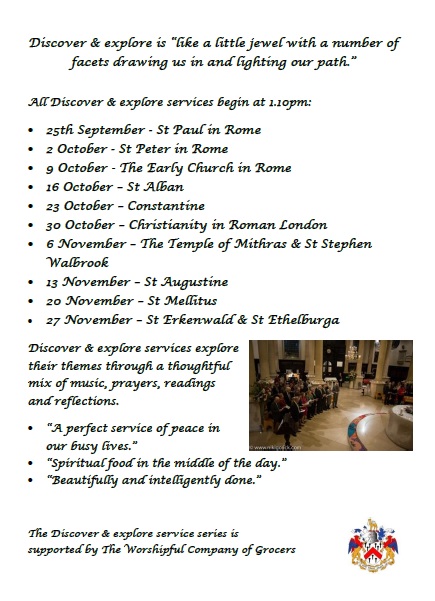
Discover & explore: Reformation 500 & Londinium

Discover & explore services at St Stephen Walbrook feature music and liturgy with the Choral Scholars of St Martin-in-the-Fields. These services explore their themes through a thoughtful mix of music, prayers, readings and reflections:
  • “A perfect service of peace in our busy lives.”
  • “Spiritual food in the middle of the day.”
  • “Beautifully and intelligently done.”
The current series of these services of musical discovery has explored Reformation 500 themes and comes to an end on Monday 3 July at 1.10pm by exploring the theme of 'Life of Repentance.' The Choral Scholars will sing: Ach, arme Welt – Brahms; The Lord's Prayer – Joshua Pacey; Anthem – Leonard Cohen; and Beati quorum via – Stanford.


Our autumn Discover & explore series will be part of the ‘Londinium’ programme organised by the City of London and will explore Rome, London & Christianity through music, prayers, readings and reflections. Highlights include St Paul in Rome, Constantine and The Temple of Mithras & St Stephen Walbrook:
  • 25th September - St Paul in Rome 
  • 2 October - St Peter in Rome 
  • 9 October - The Early Church in Rome 
  • 16 October – St Alban 
  • 23 October – Constantine 
  • 30 October – Christianity in Roman London 
  • 6 November – The Temple of Mithras & St Stephen Walbrook 
  • 13 November – St Augustine 
  • 20 November – St Mellitus 
  • 27 November – St Erkenwald & St Ethelburga
--------------------------------------------------------------------------------------

Wednesday, 1 March 2017

The Black & White World of the Law vs the Colourful World of Love

Here is my sermon from today's Ash Wednesday Eucharist at St Stephen Walbrook:

John 8. 1 - 11 is a story in which the accusers of the woman caught in adultery are shown as living in the black and white world of the Law. In the black and white world of the Law, everything is clear and everything is simple. “This woman,” they say, “was caught in the very act of committing adultery. In our Law Moses commanded that such a woman must be stoned to death.” If you do wrong then you are punished. No consideration of circumstances or motivations, no compassion for a fellow human being, no opportunity for restoration or rehabilitation, and no equality, because in this story it is the woman, not the man, who has been brought from the very act of adultery to be tried.

In the black and white world of the Law, there we find no consideration, no compassion, no restoration, no equality. The black and white world of the Law has no colour because it has no nuances, no distinctions, no difference, no variation. People often like to live in the black and white world of the Law because everything is easy to understand and easy to put into practice - no wrestling with difficulty and no struggling with conscience - but it is also a harsh world without understanding, without compassion, without forgiveness.

The hands of the accusers point away from themselves towards the woman. This is our common response as human beings to our own fallibility and failure. Instead of acknowledging our own shortcoming we attempt to distract attention away from our selves by identifying a scapegoat and angrily pointing out that person’s many failings. We are often very successful in covering up our own shortcomings when we adopt this tactic but the reality is that we are being hypocritical.

By bending down and writing in the sand with his finger, Jesus creates a pause that is pregnant with the possibility of other points of view, other perspectives, other understanding. When the simplistic rush to condemnation is halted, other questions immediately arise to muddy the waters which had initially seemed crystal clear; what would be the compassionate response, the restorative response, the forgiving response?

The words which follow this act of writing in the sand, “Whichever one of you has committed no sin may throw the first stone at her,” are words which undermine the black and white world of the Law by revealing the hypocrisy at its heart. The reality is that each one of us has broken the Law and each one of us are sinners. If that is so, on what basis can one sinner presume to judge or condemn another? To do so is a gross act of hypocrisy which multiplies one sin upon another.

Jesus and the woman by contrast live in a world of love. They live in a world without condemnation – “Is there no one left to condemn you?” Jesus asks the woman. “No one, sir,” she answers. “Well, then,” Jesus says, “I do not condemn you either.” They live in a world where second chances and fresh starts are available – “Go,” says Jesus, “but do not sin again.” This world of Love is a world where nuances exist, difference is recognized, and variation is understood. Therefore choices and chances exist which simply did not occur in the black and white world of the Law; in the world of Love a multitude of sins are covered over (1 Peter 4. 8).

What does all this have to do with Ash Wednesday? As the sign of the cross is marked in ash on your forehead, these words are said: “Remember that you are dust, and to dust you shall return. Turn away from sin and be faithful to the Gospel.” In this service, therefore, we acknowledge both our sinfulness and our mortality recognising the link between the two – the wages of sin are death.

The ash mark on our forehead is a public acknowledgement of our sinfulness but, because it is formed as a cross, it is also a sign of the forgiveness we have received. We are saying that we no longer live in the black and white world of the Law where sin automatically leads to death. Instead, like the woman caught in adultery, we have been accepted and welcomed into the world of Love by Jesus himself.

He says to us what he said to that woman, “I do not condemn you … Go, but do not sin again.” Those words are spoken to us all whether we were the accused or whether we were those who accused others. Whichever we may be, we are called to turn away from sin and be faithful to the Gospel.

This Lent we have the opportunity to explore this in practice as we are showing crucifixion drawings by the artist Francis Bacon. Bacon was an atheist, whose lifestyle was promiscuous in many ways. It would be easy to criticise him and his crucifixion images and yet through his reflections, over many years, on the crucifixion there is much for us to see and appreciate, disturbing as his images may be. Our Lenten exhibition will therefore challenge us to look outside of the black and white world of the Law and embrace the world of Love. May we rise to that challenge.

---------------------------------------------------------------------------------------------------

Valerie June - Trials, Troubles, Tribulations.

Wednesday, 23 December 2015

Levelling mountains and raising valleys

This was my reflection for the lunchtime Eucharist at St Martin-in-the-Fields today:

“All who heard … said, ‘What then will this child become?’ For, indeed, the hand of the Lord was with him.” (Luke 1. 57 - 66)

“What then will this child become?” The answer to that question is given us in the reading from Malachi 3. 1 - 4. The child born to Zechariah and Elizabeth would be the messenger who would prepare the way before the Lord, the Messiah who would suddenly (unexpectedly) come to his temple.

As the messenger preparing the way for the coming of the Lord, John the Baptist preached: “Prepare the way of the Lord, make his paths straight. Every valley shall be filled, and every mountain and hill shall be made low, and the crooked shall be made straight, and the rough ways made smooth; and all flesh shall see the salvation of God.”

The ministry of John the Baptist is described then as being like a major road building programme. This road is one that requires mountains to be levelled and valleys raised in order that it can run as straight and smooth as possible.

The purpose of this road building project – in other words, the purpose of John the Baptist’s ministry – is that Jesus, God’s salvation, should be plainly seen walking down the road towards us. Everyone is able to see him because there is nothing to block our view; no mountains blocking our vision of Jesus and no valleys from within which we are unable to look out. The purpose of John’s ministry then is that everyone should see Jesus clearly.

So it is worth asking, what are the mountains in our lives that could prevent us from seeing Jesus? John’s ministry was a call to repentance, turning away from all that is wrong in our lives in order to turn to Jesus. In the Malachi reading this is described using the imagery of refining and cleaning. The mountains that need to be torn down are the sins that we cling onto, those things that we struggle to renounce or leave behind and which therefore stand in our lives in the place where only God should be; the centre. When we put something or someone at the centre of our lives then that thing or person becomes a barrier which prevents us from seeing God. What might these things be in our lives? Well, that is for us to decide, but, in Church history, people have sometimes talked in terms of the seven deadly sins; of wrath, greed, sloth, pride, lust, envy, and gluttony.

When we are in a valley we are low down, in a depression, and can’t see a way out; so can’t see God. Here we are not talking about sins which block our view of God, instead we are talking about fears, anxieties, hurts and depressions which bring us down so that we cannot look up and out and see God. What are the fears, anxieties, hurts and depressions in our lives at present? If we want to see God more clearly then we need to be raised up so that we are no longer looking at life from the depths of a depression.

John preached a baptism of repentance for the forgiveness of sins. This is the construction project for our lives which enables us to see and receive God’s salvation in Jesus. As we turn away from the mountains of sin and the valleys of depression, we turn towards Jesus who stands ever ready to receive us with open arms.

------------------------------------------------------------------------------------------

Sarah McLachlan - O Little Town Of Bethlehem.


Monday, 11 February 2013

Still you make what purchases you please

Lent begins a series of progressions or stages starting with the temptation of Jesus and tracing Jesus’ road to the cross and beyond, step by step, through Lent, Holy Week and Easter.

As Lent begins we are invited to join Jesus for forty days in the wilderness. Our victory in the temptation comes through confession and the Word. We are also invited to look across the wilderness to the promised land of Easter. We progress with movement to the cross. Jesus laments over Jerusalem displaying the heart of God. We are invited to put our trust in him and take our victory in Jesus but we also sense something of the hope, apprehension and desolation which Jesus’ friends felt in Lent and Holy Week, before being ambushed by the wholly unexpected, deep joy of Easter. In short, Lent prepares us to experience Easter.

The beginning of Lent is itself marked by Ash Wednesday which is always six-and-a-half weeks before Easter. Palms kept from last year’s Palm Sunday are burnt and the ashes mixed with holy water to make the greyish paste used to make the sign of the cross on the foreheads of those attending services on Ash Wednesday.

Ashes are a symbol of being sorry for things we have done wrong and want to get rid of forever. The ashing is also a reminder to that we all come from ashes, and to ashes we all will return. The marking on our forehead with ash marks our renewed commitment to Christ. We want to show we are sorry for the wrong things done in the past year.

None of this is intended to be simply personal or simply about the past. For instance, Operation Noah have made an Ash Wednesday Declaration supported by the leaders of many churches calling for repentance over the prevailing ‘shrug-culture’ towards climate change.

‘Traditionally, Christians commit themselves to repentance and renewed faith in Jesus Christ on Ash Wednesday,’ said David Atkinson, Assistant Bishop in the Diocese of Southwark. ‘We must live out that faith in relation to our damaging consumer economy, over-dependence on fossil fuels and the devastation we, as a species, are inflicting on God’s world. We believe that responsible care for God’s creation is foundational to the Gospel and central to the church’s mission.’

Some of those themes are visited in this sonnet which was inspired as Malcolm Guite set about the traditional task of burning the remnants of last Palm Sunday’s palm crosses: ‘I was suddenly struck by the way both the fire and the ash were signs not only of our personal mortality and our need for repentance and renewal but also signs of the wider destruction our sinfulness inflicts upon God’s world and on our fellow creatures, on the whole web of life into which God has woven us and for which He also cares.’

Receive this cross of ash upon your brow,
Brought from the burning of Palm Sunday’s cross.
The forests of the world are burning now
And you make late repentance for the loss.
But all the trees of God would clap their hands
The very stones themselves would shout and sing
If you could covenant to love these lands
And recognise in Christ their Lord and king.

He sees the slow destruction of those trees,
He weeps to see the ancient places burn,
And still you make what purchases you please,
And still to dust and ashes you return.
But Hope could rise from ashes even now
Beginning with this sign upon your brow.

---------------------------------------------------------------------------------

Bruce Cockburn - If A Tree Falls In The Forest.

Sunday, 20 January 2013

'Life of Pi' and 'Les Miserables'

What can you say about Life of Pi that hasn't already been said? Just to reiterate that it is a beautifully shot and beautifully paced movie. The special effects are stunning and, unlike many films in which 3D seems to be a gimmicky add-on, I imagine here would add to the sense of magical realism. All this is, of course, essential if the point being made about the kind of stories we value is to carry imaginative force. That Ang Lee manages this is the supreme achievement of this marvellous movie.

Les Miserables, based as it is on a very different style of novel, is therefore a very different proposition as a movie. Victor Hugo's writing has the breadth of Dickens, without the emphasis on grotesque caricature, but what both do on a grand scale is to reveal the plight of those at bottom of the pile in society. While Dickens engages through satire and sentiment, Hugo utilises a depth of emotion which is what has been tapped in making the musical and film of the musical so successful.

Cameron Mackintosh has written of how the show elevated both the audience and the cast "to a state of powerful emotion rarely seen in the theatre." Tom Hooper utilises close-ups of his characters combined with live singing to ratchet up the emotional content of story and song. Hugo's story, with its themes of repentance and redemption, has sufficient depth and seriousness of content and character to sustain this approach. With the comic relief of the Thénardiers, Hooper's approach changes focussing on the comedy of their thieving which then has the effect of dissipating the comic bombast of their singing. With this aside, the emotive flow continues to a climax which both returns us to the story's redemptive beginning and releases the central characters and ourselves, as audience, from its relatively unrelentingly grip.

------------------------------------------------------------------------------

Anne Hathaway - I Dreamed A Dream.

Sunday, 22 July 2012

Twin track promises for a twin track life

King David lived a double life. Not in the sense that he was duplicitous but in the sense that there were twin tracks of significance running through his life.
David was the fair-haired shepherd boy who defeated a giant named Goliath. He was the wise Jewish ruler who brought the tribes of Israel together as a united nation. He was a powerful warrior, cunning diplomat, and talented musician. He was known as a "man after God's own heart" (1 Samuel 13:13 - 15) and yet he was also someone who sinned miserably. How can an adulterer and a murderer be called a man after God's own heart? It would seem to be because when he failed, he repented and then turned back to God (see Psalm 51).
Those are some of the incidents from and the aspects of the life that King David lived. They make him one of the most interesting and significant characters whose stories are told within the pages of scripture. This is all broadly in line with what God is recorded as having promised David in today’s reading (2 Samuel 17. 1 – 14a). In verses 8 – 11 we read:
I took you from looking after sheep in the fields and made you the ruler of my people Israel. I have been with you wherever you have gone, and I have defeated all your enemies as you advanced. I will make you as famous as the greatest leaders in the world. I have chosen a place for my people Israel and have settled them there, where they will live without being oppressed any more. Ever since they entered this land, they have been attacked by violent people, but this will not happen again. I promise to keep you safe from all your enemies and to give you descendants.”
Yet there is another aspect to the life of King David – the second track running through his life – that eventually comes to mean that more is written in the Bible about him than many other famous Bible characters, including Abraham and Moses. Believe it or not, there is also more in the Bible about King David than there is about Jesus!
The second track to David’s life is that he serves as a paradigm for the coming Messiah. What does that mean? A paradigm is a pattern, frame, template or model within which something broadly similar but not exactly the same can be recognized. David’s life became the template or model for what the future Davidic King – the Messiah – would look like. That future King – the Messiah – wouldn’t David come back to life or an exact copy of David in every respect but key aspects of David’s life and character became reference points enabling people who would live after him to recognize the Messiah when they saw him.  
So we read, at the end of today’s reading, that God said to David:
“I will raise up your offspring to succeed you, your own flesh and blood, and I will establish his kingdom. He is the one who will build a house for my Name, and I will establish the throne of his kingdom forever. I will be his father, and he will be my son.”
That promise could apply to David’s immediate descendents – King Solomon, who built the temple in Jerusalem, for example – but it can also be understood as speaking about a future descendent who will also be God’s Son and who will establish an eternal Kingdom. It is a twin track promise from a twin track life. David’s life was both the life that he lived in his own day and time plus the ongoing significance of his life as a pattern, template or paradigm for the future Messiah.
Matthew tells us, in his Gospel, that Jesus was a descendant of David and gives a genealogy to demonstrate this. In Acts 13 we read of Paul preaching that God had testified concerning David: “‘I have found David son of Jesse, a man after my own heart; he will do everything I want him to do.’  From this man’s descendants God has brought to Israel the Saviour Jesus, as he promised.” (v. 22 – 23)
Incidents from the life of David that were regarded by the Church Fathers as foreshadowing the life of Christ include; Bethlehem being the birthplace of both; the shepherd life of David pointing towards Jesus, the Good Shepherd; the five stones chosen to slay Goliath as typical of the five wounds of Christ. The betrayal by David’s trusted counsellor, Achitophel, and his crossing the Cedron (or Kidron) brook are reminders of events from Christ's Passion.
Many of the Psalms David is credited with writing are also typical of the future Messiah. References found in the Psalms that are understood in the New Testament to indicate that Jesus is the Messiah include the following: the Messiah will be God's Son (Psalms 2:7); He will be rejected by many but accepted by God (Psalm 118:22); his close friend will betray him (Psalm 41:9); he will experience agony on the cross (Psalm 22:1-21); he will rise from the dead (Psalm 16:8-10); he will ascend into heaven (Psalm 68:18); and will become the eternal priest-king (Psalm 110:4).

This is all very interesting but how is it significant for us? Firstly, this is how Jesus and the Early Church often explained his significance. After all, Jesus was an obscure preacher in an obscure part of the Roman Empire who never did any of the things we normally associate with greatness and who died a criminal’s death. Why should anyone pay attention to what he did and said? On the road to Emmaus (Luke 24. 25 - 27) we read of Jesus explaining to his two disciples what was said in all the Scriptures concerning himself. In Acts 8. 32 – 35, we read of Philip starting with a passage of scripture from Isaiah and going on to tell the Ethiopian official the Good News about Jesus using the scriptures. That was the usual practice of the Early Church and we can benefit ourselves from understanding Jesus’ significance in the same way.
Secondly, we are also called to live double or twin track lives in a way that is similar to that of David. Our lives, as Christians, are to be patterned or modelled on Jesus – we follow in his footsteps by doing the kinds of things which he did and said to the extent that we can in our contemporary lives. When we act in ways that are similar to Jesus – the pattern or template for our lives as Christians – we reveal for a moment something of the reality of the kingdom of God in contemporary life. Our lives as a whole, and particular actions or initiatives with which we are involved, can therefore be signs of or pointers to the reality and nature of the kingdom of God. Like the life of David, our lives can have significance both for who we are – people loved, accepted and used by God – and for what we can reveal of kingdom of God – our words and actions showing something of the pattern and nature of God’s kingdom.

David’s life speaks to us of Jesus. In what ways do our lives our lives do the same? How does the way we live our daily life speak to others of the Messiah that we love and serve and follow? Let us pattern our lives on what we know of Christ and pray for Christ to be seen in us, even when we are not consciously aware that we imitating him.

---------------------------------------------------------------------------------------------------------

Keith Green - Psalm 51.