






Most
artworks commissioned for churches function as an element within a
broader architectural, aesthetic and liturgical scheme. For some
artists this sense that the art and the artist's vision is
subordinate to a bigger, broader vision can be a part of the reason
why church commissions are unattractive and unpursued. It
is rare for an artist to given the opportunity to create the
atmosphere and ambience for a sacred space but that was the
opportunity provided to Adam Kossowski at St Benet's Chapel and it
one that he grasped with both hands.
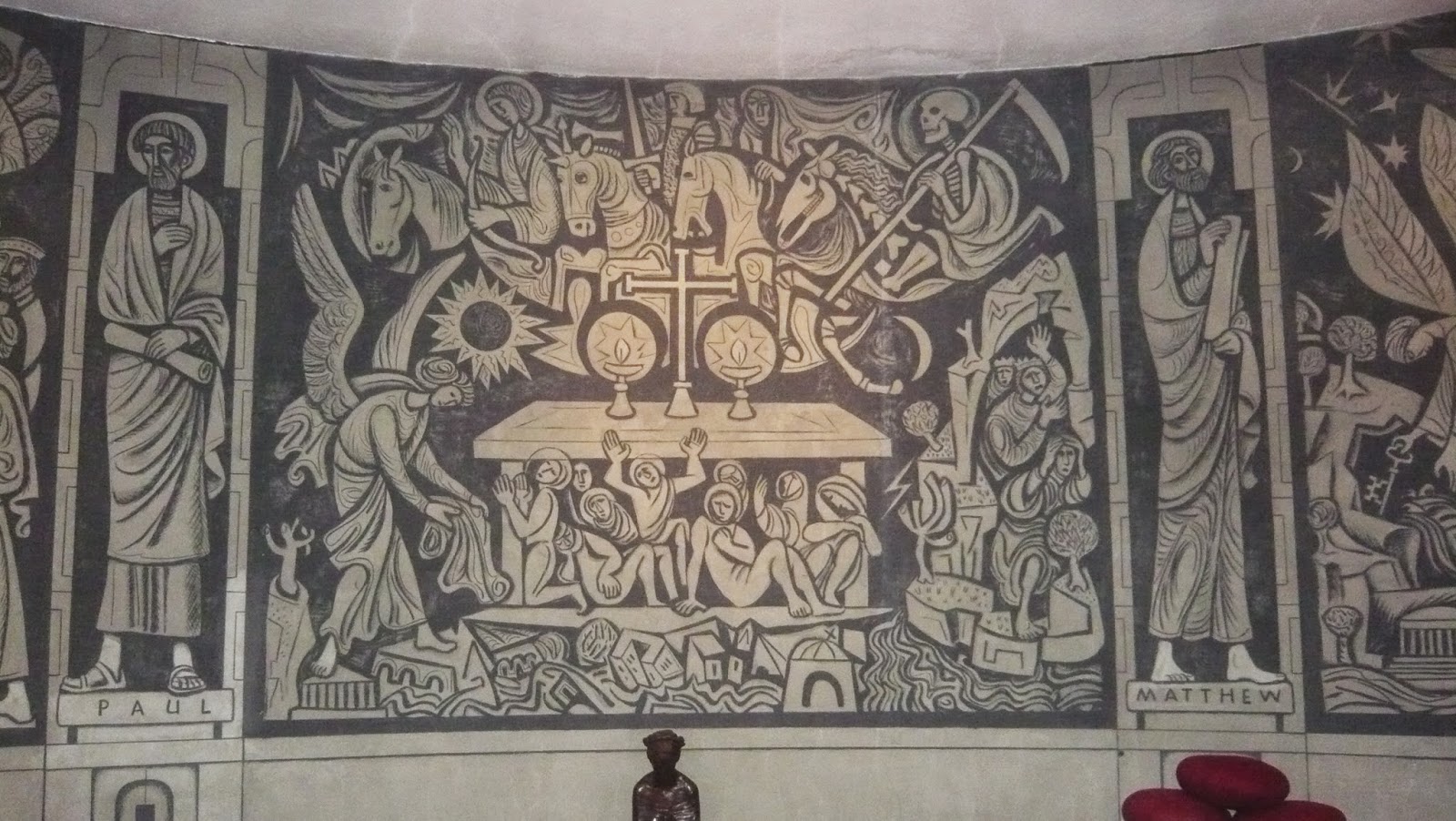
Kossowski's murals at St Benet's Chapel are unique for several reasons. First,
they fill the entire wallspace of this circular chapel surrounding
and enveloping worshippers with their imagery. Second, the murals
take those visiting or using the chapel through apocalyptic scenes
from the Revelation of St John. The choice of theme appears to have
been that of Kossowski himself who had "studied apocalyptic
symbolism and the mysticism of the meaning of numbers." Finally,
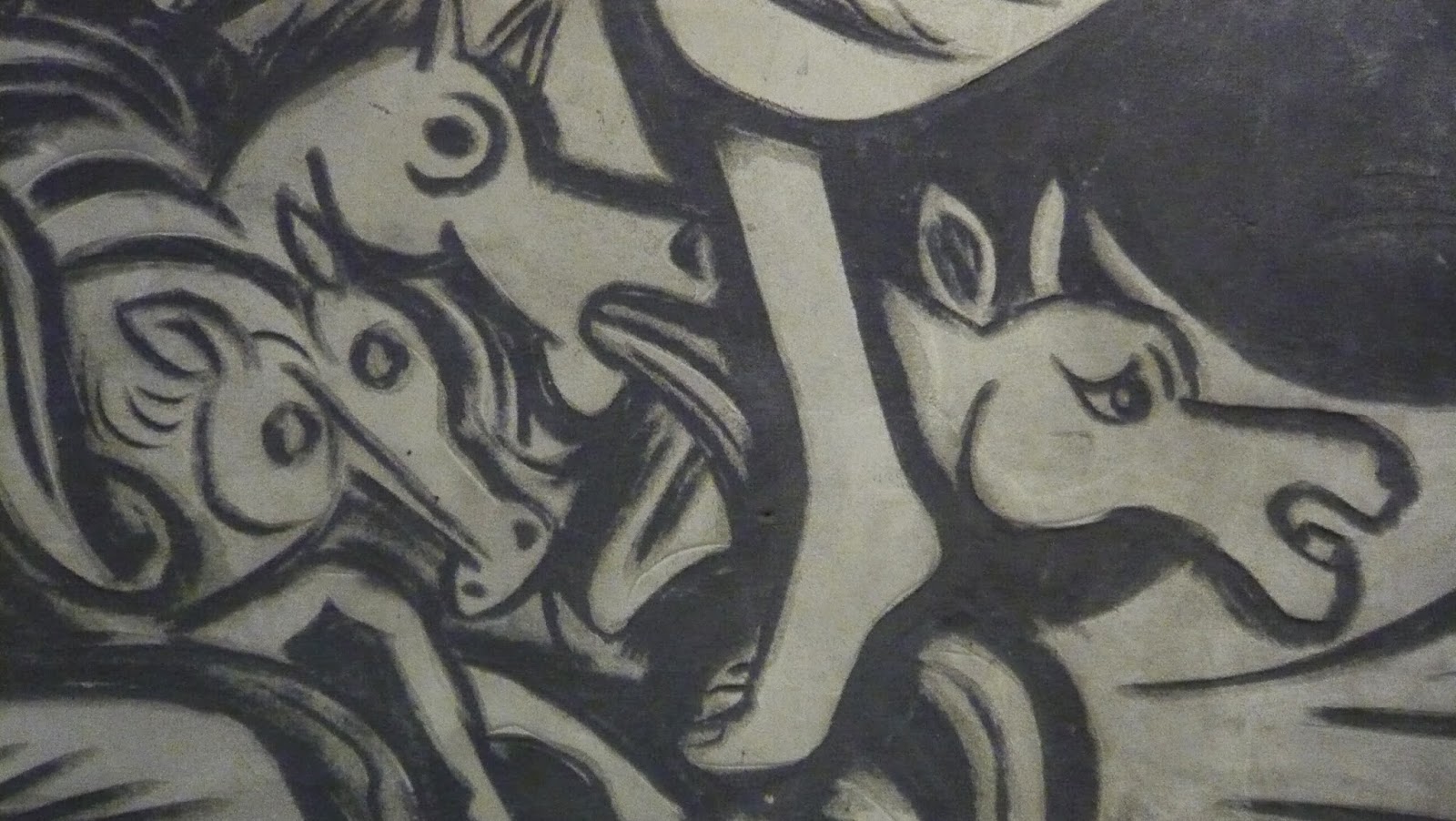
the technique used by Kossowski for these murals was sgraffito which
involves carving into two layers of freshly applied plaster. This
technique, which derives from Egypt and Assyria and was popular in
Italy during the Renaissance, is almost unheard of in Britain making
these murals the most significant example of work in this style on
these shores.
Each
of these unique aspects of the commission resulted from a high level
of trust in Kossowki's vision and technique. Here and also at
Aylesford Priory, his other major series of work in one place, his
artistic vision seems to have been entirely trusted by those who
commissioned him and he was well aware of his good fortune in this
respect. The results, in both cases, are wonderful both artistically
and spiritually and would have been impossible to have been achieved
through the usual committee or tendering processes that characterise
most church commissions.
Kossowski's
own commitment to the task, opportunity and vision was such that he
essentially lived in the Chapel while the work was being created
often sleeping there because of the need to work into the night while
the plaster was still fresh. Kossowski condenses the twenty chapters
of Revelation into seven panels separated by six vertical rectangles
in which the four Evangelists, St Peter and St Paul are depicted. The
image of St Peter is thought to be a portrait of Kossowski himself.
Kossowski's design is both a linear narrative, like a graphic novel
in plaster, and an overall unity of concept and creation which fills
and forms the space as one complex creative composition.
This
magnificent work is, in the words of Revd. Jenny Petersen (Chaplain
at Queen Mary College), unique but out of fashion. Yet she
maintains its themes have contemporary relevance for Christians on
campus who find themselves as a minority among people of other faiths
snd those of no religious faith. Again Kossowski's own experiences -
this time as an artist in exile - would have fed his own reflections
on this aspect of Revelation. Benedict Read in Adam Kossowski: Murals and Paintings notes the difficulties experienced even by refugee
artists of major pre-war reputations in finding opportunities for
their art to be exhibited and sold. Kossowski quickly found a
significant patron in the Roman Catholic Church, an experience in
exile which would have fuelled his fascination with this text and its letters to the seven churches.
The
murals have also proved to be an excellent talking point in Jenny
Petersen's ministry to those other faiths with Muslims, in
particular, understanding the themes of judgement found therein
leading to a willingness to use the space for prayer. She has
encouraged contemplation of the mural's themes by producing a series
of cards exploring the imagery of each panel together with the
relevant sections from the Revelation of St John.
The
space is kept as flexible space with no fixed furnishings and with
contemplation encouraged. When services are held, however, the altar
table is located in front of the panel depicting worship in heaven of
the lamb that was slain. In this way, worship on earth is conducted
in the context of worship in heaven. The entrance to the St Benet's Chaplaincy has a neon sign stating, 'not another church' and this is
borne out by the innovations of Jenny Petersen's ministry, the
apocalyptic power of Kossowski's vision and the links formed between
the two.
Ultimately,
though, Kossowski's vision is not focused on destruction but instead
on the hope of new life to come. After all, in his own life, his
understanding was that God had brought him through his own personal
subhuman land into a place where the Church provided him with a
living through creative commissions. This work, and his work
generally, is ultimately about rescue, redemption and salvation. Fr. Edward Maguire
has written, 'From clay and fire he forged a vision of the past,
present and future to lift up and inspire countless others ... May we
be inspired by him to use our gifts as he used his."
---------------------------------------------------------------------------
Bob Dylan - Jokerman.


