Wikio - Top Blogs - Religion and belief
Showing posts with label service. Show all posts

Saturday, 28 June 2025

A Path with a Heart: Seeking inspiration from the Nazareth Community


On Day 2 of our HeartEdge event weekend in the Parish of Wickford and Runwell, a Quiet Day was held at St Marys Runwell. Entitled 'A Path with a Heart: Seeking inspiration from the Nazareth Community', it was led by Revd Catherine Duce, Assistant Vicar for the Companions of Nazareth, St Martin-in-the-Fields.

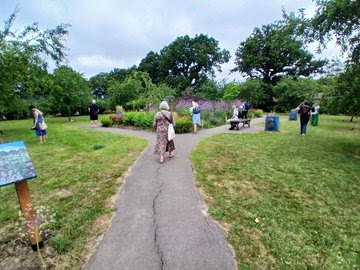
Before the Quiet Day, a Contemplative Walk, also led by Catherine, took place at Wickford Memorial Park. This was an opportunity for us to open our hearts to God’s presence in creation, in the local neighbourhood and in one another. The walk can be viewed on our Facebook page here (https://www.facebook.com/WickfordandRunwellCofE/). 

Session 1 of the Quiet Day was 'Silence: the path of contemplation': Silence and contemplative prayer are at the very heart of the Nazareth rule of life. We are formed by this silence. As we enter into silence, we place ourselves in the presence of Christ. We create the place and space for a deeper listening to God, the longings of our own souls and we grow in a deep compassion for the world. In this session we will delve deeply into silent prayer and carve space to listen to the Spirit at work in our lives.  No experience necessary. Come simply ready to rest in the presence of God. 

Our Midday Prayer was led by Revd Moses Agyam (Billericay Methodist Church and Christ Church United Reformed & Methodist, Wickford).

Session 2 of the Quiet Day was on 'Service: the path of contemplative care': In simple acts of giving and receiving and face to face encounter we discover Christ in those we meet. We recognise Christ’s presence especially among those most in need and fearful at this time. In this session we will reflect upon our own acts of service and explore themes of reciprocity and what a path of contemplative care might look like in your life. 

We ended the day with an Informal Eucharist to give thanks for God’s presence and refreshment in the gift of the sacrament. 

--------------------------------------------------------------------------------------------------------

Contemplative Walk - Wickford Memorial Park.

Thursday, 27 March 2025

Seen and Unseen: Heading Home: a pilgrimage that breaks out beauty along the way

My latest article for Seen and Unseen is entitled 'Heading Home: a pilgrimage that breaks out beauty along the way'. The article focuses on a film called 'Heading Home' which explores how we can learn a new language together as we travel:

'The aim of all these initiatives is, as Ahmanson explains, what has always been the aim; “to serve this world to make it more like the heavenly home” where our ultimate citizenship lies, and to do so by “creating beauty in buildings and art and music and serving the suffering and those in all kinds of need”. The aim of all these initiatives is, as Ahmanson explains, what has always been the aim; “to serve this world to make it more like the heavenly home” where our ultimate citizenship lies, and to do so by “creating beauty in buildings and art and music and serving the suffering and those in all kinds of need”.'

For more on 'Heading Home', see my interview for ArtWay with Roberta Ahmanson, Siobhán Jolley and Ben Quash.

My first article for Seen and Unseen was 'Life is more important than art' which reviews the themes of recent art exhibitions that tackle life’s big questions and the roles creators take.

My second article 'Corinne Bailey Rae’s energised and anguished creative journey' explores inspirations in Detroit, Leeds and Ethiopia for Corinne Bailey Rae’s latest album, Black Rainbows, which is an atlas of capacious faith.

My third article was an interview with musician and priest Rev Simpkins in which we discussed how music is an expression of humanity and his faith.

My fourth article was a guide to the Christmas season’s art, past and present. Traditionally at this time of year “great art comes tumbling through your letterbox” so, in this article, I explore the historic and contemporary art of Christmas.

My fifth article was 'Finding the human amid the wreckage of migration'. In this article I interviewed Shezad Dawood about his multimedia Leviathan exhibition at Salisbury Cathedral where personal objects recovered from ocean depths tell a story of modern and ancient migrations.

My sixth article was 'The visionary artists finding heaven down here' in which I explored a tradition of visionary artists whose works shed light on the material and spiritual worlds.

My seventh article was 'How the incomer’s eye sees identity' in which I explain how curating an exhibition for Ben Uri Online gave me the chance to highlight synergies between ancient texts and current issues.

My eighth article was 'Infernal rebellion and the questions it asks' in which I interview the author Nicholas Papadopulos about his book The Infernal Word: Notes from a Rebel Angel.

My ninth article was 'A day, night and dawn with Nick Cave’s lyrics' in which I review Adam Steiner’s Darker With The Dawn — Nick Cave’s Songs Of Love And Death and explore whether Steiner's rappel into Cave’s art helps us understand its purpose.

My 10th article was 'Theresa Lola's poetical hope' about the death-haunted yet lyrical, joyful and moving poet for a new generation.

My 11th article was 'How to look at our world: Aaron Rosen interview', exploring themes from Rosen's book 'What Would Jesus See: Ways of Looking at a Disorienting World'.

My 12th article was 'Blake, imagination and the insight of God', exploring a new exhibition - 'William Blake's Universe at the Fitzwilliam Museum - which focuses on seekers of spiritual regeneration and national revival.

My 13th article 'Matthew Krishanu: painting childhood' was an interview with Matthew Krishanu on his exhibition 'The Bough Breaks' at Camden Art Centre.

My 14th article was entitled 'Art makes life worth living' and explored why society, and churches, need the Arts.

My 15th article was entitled 'The collective effervescence of sport's congregation' and explored some of the ways in which sport and religion have been intimately entwined throughout history

My 16th article was entitled 'Paradise cottage: Milton reimagin’d' and reviewed the ways in which artist Richard Kenton Webb is conversing with the blind poet in his former home (Milton's Cottage, Chalfont St Giles).

My 17th article was entitled 'Controversial art: how can the critic love their neighbour?'. It makes suggestions of what to do when confronted with contentious culture.

My 18th article was an interview entitled 'Art, AI and apocalypse: Michael Takeo Magruder addresses our fears and questions'. In the interview the digital artist talks about the possibilities and challenges of artificial intelligence.

My 19th article was entitled 'Dark, sweet and subtle: recovered music orientates us'. In the article I highlight alt-folk music seeking inspiration from forgotten hymns.

My 20th article was entitled 'Revisiting Amazing Grace inspires new songs'. In the article I highlight folk musicians capturing both the barbaric and the beautiful in the hymn Amazing Grace and Christianity's entanglement with the transatlantic slave trade more generally.

My 21st article was entitled 'James MacMillan’s music of tranquility and discord'. In the article I noted that the composer’s music contends both the secular and sacred.

My 22nd article was a book review on Nobody's Empire by Stuart Murdoch. 'Nobody's Empire: A Novel is the fictionalised account of how ... Murdoch, lead singer of indie band Belle and Sebastian, transfigured his experience of Myalgic encephalomyelitis/chronic fatigue syndrome (ME) through faith and music.'

My 23rd article was entitled 'Rock ‘n’ roll’s long dance with religion'. The article explores how popular music conjures sacred space.

My 24th article was an interview with Alastair Gordon on the artist’s attention which explores why the overlooked and everyday capture the creative gaze.

My 25th article was about Stanley Spencer’s seen and unseen world and the artist’s child-like sense of wonder as he saw heaven everywhere.

My 26th article was entitled 'The biblical undercurrent that the Bob Dylan biopics missed' and in it I argue that the best of Dylan’s work is a contemporary Pilgrim, Dante or Rimbaud on a compassionate journey.

-------------------------------------------------------------------------------------------------------

Josh Garells - Farther Along.

Sunday, 20 October 2024

Addressing prestige and privilege

Here's the sermon that I shared at St Andrew’s Wickford this morning:

In 2019 a TUC report showed that graduates with parents in ‘professional and routine’ jobs were more than twice as likely as working-class graduates to start on a high salary, no matter what degree level they attain. The TUC’s General Secretary Frances O’Grady commented: ‘Everyone knows that getting that dream job is too often a case of who you know, not what you know.’

Is that well-known saying true? It seems that it might well be! In 2022 a paper entitled “A Causal Test of the Strength of Weak Ties,” appeared in Science magazine and appeared to confirm its truth. The paper detailed the results of a study which involved millions of users of LinkedIn, the social networking site that helps users connect with colleagues, find jobs, and advance their careers.

The research upheld an idea first posited nearly 50 years ago; that weak ties to other people have a value that strong ties do not. The people you know best may have social networks that closely resemble your own and thus may not add much new job-seeking value for you. Your more casual acquaintances, on the other hand, have social networks that overlap less with yours and may provide connections or information you would not otherwise be able to access. As a result, tapping the knowledge and contacts of people in our networks who we know less well than our core friends is more likely to help us find a new job.

Today’s Gospel reading (Mark 10: 35-45) suggests that 'in-crowds' and 'favours' were also a part of thinking and practices in Jesus' time. James and John asked Jesus for a favour in the way that Frances O’Grady alleges favours can be granted in work today. They wanted to be privileged over and above the others in the group and used a private conversation to make their request.

What James and John were after was another perennial temptation for us as human beings; the desire for prestige, in this case, the request to sit on the right and left of Jesus in glory. Similarly, within the kind of networks we noted at the beginning of this sermon, it is suggested that there may be pathways to prestige which are essentially open on the basis of birth, wealth or power.

Jesus calls this whole approach into question with his response to James and John. Today we would characterise what he says in relation to discussions of rights and responsibilities.

Jesus says firstly that places of prestige are not available without sacrifice (i.e. no rights without responsibilities), in other words there is no entitlement because of birth, schooling, friendships, networks. What matters in the kingdom of God is service and sacrifice and these not for the sake of future prestige and glory, but for their own sake and for the love of others: ‘Whoever wishes to become great among you must be your servant, and whoever wishes to be first among you must be slave of all. For the Son of Man came not to be served but to serve, and to give his life a ransom for many.

Jesus turns the search for prestige on its head. Instead of the prestige of being first being the goal and the reward, those who are great in the kingdom of God are those who make themselves the least; those who are prepared to serve in same way as Jesus, by laying down their life for others.

Michael Curry, the Presiding Bishop of the Episcopal Church, in his statement on the coronavirus outbreak and how we might live in and through it, drew on just this thinking. He said that: ‘Jesus came among us in the first place, to show us … how to live not simply as collections of individual self-interest, but how to live as the human family of God. That’s why he said love the Lord your God, love your neighbor as yourself. Because in that is hope for all of us to be the human family of God … So look out for your neighbors, look out for each other. Look out for yourselves. Listen to those who have knowledge that can help to guide us medically and help to guide us socially. Do everything that we can to do this together, to respond to each other’s needs and to respond to our own needs.’

James and John say they are prepared to do this but it is ultimately about deeds, not words, and their action in asking for a favour on their behalf clearly shows that they hadn't understood his teaching and practice at this stage in their relationship with him.

Where are we in relation to these issues? Are we chasing after worldly rewards and prestige; seeking it through favours or paying for prestige? Maybe, like James and John, we have brought the values of the world into the kingdom of God and are trying to follow Jesus for some form of personal gain?

Let’s take the opportunity that this passage provides for self-reflection on these issues and consider the possibility of aligning our thinking, values and deeds with those of Jesus as we become the servants or slaves of others in order that we serve instead of being served and give our lives for the sake of others. Amen.

--------------------------------------------------------------------------------------------------------

Sunday, 22 September 2024

Whoever welcomes a child in my name welcomes me


Here's the sermon I recorded as this Sunday's weekly sermon for the Diocese of Chelmsford (Mark 9:30-37):

The disciples had been arguing among themselves – nothing changes there, then, we might be tempted to think! They had been arguing about which of them was the greatest and thinking of what they could get out of the movement that Jesus began. What they wanted was prestige and power by being elevated over all the other disciples to what they thought of as the position of influence at the right hand of Christ. Jesus turned their thinking about what is important and about prestige and power on its head. In the kingdom of God, service; thinking of and care for others is what counts, not personal advancement, position or power. What can I do for you, not what can I do for me!

At a training weekend for new curates the then Bishop of Barking, David Hawkins, performed a handstand to demonstrate the way in which Jesus, through his teaching in the beatitudes, turns our understanding of life upside down. He was thinking of the way in which Jesus startles us as paradox, irony and surprise permeate his teachings flipping our expectations upside down: the least are the greatest; adults become like children; the religious miss the heavenly banquet; the immoral receive forgiveness and blessing. Bishop David's action turned our expectations, as curates, of Bishops and their behaviour upside-down at the same time that it perfectly illustrated his point.

Years before Jesus was born, the prophet Isaiah had promised a child born for us who would establish endless peace upheld with justice and righteousness. Isaiah described a time when the wolf shall live with the lamb, the leopard would lie down with the kid, the calf and the lion and the fatling together, with a little child leading them (Isaiah 11.1-9).

Isaiah's vision of the peaceable kingdom was centred on a child born to be the Prince of Peace. When that promised child came among us at Jesus, he said: ‘Let the little children come to me, and do not stop them; for it is to such as these that the kingdom of God belongs’; ‘Unless you change and become like children, you will never enter the kingdom of heaven’; ‘Whoever becomes humble like this child is the greatest in the kingdom of heaven’ and ‘Whoever welcomes one such child in my name welcomes me.’ The child born for us calls us to welcome children and become like children. The most radical reversal in a culture where elders were revered is that “the greatest among you must become like the youngest.”

In 2022, several of Nicola Ravenscroft’s EarthAngel sculptures were exhibited at St Andrew’s in Wickford. These bronze sculptures are of children, simply dressed in soft silk tulle, who hesitate in time, leaning forward, hopeful, poised to dive into life, eyes closed, dreaming into their future, anticipating things unseen. Nicola says that her EarthAngels are youngling messengers of peace and healing, guardians of our future.

One reason why the promised child calls us to become like children is that children see the peaceable kingdom, until adults teach them otherwise. Children don’t argue amongst themselves for prestige and position until adults have taught them to do so. That is why the children are our future and can lead the way into a better future. We need, as Thomas Traherne wrote, to unlearn the dirty devices of this world in order to become, as it were, a little child again that we may enter into the Kingdom of God.

By telling his disciples that “Whoever wants to be first must be last of all and servant of all”, Jesus turns the meaning of greatness and leadership upside down. No longer are they to be understood in terms of garnering wealth and power for oneself. Now they are understood to be about service; giving your life that others might live. Jesus, as the servant King, says to us, ‘I, your Lord and Teacher, have just washed your feet. You, then, should wash one another’s feet. I have set an example for you, so that you will do just what I have done for you.’

Michael Curry, the Presiding Bishop of the Episcopal Church, in his statement on the coronavirus outbreak reminded us that: ‘Jesus came among us in the first place, to show us … how to live not simply as collections of individual self-interest, but how to live as the human family of God. That’s why he said love the Lord your God, love your neighbor as yourself. Because in that is hope for all of us to be the human family of God.’

Through her EarthAngels, Nicola Ravenscroft extends this call and example to include our care for the earth and the creatures it supports. Her sculptures are “earth’s messenger-angels: silently calling us all to live in peace with nature”: “Earth’s children are life’s heartbeat: they are her hope, her future ... they are breath of Earth herself. Creative, inquisitive and trusting, children are Earth’s possibility thinkers. They seek out, and flourish in fellowship, in ‘oneness’, and being naturally open-hearted, and wide-eyed hungry for mystery, delight and wonder, they embrace diversity with the dignity of difference.”

These are the children we are called to welcome, the children we are to become, the children to whom the peaceable kingdom belongs. Nicola’s EarthAngels stand together, peacefully, as friends, vulnerable and strong, silently singing out their call to change. These little children lead with trusting feet, plump and bare. The Prince of Peace is with them and calls us to let them lead the way. Will you be among those who follow?

---------------------------------------------------------------------------------------------------

Raphael Ravenscroft - "... and a little child shall lead ..." Isaiah 11:6. 

Saturday, 30 September 2023

Five Marks of Mission course


Five Marks of Mission
Thursday evenings, 7.30pm - 9pm, St Andrew’s Wickford


This autumn in the Wickford and Runwell Team Ministry we have organised an informative short course on the Five Marks of Mission with some excellent contributors to which there is an open invition for folk from other churches.

The course enables us to explore the fundamentals of mission - outreach, nurture, service, justice, and creationcare - with input on Kintsugi Hope and Being With alongside the Beyond The Walls Leader for New Life Church, the Diocesan Racial Justice Officer and the Diocesan Environment Officer.
  • October 5th - Proclaiming the Good News of God’s Kingdom - Rob Purnell
  • October 12th - Responding in Loving Service - Joel Harris, Kintsugi Hope
  • October 19th - Nurturing new believers - Revd Jonathan Evens
  • October 26th - Challenging injustice - Revd Sharon Quilter
  • November 2nd - Caring for God’s Earth - Revd Sandra Eldridge
-----------------------------------------------------------------------------------------------------------

Delirious? - Now Is The Time.

Friday, 1 September 2023

Five Marks of Mission

Five Marks of Mission
Thursday evenings 7.30pm - 9pm St Andrew’s Wickford


This autumn in the Wickford and Runwell Team Ministry we have organised an informative short course on the Five Marks of Mission with some excellent contributors to which there is an open invition for folk from other churches.

The course enables us to explore the fundamentals of mission - outreach, nurture, service, justice, and creationcare - with input on Kintsugi Hope and Being With alongside the Beyond The Walls Leader for New Life Church, the Diocesan Racial Justice Officer and the Diocesan Environment Officer.
  • October 5th - Proclaiming the Good News of God’s Kingdom - Rob Purnell
  • October 12th - Responding in Loving Service - Joel Harris, Kintsugi Hope
  • October 19th - Nurturing new believers - Revd Jonathan Evens
  • October 26th - Challenging injustice - Revd Sharon Quilter
  • November 2nd - Caring for God’s Earth - Revd Sandra Eldridge
-----------------------------------------------------------------------------------------------------------

Delirious? - Find Me In The River.

Sunday, 7 May 2023

Chips off the old block

Here's the sermon I shared at St Mary's Runwell this morning:

Charles: Our New King is a two-part Channel 4 documentary which shines a light on the new British monarch, told with an extensive collection of rare royal archive and revelatory interviews from those who know him. Part 1 explored the influence on him of his mother and father.

He shares many interests with Prince Philip, as they were both artists and both were fascinated by wildlife, the Navy and young people. They shared concerns regarding the environment, while King Charles has his Prince’s Trust and Prince Philip, the Duke of Edinburgh award scheme, so there are many ways in which they were similar.

Like his mother, the Queen, King Charles has also highlighted the inspiration that his faith provides. In speaking of the Church of England, the Church in which his “own faith is so deeply rooted”, he has said that: “In that faith, and the values it inspires, I have been brought up to cherish a sense of duty to others, and to hold in the greatest respect the precious traditions, freedoms and responsibilities of our unique history and our system of parliamentary government.” He then went on to say that: “As the Queen herself did with such unswerving devotion, I too now solemnly pledge myself, throughout the remaining time God grants me, to uphold the constitutional principles at the heart of our nation.” He ended by saying that, “in carrying out the heavy task that has been laid upon me, and to which I now dedicate what remains to me of my life, I pray for the guidance and help of almighty God.”

In our Gospel reading (John 14.1-14), Jesus says, “Whoever has seen me has seen the Father.” He is speaking of the way in which children – consciously or unconsciously – reflect aspects of their parents. We have a phrase to describe this – ‘a chip off the old block’. King Charles is, in many respects, a chip off the old block as he reflects aspects of both his parents in the way he has been formed and the things he says and does. More importantly, however, by allowing his life to be shaped by the values of the Christian faith, he is also, to some extent, a chip off the old block when it comes to Jesus’ Father, too.

Jesus is the image of the invisible God. He is the way by which we can come to see what God is actually like and so become like him. That is the reason why Jesus comes as a human being to model God to us, so that we have the opportunity to begin to reflect something of God in the way that we live our lives.

Rightly, that is the focus of many of the prayers written for the Coronation:

Almighty God, the fountain of all goodness,
bless, we pray, Camilla the Queen Consort,
William Prince of Wales, the Princess of Wales,
and all the Royal Family.
Endue them with your Holy Spirit;
enrich them with your heavenly grace;
prosper them with all happiness;
and bring them to your everlasting kingdom;
through Jesus Christ our Lord.
Amen.

In such prayers, we recognise that, if we are ruled by those who genuinely reflect something of God in their lives, then our experience of the monarchy is likely to be positive in a way that is not the case when our rulers act selfishly, rather than from the heart of a servant of God and the people. Such was the case with the late Queen Elizabeth II. In his sermon at St Paul’s Cathedral for the service celebrating the Diamond Jubilee, the then Archbishop of Canterbury said that the Queen “has shown a quality of joy in the happiness of others” and “has responded with … generosity …showing honour to countless local communities and individuals of every background and class and race.” At her Funeral Service, the current Archbishop of Canterbury reflected that: “People of loving service are rare in any walk of life. Leaders of loving service are still rarer. But in all cases those who serve will be loved and remembered when those who cling to power and privileges are long forgotten.”

So, our prayer for King Charles and the Royal Family at this time should be that they reflect in their lives the nature of God as fully as possible. Praying that prayer, however, should also challenge us to make that prayer our own, too. The original Greek word for Christian is “Christianos” which comes from two Greek words; Christ means “anointed” and tian means “little.” So, the word “Christian” literally means “little anointed ones.” During his life Jesus was called the “messiah” which meant “the anointed one” and we are to be his “little anointed ones”, anointed by his Holy Spirit to represent Him in this world as his body – his hands and feet, eyes and ears – on earth. To do that we, too, need to become chips off the old block when it comes to God, his Father, or as St Paul puts it in his letter to the Ephesians, "imitators of God".

How does that happen? How do our lives come to reflect something of God? Firstly, we need to put all our trust in Jesus and in what he has done and said. By doing so, we make him central to our lives. Secondly, we need to live by every word that comes from his mouth; we need to read all we can about Jesus and then by put into practice what we have discovered in our lives. Thirdly, as we eat the bread and drink the wine in Communion, we are taking Jesus and all that his death and resurrection means into lives in order to transform us to be like him and to live as he lived.

As Queen Elizabeth said in her 2008 Christmas Broadcast: “I hope that, like me, you will be comforted by the example of Jesus of Nazareth who, often in circumstances of great adversity, managed to live an outgoing, unselfish and sacrificial life … He makes it clear that genuine human happiness and satisfaction lie more in giving than receiving; more in serving than in being served.”

As we celebrate the coronation of King Charles III this weekend, may we take the opportunity to pray that our rulers reflect the God from whom all true authority actually derives and pray, too, that we will shape our lives on that same God, allowing him to shape and mould us that we, too, become chips off the old block. Let us pray:

Gracious God,
in company with our King,
we rededicate ourselves to your service.
Take our minds and think through them,
take our lips and speak through them,
take our hearts and set them on fire
with love for you and your kingdom;
that here we may have your peace,
and in the world to come may see you face to face;
through Jesus Christ our Lord. Amen.

-----------------------------------------------------------------------------------------------------------

Make A Joyful Noise – The Coronation Anthem by Andrew Lloyd Webber

Sunday, 12 March 2023

Area Dean of Basildon


Great to be licensed as Area Dean for Basildon at St Andrew's Wickford this afternoon and for our Deanery Team to be blessed by the Archdeacon of Southend. Much thanks to everyone who came to support, especially the Choir of St Catherine's directed by Barry Pocock.

Here's the JD as set out in the Service:

"As Area Dean, Jonathan is to be among Christ’s people as one who serves. He is to guide the Chapter, building them up in fellowship. He is to care for all the clergy and lay ministers and their families, and to watch over the needs of parishes when their priest is sick or the benefice is vacant. He is responsible with the Archdeacon, for the regular visitation of the parishes. He shares the Chair of the Deanery Synod, helping the members to work together for God’s kingdom both within the deanery and beyond."

--------------------------------------------------------------------------------------------------------------

Brother, Sister, Let Me Serve You.

Sunday, 11 September 2022

What is mortal may be swallowed up by life


Here's the sermon that I preached at St Andrew’s Wickford this morning:

Imagine you were King or Queen for a day – what would you want to do with the power, fame and money you had?

We know well what Queen Elizabeth II did with that role and that opportunity. The new Queen, as Princess Elizabeth, in her 21st birthday broadcast from Capetown, on April 21, 1947, gave this message to the Empire:

“There is a motto which has been borne by many of my ancestors – a noble motto, ‘I serve.’

Those words were an inspiration to many bygone heirs to the throne.

I can make my solemn act of dedication with a whole Empire listening. I should like to make that dedication now; it is very simple.

I declare before you all that my whole life, whether it be long or short, shall be devoted to your service and the service of our great Imperial family, to which we all belong, but I shall not have the strength to carry out this resolution alone unless you join in it with me, as I now invite you to do. I know that your support will be unfailingly given.

God help me to make good my vow, and God bless all of you who are willing to share in it.”

She chose to be the servant Queen and, with deep commitment, fulfilled that role throughout her life, which is why she is so loved by the people of this nation and so missed on her death.

Her prayer was that God would help her to make good that vow and it is to God that she turns for inspiration as she has sought to fulfil it. The Queen’s personal commitment to her role as monarch, and her service to the people of the United Kingdom, are grounded in a deep faith in Jesus Christ which is an inspiration to countless citizens of nation and Commonwealth. She has said that, for her, “the teachings of Christ” and her “own personal accountability before God provide a framework” in which she tries to lead her life (Queen and Country BBC1 08.05.02). She has said that: “For me, the life of Jesus Christ, the Prince of Peace … is an inspiration and an anchor in my life. A role-model of reconciliation and forgiveness. He stretched out his hands in love, acceptance and healing. Christ’s example has taught me to seek to respect and value all people of whatever faith or none.”

In his sermon at St Paul’s Cathedral for the service celebrating the Diamond Jubilee, the Archbishop of Canterbury said that the Queen “has shown a quality of joy in the happiness of others” and “has responded with … generosity …showing honour to countless local communities and individuals of every background and class and race.”

There can, therefore, be no better way for us to remember Queen Elizabeth with gratitude than to take this opportunity to dedicate ourselves anew to the service of God, and to seek the common good through love for our neighbours near and far. As the Archbishop suggested in his Diamond Jubilee sermon, we should seek “the rebirth of an energetic, generous spirit of dedication to the common good and the public service, the rebirth of the recognition that we live less than human lives if we think just of our own individual good.”

It's not always easy to serve and think of others consistently as the Queen sought to do. We know that there were times of great sadness and difficulty in her life when, no doubt, she found it more difficult to keep her promise to serve all those she reigned over. In our Psalm today we read, ‘My help comes from the Lord, the maker of heaven and earth’ and in 1 Peter 4:9 we read, ‘If anyone serves, they should do so with the strength God provides.’ The Queen spoke often about how she asked for God’s help in undertaking her highly important role. She knew that she needed great strength to be able to serve others in the way she had committed to. What can we learn from the Queen’s example, I wonder, in asking for God’s help?

In her 2011 Christmas Message she said:

“Finding hope in adversity is one of the themes of Christmas. Jesus was born into a world full of fear. The angels came to frightened shepherds with hope in their voices: 'Fear not', they urged, 'we bring you tidings of great joy, which shall be to all people.

'For unto you is born this day in the City of David a Saviour who is Christ the Lord.'

Although we are capable of great acts of kindness, history teaches us that we sometimes need saving from ourselves - from our recklessness or our greed.

God sent into the world a unique person - neither a philosopher nor a general, important though they are, but a Saviour, with the power to forgive.

Forgiveness lies at the heart of the Christian faith. It can heal broken families, it can restore friendships and it can reconcile divided communities. It is in forgiveness that we feel the power of God's love.

It is my prayer that … we might all find room in our lives … for the love of God through Christ our Lord.”

That is what we need, not just to live a life of service in the here and now, but also for a life in eternity together with God; that future life that Queen Elizabeth has now begun. We heard in our Gospel reading of Jesus saying that, ‘it is the will of him who sent me, that I should lose nothing of all that he has given me, but raise it up on the last day.’ Jesus gathers up all that is Christ-like and life-giving about our lives and raises it again for eternity. In the Epistle we heard the hope that ‘what is mortal may be swallowed up by life’; the hope that the reality of our mortal life will be become part of the more than that is our eternal life. Then, in St Paul’s first letter to the Corinthians, we read that faith, hope and love remain; in other words, they continue into eternity. Everything that we do of faith, hope and love in this life survives into eternity and our future life with God.

That what we believe about Queen Elizabeth and her willingness to be our Servant Queen; that she takes with her into eternity all that was Christ-like about her life of service. That also needs to be our response to her death and our reflection on her life; that we might dedicate ourselves anew to the service of God, and to seek the common good through love for our neighbours near and far, not just because it benefits our world and society, but also because it has eternal consequences as all that is of faith, hope and love about our lives will also go with us into eternity. As a result, we should re-dedicate ourselves to acts of faith, hope and love and to lives of service of others.

Queen Elizabeth provides us with a marvellous example of a life committed to the service of others. She also provides us with a marvellous example of trust in God for the strength we need to live that life of service. Finally, through both her trust and service, she shows us something of the nature of eternity where all that has been Christ-like and life-giving about our lives will be gathered up and amplified in our future life together with God. 

---------------------------------------------------------------------------------------------------------

Bill Fay - Love Will Remain.

Friday, 4 March 2022

Beginning tomorrow: Fields of Vision - A Human Atlas Projection


5, 6, 7 March (18:00 – 20:00)

Fields of Vision is an immersive exterior projection created by Marcus Lyon in collaboration with St Martin-in-the-Fields. The work, covering the whole church façade, explores concepts of freedom, service and community in our modern world through oral histories, large scale portraits and ancestral DNA mapping, with music by Brian Eno. The piece weaves together the narratives of 28 extraordinary individuals from across the globe, chosen by their own communities, to tell a deeper story of our interdependence and the extraordinary power of collaboration.

Marcus Lyon says: 'We create our Human Atlas projects to inspire new generations to see the power of social change – each large-scale portrait, inspirational oral history and DNA map allows the audience to witness the extraordinary vision of those who answer the call to serve our communities across the globe.'

30-minute shows from 18:00 – 20:00 in the St Martin-in-the-Fields Courtyard. Start times 18:00, 18:40 and 19:20. Admission Free.

Sacred Space and Fields of Vision

On Sunday 6 March, Sacred Space will be held in the courtyard from 7.10pm and will incorporate the 30 minute Fields of Vision projection installation by Marcus Lyon. There will be a liturgy created to top and tail the viewing of the projection.


See my preview piece on Fields of Vision for Artlyst and my Artlyst interview with Marcus Lyon which can be viewed here. See also my survey of art at St Martin-in-the-Fields here.

----------------------------------------------------------------------------------------------------------

Brian Eno - Prophecy Theme.

Monday, 24 May 2021

CTiW Pentecost Service


Churches Together in Westminster held their annual CTiW Service of the Word for Pentecost yesterday which this year was very kindly being hosted by St Mary le Strand church.

For the benefit of those watching the recording, a service sheet is available on the CTiW website (http://ctiw.london/2021/ctiw-service-of-the-word-for-pentecost/) or from CTiW.net@gmail.com and you may also wish to have a candle ready to light during the service. We are grateful to Canon Peter Babington, Priest-in-Charge and the people of St Mary le Strand for hosting this service.

-------------------------------------------------------------------------------------------------------------

Taizé - virtual choir : Veni Sancte Spiritus.

Sunday, 1 November 2020

Solidarity Sunday 15 November: Remembering our Global Neighbours

Solidarity Sunday 15 November: Remembering our Global Neighbours

Churches Together in Westminster will observe a Solidarity Sunday on 15 November, to mark our commitment to those most vulnerable in the Coronavirus pandemic – and those who are responding.

It is about reminding ourselves and each other that there is so much good we can do - through giving, through prayer and through powerful demonstrations of unity.

The date coincides with the Roman Catholic World Day of the Poor. In his message for the fourth World Day of the Poor, Pope Francis writes that ‘keeping our gaze fixed on the poor is difficult, but that it is more necessary than ever if we are to give proper direction to our personal life and the life of society. Until we revive our sense of responsibility for our neighbour and for every person, grave economic, financial and political crises will continue.’ The Pope reminds us that prayer to God and solidarity with the poor are inseparable.

The Diocese of Westminster are holding a special service on that day in which all CTiW members are invited to participate. We are pleased to announce an invitation to join this Ecumenical World Day of the Poor Service. It is a celebration of solidarity to be held at Farm Street Church at 3pm on Sunday, November 15th. The service will be livestreamed on https://www.farmstreet.org.uk/livestream.

If you cannot join in that service, we urge you all to mark Solidarity Sunday in your own churches.

We are producing a Resources Booklet of Readings, Reflections, and Prayers to help individuals and churches reflect upon and raise awareness of how the pandemic is impacting the vulnerable of the world. This booklet is arranged as a series of daily themes on specific issues. It will have information on organisations working abroad, and how you can support them. The booklet will be sent out to all our Members in early November.

Let us join together in support and solidarity with our Global Neighbours, for Christ has no body now on earth but ours.

By Rev’d Joan Ishibashi & Gillian Dare


-----------------------------------------------------------------------------------------------------

Eric Whitacre - Hope Faith Life Love.

Sunday, 26 January 2020

Assets and abundance


This morning I preached at the Watling Valley Partnership's Annual Covenant Service held at All Saints Loughton. The Watling Valley Partnership are a Local Ecumenical Partnership of the United Reformed Church, Methodist Church, Church of England and Baptist Church, who are also HeartEdge partners.

Here is the sermon I preached:

The Royal Horticultural Society says that sowing seeds outdoors is very straight forward – just think of how many plants scatter their seeds and they grow where they land as soon as it is moist and warm. The secret to success when sowing seeds outside is to prepare a good seedbed, free of weeds and with a crumble-like soil-surface texture. Beds should be dug over in advance to allow time for the soil to settle. Cover the bed to suppress weeds then level the surface and create a crumble-like tilth picking off any remaining weeds and debris. Other problems to be addressed include pigeons and other birds which can be a pest.

Just as in the Parable of the Sower (Matthew 13. 1 – 23), the RHS guidance is that seeds are less likely to grow well where there are weeds, debris like rocks and stones, or where birds can eat the seeds. Seeds are likely to grow well in good, well-prepared soil. So far, so good; so far, so similar – the secrets of growing good crops were really no different in the time of Jesus from those of today. Given that as much was known then about sowing seeds as is known now, there is just one strange element to Jesus’ story and that is the fact that the sower deliberately sows seeds in the areas where seeds are less likely to grow, as well as in the prepared soil where the seeds are more likely to grow well. The sower is profligate with the seeds in a way that goes counter to the advice from the RHS which, as we have seen, is consonant with the understanding of sowing demonstrated by the parable. So why does the sower ignore good practice and deliberately sow seeds on the path, the rocky ground and among the thorn bushes? Does this strange aspect to the story tell us something significant about God?

The seed is the Word of the kingdom and the Word, John’s Gospel tells us, is Jesus himself. So, it is Jesus himself who is being scattered throughout the world as the seed being sown in this parable (perhaps in and through the Body of Christ, the Church). As the seed was sown indiscriminately, even recklessly, there was a breadth to what was going on here as the places that were known to be poor places for seed to grow were nevertheless given the opportunity for seeds to take root.

This suggests to us the indiscriminate and reckless nature of God’s love for all. It means that no part of our community or our world is off limits to Jesus or to us as the body of Christ. Within HeartEdge, the international, ecumenical movement for renewal within the broad church that has been initiated by St Martin-in-the-Fields and of which the Watling Valley Ecumenical Partnership is part, we express this in terms of churches seeking to be at the heart of their communities whilst also being with those who are on the margins or at the edge. By being at the heart and on the edge our mission and ministry will have something of the breadth with which the sower scatters the seed in this parable.

As we recommit to God in this service through the Covenant Prayer, may we commit to loving others in the way that God loves; at the heart and on the edge, with a reckless, indiscriminate love that welcomes all, including those who may not return that love and welcome.

The sower scatters the seed indiscriminately because the life of Jesus can spring up and flourish anywhere. This means that the life of Christ grows outside the church as well as within it. As a result, our task as Christians is not simply to take the love of Christ to all parts of our community and world but also to be actively looking to see where the seed of Jesus is taking root, growing and bearing independently of anything that the church has done. Another of the key concepts for HeartEdge is that God is continually sending gifts to the church of people who we don’t expect or recognise as being Jesus. The renewal of the Church has not come from those already within it, so instead it is likely to come from those who are currently outside of or on the edge of Church.

There are many people and organisations of good will in our communities with which we, as churches, are not yet engaging who nevertheless are well disposed towards the Church and will give some form of support, if the right connection can be made. Sam Wells, the Vicar of St Martin-in-the-Fields, tells a story of talking with a politician whose mother gave an annual donation to the Christmas Appeal at St Martin’s. When asked why someone who lived a long way from London would give regularly to St Martin’s, the answer came back that St Martin’s cares about what is important. The more we seek to be blessing to our wider community, the more we will find those locally who will support the church and partner with it, regardless of whether or not they are able or willing to attend.

There are also many people and organisations of good will in our communities with which we, as churches, are not yet engaging who nevertheless are acting in ways that bring Christ to others by giving food to the hungry, drink to the thirsty, welcoming the stranger, clothing the naked and visiting those in prison. We need to look for signs of God within our communities and then come alongside those people in solidarity and support for the ways in which they are bringing Christ to others.

The story of St Martin sharing his cloak with a beggar outside the gates of Tours has been an inspiration to us at St Martin’s. The story has inspired our congregations over the years to show compassion and care towards those in need, particularly those who are homeless or refugees. But the story has a twist, that night Christ appeared to Martin in a dream as the beggar to whom he had given half his cloak. Martin had thought he was the one sharing the love of Christ with the beggar. In reality, it was the one who was outside, on the edge, marginalised and in need, who showed the face of Christ to Martin. In the same way, we need to be alert to all those within our community who can show the face of Christ to us.

As we recommit to God in this service through the Covenant Prayer, may we commit to discerning where the Spirit is already at work within our local community in individuals and organisations becoming a blessing to the community by getting involved in the work that the Spirit has already begun and receiving a blessing as the face of Christ is shown to us in new ways.

The love of God as shown in the Gospels and in this parable is abundant, profligate, indiscriminate, and reckless. It is, as Jesus says elsewhere, pressed down, shaken together, poured out and overflowing. Jesus came to give us life in abundance, life in all its fullness, yet, within our churches we often operate with a mind-set of scarcity.

The church is getting smaller and becoming narrower. Those regularly attending worship are fewer. The church’s reputation and energy are becoming associated with initiatives that are introverted and often lack the full breadth of the gospel. In response we often focus on what our church doesn’t have, who isn’t there, and what problems it faces. In a deficit culture we begin with our hurts and our stereotypes, and find a hundred reasons why we can’t do things or certain kinds of people don’t belong. As churches we are often quick to attribute our plight to a hostile culture or an indifferent, distracted population or even a sinful generation; but much slower to recognise that our situation is significantly of our own making. In the imagery of this parable when we focus on our deficits, we are focusing on the path, the rocky ground and the thorn bushes.

By contrast, in HeartEdge, we believe that churches can do unbelievable things together by starting with one another’s assets, not our deficits. We believe churches and communities thrive when the gifts of all their members are released and they build one another’s assets. We are enough as local communities because God has given us what we need in each other. We also believe that God is giving the church everything it needs for the renewal of its life in the people who find themselves to be on the edge. Wisdom and faith are found in the places of exile and rejection. The rejected are to be sought out because they are the energy and the life-force that will transform us all. If you are looking for where the future church is coming from, look at what the church and society has so blithely rejected.

The life of the church is about constantly recognising the sin of how much we have rejected, and celebrating the grace that God gives us back what we once rejected to become the cornerstone of our lives. Thus is deficit turned to plenitude, threat turned to companionship, and fear turned to joy. This is the life of the kingdom. The life of the kingdom of God is found in recognising the abundance of the seed that is continually being sown. The life of the kingdom of God is found when we expect and look for the growth of that seed at the heart and on the edge, often in unanticipated ways, in surprising places and in unexpected people.

As we recommit to God in this service through the Covenant Prayer, may we commit to being a people who live out of the abundance of God, rather than our scarcity, by beginning with our assets, not our deficits; both those within our church and those without.

Let us pray: God of hope, in Jesus you made heaven visible to earth and earth visible to heaven: make your Church a community at the heart of your kingdom alongside those on the edge of society, that each day we may seek your glory, and embody your grace; through Christ our Lord. Amen

----------------------------------------------------------------------------------------------------

Come, let us use the grace divine.

Saturday, 23 November 2019

Thought for the Week: The Servant King

Here's my Thought for the Week at St Martin-in-the-Fields:

The Servant King

The Jewish leaders jeered at Jesus: ‘He saved others; let him save himself if he is the Messiah [or King] whom God has chosen.’ The Roman soldiers mocked him: ‘Save yourself if you are the King of the Jews.’ One of the criminals hanging there alongside him hurled insults at him: ‘Aren’t you the Messiah [or King]? Save yourself and us!’ All of them were asking ‘What kind of King are you then? If you are a King then behave as we expect a King to behave.’ Their mockery came because Jesus did not look or behave as they expected a King to do.

This Sunday is the Feast of Christ the King when we celebrate Christ as a King who turns the notion of Kingship on its head; who is seen as King at the point when he is least powerful and most vulnerable – at his own death. In Philippians 2 we read of Jesus letting go – stripping himself – of everything which made him equal with God in order to become a human being like us in order to serve us and die for us. On Maundy Thursday we celebrate Jesus’ decision to become a servant to those he had created when we re-enact his washing of the disciples feet and his words that ‘You call me Teacher and Lord, and it is right that you do so, because that is what I am. I, your Lord and Teacher have just washed your feet.’ Jesus makes service of others the true vocation and measure of Kingship.

Jesus turns the meaning of Kingside upside down. No longer is Kingship to be understood in terms of garnering wealth and power for oneself in other to defend others. Now it is understood to be about service; giving your life that others might live. Jesus, as the servant King, says to us, ‘I, your Lord and Teacher, have just washed your feet. You, then, should wash one another’s feet. I have set an example for you, so that you will do just what I have done for you.’

-----------------------------------------------------------------------------------------------

King's X - King.

Sunday, 14 July 2019

Srebrenica Memorial Week Erev Shabbat Service

It was a privilege to mark Remembering Srebrenica Memorial Week at West London Synagogue by lighting a memorial candle at the beginning of their special Srebrenica Memorial Week Erev Shabbat Service. 'Srebrenica Mother' Fudila Effendic was guest of honour, sharing about the unspeakable loss of her husband and son and her resolve not to harbour hate or revenge.

West London Synagogue aims to keep awareness alive, despite the lessons of the Shoah, of the threat of race hate and genocide. Over the past few years, they have actively and proudly participated in Srebrenica Memorial Week, honouring the memory of the 8,372 mainly men and boys who were murdered in Bosnia-Herzegovina in 1995, purely because they were Muslims. Unbelievably, this horror took place on European soil just 50 years after the end of World War ll and the cry of 'Never Again!'

We also saw 'tito's picnic' - an exhibition by Lejla Kevric, reflecting hope for a shared society - “This is a vision of optimism. It is an invitation to an idea. Thinking about the future. Ordinary people talking together.” 

-------------------------------------------------------------------------------------------------

Aida Čorbadžić and Elvir Solak.

Friday, 28 June 2019

Love is all we need

Here's a brief meditation summarising 1 Corinthian 13 that I wrote for a recent wedding I was privileged to lead:

No words have meaning without love.
No prophecies have power without love.
No understanding comes without love.
No faith is true without love.
No gift is shared without love.
No sacrifice is real without love.

Love is giving and not taking.
Love is receiving and not insisting.
Love is waiting and not rushing.
Love is bearing and not discarding.
Love is kneeling, washing,
anointing, serving.

Love is words in action.
Love is birth, life, death.
Love is the alpha and omega,
the beginning and the end.
The centre and the core,
the heart.
Love is our one achievement.
Love is all. Love is all we need.

-------------------------------------------------------------------------------------------

Victoria Williams - Love.

Sunday, 28 October 2018

Christian service: transaction or gift?

Here's the sermon that I preached at St John's Seven Kings this morning:

Bob Dylan wrote, in ‘It’s Alright Ma (I’m Only Bleeding)’, that ‘even the President of the United States sometimes must have to stand naked.’ Now, you may well have an understandable aversion to picturing the Donald in the altogether (you might prefer to picture him as Diaper Donald, the blimp that was flown during his visit to the UK), but the point that Dylan makes is that we are all fundamentally the same despite the position, prestige, wealth or power accorded to some.

The Church is, of course, not immune to the temptations of position and prestige. At St Martin-in-the-Fields last week the sermon began with a story about a minor canon in a Cathedral and the position she occupied in the processions that began and ended services. Woe betide her were she to stray from her allotted position. The story came with a wry acknowledgement that, at St Martin’s, we do not always avoid such issues ourselves.

Churches are formed of fallible human beings and so the seeking of and holding onto position and prestige is something that features in every Christian community, while being something which the example and teaching of Jesus’ leads us to try to eschew.

Jesus’ teaching that all who exalt themselves will be humbled, and those who humble themselves will be exalted (Luke 14. 1 - 14) connects with his regular use of the phrase the first shall be last and the last first. He also taught that anyone wishing to be great should be the servant of all and provided a visual example of this in washing the feet of the disciples at the Last Supper. There he said that his disciples were to follow his example of serving others. St Paul notes that Jesus provided the ultimate example of humble service which has no personal benefit, by becoming a human being and, as a human being, becoming obedient to death on a cross.

The connection between all of this teaching about humble service is the call for us to act in ways that are not transactional, but instead are about gift. As human beings, we generally act on the basis of transactions, you scratch my back and I’ll scratch yours. We generally charge for products and services and when we do volunteer often expect to receive some benefit for our contribution, generally in the form of recognition, kudos or thanks.

At the end of the final parable in today’s Gospel, Jesus says you will be blessed if those you invite to meals or banquets cannot repay you. In other words, if you receive no benefit yourself from your invitation, then it is a genuine gift. Among the benefits he thinks we should aim to eschew is that of recognition and kudos. That is why in the Sermon on the Mount he consistently teaches that our giving, our fasting and our prayers should all be in secret so that God alone sees. If we receive the acclaim of others for our giving or serving, then we have already received our reward. Jesus encourages us, as Christians, to go beyond transactions into acts of service that generate no benefit for us in order that they are simply acts of love and generosity because that is how God relates to us.

This is what is called the Gift economy. Lewis Hyde writing about the gift economy says that ‘a gift that cannot be given away ceases to be a gift’ and ‘the spirit of a gift is kept alive by its constant donation’: ‘a cardinal property of the gift: whatever we have been given is supposed to be given away again, not kept. Or, if it is kept, something of similar value should move on in its stead … You may keep your Christmas present, but it ceases to be a gift in the true sense unless you have given something else away.’

Hyde explains that our ego is bound up with transactional exchanges: ‘In the ego-of-one we speak of self-gratification, and whether it's forced or chosen, a virtue or a vice, the mark of self-gratification is its isolation. Reciprocal giving, the ego-of-two, is a little more social. We think mostly of lovers. Each of these circles is exhilarating as it expands, and the little gifts that pass between lovers touch us because each is stepping into a larger circuit. But again, if the exchange goes on and on to the exclusion of others, it soon goes stale.’

Hyde goes on to say that, when giving is reciprocal: ‘The gift moves in a circle, and two people do not make much of a circle. Two points establish a line, but a circle lies in a plane and needs at least three points.’ It is only ‘When the gift moves in a circle [that] its motion is beyond the control of the personal ego, and so each bearer must be a part of the group and each donation is an act of social faith.’

Hyde suggests ‘we think of the gift as a constantly flowing river’ and allow ourselves ‘to become a channel for its current.’ When we try to ‘dam the river’, ‘thinking what counts is ownership and size,’ ‘one of two things will happen: either it will stagnate or it will fill the person up until he bursts.’

This is why Jesus wants us to give in ways that don’t involve our ego being flattered or satisfied. He is prepared to be the dinner party guest from Hell criticising all the other guests in these stories in order to get across the point that true greatness consists of service offered as part of the gift economy where we gain no reward for our actions other than that of God seeing what we have done in secret.

So, when we want everyone to know how much time we've given to the church or how much money we have raised or how many people we have visited, Jesus says to us that we have already received our reward. When we expect others to do things our way because of our many years of service or because of the role we play, Jesus questions our motivations for wanting those things and playing that role. When we hold onto our roles or our titles because of what these things mean to us, Jesus asks us to lay them down for the sake of our own souls.

Jesus, in these stories, acts a little like one of those full body scanners at the airport used to detect objects on a person's body for security screening purposes, without physically removing clothes or making physical contact. He can see through the masks that we hold up to prevent others seeing our true motivations. Before God, we are seen as we truly are, with all our underlying motivations made clear. As Bob Dylan reminds us, ‘even the President of the United States sometimes must have to stand naked.’ His underlying motivations, like those of us all, are fully revealed in the sight of God.

This is why confession is so important as a regular part of our services. We can easily gloss over that part of the service and think to ourselves that we have done nothing that was significantly wrong in the course of the past week. Jesus, however, is calling us to look more deeply at ourselves than we are often willing to do, because he wants us to examine the motivations that underpin the things we do and these are often more selfish or self-centred than we are willing to admit.

Such self-examination, however, is not an act of beating ourselves up and forcing ourselves to find something to confess. Instead, it is a challenge to move beyond our human love of rewards – whether those are to do with money or with approval – and become more godlike in our exchanges by genuinely gifting our contributions in ways which mean we receive no reward.

Jesus says to us, when you give a luncheon or a dinner, do not invite your friends or your brothers or your relatives or rich neighbours, in case they may invite you in return, and you would be repaid. But when you give a banquet, invite those who cannot repay you, for you will be repaid at the resurrection of the righteous.

--------------------------------------------------------------------------------------------

Carleen Anderson - Leopards In The Temple.