Wikio - Top Blogs - Religion and belief
Showing posts with label pcc. Show all posts

Monday, 3 June 2024

Vision-crafting and team-building


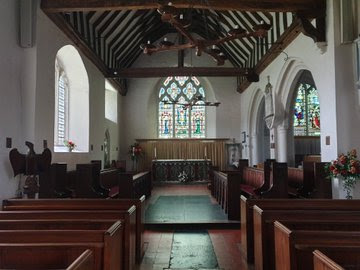
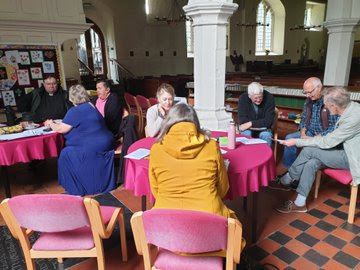
We enjoyed a PCC Away Day on Saturday at St Mary Magdalene Great Burstead, which included a lunchtime tour of the church. Revd Sue led us in Morning Prayer and a Wellbeing exercise and Revd Steve celebrated at the closing Eucharist.
 
In between, we were led in vision crafting and team building exercises by Sarah Rogers, one of three mission consultants available to parishes in the Basildon Deanery through Mission Opportunities Funding from the Diocese of Chelmsford. Sarah helped us think about our vision and values based on our current mission and ministry activities and helped us identify challenges and opportunities whilst identifying key initiatives and those requiring additional resource. All in all, a very productive and enjoyable day.

Our thanks to everyone who took part and to St Mary's Great Burstead for hosting us.

---------------------------------------------------------------------------------------------------------

The Moody Blues - Minstrel's Song. 

Sunday, 3 January 2016

Past Life - Present Mission (2.1)

Interspersed among the Chapters of 'Past Life - Present Mission' were personal reflections and stories from the research period. These are the reflections/stories from Chapter 1:

Weathered wood

On my personal Celtic Pilgrimage of Discovery I was, at one point, on a beach in South Uist, one of the Western Isles, way out in the Atlantic Ocean. It was low tide. There was a great sense of the Presence of God. A sense of a massive God whose Presence provided the wonderful world that I was perceiving and responding to. At the water's edge I saw a little wooden object, a piece of weathered wood that looked like a dolphin. As I picked it up and considered it – there, at low tide, left by the mighty Atlantic - I felt it was a symbol of a mighty God who has limitless power and resources. A God who works in our lives to get rid of the rubbish and the unnecessary baggage, rather like this piece of weathered wood where all the soft wood had rotted away leaving only the hardwood and a unique shape. So, the God whose presence could be felt in our lives sends us, or allows us, to go through deep waters that we might become like this piece of weathered hardwood. Some time later a member of St Edmund’s Tysley had a major operation, which we knew was serious. Her husband suggested a particular time for me to visit in hospital. I felt at such a loss to know how to respond and, in the end, took this little symbol of God's presence, His love and His way of working in our lives and gave it to this lady, explaining how and where I got it. From that point on it remained with her until the Lord took her to be with him. On at least one occasion whilst she was in hospital she told her doctors what this object symbolised for her. Her funeral occurred part way through the ‘Woven Cord’ programme and was a moment at which members of St Edmund’s realised that, as with Celtic Christians, they were open to the reality and nearness of death and the presence of the spiritual world in a way that was not apparent in the surrounding community.


Spiritual Visions

From the beginning of January 1996, for a period of at least eight to ten weeks I received a series of visionary experiences, some of which reached a climax before a PCC Away Day. For the previous 40 years since I became an adult, I had had a few visionary experiences, six to eight at the most, so they were very occasional. I would describe them as being able to enter into the spiritual dimension that surrounded a current situation. In the past and again now, they involved descriptive awareness about the people in the vision, and their actions. The majority related developmentally to where I was ‘at’, including a limited prophetic discernment about my future.

Three days before the PCC Away Day I awoke late into the night and the matter of the Away Day came strongly to mind. I was aware of God’s Presence and being in the spiritual dimension. I then had visionary pictures of five people who would be attending the Away Day. Each picture was clear and the sense or meaning of the vision was definite. In addition the sense was somehow impressed upon me that the Lord wanted to look at our pattern of relationships as His people at St. Edmund’s.

At the afternoon session of the Away Day, I shared generally about the visionary experience. After discussion, everyone agreed that if ‘they’ were one of the five, they would be willing for the vision to be openly shared. This then took place, and it was a deeply moving experience. It was experiential in terms of the awareness of God’s Presence walking amongst His people. This led immediately into a service of Holy Communion. It was clear that one central action of the Lord in this matter was to put His hand on our relationships, our need to change in specific ways and to be able to receive spiritual gifts from Him. Inevitably, any spiritual challenge about relationships and what we are deep within, can make us feel vulnerable but what the Lord was offering through the pain was precious and was linked to our potential.

--------------------------------------------------------------------------------------------

Dave Bainbridge & David Fitzgerald - Life Journey.

Friday, 13 April 2012

Church of England: Complex structures

In a Guardian article published on Good Friday, Andrew Brown quoted Justin Welby, Bishop of Durham as saying, "The longer I go on with this, the more I realise that the Church of England is not an organisation in any recognisable sense." In the article, Welby is quoted as expanding on this statement as follows:
"Any sort of concept of top-down direction is much more complicated than it looks. Part of it is illusion: because bishops are dressed up in funny clothes, with funny hats and special sticks it's assumed that if they say to a bunch of parish clergy 'do something', they will do it. But that's not how it works and never has been. Each part of the church has its own competence."
Welby is, as Brown notes, a bishop who "worked for 12 years in the oil industry before becoming a priest, so he knows something about the outside world." What he seems to be saying is that the structure of the Church of England doesn't look or function anything like the organisations he knew before ordination.

To the extent that I understand its structures it seems to me that the Church of England combines three different structures - a network of autonomous charities (parishes) covering the entire country; a regional framework (dioceses) which primarily supports the parishes; and a central structure delivering services to both dioceses and parishes while also undertaking national initiatives for the Church as a whole.

Within these three different structures there is rarely any direct line managerial responsibility for those whose ministries are enabled by some combination of these three structures. For clergy, this has presumably stemmed from our legal status as ministers of God rather than employees of a human institution. Clergy are centrally selected and trained but are appointed by a combination of external patrons, Diocese, and parish. We require a licence from the Diocese to minister but, once this has been granted, have considerable security and autonomy in parish ministry combined with minimal supervision (this situation is changing to a limited extent as a result of common tenure). Clergy generally chair the PCC (or varient) but it is the PCC as a whole which has overall responsibility for the charity that is the parish. As a result, the parish is essentially independent of the diocese and national church, although reliant on both for ordained ministers. The overlaps and complexities of these relationships extend throughout the three different structures and mean that, as Welby notes, the usual line management arrangements do not operate in anything like the same way in the Church of England as they do in other organisations.

All this has massive implications for the future of the Church of England because it means that there is no quick or simple mechanism for making the changes which are needed to respond to the changed mission context in which we minister. For example, Transforming Presence, the strategic document issued recently by Stephen Cottrell, Bishop of Chelmsford, notes that, while deaneries have been asked to think about cutting stipendiary posts because of the ticking time bomb of clergy retirements, many deaneries have simply planned ahead on the basis of who is going to retire next. What the document doesn't acknowledge however is that, because of the complexities noted above, the Church of England has no mechanisms for doing anything else.

None of this will change quickly so, as well as thinking about possible future structural changes, we need to make the best of the structures we have and recognise that in some respects what have is a structure which is focussed on the local parish but doesn't make that structure work very effectively (partly because of the inbuilt complexities).

In his article, Andrew Brown also quoted Alan Wilson, the Bishop of Buckingham, as saying, "The church of the future may be less a civil service or conventional business, and more a movement like Alcoholics Anonymous, the ultimate locally delivered, life-changing non-profit organisation. The job of the hierarchy will be to enable this, not to represent it or control it."

But as we have said the Church of England is not structured like the civil service or conventional business and we are actually structured for local delivery. The problem is the difficulty of ensuring that the three different structures work together cohesively and changing attitudes of independence and autonomy within each of the structures which do not prioritise cohesion and collaborative working. 

--------------------------------------------------------------------------------------------

Switchfoot - Dare You To Move.

Monday, 25 July 2011

God is in the multiplication business

The kingdom of God is a place of multiplication. The kingdom of God is a place of exponential growth. The kingdom of God is a place where the tiniest seed can become the biggest plant. The kingdom of God is a place where a grain of yeast can make a whole batch of dough rise. The kingdom of God is a place where a child’s lunch can feed 5,000. The kingdom of God is a place where the salt of our behaviour can flavour the community in which we live. The kingdom of God is a place where the little we can offer can be used to the praise and glory of God.

The Holy Spirit’s presence is shown in us in some way for the good of all. We have been given the abilities we need for our particular service in God’s kingdom. Our lives have meaning and purpose because God has work that only we can do. That is why we are here and that is the message that we have been sharing at St John's Seven Kings over the past 12 months since our Vocations Sunday service last September. What we have been seeking to do over that time is affirm and encourage the calling of the whole people of God; to identify and release the gifts God has given us to be more effectively his church.

As a PCC we believe that to do that fully here at St Johns we need to set up a Ministry Leadership Team. A Ministry Leadership Team is essentially those who lead, encourage and build up the work of the whole Body of Christ on behalf of the PCC and the five people who form the Ministry Leadership Team will each have overall responsibility for one of five key areas in our mission and ministry; Children and Youth, Mission, Pastoral, Peace & Justice, and Worship.

So, for five people in our congregation we believe that God’s meaning and purpose for their lives involves becoming a part of the Ministry Leadership Team here at St John’s. And that is where we come back to the place where we began, as each of us are likely to feel that we don’t have the gifts or the confidence to take on these roles. But God is in the multiplication business and can take the little that we can offer and use to his praise and glory.

Just as in the parable of the mustard seed, our small inputs can have a big effect and, just as in the parable of the yeast, the influence that one person can have can affect a whole church or community. The same can be true in terms of the contribution that the members of the Ministry Leadership Team can make to our church as a whole as they enable each person here to contribute in some way to the mission and ministry of St Johns, however big or small that input may be.
-------------------------------------------------------------------------------------------

The Staple Singers - I'll Take You There.

Sunday, 10 April 2011

Ministry Leadership Team

Today was our Annual Parochial Church Meeting, which included the following sermon:

Acts 13.1-3 shows us one way in which a missionary church of the first century was organised in the period covered by the New Testament. In the church at Antioch, we see:

• Members exercised different gifts; as there were, at least, prophets and teachers in this church (13.1a);
• Barnabas, Simeon called Niger, Lucius of Cyrene, Manaen (who had been brought up with Herod the tetrarch) and Saul were representative of the culture of the area (13.1b);
• They were also part of the worshipping and praying congregation; as they were chosen while worshipping the Lord and fasting (13.2a);
• Set apart for kingdom work i.e. the work to which God called them (13.2b);
• Sent out for apostolic ministry in wider community (13.3); but
• Remained accountable to church leaders and members of the church (14.26-27).

Ministry as Partnership - MaP - is the name the Chelmsford Diocese has given to new models of Christian ministry which were beginning to be developed at the turn of the millennium and which aim to bring us back to patterns of church life that more resemble the missionary church of the first century.

At its heart, Ministry as Partnership seeks to affirm and encourage the calling of the whole people of God. It is about identifying and releasing all the gifts God has given us to be more effectively his church, principles which now underpin all diocesan and national strategies, including the major Mission Shaped Church and Fresh Expressions initiatives.

Within our changing world and culture, parishes are delivering ministry in many different ways. No one way is appropriate for all, but where the God-given gifts of all baptised members of the local church are being identified and used, there is growing confidence and a greater sense of moving forward. Historically, we may not have as many stipendiary posts, but there have never been so many following a calling, whether in a commissioned ministry or more informally.

Ministry as Partnership provides a process for establishing a Ministry Leadership Team within a local church. A Ministry Leadership Team is essentially those who lead, encourage and build up the work of the whole Body of Christ on behalf of the PCC. This year our PCC has taken the decision that we should set up a Ministry Leadership Team at St John’s Seven Kings.

The Ministry as Partnership process has five steps for establishing a Ministry Leadership Team within a local church:

• Building the vision – assessing where we are and discerning where we would like to be
• Making decisions – envisioning a team to suit local needs
• Forming a team – practical guidance for getting underway
• Staying fit – the ongoing life of the team, particularly at transition stages
• Going deeper – theology and ecclesiology for leaders and others

Looking at these five steps, you can see that we have already been working on the first two. We have our Church vision, which we reviewed in the first year or so that I was here:

That led to a renewed focus on our engagement with the local community which has in turn led to new people joining the church. As a result, we have moved onto Step 2 which is about envisioning all of us for ministry. Our Vocations Sunday service led on to the SHAPE course, the faith and work video interviews, and currently the Care and Share Lent course. All of which have emphasised that all believers of all ages and abilities have been called by God and have a vocation to follow. All have gifts to offer for the common good of the church and world.

All of which means that we are now ready for Step 3 which is where we form the Ministry Leadership Team itself. In the coming months, we will be asking you to think and pray about five areas of ministry here at St John’s and which members of our congregation could be responsible for each of these areas. It could be you! The five ministry areas are: Children and Youth; Mission; Pastoral; Peace and Justice; and Worship.

The kind of people that we will be seeking as leaders are those who have a developing spiritual life of their own and who seek to nurture and disciple others. Leadership is a gift for the common good and we will be asking those who become responsible for these areas of ministry to work in partnership with all those who are also involved in that area of ministry. Christian leadership is less to do with command-and-control than with establishing the environment within which others are empowered to use their gifts. The corporate leadership at St John’s (i.e. licensed minister(s), the PCC and the Ministry Leadership Team) are the guardians of God’s vision for this community of faith.

At St John's we will all have the opportunity over the next few months to reflect more on these areas of ministry and what is involved in taking them forward. Working towards partnership in ministry is a demanding and worthwhile challenge within which prayer deserves to be a high priority. In setting new directions, let us seek to keep in step with the purposes of God in the power of the Spirit; joining in partnership as God works in his world and his church.

-----------------------------------------------------------------------------------

Delirious? - Now Is The Time.

Sunday, 20 June 2010

Church vision


Yesterday we held an information session for our current PCC which ended by outlining the current vision for St John's Seven Kings.

It is our vision to grow together as a community of God's people, filled and empowered by the Holy Spirit to follow Jesus Christ's example and teaching.
We believe God has called us to be a:
  • Worshipping Community - committed to prayer, study of the Bible, sharing of Holy Communion, praising God and listening to God as central to our lives and life together.
  • Loving Community - committed to welcoming, accepting and caring for one another and all whom God brings to us.
  • Inclusive Community - of many races and cultures, committed to learning together and growing together in unity and love.
  • Growing Community - committed to seeking God's grace to grow in understanding, maturity of faith and love, and in numbers.
  • Serving Community - committed to the people of the Seven Kings area, to use our God-given resources to meet needs as and when possible.
  • Witnessing Community - committed joyfully and humbly to sharing the wonderful good news of God's love for all people.
  • Healing Community - committed to seeking to grow in wholeness through care and prayer for one another and for those who seek God's healing in their lives.
  • Prophetic Community - committed to seeking and speaking out for justice and peace in our community, nation and world.

Initially in my time at St John's we have focused on the renewal of the community/outward facing aspects of this vision – serving /prophetic/witnessing leading to growing. We have worked with the kingdom model of mission - God>World>Church - which starts with action and partnerships in the community, for the sake of the kingdom. Church is then for those who respond to the call to share in God’s transforming mission. Our texts for the year also reflected this approach - “Watch for the new thing I am going to do. It is happening already - you can see it now!” (Isaiah 43:19a) and “All of creation waits with eager longing for God to reveal his children” (Romans 8.19).

Among the action we have taken as a result have been:

  • Promoting and developing the St John’s Centre as a centre for the community: 20+ community groups/activities and 100s of users;
  • Community engagement – Take Action for Seven Kings / Seven Kings & Newbury Park Resident's Association / Living Streets campaigns for improved community facilities;
  • Community Garden – a visible sign that we are here and we are for the community.

Next is to be renewal of the internal Church focus: worshipping/loving/ inclusive/healing leading to growing. Our text for 2010 reflects this focus: "Be alert, stand firm in the faith, be brave, be strong. Do all your work in love." (1 Corinthians 16 v 13-14). Among the actions which we expect to develop as a result of this focus are: planning our future deployment for ministry; holding a Vocations Day; and exploring the possibility of a Ministry Leadership Team.

Our prayer is: Lord, we are communities in communion with you, our rainbow-loving, promise-keeping Creating Father God. Bring us together in trust and hope, remembering the marginalised we must represent, the needy for whom we can speak, the poor with whom we are included. Amen.

-----------------------------------------------------------------------------------

Van Morrison - In The Garden.

Monday, 23 February 2009

Dealing with disagreements

One of the things we're not particularly good at doing in the Church as a whole, either at the personal or corporate levels, is dealing with disagreements. Witness the current debates in Anglican Communion about homosexuality or in the Church of England over women bishops. More recently there has been more heat than light generated over two other contentious issues in Evangelicalism; the recent NEAC 'consultation' and the current debate over a critical review of Patrick Sookhdeo's latest book.

When I do 'Marriage Guidance' with couples preparing for their wedding at St John's I always ensure that we cover issues of conflict and get couples to discuss their differing approaches to it in order that they can work out for themselves how to fight as friends. Something similar seems needed within the Church judging by the virulancy of some responses to Christian brothers and sisters over some of the above issues.

At St John's we have recently begun a Bible study series entitled 'Dealing with disagreements' in an attempt, which has not been without its own tensions, to find ways to discuss where and how we disagree within our own church family.

As part of this process we will take forward discussions that began at last year's PCC Away Day of two current controversial issues about which we need to be informed; the issue of responses to homosexuality within the Anglican Communion and the issue of transition in society from reliance on fossil fuels. Both have impacts for local churches and local communities and our PCC think that it would be helpful for there to be discussion at St John's about both topics.

That is not, however, where we are starting our discussions. Instead we are beginning by looking at two areas of disagreement that occurred in the early church (Romans 14 & Acts 15. 1-21). From these passages we are aiming to identify principles for dealing with disagreements that could be applied during our discussions of the two current controversial issues. The final session of the study will then help us reflect on the different ways in which the Bible has been used throughout our discussions and the extent to which our different ways of understanding scripture influence the positions that we take on controversial issues.

If this sounds of interest to you then you can follow a part of the debate online as one of our housegroups are posting summaries of their discussions on their blog. Their first two posts can be found by clicking here and here.

-----------------------------------------------------------------------------

Elvis Costello - Indoor Fireworks.

Wednesday, 26 November 2008

Reducing oil dependency (and other resource scarcity issues)

Redbridge Faith Forum have published a report from the meeting held with Redbridge Green Fair on 'What can Redbridge do to reduce oil dependency?'

At St John's we have decided, following our PCC Away Day, to look at some materials giving a Christian perspective on peak oil in our homegroups in the New Year and will be using materials that Sam Norton has posted to do so.

On Monday I attended a very useful day's training on 'Energy Efficiency and Community Buildings', again organised by the Faith Forum and delivered by the Energy Saving Trust. Their national support programme, Community Action for Energy, is a network of like-minded people with an interest in community-based energy projects. Membership of the network is free and offers:
  • Community helpline;
  • Community support network providing 1.5 days of professional consultancy;
  • Travel bursaries;
  • Training courses;
  • A guide to energy efficiency projects;
  • Website;
  • Case studies;
  • Newsletter;
  • E-news updates; and an
  • Annual conference.
Finally, last night I went to the Tomorrow Network event on 'The Future of the Food Crisis' at the Royal Society where I heard Duncan Green, Director of Research at Oxfam, and Alex Evans, of the Center on International Cooperation, discuss the current food crisis throughout the world and its future prospects.

Among the points they made were the following:
  • Recent food price rises represent a structural shift not a temporary blip because of four resource scarcity issues: energy (tight supply fundamentals and effect of bio fuels); water (demand has tripled over past 50 years); land availability (only 12% usable arable land left and pressure for other uses of it); and effects on agriculture of climate change (low crop yields and emissions from agriculture).
  • The cost of high food prices is 850m + hungry people selling their futures (e.g. livestock); getting credit from loan sharks; sending children to work; and parents eating too little in order to feed their children.
  • Agriculture must be made pro-poor through: small farmer-based agricultural growth (e.g. Viet Nam and India); effective states with active citizens (e.g. consumer associations such as the grain banks in Uganda); shifts to low carbon production; addressing the challenges of supermarketization, biofuels and outmigration; and solving the dilemma of food vs feed vs fuel.
  • Property rights matters for poorer people and women in particular. A fairer distribution of land leads to greater growth (e.g. Taiwan and South Korea).
  • Build community resilience to climate change i.e. addressing the loss of inherited knowledge when climate patterns change.
  • Actions needed now include: raising yield and making food production more sustainable, resilient and fair; invest more in agriculture; focus on small farms (largest employer in the world); aid donors to focus on the four resource scarcity issues; social protection for poor people; develop security of supply through buffer food stocks and equitable trade agreements with developing countries; address effect that Western lifestyle (bio fuels and diet) has on the rest of the world.

----------------------------------------------------------------------------------

U2 - Love and Peace or Else.

Tuesday, 14 October 2008

Peak oil

The other big issue that we addressed at the PCC Away Day for St John's Seven Kings at Peterhouse was that of peak oil and its effect on the current economic turmoil. For this, we made use of Sam Norton's Let Us Be Human materials and the session 'Peak Oil revisited' in particular.

In this session, which was prepared in 2006, Sam suggests that the economic impacts of peak oil that will work through include the following:
  • Transport will become extremely expensive. To begin with we will respond by forming car pools to keep the system ticking over, people will share cars much more. And the electric rail will continue.
  • Food is going to start becoming very expensive unless we set up local food sources. I think it is one of the most important things that we need to do. We need to ask ourselves the question, “Where is our food going to come from?” Talking to one of the Mersea farmers the other day, and talking about the possibility of shifting to organic production of food on Mersea Island, he said, “Well the thing is, if you take away fossil fuel fertiliser, to get an indication of what the result will be, look at what was farmed a hundred years ago.” And basically Mersea Island had sheep. The soil isn’t good enough to grow crops on without the input of fossil fuels. So Mersea Island is not going to be independent in terms of it’s food supply.
  • Heating is going to be expensive. You have already noticed this in your bills because the gas peak is also imminent, and whereas oil declines gradually in a safe world, gas falls off a cliff. So much more house sharing, grannies will live with parents.
  • Electricity will become very expensive. All these labour saving devices are only possible when energy is cheaper than human labour. That ratio will reverse. Human labour will be cheaper than electricity.
  • Following that through, lots of businesses will fail, airlines are the canaries in the coal mine. Four out of six American airlines are now in chapter eleven bankruptcy proceedings.
  • Unemployment will rise initially as all the businesses fail but then there will be a great demand to go back to the land.
  • The stock markets will contract so think about pensions, think about stipends, what’s going to happen to the housing market – I haven’t got a clue. Is there going to be inflation? Is there going to be deflation? Who knows?
  • We are looking at minimum at a re-run of the 1930’s in terms of the scale of what’s being faced.
People were impressed with the extent to which Sam had been accurate in predicting what is now beginning to unfold in our economy and showed interest in exploring the idea of transition initiatives further possibly by a visit to Mersea Island to see what Sam and others are involved in there.

-------------------------------------------------------------------------------

Bob Dylan - Not Dark Yet.

Saturday, 11 October 2008

GAFCON & the Lambeth Conference: Where do we go from here?

At our PCC Away Day today we thought about the outcomes from the GAFCON and Lambeth Conferences in order to begin discussion about the effect that these conferences should have on us at St John's Seven Kings. The material we used was as follows:

The issues

GAFCON: "The ... acceptance and promotion within the provinces of the Anglican Communion of a different ‘gospel’ (cf. Galatians 1:6-8) which is contrary to the apostolic gospel ... The ... declaration by provincial bodies in the Global South that they are out of communion with bishops and churches that promote this false gospel ... The ... manifest failure of the Communion Instruments to exercise discipline in the face of overt heterodoxy."

Lambeth: "The whole issue of homosexual relations is also highly sensitive because there are very strong affirmations and denials in different cultures across the world which are reflected in contrasting civil provisions, ranging from legal provision for same-sex marriage to criminal action against homosexuals. In some parts of the Communion, homosexual relations are a taboo while in others they have become a human rights issue. The issue of homosexuality has challenged us and our Churches on what it might mean to be a Communion. We are still learning how to be the Communion that God has called and gifted us to be."

1. Approach to homosexuality
2. Approach to scripture
3. Approach to structures of the Anglican Communion

Lambeth: "There is confusion about what "the issue" really means. There are three aspects that would help to clarify discussions: How the church evangelizes, disciples and provides pastoral care for homosexual people; How and on what basis the church admits people to Sacred Orders; How the church deals with the first two locally and globally."

Approach to homosexuality

GAFCON: "This false gospel … promotes a variety of sexual preferences and immoral behaviour as a universal human right. It claims God’s blessing for same-sex unions over against the biblical teaching on holy matrimony. In 2003 this false gospel led to the consecration of a bishop living in a homosexual relationship."

Lambeth: "The issue of homosexual relations is as sensitive as it is because it conflicts with the long tradition of Christian moral teaching. For some, the new teaching cannot be acceptable on biblical grounds as they consider all homosexual activity as intrinsically sinful. Tension has arisen when those who hold the traditional teaching are faced with changes in the Church’s life or teaching without being able to understand or engage with a clear presentation of how people have come to a new understanding of scripture and pastoral theology."

Approach to scripture

GAFCON: "We believe the Holy Scriptures of the Old and New Testaments to be the Word of God written and to contain all things necessary for salvation. The Bible is to be translated, read, preached, taught and obeyed in its plain and canonical sense, respectful of the church’s historic and consensual reading."

Lambeth: "We acknowledge the full reliability of the texts of the canonical Scriptures given to us by God … From this strong sense of biblical reliability the Church derives norms of moral and ethical life that are to be honoured by the whole Body of Christ; at the same time we discover biblically faithful means to respond pastorally to those who are unable to observe such norms. When serious disagreements arise among us about moral and ethical norms we are called to intensify our efforts to discover God’s Word through continuing scriptural discernment … Biblical scholars have a variety of exegetical tools for their use and employ many different methods of biblical exposition and interpretation. When used discerningly and under the guidance of the Holy Spirit, these tools and methods can assist us in breaking open the Holy Scriptures and enrich our understanding of God’s Word."

Approach to structures of the Anglican Communion

GAFCON: "Sadly, this crisis has torn the fabric of the Communion in such a way that it cannot simply be patched back together … We, the participants in the Global Anglican Future Conference, do hereby acknowledge the participating Primates of GAFCON who have called us together, and encourage them to form the initial Council of the GAFCON movement. We look forward to the enlargement of the Council and entreat the Primates to organise and expand the fellowship of confessing Anglicans … Our fellowship is not breaking away from the Anglican Communion."

Lambeth: "There is a willingness to continue exploring a Covenant together … The ‘Instruments of Communion’ are the Archbishop of Canterbury, the Lambeth Conference, the Anglican Consultative Council and the Primates’ Meeting. There is a need to clarify the role and function of each of these ... and their relationship one to another … There is clear majority support for a Pastoral Forum … There is widespread support for moratoria, building on those that are already being honoured … The moratoria cover ...: ordinations of persons living in a same gender union to the episcopate; the blessing of same-sex unions; cross-border incursions by bishops."

Questions

1. Approach to structures of the Anglican Communion: GAFCON is forming a new Fellowship of Confessing Anglicans led by a Council of Archbishops and Bishops while Lambeth wants to review the four Instruments of Communion, establish a Pastoral Council, introduce an Anglican Covenant and maintain moratoria. Which do you think is the better approach and why?

2. Approach to scripture: GAFCON believes that "the Bible is to be translated, read, preached, taught and obeyed in its plain and canonical sense" while Lambeth argues that "Biblical scholars have a variety of exegetical tools for their use and employ many different methods of biblical exposition and interpretation. When used discerningly and under the guidance of the Holy Spirit, these tools and methods can assist us in breaking open the Holy Scriptures and enrich our understanding of God’s Word." Which do you think is the better approach to understanding scripture and why?

3. Approach to homosexuality: A false gospel or a new understanding of scripture and pastoral theology? Which do you think is the case when it comes to different approaches to homosexuality taken by Christians and why? How should we deal with the tensions that arise when those who hold the traditional teaching are faced with people who have come to a new understanding of scripture and pastoral theology?

4. Where do we go from here? What effect do you think these issues have or ought to have on St John’s and why?

------------------------------------------------------------------------------

Keane - Everybody's Changing.