Wikio - Top Blogs - Religion and belief
Showing posts with label illustrations. Show all posts

Monday, 23 May 2022

Peter S. Smith, The Dalziel Woodpeckers, and Hans Rookmaaker


Peter S. Smith is currently showing work in RE Original Prints 2022 at the Bankside Gallery and also has a print called ‘Dalziel’s Apprentice’ in an interesting exhibition in the Print Room at the British Museum.

This intriguing new display, The woodpecking factory: Victorian illustrations by the Brothers Dalziel, highlights over 50 works engraved on wood by the Brothers Dalziel firm, illustrating literary and commercial work published throughout the Victorian period. Established in 1839, the Brothers Dalziel (one of whom was a sister – Margaret – a talented senior engraver) became the most successful wood-engraving company in Britain, employing dozens of engravers.

The Brothers Dalziel had enormous cultural power in Victorian Britain, shaping the way people visualised art, goods and ideas. Mostly the engravers made images after designs by draughtspeople, including major artists such as Frederic Leighton and John Everett Millais, and it's these artists who were widely credited and remembered. However, the process was collaborative and the skill of the craftspeople (affectionately known as 'woodpeckers') who engraved such illustrations was considerable.

‘Dalziel’s Apprentice’ is Peter's homage to those Victorian trade engravers and their apprentices who had to cut away all that white in order to make their prints emulate black pen and ink drawings!

Additionally, ‘The Big Picture’ magazine has a section about Hans Rookmaaker and asked Peter to write about him focusing on one specific aspect of his work. In his article Peter has focused on Rookmaaker's use of the term ‘Modern Art’ in the book Modern Art and the Death of a Culture. For more of Peter's reflections on the work of Rookmaaker see here and here.

In his article, Peter refers to Sixten Ringbom's The Sounding Cosmos. A Study in the Spiritualism of Kandinsky and the Genesis of Abstract Painting, a work on the mystical and theosophical themes in modern art. He argues that spiritual elements in modern art have been hidden in plain sight "because many of the institutional guardians of Modernism chose to overlook it" citing Waldemar Januszczak, who argued, in a 2021 article, "that the art historians and institutions of Modernism repeatedly ignored any idea that in Modernism there can be found religious or hermetic intentions" because of "a fear that it would sully the waters."

------------------------------------------------------------------------------------------------------------

Sarah Brown - I'm On My Way.

Tuesday, 19 November 2019

The City is my Monastery: A contemporary rule of life


My colleague at St Martin-in-the-Fields, Richard Carter has written a book called
The City is My Monastery: A Contemporary Rule of Life. It’s being published by Canterbury Press with Forward by Sam Wells and Afterword by Rowan Williams. The book is illustrated by Andrew Carter, Helen Ireland, and Vicky Howard.

On Wednesday 20 November 6.30pm in our service of Bread for the World at St Martin-in-the-Fields Richard will speak about the book.

Richard Carter swapped a life of simplicity with an Anglican religious order in the Solomon Islands for parish ministry in one of London’s busiest churches, St Martin-in-the-Fields.

Seeing a need for monastic values in the centre of the city, he founded the Nazareth Community. Its members gather from everyday life to seek God in contemplation, to acknowledge their dependence on God’s grace and to learn to live openly and generously with all.

Part story, part spiritual meditation, The City is My Monastery offers spiritual wisdom for daily life rooted in the Nazareth Community’s seven guiding principles: Silence, Service, Scripture, Sacrament, Sharing, Sabbath Time and Staying.

‘This wonderful book is both recognizable and startlingly new. What we are given here is not simply another book on ‘spirituality’ but a workbook for living in and with meaning, Christian meaning, Jesus-shaped meaning.’ Rowan Williams

‘This book is a generous gift. The City is My Monastery is rich and moving reading which warmed my spirit and encouraged me to stay.’ The Rt Revd Sarah Mullally, Bishop of London

‘This is a book that moved me deeply and will surely strengthen and give heart to many. It is an autobiography of poetry and prayer. Above all, a powerful poetic meditation on meeting God every day on the streets and in the people of London.’ Neil MacGregor, founding director of the Humboldt Forum in Berlin, director of the British Museum 2002-2015

‘Precious few are the books that accomplish what this masterfully practical and inspiring book accomplishes. Nor do they do so with such grace, depth and unflinching insight. Those who tread the pathless path of contemplation will be grateful to be in Richard Carter’s debt for the gift of this remarkable book.’ Martin Laird OSA, author of An Ocean of Light

‘The City is my Monastery is beautiful, inspiring, humble and attractive. It is so deeply soaked in loving attention and that is what makes it so infectious.’ The Revd Sam Wells, Vicar of St Martin-in-the-Fields

‘This is a life-changing book, and needs to be read as it is written - as a prayer.’ Sarah Coakley, Norris-Hulse Professor Emerita, University of Cambridge

‘There are treasures on every page: wisdom gathered, practised and shared. This book is so readable it could be a quick read, but linger and use it slowly over the months and years. This is a guide to life.’ The Rt Revd Nicholas Holtam, Bishop of Salisbury

‘This is one of those books that can be a lifetime’s companion, holding before us what we are here for: Life.’ Father George Guiver, Community of the Resurrection.

‘Richard Carter has written a book not of abstract theory but of lived experience and practice. It will inspire urban and rural dwellers alike.’ Revd Lucy Winkett Rector St James's Church, Piccadilly

---------------------------------------------------------------------------------------------

Thursday, 19 October 2017

Law and love

Here is my sermon from today's Eucharist at St Stephen Walbrook:

There are 613 commandments in the Torah, which divide up into 248 positive commandments (Thou shalt's) and 365 negative commandments (Thou shalt not's). Jesus says that all these hang on the two commandments to love God and love our neighbour as ourselves.

Tom Wright, the former Bishop of Durham, has a helpful illustration for the way in these negative commandments work. He says, “The illustration I sometimes use is that when you learn to drive a car, the idea is that you will quickly come to do most of the things “automatically”, changing gear, using the brakes, etc., and that you will develop the “virtues” of a good driver, looking out for other road users, not allowing yourself to be distracted, etc.; but that the highways agencies construct crash barriers and so on so that even if you don’t drive appropriately damage is limited; and also those “rumble strips”, as we call them in the UK, which make a loud noise on the tire if you even drift to the edge of the roadway. “Rules” and “the Moral Law” are like those crash barriers and rumble strips. Ideally you won’t need them because you will have learned the character-strengths and will drive down the moral highway appropriately. But the rules are there so that when you start to drift, you are at once alerted and can take appropriate action – particularly figuring out what strengths need more work to stop it happening again.”

The other side of the equation are the positive commandments; the virtues in life which we are intended to quickly learn to do automatically. This is where we begin to engage with love and see that love and law can work together. Tom Wright has said that “the point about “vice”, the opposite of “virtue”, is that, whereas virtue requires moral effort, all that has to happen for vice to take hold is for people to coast along in neutral: moral laziness leads directly to moral deformation. The thing about virtue is that it requires Thought and Effort . . .”

So change begins with a conscious decision, not a magical or instant makeover. Tom Wright says, “The point about the word “virtue” – if we can recapture it in its strong sense – is that it refers, not so much to “doing the right things”, but to the forming of habits and hence of moral character ... All behaviour is habit-forming … we [can] use the word “virtue” and “virtuous” simply to mean “behaviour we have had to work at which has formed our character so that at last it becomes natural and spontaneous to live like that.”

Let’s use an illustration to consider how this works, that of parents teaching their children the rules of the road. To begin with, when children are very young, the rules of the road are very restrictive i.e. the child must never cross a road without a parent and must always cross at a crossing with the parent and while holding the parents hand. As the child grows, they are taught new rules for crossing the road; for me, that was the Green Cross Code - stop, look and listen. Now, the aim is that the child learns to judge for him or herself when it is safe to cross the road. Eventually, the rules with which we began – don’t cross on your own, don’t cross unless you are at a crossing – are left behind because the child has learnt how to cross the road safely using their own initiative. Elbert Hubbard has said, “Initiative is doing the right things without being told.” We are able to use initiative because we have not only learnt the rules but have learnt to apply in our lives and situations. At this point, we are no longer restricted just to crossing the road at specific crossing places but can cross wherever we judge it to be safe to do so. So, we have gone beyond the rules by learning and applying the rules. In other words, we have found the true purpose of those rules which our parents enforced when we were young; which is that we learn to cross the road safely by ourselves wherever we are.

Jesus is essentially saying the same thing when he speaks about the Law. The Law starts by keeping us safe – do not murder, do not steal. If we all abide by the Law then we do not harm each other. That is good, but it is not enough. We also need to learn to love one another. That means doing more than the Law requires but to do that is also the fulfilling of the Law. If the Law is about maintaining good relations between us, then love is the fulfilment of the Law’s intent, and that is why Jesus said the heart of the Law is found in these words: “Love the Lord your God with all your heart and with all your soul and with all your strength and with all your mind” and, “Love your neighbour as yourself.”

In order to fulfil the Law and these teachings we are to love as Jesus loved; with a love that is patient and kind, which does not envy or boast, is not proud. does not dishonour others, is not self-seeking, is not easily angered, keeps no record of wrongs, does not delight in evil but rejoices with the truth, always protects, always trusts, always hopes, always perseveres.

-----------------------------------------------------------------------------------------

Dominique Lawalree - Minimum II.

Friday, 10 April 2015

Beverley Barr: iconographer, illustrator and artist

Today I spoke to Beverley Barr, iconographer, illustrator and artist, who trained at Bath Academy of Art. During this time, she undertook commissions, mainly portraits, and painted her first liturgical artwork.

She is a member of the Association of Illustrators and is familiar with making illustrations for church publications of different denominations, and icons for private devotional, and liturgical purposes, as well as portraiture and other artwork, and works to commissions.

Beverley gives talks about the Stations of the Cross and/or conducts liturgies using them as aids to worship. She has produced a booklet of her Stations of the Cross images combined with Bible readings, prayers, meditations and other information.

Beverley has spent a good many years researching medieval artwork, eleven of these years exclusively in manuscripts, and often works by illuminating on vellum.

She will be exhibiting at All Saints Kings Heath from 28th June – 30th August.


-------------------------------------------------------------------------------------------------------------------------------

Daniel Buchanan - O Rubor Sanguinis.

Monday, 16 March 2015

Maurizio Galia, illustrator and musician

During commission4mission's Arts in Worship event on Saturday I had the opportunity to meet Italian artist, illustrator and musician, Maurizio Galia.

Born in Moncalieri (Turin) Italy on the 28th May 1963, Maurizio Galia studied at the Academy of Fine Arts in Turin, from 1978 until 1986, under the direction of Francesco Tabusso, Enzo Sciavolino and Sergio Saroni. From 1982 he worked for various agencies and specialized as visual designer and illustrator for comics and books. During these years he also worked part-time as a musician in a Prog Rock group.

-------------------------------------------------------------------------------------------------

Maury E I Pronomi - Oceano.

Sunday, 13 July 2014

Sabbatical art pilgrimage: St Michael and All Angels Waterford


In 1919 designs by Harry Clarke for a two-light window, St Cecilia and a Listening Angel, commissioned for St Michael and All Angels Waterford were rejected by the Diocesan Advisory Committee (DAC) on the grounds that the design was out of keeping with the Pre-Raphaelite windows already in the church.

St Michael and All Angels is a minor gem of a Church which was consecrated in 1872, built in the style of Early English Gothic, and populated throughout with Pre-Raphaelite stained glass as well as mosaics from James Powell and Sons (the Whitefriars Studio). St Michael and All Angels, therefore, stands in a tradition which reflects a set of very English styles and influences.

Henry Woodyer, its architect, was a disciple of Augustus Pugin. Giles Worsley has written that Woodyer’s work is “predominantly muscular Gothic, in the spirit of A W N Pugin” and like Pugin “stems from his religious bent.” At its best, he argues, “there is an energetic vigour to his religious and secular work” and “a convincing vision of the Middle Ages, rich with colour and decoration.”

Augustus Welby Pugin - the architect, designer, writer, and theorist known as ‘God’s own architect’ - had a major influence on architecture and design throughout the English-speaking world well into the twentieth century. His importance lies both in his creation of the Neo-Gothic style and in his anticipation of many of the statements on design by John Ruskin which led to the formation of the Pre-Raphaelite Brotherhood, the work of Morris & Co., and the development of the Arts & Crafts Movement.

William Morris - poet, artist, philosopher, typographer and political theorist - was the greatest designer and one of the most outstanding figures of the Arts and Crafts Movement. In 1861, with a group of friends, he started the business Morris, Marshall, Faulkner & Co. which provided beautiful, hand-crafted products and furnishings for the home. Influenced by the ideas and writings of Thomas Carlyle and John Ruskin, the company revived many of the traditional arts which had been swept away by industrialisation including embroideries, tapestries and stained-glass.

In addition to the creation of new artefacts, Morris was also concerned about the preservation of art and architecture from earlier ages and so, in 1877, he and other notable members of the Pre Raphaelite brotherhood held the inaugural meeting of the Society for the Protection of Ancient Buildings (SPAB) in Bloomsbury. As founding members they were deeply concerned that well-meaning architects were scraping away the historic fabric of too many buildings in their zealous ‘restorations.’ When the DAC rejected Clarke’s design for St Michael and All Angels, they were in essence seeking to follow this strand of Morris’ thought; although whether he would have agreed with their decision is a moot point.

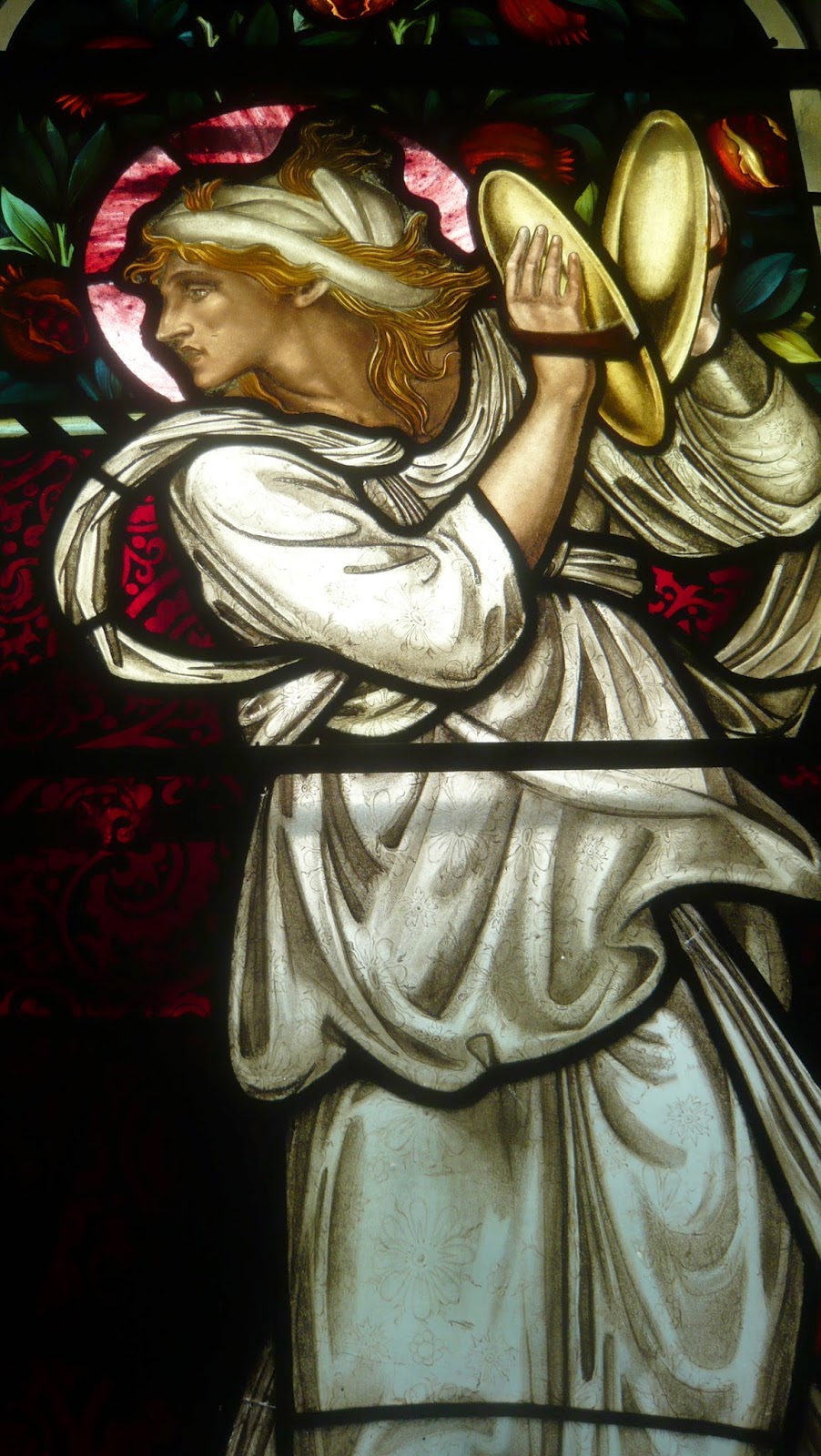
Many of the windows at St Michael and All Angels are by Morris & Co. and feature leading Pre-Raphaelites including Ford Madox Brown, Edward Burne-Jones, Morris, and, possibly, Dante Gabriel Rossetti. Later windows by Selwyn Image, Karl Parsons and Douglas Strachan are part of the same tradition and ensure that the feel of the building as a whole is cohesive. The third chancel window, which depicts the prophetess Miriam and was completed by Morris from a design by Burne-Jones, was included on a list of the 12 best stained glass windows in English churches as judged by photographer Lucinda Lambton.

The Whitefriars Company was a successful British glasshouse closely associated with leading architects and designers from the later portion of the 19th century onwards including Philip Webb who designed glass for William Morris. From 1876 James Crofts Powell ran the stained glass department which also developed mosaic techniques to the Byzantine standards of Ravenna. Powell’s opus sectile mosaics were tilted to deflect the light and gained sufficient credit to be used by William Blake Richmond in his work at St Paul’sCathedral. Whitefriars carried out the creation of the chancel mosaics at St Michael and All Angels to designs by J. P. Hutchinson.

Despite the beauty of the artwork and the building, it is not primarily the Pre-Raphaelite work that I have come to see here. The most recent of the windows, the 1929 St Cecilia and Angel by Karl Parsons, is described in the Church guide as being “especially beautiful when the summer evening sun shines through its vibrant colours.” Acid-etching and plating was used to create the enriched colour and texture found in this window. The window depicts St Cecilia, the Patron Saint of Music, and the music she has inspired on this occasion, which is included in the upper tracery section above the figures, is the fugue from Beethoven’s penultimate piano sonata.

Karl Parsons was pupil and assistant to Christopher Whall, who was an important member of the Arts and Crafts Movement, a leading designer of stained glass and a teacher at the Royal College of Art (RCA) and the Central School of Art and Design. In addition to his work in England, Whall also assisted in reviving the art of stained glass in Ireland. At the invitation of Edward Martyn, Whall, and his colleague Alfred Ernest Child, worked with Sarah Purser to set up a new school of stained glass in Dublin which was christened An Tύr Gloine (Tower of Glass), with a credo that “each window should be in all its artistic parts the work of one individual artist.’

Parsons, who also taught at the RCA and Central School was a craftsman of outstanding ability who worked from a studio at the Glass House Fulham; the centre for most stained glass designers during the first half of the twentieth century. He and Harry Clarke met in 1913, while Clarke was studying the craft and before he began work for his father’s glass workshop, the Clarke Studios, also based in Dublin. The two men remained close friends until Clarke’s death in 1931. The St Cecilia and Angel window at St Michael and All Angels, although “unmistakably by Parsons rather than Clarke” was based on Clarke’s rejected design and means that a trace of the rejected work is found in this church despite its perceived incongruity with the existing Pre-Raphaelite glass (Harry Clarke: The Life & Work, Nicola Gordon Bowe).

Among the many ironies of this story is the fact that Clarke has been described as “the last of the Pre-Raphaelites” and “played a major part in the Arts and Crafts movement in Ireland … as well as in the international stained glass revival which arose from the movement in England.” He “can also be seen as Ireland’s major Symbolist artist, whether in his illustrations or in his stained glass” (Gordon Bowe). Symbolism was also a wider international movement of which the Pre-Raphaelites were part. Therefore, the rejected design, while considered out of keeping with the Pre-Raphaelite windows already in the church, was actually part of a body of work that built on the foundation laid by the Pre-Raphaelites.

Clarke’s strange genius was to fuse “the Burne-Jones/Whall idiom” with “an eclectic and decadent Symbolism of medieval richness and Byzantine splendour” which was achieved by means of his having, as a young man, “absorbed Burne-Jones, [Aubrey] Beardsey, Charles Ricketts, Edmund Dulac, Kay Nielsen, the Glasgow School, [Gustave] Klimt, the Japanese print, the Symbolists, and the Russian ballet.” As a result, “his art displays a wilful decadence and an ambivalent religious mysticism of medieval intensity which ranges from the sublimely beautiful to the grotesquely macabre, rarely found in the work of his Celtic peers.” (Gordon Bowe).

Similarly, James White has noted that Clarke “always carried the sensual-mystical conflict with him” - viewing “his drawings as an outlet from the religious subjects with which he was daily involved in his stained glass work” – and that, as a result, “few artists have been more concerned with the conflict of religion and sensuality.” His works are “uniquely imaginative creations” undertaken with remarkable technical skill meaning that “when he applied his minute and precise line to his process of plating and aciding he achieved an art form of extraordinary perfection.” Peyton Skipwith has suggested that by means of Clarke’s work, alongside that of Evie Hone at An Tύr Gloine, it was Ireland which revived the art of stained glass in the twentieth century (Gordon Bowe).

During his short life Clarke created 160 stained glass windows for churches and private patrons in Ireland, England, the United States and Australia. His unique style and technique combined rich colours with elongated figures that exude poise and grace. Deep blues and ruby reds were the hallmark of his work. As an illustrator of books, his five books for Harrap and Co show his genius in the area of graphic art. In England, work by Clarke is most easily seen at the Victoria & Albert Museum in London and the Stained Glass Museum in Ely.

--------------------------------------------------------------------------------------

The Blue Aeroplanes - Colour Me.