From 1898–9 local developer Cameron Corbett laid out
an estate of good quality houses that clerks and lower grade civil servants
could afford. As a result, this development in Seven Kings extending to
Goodmayes has been called “the town built in a year.” Corbett added the
Mayfield estate to the south and Downshall to the north meaning that the area
quickly had 10,000 inhabitants (http://hidden-london.com/gazetteer/seven-kings/).
Several churches were built as a result including St Paul’s Goodmayes built in response to the development of the Mayfield Estate. When
the decision was made, in 1901, to build St Paul’s this estate had 420 houses, built
in the preceding eighteen months, 300 of which were occupied, representing
perhaps 1,500 people. More were to be built on the south side of the railway
line, meaning that a clear need for a church was established.
The Church which was built is in the style of Gothic
architecture, that had been popularised by A.W.N. Pugin and which
characterised church building by the Arts & Crafts Movement. The materials
used are red brick with stone dressing. Messrs. Chancellor & Son of
Chelmsford and London were the architects and the contractors for the first
portion of the building were Messrs. Brown & Son of Braintree. The building
was completed by additions in 1905, 1917 and 1929. The completed church was consecrated
by the Lord Bishop of Chelmsford, The Right Reverend John Edwin on
Thursday 22nd March 1917, when St Paul's became the independent parish
church of Goodmayes.
St Paul’s Goodmayes has been a prolific and generous
patron of the arts since the church was originally built and now has a vast
array of artwork reflecting the movement in Church Art from the medievalism of
the Arts & Crafts Movement through the angular, cubist influences of Leonard Evetts to the semi-abstract
work of contemporary artist Henry
Shelton. The materials used include stained glass, silver, brass, copper,
oil on canvas, watercolour, carvings (in both stone and wood), wrought iron
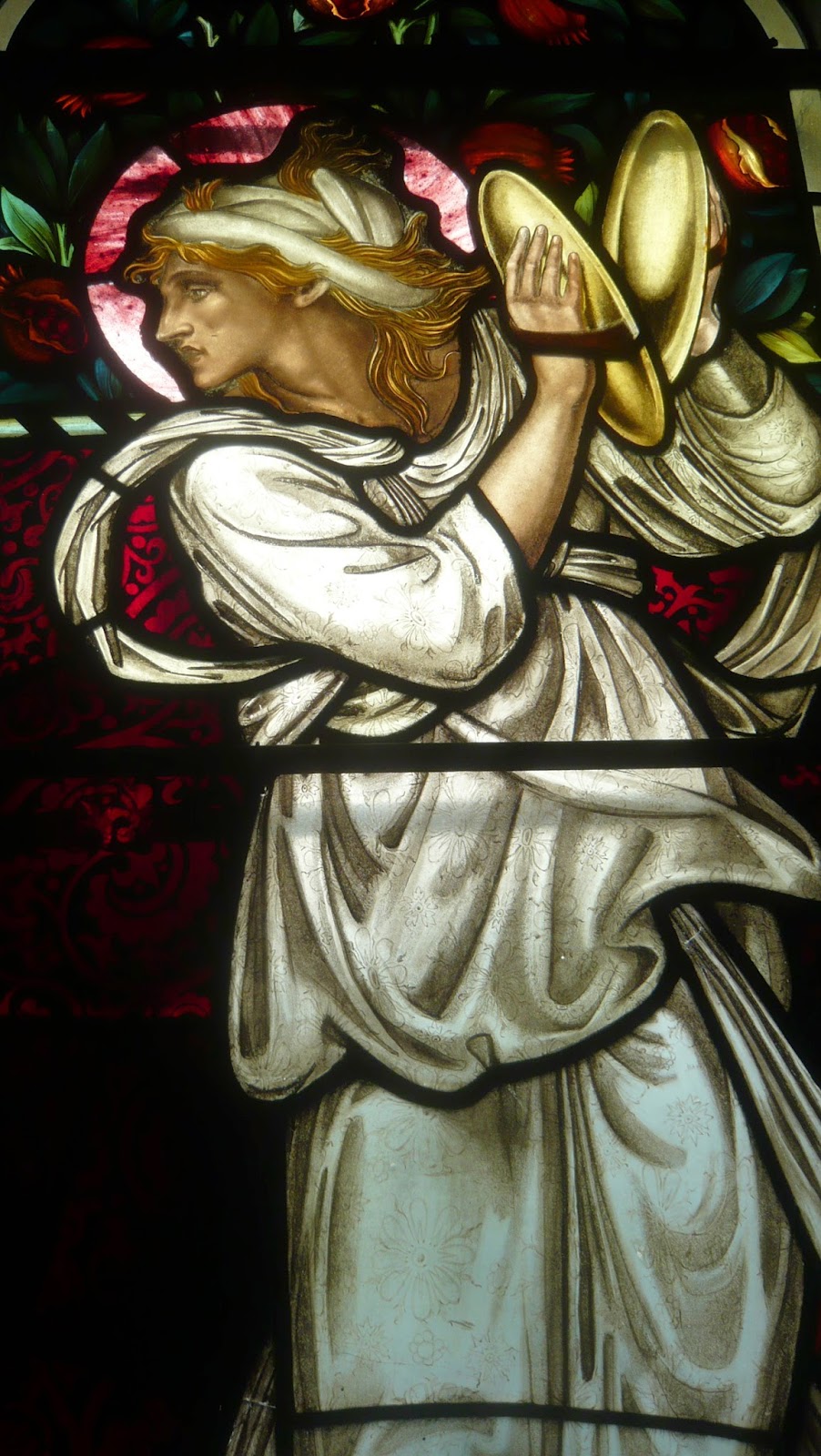
work, gilding work and ceramics. There is work from the studios of Fullers, Morris & Co., Whitefriars and
the Faith Craft Company, with designs from artists such as Sir Edward Burne-Jones,
J.H. Dearle, Evetts, Alfred Fisher, Jane
Quail, and Shelton.
The Church website documents the many commissions revealing the value of
memorial bequests for the commissioning of much Church Art. The first
stained-glass in St. Paul`s was the East Window of the Lady Chapel which was
made by the Fullers Studio (by which the work of Geoffrey Fuller Webb may be indicated). At the end of July 1944, this window was almost
completely destroyed by a flying bomb, leaving only the tracery (small upper
windows) intact. These show the Arms of Canterbury and Chelmsford, flanked by
St. Paul, the Patron of the church and St. Cedd the 7th century
missionary Bishop in Essex.
The original main lights of the window showed Our Lady and the Infant Christ,
flanked by Wise Men and Shepherds. The replacement, from 1957, is an entirely
new design depicting the same scene. The three lights now show Our Lady
and the Infant Christ with the kings and shepherds to left and right
respectively. The replacement window came from the Whitefriars Studio and
contains their mark, a White Friar, in the bottom right-hand corner, while the
artist has signed it off with his normal signature, the trilby he wore in his
workshop.
Like the Lady Chapel window the East Window was severely damaged in July 1944
by a flying bomb landing on the East side of the church: only one-seventh of
the original remained, (to judge by the insurance valuation before and after). The
original had been donated by Leonard Randall, a generous benefactor of St.
Paul`s, and had been dedicated on 15th September 1929. A design by
Sir Edward Burne-Jones was used for this window which was created and installed
twice by Morris & Co., firstly in 1929 and again in 1954.
As Morris & Co. note on their website (https://www.william-morris.co.uk/),
William Morris is regarded as the greatest designer and one of the most outstanding
figures of the Arts & Crafts Movement: ‘In 1861, with a group of
friends, he started the decorating business Morris, Marshall, Faulkner &
Co. which provided beautiful, hand-crafted products and furnishings for the
home. This was highly controversial at the time as it denounced the ‘progress’
of the machine age by rejecting unnecessary mechanical
intervention. Influenced by the ideas and writings of Thomas Carlyle and
John Ruskin, who sought to re-dress class inequality and improve society by reinstating
the
values of the past, Morris was motivated by the desire to provide affordable
‘art for all.’
Driven
by his boundless enthusiasm, the output of the company was prolific and
encompassed all the decorative arts. He is perhaps best known for his wallpaper
and fabric designs but he also designed and made embroideries, tapestries and
stained-glass, reviving many of the traditional arts which had been swept away
by industrialisation. Before he mastered each craft, he learnt every stage of
the hand making process and understood his materials thoroughly so that he
could get the best results and teach others.’
Burne-Jones became the chief designer of stained glass (creating over 100
drawings throughout his lifetime) and a separate area at Merton Abbey, where
Morris’ workshops were located from 1881 onwards, was allocated to his glass
workshops. Morris & Co. dominated British stained glass production during
the 1870s and 1880s.
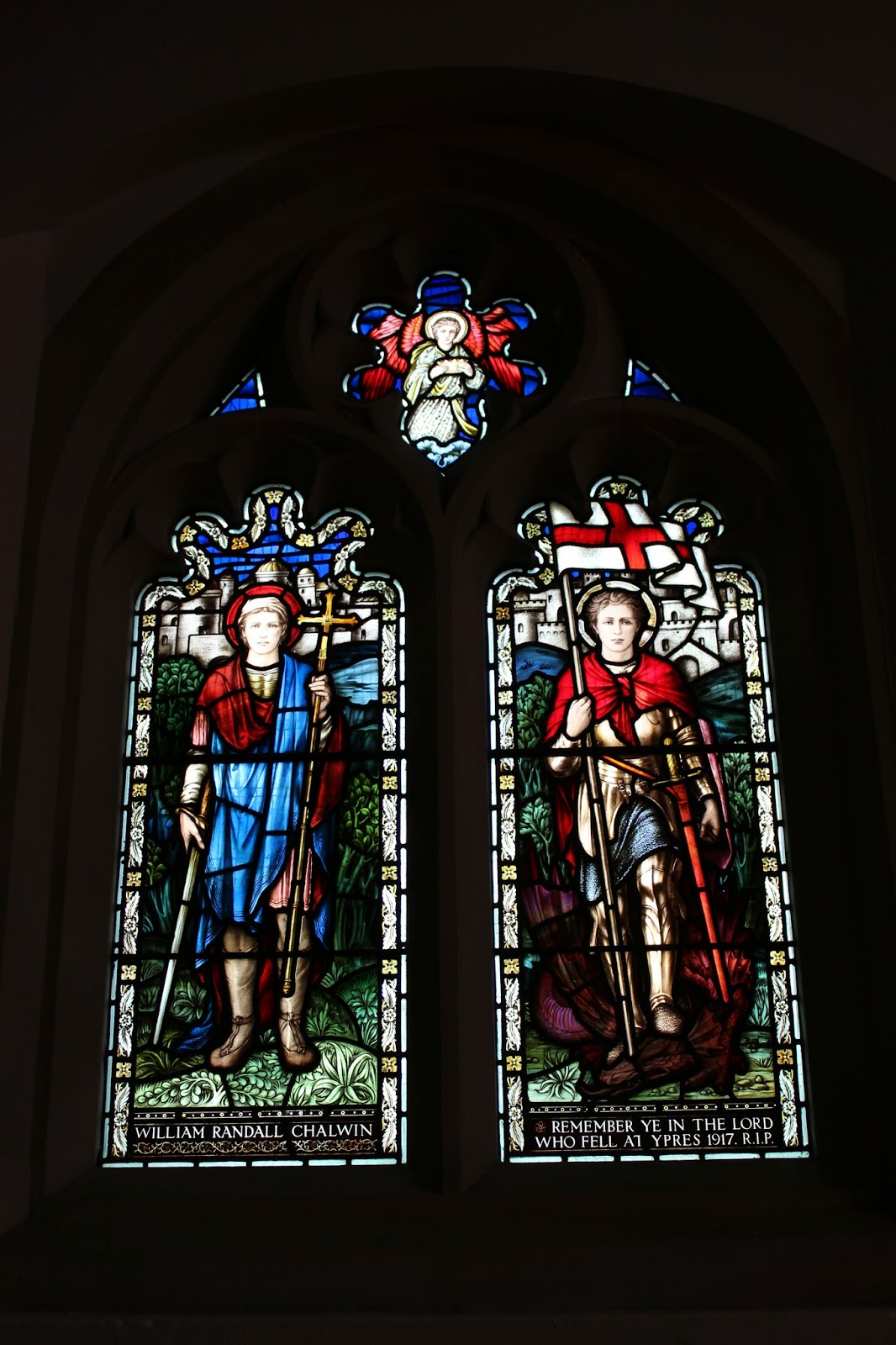
The St. Alban and St. George window was donated by Leonard Randall in 1929
in memory of his nephew killed in World War I, and had been installed at the
same time as the East Window. Also made by Morris & Co., this window was not
a 19th century Burne-Jones design but instead a contemporary design by J.H. Dearle,
who was then designing for the firm. Dearle also designed the figure of St.
Peter for another West end window installed in 1933, which was complemented by
a figure of St. Paul to a design by Burne-Jones.
In between these two smaller windows is the main West Window which was
made, like the previous ones, by Morris & Co (again from a design by
Burne-Jones) and was dedicated on 18th December 1932. Leonard Randall, the
donor of several earlier windows, died in 1932 leaving a large sum to St.
Paul`s, including £400 for a window in the new Baptistry, which had been built
into the West End of the church in 1929. The window depicts a well-known scene
from the Gospels, where women were bringing their children to Jesus and He was
blessing them. The text below (Luke 18.16) reads: ‘Suffer little children to
come unto Me.’
The last of the Morris & Co. windows in St. Paul`s depicts David and
Jonathan and was designed (in a rather different style from the others) by D.W.Dearle (not J. H.). This window cost £96.15s. in memory of Mr. A. E.
Godfrey, and was dedicated on 4th September 1949. Today it is the ‘odd-man-out’
in the Lady Chapel as the three surrounding windows all feature Our Lady and
the events of Christ`s birth. In 1949, however, it was the only stained-glass
in the Chapel, (apart from the tracery over the East Window); the rest being
added later.
The surrounding windows are the most recent at St Paul’s being created in 1975
and 1980 by the prolific stained glass artist, Leonard Evetts. On 1st June 1973
Walter Tolbart died leaving a substantial bequest to the Church. He had
expressed a wish that part of this money should be used for a proposed window
and approaches were made to various artists, as a result, in 1974. Finally, in
April 1975, the PCC approved a design by Leonard Evetts, depicting the
Annunciation; and the window was dedicated in memory of both Doreen and Walter
Tolbart on 30th November of that year.
In the left-hand light, the archangel Gabriel “is drawn to give the impression
that on wing he has silently entered the drama, barely touching the earth” to
quote the artist`s own account. Our Lady is depicted on the right; she wears
the traditional blue robe, which is decorated with a Madonna Lily. Gabriel`s
salutation is written across the centre in Latin: ‘Ave Maria, gratia plena,
Dominus tecum’ – Hail Mary, full of grace, the Lord is with thee.’ Gabriel went
on to say that Mary would conceive by the Holy Spirit, and the Spirit appears
in symbolic form represented by a Dove in the tracery, from where shafts of
light can be seen descending onto the figure of our Lady.
Then, when Miss Norah Sherren died on 17th March 1977 at the age of 82, she was
described as ‘the senior member of the congregation’, having been present at
the laying of the Foundation Stone of St. Paul`s. Miss Sherren left a
considerable sum to the Church, including £1,000 for a memorial window. This forms
a pair with the Annunciation Window: both being designed by Leonard Evetts, and
with the new window telling the next episode in the life of Our Lady.
Immediately after the Annunciation, Mary spent three months at the home of her
cousin Elizabeth, soon to be the mother of John the Baptist, and the two women
rejoiced together over the sons they were to bear; Mary`s words of celebration
included the ‘Magnificat’. This story, generally called the ‘Visitation’, took
place in the hill-country of Judea, which is represented by the rocky scenery
in the background of the window. Elizabeth is shown on the left, Mary on the
right – notice the blue robe and lilies once again. As with the Annunciation
Window, Evett’s signature is just visible: ‘L.C. Evetts fecit. 1980.’ The
window was installed and dedicated on the Feast of Christ the King, 26th
October 1980, and was the last stained glass window to be installed in St
Paul's to date.
Prior to the Evetts’ windows two other modern windows had been commissioned.
The Jesus the Carpenter Window was made by the Faith Craft Company, and was
installed in 1963. The Faith Craft Company was a studio set up through the
Society of the Faith, which grew from vestment manufacture to encompass various
aspects of church furniture such as joinery, stained glass and statues. The
Company was in operation from 1921 to 1972.
The centre section of the window shows Jesus in the carpenter`s shop at
Nazareth, surrounded by the tools of His trade. On the left, there is a roundel
depicting the Sower (the subject of our Lord`s famous parable); while a similar
roundel on the right shows St. Paul working as a tentmaker. This unusual
combination of images commemorates the longest-serving Churchwarden of St.
Paul`s, Foster Threadgold, who had died at the beginning of 1959, in his 29th year
of office. Well over 100 people contributed towards the memorial which was
located on the North side of the Church, as near as possible to the
churchwarden`s seat which he had occupied for so many years.
Finally, the St. Timothy Window comes from the Whitefriars Studio and the hand
of Alfred Fisher. The
Whitefriars Company was a successful British glasshouse closely associated with
leading architects and designers from the later portion of the 19th century
onwards including Philip
Webb who designed glass for Morris & Co.
This is a lovely bright window with vivid colours achieved by the use of
hand-made ‘Norman slab’ glass, which retains its lustre even in dull
conditions. The window shows Timothy as a youthful figure, staff in hand,
presumably engaged on some missionary journey. In the two small tracery lights
above, there are symbols of the activities for which Frank Hills, in whose
memory the window was given, is remembered: he was a member of the Choir for
some 40 years, which explains the page of music, and the words ‘O Sing unto the
Lord’; he was also at one point Churchwarden here and was also involved in the
Scout Movement – hence the Churchwarden`s staff and the Scout emblem. But the
words ‘Honour thy God’ have a double significance: as well as being appropriate
to Frank Hills’ life, they are also a play on the name ‘Timothy’, which is
derived from two Greek words meaning ‘honour’ and ‘God’.
Fr. Benjamin Rutt-Field, who oversaw the addition to St Paul's Goodmayes of a Madonna and Child by the contemporary Roman Catholic
sculptor Jane
Quail and Shelton’s Stations of the Crown of Thorns
has said that all too “often
people walk past churches and think it is just a plain building - they aren't
aware of the beauty inside.”
It was Fr Rutt-Field’s belief that “for Christian art to have any significance
and empathy it must be Spirit-driven, Spirit-imprinted; it should stimulate
both our imaginations and our prayers.” With this in mind, he wrote an original
set of meditations to accompany the new set of Stations of the Cross commissioned from
noted religious artist, Henry Shelton, through
commission4mission.
The seed for this commission was sown by an elderly parishioner who gifted a
generous sum for a new set of Stations and whose memory lives on in the
dedication of the tryptich, incorporating Stations XI, XII and XIII, which, as
altarpiece, forms the central focus of the scheme. This tryptich has
inventively incorporated an existing metal crucifix into its design to form
Station XII; 'Jesus dies on the cross'. There are 15 paintings in all, as the
scheme includes a resurrection 'Station' depicting Christ present in the
Eucharistic elements.
These, though, are not the only unusual elements of these Stations, in that, as
part of its semi-abstract imagery, Christ is depicted throughout only by the
Crown of Thorns. Fr. Rutt-Field notes that, “these Stations are known as the
‘Crown of Thorns’, rather than ‘The Cross’, because Jesus is depicted in each
one as a simple, humble crown of thorns.”
Shelton says of his semi-abstract style and minimal flowing lines, that, “as
I’ve got older I’ve learnt that ‘less is more’ and through the development of my
work I’ve learnt to express emotion in a semi-abstract form.” This is why he
paints; “it all goes back to feeling; the pathos of suffering.”
The power of art to evoke emotion is what originally inspired Shelton and which
has sustained his work throughout his career: “When I first saw the great Rembrandt’s in the Rijksmuseum in Amsterdam, the power of his
images seemed to transcend time. The same thing attracted me to Christian Art
as a choirboy at All Saints West Ham; the art spoke to
me. I used to look at the altar and see images that were just so powerful. The
images seemed to bring the past into the present and to form a profound link
with the lineage of the past. I see myself as an artist trying in my small way
to continue that lineage and my passion as a Christian artist is to keep that
lineage alive in my generation as a witness.”
However, as an artist who often paints with the tones and harmonies of the
Dutch Masters, this commission represents a considerable lightening of
Shelton’s palette in order that the colour scheme of these 'Stations'
harmonizes with the existing stained glass. At St Paul’s Goodmayes, Shelton's
'Stations' complement the existing works to create a feast of visual art for
worshipper and visitor alike.
The commission was only the second to be completed by commission4mission, of
which Shelton is both a founder member and the current Chairman. Shelton says,
of commission4mission, “I want us to be offering quality work and
craftsmanship, rather than mass-produced work, to continue the legacy of the
Church as a great commissioner of art. The Church has, in fact, commissioned
some of the greatest works of art ever produced.”
To have his work in churches, Shelton says, “really is the fulfilment of my
life’s work.” He doesn’t have much ambition to show in galleries and says that,
“the whole point for me is to create reaction and engage people; for people to
enjoy and be moved by my work, just as I’ve been engaged by the work of other
artists.”
His most recent pictures have all come to him in prayer as he has been
meditating on particular Bible passages. Most of his work now comes through a
meditational process and it is, perhaps, this quality of Shelton’s work to
which Fr. Rutt-Field is responding when he says: “I firmly believe that these new
Stations of the Crown of Thorns, painted by a deeply committed Christian
artist, are indeed both Spirit-driven and Spirit imprinted. They will greatly
enhance and beautify the simple form and architectural lines of our parish
church, as well as our worship.”
As St Paul’s Goodmayes is a neighbouring parish to my own, I have had the
opportunity to undertake ministry in partnership with Fr Rutt-Field and his
congregation which has often made significant use of art and the artworks at St
Paul’s Goodmayes. Art competitions and workshops have led to exhibitions timed
to feature as part of community festivals, while the local cluster of Anglican
churches created an Art Trail with a route for visiting each church in turn and
highlighting artworks of interest in the four churches. The creation of the Art
Trail was a recommendation in the report produced following a Community Street Audit of
Aldborough Road South by the Seven Kings & Newbury Park
Resident's Association and the Fitter for Walking project of Living Streets. Printing of the Art Trail leaflets was
funded by Living Streets as part of the Fitter for Walking project and copies
of the leaflets can now be found in the four churches. Fitter for Walking
helped residents create streets they can be proud of and was funded by the Big
Lottery Fund, along with contributions from local authorities, to work in five
areas of England.
Churches
have for many years been significant patrons of the visual arts and contain
important and interesting works of art. The local Anglican churches in
Aldborough Hatch, Goodmayes and Seven Kings are no exception with works of art
by excellent local and national artists from the 19th, 20th and 21st
centuries. The significant works of art in these churches, taken collectively,
represent a major contribution to the legacy of the church as an important
commissioner of art. The rich and diverse range of work found at St Paul’s Goodmayes
provides a demonstration of ways in which the visual arts enhance worship and
mission. The story of their commissions reveals the significance of memorial
donations and the journey that Church commissions made in the twentieth century
from the medievalism of the Arts & Crafts movement to the semi-abstract
styles of contemporary artists.
-----------------------------------------------------------------------------------------
Larry Norman - Country Church, Country People.




.jpg)