Wikio - Top Blogs - Religion and belief
Showing posts with label australia. Show all posts

Saturday, 13 November 2021

ArtWay - Sidney Nolan: Angel over Ely

My latest Visual Meditation for ArtWay focuses on 'Angel over Ely' by Sidney Nolan:

'Sidney Nolan was one of Australia's best-known artists from the 20th century, his reputation resting primarily on paintings of Australian landscapes and legends from Australian history, most famously Ned Kelly, the bushranger and outlaw. However, his work is also among the most diverse in modern art, with images in a wide variety of mediums as he worked quickly in series and regularly innovated in his use of materials.

Angel over Ely was painted using ink and enamel on glass and is one of over 130 such paintings Nolan produced between 1948 and 1951. Nolan painted this image after a visit to Ely Cathedral in England during the winter of 1950–51, while staying with his wife Cynthia’s sister in Cambridge. The image represents the moment when religious symbolism returned to his repertoire, inspired by the thought of angels over the cathedral and a subsequent trip to Italy. The subject of floating or flying angels then recurs constantly in his magnificent religious series of 1951/52 set against an Australian outback landscape.

Nolan wrote to fellow artist Albert Tucker in 1951 saying: "Our trip to Europe forced a few vigorous conclusions on me. The outstanding one being that the painters who moved me most (El Greco & Giotto) seemed men primarily of faith."'

For more on Sidney Nolan see my preview for Artlyst of Sidney Nolan: Colour of the Sky – Auschwitz Paintings and Sidney Nolan's Africa, my interview with Andrew Turley.

My visual meditations include work by María Inés Aguirre, Giampaolo Babetto, Marian Bohusz-Szyszko, Alexander de Cadenet, Christopher Clack, Marlene Dumas, Terry Ffyffe, Jake Flood, Antoni Gaudi, Nicola Green, Maciej Hoffman, Lakwena Maciver, S. Billie Mandle, Giacomo Manzù, Michael Pendry, Maurice Novarina, Regan O'Callaghan, Ana Maria Pacheco, John Piper, Nicola Ravenscroft, Albert Servaes, Henry Shelton, Anna Sikorska, Jan Toorop, Edmund de Waal and Sane Wadu.

My Church of the Month reports include: All Saints Parish Church, Tudeley, Aylesford Priory, Canterbury Cathedral, Chapel of St. Thérèse of the Child Jesus and the Holy Face, Hem, Chelmsford Cathedral, Churches in Little Walsingham, Coventry Cathedral, Église de Saint-Paul à Grange-Canal, Eton College Chapel, Lumen, Metz Cathedral, Notre Dame du Léman, Notre-Dame de Toute Grâce, Plateau d’Assy,Romont, Sint Martinuskerk Latem, St Aidan of Lindisfarne, St Alban Romford, St. Andrew Bobola Polish RC Church, St. Margaret’s Church, Ditchling, and Ditchling Museum of Art + Craft, St Mary the Virgin, Downe, St Michael and All Angels Berwick and St Paul Goodmayes, as well as earlier reports of visits to sites associated with Marian Bohusz-Szyszko, Marc Chagall, Jean Cocteau, Antoni Gaudi and Henri Matisse.

Blogs for ArtWay include: Congruity and controversy: exploring issues for contemporary commissions;
Photographing Religious Practice; Spirituality and/in Modern Art; and The Spirituality of the Artist-Clown.

Interviews for ArtWay include: Sophie Hacker and Peter Koenig. I also interviewed ArtWay founder Marleen Hengelaar Rookmaaker for Artlyst.

I have reviewed: Art and the Church: A Fractious Embrace, Kempe: The Life, Art and Legacy of Charles Eamer Kempe and Jazz, Blues, and Spirituals.

Other of my writings for ArtWay can be found here. My pieces for Church Times can be found here. Those for Artlyst are here and those for Art+Christianity are here. See also
Modern religious art: airbrushed from art history?

------------------------------------------------------------------------------------------------------------

Love - Orange Skies.

Sunday, 25 April 2021

Artlyst - George Gittoes: Equal parts artist and warrior

My latest article for Artlyst is a preview of 'George Gittoes: on being there' at Casula Powerhouse Arts Centre. Australian artist and documentary filmmaker, George Gittoes is an artist willing to create in the face of chaos and potential destruction:

'George Gittoes: on being there gives privileged access to his process through his personal visual diaries, field drawings, photography and film. Through these forms, we experience an amazing human journey that holds out the hopeful power of creativity in the face of prejudice and fear. This is a magnificent visual record of how Gittoes not only survives but creates in the face of forces that would seek to repress the human imagination.

Gittoes has learned that documenting frontline action is not enough; he wants to use art to bring about change. He wants, as Pattenden writes, ‘to pull us into these narratives and for us to consider what matters most when we talk about what life means and the nature of survival and human thriving.’'

My other pieces for Artlyst are:

Interviews -

Articles -
-----------------------------------------------------------------------------------------------------------

Bruce Cockburn - Call It Democracy.

Friday, 2 January 2015

A listening gaze: Paul Martin and Idris Murphy

Edgelands is an exhibition of new work by Paul Martin and Idris Murphy at The Warburton Gallery:

'Idris Murphy and Paul Martin, who exhibit together here for the first time, met in London at the age of 22; they met again in Perth, Western Australia at 65, a meeting which planted the seed for this show. The intervening years were spent painting and making, teaching and learning, seeking an understanding of the nature of nature and a sense of which what Martin has called“the gritty sacredness of places and things” ...

Paul Martin’s most recent exhibition was in part inspired by his reading of Rilke, who wrote that “in order for a Thing to speak to you, you must regard it for a certain time as the only one that exists, as the one and only phenomenon, which through your laborious and exclusive love is now placed at the centre of the universe”. Idris Murphy, in the introduction to his 2013 show Everywhen, quoted the words attributed to the 1st century churchman Ignatius of Antioch: “We each carry our own depth of silence, a human kind of silence, not found anywhere else…silence is a presence, a receptivity, a readiness, a waiting, a listening.” It is perhaps here that Murphy and Martin find their greatest point of convergence, in the understanding that the environmental challenges we face necessitate our developing this readiness and receptivity, this capacity for concentration, for laborious and exclusive love, this ability to regard nature with a steadiness of gaze that we might equate with the aesthetic gaze, and that this, ultimately, might be what constitutes the work of art.'

The works on show are complemented by a series of texts from leading Scottish and Australian writers reflecting on the ecological and environmental challenges we face across the world. This strand of the show is collated and introduced by the renowned novelist and short story writer Tim Winton.


'Here are two painters who’ve learnt to look at natural forms so keenly and humbly that theirs has become, each in their own way, and in separate hemispheres, a listening gaze. Their reverent attention seems to have left them open to the steady returning stare of a creation that groans in travail even as it feeds us. The world we see in their recent work has been transformed and illuminated through their loving attention and in turn, over the decades, as artists, they have clearly been changed.'

--------------------------------------------------------------------------------------

Midnight Oil - Dreamworld.

Saturday, 2 August 2014

Sabbatical art pilgrimage: Belsey Bridge Conference Centre's Norfolk Room


Via Beata way station


St Julian's Church, Norwich


'Stations of the Cross' by Irene Orgden at St Julian's Church 

'The Revelations of Divine Love of Julian of Norwich,' are a series of paintings by Alan Oldfield which were first exhibited in Oldfield's home city of Sydney before being shown at Norwich Cathedral in 1988 as part of the Norwich Festival of the Arts. These huge paintings made a sizeable impact with aged vergers heard commenting on how strange it was that such images of a mere Norwich girl should have come all the way from 'down under.'

Oldfield first became aware of Julian of Norwich through her phrase 'all manner of things shall be well' which is quoted in T.S. Eliot's 'Four Quartets'. Later he found 'Enfolded in Love', a book of extracts from her writings, on a church bookstall and decided to learn more about the medieval anchoress, the first woman to write a book in English, who lived beside St Julian's Church in King Street Norwich in the 14th century.

Oldfield spoke of these paintings as being his way of paying back what he had learned from Julian of Norwich. 'She is not a very visual mystic,' he said, 'but as she struggled to put her vision into words, so I have struggled to clarify in paint what I feel about her work.'

Struggle and passion are not, however, part of the way in which these paintings have often been viewed. Rosemary Crumlin criticises the series for lacking passion as a result of the careful staging utilised by Oldfield in his theological reflections on Mother Julian's visions. Peter Haynes writes of this more positively as 'conceptual resolution' deriving from Oldfield's 'sensitive understanding' of both source (the visions) and context (medieval art).

Oldfield described the strengths of realism as being 'draughtsmanship, line and closed composition, its success in allusiveness and anonymity.' Crumlin suggests that Oldfield's mature paintings, drawings and theatre designs carry out this brief and incorporate the insights of colour field and hard edge.' He 'often places a frame around a moment of time ... so that the picture space becomes like the theatre stage and the figures become like actors frozen in time and isolated often from each other.' His paintings often 'include explicit references to paintings and to painters he admires,' such as Piero della Francesca and Fra Angelico.

One of the series, 'A High and Spiritual Shewing of Christ's Mother according to Julian of Norwich' was joint winner of The Blake Prize in 1987. In this painting 'Julian pulls back the curtain to see the young Mary at the moment of her 'yes' to the archangel Gabriel's news that, although a virgin (symbolised by the vase of lilies), she is to become the Mother of God' (R. Crumlin, 'The Blake Book,' Macmillan, Melbourne, 2011).

The Blake Prize for Religious Art began in 1951 with an exhibition in Sydney and was 'the idea of Michael Scott, a Jesuit priest, and Richard Morley, a Jewish businessman, who saw in it a way of encouraging the Church to become patron of the arts and remedying what they considered the appalling state of the art in churches.' The Blake Committee 'looked to the European Sacred Art Renewal Movement centred in France for inspiration,' in particular to Notre-Dame deToute Grâce at Assy in the French Alps where, 'within the one building, priest, architect and modern artists had worked together in creative dialogue' (R. Crumlin, 'The Blake Book,' Macmillan, Melbourne, 2011).

Despite the fact that 'before 1940 there was little religious art in Australia' and that 'Churches in Australia rarely took the best artists seriously enough to commission their work,' as Margaret Manion has written, for a 'surprisingly large number of gifted Australian artists, the relationship between art and religion has continued to provide a creative challenge' (R. Crumlin, 'Images of Religion in Australian Art,' Bay Books, 1988). Roy de Maistre was probably the best known of these artists in the UK with commissions at Westminster Cathedral and St Aidan's East Acton, a major retrospective at the Whitechapel Gallery and his friendship with Francis Bacon. Arthur Boyd also spent time in the UK, during the Sixties and had his work championed by the art critic, Peter Fuller. In Australia itself artists such as John Coburn, Leonard French, Roger Kemp, Justin O'Brien and Eric Smith all created art which communicated religious feeling and intention.

Oldfield's work came to England primarily because of its content and then stayed when another in the series, 'The Revelations of Julian of Norwich' was purchased by the Friends of Julian of Norwich and hung in what was then the Chapel of St Gabriel's Retreat Centre at Ditchingham in Norfolk. Oldfield gave an additional work 'The Revelations of Divine Love' to the Friends of Julian and this now hangs in the Julian Centre which sits beside St Julian's Church where Julian had her cell. This image depicts the beautiful and lively child who, in one of Julian's shewings, sprang up from a foul and stinking body on the ground.

Realising that the series would be broken up, Oldfield created a film of the paintings with Sheila Upjohn (whose translation of Julian's writings Oldfield had read) reading selected extracts from Julian's shewings. Upjohn would later make a similar use of extracts from Julian in the booklet based on the 'Stations of the Cross' by Irene Ogden which can be found at St Julian's Church. 'Julian and the Scribe' found an ecclesiastical setting, at St Peter's Cremorne, while Oldfield and Earle Backen both created significant work (sometimes jointly)  for Christchurch St Laurence in Sydney where both worshipped and where Oldfield served as churchwarden.

The St Gabriel's Centre in Ditchingham has since become the Belsey Bridge Conference Centre but Oldfield's painting still hangs in the Norfolk Room, which now doubles as the chapel and a conference room. I first encountered this striking image while on a training course here and returned to it as part of my sabbatical art pilgrimage by taking an individual retreat at the Belsey Bridge Centre. On this occasion I shared the space with priests and laity from the Oratory of the Good Shepherd (OGS), who were also there on retreat. The OGS is an international community of Anglicans, ordained and lay, who share a common Rule of Life.

A new addition to the site was a Via Beata way station. These are part of a developing series of shelters running west to east across the UK from St David’s to Lowestoft, each of which contain a single piece of Christian art. The image at the Belsey Bridge Centre is of Christ and his two disciples on the Emmaus road.

The Chapel has survived several changes since its construction in 1960 when it was the chapel for a school run by nuns from the nearby All Hallows Convent. The community of Sisters took up residence in the 1850s and the All Hallows community flourished so that by the end of the 19th century they were running a hospital, an orphanage, a home for fallen women and the school. The complex of late 19th and early 20th century red brick gothic buildings survives, a maze of corridors connecting what were once separate buildings. Simon Nott writes, 'The chapel of the school was rebuilt in 1960 in memory of Herbert Palmer, Warden of the Community of All Hallows and Chaplain to the school. It is a large, light, airy building, absolutely typical of its date: ten years earlier and there would have been more of a sense of a shadowy past, and ten years later it would have responded to the reforms of Vatican II (despite being Anglican) by having an altar in the centre rather than at the east end'.
  
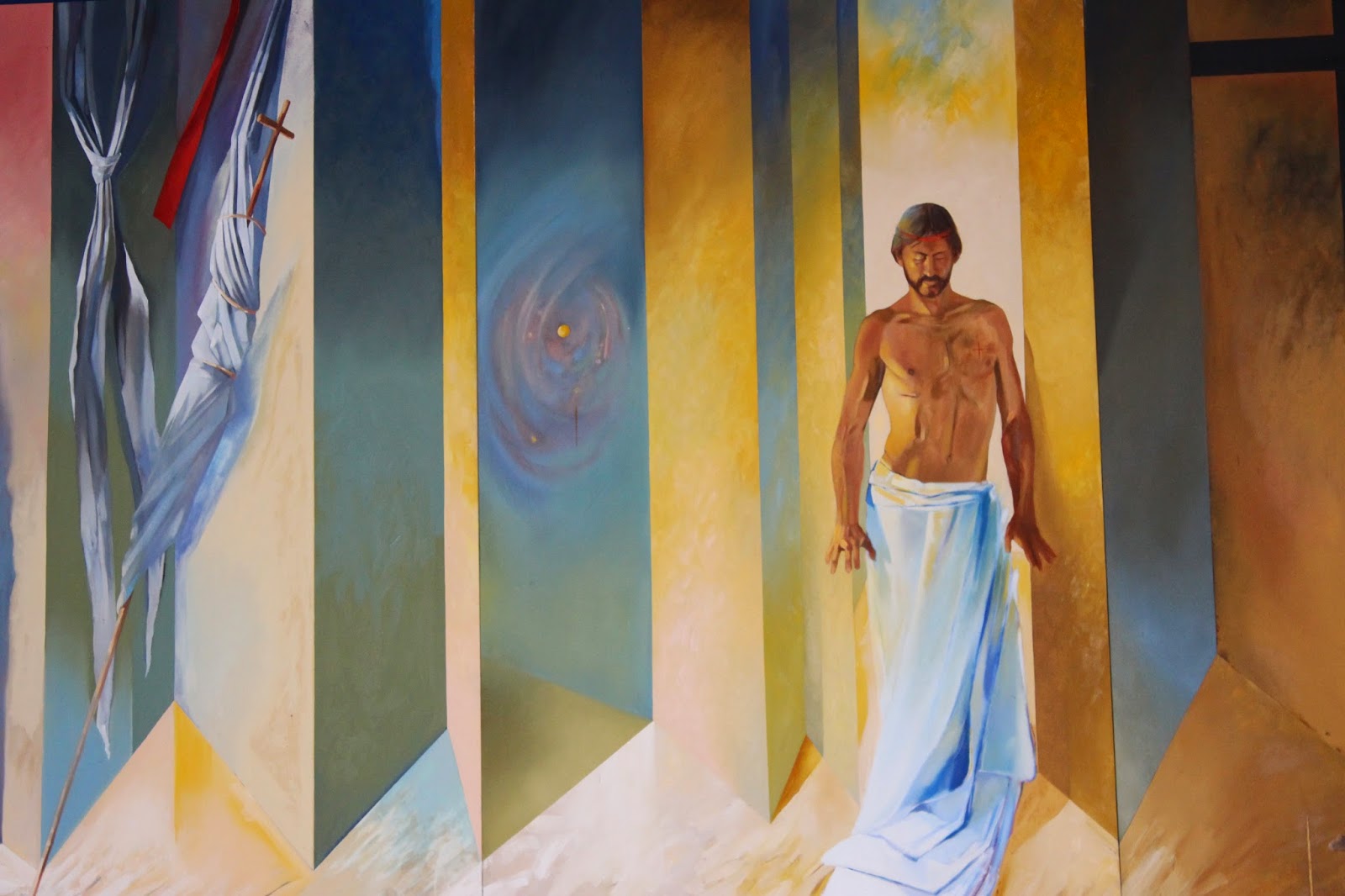
We enter the painting of 'The Revelations of Julian of Norwich' on the right in shadow; the shadow of Mother Julian on the wall of her cell. Constraining rectangles frame her for us, standing at her reading desk looking out into her field of vision. Red and white tiles circumscribe her cell-space, as sky-blue walls suggest the infinite breadth of her visions.

One painted panel contains her cell, a further three, her visions. 16 screens correspond to 16 showings set side-by-side like theatre sets; God's purposes played out on the stage of history. A tall, thin white candle levitates above the tiled floor illuminating Julian's cell; a 2D image at its apex, becoming 3D at its base. The first of several optical illusions; what we think we see never being all we see.

Julian looks back to her 16 showings and we follow her gaze to be taken back to the cross. Sombre shades and tones conceal a crown of thorns, an empty cross and barren land. Suffering indicated through absence and the shadow of death.

Beyond the cross, the resurrected Christ; his winding cloths now worn around his waist, spilling before him like the train of a bride rides behind. A red band rings him, a cross-shaped scar upon his breast, head bowed, palms held to bless those ministering and receiving at the altar below. Behind his head the stage-set of time opens revealing 'three heavens' of infinite eternity. Beyond him still the vision of the hazelnut painted planet-like in a galaxies' swirl; planet or nut, mass or pinprick, all will be well and all manner of thing be well - the resurrection initiates it!

So, finally, the cross wrapped in the winding sheets of the grave waiting for release, the sheets becoming the waved flag of victory at the return when the resurrection of all restores all to wellness and the vision of the hazelnut come to pass.


For now, vision extends beyond the painting beyond the showings, beyond ... where there is shadow, the shadow of God, revealing the limits of all our imaging. God is beyond the partial and incomplete images we construct. The shadow is God waiting in the wings for the moment of reunion when we shall see and know fully even as we are fully seen and known.

---------------------------------------------------------------------------------------------------

Sydney Carter and OHRWURM Folk Orchestra - Bells Of Norwich.

Monday, 11 November 2013

Australia at the RA

With 200 works by 146 artists, Australia is the most comprehensive survey of Australian art to have been mounted outside of Australia itself. The story told is one of cultural interaction between Australia’s indigenous peoples and its non-indigenous settlers. Sitting alongside this cultural story is the art historical story of the introduction and dominance of Modernism within Australian art.

The art of Australia’s indigenous peoples possesses an integrity and harmony with life and land which is initially absent from the figurative landscape-based art of the early white settlers. Aboriginal art is both made from the land and about the land. Shapes and symbols of the land are mapped on rocks, ground, bark, bodies and, in more recent years, canvas to enact and embody creation narratives and the balance which exists between the spiritual, natural and moral elements of the world.

While the indigenous peoples of Australia lived in the land and the land lived in them, the early white settlers brought with them an observational approach to landscape. Beginning with views of settlements and gradually expanding to depict the wilderness around them, the early settler artists established landscape as the dominant feature of Australian art. The variation and expanse of Australia’s land mass has provided endless opportunities to celebrate its terrain, vegetation, light and human settlements.

Within this has been a conflicted relationship with its indigenous peoples beginning with observational paintings of aboriginal settlements and rituals, through heroic dramatisations of settler activity which excluded on canvas, as in life, the indigenous peoples, and two-way influences (vis-à-vis Aboriginal artist Albert Namatjira mastering European styles while Margaret Preston, a supporter of Namatjira, adopted the palette, flat planes and aspects of mark marking of indigenous art), to contemporary commentaries on race relations which are intentionally provocative.

Modern art began in Australia with the plein-air Impressionism of Tom Roberts, Frederick McCubbin, Arthur Streeton and Charles Condor, among others. The work they produced adapted Impressionism to the particular light and terrain of Australia and artists began to talk of a specifically Australian tradition. The early Modernists emphasised colour and composition in cityscapes, with the newly constructed Sydney Harbour Bridge a particular focus, but the greatest period of Australian art to date featured the Expressionism of Arthur Boyd, Sidney Nolan and Albert Tucker. In their works, land, emotion and symbol coalesced by means of Modernism which, nevertheless, had parallels with Australia’s indigenous artists. In them, the land was speaking powerfully, albeit with strangeness and stress, once again.

Within both the cultural and art historical stories told within this exhibition are hints of another spirituality, the Christianity brought to Australia by the settlers. While the key catalyst for the recognition by the art world of Australia’s indigenous art is identified as being the work of Geoffrey Bardon, an art teacher at the local school in Papunya during the 1970s, Christian missions in Eastern Arnhem Land and Hermannsburg in the 1930s led to monumental panels of ancestors by Yolngu artists placed beside the altar of the local mission church together with the launch of the successful career of Albert Namatjira.
Roy de Maistre wrote that colour "constitutes … the spiritual speech of every living thing." Margaret Preston used The Expulsion to protest at the exclusion of Aborigines from their natural lands. Arthur Boyd set the casting out of the money changers from the Temple in Bendigo and Port Melbourne in his protest at materialism and greed. G.W. Bot’s Garden of Gethsemene, with its three slashes representing three crosses, was a response to the death of her daughter in 1999. These examples from the exhibition are symptomatic of a deeper, broader pool of Christian imagery and spirituality within Australian art which is not plumbed by this exhibition but includes work by Justin O’Brien, Leonard French, Eric Smith and Idris Murphy, among others, much of which has been stimulated by the Blake Prize for Religious Art. When explored alongside the spirituality of Aboriginal art, searching for meaning through this strand of Australian art and creativity can, as Sr. Rosemary Crumlin (author of Aboriginal Art and Spirituality and Images of Religion in Australian Art) has said, lead to the finding of deeper ways into our questions about life and meaning.

Similarly, as the RA’s own guide states, this exhibition "reflects the vastness of the land and the diversity of its people, exploring the implications of these realities - and mythologies - for national identity."

----------------------------------------------------------------------------------------------

Midnight Oil - One Country.

Saturday, 21 September 2013

Struggles to contend with the Australian landscape

Australia is "the first major survey of Australian art in the UK for 50 years, this exhibition spans more than 200 years from 1800 to the present day and seeks to uncover the fascinating social and cultural evolution of a nation through its art. Two hundred works including painting, drawing, photography, watercolours and multimedia will shed light on a period of rapid and intense change; from the impact of colonisation on an indigenous people, to the pioneering nation building of the 19th century through to the enterprising urbanisation of the last 100 years."

Anthony Gormley comments: "When I think of Sidney Nolan, Fred Williams or Arthur Boyd, I think of harsh earth and fierce sunlight. Through its new occupiers, somehow Australia produced modernist vigour ... There is a directness in the Indigenous traditions, whether the dots of the Western Desert or the colour field paintings of the Great Sandy Desert, where pigment is used to carry mineral truth as well as lived feeling."

Leading Australian contemporary landscape painter Idris Murphy has said:

"I’m not interested in negotiating my way around Indigenous painting. I think it is going to be a problem – can the Western tradition sustain a view of the world? I mean, Peter Fuller used to talk about this when he came to Australia very briefly; he saw in Fred Williams and Sidney Nolan the potential for the ‘last great hurrah’ of the Northern Romantic tradition and I think there’s a lot of truth in what he said. I think it’s going to be a problem – it’s not a problem for me – I’m just lapping it up! Of course I’m not Indigenous but I love the idea of this great wonderful European tradition, which I belong to, fusing with Indigenous art – happening right under my nose, in my lifetime! And I can see that as a whole new sort of language base for contemporary painting."

It will be interesting to see if this show gives any sense of this new sort of language base that Murphy sees in contemporary Australian art. By contrast Adrian Searle has suggested that the show is strong on Aboriginal art and full of classics – but loses its way in modern times:

"The show peters out in a parade of examples, a checklist of single works hung cheek by jowl with no real coherence. There is too much that feels secondary, or like retreads of flavour-of-the-month international fashions.
 
I am certainly no expert on Australian art, but even I can tell that, however enlightening parts of the earlier sections are, the show fails to give a sense of any of the more recent art except in a tokenistic way."
 
The Guardian does have a helpful timeline of Australian art, however: A history of Australian art – interactive timeline.
 
Back at the RA, author Tim Winton will explore his belief that ‘Australia the place is constantly overshadowed by Australia the national idea. Undoubtedly the nation and its projects have shaped my education and my prospects, but the degree to which geography, distance and weather have moulded my sensory palate, my imagination and expectations is substantial. Landscape has exerted a kind of force upon me that is every bit as geological as family.’

In today's Guardian, Winton selects Fred Williams's Yellow Landscape, 1968-9 as his favourite artwork from his homeland:

"he renders the scale and mystery of the physical world by tiny marks. The forms and figures are like scars in the hide of a beast too big to properly conceive of, let alone see entire. All these wens and divots are without pattern and yet they bring to mind calligraphy. These are the marks, the messy, chaotic texture that even the practised eye struggles to contend with in the Australian landscape. Whether you're seeing it from the air or at ground level, this is what your senses struggle with in the open country, such flat planes worked over with hieroglyphics born of fire, erosion, meteor showers, drought and epochal passages of time. Here humans might seem incidental."

--------------------------------------------------------------------------------------------

Midnight Oil - Dreamworld.

Friday, 11 January 2013

Mexico and Australia: Revolution and Land

I'm looking forward to two exhibitions at the Royal Academy in the Autumn. The first is Mexico: A Revolution in Art, 1910 – 1940, (The Sackler Wing of Galleries, 6 July – 29 September 2013) which "will examine the intense thirty year period of artistic creativity that took place in Mexico at the beginning of the twentieth century. The turmoil of the revolution between 1910 and 1920 ushered in a period of profound political change in which the arts were placed centre stage. Often referred to as a cultural renaissance, artists were employed by the Ministry of Public Education on ambitious public arts projects designed to promote the principles of the revolution.

The exhibition will explore this period both in terms of national and international artists. Work by
significant Mexican artists, such as Diego Rivera, José Clemente Orozco and David Alfaro Siqueiros,
will be placed alongside that of individuals who were affected by their experiences in Mexico. These
include Josef Albers, Edward Burra, Philip Guston, Marsden Hartley, Paul Strand, Henri Cartier-
Bresson, Henrietta Shore, Leon Underwood, Tina Modotti and Edward Weston. Mexico: A Revolution
in Art, 1910 – 1940 will reveal a dynamic and often turbulent cultural environment that included some
seminal figures of the twentieth century reflecting on their interaction with each other and their
differing responses to the same subject: Mexico."

The San Bernadino County Museum describes the Mexican Mural Movement as follows: "The Mexican Mural Movement began about 1913 when Mexican President Victoriano Huerta appointed Alfredo Martinez as director of the Escuela Nacional de Artes Plasticas. Gerardo Murillo (who called himself Dr. Alt) of Guadalajara painted the first modern mural in Mexico, and pioneered the idea that Mexican art should reflect Mexican life. After the revolution, the new government commissioned works of public art that supported and affirmed the values of the revolution and the Mexican identity: a broader knowledge of revolutionary history and the Mexican people’s pre-Columbian past.

Three muralists—“los tres grandes,” José Clemente Orozco, Diego Rivera, and David Alfaro Siqueiros—became the internationally-known leaders of the mural movement. All believed that art, the highest form of human expression, was a key force in social revolution. Together, they created the Labor Union of Technical Workers, Painters and Sculptors and devoted themselves to large-scale murals illustrating the history of Mexico, its people, its society, and the revolution. Their work was not always received positively. All spent some time in the United States creating works of art."

Rivera "did not represent religious images unless they were useful as social observations ... The most that he came close to portray religious messages was at the murals in Chapingo, where his images functioned as a catechism exhorting a new generation of Mexican farm workers and agricultural planners to uphold a modern nationally, constructive, self-respecting way of life, based on the credo "exploitation of the land, not of man."" Nevertheless, it has been noted that his Detroit Industry Murals "are rife with Christian themes and utopian symbolism."

Orozco "painted the theme, Cristo destruye su cruz, three times in his life, twice as murals — one of which still survives at Dartmouth College — and once on a 4’ x 3’ canvas." The image has been understood both as saying “It is finished!” to the violence that destroys and oppresses and as a denial of "the sacrificial destiny meant for him."

"Siqueiros painted some fifteen portraits of Christ ... on August 2, 1963, he inscribed the following quote from the most devout of Italian painters, Fra Angelico, in the back of his painting Cristo del Pueblo: "May only he who believes in Christ paint Christ." And in another occasion, during his imprisonment, he declared: "Was Jesus Christ not, like me, a victim of social dissolution, a persecuted man?" On August 9, 1963, from his cell at a crime prevention facility, Siqueiros inscribed the following words regarding the Via Crucis on the back of his painting, Mutilated Christ: "First, his enemies crucified him 2000 years ago. Then, they mutilated him from the Middle Ages on, and today, their new and true friends restore him under the political pressure of communism post-Ecumenical Council. This small work is dedicated to the latter."

The second exhibition is Australia (Main Galleries, 21 September – 8 December 2013), "the first survey of Australian art in the UK in over 50 years. The exhibition will reveal the development of Australian art through over 180 paintings, prints and drawings, watercolours, photographs and multimedia works, incorporating
settlers’ images of the land from the beginning of the nineteenth century to today, together with art by
Aboriginal Australians. The exhibition will consider the tensions both real and imagined between the
landscape as a source of production, enjoyment, relaxation and inspiration, and conversely as a
place loaded with mystery and danger.

The exhibition will include works by Aboriginal artists such as Albert Namatjira, Rover Thomas, Emily
Kame Kngwarreye and Fiona Foley. Nineteenth century European immigrants such as John Glover
and Eugene von Guerard will also feature, as well as the Australian Impressionists whose paintings
relied heavily on the mythology of the Australian bush: Arthur Streeton, Tom Roberts (a student of
the Royal Academy Schools), Charles Conder and Frederick McCubbin. Early Modernists such as
Margaret Preston, Grace Cossington Smith and Roy de Maistre will hang alongside the leading
twentieth century painters: Arthur Boyd, Rosalie Gascoigne, Fred Williams, Brett Whiteley and
Sidney Nolan RA, with the exhibition ending in the twenty-first century with internationally recognised
artists such as Shaun Gladwell, Bill Henson and Tracey Moffatt."

Margaret M. Manion has written that "for a surprisingly large number of gifted Australian artists, the relationship between art and religion has continued to provide a creative challenge." Robert Hughes suggested in The Art of Australia that Justin O'Brien "was the first Australian painter to concentrate on religious imagery" but that religious painting in Australia was "quickened" by Eric Smith and Leonard French. Rosemary Crumlin writes in Images of Religion in Australian Art that with "the founding of the Blake Prize for Religious Art in 1950, many artists turned to the Scriptures for subject matter in their paintings, some of them for the first time":

"Roy de Maistre, reconverted to Catholicism in London, worked often from the Bible and became associated with the Sacred Art Renewal Movement in England. In Melbourne, Russian immigrant Danila Vassilieff used religious subjects, often ironically, sometimes humourously and with zest. In Melbourne also, the Boyd family, always deeply religious, provided its younger generation, including Arthur Boyd and his brother-in-law John Perceval, with an easy familiarity with the Scriptures as texts of faith and guidance for living."

In The Blake Book: Art, religion and spirituality in Australia, Crumlin continues the story providing "a fascinating visual social history of Australia and an astute, well-documented history of The Blake Prize from 1951 - 2011. The book traces many significant changes in art and art movements, both within and beyond Australia. Through their work and words, the artists have room to speak of what has influenced them and found expression in their Blake entries. The influences they name range widely. Choices often surprise.
Among the winning artists presented in the book are Donald Friend, John Coburn, Stanislaus Rapotec, Roger Kemp, Ken Whisson, Maryanne Coutts, George Gittoes and Euan Macleod. Space is given to indigenous art and the many exhibited artists other than the winners."

-----------------------------------------------------------------------------------

Midnight Oil - My Country.

Saturday, 20 October 2012

Murphy, McCahon and Buber

"Idris Murphy’s extensive career as a painter has been widely lauded. Since 1988, Murphy has been Lecturer at UNSW’s College of Fine Arts, Sydney, and in 1994 received his Doctorate of Creative Arts from the University of Wollongong. Acknowledged as one of the most influential landscape painters in Australian contemporary art, his work is held in the public collections of the National Gallery of Australia, the National Library of Australia, Canberra and the Art Gallery of NSW. In 2009, following a New Zealand tour, a survey exhibition of Murphy’s work—I-Thou—was held at King Street Gallery on William and at the Hazelhurst Regional Gallery, Sydney."

Murphy said that "the things that enticed me originally to go to New Zealand: Colin McCahon, to see the land and to see what he has made of it, and from it, first hand. To somehow use it as a contrast to the desert country that I am most at home with."

John McDonald wrote: "This intense identification with the landscape can be felt everywhere in this survey. It is a relationship that comes naturally to Aboriginal artist but requires strenuous efforts on behalf of Westerners, who have to break with the pictorial habits of a lifetime. Whereas most non-indigenous artists tend to objectify the landscape, Murphy tries to fuse his own subjectivity with the mood and spirit of a place. The results are far from realistic but they are powerful and persuasive. This quest entails a leap of faith on behalf of the artist, a willingness to believe in a greater truth that lies beyond the veil of appearances. In trying to discern the atmosphere conjured up by these paintings, one might use the word “spiritual” with confidence and “mystical” with only slight embarrassment."

Murphy "titled the show I and Thou, after the small but influential book by the Jewish philosopher Martin Buber. It is a basic existentialist idea, that one only becomes “I” through understanding one’s existence in relation to an “Other”; but Buber extends this to the relationship between a human being and God, and even to his own relationship with a tree. It is the tree idea for which Murphy has a special affection. In the catalogue he quotes Buber’s words: “In considering the tree I become bound up in relation to it. The tree is no longer It.”

Murphy writes: "When looking back and considering the 'influences' on my work, several artists and writers come to mind; these may be more or less influential at any given time. There are though, certain connections that hold and seem to be continuing. Martin Buber has been one of these connections; often encountered in quotes by other writers. Buber's articulation of how we respond to the world has been seminal to my way of seeing and therefore how I 'see' my paintings. The Martin Buber connection (exemplified by McMahon's Painting I-Thou) added to my interest in the work of Colin McMahon; in particular the way in which he depicted land ... As the difference between the truth of a painting and the truth about a painting are significant. Buber's writings have for me been a way of continuing my assessment of western paradigms in painting and have added to my encounter with indigenous art."

I and Thou "is one of McCahon’s earliest ‘word’ paintings, in which words are presented as the main imagery. The words have a physical presence, appearing as three dimensional, solid forms in space, while still maintaining their linguistic function. The fracturing of the picture surface and the spatial ambiguities of the image clearly indicates the artist’s familiarity with Cubist notions of constructing space. The presentation of the words also resembles the handiwork of signwriters, whose craft had interested McCahon since youth."


"In the first ‘word paintings’ by McCahon each image is constructed in a manner best described as ‘architectural’. To compose the paintings I Am ... and I and Thou ... McCahon has rendered each phrase in block letters, achieving pictorial illusion through the restriction of colour and the placement of the words on (or in) an ambiguous background. Dating from February 1954, both images are notable for their strong vertical, linear structure.

The source for each title is clear. ‘I and Thou’ is the title of a book by the theologian Martin Buber. ‘I am’, which McCahon re-employs in several guises in later works, is drawn from Exodus 3:4–6:

‘Then Moses said to God, “if I go to the Israelites and tell them that the God of their forefathers has sent me to them, and they ask me his name, what shall I say?” God answered “I AM that is who I am. Tell them I AM has sent you to them.”’

Of course in McCahon’s painting of this name, an ambiguity is present. For while the ‘I’ in ‘I AM’ is the God of the Old Testament, it is also possible to read it as a statement of affirmation by McCahon, who with these words reasserts himself as an artist.

In respect of the work I and Thou 1954, critic Francis Pound has a further suggestion – that the ‘I’ is floating around in Cubist space because everything is still unclear: a New Zealand culture has not yet been formed. The ‘I’ moves around in time and space.!"


----------------------------------------------------------------------------------

I And Thou - Go or Go Ahead.

Saturday, 5 November 2011

Beyond 'Airbrushed from Art History' (8)

The Pilgrim Project features artists across different practices – art, music, writing, poetry, film, cultural groups and more – that bring back storytelling. It is a network of artists concerned with the expression of the search for the sacred and engagement of the human experience and builds connections across different audiences and demographics.
Michael Galovic engages himself in a few parallel directions: traditional icons, contemporary religious and non religious art. He keeps revisiting the theme he graduated with: The Flight and Fall of Icarus as well as the Crucifixion theme, but has been particularly focused lately on building a body of work on Uluru, the sacred Rock in the Northern Teritory of Australia. He says, ‘I am attracted to the powerful imagery in general. [It is] the highest possible drama of mankind ever seen and experienced… It talked to me. It resonated with me on that level immediately before I embraced any kind of faith.’

Patricia Varney adopts Christian themes in her works and utilises them in the contemporary practice of painting. Her focus is best identified by a layering of symbolism through the mystery of Christian paradoxes: the meeting of heaven and earth (divine geometry), the Annunciation (the possibility of Christ becoming man) and the illustrative expressions of what it means to ‘see’.

Eleni Antoniou Holloway is heavily influenced by the material she uses – clay is not only a process of making, but is the conceptual foundation for her work. She explores the work of clay through its historical function and through the personal narratives, metaphors and Christian symbolism of the ancient material: creation, the desire to create, the imprint of the maker, transformational processes and the pouring and containment of meaning.

Kristone Capistrano’s art practice is driven by an ongoing fascination with the person – moving beyond a story into connecting with the very essence of personhood. Working within the traditions of portraiture, he moves towards a questioning of presence and how it continues to linger, despite the departure of the person. His work functions in capturing, (re)presenting and (re)constructing the (corpo)real presence the composition of his work.

The Mandorla Art Award is a thematic religious art prize, attracting some of Australia’s finest artists since its 1985 inception. This achievement represents the dream of a small group of committed Christians, who call themselves “The Mandorla Centre of Inner Peace”. They were concerned by the overwhelmingly secular nature of contemporary art and so set about reviving an interest in and patronage of religious art. The Mandorla Art Award employs a thematic spiritual inspiration that changes with each exhibition. These inspirations are defined by quotations from the Bible and all participating artists are requested to interpret these in their own way.

The root of Art is compassion. At times we may forget beauty and neglect the dignity of each other’s story. The expression of our lives brings us into direct conversation with each other: it gives us the opportunity to stop and learn from and about one another and see ourselves in another’s eyes. These stories allow us to enter into our humanity and help us realise that we are not alone, but travel alongside each other in a pilgrimage that calls for transformation.

----------------------------------------------------------------------------------------

Eli Moore - What Good Am I?