Wikio - Top Blogs - Religion and belief
Showing posts with label paying attention. Show all posts

Friday, 5 April 2024

Church Times - Book review: The Spiritual Adventure of Henri Matisse: Vence’s Chapel of the Rosary by Charles Miller

My latest book review for Church Times is on The Spiritual Adventure of Henri Matisse: Vence’s Chapel of the Rosary by Charles Miller:

'the author explores the deep overlap between the attrait (attention) that artists pay to their subject and the attrait in contemplative prayer. For Matisse, such attention involved intuition and intellect, contemplation and communion, light and glory, combined with a monk-like detachment.'

For more on Matisse's Chapel, click here for an ArtWay article I wrote following my visit in 2012.

Other of my pieces for Church Times can be found here. My writing for ArtWay can be found here. My pieces for Artlyst are here, those for Seen & Unseen are here, and those for Art+Christianity are here.

-------------------------------------------------------------------------------------------------

T Bone Burnett - Waiting For You (Visualizer) ft. Lucius

Sunday, 1 October 2023

Paying attention: Consider the lilies

Here's the sermon that I shared at St Mary’s Runwell this morning for their Harvest Festival:

In our reading today we heard Jesus tell us that we should look at the flowers of the field. Stop and notice. In his painting called Consider the Lilies, Stanley Spencer depicts Jesus as mountainous in comparison with the daisies (not lilies) that he contemplates. Archbishop Stephen Cottrell has noted that this Jesus is playful, "huge and humble", godlike. Mark Oakley writes that ‘Whereas lilies call for attention, in church or posh hallways, daisies are overlooked, or considered problematic in our neat lawns. Jesus relishes their beauty, and, at the same time, challenges the sad fact about human beings that "when it comes to the present moment, we're not present".’ 

Cottrell then cleverly refers us to the words of Nadine Stair: ‘If I had my life to live over . . . I'd relax, I would limber up. I would be sillier than I have been. . . I would do more walking and looking. . . I would pick more daisies.’

Simon Small writes that we find it difficult to do this because: ‘Our minds find paying full attention to now very difficult. This is because our minds live in time. Our thoughts are preoccupied with past and future, and the present moment is missed.’ But, he says: ‘To pay profound attention to reality is prayer, because to enter the depths of this moment is to encounter God. There is always only now. It is the only place that God can be found.’

This is very much what Jesus seems to be saying to us through his teaching on worry and anxiety as found in today’s Gospel reading (Matthew 6. 24 -34). When we are preoccupied with what might happen in the future, we are not living fully in the present and may well misunderstand or misinterpret what is actually going on. Jesus encourages us to live fully in the present because, as Simon Small says, that is where we encounter God.

When we genuinely encounter God in the here and now, we know that his love and forgiveness surround us and that his Spirit fills us. As Jesus prayed in John 17, he is in us and we are in him. When we know this in our hearts in the here and now, we can relax because whatever happens to us, we are accepted, forgiven, loved and gifted by the God who created all things and who will bring all things to their rightful end. We are held in the palm of his hands and, therefore, as Julian of Norwich put it, “all shall be well, and all shall be well, and all manner of thing shall be well”.

Jesus says that the more we live in the present and the more we encounter God’s love in the here and now, the less we will be anxious or worried. Prayer is able to help us do both things and therefore helps us to reduce our sense of anxiety or worry. Not because we have listed all our worries to God and believe that he will solve them all for us, but instead because, through prayer, we encounter more of God’s love and, as a result, trust that he will be with us whatever comes our way.

Harvest provides a wonderful opportunity for us to do this in relation to the natural world around us including the birds of the air and the lilies of the field. Harvest provides an ‘opportunity to reflect and give thanks for all the good things in our lives, especially the way in which the earth produces food for us to eat, to give thanks for all those who work to produce food and drink for us to enjoy, to say sorry for the times we are not grateful, that we don’t notice God’s work in the world, that we don’t look after the things God has given us.’ ‘We live in a different time from our ancestors where the harvest and bringing the harvest in would have dominated everyone’s lives’ but today we probably hardly notice it. What we can do, however, is pay attention to what is around us, whether in our gardens and parks or in our homes and town.

Pope Francis has written on the connection between care for our common home and paying attention in his encyclical Laudato Si. There, he wrote: ‘Those who enjoy more and live better each moment are those who have given up dipping here and there, always on the look-out for what they do not have. They experience what it means to appreciate each person and each thing, learning familiarity with the simplest things and how to enjoy them. So they are able to shed their unsatisfied needs, reducing their obsessiveness and weariness. Even living on little they can live a lot, above all when they cultivate other pleasures and find satisfaction in fraternal encounters, in service, in developing their gifts, in music and art, in contact with nature and in prayer.’ (Laudato Si 223)

He continues, saying, ‘No one can cultivate a sober and satisfying life without being at peace with him or herself…. Inner peace is closely related to care for ecology and for the common good because, lived out authentically, it is reflected in a balanced lifestyle together with a capacity for wonder which takes us to a deeper understanding of life. Nature is filled with words of love, but how can we listen to them amid constant noise, interminable and nerve-wracking distractions, or the cult of appearances.’ (Laudato Si 225)

He concludes, drawing on today’s Gospel reading, that: ‘We are speaking of an attitude of heart, one which approaches life with serene attentiveness, which is capable of being fully present to someone…which accepts each moment as a gift from God to be lived to the full. Jesus taught us this attitude when he invited us to contemplate the lilies of the field and the birds of the air…. He was completely present to everyone and to everything and in this way he showed us the way to overcome that unhealthy anxiety which makes us superficial, aggressive and compulsive consumers.’ (Laudato Si 226)

Pope Francis quotes Patriarch Bartholomew as saying that we should look for solutions to the climate emergency in a change of humanity: ‘He asks us to replace consumption with sacrifice, greed with generosity, wastefulness with a spirit of sharing, an asceticism which “entails learning to give, and not simply to give up. It is a way of loving, of moving gradually away from what I want to what God’s world needs. It is liberation from fear, greed and compulsion”. Bartholomew says that, ‘As Christians, we are also called “to accept the world as a sacrament of communion, as a way of sharing with God and our neighbours on a global scale. It is our humble conviction that the divine and the human meet in the slightest detail in the seamless garment of God’s creation, in the last speck of dust of our planet”.’ 

Such an attitude begins with our looking closely, attentively, at the world around us as Jesus encourages us to do in today’s Gospel reading and as Stanley Spencer shows him doing in ‘Consider the Lilies’. This Harvest, may we increasingly do the same.


------------------------------------------------------------------------------------------------------------

Barclay James Harvest - Hymn.

Saturday, 29 July 2023

ArtWay Visual Meditation - Gwen John: The Nun

My latest Visual Meditation for ArtWay is on the work of Gwen John, which can currently be seen at Pallant House in the exhibition Gwen John: Art and Life in London and Paris:

"The wisdom of quietude and purity which derives from paying prayerful attention is what we find expressed throughout John’s work and is the great gift that she offers to us."

My preview of Gwen John: Art and Life in London and Paris for Artlyst can be found here and my review of Reunited: Gwen John, Mere Poussepin and the Catholic Church for Art+Christianity can be found here. See also 20th Century Women Artists Challenging Conventions In Britain here.

My visual meditations for ArtWay include work by María Inés Aguirre, Giampaolo Babetto, Marian Bohusz-Szyszko, Alexander de Cadenet, Christopher Clack, Marlene Dumas, Terry Ffyffe, Jake Flood, Antoni Gaudi, Nicola Green, Maciej Hoffman, Lakwena Maciver, S. Billie Mandle, Giacomo Manzù, Sidney Nolan, Michael Pendry, Maurice Novarina, Regan O'Callaghan, Ana Maria Pacheco, John Piper, Nicola Ravenscroft, Albert Servaes, Henry Shelton, Anna Sikorska, Alan Stewart, Jan Toorop, Andrew Vessey, Edmund de Waal and Sane Wadu.

My Church of the Month reports include: All Saints Parish Church, Tudeley, Aylesford Priory, Canterbury Cathedral, Chapel of St. Thérèse of the Child Jesus and the Holy Face, Hem, Chelmsford Cathedral, Churches in Little Walsingham, Coventry Cathedral, Église de Saint-Paul à Grange-Canal, Eton College Chapel, Lumen, Metz Cathedral, Notre Dame du Léman, Notre-Dame de Toute Grâce, Plateau d’Assy,Romont, Sint Martinuskerk Latem, St Aidan of Lindisfarne, St Alban Romford, St. Andrew Bobola Polish RC Church, St. Margaret’s Church, Ditchling, and Ditchling Museum of Art + Craft, St Mary the Virgin, Downe, St Michael and All Angels Berwick and St Paul Goodmayes, as well as earlier reports of visits to sites associated with Marian Bohusz-Szyszko, Marc Chagall, Jean Cocteau, Antoni Gaudi and Henri Matisse.

Blogs for ArtWay include: Congruity and controversy: exploring issues for contemporary commissions; Ervin Bossanyi: A vision for unity and harmony; Georges Rouault and André Girard: Crucifixion and Resurrection, Penitence and Life Anew; Photographing Religious Practice; Spirituality and/in Modern Art; and The Spirituality of the Artist-Clown.

Interviews for ArtWay include: Sophie Hacker, Peter Koenig and Belinda Scarlett. I also interviewed ArtWay founder Marleen Hengelaar Rookmaaker for Artlyst.

I have reviewed: Art and the Church: A Fractious Embrace, Kempe: The Life, Art and Legacy of Charles Eamer Kempe and Jazz, Blues, and Spirituals.

Other of my writings for ArtWay can be found here. My pieces for Church Times can be found here. Those for Artlyst are here and those for Art+Christianity are here.

------------------------------------------------------------------------------------------------------------

Sinead O'Connor - Take Me To Church.

Sunday, 9 July 2023

Come as a child

Here is the reflection I shared in today's Eucharist at St Andrew's Wickford:

The poem called ‘Song of Childhood’ by Peter Handke which features in the film Wings of Desire captures, for me, something of the openness of childhood when the world lies open before us and we encounter it without cynicism or prior knowledge. The big questions of life are in front of us but we have yet found answers or the pretence that we can know all the answers.

In the poem the child has retained that openness to life and existence as she or he has grown but in our gospel reading (Matthew 11. 25-30) today we hear of people who have not. When Jesus speaks about the wise and the intelligent, he is speaking of those who think they already have knowledge of what God wants. They are those who cannot receive the new thing that God wants to give because they think they already know all there is to know. As a result, they are closed off to what God wants to share.

Jesus says that those able to receive are like children. They are not worldly wise or information wise and, as a result, they are open to what is new and what is revealed. This is how we need to be if we are to receive what God has revealed to us in Jesus.

Tom Wright says this: “Jesus had come to know his father the way a son does: not by studying books about him, but by living in his presence, listening for his voice, and learning from him as an apprentice does from a master, by watching and imitating. And he was now discovering that the wise and learned were getting nowhere, and that the ‘little people’ – the poor, the sinners, the tax collectors, ordinary folk – were discovering more of God, simply by following him, Jesus, than the learned specialists who declared that what he was doing didn’t fit with their complicated theories.”

Sister Corita Kent has described the way in which children look and learn:

“Ask [a] child to come from the front of the house to the back and closely observe her small journey. It will be full of pauses, circling, touching and picking up in order to smell, shake, taste, rub, and scrape. The child’s eyes won’t leave the ground, and every piece of paper, every scrap, every object along the path will be a new discovery.

It does not matter that his is all familiar territory – the same house, the same rug and chair. To the child, the journey of this particular day, with its special light and sound, has never been made before. So the child treats the situation with the open curiosity and attention that it deserves.

The child is quite right.”

Sister Corita went on to argue that through practice adults can learn once again to see as children do. She suggested that the kind slow looking practised by children, like prayer and art, enables us to view life without being distracted and allows us to put all our attention on a special area for a time. When we slow ourselves and focus our attention in this way we begin to receive what the world around has to show us; we notice things that others don’t and come to see that ordinary things are wondrous. The art historian John Ruskin claimed that the power of seeing in this way is ‘the teaching of all things,’ and that ‘To see clearly is poetry, prophecy, and religion – all in one.’

This is a form of prayer taking us to a place and space full of delight and wonder; prayer, poetry and prophecy. Children naturally see this through the attention that they pay to the world around them, until we, as adults, teach them otherwise. Like the poet Thomas Traherne, we need to unlearn the dirty devices of this world in order to become, as it were, a little child again that we may enter into the Kingdom of God.

Unless you come,
come as a child,
not grasping but trusting,
not arrogantly but humbly,
not resisting but accepting,
not feebly but vigorously,
not giving but receiving,
not self-centred but God-centred,
not teaching but feeding,
not gaining life but losing life,
not leaving but returning,
not closed, but open.

Unless you come,
come as a child,
you cannot enter
the kingdom of God.

--------------------------------------------------------------------------------------------------

Van Morrison - Song Of Being A Child.

Friday, 16 September 2022

Praying through the week


On Wednesday we held our first Quiet Day in the 'thin space' of St Mary's Runwell.

We explored how to hear from and encounter God in the ordinary, everyday things, people, situations and emotions around us, by having an ongoing conversation with God in which we pray through our emotions and our everyday encounters. We used prayers from David Adam, Ruth Burgess, the Carmina Gadelica, and Martin Wallace, poems by George Herbert and Gerard Manley Hopkins, and music from Bill Fay and Victoria Williams. There were also prayers exercises based on the Psalms and everyday activities, plus a meditation using a range of everyday objects.

Additionally, those attending made use of a new leaflet providing a reflective tour of the art and architecture at St Mary's Runwell. St Mary's is a magnificent mediaeval building which boasts an interesting and mixed history. The church is often described by both visitors and regular worshippers as a powerful sacred space to which they have been drawn. This powerful impact comes in part from the art and architecture in the space. The leaflet provides information about that aspect of the building and suggests reflections and prayers as the building and its artworks are viewed.

The next Quiet Day at St Mary's will be on 11 March 2023. Look out for publicity nearer the time.

----------------------------------------------------------------------------------------------------------

Monday, 29 August 2022

Consenting Attention: Simone Weil's Prayer and the Poetry of Denise Levertov

For more on poets, attention and prayer (see my post Poets paying attention to prayer) see also the following:

A Poetics of Consenting Attention: Simone Weil's Prayer and the Poetry of Denise Levertov
Katy Wright-Bushman

Abstract: This article examines the practice of attention as a subject of Denise Levertov's poetry, one that emerges fully only after her commitment to Christianity and its convictions of immanent, incarnate transcendence. Simone Weil fluidly and precisely describes this practice and the receptive consent to the subject that accompanies it in her response to stark contemporary circumstances earlier in the century. I explore Levertov's exemplification of this practice in Weil's terms, arguing that Levertov's hesitant and late-arriving Catholicism, like Weil's own devotional experience, underwrites the responsorial practice of attention. It operates for Levertov as both a poetic method and as a response to contemporary questions of poetics and language, producing a poetics that privileges the possibility of knowing as love and speaking as prayer.

and

Poetry, Attentiveness and Prayer: One Poet's Lesson
Ed Block

Abstract: In The Grain of Wheat, Hans Urs von Balthasar quotes St. Basil on the intent contemplation of God's works. In Letters to Malcolm, C. S. Lewis speaks of making “every pleasure into a channel of adoration”, by praising “these pure and spontaneous pleasures” as “‘patches of Godlight’ in the woods of our experience.” According to Iris Murdoch, such attentiveness requires a degree of “selflessness” that resembles aesthetic contemplation and— it may be inferred — prayerful reflection. Using these passages and others by Kathleen Norris and Simone Weil, this essay offers related perspectives on the process and the effects of attentiveness, in poetry and prayer. Poets practise, and thereby teach an attentiveness that is analogous to that achieved in certain forms of prayer. Prayer, like poetry, gives thanks for the mysteries — even as it seeks to understand and respond to the injustices and sufferings — of life. Denise Levertov illustrates in her poetry an awareness of how such attentiveness can be productive, in her late religious poems especially.

These themes are also explored in ""passionate reverence / active love": Levertov and Weil in the Communion of Struggle" by Cynthia R. Wallace "in this need to dance/this need to kneel: Denise Levertov and the Poetics of Faith", edited by Michael P. Murphy and Melissa Bradshaw. Wipf and Stock, 2019.

That Denise Levertov (1923-97) was one of the most pioneering and skilled poets of her generation is beyond dispute. Her masterly use of language, innovative experimentations with organic form, and the political acuity disclosed by her activist poetry are well marked by critical communities. But it is also quite clear that the poems Levertov wrote in the last twenty years of her life, with their more explicit focus on theological themes and subjects, are among the best poems written on religious experience of any century, let alone the twentieth. The collection of essays gathered here shed vital light on this neglected aspect of Levertov studies so as to expand and enrich the scope of critical engagement. In a mixture of theoretical considerations and close readings, these essays provide valuable reflections about the complex relationship between poetry and belief and offer philosophically robust insights into different styles of poetic imagination. The abiding hope is to broaden the terrain for discussions in twenty-first-century theology, literary theory, poetics, and aesthetics--honoring immanence, exploring transcendence, and dwelling with integrity within the spaces between.

------------------------------------------------------------------------------------------------------

Bill Fay - City Of Dreams.

Sunday, 7 August 2022

Poets paying attention to prayer

I've written a lot on the theme of paying attention equating to prayer. See, for example, my series of posts entitled 'Seeing is Receiving: The art of contemplation' or my talk on 'Paying attention through art.'

I've recently come across W.H. Auden and David Miller saying essentially the same things:

W. H. Auden once said: “Choice of attention—to pay attention to this and ignore that—is to the inner life what choice of action is to the outer.”

He also said, "I think what is important is to teach ... the technique of prayer. That is, the technique of paying attention and of forgetting oneself ..."

"To pray is to pay attention to something or someone other than oneself. Whenever a man so concentrates his attention - on a landscape, a poem, a geometrical problem, an idol, or the True God ..."

David Miller expands on this in the notes of his Introduction to 'The Alchemist's Mind':

'“Attentiveness is the rarest and purest form of generosity” (Simone Weil, quoted in Jacques Cabaud, Simone Weil: A Fellowship in Love, NY: Channel Press, 1964, p 251). (The phrase occurs in a letter to the poet Joë Bousquet.) If the philosopher Nicholas Malebranche said that attention “is the natural prayer of the soul”, Weil echoed this, consciously or not, when she wrote that “Attention, taken to its highest degree, is the same thing as prayer. It presupposes faith and love”. (Weil, Gravity and Grace, tr Emma Crawford and Mario von der Ruhr, London/NY: Routledge, 2002, p 117. The Malebranche quotation is known to many of us, and certainly to me, from Paul Celan’s famous speech “The Meridian” (1960), in: Celan, Collected Prose, tr Rosmarie Waldrop, NY: Routledge, 2003, p 50.) (No space here for going into Weil’s fierce critique of the imagination in relation to her espousal of attention.) See my essay “Robert Lax’s 21 pages”, op cit, where I speak of attention or attentiveness in relation to a contemplative or meditative approach. Attention is what persists, obdurately, and penetrates and uncovers... disinterestedly, and by staying with its subject, rather than by some act of force. Attention is faithful to what it attends to. It aspires to a form of lucidity, no matter how complex (and without ignoring this complexity or trying to falsely simplify it). It is an absorption into things, but a thoughtful one.'

-------------------------------------------------------------------------------------------------------------

Arvo Pärt - Annum Per Annum.

Friday, 15 July 2016

Lord, teach us to pray


‘Lord Teach us to Pray’ was a School of Prayer held as a marvellous Parish Away Day for St Martin-in-the-Fields at St Mellitus College last Saturday. In exploring the theme of prayer together, we asked - Why do we pray? How can we pray? What should we pray for?

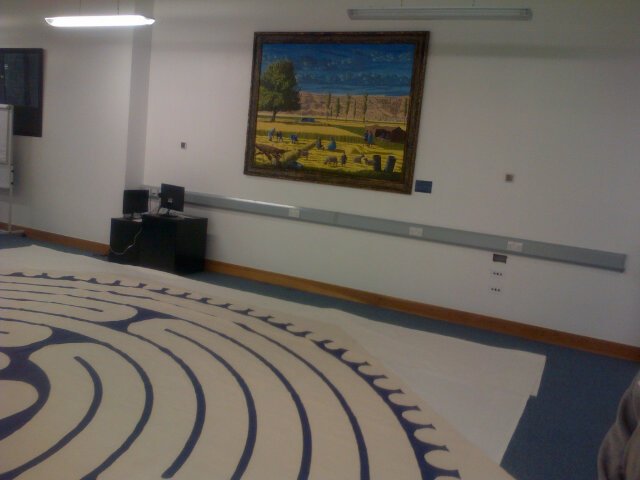
Led by our clergy team and a very wide range of members of the St Martin’s congregation the day offered a wonderful chance to explore a broad range of traditions and practices of prayer including through music, meditation, intercession, a labyrinth, movement and drama, pottery and art. There was the chance to choose the forms of prayer that interested us the most and to learn about or try those that were unfamiliar to us. There was also time to pray together and enjoy time together as a community, including a shared silent Eucharist. I particularly enjoyed a session on centring prayer and the opportunity to walk a labyrinth once again.

I gave a presentation on Icons and Images which encouraged participants to both pay attention to images when using icons or other images as part of prayer and also to look beyond the image as a window into the divine. I briefly unpacked something of the history and theology of icons but also looked at the influence of icon painting on modern art and therefore ways in which all images can be used within prayer, particularly when prayer is understood as, the words of Simone Weil, absolute unmixed attention.

------------------------------------------------------------------------------------------

Taize - Let All Who Are Thirsty Come.

Friday, 6 May 2016

Review - Recording Britain Now: Society

My latest review for Church Times is of “Recording Britain Now: Society”, the 2015 John Ruskin Prize exhibition:

"[John] Ruskin believed that, to achieve the highest artistic ideals, the artist must understand the God given laws of nature by paying attention to minute details as well as spectacular effects. Accordingly, [Susie] Hamilton, like others in the show, observes from the sidelines, “scrutinising tourists, shoppers, holidaymakers, diners, hen nights and other scenes of leisure”, working quickly to catch particular poses that say “something about human vulnerability and about the pathos of those who process or trudge or consume or travel in the quest for meaning or excitement”.

In this way, her paying attention to minute details results in the poetry and prophecy of which Ruskin spoke. Similarly, Simone Weil believed that to pay attention in this way was prayer. If we see clearly with these artists and this exhibition, then we will be praying, and, when we pay attention to the issue of isolation, which is what they see so clearly, we will be focusing on the very mission of God."

-------------------------------------------------------------------------------------------------------

Gregory Porter - Take Me To The Alley.

Saturday, 23 April 2016

Poem: Paying Attention

Attend, attend, pay attention, contemplate.
Open eyes of faith to days, minutes,
moments of miracle and marvel; there is wildness
and wonder wherever you go, present
in moments that never repeat, running free,
never coming again. Savour, savour the present –
small things, dull moments, dry prayers –
sacraments of presence, sense of wonder,
daily divine depth in the here and now.
There’s only here, there’s only now,
these are the days, this is the fiery vision,
awe and wildness, miracle and flame. Take off
your shoes, stand in the holy fire; sacrament
of the burning, always consumed, never repeating
present moment, knowing the time is now.

--------------------------------------------------------------------------------------

Victoria Williams - This Moment.

Friday, 11 March 2016

Paying attention: Ethics

"All this should make us think a bit harder about how we as Christians approach the whole business of ethics. . . . if the desert literature is right, then we all need training in listening and attending almost more than anything else. Unless we are capable of patience before each other, before the mysteriousness of each other, it’s very unlikely that we will do God’s will with any kind of fullness. Without a basic education in attention, no deeply ethical behavior is really going to be possible; we may only keep the rules and do what is technically and externally the right thing. but that 'doing the right thing' will not be grounded yet in who we are, in the person God wants us to become, and it may not survive stress and temptation. It may also be quite capable of existing alongside attitudes and habits dangerous to ourselves and each other; it may not bring us life with and through the neighbour. Our Christian codes of behaviour quite rightly tell us that some sorts of action are always wrong - torture or fraud, killing the innocents or the unborn, sexual violence and infidelity - but to see why that is so requires us to go back a step or two to see why this or that action is bound to speak of inattention, why this or that action makes it impossible to listen for the word in another person. Unless we can grasp something of that, our ethics will never really be integrated with our search and our prayer for holy life in community."


------------------------------------------------------------------------------------------------

Jennifer Warnes - Joan Of Arc.

Monday, 29 February 2016

Paying Attention: Mystery

Here is the third of addresses from 'Paying Attention', the Silent Retreat at the Retreat House, Pleshey, organised for the communities of St Martin-in-the-Fields and St Stephen Walbrook. We explored ways of paying attention to people, creation, events, emotions, absence and mystery. Earlier, at St Martin's, I had also spoken about paying attention in terms of the Arts.

Paying Attention: Mystery

The singer-songwriter Bruce Cockburn sings, “You can't tell me there is no mystery / It's everywhere I turn.”

Andrew Davison has helpfully explained why this is so:

“It is fairly obvious that theology concerns topics beyond our full comprehension. This is illustrated in science by the way our basic picture has to change for time to time: Newton eclipsed Aristotle; quantum mechanics eclipsed Newton. Such shifts are no disaster, unless your only standard for intellectual success is completeness: having things cut and dried, sorted out. Scientific revolutions show us that the world is always beyond our grasp.

Knowledge is always partial because, frankly, the world is rather strange. Human knowledge goes only so far; behind it there is mystery. The development of science over the centuries confirms that mystery rather than denying it. The fact that science is forced to shift, again and again, demonstrates that human knowledge is constitutively incomplete.

I would give the name “faith” to this mixture of knowledge and mystery; we understand in part, as St Paul memorably put it.

Science grasps something of the truth about the world, but it is partial, and it develops. Religion and theology grasp something of the truth about the world and about God — although I would rather say that they touch God than that they grasp him. That is also partial knowledge, and it develops. As Aristotle said, one can take great joy in even a little knowledge of the highest things …

Finally, science knows only in part, just as theology knows only in part. We never fully know what we are talking about; but we can talk about it. Saying that you know in part is not a weakness; it is reason at its strongest and most mature. There is to everything a mysterious depth that eludes us.”

St Paul writes in 1 Corinthians 13. 9 – 12: “For we know only in part, and we prophesy only in part; but when the complete comes, the partial will come to an end. When I was a child, I spoke like a child, I thought like a child, I reasoned like a child; when I became an adult, I put an end to childish ways. For now we see in a mirror, dimly, but then we will see face to face. Now I know only in part; then I will know fully, even as I have been fully known.”

In thinking about the way scripture speaks to us about God, Stephen Fowl notes that, “When it comes to almost any topic in Christian theology, but particularly to God, we will not get off to a good start if we expect the scriptures to demonstrate a unified, cut-and-dried doctrine of God.

Viewing scripture as a receptacle of doctrines will frustrate us, because on the one hand scripture’s accounts of God are rich and variegated, but on the other these accounts are not systematically organised.”

It is more theologically fruitful, he suggests, to see that scripture recognises this diversity and theologising about how we can organise and account for this variety.

In their book ‘The Abundant Community’, John McKnight and Peter Block suggest:

“A competent community creates space for what is unknowable about life. This is another major distinction from systems. In system life, living with mystery is considered poor planning. Systems are organized around the desire for certainty, science, and measurability. Planning, goals, blueprints are a defense against mystery. Institutions are about eliminating mystery. They are concerned with risk reduction or risk management. Taking uncertainty out of the future …

“Mystery is the answer to the unknown. In actualising its abundance, a community welcomes mystery, for that is a catalyst for creativity. Mystery gives us freedom from the burden of answers. Answers are just a restatement of the past …

Mystery is to the unknown as grief is to sorrow. What do you do when you do not know what is going to happen to you? You name it a mystery. It lets you go. It is a name for things we cannot fully know or control …

“The reason we need art in all its forms is to grasp the mystery in our lives, to recognize the mysteries around us. To get away from the pre-ordained structured way of seeing things. That is why you can listen to a song over and over. You know exactly what is coming, and it still holds an element of wonder. Which may be the primary function of art and why it is so essential to sustaining community.”

One gift that poetry, in particular, has to offer to us “is not an affirmation, but a negation of the power of any formulation.” Malcolm Guite writes that:

“Because poets push language to the limit, they are especially aware that language has its limits. Often a poet’s greatest art is to bring us to the brink of language, and gesture wordlessly beyond it.

This is especially T. S. Eliot’s art in his greatest achievement, Four Quartets. The fifth section of each quartet constantly returns to his theme of words that “strain, Crack and sometimes break, under the burden . . . Decay with imprecision” (“Burnt Norton”).

Even the radiant spiritual poetry of these quartets has, as it were watermarked into every page, Eliot’s explicit confession of the limitations of language: “only . . . Hints followed by guesses” (“The Dry Salvages”).

All of that is summed up in two lines from “East Coker”:

The only wisdom we can hope to acquire
Is the wisdom of humility: humility is endless.”

If we are to pay attention to the mystery of God, there are ultimately only three responses we can make. The first is to keep exploring. Eliot writes in ‘Little Gidding,’ “We shall not cease from exploration,” and that is right because if we stop searching, if we stop questioning, then we get stuck and stagnate. We only have to look at nature to see the way in which all growth involves change; the caterpillar and butterfly being one of the most dramatic examples. Our own bodies are constantly changing throughout our lives with many of our cells being replaced as we progress through life. Growth involves constant change and if we apply this same principle to our thought life, our emotional life and our spiritual life then, as Eliot wrote, we must not cease from exploration.

The second is to express our sense of awe and wonder by kneeling in worship. Once again, T. S. Eliot’s ‘Little Gidding’ describes this well:

“If you came this way,
Taking any route, starting from anywhere,
At any time or at any season,
It would always be the same: you would have to put off
Sense and notion. You are not here to verify,
Instruct yourself, or inform curiosity
Or carry report. You are here to kneel …”

The answer to our questions is a person, not a fact, and the person who is the answer to our questions turns out to be God himself. Because God is infinite, he cannot be fully known or understood by human beings. With God, there is always more for us to know and understand. Knowing God in this way is exploration; like diving into the ocean and always being able to dive down deeper

The third response is to give gifts. Christina Rossetti expressed the gift we should give in her carol, ‘In the bleak midwinter’:

“What can I give Him, poor as I am?
If I were a shepherd, I would bring a lamb;
If I were a Wise Man, I would do my part;
Yet what I can I give Him: give my heart.”

I began by quoting Bruce Cockburn and I’d like to end doing so again. Death is the ultimate mystery for us and here Cockburn pictures it as entering into mystery:

"There you go
Swimming deeper into mystery
Here I remain
Only seeing where you used to be
Stared at the ceiling
'Til my ears filled up with tears
Never got to know you
Suddenly you're out of here

Gone from mystery into mystery
Gone from daylight into night
Another step deeper into darkness
Closer to the light"

-------------------------------------------------------------------------------------

Bruce Cockburn - Mystery.

Saturday, 27 February 2016

Paying Attention: Emotions

Here is my second address from our Silent Retreat:

Paying Attention: Emotions

Many of the great figures in the Bible seem to have viewed prayer as being more like a constant conversation with God than they did a scheduled time for making requests. In some ways there seems to be a greater understanding of this in Judaism than in Christianity. I’ve been helped and challenged by some of what Jonathan Sacks, the former Chief Rabbi, has said about this understanding of prayer in a fascinating lecture called Judaism, Justice and Tragedy - Confronting the problem of evil.

He sees Abraham as being the starting point in scripture for this kind of dialogue between God and human beings and said that “there begins a dialogue between Heaven and Earth which has not ceased in 4,000 years”. He calls it the dialogue in which God and Man find one another and says that the mood of these dialogues between the prophets and God has been a never-ending feature in Judaism.

Have a look at the conversation between God and Abraham in Genesis 18. 16-33 and see what goes on there. The first thing to see in verse 17 is that God invites the conversation. He could have hidden his thoughts and plans from Abraham but he chooses not to. Instead he shares with Abraham and invites not just conversation but challenge from Abraham. Because that is what Abraham does in this conversation – he challenges God. What Abraham says to God, recorded for is in verse 25, is stunning - "God forbid that You should do such a thing! To kill the righteous with the wicked so that the righteous should have the same fate as the wicked, God forbid! Shall the Judge of all the earth not do justice?" It sounds blasphemous that a human being, who as Abraham says of himself in verse 27 is “nothing but dust and ashes”, should speak in this way to his creator. It sounds blasphemous until we remember that God chose to initiate this conversation and this challenge.

What is God doing then through this conversation? Let’s go back to what God said about Abraham before beginning this conversation. In verse 19, God says that Abraham has been chosen to “direct his children and his household after him to keep the way of the Lord by doing what is right and just”. Remember that phrase, “what is right and just” because it the phrase that Abraham throws back in God’s face – “Will not the Judge of all the earth do right?” - “Shall the Judge of all the earth not do justice?". Through their conversation, God is teaching Abraham to argue passionately for what is right and what is just. As Abraham learns to do this he becomes more able to righteousness and justice to his children and household.

In the same way, God wants us to be in conversation, in dialogue, in debate, in arguments with him so that we can find him for ourselves and actually embody his characteristics and interests ourselves. He wants us to learn to do right through discussion rather than by rote. If all we do as Christians is to learn a set of rules then we will never be able to apply those rules to real life. Because in order to do right we need to apply the Spirit of the Law, not the letter of the Law. Jesus did this constantly and his application of the Spirit of the Law continually brought him into conflict with the religious leaders of his day who were concerned with the letter of the Law. A good example is the story of the woman caught in adultery in John 8. 1-11.

We can see this acted out for us by the people of Israel at Mount Sinai. Let’s look quickly at Exodus 19. In verse 6 we read of God saying that the Israelites “will be for him a kingdom of priests and a holy nation”. Priests in Israel were the people who went into the holy place, into God’s presence. So God is saying that he wants all the people of Israel to come into his presence and to speak with him face-to-face. But turn over the page to Chapter 20.19 and you’ll find the people of Israel saying to Moses, “Speak to us yourself and we will listen. But do not have God speak to us or we will die”. In other words, they are saying we’ll obey God’s rules but we won’t speak with him face to face. They appoint Moses to be their mediator, to go into God’s presence on their behalf.

Moses learns to mirror God from his conversations and debates with God. So much so, that his face begins to shine with the reflection of God’s glory. But the people never really learn what God is like because they will not speak with him face to face. They keep him at arms length by using Moses as the mediator and by trying to keep rules which they know but don’t understand. Paul says in 2 Corinthians 3.18 that we, like Moses, with unveiled faces, seeing the glory of the Lord as though reflected in a mirror, are to be transformed into the same image from one degree of glory to another. That transformation comes as we dialogue, debate, argue and converse with God.

Other people in the Bible who have these kind of conversations with God include: Jacob; Samuel; Job; Jeremiah; Jonah; Habakkuk; Jesus and Paul. The Psalms though are where most of the conversations between people and God are recorded. Virtually all the Psalms are conversations where it is assumed that the hearer is either God or the people of Israel. Some of the Psalms are actually written as conversations though e.g. Psalm 12. In verses 1-4 the Psalmist cries out to God for help, in verses 5-6 God answers and in verses 7-8 the Psalmist responds by expressing confidence in God. Psalm 77 is the record of a similar conversation with God. In verses 1-6 the Psalmist tells us how he cried out to God, in verses 7-9 he tells what he cried out, in verses 10-12 he tells us how God answered his cry, and in verses 13-20 he tells us of his response to God’s answer.

This approach to prayer is one that a number of Christian poets have picked up and used over the centuries:

•             Dialogue – George Herbert
•             Love III – George Herbert
•             Bittersweet – George Herbert
•             Thou art indeed just, Lord – Gerard Manley Hopkins

The conversations with God that are recorded for us in the Psalms are one’s that involve a whole range of different emotions. You might like to read through some Psalms and identify what is the emotion being expressed. Once you’ve done that then choose three of these different emotions that connect with you and think, if you were to have a conversation with God which involved that emotion, what you would be talking about with him and what you would be wanting to say to him. 

We are often quite restrained in our relationship with God and in our praying. Therefore, we often praise God and say that we will obey or follow him but we rarely argue, protest, complain or question him, at least not publicly. Would today be a good opportunity to start including some of these more difficult emotions in your prayer life?

----------------------------------------------------------------------------------------

Mark Heard - Strong Hand Of Love.

Paying Attention: Events

Here is my first address from the Silent Retreat at the Retreat House, Pleshey, organised for the communities of St Martin-in-the-Fields and St Stephen Walbrook. Entitled 'Paying Attention', we are exploring ways of paying attention to people, creation, events, emotions, absence and mystery. Earlier, at St Martin's, I spoke about paying attention in terms of the Arts.

Paying Attention: Events

The Bible is full of encouragement to reflect. The words, reflect, consider, ponder, meditate and examine, crop up everywhere. God encourages us to reflect on everything; his words (2 Timothy 2.7), his great acts (1 Samuel 12.24), his statutes (Psalm 119.95), his miracles (Mark 6.52), Jesus (Hebrews 3.1), God's servants (Job 1.8), the heavens (Psalm 8.3), the plants (Matthew 6.28), the weak (Psalm 41.1), the wicked (Psalm 37.10), oppression (Ecclesiastes 4.1), labour (Ecclesiastes 4.4), the heart (Proverbs 24.12), our troubles (Psalm 9.13), our enemies (Psalm 25.19), our sins (2 Corinthians 13.5). Everything is up for reflection but we are guided by the need to look for the excellent or praiseworthy (Philippians 4.8) and to learn from whatever we see or experience (Proverbs 24.32).

Clearly all this reflection cannot take place just at specific times. Just as we are told to pray always, the implication of the Bible's encouragement to reflection is that we should reflect at all times. We need to make a habit of reflection, a habit of learning from experience and of looking for the excellent things. How can we do this?

One of the ways, I would suggest is that we use all that is around us – what we see, do and experience. Everything around us can potentially be part of our ongoing conversation with God, part of which is reflection. The Celtic Christians had a sense of the heavenly being found in the earthly, particularly in the ordinary events and tasks of home and work, together with the sense that every event or task can be blessed if we see God in it.

David Adam, who has written many contemporary prayers in this style, says that: “Much of Celtic prayer spoke naturally to God in the working place of life. There was no false division into sacred and secular. God pervaded all and was to be met in their daily work and travels. If our God is to be found only in our churches and our private prayers, we are denuding the world of His reality and our faith of credibility. We need to reveal that our God is in all the world and waits to be discovered there – or, to be more exact, the world is in Him, all is in the heart of God. Our work, our travels, our joys and our sorrows are enfolded in His loving care. We cannot for a moment fall out of the hands of God. Typing pool and workshop, office and factory are all as sacred as the church. The presence of God pervades the work place as much as He does a church sanctuary.” (Power Lines: Celtic Prayers about Work, SPCK, 1992)

Other examples of similar styles of prayer include, Alexander Carmichael’s Carmina Gadelica, a collection of Gaelic prayers and poems collected in the late 19th century, which “abounds with prayers invoking God’s blessing on such routine daily tasks as lighting the fire, milking the cow and preparing for bed.” Many of George Herbert’s poems use everyday imagery (mainly church-based as he was also a priest) and are based on the idea that God is found everywhere within his world. People like Ray Simpson and Ruth Burgess have provided series of contemporary blessings for everyday life covering computers, exams, parties, pets, cars, meetings, lunchtimes, days off and all sorts of life situations from leaving school and a girl’s first period to divorce, redundancy and mid-life crises.

Similarly, Martin Wallace suggests that: “Just as God walked with Adam in the garden of Eden, so he now walks with us in the streets of the city chatting about the events of the day and the images we see.” (City Prayers, The Canterbury Press, 1994) He wants to encourage us to “chat with God in the city, bouncing ideas together with him, between the truths of the Bible and the truths of urban life” and, “as you walk down your street, wait for the lift, or fumble for change at the cash-till … to construct your own prayers of urban imagery.”

One helpful way of beginning to do this is to identify the times and spaces in your normal day when you could take time to pray in this way. Before ordination, when I worked in Central London I used to use my walk to and from the tube station in this way and also had a prayer on my PC that I would pray as I ate lunch at my desk. As a result, since being ordained I have been sending emails to working people in the congregation of which I have been part with a brief reflection and prayer that they can use in these ways.

If you would like to pay more attention to events in this way, why not start by making a list of all the things that you see and do in a typical day? Then think how you could use these to reflect and pray. Then, as Martin Wallace suggests, you might like to try writing your own prayer, reflection or blessing using some of these things as your starting point.

-----------------------------------------------------------------------------------------

The Jam - News Of The World.