Wikio - Top Blogs - Religion and belief
Showing posts with label oldfield. Show all posts

Friday, 3 November 2023

Church Times - Art review: Love is the Meaning in Norwich churches

My latest review for Church Times is on Love is the Meaning an exhibition in several of Norwich's churches:

'“LOVE is the Meaning”, an exhibition of new art celebrating the words and shewings of Julian of Norwich, is the last event in the year-long programme of events for the 650th anniversary of Julian’s “shewings”.

Including an art exhibition in the anniversary programme is a way of reminding those celebrating that, while Julian’s words formed the earliest surviving book in the English language written by a woman, those words began as a series of images. The images that Julian saw were sent to her from God at her request, because she wanted to understand life and what it means.

Accordingly, the 34 participating artists were asked to look at Julian’s descriptions of her visions and then explore their meaning in our day. Their images have been shared between three Norwich churches, these being the places most associated with Julian when she lived in Norwich 650 years ago. This enables viewers to go on a prayerful pilgrimage around images and sites connected with her life.'

For more on the 650th Anniversary events and an anthology of poems published in celebration of it, to which I contributed, click here. For my sabbatical visits to sites connected with Julian click here.

Other of my pieces for Church Times can be found here. My writing for ArtWay can be found here. My pieces for Artlyst are here and those for Art+Christianity are here.

-------------------------------------------------------------------------------------------------------------

Saturday, 15 July 2023

All Shall Be Well: Poems for Julian of Norwich


All Shall Be Well: Poems for Julian of Norwich, the Amethyst Press anthology of new poems for Julian of Norwich is now available in print and as an e-book!

To celebrate the 650th anniversary of Julian of Norwich's visionary 'Shewings', here is 'All Shall Be Well', an anthology of new poems for Mother Julian, medieval mystic, anchoress, and the first woman to write a book in English. Lyrical, prayerful, vivid and insightful, these poems offer a poetic testament to Julian's enduring legacy of prayer and confidence in a merciful God who assured her that 'All Shall Be Well, and All Shall Be Well, and All Manner of Thing Shall Be Well.' The anthology has been edited by and comes with an introduction by Sarah Law, editor of Amethyst Review.

With contributions from: Susan Brice, Mark S. Burrows, Lance Carden, Carol Casey, Johanna Caton, O.S.B.. Sarah Cave, Ann Cefola, Jennifer Clark, Linda Collins, Jonathan Cooper, Scott Dalgarno, Keren Dibbens-Wyatt, Diana Durham, Jeffrey Essmann, Jonathan Evens, Ruth Gilchrist, Maryanne Hannan, James Harpur, Maura H. Harrison, Kale Hensley, Terry E. Hill, Angela Hoffman, Laura Reece Hogan, Erich von Hungen, Rosie Jackson, Elisabeth Engell Jessen, Sylvia Karman, Jane Keenan, Adrienne Keller, Desmond Kon, Irina Kuzminsky, Sarah Law, Tim Lenton, Shannon Lippert, Viv Longley, Rupert M. Loydell, Hannah Lucas, Tony Lucas, Marjorie Maddox, Marda Messick, Jennifer Davis Michael, Nessa O’Mahony, Tory V. Pearman, Ann Power, Frances Presley, Patrick T. Reardon, Merryn Rutledge, Deborah W. Sage, Maha Salih, Steven Searcy, Kathryn Simmonds, Susan Delaney Spear, Mark Tulin, Laura Varnam, Gail White, Martin Willitts Jr and Mike Wilson. 

My poem for the anthology is based on a large painting 'The Revelations of Julian of Norwich' by Australian artist Alan Oldfield which is to be found at the Belsey Bridge Conference Centre in Ditchingham, Norfolk.

Amazon US

Amazon UK

Amazon AU

(plus other Amazon platforms)

Please make a note of the online launch to be held on September 20th. To learn more about Julian of Norwich, please visit the Friends of Julian and consider supporting their work.

Amethyst Review is a publication for readers and writers who are interested in creative exploration of spirituality and the sacred. Readers and writers of all religions and none are most welcome. All work published engages in some way with spirituality or the sacred in a spirit of thoughtful and respectful inquiry, rather than proselytizing.

The Editor-in-chief is Sarah Law – poet (mainly), tutor, occasional critic, sometime fiction writer. She has published five poetry collections, the latest of which is 'Ink’s Wish'. She set up Amethyst Review feeling the lack of a UK-based platform for the sharing and readership of new literary writing that engages in some way with spirituality and the sacred.

Foue of my poems have appeared in Amethyst Review. They are: 'Runwell', 'Are/Are Not', 'Attend, attend' and 'Maritain, Green, Beckett and Anderson in conversation down through the ages'. I have also had several poems in Stride magazine, including several reflecting on other poets, beginning with the artist-poet David Jones, continuing with Dylan Thomas and ending with Jack Clemo. To read my poems published by Stride, click here, here, here, here, and here.

Additionally, several of my short stories have been published by International Times, the Magazine of Resistance, including three about Nicola Ravenscroft's mudcub sculptures, which we exhibited at St Andrew's Wickford last Autumn. The first story in the series is 'The Mudcubs and the O Zone holes'. The second is 'The Mudcubs and the Clean-Up King', and the third is 'The mudcubs and the Wall'. My other short stories to have been published by International Times are 'The Black Rain', a story about the impact of violence in our media, 'The New Dark Ages', a story about principles and understandings that are gradually fading away from our modern societies, and 'The curious glasses', a story based on the butterfly effect.

--------------------------------------------------------------------------------------------------------------

Bruce Cockburn - 3 Al Purdy's.

Monday, 19 June 2023

All Shall Be Well: Poems for Julian of Norwich


To celebrate the 650th anniversary of Julian of Norwich's visionary 'Shewings', here is 'All Shall Be Well', an anthology of new poems for Mother Julian, medieval mystic, anchoress, and the first woman to write a book in English. Lyrical, prayerful, vivid and insightful, these poems offer a poetic testament to Julian's enduring legacy of prayer and confidence in a merciful God who assured her that 'All Shall Be Well, and All Shall Be Well, and All Manner of Thing Shall Be Well.' The anthology has been edited by and comes with an introduction by Sarah Law, editor of Amethyst Review.

The anthology has contributions from: Susan Brice, Mark S. Burrows, Lance Carden, Carol Casey, Johanna Caton, O.S.B.. Sarah Cave, Ann Cefola, Jennifer Clark, Linda Collins, Jonathan Cooper, Scott Dalgarno, Keren Dibbens-Wyatt, Jeffrey Essmann, Jonathan Evens, Ruth Gilchrist, Maryanne Hannan, James Harpur, Maura H. Harrison, Kale Hensley, Terry E. Hill, Angela Hoffman, Laura Reece Hogan, Erich von Hungen, Rosie Jackson, Elisabeth Engell Jessen, Sylvia Karman, Jane Keenan, Adrienne Keller, Desmond Kon, Irina Kuzminsky, Sarah Law, Tim Lenton, Shannon Lippert, Viv Longley, Rupert M. Loydell, Hannah Lucas, Tony Lucas, Marjorie Maddox, Marda Messick, Jennifer Davis Michael, Nessa O’Mahony, Tory V. Pearman, Ann Power, Frances Presley, Patrick T. Reardon, Merryn Rutledge, Deborah W. Sage, Maha Salih, Steven Searcy, Kathryn Simmonds, Susan Delaney Spear, Mark Tulin, Laura Varnam, Gail White, Martin Willitts Jr and Mike Wilson.

My poem for the anthology is based on a large painting 'The Revelations of Julian of Norwich' by Australian artist Alan Oldfield which is to be found at the Belsey Bridge Conference Centre in Ditchingham, Norfolk.

The online launch of the anthology is to be held on September 20th. To learn more about Julian of Norwich, please visit the Friends of Julian and consider supporting their work.

---------------------------------------------------------------------------------------------------------

The Albion Christmas Band - Julian Of Norwich.

Thursday, 13 November 2014

Sabbatical art pilgrimage: Report - Part 5

The story of the renaissance in Church commissions is not one which has been well told, either by the Church or the mainstream art world. There are many reasons for this on both sides but my concern in making this story the focus of my sabbatical has been to encourage the Church to tell and to value this story.

As both a parish priest and through commission4mission, the group of artists of which I am part, I have seen the value of promoting and publicising the artworks which churches have commissioned. Through the creation of Art Trails locally and regionally, we have provided churches with a means of publicity which has led to events such as art competitions, exhibitions, festivals and talks, community art workshops, guided and sponsored walks, and Study Days. Each has brought new contacts to the churches involved and has built relationships between these churches and local artists/arts organisations.

The commissions I have seen speak powerfully and movingly of the Christian faith and therefore inform the spirituality of those who see them. It is my contention that to tell more fully the story of the engagement which the Church has had with modern and contemporary art could have similar impact on a wider scale and would also have the effect of providing emerging artists from within the Church and the faith with a greater range of role models and approaches for their own developing inspiration and practice.

During my sabbatical I have visited churches which seem to have little or no regard for the artworks they possess and others which actively utilize them in their mission and ministry. Commissions can often occur at the instigation of a particular individual (e.g. Hingley, Hussey, Judd), so that, on occasion, when that individual is no longer there the impetus for seeing commissions as central to mission and ministry can also be lost. 

In much thinking and teaching on church art the work and the artist(s) are subservient to the liturgy and therefore are not given prominence, as in a gallery or museum with their different functions. In this way of thinking it is what the works signify or communicate of the faith that is important, not what they are or who it was that made them. This view of art wants to screen out the fullness of the interaction that the artwork has with its context on the basis of art for Christ's sake.

In my view this is to diminish the fullness of what the work of art is and can be in its context and, therefore, to restrict or restrain the artwork. Works of art are what they are, a unique entity in their own right, but they are brought to birth by an artist(s) who influence significantly the nature of the artwork itself. The artwork is brought to birth in and often for a particular context with which the artwork is in a dialogue. Additionally, the artwork continues to exist, while displayed, in a continuing context within which it is seen and with which it interacts. We respect and remember the integrity of the work by always remaining in dialogue with it and never privileging one facet or perspective over another in order to say 'this' is what it is.

Église St Michel,Les Breseux, is a church that has really engaged with the artworks it has commissioned and the visitors who therefore come to see those commissions. This church is aware that it now receives visitors who would not otherwise come and therefore takes their needs into account with simple but essential facilities provided and a small exhibition about the commissions, Manessier, and arte sacré more generally. Many larger churches do not do as much and Les Breseux is both an exemplar and an example as to why and how to cater for and minister to those who visit to view wonderful works of art.

Metz and Chichester Cathedrals both have simple but effective leaflets which identify a prayerful route around the spaces taking in the most significant commissions and offering a brief prayer in response to each. Such leaflets encourage all visitors not simply to be tourists but worshippers as well. I know from personal experience, having created a similar leaflet for St Margaret's Barking, how much such simple initiatives are appreciated by parishioners and visitors alike.

An argument can be made that such approaches, like the information provided on wall cards in museum exhibitions, can direct viewers to see the artwork from one perspective alone. However, this does not have to be the case as viewers often take that perspective as a starting point for then seeing others themselves. Additionally, providing no way in to perspectives on artwork, as curators have found, can leave viewers unable to begin to engage with the artwork at all.

Taking the meditative nature of his Julian of Norwich series further, Alan Oldfield created a film of the paintings with Sheila Upjohn reading selected extracts from Julian's shewings. Upjohn would later make a similar use of extracts from Julian in the booklet based on the 'Stations of the Cross' by Irene Ogden which can be found at St Julian's Church in Norwich. Jane Quail's 'Stations of the Cross' based on the Beatitudes were installed in the grounds of the Anglican Shrine at Walsingham in 2001 and are much loved by pilgrims. As with the Stations of the Cross by Ogden, a booklet with meditations based on the images and texts has been published. These are imaginative artworks which make creative textual and visual connections between the events of the 14 Stations and scriptures not normally associated with those events. They integrate scriptures creating a harmonious whole and opening up the scriptures to other interpretations and connections.

Metz Cathedral, like many other Cathedrals and churches, also has an ongoing arts programme centred on music and the visual arts. Exhibitions are hung within the body of the Cathedral with the exhibition at the time I visited, by Eban, being abstract works based on these words from Georges Rouault: “Shape, color, harmony / Oasis or mirage / For the eyes, the heart or the mind.” Similarly and as part of understanding that its commissions (stained glass windows by Chagall) had created for it a new and wider ministry, Tudeley Parish Church organizes an annual music festival. The Tudeley Festival, which specializes in period performance, was established in 1985 and the church also hosts concerts by visiting musicians and choirs at other points throughout the year.

Tudeley also has an excellent website with significant information about its commissions and other initiatives. The range and quality of information on their website remains relatively rare, even among those churches and cathedrals which do feature their artworks, but another which provides a marvelous example of what can be done online is Berwick Parish Church in Sussex under the heading of ‘Bloomsbury at Berwick’.

As a result of its memorial commissions St Andrew Bobola in Shepherds Bush is a significant space for memory and memorial for those remembering Poles who died during World War II, but also, more generally, for the Polish community in the UK as a whole. The Sandham Memorial Chapel at Burghclere with its murals by Stanley Spencer was specifically created as a memorial space. St Andrew Bobola and Berwick Parish Church, by contrast, incorporate a memorial function into their wider ministry by means of their commissions.

Adam Kossowski’s murals at St Benet's Chapel have proved to be an excellent talking point in the Rev. Jenny Petersen's ministry to students of other faiths, with Muslims in particular understanding the themes of judgement found therein, leading to a willingness to use the space for prayer. She has encouraged contemplation of the mural's themes by producing a series of cards exploring the imagery of each panel together with the relevant sections from the Revelation of St John.

At St AlbanRomford their commissions have given the parish a 'beyond-the-parish ministry' in that other parishes considering commissions are regularly recommended to visit St Alban's in order to see what has been achieved, be inspired, gain ideas and be put in touch with artists. Visits also come as a result of the parish participating in borough-based Open House and Art Trail events as well as school visits. As Chairman of Governors and Link-Governor for Art and Design at The Frances Bardsley School for Girls, Fr. Hingley has played a significant role in the development of the School as a centre of excellence for the Arts including the Brentwood Road Gallery and commissions at the School by Reytiens and Cazalet. This engagement, which has led to the School joining the Chelmsford Diocesan Board of Education Affiliated Schools Scheme, enables the School, Parish and Diocese to "support each other in the spirit of Christian fellowship and service" finding "innovative ways of working together and learning from one another." One outcome was the inclusion of artworks by students which featured in the church as part of its Fan the Flame mission week.

In 2009 St Alban's hosted the launch of commission4mission which seeks to encourage churches to commission contemporary art as a mission opportunity. St Alban's exemplifies all that commission4mission suggests that local church engagement with the Arts can provide:

  • works of art which speak eloquently of the Christian faith;
  • a reason to visit a church – something that was tapped with their Art Trail for the Barking Episcopal Area;
  • links between churches and local arts organisations/ initiatives; and
  • a focus for people to come together for a shared activity.
To view the Arts in this way provides a further point of connection with the desire of the French Dominicans for a Christianity that was engaged with the secular world. As a result, they argued that priests should not live in ‘Christian ghettos’ but should join with the citizenry ‘to establish a new, spiritually inspired system of social justice’ - the worker-priest movement – and, with artists, to preach a ‘new gospel of sacred art’ that could help these artists come to ‘Christian awareness.’ These initiatives were representative of ‘a new evangelical spirit’ which was concerned with contextualized mission and which can continue to be replicated today in the current engagement which the Church has with the Arts.

-------------------------------------------------------------------------------------------

Leoš Janáček - Glagolitic Mass.

Sunday, 7 September 2014

Sabbatical art pilgrimage: Evening Services

I am using photographs, meditations and other resources from my sabbatical art pilgrimage for Evening Services at St John's Seven Kings during September.

This evening we focused on Julian of Norwich using the DVD of Alan Oldfield's paintings and extracts from Julian's Revelations of Divine Love. I also read my Julian meditations together with a slideshow of Passion images taken during my sabbatical visits.

Next week I will be using Jane Quail's Stations of the Cross, which can be found at the Anglican Shrine in Walsingham.

--------------------------------------------------------------------------------

Arcade Fire - Supersymmetry.

Monday, 18 August 2014

Julian Meditation 2

Here is the second collage of words from Julian of Norwich which I have compiled as part of reflecting on the her writings, particularly as used in the DVD featuring Alan Oldfield's paintings. They are intended to put Julian's words in new combinations while retaining her overall meaning:

There were times when I wanted to look away from the Cross, but I dared not.
The huge, hard, hurtful nails pulled the wounds wide open
The body sagged with the weight of its long hanging
Fair skin was driven deep into the tender flesh
Harsh striking all over the sweet body
The nails wrenched it as the weight of the body pulled against it
Shaken in sorrow and anguish and tribulation
As a cloth is shaken in the wind
The weeping and wailing of the soul
Bearing the loss of every kind of comfort except the deep, quiet keeping of God

I knew that while I gazed on the Cross I was safe and sound.
The holy joining made in heaven. God's son fell with Adam
Adam's old shirt - narrow, threadbare and short - our mortal flesh that God's son took upon him
So joined in love that the greatness of our love caused the greatness of his grief
The shame, the despising, the utter stripping he accepted
All the bodily and spiritual pains and passions of his creatures
Our Lord Jesus made nothing for us and we made nothing with him
In our joining together in love lies the life of all who shall be saved
In falling and rising again we are held close in one love
For our falling does not stop him loving us

I dared not look away. I was not willingly going to imperil my soul.
Flee to our Lord and we shall be comforted. Touch him and we shall be made clean.
Cling to him and we shall be safe and sound from every kind of danger.
For our courteous Lord wills that we should be at home with him
as heart may think or soul may desire .
Our soul rests in God its true peace, our soul stands in God its true strength,
and is deep-rooted in God for endless love.
He did not say 'You shall not be tempest-tossed, you shall not be work-weary,
you shall not be discomforted'.

But he did say, 'You shall not be overcome.'

-------------------------------------------------------------------------------

Indelible Grace - All Must Be Well.

Sunday, 10 August 2014

Julian meditation 1

As part of reflecting on the writings of Julian of Norwich, particularly as used in the DVD featuring Alan Oldfield's paintings, I have been creating two collages of Julian's words which are intended to put them in new combinations while retaining her overall meaning:

He is the holy joining made in heaven;
joined together with us in love.
He is wearing Adam's old shirt;
narrow, threadbare and short.
He is fallen with Adam; accepting the shame,
the despising, the utter stripping,
accepting all the bodily and spiritual pains
and passions of us, his creatures.
He is shaken in sorrow, anguish and tribulation
as a cloth is shaken in the wind.
He is made nothing for us; the sadness
and thinness of our likeness.
He is the image so disfigured and so far from fair.
He is the token and likeness of our foul, dark deeds.
He is embracing death at his own will.
He is matter for mourning.

He is bearing the loss of every kind of comfort
except the deep, quiet keeping of God.
He is the falling and rising again
that holds us in one love.
He is our clothing, he wraps and holds us.
He enfolds us in love, will never let us go.
He is everything that is good and comforting us.
He is looking on us with love
to make us his partners in good deeds.
He is the high, endless knowledge of God
which we could never have had without him.
He is our beautiful, bright, blessed Lord.
He is so great, so holy, so mighty and so good.
He is the glory of heaven, flower of earth

and fruit of the virgin's womb.

-------------------------------------------------------------------------------

John Tavener - Ikon Of Light.


Saturday, 2 August 2014

Sabbatical art pilgrimage: Belsey Bridge Conference Centre's Norfolk Room


Via Beata way station


St Julian's Church, Norwich


'Stations of the Cross' by Irene Orgden at St Julian's Church 

'The Revelations of Divine Love of Julian of Norwich,' are a series of paintings by Alan Oldfield which were first exhibited in Oldfield's home city of Sydney before being shown at Norwich Cathedral in 1988 as part of the Norwich Festival of the Arts. These huge paintings made a sizeable impact with aged vergers heard commenting on how strange it was that such images of a mere Norwich girl should have come all the way from 'down under.'

Oldfield first became aware of Julian of Norwich through her phrase 'all manner of things shall be well' which is quoted in T.S. Eliot's 'Four Quartets'. Later he found 'Enfolded in Love', a book of extracts from her writings, on a church bookstall and decided to learn more about the medieval anchoress, the first woman to write a book in English, who lived beside St Julian's Church in King Street Norwich in the 14th century.

Oldfield spoke of these paintings as being his way of paying back what he had learned from Julian of Norwich. 'She is not a very visual mystic,' he said, 'but as she struggled to put her vision into words, so I have struggled to clarify in paint what I feel about her work.'

Struggle and passion are not, however, part of the way in which these paintings have often been viewed. Rosemary Crumlin criticises the series for lacking passion as a result of the careful staging utilised by Oldfield in his theological reflections on Mother Julian's visions. Peter Haynes writes of this more positively as 'conceptual resolution' deriving from Oldfield's 'sensitive understanding' of both source (the visions) and context (medieval art).

Oldfield described the strengths of realism as being 'draughtsmanship, line and closed composition, its success in allusiveness and anonymity.' Crumlin suggests that Oldfield's mature paintings, drawings and theatre designs carry out this brief and incorporate the insights of colour field and hard edge.' He 'often places a frame around a moment of time ... so that the picture space becomes like the theatre stage and the figures become like actors frozen in time and isolated often from each other.' His paintings often 'include explicit references to paintings and to painters he admires,' such as Piero della Francesca and Fra Angelico.

One of the series, 'A High and Spiritual Shewing of Christ's Mother according to Julian of Norwich' was joint winner of The Blake Prize in 1987. In this painting 'Julian pulls back the curtain to see the young Mary at the moment of her 'yes' to the archangel Gabriel's news that, although a virgin (symbolised by the vase of lilies), she is to become the Mother of God' (R. Crumlin, 'The Blake Book,' Macmillan, Melbourne, 2011).

The Blake Prize for Religious Art began in 1951 with an exhibition in Sydney and was 'the idea of Michael Scott, a Jesuit priest, and Richard Morley, a Jewish businessman, who saw in it a way of encouraging the Church to become patron of the arts and remedying what they considered the appalling state of the art in churches.' The Blake Committee 'looked to the European Sacred Art Renewal Movement centred in France for inspiration,' in particular to Notre-Dame deToute Grâce at Assy in the French Alps where, 'within the one building, priest, architect and modern artists had worked together in creative dialogue' (R. Crumlin, 'The Blake Book,' Macmillan, Melbourne, 2011).

Despite the fact that 'before 1940 there was little religious art in Australia' and that 'Churches in Australia rarely took the best artists seriously enough to commission their work,' as Margaret Manion has written, for a 'surprisingly large number of gifted Australian artists, the relationship between art and religion has continued to provide a creative challenge' (R. Crumlin, 'Images of Religion in Australian Art,' Bay Books, 1988). Roy de Maistre was probably the best known of these artists in the UK with commissions at Westminster Cathedral and St Aidan's East Acton, a major retrospective at the Whitechapel Gallery and his friendship with Francis Bacon. Arthur Boyd also spent time in the UK, during the Sixties and had his work championed by the art critic, Peter Fuller. In Australia itself artists such as John Coburn, Leonard French, Roger Kemp, Justin O'Brien and Eric Smith all created art which communicated religious feeling and intention.

Oldfield's work came to England primarily because of its content and then stayed when another in the series, 'The Revelations of Julian of Norwich' was purchased by the Friends of Julian of Norwich and hung in what was then the Chapel of St Gabriel's Retreat Centre at Ditchingham in Norfolk. Oldfield gave an additional work 'The Revelations of Divine Love' to the Friends of Julian and this now hangs in the Julian Centre which sits beside St Julian's Church where Julian had her cell. This image depicts the beautiful and lively child who, in one of Julian's shewings, sprang up from a foul and stinking body on the ground.

Realising that the series would be broken up, Oldfield created a film of the paintings with Sheila Upjohn (whose translation of Julian's writings Oldfield had read) reading selected extracts from Julian's shewings. Upjohn would later make a similar use of extracts from Julian in the booklet based on the 'Stations of the Cross' by Irene Ogden which can be found at St Julian's Church. 'Julian and the Scribe' found an ecclesiastical setting, at St Peter's Cremorne, while Oldfield and Earle Backen both created significant work (sometimes jointly)  for Christchurch St Laurence in Sydney where both worshipped and where Oldfield served as churchwarden.

The St Gabriel's Centre in Ditchingham has since become the Belsey Bridge Conference Centre but Oldfield's painting still hangs in the Norfolk Room, which now doubles as the chapel and a conference room. I first encountered this striking image while on a training course here and returned to it as part of my sabbatical art pilgrimage by taking an individual retreat at the Belsey Bridge Centre. On this occasion I shared the space with priests and laity from the Oratory of the Good Shepherd (OGS), who were also there on retreat. The OGS is an international community of Anglicans, ordained and lay, who share a common Rule of Life.

A new addition to the site was a Via Beata way station. These are part of a developing series of shelters running west to east across the UK from St David’s to Lowestoft, each of which contain a single piece of Christian art. The image at the Belsey Bridge Centre is of Christ and his two disciples on the Emmaus road.

The Chapel has survived several changes since its construction in 1960 when it was the chapel for a school run by nuns from the nearby All Hallows Convent. The community of Sisters took up residence in the 1850s and the All Hallows community flourished so that by the end of the 19th century they were running a hospital, an orphanage, a home for fallen women and the school. The complex of late 19th and early 20th century red brick gothic buildings survives, a maze of corridors connecting what were once separate buildings. Simon Nott writes, 'The chapel of the school was rebuilt in 1960 in memory of Herbert Palmer, Warden of the Community of All Hallows and Chaplain to the school. It is a large, light, airy building, absolutely typical of its date: ten years earlier and there would have been more of a sense of a shadowy past, and ten years later it would have responded to the reforms of Vatican II (despite being Anglican) by having an altar in the centre rather than at the east end'.
  
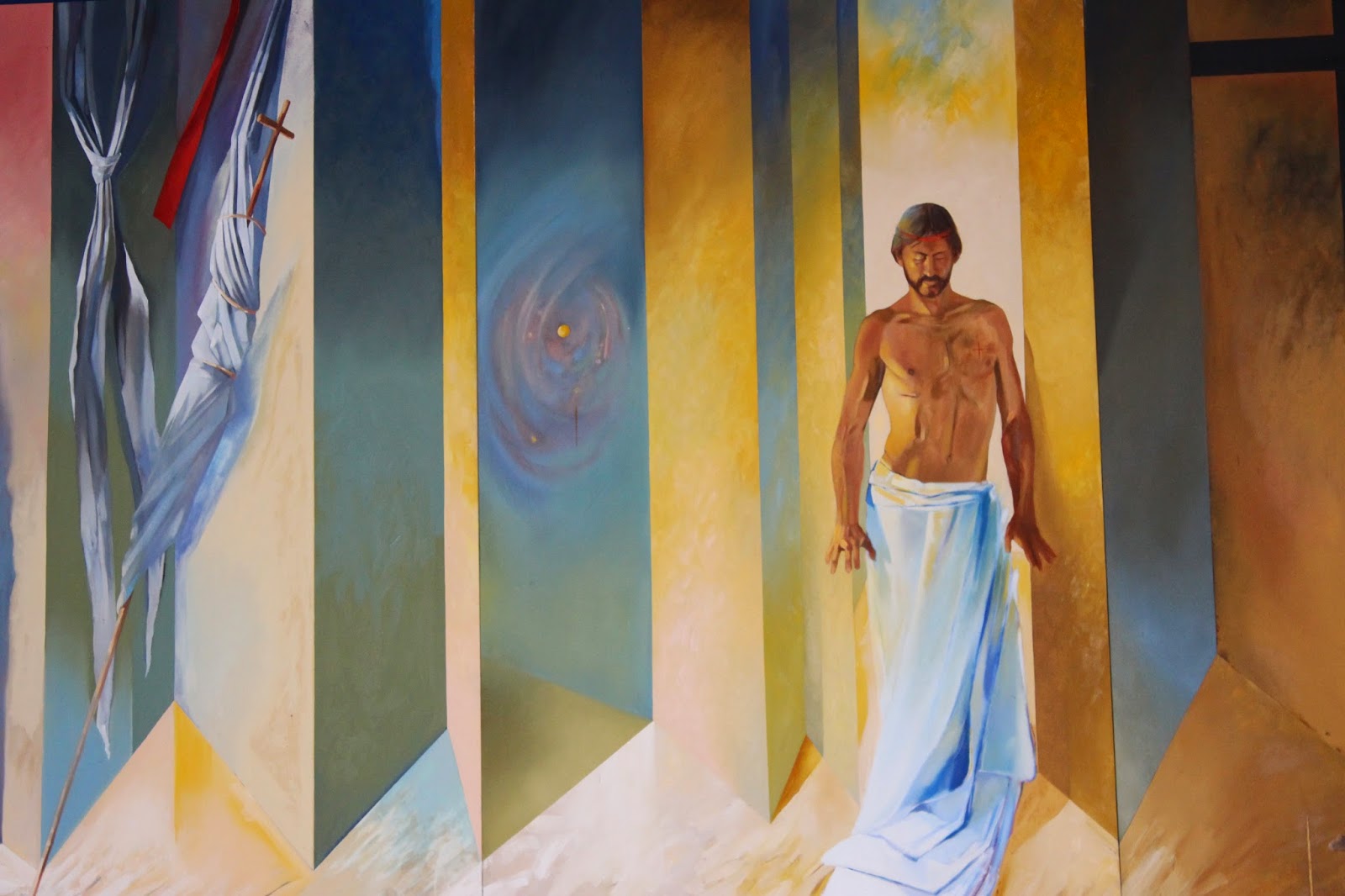
We enter the painting of 'The Revelations of Julian of Norwich' on the right in shadow; the shadow of Mother Julian on the wall of her cell. Constraining rectangles frame her for us, standing at her reading desk looking out into her field of vision. Red and white tiles circumscribe her cell-space, as sky-blue walls suggest the infinite breadth of her visions.

One painted panel contains her cell, a further three, her visions. 16 screens correspond to 16 showings set side-by-side like theatre sets; God's purposes played out on the stage of history. A tall, thin white candle levitates above the tiled floor illuminating Julian's cell; a 2D image at its apex, becoming 3D at its base. The first of several optical illusions; what we think we see never being all we see.

Julian looks back to her 16 showings and we follow her gaze to be taken back to the cross. Sombre shades and tones conceal a crown of thorns, an empty cross and barren land. Suffering indicated through absence and the shadow of death.

Beyond the cross, the resurrected Christ; his winding cloths now worn around his waist, spilling before him like the train of a bride rides behind. A red band rings him, a cross-shaped scar upon his breast, head bowed, palms held to bless those ministering and receiving at the altar below. Behind his head the stage-set of time opens revealing 'three heavens' of infinite eternity. Beyond him still the vision of the hazelnut painted planet-like in a galaxies' swirl; planet or nut, mass or pinprick, all will be well and all manner of thing be well - the resurrection initiates it!

So, finally, the cross wrapped in the winding sheets of the grave waiting for release, the sheets becoming the waved flag of victory at the return when the resurrection of all restores all to wellness and the vision of the hazelnut come to pass.


For now, vision extends beyond the painting beyond the showings, beyond ... where there is shadow, the shadow of God, revealing the limits of all our imaging. God is beyond the partial and incomplete images we construct. The shadow is God waiting in the wings for the moment of reunion when we shall see and know fully even as we are fully seen and known.

---------------------------------------------------------------------------------------------------

Sydney Carter and OHRWURM Folk Orchestra - Bells Of Norwich.

Saturday, 19 September 2009

Revelations of Divine Love


Meditation on Revelations of Divine Love of Julian of Norwich (1985 - 1988) by Alan Oldfield at St Gabriel's Conference Centre Ditchingham, Wednesday 16th September 2009

We enter
the painting
on the right
in shadow;
the shadow of
Mother Julian
on the wall
of her cell.
Constraining
rectangles
frame her
for us,
standing at
her reading desk
looking out
into her field
of vision.
Red and
white tiles
circumscribe
her cell-space,
as skyblue
walls
suggest
the infinite
breadth
of her visions.
One
painted panel
contains
her cell,
a further
three,
her visions.
16 screens
correspond
to 16
showings
set
side-by-side
like
theatre sets;
God's purposes
played out
on the stage
of history.
A tall,
thin
white
candle
levitates above
the tiled floor
illuminating
Julian's cell;
a 2D image
at its apex
becoming 3D
at its base.
The first of
several
optical
illusions;
what we
think
we see
never being
all
we see.
Julian looks
back
to her 16
showings
and we
follow
her gaze
to be
taken
back
to the
cross.
Sombre shades
and tones
conceal
a crown
of thorns,
an empty
cross
and barren
land.
Suffering
indicated
through
absence and
the shadow
of death.
Beyond
the cross,
the resurrected
Christ;
his winding
cloths
now worn
around
his waist,
spilling
before him
like the train
of a bride
rides behind.
A red band
rings him,
a cross-
shaped scar
upon his
breast,
head bowed,
palms held
to bless
those ministering
and receiving
at the
altar
below.
Behind
his head
the stage-set
of time
opens
revealing
'three heavens'
of infinite
eternity.
Beyond
him still
the vision of
the hazelnut
painted
planet-like
in a galaxies'
swirl;
planet or nut,
mass or pinprick,
all
will be well
and
all manner
of thing
be well -
the resurrection
initiates it!
So, finally,
the cross
wrapped
in the winding
sheets
of the grave
waiting
for release,
the sheets
becoming
the waved
flag of
vistory
at the return
when
the resurrection
of all
restores all
to wellness
and
the vision of
the hazelnut
come
to pass.
For now,
vision
extends beyond
the painting,
beyond the
showings,
beyond ...
where there
is shadow,
the shadow
of God,
revealing
the limits
of all our
imaging.
God is
beyond
the partial
and imcomplete
images
we construct.
The shadow
is God
waiting
in the wings
for the
moment of
reunion
when
we shall see
and know
fully
even
as we are
fully
seen
and known.

-----------------------------------------------------------------------------------

Lifehouse - Whatever It Takes.

Saturday, 16 May 2009

St Gabriel's Conference Centre, Ditchingham

Creation banner at Ditchingham Church


Detail of painted panel at Ditchingham Church

Detail of Alan Oldfield's Julian of Norwich painting in the chapel at St Gabriel's

Detail of Alan Oldfield's Julian of Norwich painting in the chapel of St Gabriel's

Alan Oldfield's Julian of Norwich painting
I've spent the past week at St Gabriel's Conference Centre, Ditchingham working on the Clergy Leadership Programme with a great group of incumbents and chaplains for the Chelmsford Diocese. The best part of the week was the high degree of friendship and support demonstrated from people of different traditions and theologies. Seeing this demonstrated once again is a vital reminder of the way in which friendships and real interaction can often override differences of theology and tradition and maintain the diversity that characterises Anglicanism at its best.

------------------------------------------------------------------------------

Shangri Las - Leader of the Pack.