Wikio - Top Blogs - Religion and belief
Showing posts with label aguirre. Show all posts

Monday, 13 July 2015

Discover & explore: Imagination


A.N. Wilson has written that, in the first half of the twentieth century, there were artistic giants in the Anglican Church. He was thinking people such as T.S. Eliot, C.S. Lewis and Dorothy L. Sayers.

Sayers, best known for her fictional detective Lord Peter Wimsey, was also, like C.S. Lewis, a popular Christian apologist. Her most interesting apologetic work is perhaps The Mind of the Maker (1941) where she explores the creative act itself in the Trinitarian terms of Idea (Father), Energy (Son), and Power (Spirit):

“For every work [or act] of creation is threefold, an earthly trinity to match the heavenly.

First, [not in time, but merely in order of enumeration] there is the Creative Idea, passionless, timeless, beholding the whole work complete at once, the end in the beginning: and this is the image of the Father.

Second, there is the Creative Energy [or Activity] begotten of that idea, working in time from the beginning to the end, with sweat and passion, being incarnate in the bonds of matter: and this is the image of the Word.

Third, there is the Creative Power, the meaning of the work and its response in the lively soul: and this is the image of the indwelling Spirit.

And these three are one, each equally in itself the whole work, whereof none can exist without other: and this is the image of the Trinity.”

If the relationships within the Trinity provide the model for our creativity as human beings, this suggests that our creativity itself comes from God. Sayers remarks in the book that the one thing we know for sure about God at the point that he makes humanity in his own image is that he is creative: “The characteristic common to God and man, is … the desire and ability to make things.”

God is the ultimate creator, who created from nothing. Sayers quotes Nikolai Berdyaev approvingly when he says, "God created the world by imagination" and we get an insight into God’s imaginative work of creation through the passage from Job (38. 4 - 21). As those made in the image of God, we are sub-creators, able to, as Sayers puts it, "rearrange the unalterable and indestructible units of matter in the universe and build them up into new forms."

These ideas, which see human creativity and the creative act itself as being formed and framed by God, lead us to view art and the imagination as a gift from God. Max Lieberman & Michael McFadden note that the:

“idea of the artist as instrument of the divine, or acting with divine inspiration, has been an archetypal theme espoused by great artists attempting to express the processes of their work. Kahlil Gibran, the great 20th century mystic poet and artist touched on two of the metaphors of antiquity, to describe the process of an artist's creation in writing, "Am I a harp that the hand of the almighty may touch me or a flute that this breath may pass through me?" Gibran perhaps unconsciously, refers to the Ancient Greek metaphor of the Aeolian Harp and the Hindu myth of Lord Krishna's flute … The Aeolian Harp represents the artist, whose finely tuned and sensitive soul responds to the divine breeze of the Holy Spirit as it blows through the strings, turning what is invisible and intangible to most, into beautiful enchanting music to move the minds and hearts of those who might be otherwise insensitive to the movement of this divine force … The artist is similarly conceived as a musical instrument in an Ancient Hindu myth … The great artist is conceived as the hollowed-out instrument of God, emptied of egoism and selfish desire, and thus able to transmit the experience of their union with the divine through the enchanting "music" of their artwork.

Some years ago I encountered the same idea in a book called Written In My Soul, a series of interviews with some of the most well-known singer-songwriters from the 1950s onward, where I was struck by the extent to which these great artists – Bob Dylan, Neil Young, Van Morrison and others – felt that their songs were given to them in moments of revelation, that their songs were already written and ‘came through them as though radio receivers – without much conscious effort or direction.’ More recently, the singer-songwriter Bill Fay has released a track called ‘Who is the Sender?’ in which he asserts that his songs are delivered to him by the unknown sender. Songs aren't written, but found. "Music gives," he says, and he is a grateful receiver.

MIA, the artist who work we were exhibiting at St Stephen Walbrook at the beginning of this service series, has identified similar words of Paul Klee as describing her own creative process: “Everything around me dissolves and interesting works emerge as if of their own accord. My hand is entirely the instrument of a distant sphere. It isnʼt my head that is working, but something else, something higher, something somewhere more remote. I must have great friends out there – obscure, but also brilliant - and theyʼre all very good to me.”

Samuel Taylor Coleridge was in a similar moment of inspiration while writing Kubla Khan. He wrote: “In the summer of the year 1797, the Author, then in ill health, had retired to a lonely farm house between Porlock and Linton, on the Exmoor confines of Somerset and Devonshire. In consequence of a slight indisposition, an anodyne had been prescribed, from the effects of which he fell asleep in his chair at the moment that he was reading the following sentence, or words of the same substance, in 'Purchas's Pilgrimes:' 'Here the Khan Kubla commanded a palace to be built, and a stately garden thereunto: and thus ten miles of fertile ground were inclosed with a wall.'

The Author continued for about three hours in a profound sleep, at least of the external senses, during which time he has the most vivid confidence, that he could not have composed less than from two to three hundred lines; if that indeed can be called composition in which all the images rose up before him as things, with a parallel production of the correspondent expressions, without any sensation or consciousness of effort. On awakening he appeared to himself to have a distinct recollection of the whole, and taking his pen, ink, and paper, instantly and eagerly wrote down the lines that are here preserved. At this moment he was unfortunately called out by a person on business from Porlock, and detained by him above an hour, and on his return to his room, found, to his no small surprise and mortification, that though he still retained some vague and dim recollection of the general purport of the vision, yet, with the exception of some eight or ten scattered lines and images, all the rest had passed away like the images on the surface of a stream into which a stone had been cast, but, alas! without the after restoration of the latter.”

The gift of imagination is one given in moments of inspiration which cannot be repeated. Such experiences can be described as experiences of the Holy Spirit inspiring or coming on the artist. Certainly that has been my experience both in creating and preaching. I will often reflect or meditate on an experience, a song, an image, a Bible passage, by putting it in my mind, carrying it around in my mind over several days or weeks, reminding myself of it from time to time and just generally living with it for a period of time and when I do that then I find that, at some unexpected moment, a new thought or idea or image will come to me that makes sense or takes forward the experience or song or image or passage on which I had been reflecting. To my mind that is the Spirit coming and making connections, bringing clarity, making sense.

That was also Coleridge’s understanding of imagination. He was part of the Victorian Romantic movement, which features in the Guildhall Art Gallery’s collection, where visualising the distant past and opening up worlds of imaginative possibility offered “much needed escapism from the harsh realities of everyday life.” For Coleridge, though, imagination is the intuitive, unitive faculty in us that sees the whole behind the parts; the one and the many. Where reason analyses and reduces into parts, imagination puts the parts together into a whole and takes us to the hidden metaphysical unity behind multiplicity. For Coleridge, as for Sayers, this is not simply “much needed escapism from the harsh realities of everyday life” but instead “a repetition in the finite mind of the eternal act of creation in the infinite I Am.”

--------------------------------------------------------------------------------

John Rutter - Look At The World.

Saturday, 27 June 2015

ArtWay meditation: María Inés Aguirre

In my latest visual meditation for ArtWay I reflect on works by María Inés Aguirre (MIA) whose work is known for its vibrant colours and spontaneity and is her response to nature, music and her emotional and spiritual life:

"MIA speaks of emotions being inherent in colour and line. By following these lines and colours she is led to the image. Risk and adventure and the resulting spontaneity are key to her art. Her work fuses colour, music, emotion and nature in ‘a sun-burst of colour, of joy and imagination.’ Each painting, MIA says, ‘is a solar flare of colours.’"

My other ArtWay meditations include work by Marian Bohusz-Szyszko, Christopher Clack, Marlene Dumas, Antoni Gaudi, Maciej Hoffman, Maurice Novarina, John Piper, and Henry Shelton.

-------------------------------------------------------------------------------------------

T. Bone Burnett - Power Of Love.

Monday, 15 June 2015

The Way of the Heart


We enter the way of the heart
as we are led by emotion.
This is the path of passion
which is only begun
through an open vulnerability
of expression; this who I am,
this is how I feel.
Confusion and compassion,
anguish and ecstasy,
insecurity and joy,
pain and pleasure;
it is as we shuttle
forward and back
exploring, through art
or prayer, the twin poles
of our being, that
we encounter one
who walks beside
sharing our emotions
by means of
his own Passion
walked from
crucifixion to
resurrection.
Walk on, walk on,
through rain and storm
with hope in your heart
for you will never
walk alone.

-----------------------------------------------------------------------------------------------------------

M Ward - Epistemology.

Art as Gift


Here are my reflections on 'Art as Gift' as given today at the exhibition reception for María Inés Aguirre's 'Via Cordis - The Way of the Heart' exhibition at St Stephen Walbrook:

‘Had a song delivered
Through my door today
From an unknown sender
Far away

Had a song delivered
Through my ears today
Through the chords on this piano
That I play

Who is the sender?
I'd really like to know.

I wanna say thank you
To the unknown sender far away.’

Singer-songwriter Bill Fay asserts that songs aren't actually written, but found. "Music gives," he says, and he is a grateful receiver. It makes him wonder, as we have heard, ‘Who is the sender?’

Some years ago I read a book called Written In My Soul, a series of interviews with some of the most well-known singer-songwriters from the 1950s onward, and was struck by the extent to which these great artists – Bob Dylan, Neil Young, Van Morrison and others – felt that their songs were given to them in moments of revelation, that their songs were already written and ‘came through them as though radio receivers – without much conscious effort or direction.’

MIA has identified similar words of Paul Klee as describing her own creative process: “Everything around me dissolves and interesting works emerge as if of their own accord. My hand is entirely the instrument of a distant sphere. It isnʼt my head that is working, but something else, something higher, something somewhere more remote. I must have great friends out there – obscure, but also brilliant - and theyʼre all very good to me.”

What these artists and musicians are describing is a sense of art as gift. On a practical level, there are several different ways in which this experience can occur. The practices of the visionary artist Cecil Collins are instructive in this regard as they cover much of the relevant territory.

Collins said that he had ‘two ways of working’ and that he ‘alternated between these at different periods of his life.’ His first method was to ‘reflect on a particular vision within his imagination, often down to the smallest details.’ Because he had the ‘faculty of inner sight of the painting,’ it was ‘rare for him to make any preliminary studies beyond a rough sketch in pencil.’ In this, he was similar to William Blake who, when asked by a lady, amazed at his detailed description of a pastoral scene he had recently witnessed, where he had seen it, replied, “Here, Madam,” while touching his forehead. Stanley Spencer was another visionary artist to whom the vision of the painting was given first in his imagination before transferring this vision whole to canvas using under-drawing based on a grid. This method can be clearly seen in Spencer’s unfinished painting of ‘Christ preaching at Cookham Regatta’ which is at the Stanley Spencer Gallery in Cookham.

When Cecil Collins did not know what he was to paint but nevertheless had a strong impulse to do so, he would use a process he called ‘the Matrix.’ He would choose two complementary colours, then, with his eyes shut he would paint a number of brush strokes. He would then open his eyes and consider the marks on the paper or canvas. As he looked images would suggest themselves and he would select and paint the one that he wished to impose as the predominate image. The point of the Matrix was to ‘penetrate deeper into the creative imagination so that it is that which speaks to the artist and not the shallower levels of the mind ... The Matrix ... stands for all the hidden desires of the soul.’

This process of being led by the marks one makes on canvas or paper is also experienced by artists in terms of a sense of gift. In this instance, rather than being given the image whole, the artist is led to the image by the mark making process itself. MIA has, I think indicated that she may use a similar approach, in speaking about the emotions inherent in colour and line. As Michael Hutchinson-Uzielli has noted, ‘Mia's paintings map her emotions and imagination, with colour, texture and sinuous lines depicting the landscape of her thoughts.’ By following and depicting the emotions of colour and line the painting is gifted to her and she taps into the divine.

Another phrase which has been used to describe this process is ‘truth to materials’, a phrase that emerged from the Arts and Crafts Movement, through its rejection of design work (often Victorian) which disguised by ornamentation the natural properties of the materials used. The phrase has been associated particularly with sculptors and architects, as both are able to reveal, in their way of working and in the finished article, the quality and personality of their materials; wood showing its grain, metal its tensile strength, and stone its texture. Henry Moore, for example, whose altar is central to this space wrote that, "each material has its own individual qualities … Stone, for example, is hard and concentrated and should not be falsified to look like soft flesh … It should keep its hard tense stoniness." Such artists search stones or wood which of their own creative potentialities. In these cases, the sculpture is gifted to the artist by the materials they use and their sculptures retain the personality and characteristics of these materials even at the same time as they may be transformed into characters and forms of myth and metaphor.

In a Christian context, such experiences and approaches can be described as experiences of the Holy Spirit inspiring or coming on the artist. Certainly that has been my experience both in creating and preaching. I will often reflect or meditate on an experience, a song, an image, a Bible passage, by putting it in my mind, carrying it around in my mind over several days or weeks, reminding myself of it from time to time and just generally living with it for a period of time and when I do that then I find that, at some unexpected moment, a new thought or idea or image will come to me that makes sense or takes forward the experience or song or image or passage on which I had been reflecting. To my mind that is the Spirit coming and making connections, bringing clarity, making sense.

I have written about this experience of art as gift in a poem entitled ‘The Mark’:

Begin, begin,
let something be.
Make a blot,
a dash, a stroke.
Make your mark.
Obliterate the anonymity
of the white-blank page.
Intervene
in the seeming
infinite abyss
of nothingness.
From nothing
to something
by means of
mark-making.
Creation waits
to be discovered,
uncovered,
never fully conceived,
growing through
relating.
Follow the trail,
the sign,
one mark
at a time
to a novel,
a poem,
a painting.
Begin, begin,
in the beginning
is the word,
the mark,
the world.

-------------------------------------------------------------------------------------------

Michael McDermott - The Silent Will Soon Be Singing.

Thursday, 11 June 2015

The Path of Generosity

This parable (Luke 16. 19 – 31), more than perhaps any other of the parables told by Jesus, is a story of contrasts. Contrasts between rich and poor, hell and heaven, and, perhaps most significant of all, between the way of greed and the way of generosity.

As in the parable of the Rich Fool, where a farmer stores up what he has for himself and then dies when he had expected to eat, drink and be merry, this parable is about the dangers of gaining wealth solely for oneself. Here, the focus isn’t on the inevitability of death but instead the impact of greed in the afterlife.

The selfishness of the Rich man in this life results in separation from God in the next. When he realises his predicament, the rich man wants to warn his siblings who are still alive so that they will follow the path of generosity rather than the path of greed, but is told that they have all the warning they need in the scripture – Moses and the prophets. If they don’t pay heed to their sacred writings then they are unlikely to pay heed to anything else.

So, the contrast between the way of greed and the way of generosity is the central contrast within this parable. The parable is told to encourage its hearers to take the path of generosity in their lives.

We have in church today paintings which share a similar message. María Inés Aguirre’s exhibition is called ‘The Way of the Heart’ and shows us scenes from the life of Christ and the Saints which encourage reflection on self-sacrifice and generous love.

MIA’s paintings result from her gifts as an artist. She thinks that the paintings are given to her by a higher power as she follows the emotions of line and colour. They are offered to us as a gift for our reflection on those emotions provoked by the Passion of Christ while seeing that story as also representing the different moods of our lives too. Contemplating MIA’s paintings, like reflecting on Jesus’ parables, leads us towards the path of passionate, generous love; the Way of the Heart.

The story of the rich man and Lazarus is chiefly aimed at the Pharisees who, we are told in an earlier verse, were lovers of money. It was not only the Pharisees’ love of wealth that set them apart but, more importantly, their hardness of heart. While we might feel revulsion at the lavish lifestyle of the rich man, the horror lies in the fact that he ignores the needs of his neighbour.

The story of the rich man and Lazarus does not call us to condemn wealth, but to notice the needs of our neighbours – both on our doorsteps and further afield – and to examine our own lives in the light of this. It asks us to consider the following questions:
  • Who is our neighbour? 
  • Are we so wrapped up in our own fulfilment that we forget our neighbours whose potential is denied? 
  • Are we ready to share our resources so that we can all become the people God would have us be?
These questions are as pertinent now as they were in Jesus’ day. And now as then, they are not questions to be put off for another day.

Jesus teaches that our resources are for the benefit of everyone. He continually considers the poor, and those who are on the margins of society first. Interestingly, this is seen in this parable by the fact that it is the only one of Jesus’ parables where someone is given a name. And the named person is Lazarus, not the rich man. In our society, the rich and powerful are constantly named to us, giving the message that these people are of more value than others. Who is it that we name and value? Is it the people society gives value to, or is it the people of the poor countries who are eating the scraps from our table? The answer to that question will reveal whether we are walking the way of greed or the way of generous love.

----------------------------------------------------------------------------------------------

Roland de Lassus - Psalmi Davidis Poenitentiales.

Tuesday, 9 June 2015

Via Cordis - The Way of the Heart


Via Cordis – The Way of the Heart: Paintings by María Inés Aguirre (MIA)
Monday 8th – Friday 26th June, 10.00am – 4.00pm. St Stephen Walbrook, 39 Walbrook, London EC4N 8BN.
Exhibition reception - Monday 15th June, 6.30pm. All are welcome.


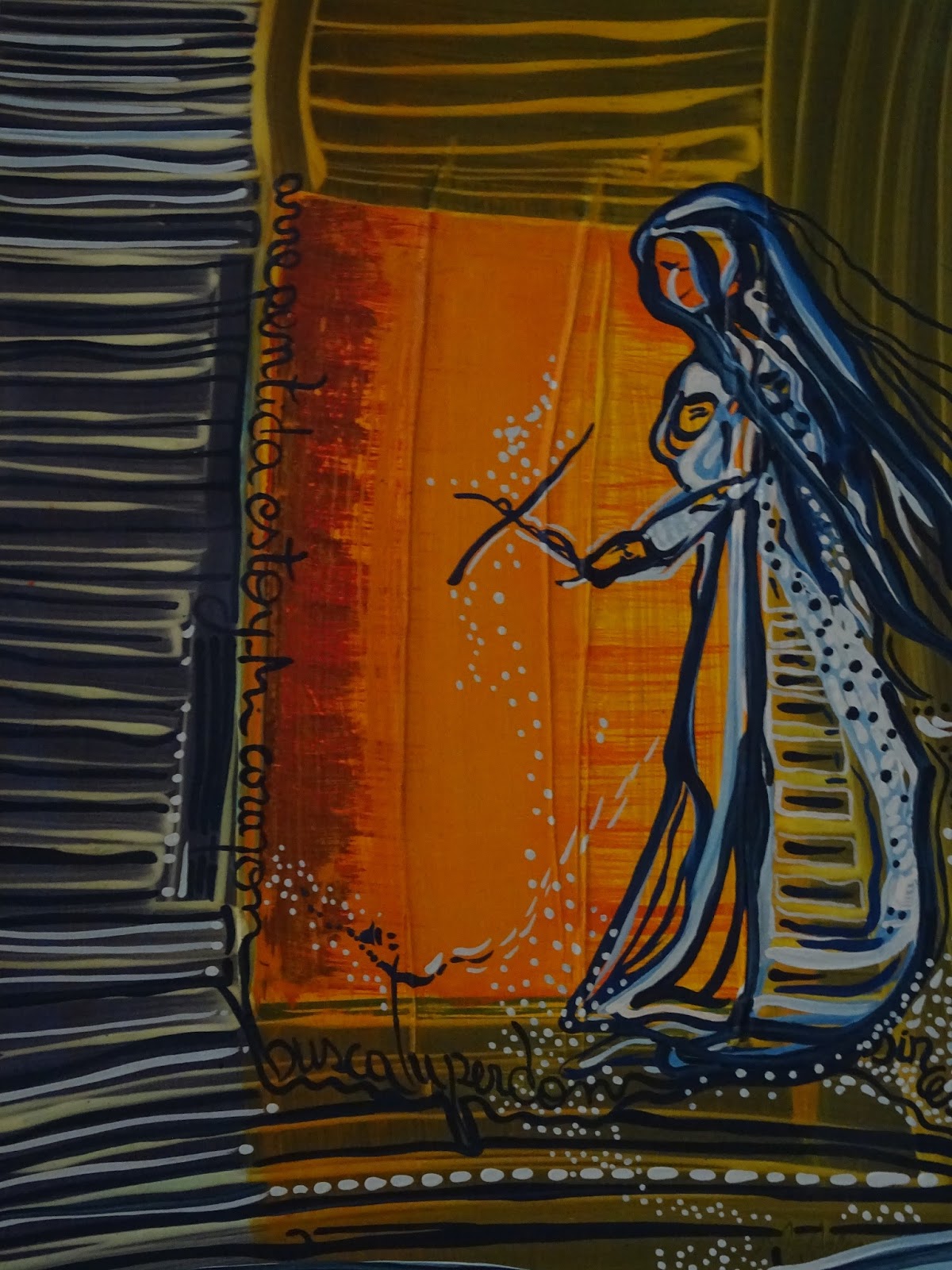
Each painting, María Inés Aguirre (MIA) says, “is a solar flare of colours” where every colour is an emotion. The critic Pierre Restany identified the distinctive quality of MIA’s art as having its roots in her emotional life which then manifests itself in “the exuberance and spontaneity of her painting.”

MIA has spoken of risk and adventure, and the resulting spontaneity, as being key to her art. Her work fuses colour, music, emotion and nature in “a sun-burst of colour, of joy and imagination.”

As Michael Hutchinson-Uzielli has noted, this means that "Mia's paintings map her emotions and imagination, with colour, texture and sinuous lines depicting the landscape of her thoughts.” Her work is, therefore, cartography of the heart or soul, as she, herself, has suggested in selecting the title ‘Via Cordis: The Way of the Heart’ for this show.

MIA says the following words of Paul Klee, from 1918, describe her own creative process: “Everything around me dissolves and interesting works emerge as if of their own accord. My hand is entirely the instrument of a distant sphere. It isnʼt my head that is working, but something else, something higher, something somewhere more remote. I must have great friends out there – obscure, but also brilliant - and theyʼre all very good to me.”

MIA’s identification with Klee’s description of creativity as involving a sense of giftedness from a higher force helps us in understanding the emotional impact of her work more fully. As a result, we could either see the emotions she maps in her work as being divinely inspired or think that by following and depicting those emotions she taps into the divine.

Her work has connected with traditional religious iconography, although not with traditional outcomes. Her ‘Via Crucis’, ‘Via Lucis’ and now ‘Via Cordis’ exhibitions have engaged with the imagery of the ‘Stations of the Cross’, the ‘Path of Light’ and now the ‘Way of the Heart’. Through these series she has reflected on emotions provoked by the Passion of Christ while seeing that narrative as also representing the different moods of modern man.

These are works to contemplate as, through energy of line and brilliance of colour (that “sun-burst of joy and imagination”), they refresh the soul.

MIA studied Fine Art at the University of Tucumán (Argentina) and the Accademia di Belle Arti in Venice. She has exhibited in Europe, Asia and the Americas and has shows later this year in Hong Kong, France and Argentina. Her work stands out for its colour, energy and spontaneity. Her fascination with the connections between music and colour led her to become the first visual artist in residence at Steinway & Sons, London, where she transformed a Steinway Model D concert grand piano into 'Dancing Soul'. She is represented by ArtMoorHouse - Moor House, 120 London Wall, London, EC2Y 5ET. Tel: +44(0)7502211914. Email: info@artmoorhouse.com. Web: http://www.artmoorhouse.com/.

-----------------------------------------------------------------------------------------------------------

The Milgram Trio - Piano Trio in E minor Op 90 'Dumky'.

Monday, 25 May 2015

Via Cordis – The Way of the Heart


St Stephen Walbrook is to host an exhibition of ceramics & paintings by María Inés Aguirre (MIA) entitled 'Via Cordis – The Way of the Heart' (Monday 8th – Friday 26th June, 10.00am – 4.00pm). An exhibition reception is being held with MIA on Monday 15th June, 6.30pm, at which I will speak about 'Art as Gift'. All are welcome.

Each painting, MIA says, “is a solar flare of colours” where every colour is an emotion. The critic Pierre Restany identified the distinctive quality of MIA’s art as having its roots in her emotional life which then manifests itself in “the exuberance and spontaneity of her painting.”

MIA has spoken of risk and adventure, and the resulting spontaneity, as being key to her art. Her work fuses colour, music, emotion and nature in “a sun-burst of colour, of joy and imagination.”

As Michael Hutchinson-Uzielli has noted, this means that "Mia's paintings map her emotions and imagination, with colour, texture and sinuous lines depicting the landscape of her thoughts.” Her work is, therefore, cartography of the heart or soul, as she, herself, has suggested in selecting the title ‘Via Cordis: The Way of the Heart’ for this show.

MIA says the following words of Paul Klee, from 1918, describe her own creative process: “Everything around me dissolves and interesting works emerge as if of their own accord. My hand is entirely the instrument of a distant sphere. It isnʼt my head that is working, but something else, something higher, something somewhere more remote. I must have great friends out there – obscure, but also brilliant - and theyʼre all very good to me.”

MIA’s identification with Klee’s description of creativity as involving a sense of giftedness from a higher force helps us in understanding the emotional impact of her work more fully. As a result, we could either see the emotions she maps in her work as being divinely inspired or think that by following and depicting those emotions she taps into the divine.

Her work has connected with traditional religious iconography, although not with traditional outcomes. Her ‘Via Crucis’, ‘Via Lucis’ and now ‘Via Cordis’ exhibitions have engaged with the imagery of the ‘Stations of the Cross’, the ‘Path of Light’ and now the ‘Way of the Heart’. Through these series she has reflected on emotions provoked by the Passion of Christ while seeing that narrative as also representing the different moods of modern man.

These are works to contemplate as, through energy of line and brilliance of colour (that “sun-burst of joy and imagination”), they refresh the soul.

MIA studied Fine Art at the University of Tucumán (Argentina) and the Accademia di Belle Arti in Venice. She has exhibited in Europe, Asia and the Americas and has shows later this year in Hong Kong, France and Argentina. Her work stands out for its colour, energy and spontaneity. Her fascination with the connections between music and colour led her to become the first visual artist in residence at Steinway & Sons, London, where she transformed a Steinway Model D concert grand piano into 'Dancing Soul'. She is represented by ArtMoorHouse - Moor House, 120 London Wall, London, EC2Y 5ET. Tel: +44(0)7502211914. Email: info@artmoorhouse.com. Web: http://www.artmoorhouse.com/.

St Stephen Walbrook – Tel: 020 7626 9000. Email: office@ststephenwalbrook.net. Web: www.ststephenwalbrook.net.

-----------------------------------------------------------------------------------------------

The Civil Wars - Sacred Heart.

Tuesday, 19 May 2015

Via Cordis - The Way of the Heart


'Via Cordis – The Way of the Heart' is an exhibition of ceramics & paintings by María Inés Aguirre (MIA) in June at St Stephen Walbrook (Monday 8th – Friday 26th June, 10.00am – 4.00pm). An exhibition reception is being held with MIA on Monday 15th June, 6.30pm, at which I will speak about 'Art as Gift'. All are welcome.

MIA studied Fine Art at the University of Tucumán (Argentina) and the Accademia di Belle Arti in Venice. She has exhibited in Europe, Asia and the Americas and has shows later this year in Hong Kong, France and Argentina. Her work stands out for its colour, energy and spontaneity. Her fascination with the connections between music and colour led her to become the first visual artist in residence at Steinway & Sons, London, where she transformed a Steinway Model D concert grand piano into 'Dancing Soul'. 

Through her 'Via Crucis', 'Via Lucis' and now 'Via Cordis' series she has reflected on emotions provoked by the Passion of Christ while seeing that narrative as also representing the different moods of modern man. These are works to contemplate as, through energy of line and brilliance of colour, they refresh the soul.

----------------------------------------------------------------------------------------

The Harbour Lights - Another Rainbow.

Thursday, 2 April 2015

Metaphysical symbol of purity and spiritual transformation

ArtMoorHouse is a creative space in a Norman Foster building at the heart of the City of London which provides the setting for a successful synergy between Art and Business.

Their current show is by Maria Ines Aguirre and is entitled The Element of Freedom. The element in question is water which is described as follows:

'Water is the carrier of nature, the pulse of life. Water changes itself info as many natures as the different places throng which it runs. Water does not resist, it flows, always going to where it wants to, so, in the end, nothing can resist it.

Metaphysical symbol of purity and spiritual transformation, water is the allegory of a new founded freedom; a freedom which is gained independently through the the ability to adapt to changing of the circumstances, whilst always remaining true to ourselves.'

Aguirre's work stands out for its colour, energy and spontaneity. Her fascination with the connections between music and colour led her to become the first visual artist in residence at Steinway & Sons, London, where she transformed a Steinway Model D concert grand piano into 'Dancing Soul'.

Pierre Restany wrote the following about Aguirre's work: 'We have become too intellectual in our ways of perceiving things. The dominance of rational thought over activities based on feeling prevents us from understanding the fullest dimension of any concept... For Mia, emotion is colour and colour is the virtual expression of emotions.'

-------------------------------------------------------------------------------------------

Joni Mitchell - Hejira.