Wikio - Top Blogs - Religion and belief
Showing posts with label job. Show all posts

Wednesday, 2 October 2024

A real relationship and conversation with God

Here's the sermon I shared at St Andrew’s Wickford this morning:

Although he doesn’t deserve it, Job is a man on whom all the troubles of the world have come (Job 9.1-12, 14-16). In rapid succession he loses all his livestock, servants and children. Then sores break out all over his body and his wife tells him to curse God and die. If we think life is hard for us, we might want to look at the story of Job and think again.

The book of Job is told as a series of conversations. It begins with a conversation between God and Satan about Job, continues with a conversation between Job and his friends about God and his response to suffering and ends with a conversation between Job and God himself. 

Job asks in 9.14-16:

“How then can I answer him,
choosing my words with him?
… If I summoned him and he answered me,
I do not believe that he would listen to my voice.”

However, Job’s experience, as the story progresses, is that it is possible for him to discuss and debate with God and what changes Job in this story is not the arguments and words of other human beings but the experience of genuinely meeting and speaking with God himself. Job asks why good people suffer and his friends reply that people suffer because of their wickedness, because they have not helped others and that we are punished in order to repent and be healed. Job knows in his heart and in his conscience that he has helped others and has not done wrong. Job’s friends are only able to tell Job what they think about God what they aren’t able to do is to help him encounter God himself. The story is told as a series of conversation because Job entering in to a conversation with God himself is what the book is all about.

Job’s friends - and, to begin with, Job, himself - think that being in relationship with God is primarily to do with our keeping a set of rules and regulations. If we do the right things then we will have God’s favour. The problem with this view is that we can look around the world and see wicked people who seem to prosper and good people who experience tragedy. This problem is acute for Job because he is one of those good people who experience tragedy. This view is still apparent in many churches today despite our knowledge of God’s grace and forgiveness in Jesus. Yet, when we act like that we are, like Job’s friends, setting up a series of standards which we believe come from God, and saying that if you don’t meet those standards or don’t repent, then you are outside of God’s will and no longer a follower of God.

But at the end of this story, it is Job’s friends with whom God is angry, not Job. In fact, Job himself has to pray for his friends so that they are not disgraced by God. The problem God has with Job’s friends is that they have not spoken the truth about God, as Job did. And yet much of what they had to say about God is standard theology about God. So, what is the difference between Job’s friends and Job? The difference is that Job wants to speak with God while his friends want to speak about God.

Job’s friends have a black and white view of God with no shades of grey and this is actually a way of avoiding encounter with God. In this way of thinking if life is going well then you know you must be keeping the rules because you have God’s favour and if life is not going well then you know you must have done something wrong and need to repent. Life is very simple and when you understand life like that you can keep God at arms length and don’t need to talk with him because you know what you have to do and all that matters is doing it right.

Job, however, knows that life is not as simple as that and, as a result, he wants to ask God about it direct. And when he starts talking to God, God starts talking to him. And what God has to say isn’t about giving Job rules and regulations to follow; it isn’t even about answering Job’s questions. It is simply about allowing Job to experience the magnitude of being in a real relationship and conversation with God. May it be so for each one of us. Amen.

--------------------------------------------------------------------------------------------------

Midnight Oil - World That I See.

Sunday, 28 July 2024

Meeting God in the dark night of the soul

Here's the sermon I shared this evening at St Catherine's Wickford:

The book of Job is the record of one man’s dark night of the soul. In the story Job loses everything that gave his life meaning. His family are wiped out, his home, money and possessions are lost, he experiences severe and painful illnesses and is left alone, except for three friends who are more hindrance than help as they offer only platitudes that essentially pin the blame for his condition on Job himself.

Job knows that the diagnosis offered by his friends is wrong. He knows there is nothing he has done to deserve his suffering. He knows that it is not punishment for something he has done and this gives us one of the reasons why this is such a significant book to find within the pages of the scriptures. The book of Job tells us that much suffering in this world is undeserved. There are times in life when we do reap what we sow and bear the consequences of our choices, as Job’s friends assume must be the case for him. But this is not one of those times and the story is told, in part, to warn us against making the assumptions made by Job’s friends. Not all suffering is brought on by our actions, sometimes life simply deals us a bum hand - and that’s the way it is!

Job is understandably angry about this situation. In the section of the poem we heard read today (Job 19:1-27), he says that he has been broken down on every side and that he has been pursued by both his friends and by God. God accepts Job’s arguing with him and affirms him in so doing. In the final chapter of the book, God says that he is angry with Job’s friends because they did not speak the truth about him, the way his servant Job did. So, the friends who said “it’s all your fault and God is right to punish you” were condemned and Job, who argued his case with God is affirmed.

The book of Job is important, therefore, because it tells us that it is ok to argue with God and to complain to him when life seems unfair. That is important because it is not how we have been brought up to think about relationship with God. Most of us instinctively think that submission to the will of God rather than arguing the toss with God is what makes for a good Christian. Job tells us that that is not so. And, in fact, if we read scripture carefully, we will finish that stories are told of all the heroes of the faith - from Abraham through Moses, Jeremiah and Habbakuk to Jesus and Paul - arguing with God. Why? Because it means we are in real relationship with God. Our virtuous mask comes off and we say what we really mean. We are honest with God in a way that we cannot be when we are trying to be righteous. That is real relationship and that is what God wants more than anything.

This is something which has been acknowledged and understood throughout Church history. The phrase which I used of Job at the beginning of this sermon - the dark night of the soul - was coined by St John of the Cross while imprisoned in a tiny prison cell for his attempts to reform the Church. He was a sixteenth-century Spanish mystic who wrote many of his poems on a scroll smuggled to him by one of his guards. After escaping his captors, he wrote the Dark Night of the Soul, a poem about the painful experience that people endure as they seek to grow in spiritual maturity and union with God.

Similarly, the poet Gerard Manley Hopkins wrote of “That night, that year / Of now done darkness I wretch lay wrestling with (my God!) my God.”

I wake and feel the fell of dark, not day.
What hours, O what black hours we have spent
This night! what sights you, heart, saw; ways you went!
And more must, in yet longer light's delay.
With witness I speak this. But where I say
Hours I mean years, mean life. And my lament
Is cries countless, cries like dead letters sent
To dearest him that lives alas! away.
I am gall, I am heartburn. God's most deep decree
Bitter would have me taste: my taste was me;
Bones built in me, flesh filled, blood brimmed the curse.
Selfyeast of spirit a dull dough sours. I see
The lost are like this, and their scourge to be
As I am mine, their sweating selves; but worse.

At the end of the Book of Job, Job says, “I talked about things I did not understand, about marvels too great for me to know.” Through his dark night of the soul, he comes to understand that God is not who or what he had thought him to be. God is more than he had imagined or conceived. Human beings can know God but cannot know God fully because is always more than we can imagine or conceive. Every image or idea we have of God is inadequate because God is always more than any human definition. We can say, for example, that God is Father but to say that cannot fully define God as God can also be understood as Mother and as child and as Spirit (without gender). All these different things are true of God at one and the same time. So, God is both known to us and yet unknowable. In the dark night of the soul, all that we had thought we knew of God is taken away from us and we experience something of the mystery of God.

Summing all this up, what can we say? We need to be careful about the advice we offer to those who are suffering. In particular, not to assume that they have in some way brought their suffering on themselves. God said to Job’s friends, “you did not speak the truth about me, the way my servant Job did.” Then, to understand that we do not have to suffer in silence. To argue or complain to God actually brings us into a deeper relationship with him and is a valid part of prayer. Job says, “I still rebel and complain against God; I cannot keep from groaning.” Finally, we need to be prepared to have our understandings of God brought into question as he challenges us to engage with the mystery of who he is, the One who is always more than we can ever conceive or image. And so, like Job, we say “I talked about things I did not understand, about marvels too great for me to know.” May it be so for each one of us. Amen.

-----------------------------------------------------------------------------------------------------

Tuesday, 5 September 2023

The Art of Creation


This one-day conference brought together speakers from a wide range of disciplines to explore the intersection of art, theology, and ecology. The event, at King's College London, fostered dialogue and collaboration between these fields and encouragement of innovative approaches.

The programme included short papers that explored the relationship between art, theology, and ecology in relation to three works of art from the National Gallery’s collection: Monet’s 'Flood Waters', Van Gogh’s 'Long Grass with Butterflies', and Ruysch’s 'Flowers in a Vase'. It also featured a reflection on the 'Saint Francis of Assisi' exhibition at the National Gallery, from co-curator Joost Joustra.

The presentations were:
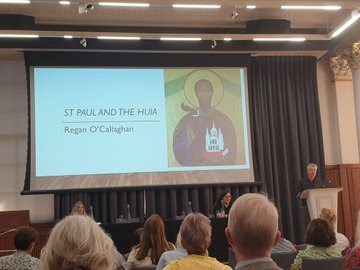
  • Art At Creation’s Extinction: Ecological Theologies in Ruysch’s Flowers in a Vase and Regan O’Callaghan’s St Paul and the Huia – Steve Taylor
  • ‘God Saw All That He Had Made and Found it Very Good’ – Melissa Raphael
  • Letting Creation Speak: A Theology of Resonance and the Ecological Art of Vincent van Gogh – Wes Vander Lugt
  • Nouvelle Theologie, Van Gogh, and Artist Practice – Anna Yearwood
  • Reflections on St Francis of Assisi – Dr Joost Joustra, as Howard and Roberta Ahmanson Associate Curator of Art and Religion and one of the curators of the exhibition
  • ‘We Are Water Spirits’: An Ecofeminist Theological Response to Monet’s Floodwaters in Conversation with South African Poetry – Ninnaku Oberholzer
My paper 'Job 38.1-11 and The Art of Creation' explored the way in which the abundance of nature exceeds human constraints in the three images. Claude Monet depicts river waters exceeding their natural banks to flood surrounding lands in Flood Waters, Vincent Van Gogh paints an expanse of grass extending beyond his canvas in Long Grass with Butterflies, while Rachel Ruysch’s Flowers in a Vase brings flowers that bloom at different times of year together in one image. This evidence of our inability as human beings to corral nature was equated to the intent of the questions posed by God in Job 38.1-33, as these are intended to show Job (and the readers of this text) the limits to human understanding. The ways in which the three artists use their canvasses was also explored in order to contrast the limits of human understanding and the fecundity of nature with the necessity of edges, frames, and other constraints in order that human beings sub-create or co-create. In these ways, the paper reflected on the possibilities and limits to human creativity in relation to divine creativity, using the attempt by artists to depict the beauty and wonder of God’s creation on canvas as a paradigm for creation-care more generally.

------------------------------------------------------------------------------------------------------------

Water into Wine  Band - Harvest Time.

Sunday, 21 February 2021

Close to nature: Life in Lenten environments

Sermon preached at All Saints Church, Tooting on the first Sunday of Lent and the beginning of their Lent in Pictures project.

Readings: Job 38.1-7, 25-29, 36-41, 42.1-6; Revelation 22.1-5; and Matthew 4.11-17, 24. 1-3


Around the mid-point of his life, my father switched careers from community work to retrain as a landscape gardener. We moved from the city of Oxford to a village in Somerset and, although the change was to some extent forced on him and caused financial difficulties for us as a family, he came to greatly appreciate the enhanced sense of being in nature and of living closer to the natural rhythms of the seasons and the circle of life.

However, while our awareness of nature is undoubtedly enhanced by times in the countryside, we don’t need to live in a rural area in order to aware of and affected by the natural world. Those who live here in Britain are, for example, well known for being obsessed with talking about the weather. According to research, 94% of British respondents admit to having conversed about the weather in the past six hours, while 38% say they have in the past 60 minutes. Kate Fox, who performed the studies in 2010 for an update of her book Watching the English, says “This means at almost any moment in this country, at least a third of the population is either talking about the weather, has already done so or is about to do so.” This is because there are several features of this country’s geography that make our weather the way it is: mild, changeable, and famously unpredictable. For many the changing seasons and weather affect our mood and can, for some, cause depression with Seasonal affective disorder (SAD), for example, being a type of depression that comes and goes in a seasonal pattern possibly linked to reduced exposure to sunlight during the shorter autumn and winter days.

Our theme for today, based on your Lent project, is relationship with the natural world, thinking especially of the environments in the Lenten stories. Our readings illustrate key aspects of that relationship – challenge, awe, mission, healing. In fact, these readings can be ordered to suggest a journey through the environments of Lent and life, involving environments of remove, ruin, renewal, and recuperation.

The readings from the Book of Job are about the expansive nature of the universe in which we find ourselves; both the breadth and depth of creation in macro and micro dimensions. We move through a series of questions that range from the earth’s foundations in creation through the patterns of the weather to the hunting practices of predators. Job is asked whether he was present at creation, how creation occurred, whether he understands the workings of the natural world, and whether he can provide for the creatures of the world. The answer to all these questions is clearly ‘No, he does not’ and that realisation brings him to his knees with a sense of awe towards the God who can answer such questions and a sense of humility through a realisation of his place within a world that is immense and teeming with myriad forms of life.

Job has an experience of the vastness of the universe and the awesome nature of the God who created; a God who is removed from us because we have no means of comprehending the length and breadth, height, depth or diversity of his nature, activity and potential. All Job can do in the environment of remoteness is to stand in awe and wonder, aware of his insignificance in the face of such expanse.

I wonder whether you have had such an experience; maybe lying on a hill contemplating the night sky or at the peak of a high mountain on a cloudless day seeing what seems to be the whole earth laid out beneath you or in the depths of a wood or forest surrounded by an amazing array of flora, fauna and creatures. That same sense of immensity can also be found in the micro as well as the macro if we learn to look with attention; the beauty of a snowflake or the intricacies of a cobweb, the patterns of a leaf or the hues of a petal. I wonder whether you can find an environment – literal or virtual – in which you can experience a sense of remove bringing awe and humility. I wonder too whether you can capture something of that sense of remove in a photo, poem, painting or other creative work for your Lenten project, exhibition and film.

In Matthew 24 we hear Jesus conjure up an environment of ruin for his disciples. His disciples came to point out to him the magnificence of the buildings of the temple and he assured them that, in the near future, not one stone will be left upon another; all will be thrown down. All human environments are subject to decay yet the natural impermanence and temporality of our constructions and creations was not the point that Jesus was making here. His statement was a prophecy regarding events that would occur within the lifetime of his disciples – the fall of Jerusalem in AD70 – which would be a confirmation to those disciples of the truth of Jesus’ words and a vindication of him as a true prophet. His words were also a warning preparing his disciples for a time of trauma and trial when their lives would be at risk and their faith tested.

The environment of ruin – whether physical, emotional, spiritual or all three – is a place of real trauma which can nevertheless become the place where God becomes more real to us than ever was the case in times of prosperity. That was the experience of the Israelites in exile as Babylon was the place where their scriptures were written down and compiled. For Christ, the letting go of life through the agony of the cross was inextricably united to the astonishing renewal of resurrection. For the first disciples, the destruction of the Temple and the perils of persecution were the crucible in which the Early Church was fashioned.

This lockdown Lent it may be that the pandemic has formed an environment of ruin for us and for our world as economies have contracted, jobs have been lost, restrictions enforced, and millions have died. As we survey the devastation that has been caused, can we encounter God with us in new ways and in new depths of experience as we see the myriad ways we can find at this time to be with others through in-person care and virtual connections. I wonder how you can reflect on the environment of ruin through your Lenten project and Lenten experiences.

By contrast our reading from Matthew 4 sees Jesus leave the place of trial and restriction to make his home in Capernaum by the sea and to go on the road by the sea, across the Jordan, to Galilee of the Gentiles proclaiming that the kingdom of heaven has come near and that light has come to those who sit in darkness and the shadow of death.

This is the environment of renewal; a place of activity and vocation, of gatherings and shelters, of journeys and arrivals, of farming and fishing. In three short years, Jesus travelled throughout Galilee and beyond, calling and training disciples sending out 12 and then 72 while others supported them financially from their homes. This is the environment in which his teaching was shared; whether sermons on mountains, stories from boats or acted parables in upper rooms. The stories he told were also set in this environment and peopled by farmers and fishermen.

This environment is one of daily life and work. It is ordinary, everyday and mundane yet the kingdom of heaven is near and the light of illumination is at hand. I wonder what you will find of heaven in your everyday life and work this Lent. How will your stories and sharing, your activity and travel – whether literal or virtual – be blessed and broken for revelation and renewal? How will you picture or describe the in-breaking of the kingdom in the environment of renewal for your Lenten project?

The final environment in our readings is that of recuperation. Our destiny, our destination, is a city where the river of the water of life flows through the middle of the street with the tree of life alongside and the leaves of the tree are for the healing of the nations. This is a place of restoration where nothing accursed will be found any more, where God will wipe every tear from our eyes and death, mourning and crying and pain will be no more. The wolf shall live with the lamb, the leopard shall lie down with the kid, the calf and the lion and the fatling together, and a little child shall lead them. They will not hurt or destroy for the earth will be full of the knowledge of the Lord as the waters cover the sea.

Our experience in this world is of being led to green pastures and of being led through the valley of the shadow of death, but our ultimate end is to dwell in the house of the Lord forever where goodness and mercy shall follow us all the days of our lives. I wonder where are the green pastures and still waters to which we can be led this Lent in order that we experience a taste of the restoration we shall experience in that final environment of recuperation. What images and words can we find to illustrate and illuminate that experience for those that will see your Lenten project, exhibition and film?

If you seek out these environments and experiences this Lent and if you share them through pictures, photographs, films for your Lenten project, then you will have the experience that my father knew, in moving from community work to landscape gardening, of coming closer to the natural rhythms of the seasons and the circle of life. By coming into these Lenten environments of remove, ruin, renewal, and recuperation, you will experience challenge, awe, vocation, and healing while coming closer to the pattern of death and resurrection, letting go and receiving back that is the natural rhythm of the spiritual life. It is my prayer that that may be your experience this Lent. Amen.

----------------------------------------------------------------------------------------------------------

John Tavener - Eternity's Sunrise.

Friday, 2 October 2020

Conversation that will transform creation for good

Here's the reflection that I shared during today's lunchtime Eucharist for St Martin-in-the-Fields:

The book of Job is told as a series of conversation – conversations between God and Satan, between Job and his friends, and between Job and God - because being in conversation with God is what the book is all about. At the end of the book Job says to God, “In the past I knew only what others had told me, but now I have seen you with my own eyes” and this is perhaps the key statement to understanding what is going on in this book.

The book of Job is concerned with the problem of pain; why does suffering occur and why do good people suffer? But the book does not provide answers to these questions. Job’s friends try to tell him that because he is suffering then he must be at fault in some way. But Job knows that that is not the case and this is confirmed at the end of the book when God is angry with Job’s friends because they did not speak the truth about him as Job did. Instead of accepting the advice of his friends and saying that he is at fault, Job decides to state his case to God and by doing so starts a conversation with God in which he begins to see God with his own eyes instead of hearing about God from what others had to tell him. The important thing that happens in this book; the thing that changes Job and his situation is that he begins this conversation.

It is part of this conversation with God that we have heard read today (Job 38:1, 12-21, 40:3-5) and what we have heard is mainly God’s contribution to the conversation. One of the most obvious things to jump out at us from what God says is that he doesn’t provide any answers to Job’s questions. Instead, he asks a series of other questions which give Job a sense of the awesome nature of God as creator and sustainer of life. It is God who created and ordered the world and who understands its patterns and cycles of life: the times of birth for mountain goats and wild deer; the freedom of wild donkeys; the strength of wild oxen and horses; the speed of the ostrich; the flight of the hawk and the nesting of the eagle. All of these and more God created and understands their pattern of life and their place in the tapestry of nature and circle of life. All of these and more God understands while Job does not.

It is easy to read these passages and think that what God wants to do is to belittle Job by making him realise just how insignificant he is as a human being and therefore that he should simply respond by accepting what God does and says. Job seems to feel like that too because when God challenges him to answer his questions Job throws up his hands and says, “I spoke foolishly, Lord. What can I answer? I will not try to say anything else. I have already said more than I should.” Often people read the book of Job as though that is the answer to the problem of suffering; it is all in God’s hands, we can’t understand and therefore we should just trust him.

But that isn’t what God wants at all. Instead, God goes on to say, “Stand up like a man, and answer my questions.” God challenges Job to give an answer to his questions and says that it is in the nature of his humanity that Job should answer these questions. God wants to be in a conversation with human beings where we take responsibility for our lives and our world. Where we find answers to the questions that God poses to human beings but where we find those answers in conversation with God.

When we are out of conversation with God or only have knowledge of God through others, then we are not working in partnership with God for the benefit of the world in which we live. That is the situation in which humanity finds itself in relation to the questions that God asked of Job: Do you know when mountain goats are born? Do you know how long wild deer carry their young? Will the wild ox work for you? Human beings now know the answers to these and many of the other questions that God asked of Job. That is not wrong. God wanted us to be able to explore his creation and find answers to those questions. But he wanted humanity to do that together with him, in conversation with him. Instead for most of human history, we have ignored God and explored his creation on our terms and in our way exploiting creation for our own gain. We know now where that has got us; that we stand in danger of destroying God’s creation and ourselves along with it. We have a desperate and urgent need as human beings to be talking to God about the answers to the questions he posed to Job.

God wants us to be in conversation with him and when we are, as Job found, it transforms our understanding of ourselves and our world. Throughout history God has been seeking people who will be in conversation with him and who through that conversation will transform his creation for good and not for ill. Because of our selfish exploitation of the world and its resources it seems that we stand on the precipice of an ecological disaster. Will that realisation be sufficient to bring our generation back into conversation with God just as the destruction of his world propelled Job into his challenge to God which opened a life-changing conversation through which he saw God with his own eyes? 

------------------------------------------------------------------------------------------------------------

Marvin Gaye - What's Going On?

Tuesday, 24 April 2018

Engaging with religious approaches to grief and loss

Exhibitions at Glasgow International 2018 and by Art Angel engage with religious approaches to grief and loss:

'For his solo exhibition at Tramway, Turner Prize-winning artist Mark Leckey has taken as his starting point an 18th Century wooden figurine of Job held at the Wellcome Collection in London. Leckey has enlarged the object to human scale. This single forsaken biblical figure occupies alone the vast space of Tramway.

The title ‘Nobodaddy’ is taken from the poem by William Blake, a name that for Blake is a play on the idea of God the father of no one, but also the man with no body. In Leckey’s sculpture this body is expanded and infiltrated by technology. Man’s limbs are hollowed out, the organs removed, and filled with speakers that give voice to his state. Opposite the sculpture a large video projection mirrors the figure as it is toggles through different scenarios.'

Laura Cumming writes: 'Based on a German carving, Mark Leckey’s statue is larger than life and fully as profound with its sorrowful face and putrefying sores. A poor soul lost in suffering, almost, he sits alone in his melancholy contemplation, head in hand like Rodin’s Thinker.

But what he’s thinking is voiced in the air. The statue speaks, words emitting from its wounds and also from a screen in which the motionless Job is given some kind of life through a flux of shifting light and scenario. Time passes, place changes, the days speed and slow; and still the prophet endures. He talks of his plagues, ancient and modern (the camera enters the figure, an endoscopy of hollowed tracts), bewildered by their harshness; and yet there is still hope: he dreams of swimming, and even of flying.

The lament is powerfully moving, not least because the Turner prize-winning artist sets up a tension between the virtual and the real. The screen, with all its brilliant CGI effects, is restlessly compelling, and yet one is drawn loyally back to the poor simple statue. It is a gripping standoff between old and new technologies, in which the biblical agonies of Job, thousands of years ago, are made devastatingly present and timeless.'

Taryn Simon's first major performance work An Occupation of Loss takes place in a subterranean location in Central London. 'Each night, professional mourners simultaneously broadcast their lamentations, enacting rituals of grief from around the world.'

'Their sonic mourning is performed in recitations that include northern Albanian laments, which seek to excavate “uncried words”; Venezuelan laments, which safeguard the soul’s passage to the Milky Way; Greek Epirotic laments, which bind the story of a life with its afterlife; and Yezidi laments, which map a topography of displacement and exile.'

Adrian Searle writes: 'Alone, in couples and in trios and quartets, these singers and musicians – Armenian Yazidis, Cambodian performers of Kantaomming, Ghanaian women wailing and crying, performers of Greek polyphonic panegyri – are singing for those who are not here ... Their indifference to us despite our proximity is disturbing, as one is led by sound from one group to another, from culture to culture, language to language, ritual to ritual. Sometimes I feel like I am intruding on a stranger’s grief. At other moments transfixed and bewildered, like a lost anthropologist, a rubber-necker, a ghoul. Do I think about my own losses, the dead I didn’t mourn, my insufficiency of tears, my failed gravitas?

For all the polyphonies and cultural differences, there is an overall measure to the forms and sounds of lamentation, a register of sorrow that appears to cross times and places, religions and beliefs. What they mostly have in common, apart from a display of outward mourning and loss, is a sense of paying witness, and of being alive among the dead.'

-------------------------------------------------------------------------------------------------

John Prine & Nanci Griffith - The Speed Of The Sound Of Loneliness.

Monday, 13 July 2015

Discover & explore: Imagination


A.N. Wilson has written that, in the first half of the twentieth century, there were artistic giants in the Anglican Church. He was thinking people such as T.S. Eliot, C.S. Lewis and Dorothy L. Sayers.

Sayers, best known for her fictional detective Lord Peter Wimsey, was also, like C.S. Lewis, a popular Christian apologist. Her most interesting apologetic work is perhaps The Mind of the Maker (1941) where she explores the creative act itself in the Trinitarian terms of Idea (Father), Energy (Son), and Power (Spirit):

“For every work [or act] of creation is threefold, an earthly trinity to match the heavenly.

First, [not in time, but merely in order of enumeration] there is the Creative Idea, passionless, timeless, beholding the whole work complete at once, the end in the beginning: and this is the image of the Father.

Second, there is the Creative Energy [or Activity] begotten of that idea, working in time from the beginning to the end, with sweat and passion, being incarnate in the bonds of matter: and this is the image of the Word.

Third, there is the Creative Power, the meaning of the work and its response in the lively soul: and this is the image of the indwelling Spirit.

And these three are one, each equally in itself the whole work, whereof none can exist without other: and this is the image of the Trinity.”

If the relationships within the Trinity provide the model for our creativity as human beings, this suggests that our creativity itself comes from God. Sayers remarks in the book that the one thing we know for sure about God at the point that he makes humanity in his own image is that he is creative: “The characteristic common to God and man, is … the desire and ability to make things.”

God is the ultimate creator, who created from nothing. Sayers quotes Nikolai Berdyaev approvingly when he says, "God created the world by imagination" and we get an insight into God’s imaginative work of creation through the passage from Job (38. 4 - 21). As those made in the image of God, we are sub-creators, able to, as Sayers puts it, "rearrange the unalterable and indestructible units of matter in the universe and build them up into new forms."

These ideas, which see human creativity and the creative act itself as being formed and framed by God, lead us to view art and the imagination as a gift from God. Max Lieberman & Michael McFadden note that the:

“idea of the artist as instrument of the divine, or acting with divine inspiration, has been an archetypal theme espoused by great artists attempting to express the processes of their work. Kahlil Gibran, the great 20th century mystic poet and artist touched on two of the metaphors of antiquity, to describe the process of an artist's creation in writing, "Am I a harp that the hand of the almighty may touch me or a flute that this breath may pass through me?" Gibran perhaps unconsciously, refers to the Ancient Greek metaphor of the Aeolian Harp and the Hindu myth of Lord Krishna's flute … The Aeolian Harp represents the artist, whose finely tuned and sensitive soul responds to the divine breeze of the Holy Spirit as it blows through the strings, turning what is invisible and intangible to most, into beautiful enchanting music to move the minds and hearts of those who might be otherwise insensitive to the movement of this divine force … The artist is similarly conceived as a musical instrument in an Ancient Hindu myth … The great artist is conceived as the hollowed-out instrument of God, emptied of egoism and selfish desire, and thus able to transmit the experience of their union with the divine through the enchanting "music" of their artwork.

Some years ago I encountered the same idea in a book called Written In My Soul, a series of interviews with some of the most well-known singer-songwriters from the 1950s onward, where I was struck by the extent to which these great artists – Bob Dylan, Neil Young, Van Morrison and others – felt that their songs were given to them in moments of revelation, that their songs were already written and ‘came through them as though radio receivers – without much conscious effort or direction.’ More recently, the singer-songwriter Bill Fay has released a track called ‘Who is the Sender?’ in which he asserts that his songs are delivered to him by the unknown sender. Songs aren't written, but found. "Music gives," he says, and he is a grateful receiver.

MIA, the artist who work we were exhibiting at St Stephen Walbrook at the beginning of this service series, has identified similar words of Paul Klee as describing her own creative process: “Everything around me dissolves and interesting works emerge as if of their own accord. My hand is entirely the instrument of a distant sphere. It isnʼt my head that is working, but something else, something higher, something somewhere more remote. I must have great friends out there – obscure, but also brilliant - and theyʼre all very good to me.”

Samuel Taylor Coleridge was in a similar moment of inspiration while writing Kubla Khan. He wrote: “In the summer of the year 1797, the Author, then in ill health, had retired to a lonely farm house between Porlock and Linton, on the Exmoor confines of Somerset and Devonshire. In consequence of a slight indisposition, an anodyne had been prescribed, from the effects of which he fell asleep in his chair at the moment that he was reading the following sentence, or words of the same substance, in 'Purchas's Pilgrimes:' 'Here the Khan Kubla commanded a palace to be built, and a stately garden thereunto: and thus ten miles of fertile ground were inclosed with a wall.'

The Author continued for about three hours in a profound sleep, at least of the external senses, during which time he has the most vivid confidence, that he could not have composed less than from two to three hundred lines; if that indeed can be called composition in which all the images rose up before him as things, with a parallel production of the correspondent expressions, without any sensation or consciousness of effort. On awakening he appeared to himself to have a distinct recollection of the whole, and taking his pen, ink, and paper, instantly and eagerly wrote down the lines that are here preserved. At this moment he was unfortunately called out by a person on business from Porlock, and detained by him above an hour, and on his return to his room, found, to his no small surprise and mortification, that though he still retained some vague and dim recollection of the general purport of the vision, yet, with the exception of some eight or ten scattered lines and images, all the rest had passed away like the images on the surface of a stream into which a stone had been cast, but, alas! without the after restoration of the latter.”

The gift of imagination is one given in moments of inspiration which cannot be repeated. Such experiences can be described as experiences of the Holy Spirit inspiring or coming on the artist. Certainly that has been my experience both in creating and preaching. I will often reflect or meditate on an experience, a song, an image, a Bible passage, by putting it in my mind, carrying it around in my mind over several days or weeks, reminding myself of it from time to time and just generally living with it for a period of time and when I do that then I find that, at some unexpected moment, a new thought or idea or image will come to me that makes sense or takes forward the experience or song or image or passage on which I had been reflecting. To my mind that is the Spirit coming and making connections, bringing clarity, making sense.

That was also Coleridge’s understanding of imagination. He was part of the Victorian Romantic movement, which features in the Guildhall Art Gallery’s collection, where visualising the distant past and opening up worlds of imaginative possibility offered “much needed escapism from the harsh realities of everyday life.” For Coleridge, though, imagination is the intuitive, unitive faculty in us that sees the whole behind the parts; the one and the many. Where reason analyses and reduces into parts, imagination puts the parts together into a whole and takes us to the hidden metaphysical unity behind multiplicity. For Coleridge, as for Sayers, this is not simply “much needed escapism from the harsh realities of everyday life” but instead “a repetition in the finite mind of the eternal act of creation in the infinite I Am.”

--------------------------------------------------------------------------------

John Rutter - Look At The World.

Friday, 7 November 2014

Guardian arts updates

Today's Guardian has some interesting articles:

Andy Warhol: 'the pertinence of the Velvet Underground to understanding Warhol is more than decorative. If you believe the cliches about this famous yet elusive man – that he was a heartless “business artist”, a vacuous worshipper of celebrity – I recommend a course of listening to Reed and Cale. Few who have done so dispute that the band Warhol discovered was one of the most serious, original and aesthetically rich in the history of rock. So how come the “superficial” Warhol instantly got them?

Clearly, because he was not so superficial after all. Warhol did not create some jokey, Monkees-like, money-spinning pop group, but instead promoted a disturbing avant-garde outfit who sang about drug addiction and sadomasochism. For he was never a cheerleader for the mainstream. He was and is the quintessential painter of modern life – a reporter, a documentarist, a louche teller of awkward truths.'

Leviathan: 'it is perhaps the church that comes in for Leviathan’s most sledgehammer satire. “We are reawakening the soul of the Russian people,” intones the film’s imperious bishop, voice shaking with righteous anger as he reels off a list of enemies who would undermine Russia. It is a voice that could come from the daily evening news bulletins on state-controlled television. This bishop, with his gold and mahogany office, contrasts with a local bedraggled priest who gives the distraught Nikolai an impromptu sermon on the tests that God might have in store. Zvyagintsev describes himself as secular, but a believer.'

'The great trial of Job is reborn in this magnificent Russian movie, first seen at Cannes this year. Leviathan is a tragic drama, compelling in its moral seriousness, with a severity and force that escalate into a terrible, annihilating sort of grandeur. Zvyagintsev combines an Old Testament fable with something like Tarkovsky’s Sacrifice; it also has something of Elia Kazan’s On the Waterfront or Robert Rossen’s municipal graft classic All the King’s Men.'

Fuse ODG: 'You get the impression that, whatever the situation, Fuse, an avowed Christian, would fix it ... The songs on his album – Keep On Shining, Beautiful Sunray, Bucket Full of Sunshine – are almost indecently bubbly. It’s as though he’s willing us to join him in his jubilant state ... I knew I had to go through what I did so that I could share my story. So that I could have a platform where I could speak out, be influential and change lives. Whether it’s working with ex-offenders or now making afrobeats and pushing the new Africa that inspired me – most of the things I do in my life are to help other people,” he says, matter-of-factly.'

---------------------------------------------------------------------------------------------------

Velvet Underground - That's The Story Of My Life.

Monday, 3 June 2013

Sophia Hub pilot - Job vacancy

Do you want to empower people to change our local community? 

Sophia Hubs are local centres which foster new social enterprises and businesses, harnessing the ageless principles of wisdom. We seek a talented Project Coordinator and Developer to set up and deliver a pilot Sophia Hub in Seven Kings and Newbury Park, thereby helping to take the Sophia Hubs project into its next phase of development and growth.
 
Contact Rev. Jonathan Evens at jonathan.evens@btinternet.com or Sophia Hubs, c/o St John the Evangelist, St John’s Road, Seven Kings, Ilford, Essex IG2 7BB for a copy of the Job Description and Person Specification. Apply by submitting your CV, a supporting statement explaining how your experience is right for this job and how you meet the person specification, and details of two referees. Applications to be made by Friday 21st June 2013.

The Cathedral Innovation Centre, one of several organisations with which Sophia Hubs are liaising, has recently launched its Faith In Enterprise Awards, a £275,000 national initiative of the Cathedral Innovation Centre open to entrepreneurs aged 18 to 30 of all communities. The Faith In Enterprise award funds are open to all but are especially aimed to encourage local religious leaders to identify fresh entrepreneurial talent in their towns and cities; at supporting young entrepreneurs to emerge from the major faith communities; as an opportunity for young entrepreneurs from diverse communities to collaborate, and as a means to unlock the talents, time and resources of people of faith to support growth, launch firms and establish business and social ventures in tough economic times.

------------------------------------------------------------------------------------------

Thursday, 25 October 2012

Retreat reading


I'm just back from my annual cell group retreat (with fellow bloggers Sam Norton and Paul Trathen, among others) which this year took place at the Carmelite Priory at Boars Hill. Here are some of the highlights from my retreat reading which reflect our Carmelite setting:

"Applying the practice of the Übersichtliche Darstellung, then, to our 'mystical investigations', here we observe a process of watching or seeing the 'Form of Life' (Lebensform) through the 'language games' (Sprachspiele) that are employed. Our job is not to make mystical interpretations of certain Weltanschauungen but to present 'everything as it is'. The ontological questions no longer concern us. When Wittgenstein's approach is applied to the spiritual realm, its application is neatly summarized by Drury's remarks concerning The Tractatus:

For me, from the very first, and ever since, and still now, certain sentences from the Tractatus Logico-Philosophicus stuck in my mind like arrows, and have determined the direction of my thinking. They are these:

1. 'Everything that can be put into words can be put clearly'
2. 'Philosophy will signify what cannot be said by presenting clearly what can be said'
3. 'There are, indeed, things which cannot be put into words. They make themselves manifest. They are mystical'.
(Drury 1973:iv)

... Drury ... delineated the relationship between (1) the need to speak clearly - the Übersichtliche Blick of the philosopher, and (2) how this relates to the 'unsayable' and the 'mystical'. By delineating what can be said clearly we also delineate what cannot be said but can be shown. This ... is the role of the philosopher who investigates 'the mystical' ... 

the Wittgensteinian approach advocated here concentrates the mystic 'speech act' in it's overall communicative intent; that is, through showing as well as saying. This leads to the notion ... of the 'performative discourse of mystical speech'."

"... the Wittgensteinian move from Weltanschauungen to Weltbild under the Übersichtliche Darstellung - from mind/body Cartesian dualism to a post-enlightenment suspicion of the Cartesian 'I' - mirrors the strategies of 'mystical discourse'. The mystical strategies ... of unknowing and affectivity ... are held alike by the contemporary post-enlightenment discourse of Wittgenstein and the pre-enlightenment discourse of theologia mystica. That is, with the 'postmodern' critique of Cartesian dualism we return to a 'pre-modern' notion of self. Both discourses share similar strategies and ... for both 'style' is as important as 'content'.

Both Teresa and Wittgenstein ... are in their own ways inviting their readers to move 'out of the head' into embodied practices. This ... is the key 'transformational strategy' of both Ludwig Wittgenstein and the writers of the Christian tradition of theologia mystica:

A religious question is either a 'life question' or (empty) chatter. This language game, we could say, only deals with 'life questions'.
(Wittgenstein BEE 183:202)"

Peter Tyler, The Return To The Mystical

"Mysticism is a protean term used to signify a variety of disparate phenomena from the sublime to the trivial, from the effusions of the God-intoxicated saint to the babblings of the hallucinogen-intoxicated addict. It runs the gamut from St Teresa's mansions of the soul to Timothy Leary's neural cocoon ... Although mysticism is a puzzle it should be kept in mind that its often exotic language and the bizarre phenomenon associated with it hinge on a single point: If God exists - and the consensus of the Mystics of the Book (that is, the followers of Judaism, Christianity, Islam) believe that He does - then God is the ultimate goal of human life. Moreover, He is a goal which humankind cannot attain by its efforts alone. Divine aid is necessary. The conviction that the beatific vision is grounded on God, the lumen gloriae of the theologians, delivered Christianity from becoming no more than another priggish intellectual sect or esoteric mystery religion ... It can be said that the mystic claims to be able to penetrate the carapace of the external world, view the beauty within, and ascend to its source, the "all-beautiful One" of St Augustine. That the mystic is directed towards this vision is often lost in the horrifying penances and bizarre exotica that glut their accounts." R. A. Herrera, Silent Music: The Life, Work, and Thought of St John of the Cross  

“I would still argue that everyone, no matter how confused or ill-situated in life, can have at least modest mystical experiences. They may be as simple as the beautiful stillness that settles at the sight of a sunset or a brief period of wonder at the birth of a child. Mysticism doesn’t have to be a life profession. Further, I think that much of our depression, anxiety, and addiction has to do with what John writes about: the soul’s need and longing for transcendence. This need is instinctual and unavoidable.” Thomas Moore, Foreword to M. Starr trans., St John of the Cross: Dark Night of the Soul

“God stripped Job naked and left him on a dunghill, vulnerable and persecuted by his friends. The ground was teeming with worms. Job was filled with anguish and bitterness. This was exactly when God Most High, he who lifts the poor man from the dunghill, was pleased to come down and speak with him face-to-face. This is when God revealed to Job the depths and heights of his wisdom, which he had never done in the time of Job’s prosperity.” St John of the Cross, Dark Night of the Soul

"Men invent means and methods of coming at God's love, they learn rules and set up devices to remind them of that love, and it seems like a world of trouble to bring oneself into the consciousness of God's presence. Yet it might be so simple. Is it not quicker and easier just to do our common business wholly for the love of him?" 

 "Nor is it needful that we should have great things to do. . . We can do little things for God; I turn the cake that is frying on the pan for love of him, and that done, if there is nothing else to call me, I prostrate myself in worship before him, who has given me grace to work; afterwards I rise happier than a king. It is enough for me to pick up but a straw from the ground for the love of God." 

"The time of business does not with me differ from the time of prayer; and in the noise and clatter of my kitchen, while several persons are at the same time calling for different things, I possess God in as great tranquility as if I were upon my knees at the blessed sacrament." 

Brother Lawrence, Practising the Presence of God 

--------------------------------------------------------------------------------------------------

Steve Bell - Kindness.

Sunday, 14 October 2012

Job and the Dark Night of the Soul

The book of Job is the record of one man’s dark night of the soul. In the story Job loses everything that gave his life meaning. His family are wiped out, his home, money and possessions are lost, he experiences severe and painful illnesses and is left alone, except for three friends who are more hindrance than help as they offer only platitudes that essentially pin the blame for his condition on Job himself.

Job knows that the diagnosis offered by his friends is wrong. He knows there is nothing he has done to deserve his suffering. He knows that it is not punishment for something he has done and this gives us one of the reasons why this is such a significant book to find within the pages of the scriptures. The book of Job tells us that much suffering in this world is undeserved. There are times in life when we do reap what we sow and bear the consequences of our choices, as Job’s friends assume must be the case for him. But this is not one of those times and the story is told, in part, to warn us against making the assumptions made by Job’s friends. Not all suffering is brought on by our actions, sometimes life simply deals us a bum hand - and that’s the way it is!

Job is understandably angry about this situation. In the section of the poem we heard read today (Job 23. 1-9, 16-end), he is so angry that he argues the toss with God, saying "I still rebel and complain against God; I cannot keep from groaning." God accepts Job’s arguing with him and affirms him in so doing. In the final chapter of the book, God says that he is angry with Job’s friends because they did not speak the truth about him, the way his servant Job did. So, the friends who said "it’s all your fault and God is right to punish you" were condemned and Job, who argued his case with God is affirmed.

The book of Job is important, therefore, because it tells us that it is ok to argue with God and to complain to him when life seems unfair. That is important because it is not how we have been brought up to think about relationship with God. Most of us instinctively think that submission to the will of God rather than arguing the toss with God is what makes for a good Christian. Job tells us that that is not so. And, in fact, if we read scripture carefully we will finish that stories are told of all the heroes of the faith - from Abraham through Moses, Jeremiah and Habbakuk to Jesus and Paul - arguing with God. Why? Because it means we are in real relationship with God. Our virtuous mask comes off and we say what we really mean. We are honest with God in a way that we cannot be when we are trying to be righteous. That is real relationship and that is what God wants more than anything.

This is something which has been acknowledged and understood throughout Church history. The phrase which I used of Job at the beginning of this sermon - the dark night of the soul - was coined by St John of the Cross while imprisoned in a tiny prison cell for his attempts to reform the Church. He was a sixteenth-century Spanish mystic who wrote many of his poems on a scroll smuggled to him by one of his guards. After escaping his captors, he wrote the Dark Night of the Soul, a poem about the painful experience that people endure as they seek to grow in spiritual maturity and union with God.

Similarly, the poet Gerard Manley Hopkins wrote of "That night, that year / Of now done darkness I wretch lay wrestling with (my God!) my God."

I wake and feel the fell of dark, not day.
What hours, O what black hours we have spent
This night! what sights you, heart, saw; ways you went!
And more must, in yet longer light's delay.
With witness I speak this. But where I say
Hours I mean years, mean life. And my lament
Is cries countless, cries like dead letters sent
To dearest him that lives alas! away.
I am gall, I am heartburn. God's most deep decree
Bitter would have me taste: my taste was me;
Bones built in me, flesh filled, blood brimmed the curse.
Selfyeast of spirit a dull dough sours. I see
The lost are like this, and their scourge to be
As I am mine, their sweating selves; but worse.

At the end of the Book of Job, Job says, "I talked about things I did not understand, about marvels too great for me to know." Through his dark night of the soul, he comes to understand that God is not who or what he had thought him to be. God is more than he had imagined or conceived. Human beings can know God but cannot know God fully because is always more than we can imagine or conceive. Every image or idea we have of God is inadequate because God is always more than any human definition. We can say, for example, that God is Father but to say that cannot fully define God as God can also be understood as Mother and as child and as Spirit (without gender). All these different things are true of God at one and the same time. So God is both known to us and yet unknowable. In the dark night of the soul, all that we had thought we knew of God is taken away from us and we experience something of the mystery of God.


Summing all this up, what can we say? We need to be careful about the advice we offer to those who are suffering. In particular, not to assume that they have in some way brought their suffering on themselves. God said to Job’s friends, "you did not speak the truth about me, the way my servant Job did." Then, to understand that we do not have to suffer in silence. To argue or complain to God actually brings us into a deeper relationship with him and is a valid part of prayer. Job says, "I still rebel and complain against God; I cannot keep from groaning." Finally, we need to be prepared to have our understandings of God brought into question as he challenges us to engage with the mystery of who he is, the One who is always more than we can ever conceive or image. And so, like Job, we say "I talked about things I did not understand, about marvels too great for me to know."

--------------------------------------------------------------------------------

Julie Miller - By Way Of Sorrow.

Friday, 5 November 2010

The miracle of prayer

There are times in ministry when you are taken aback by things that you didn’t expect to hear. Last Saturday at the end of our conversation to plan a funeral was one of those times, as the lady I was speaking to told me about her experience of prayer. She said that prayer is simply having a conversation with God and that God is always there for us to talk to. Having that conversation, talking with God, she said, brings comfort.

I’ve spent quite a bit of my ordained ministry talking to people in churches about prayer as an ongoing conversation with God and they don’t always get it, perhaps because they are more used to the set prayers that you find in many services. So, to talk to this lady and find that she already understood was hugely encouraging.

The Bible is actually full to overflowing with stories of people who talk to God. Abraham and Moses have arguments with God. Job complains about the unfair things that happen to him in his life. Jesus questions whether going to the cross is the only way to achieve salvation. The Psalmist yells out to God, yells with all his might, yells at the top of his lungs, and then finds that God listens.

That is part of what St Paul was writing about in verses from his letter to the Church at Philippi:


"Don't fret or worry. Instead of worrying, pray. Let petitions and praises shape your worries into prayers, letting God know your concerns. Before you know it, a sense of God's wholeness, everything coming together for good, will come and settle you down. It's wonderful what happens when Christ displaces worry at the centre of your life." (Philippians 4. 6 and 7)

He says that instead of letting worry eat us up we can do something positive with our worries by turning them into prayers; by simply starting to talk to God about whatever is going on for us. Whatever is affecting us, bugging us, or getting us down.

When we do that, it doesn’t magically change the situation. It does suddenly make everything right. But what does changes is us and our attitude towards whatever is going on. St Paul says that a sense of God's wholeness, everything coming together for good, will come and settle us down. That, instead of our worries being at the centre of our lives, Christ will displace the worry enabling us to cope and get through. It's wonderful when that happens. It is the miracle of prayer.

---------------------------------------------------------------------------------
 
Aretha Franklin - I Say A Little Prayer.