3. Surrender I began the European leg of my sabbatical art pilgrimage with a mixture of excitement and trepidation. Excitement, because this was the start of a wonderful adventure; trepidation, because I was unsure as to whether my itinerary and the practical arrangements I needed to make as I travelled would work. I had not travelled in this way before and was unsure as to whether the churches I planned to visit would all be open and whether I would find accommodation for my overnight stays. Nevertheless, as this was the beginning of a great adventure, I resolved to surrender myself to the experience come what may.
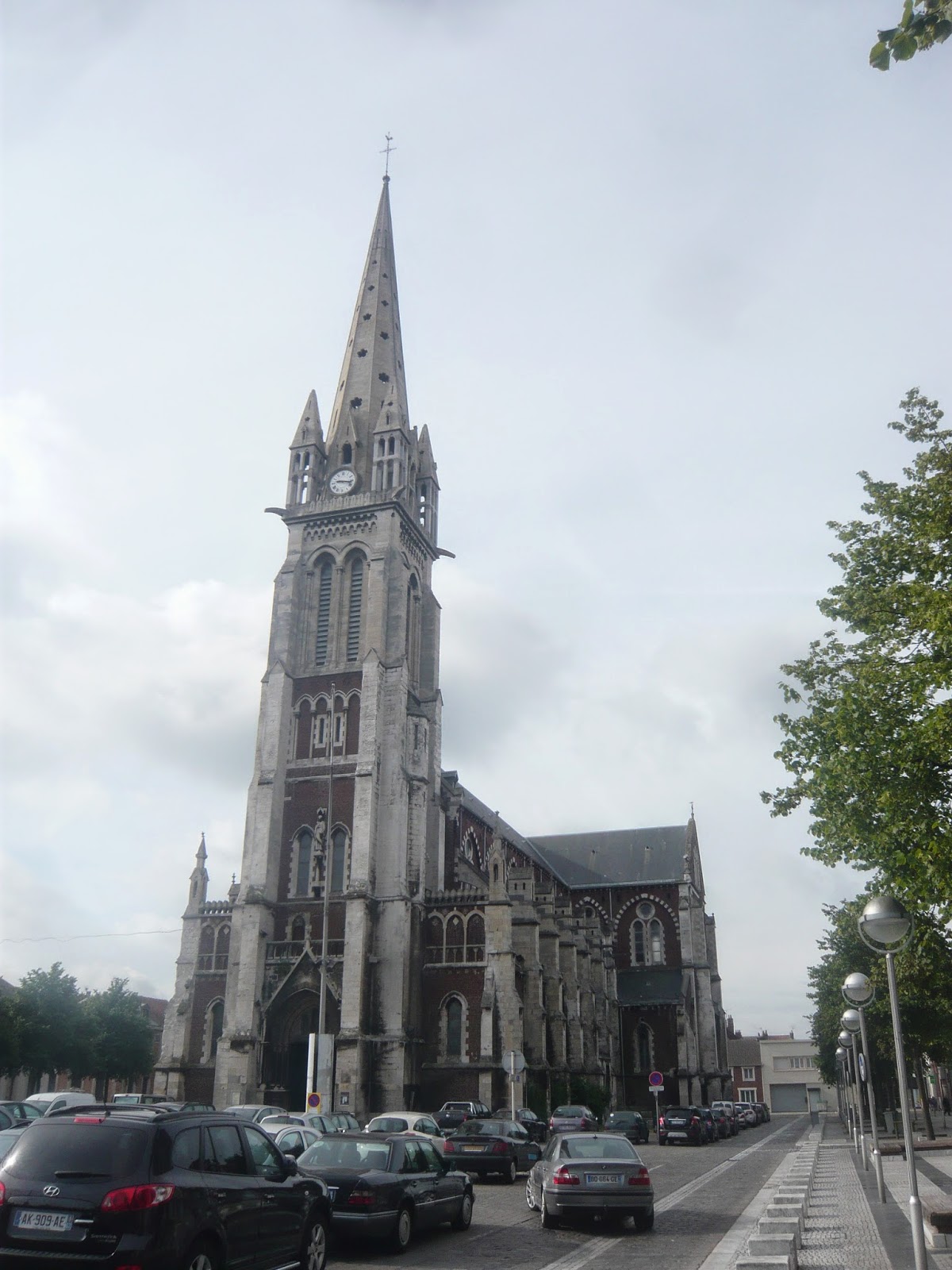
My journey did not have an auspicious start as, on the approach to Lille, I become part of one of the longest tailbacks it has been my misfortune to encounter with the delay increasing my initial anxieties about the possible difficulties of keeping to my planned itinerary. We did, however, mostly move throughout many kilometres, albeit at a snail’s pace, and eventually reached the cause of the delay – a convoy of tractors filling all the lanes and accompanied by the emergency and highways services. Presumably a protest on behalf of farmers, it served to remind of the rural origins of Hem, which means ‘the dwelling-place’. Originally a hamlet in an agricultural area of northern France, its population grew rapidly after the Second World War with one effect of growth being the consecration in 1958 of the
Chapelle Sainte-Thérèse-de-l'Enfant-Jésus et de la Sainte-Face.
An inauspicious and lengthy journey to visit a church that is not included on many tourist sites and which has been described as looking like a barn. As the Chapelle Sainte-Thérèse has external sculptures and a mosaic over its entrance, I reasoned that the journey would not be completely wasted were the church to be locked. It was not and, as I travelled on, it was only when I returned to Calais that I found churches which were not open regularly.
The modest external appearance of the Chapelle Sainte-Thérèse deceives, however, as once within I was in another world, one in in which I was submerged in coloured light. Here there are mosaics and windows by
Alfred Manessier, sculptures by
Eugène Dodeigne and
Jean Roulland, and a tapestry of the Sainte-Face based on a painting by
Georges Rouault which was made by the Plasse Le Caisne workshop. The architect was Hermann Bauer and the church has been described as a fine example of art sacré after World War II.
Manessier’s glass sets the tone and creates the spirituality which informs this marvellous space. It does so, not simply through the spirituality of his abstract design and colour harmonies, but also through the concept of stained glass architecture - of a light-filled architectural unit – that I find here. Stained glass here is not windows, but walls. There is no narrative; instead a loose cubist concrete grid holds a great chromatic richness. The play of light and colour created in the space is redolent of the Carmelite spirituality of Thérèse of Lisieux, which was the inspiration for Manessier’s design. Stained glass here creates spiritual space, a sense of prayer and a glimpse of heaven.
When reviewing Manessier’s exhibition at the Venice Biennale in 1962 - for which he was awarded the international prize for painting (to date, the last occasion that a French artist has been awarded this prize) - Jacques Lassaigne wrote of Manessier’s ‘majestic orchestration of vibrant tonalities and pure rhythms.’ Lassaigne also suggested that at various points in Manessier’s very rich career ‘a kind of pause of meditation and inner transformation’ had ‘enabled him to transform the powerful impressions which he had received … into new means of evoking and glorifying secret presences.’
[i] The twentieth century renewal of religious art in Europe, of which this church is a fine example, included a move from storytelling in stained glass by means of narrative figuration to the creation of spiritual space using abstract colour as pioneered by Manessier and
Jean Bazaine in France. In the past churches were centres for the drama of the visual - the drama and spectacle of the liturgy combined with the visual narrative of scripture in stained glass. Now people find their visual stimulation elsewhere - through the media primarily – and, as a result, churches have become centres for the opposite of visual stimulation e.g. centres of visual contemplation, where narrative is less essential than ambience and atmosphere.
Slowing down to look on a sustained basis in such a space enables us to surrender ourselves to the work of art in order that we enter the world it creates and immerse ourselves within that place. That was certainly my experience in the Chapelle Sainte-Thérèse-de-l'Enfant-Jésus et de la Sainte-Face. When looking at a painting by Paolo Veronese,
John Ruskin wrote of feeling ‘as if I had been plunged into a sea of wine of thought, and must drink to drowning’.
[ii] Similarly, the art historian immersed himself in the dimensions and details of Leonardo’s Musician.
James Crockford has described this experience of surrender in relation to
Tudeley Parish Church:
‘There’s an overwhelming experience, as you cross the threshold, of having entered a different sort of space. You feel immersed, surrounded, swallowed, which … is a significant part of the effect. The windows have a way of surrounding you and won’t let you go. They weigh heavily on the space. And that’s not simply a weight of colour and design. There’s far more to these windows, as always with Chagall; a density of symbolism and encounter.
What has, for years, spoken to me, and stayed with me, about this scene of Chagall’s, is not the detail of what it all might convey in its parts or its whole, but rather the experience of sitting in that still, small church, immersed in the colour and pain and hope of those windows shining through.’
[iii] As we do the same, we come to appreciate and live within the world to which the artwork introduces us. Joe Moran has described this as being like a swimmer who stops counting the number of pool laps they have done and just enjoys how their body feels and moves in water.
[iv] This is then the point at which we begin enjoying or appreciating an experience for its own sake and not for any other motive. To reach that point is to experience a taste of heaven. The Westminster Shorter Catechism famously says that the chief end of human beings is to glorify God and enjoy God forever. However, if there are instrumental reasons leading to our enjoyment of God that we are not simply enjoying for who God is. Therefore, we pray ‘God of time and eternity, if I love thee for hope of heaven, then deny me heaven; if I love thee for fear of hell, then give me hell; but if I love thee for thyself alone, then give me thyself alone.’
Our experience in heaven will be entirely relational. In heaven there will be nothing to fix, nothing to solve, and therefore no work to be done. In heaven there will be no more death or mourning or crying or pain, for the old order of things will have passed away. In heaven there will be nothing we can do for others, because God will have done everything for us. So, what will there be to do? Heaven is all about our relationships; being with God, with ourselves, with others, and with creation. Heaven is all about enjoying our relationships to the full for what they are. We prepare for life in heaven by anticipating heaven in the here and now; by prioritising relationships which we enjoy simply for who or what the person, creature, artefact or experience is. So, when we surrender to art in the way I experienced in Hem and which I have been describing here, we are experiencing a taste of heaven.
The favourite Christmas story of
Stephen Cottrell concerns a two year old called Miriam at a church on the edge of Chichester where he was parish priest. The red brick rectangular church seated about 80 and was full to overflowing for the Christmas Day service. As every space was taken, the crib scene had been placed under the altar. During the service Miriam wandered into the sanctuary and stood for a while observing the nativity scene. It was a large nativity set and so the characters in the scene were about the same size as the two year old. After observing the scene for a while, Miriam carefully climbed in under the altar making her way around the characters to sit in a space within the crib scene where she then remained for the rest of the service.
What she did was essentially an acted parable to the congregation because she immersed herself in the story. That is what we are called to do when we become Christians. It is what is going on when we are baptised. Baptism is our immersion in the Christian story.
When Jesus was baptised he was saying that he would immerse himself in this story and play his special, unique part within it. As he made that commitment, God the Father affirmed him in his identity and purpose by saying, ‘You are my own dear Son. I am pleased with you’ (John 3.17). As we do what Miriam did and immerse ourselves that story, then we are also affirmed by God in just the same way. St Paul writes in Romans 8.14–17 that: ‘Those who are led by God's Spirit are God's children. For the Spirit that God has given you does not make you slaves and cause you to be afraid; instead, the Spirit makes you God's children, and by the Spirit's power we cry out to God, “Father! My Father!” God's Spirit joins himself to our spirits to declare that we are God's children. Since we are his children, we will possess the blessings he keeps for his people, and we will also possess with Christ what God has kept for him; for if we share Christ's suffering, we will also share his glory.’ Paul was saying that, as we enter the story, we are adopted by God as his children and become brothers and sisters of Jesus, co-heirs with him of all he possesses.
How then do we play or pray our part in the story? That all depends on our coming to know the story and what happens within it. We start by looking at what we know of the story to date – the things God has done in and through Israel, Jesus and the Church – and we also look at the hints we have about the way the story will end with the coming in full of the kingdom of God on earth as in heaven. Then we say to ourselves, ‘What is it that people do in this story? How do they act and behave? And then we start to do, say and pray similar things as we have the opportunity. As Christians we are never given a script which has all our lines and actions printed on it. Instead, we have to improvise our part on the basis of what we know of the story so far, on the basis of the example provided by those who have lived in the story before, and on the basis of the opportunities provided in the places where we are and among the people that we know.
Living in the Christian story, therefore, is a challenge – something we should know anyway from looking at the life and death of Jesus – but it comes with the affirmation that we are part of God’s family; his dearly loved children, brothers and sisters of and co-heirs with Jesus himself. When we know this we can relax because whatever happens to us we are accepted, forgiven, loved and gifted by the God who created all things and who will bring all things to their rightful end. When we do that we are like Miriam climbing in under the altar to become part of the crib scene. When we do that we become immersed in God’s story which makes us his children and gives us identity, purpose and meaning.
Explore All public acts of worship also place or immerse us in the story and therefore enable us to pray the story as we pray the service. As worshippers we are often unaware of that reality, partly because it is often not explained and partly because of our familiarity with liturgies that were curated many years before and which come with warnings that they should not be changed or amended. Those warnings are generally there because we seek to remain in continuity with the great cloud or crowd of witnesses who have gone before and who now cheer us on from their stadium seats in heaven.
However, there is value in being taken out of the familiar and alternative worship curators, having learnt from installation artists, regularly do this to immerse us in new worlds in order that we see the familiar afresh or the new for the first time. Here are two examples of this being done, shared in the hope that you might develop your own initiatives.
Jonny Baker is an alt worship organiser that has adopted the idea of curation - as a role for imagining and overseeing an exhibition or art experience - to use it for different and inventive ways of thinking about how to lead a service or praise event. In this context, rather than simply presiding over liturgy or fronting a band, curation involves negotiating between institutions and artists and making do with what is to hand to create something immersive and brilliant. The hope is that moments of epiphany will be experienced as God is invited to be and breathe in immersive spaces, and people make connections with their own lives and stories.
[v] Baker suggests that ‘worship imagines a world, nothing less’.
[vi] He is ‘not content with the world - globally, politically, or indeed the church world or the way worship is played out and imagines the world’, so asks what kind of a world to imagine or make? He suggests this may be ‘the most important question any of us can ask’ and one it will ‘take a lifetime to answer’:
‘Reflecting on alternative worship, which is where the notion of worship curation has come from, I think it has been about imagining new worlds, new relationships, new strategies and tactics, and counter-publics, about saying that other worlds are indeed possible, that business as usual simply will not do.’
[vii] An artwork which enabled people become a part of the installation by viewing themselves in mirrored surfaces featured as an
Advent art installation created through churches in the London Borough of Redbridge in 2008. This was comprised of three panels of mirrored perspex mounted on wooden backing panels. The mirrored surfaces were painted to an abstract design using differing textures and densities of paint while leaving unpainted areas forming the shape of a star and the repeated word ‘peace’.
The sombre colours and rectangular voids of this abstract artwork recalled works by
Mark Rothko in the Tate collection. Rothko’s later paintings have often been understood as depictions of the absence of God and the darkness of the world; an impression reinforced by Rothko’s suicide on the day that the Tate received those paintings. St Paul wrote that our experience in life is that of seeing in a mirror dimly (1 Corinthians 13.12); we do not see clearly and our understanding of life is clouded, is what he seemed to say. That may also have been the experience of those viewing this installation, where the abstract colour had been applied to mirrored perspex, clouding our ability to see clearly in the mirrored panels of the installation. Yet this may also have depicted the reality of which the poet
Martin Wroe has written that God can be seen as ‘the abstract art of paint and poem when our propaganda makes everything clear.’
[viii] In the darkness of the abstract design, viewers could still see reflected, candles, lit within the space where the artwork stood, and, picked out on the panels, forming a star, there were also lines of clear reflection. The light beaming from the star on the right panel was linked by a line to the repeated word ‘Peace’ on the left. Viewers were asked to consider in what ways there might be links between light and peace in the darkness of our world.
What might the blurred and clear mirrored spaces of this installation have shown? Essentially, as in any mirror, we saw ourselves, both blurred and distinct. As a result, we asked ourselves: Are we defined by the darkness or are we one of the many points of light reflected in the darkness of this design? Is the reflection of our light blurred or distinct as we shine in the world? In what ways could we become light bringers and peace makers? After all, we reflected, it is better to light a candle than to curse the darkness.
Those who viewed this work became immersed in it as they saw themselves in its surface. Its reflection enabled their reflection and through reflection something essential was glimpsed. Those who sat in that still, silent space were immersed in the colour and pain and hope of the installation. They entered, experienced and prayed the Advent story.
Wonderings I wonder if you can recall a time when you were immersed in an activity or environment where you lost all sense of time. I wonder how you felt and what that experience gave to you.
I wonder which stories you have lived by and which you have left behind.
I wonder when was the last time you felt immersed by light, colour or sound.
Prayer Abundant God, even eternity's too short to extol you. Like a child learning to jump or dive into water, may I no longer teeter on the edge anxious and afraid, but take the step, however faltering, of falling into your arms of love and immersing myself in your abundance. Amen.
Spiritual exercise Next time it is possible for you to take a shower try to reflect on the experience prayerfully. Think about how it feels to be under (immersed in) the water and of the effect that this immersion has for you. Turn the experience and the effect into prayers.
Art actions Read the Worship Tricks series at
https://jonnybaker.blogs.com/ View A New Jerusalem by Michael Takeo Magruder -
http://www.takeo.org/nspace/2014-dta-new-jerusalem/. This is an immersive virtual reality installation that seeks to embody the spirit of the new Jerusalem as described in the Book of Revelation.
[i] J.P. Hodin, Manessier, Praeger Publishers, 1972, p. 78
[ii] J. Evans & J.H. Whitehouse eds., The Diaries of John Ruskin, Oxford, 1956, vol. 2, p. 437
[iii] J. Crockford, ‘Chagall at Tudeley’, Sermon preached at University Church, Oxford, 7th April 2019 -
https://www.universitychurch.ox.ac.uk/sermons/chagall-tudeley?fbclid=IwAR3hxj1Lah8A5Uq2yYjggxw1rafwJlxq-4V86olsvwSdpyoLAJ11kKNvKAc [iv] J. Moran -
https://www.theguardian.com/books/2018/sep/14/joe-moran-pleasures-of-slow-reading [v] J. Baker, Curating Worship, SPCK Publishing, 2010
[vi] https://jonnybaker.blogs.com/jonnybaker/2009/05/worship-curation-2-the-making-of-a-world.html [vii] https://jonnybaker.blogs.com/jonnybaker/2009/05/worship-curation-2-the-making-of-a-world.html [viii] http://martinwroe.com/2012/04/dark/Click
here for the other parts of
'Seeing is Receiving'. See also
'And a little child shall lead them' which explores similar themes.
-----------------------------------------------------------------------------------------------------------