Wikio - Top Blogs - Religion and belief
Showing posts with label dementia. Show all posts

Thursday, 2 October 2025

Launch event: What Music Means to Me


Great to be at the launch today, at local care home The Grange, of Cathy Sahadevan's 'What Music Means to Me'.

Back in 2018, Cathy founded the One Voice Choir, a dementia-friendly choir created to bring joy, connection, and confidence to residents through the power of music. What began as a simple idea soon transformed not only the lives of the residents but Cathy’s own, as she witnessed first-hand the remarkable impact music could have.

Cathy shared that: “Through the choir, residents developed confidence, built friendships, and enjoyed unforgettable opportunities, including meeting Tim Howar from Mike and the Mechanics, and forming a connection with national treasure Tony Christie. I was inspired to write the book because I wanted to share my story and bring the power of music to people living with dementia.”

Cathy decided to share her story in book form, with encouragement and support from the choir members themselves. She hopes her journey will show others that you don’t need formal music training to make a difference, just passion, enthusiasm, and the belief that music can reach people when words cannot.

"This book is a heart warming memoir that celebrates a tale of success and the spirit of giving it a go. It's an inspirational tale that shows the joy that music can bring to the hearts and minds of people living with dementia."- Tony Christie.

The choir’s journey has created a vibrant culture both within and beyond the The Grange Care Home, earning awards, supporting charity work, and attracting the backing of organisations such as Music for Dementia. The choir continues to evolve, spreading happiness and creating magical moments wherever they perform.

Peyton Miles, Foundation Manager at Music for Dementia, praised Cathy’s work, saying: “What happens when one person decides to ‘give it a go’? In this touching GIAG story, a care home is transformed through music, as a once nervous choir blossoms into a source of pride, purpose, and joy for residents and staff alike.”

-----------------------------------------------------------------------------------------------------

One Voice Choir - You Raise Me Up.

Monday, 19 August 2024

Kate Carpenter: Kaleidoscope

Kate Carpenter's photographic work tells stories about family, memory and forgetting, blending metaphors in woodland landscapes with documentary, portrait and archival imagery. Much of it is rooted in her experience of caring for her grandmother, aunt and mother through the years of their dementia.

Her work has been exhibited in the UK and beyond, and has featured in various print and online publications, including her own recent photobook Kaleidoscope.

She has written of  Kaleidoscope:

"I am glad of the consolations of photography as I muddle my way through and reflect on what it all means for me. The very act of photography is an act of nostalgia; it has threaded its way down the generations of my family and is a homecoming of sorts. As for the other thread - of course, I wonder whether that is coming for me too. In response, I think, I’m drawn to the woods, to the uncanny, tangled fractals of the trees, where I can at once play with my fears and simultaneously keep them at bay.

Anticipating the losses and the forgetting to come, I photograph life in that house, in that home that we seek to keep happy for as long as we humanly can. With my mother’s blessing and companionship, I am exploring the family archive to tell a version of her story, and with it, a part of my own."

-------------------------------------------------------------------------------------------------------

Joni Mitchell - Little Green.

Wednesday, 28 September 2016

Theological reflection: End of Life with Dementia

Here is the theological reflection that I shared last night as part of the evening on End of Life with Dementia held at St Martin-in-the-Fields:

In her book, ‘My Year with a Horse: Feeling the fear but doing it anyway,’ Hazel Southam writes of facing the daunting task of telling her dad that he isn’t coming home: ‘I visit him as soon as I’m back and … sit down and tell him the truth. This is his home now. He’s not well enough to come home. And he won’t be getting better. This team of carers can look after him properly and we simply can’t. I am very, very sorry. He looks me in the eye and under­stands. We hold hands and cry. He never cries.

We have the kind of conversation that you have before someone dies. We talk of love and laughter, God, cats, The Guardian, and cricket. I remind him of the village where we all grew up, of its orchards, his football team. He asks, “Where do I live?” and “Where is my house?” a great deal these days. I used to try explaining, but as none of it makes any sense to him — the past 75 years having been wiped out — I talk about the village instead. That he remembers.

I feel, as my mother often says, like a wrung-out piece of rag. There are things that you don’t want to tell your parents: my A-level results aren’t very good; I’ve left my job with the big publishing company; I’ll be reporting from a war zone. But “You’re not coming home” is by far the worst. I comfort myself with the thought that, however bleak this moment, it won’t come again. Daddy knows now, and whilst we may discuss it in the future, it won’t be like this. Only, of course, it is. The next day and the day after and every day for years he will ask when he’s coming home and I will have to tell him the freshly shocking news that he won’t be. Every time it will be new to him, as five minutes later he will have forgotten it entirely. It is my own personal hell, and his, too, probably.’

Nicci Gerrard, from John’s Campaign, puts it like this: ‘When people are in the last stages of dementia, we who love them (we whom they have loved) may bend over them, trying to find in the sounds they are making some words, sentences, a form of communication and a kind of meaning. Even a syllable is precious now. It is a bit like a parent straining to hear language emerging from their baby’s babble of sound – but with a baby this emergent language marks the beginning of the great formation of the self, and is full of hope and possibility.

With the person who lives – and who dies – with dementia, the language that connects us to others is disappearing, the self is being broken up. An entire world is being un-made. We come to darkness, silence, the radical slowing of death: dementia’s long goodbye.’

Gerrard notes that this long goodbye occurs because ‘Telling stories is part of what makes us human’: ‘With stories, we make sense of the world and impose a kind of order on to chaos. We continually edit our own lives into a narrative that will give it a coherent meaning: without this, we’re lost.

And people with advanced dementia become lost: lost to us and lost themselves. They can no longer speak themselves and without memory to bind the pieces of their life together, they are trapped in an endless present.‘

That was Hazel Southam’s experience too, but, she instinctively found a way of sparking memories in her father by retelling part of his story: ‘I used to try explaining, but as none of it makes any sense to him — the past 75 years having been wiped out — I talk about the village instead. That he remembers.’

Healthcare professionals are increasingly recognising that ‘Storytelling sparks memories, encourages verbalization and promotes self-esteem among those with dementia.’ The Contented Dementia Trust who advocate the SPECAL method explain the significance of story in this way: ‘A person with dementia will experience random, intermittent and increasingly frequent memory blanks relating to the facts around recent events. However, some memories of past events are always available and can be readily recalled by the person, given the right circumstances.

The SPECAL method uses selected intact memories from the person’s pre-dementia past and links these to their activities in the present. This means that the person is able to maintain a relatively content life in the present, drawing on their own memories of situations and activities which may have occurred many years ago but still have useful meaning for them in their life today.’

Narrative theology says that, as human beings, we are storytellers, and, as Christians, we blend our story with God’s story. Roger Olson helpfully summarises the main aspects of narrative theology. The Bible, he writes, tells ‘the great story of God whose central character (for Christians, at least) is Jesus Christ.’ ‘Therefore, all must be interpreted in light of that story and its purpose—to reveal the character of God through his mighty acts leading up to and centering around Jesus Christ.’

‘Theology is our best human attempt to understand the biblical drama-story’ and that is done by ‘“living the story” together with a community of faith shaped by the story.’ ‘The task of the church is to “faithfully improvise” the “rest of the story.” Christians are not called simply to live in the story; they are called to continue the story in their own cultural contexts. First they must be grounded in the story. They must be people for whom the story “absorbs the world.” Second, they must together (communally) improvise the “rest of the story” faithfully to the story given in the Bible.’

These two stories - the personal story of the person with dementia and the meta-narrative of salvation history – should intertwine throughout our lives as Christians, but, perhaps, never more significantly as we approach death. One common experience for clergy after funerals or memorials is to hear people say, I wish the person we had been remembering could have heard those tributes while they were alive. That could always have been the case, if we had been more intentional about hearing, re-calling and celebrating the story of that person. In the case of those with dementia, to do so is even more vital as it sparks past memories which may have useful meaning for today but even at the point of death, although the person may be unable to respond, there may nevertheless be an ability to hear and take comfort from the celebration of their life through storytelling.

As Christians, we can do more because our personal story can be blended with God’s story. This is particularly so in relation to the Eucharist, where the key events in God’s story are re-enacted and re-membered. It has been my experience, in taking communion to parishioners with dementia, that this celebration has been the moment in the visit when those I have been visiting have become most engaged, most participative and most present as they remember and join in with familiar words and phrases, recalling the prayers and re-inhabiting the story.

As Christians, our hope is also that this story and our being blended with it does not end. This hope has, I think, been articulated well by scientist and priest, John Polkinghorne, who says that "the immensely complex ‘information-bearing pattern’ (memories, character, etc) carried at any one time by the matter of my body ... is the soul and, though it will dissolve with the decay of my body, it is a perfectly sensible hope that the faithful God will not allow it to be lost but will preserve it in the divine memory in order to restore its embodiment in the great divine act of resurrection."

For all these reasons I agree with Nicci Gerrard, who ends the article from which I have quoted, by saying: ‘The question of how we care for those with dementia is also a question of how we live and how we die. It is about what it means to be human. We are all human. We all have stories.’

------------------------------------------------------------------------------------

Leonard Cohen - You Want It Darker.

Tuesday, 2 August 2016

End of Life with Dementia


The next Dementia evening at St Martin-in-the-Fields is entitled End of Life with Dementia and will be on Tuesday 27 September, 7.00pm - 9.00pm in St Martin’s Hall.

We look forward to an evening where we continue to explore what it means to become a more dementia-friendly church and what the experience of dementia might teach us about God, with input from those with lived experience, healthcare professionals and theological reflection. I will contribute a short theological reflection. All are welcome.

Tickets are available at stmartininthefields.eventbrite.com or on the door. There will be a break for refreshments. Suggested donation £5.

------------------------------------------------------------------------------------------

Candi Statopn - Even The Bad Times Are Good.

Sunday, 6 March 2016

What constitutes family life? Remembering Jesus and his Mother

Here is my sermon from today's 10.00am Eucharist at St Martin-in-the-Fields:

In our ongoing series of evenings about dementia at St Martin-in-the-Fields we explore what it means to become a more dementia-friendly church and what the experience of dementia might teach us about God. Our most recent session was entitled ‘Praying with Dementia’ and included an opportunity to explore dementia-inclusive worship together.

The liturgy that we used that evening was led and prepared by Revd Edward Thornley, the Assistant Curate (Chaplain) at St Marylebone Parish Church, and was taken from a service that was originally held at a dementia care home in Norfolk on Mothering Sunday in 2012. The care home where this service originally took place was a residential community for ninety residents, all of whom were elderly people who suffered from advanced stages of dementia in various forms. The service used today’s Gospel reading (John 19. 25b - 27) and was designed to provide a flexible, gentle, meditative space in an often painful and difficult environment.

Family members of residents were contacted prior to the service, to bring objects and examples which they could share during the service, which would be relevant to them and their families. It was a happy service because of the memories brought back to people, although it was equally a hard service for some, as they mourned the fact that those were times past. The service was designed to keep people in the present, and to appreciate how that same person who they loved was still there, and how they could recognize each other, through sharing memories and objects.

When we used this liturgy at ‘Praying with Dementia’ those who shared their memories used photographs, a blanket and a mobile phone to prompt memories of their mothers, before we all then shared memories with each other in pairs. The different items that had prompted memories were gathered together and displayed on a central table as a visual reminder of all that had been shared.

Our starting point had been the simple observation that Jesus remembered his mother while on the cross and our liturgy, in its simplicity and familiarity, aimed to reawaken memory of those who, for good or ill, are foundational to our lives, experiences and memories. We were reminded that the simplest things we see and do can often be the most profound and those that touch us in the deepest places.

This time of sharing was also a reminder to us that remembering, both in the sense of bringing back to mind and also of re-enacting is central to who we are as people. As Katherine Hedderly highlighted later that same evening, “The community of the church has a special place in this work because it is a community of remembrance and resurrection. “‘Do this’ in remembrance of me.” We remember what Jesus did and we act upon it in the present. We are witnesses to the living memory of Jesus in the world, to God’s living presence with us, as we are re-membered, or reformed, as a community together. Holding in our midst with love those who no longer have their memory, must be a special task for the church, because we know in a very special way what it means to know who we are because someone remembered us; Jesus Christ, the same, yesterday, today and tomorrow.”

Jesus' remembering of his mother occurred while he was undergoing the most extreme agony personally. For some of us, to remember our mothers in the way we have just been discussing, might involve complex and conflicted memories which bring back to mind some of our more painful moments in life. Jesus ministered in and through and out of his pain; remembering particular people (his mother and John, his disciple), forgiving those who tortured and mocked him, and dying for the salvation of all.

It is from reflection on those experiences and actions of Jesus, that the idea of the wounded healer has come. This is the idea that our own pain and difficulties - our wounds - do not necessarily preclude us from ministry but may provide a resource or source from which our ministry can flow. To remember and reach out to support, sustain and strengthen others whilst remaining wounded ourselves may be, as was the case for Jesus, among the deepest and most profound of our ministries to others.

In bringing his mother into a mother-son relationship with one of his disciples, Jesus was extending our understanding and concept of what constitutes family life. For John to view Jesus' biological mother as his mother and for Mary to view John as her son, went beyond ties of blood into other forms of relationship. We could talk in terms of adoption (although in our day and time that word has a legal definition that is narrower than what is happening here) or we could talk in terms of extended families (a more helpful phrase, which we have, in part, lost sight of in a time when we still think primarily of nuclear families). However, we choose to categorise what Jesus did here, we need to recognise that he was initiating a family relationship which was not based on ties of blood and that this necessarily opens up space in which a range of family structures and family ties become possible.

The Nativity story also sets out unconventional and non-idealised relationships which God chose to use at the beginning of Jesus’ life; a conception outside of marriage, a relationship on the brink of divorce, a foster-father, a birth in cramped and crowded circumstances, an immediate threat to life followed by refugee status. When these are added to the fact that, during his ministry, Jesus called his followers to leave behind their family obligations in order to follow him, said that families would be divided because some would respond to him and others not, while, on one occasion, when told his family were outside, said: "Who is my mother? Who are my brothers? … Whoever does what my Father in heaven wants is my brother, my sister, and my mother", we see that conventional structures for family life were not really a major priority in Jesus’ thinking or praxis. Jesus’ emphasis in his teaching was on his followers as his family, rather than his blood and adoptive relatives, while his death was for the entire family of God - all people everywhere. What we might now call Mother Church was, therefore, the key family relationship which was at the fore-front of Jesus’ teaching and practice.

Within this he seems less interested in particular structures for our relationships and more interested in those relationships being ones which nurture those who are in relationship, whilst also being open to support others in need through that same relationship. On this basis, it does not matter whether we are in a nuclear family, single parent family, same-sex family, extended family etc. What matters is the quality of relationships within that family and our openness to others. Just as the diverse objects on the table at the Dementia evening were brought together and held together in worship, so our diverse relationships can also be held together within the context of the Church.

I had specific experience as I was growing up of a nuclear family that sought to become an extended family. My parents called the various homes in which we lived 'The Oasis', as they had decided that they wanted their homes to be places of refreshment and renewal to those who thought they were in the wilderness. My father’s different jobs as a social worker, lecturer and landscape gardener meant that we lived in five different homes up to and including my teenage years, but, in each place that we lived, they met young people that they unofficially adopted into our family and supported, as those people lived through the difficulties or issues they were dealing with at the time. My mother keeps in touch with all these people, who were able, in part through the support of my parents, to overcome the issues they faced in the early part of their lives, and go on to find jobs and have families themselves. I was reminded of this only last week, when my mother went to stay with one of these families to offer support after the wife had had an operation for cancer.

In a society which, at the time, was predominantly based on nuclear families their actions were to some extent unusual, but would have been much less unusual in the society of Jesus' day and time, based as it was on a model of extended families. Our own day and time has, as we know, seen a growth of alternative family structures meaning that we can celebrate today all those who act as mothers or parents to others outside of biological ties, including all those who adopt or foster, but also thinking outside those legalised frameworks for care.

We have reflected that in Jesus’s life and teaching there is less of a focus on the structures of our relationships and more of an emphasis on relationships which are characterised by qualities of compassion, kindness, humility, meekness, and patience. These are qualities with which our New Testament reading from Colossians calls us to clothe ourselves (Colossians 3. 12 - 17). They are qualities that we can easily associate with motherhood but which are applicable to all of us as Christians. In Colossians 3 we are called to bear with one another, forgive each other; clothe ourselves with love, which binds everything together in perfect harmony, and let the peace of Christ rule in our hearts, to which we were called in the one body. These are all actions which are consistent with what we understand mothers, at their best, to do for their children. But the call, here, is to practice these qualities not just in our families and among our blood relatives, but with all those we encounter and, especially, here in Church. They are, perhaps, then, maternal qualities for application in Mother Church.

Finally, it is worth reflecting that, on the road to the cross, Jesus described himself as a mother hen wanting to gather the people of Jerusalem under his sheltering and nurturing wing. The scriptural witness is that that is precisely what he did through his death on the cross whereby he draws all people to himself. In Ephesians we are told that he broke down the dividing wall of hostility between us, creating, in himself, one new humanity, making peace and reconciling us to God in one body through the cross. He acted, therefore, like a mother sacrificing herself for her children. So, as we follow in the footsteps of Jesus, our mother, we are called to fashion our lives on her sacrifice and example by clothing ourselves with compassion, kindness, humility, meekness, and patience, bearing with and forgiving one another, letting the peace of Christ rule in our hearts.

--------------------------------------------------------------------------------

The Waterboys - All The Things She Gave Me.

Saturday, 5 March 2016

Reflecting on family life & climate change

Tomorrow, at St Martin-in-the-Fields, we host BBC Radio 4 Sunday Worship. The occasion is Mothering Sunday and the theme is ‘A sword will pierce your own heart also.’ The preacher is Revd Anna Poulson, whose daughter had Aicardi Syndrome and died aged three.

Then, at our 10.00am Eucharist, I will be preaching on the theme of What constitutes family life? Remembering Jesus and his Mother, with reflections drawn from our 'Praying with Dementia' evening and my own experience of extended family life.

At our 5.00pm Issues of our Time service, Revd Dr Sam Wells, Vicar of St Martin-in-the-Fields, explores the Church’s perspective on the themes of our time. Tomorrow's theme is Climate Change: Crisis Management or Full-Scale Repentance? While ecology is always among the leading concerns of our time, two events happened in 2015 to give it an especial focus. The first was the publication in June of the papal encyclical Laudato si'. The second was the United Nations Climate Change Conference held in Paris in December. The two events map the territory of the ecological crisis in contrasting ways. In his sermon Sam intends to dig inside both the Pope’s thinking and that of the Paris delegates, and identify what the ecological debate is really about, and where we can focus our energies in responding faithfully to it.

-----------------------------------------------------------------------------------------------

Sergei Rachmaninoff - Ave Maria.

Monday, 22 February 2016

Praying With Dementia


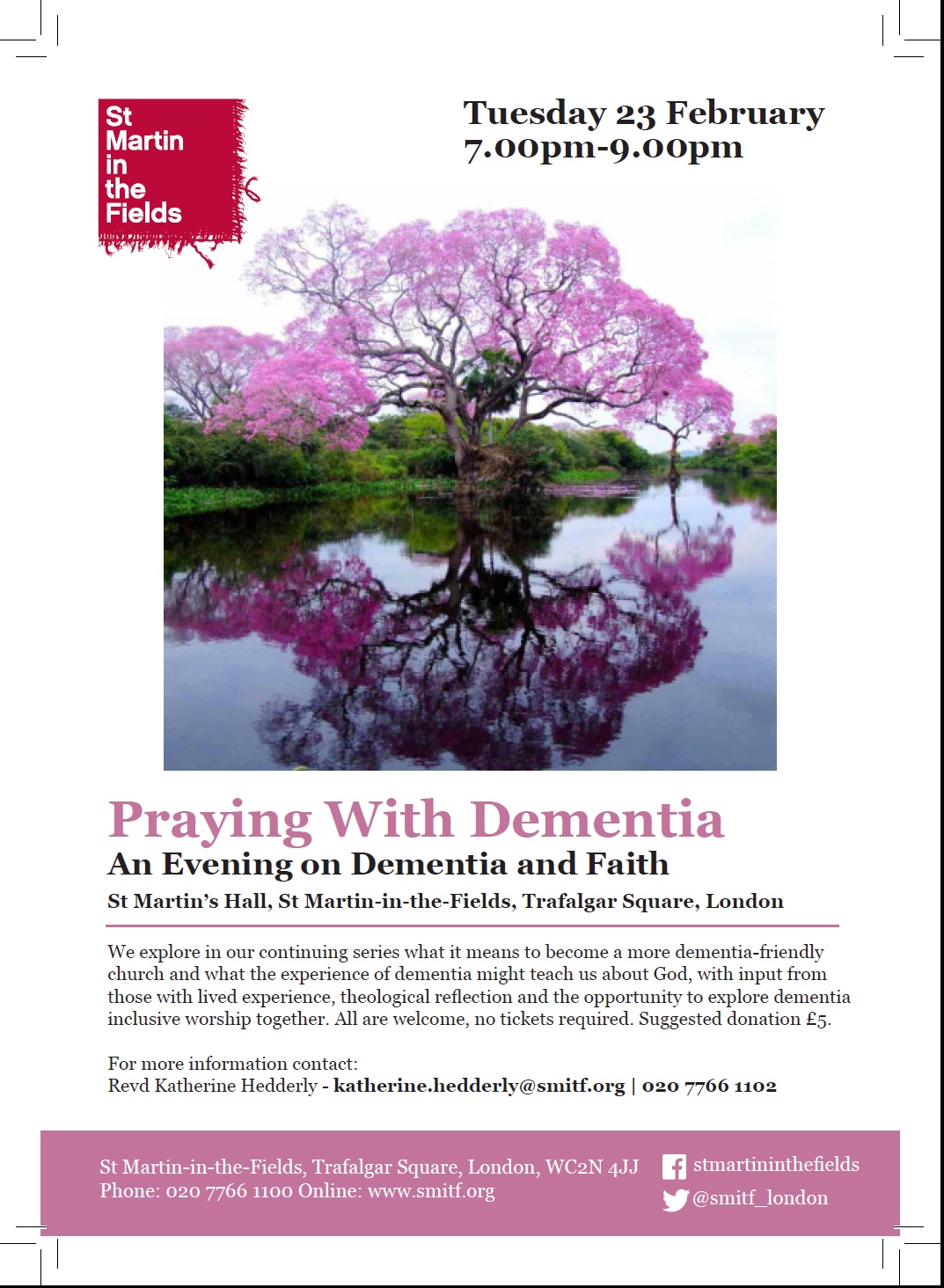
Tuesday 23 February, 7:00 pm - Praying With Dementia

We explore in our continuing series at St Martin-in-the-Fields what it means to become a more dementia-friendly church and what the experience of dementia might teach us about God, with input from those with lived experience, theological reflection and the opportunity to explore dementia-inclusive worship together. All are welcome, no tickets required. The evening will be held in St Martin’s Hall.

----------------------------------------------------------------------------------------------

Peter Case - Long Time Gone.

Friday, 22 January 2016

Praying with Dementia


Praying With Dementia, Tuesday 23 February, 7.00-9.00pm, St Martin’s Hall, St Martin-in-the-Fields. 

We continue to explore the experience of dementia and faith following our very successful evenings
last year. Through the insight of lived experience and theological reflection we will continue to
look at how our church life and worship might grow in a more dementia-friendly way. We will explore what the experience of dementia might teach us about God, with input from those with lived experience, theological reflection and the opportunity to explore dementia-inclusive worship together. All are welcome, no tickets required.

The evening will be held in St Martin’s Hall.
Start: February 23, 2016 7:00 pm
End: February 23, 2016 9:00 pm
Cost: No tickets required.
Venue: St Martin-in-the-Fields

Phone: 020 7766 1100. 
All are welcome. 
Suggested donation £5.

-------------------------------------------------------------------------------------------

U2 - Walk On.
 

Sunday, 27 September 2015

Held in the divine memory

Here is the piece I wrote for this week's parish newsletter at St Martin-in-the-Fields:

During the recent Living with Dementia evening at St Martin-in-the-Fields several people expressed the hope that has been articulated well by scientist and priest, John Polkinghorne, that "the immensely complex ‘information-bearing pattern’ (memories, character, etc) carried at any one time by the matter of my body ... is the soul and, though it will dissolve with the decay of my body, it is a perfectly sensible hope that the faithful God will not allow it to be lost but will preserve it in the divine memory in order to restore its embodiment in the great divine act of resurrection."

I was reminded by this of the parables Jesus told in which a sheep, a coin and a son, respectively, are lost. Each story ends with rejoicing over the finding again of that which was lost. These stories hold out the possibility that, in God, nothing is lost. Certainly, the importance to Jesus of that which was lost being found is emphasised by his choosing to tell three different stories on this same theme.

In the context of a condition like dementia in which memory is progressively lost, it could be a source of some hope that nothing is lost and that all we are and have been is held in the divine memory. If we are, in some sense, as Psalm 139 suggests, fearfully and wonderfully made by being formed or knit together by God in our mother’s womb; if our frame is not hidden from God when we were being made in secret, if God’s eyes beheld our unformed substance, and if all the days that have been formed for us were written in God’s book when none of them as yet existed, then it would follow beautifully and logically that those memories and knowledge would be retained in the divine memory for eternity. Maybe, as the saying goes, nothing lasts but nothing is lost.

-----------------------------------------------------------------------------------------------

Simon & Garfunkel - Bookends Theme.

Friday, 18 September 2015

Living with Dementia

On Tuesday, at St Martin-in-the-Fields, we continued our exploration of the experience of dementia and faith, through the insight of lived experience and theological reflection, as we looked at how our church life and worship might grow in a more dementia-friendly way. We were helped enormously in doing so by Clive Wright, David Warbrick and Sister Margaret.

David Warbrick said: "I was seeing, pared down, the very fabric of faith: imagination, analogy, metaphor, improvisation, musicality of speech, the power of words to evoke rather than confine and control. In his dementia, Dad laid bare the workings of the equipment God has given human beings for prayer. Half an hour in his real-yet-imaginary world burnished my vision of the world outside. The slowness and sense of presence made me see the exquisite delicacy of facial expressions and listen to intonation as much as to words, so something shifted in me. Just as his paintings have made me stop and behold rather than merely look at the world, maybe in his childlike dementia he has offered me a gift of perception I need to receive precisely now if I am to stay in touch with the kingdom of heaven during this exciting, potentially fruitful but also perhaps dangerously self-important, busily distracted decade of my life."

Several people spoke a sense of hope as a result of the idea developed by John Polkinghorne that "the immensely complex ‘information-bearing pattern’ (memories, character, etc) carried at any one time by the matter of my body ... is the soul and, though it will dissolve with the decay of my body, it is a perfectly sensible hope that the faithful God will not allow it to be lost but will preserve it in the divine memory in order to restore its embodiment in the great divine act of resurrection."

Also of particular interest was the thought that it is our earliest memories which are the last to fade. This is an additional reason for seeking to ensure that children have positive experiences in their childhood, as those memories may well be the place that they inhabit again at the end of their lives.

These are just some points of particular note for me from an evening which was full of value for those who came. Much discussion about dementia is to do with increasing understanding and thinking about the small things that we can do to make a difference to people affected by dementia in our community. That is deeply valuable but this evening took the discussion in very different directions which confronted some of the very real questions and challenges that the experience of living with dementia raises.

---------------------------------------------------------------------------------------
Friday, 7 August 2015

Living on the Edge and Living with Dementia


St Martin-in-the-Fields partners Inclusive Church to offer an annual conference on the subject of disability and church. This year's conference is entitled 'Living on the Edge' and will be held in the St Martin's Hall on Saturday 17th October 2015 (10.30am - 4.30pm).

How do we respond when we find ourselves excluded? A day exploring how disabled people are finding new ways to use their experience of exclusion to improve understanding and address barriers to belonging. Through talks and workshops, using the art space, silent space and marketplace, this is an opportunity organised by and for disabled people, supporters and people with an interest in the issues to gather and resource each other and the church.

Speakers include: Ann Memmott – national autism advisor; Eva McIntyre – Mental Health Matters; the Disability Advisory Group, St Martin’s; WAVE; Disability & Jesus; and Sam Wells.

Cost: £20 | £10 concessions

/stmartininthefields @smitf_london St Martin-in-the-Fields, Trafalgar Square, London, WC2N 4JJ Phone: 020 7766 1100 Online: www.smitf.org

Register at www.inclusive-church.org/disability-conference-2015 or by post to: Living on the Edge, 4 Ferney, Dursley, Gloucestershire GL11 5AB


St Martin's is also continuing to explore the experience of dementia and faith, through the insight of lived experience and theological reflection, as we look at how our church life and worship might grow in a more dementia-friendly way. This 'Living with Dementia' event will take place in St Martin’s Hall on September 15, 2015 at 7:00 pm. All are welcome.

These initiatives stem from work which is now taken forward by the Disability Advisory Group (DAG). The DAG draws together people with insight or interest in this work arising from their own lived experience of long-term illness, physical or sensory impairment or mental health issues; or from a support, caring or professional role (paid or unpaid). Open meetings once a term, use the gathered expertise to inform and guide work on disability, with a particular focus or topic relating to issues of disability, inclusion and faith.

------------------------------------------------------------------------------------------

Evelyn Glennie - A Little Prayer.

Monday, 6 July 2015

The Book of Common Prayer

Here are some reflections prepared recently on the significance of the Book of Common Prayer:

In 12 years of ordained ministry each of the parishes in which I have ministered have made use of the Book of Common Prayer in their patterns of services. At St Stephen Walbrook the Book of Common Prayer is used at our main weekly Eucharist, while in other settings its primary use has been as an early morning Eucharist or for Evensong. In all of these contexts I have greatly appreciated the sense that those attending engage with God through the familiarity of its language reinforced by repetition over the years.

The familiarity of its language, for those brought up with it, has been particularly moving when ministering pastorally to those experiencing dementia. Often these conversations are entirely disconnected from the present or are entirely set in the past because the short-term memory of the individual has declined significantly. However, when we share communion together the individual often comes fully into the present recalling words learnt in their youth in order to repeat them in the here and now as the significance of receiving the body and blood of our Lord is remembered.

So, one reason why I appreciate the Book of Common Prayer is to do with what it means to my parishioners. The BCP is 'generally reckoned a masterpiece of writing, as Thomas Cranmer's use of idiom, cadences, imagery, repetition, contrast and general rhythm made doctrine, devotion, and the sheer use of English both memorable and exemplary. In this way, the language and indeed the whole culture of the BCP came to be a major ingredient in not only the religion of England, but in the thought-forms and speech of a large proportion of English men and women.'

The spell that its language weaves on parishioners and others also leads me to appreciate the role it has played historically. 'From the 16th century to the 20th, literacy spread, particularly in the 19th century. The King James Bible was found in every literate home, and taught in school, as well as in the Sunday Schools which developed from the latter half of the 1800s. For many, members of the Church of England (one third of the nation at the religious census in 1851), the Book of Common Prayer was the partner of the Bible, being read and learned at home, and very often also carried to church.'

'Cranmer wanted the people of England to be constantly exposed to Holy Scripture in a language they understood, working through the whole of the Bible regularly and the Psalms every month, while following a calendar that rehearsed in every church year the whole story of salvation starting with the Fall and culminating in Christ's unique sacrifice of himself on the Cross and his glorious resurrection, the benefits of which we are not worthy to receive on any merits of ours—"we are not worthy so much as to gather up the crumbs from under Thy table"—but only through the purest grace extended on the basis of Christ's unique status as Lord and Saviour.' This strong emphasis on a lectionary that takes people through the whole Bible is also hugely valuable.

'Cranmer strove to maintain as much continuity with traditional forms of worship as he could, given his commitments to the Reformation. In the ecumenical spirit that characterizes the Book of Common Prayer, he went to the Latin liturgy that the English Catholic Church had used for centuries, in particular, the Sarum Missal, which priests at Salisbury Cathedral had long used to conduct services.

He translated and simplified a good deal of the Sarum Missal. From the monastic services of Matins, Vespers, and Compline he fashioned Morning Prayer and Evening Prayer. He borrowed elements of the liturgy of the Reformed church in Cologne, and adapted a prayer of St. John Chrysostom from the Byzantine rite. He also wrote dozens of new prayers and collects, in a language at once grand and simple, heightened and practical, archaic and timeless.'

As a result, 'theologically, the Book of Common Prayer is both radical and conservative. Its Protestantism can be felt in its emphasis on man’s sinfulness, and on the unearned gift of God’s salvation. Still, it was an eclectic and consoling document, the least revolutionary of the European Protestant liturgies.'

This leads us, I think, to a place where faithfulness to the Book of Common Prayer does not simply mean its continued use with the liturgy of the Church of England but also means addressing similar issues to those addressed by Cranmer – issues of faith literacy, ecumenical dialogue and biblical education – in ways that are both contemporary and which have synergies with Cranmer’s solutions.

St Stephen Walbrook is, I think, an example of the way in which it is possible to combine old and new in the present in ways that have synergy which the past. The central setting of the altar reflects modern understandings of Church and liturgy but its location below and mirroring Sir Christopher Wren’s dome is, in fact, sympathetic to and understanding of Wren’s original design of squares and circles. The result is that when most people first see this space, as a whole, once they have ascended the stairs, they are amazed and delighted, thinking that they have in some small measure had a taste of heaven. What they are responding to is not simply Wren’s original design or Henry Moore’s altar but the integration of the two in the reordering which does not detract from either and instead creates something which is more than the sum of its parts. That was also Cranmer's achievement and we honour him and that achievement best, I think, when we seek to do for our time what he achieved in his.

-----------------------------------------------------------------------------------------------

John Rutter - The Lord Bless You And Keep You.


Thursday, 25 June 2015

Praying for those with lived experience of dementia

Last Friday I took the funeral of Jean Bateman, a long-time member of St John's Seven Kings and Ward Sister at Chadwell Heath Hospital, while yesterday I led the Memorial Service for Dame Mary Glen Haig at St Martin-in-the-Fields.

One key connection, besides a shared involvement in healthcare, between the two services was the onset of dementia in the latter years of both whose lives we celebrated. In the prayers which drew the various threads of Dame Mary's Memorial Service together I prayed for those who experience dementia and those who are alongside providing care. This prayer was particularly appreciated by those who attended the service from Vale House, where Dame Mary lived for the final two years of her life.  

Their sense that prayer for those with dementia and those who are carers was unusual is an indication of the need for the Dementia Friends awareness campaign, which is also being taken into churches. St Martin's has already held one moving and informative evening on the theme of lived experience of dementia, and is planning more such evenings.

-----------------------------------------------------------------------------------------------

Edward Elgar - Nimrod.

Saturday, 13 December 2014

Dementia Awareness


----------------------------------------------------------------------------------------

Sam Phillips - I Need Love.

Wednesday, 27 August 2014

Dementia Friendly Churches

While at Greenbelt, I attended a session run by Livability and the Alzheimer's Society about Dementia Friendly Churches and, as a result, am now officially a Dementia Friend.

The Dementia Friendly Churches Initiative offers a range of services / resources to support churches to become more accessible and inclusive for people with dementia and their carers.

Dementia Friendly Churches Initiative offers a number of services:
  • An audit to assess how dementia friendly your church currently is and develop an action plan.
  • Mentoring – on-going mentoring and advice for your church or organisation.
  • A one off ‘Dementia Friends’ training session for your church or organisation.
  • A four part series of training/workshops for your church/ organisation.
 

Dementia is a disease which impairs people’s ability to remember, think and make choices. Globally, Dementia, including Alzheimer’s disease, is one of the biggest global public health challenges facing our generation. Today, over 35 million people worldwide currently live with the condition and this number is expected to double by 2030 and more than triple by 2050 to 115 million. In the UK alone, it currently affects 800,000 people and that number is expected to double in the next 30 years.

Tackling Dementia has been a key priority for the current Government; in 2012 Prime Minister, David Cameron launched the Dementia Challenge – an ambitious three year programme designed to make a real difference to people with dementia and their carers. One of the aims of the challenge, in partnership with the Alzheimer’s Society, is to recruit and train 1 million volunteers ‘Dementia friends’ to support people with dementia by 2015. Livability is working alongside the Alzheimer’s Society help achieve this outcome by equipping members of churches and Christian organisations to become dementia friends.

Livability is part of the Dementia Action Alliance, a national membership body comprising over 900 organisations committed to transforming the quality of life of people living with dementia in the UK and the millions of people who care for them. Livability is also a member of the Civil Society and Voluntary Agencies Sub-group for the Prime Minister’s Dementia Challenge Committee.

------------------------------------------------------------------------------------

Love - Old Man.