Wikio - Top Blogs - Religion and belief
Showing posts with label ireland. Show all posts

Friday, 30 May 2025

Church Times - Art review: Mainie Jellett and Evie Hone. The Art of Friendship (National Gallery of Ireland, Dublin)

My latest exhibition review for Church Times is on “Mainie Jellett and Evie Hone. The Art of Friendship” at the National Gallery of Ireland:

'Jellett and Hone are significant as pioneering Irish modernists, as women artists undertaking that mission at that time, and as artists allowing their understanding of the ways in which faith and art intertwine to shape the work they produced. As a result, they are important counterpoints to the narrative that treats modernism as a primarily secular endeavour, and abstraction, through its lack of content, as a primary example of art that was principally for art’s sake alone.'

For more on Jellett and Hone see here, here, here, here, and here.

Other of my pieces for Church Times can be found here. My writing for ArtWay can be found here. My pieces for Artlyst are here, those for Seen & Unseen are here, and those for Art+Christianity are here.

---------------------------------------------------------------------------------------------------------

Van Morrison - Into The Mystic.

Wednesday, 29 May 2024

Harry Clarke and An Túr Gloine at St Eunan's Cathedral


'The 19th century Catholic revival in England influenced a renewed interest in the Gothic style and in the use of stained glass, while the Celtic revival in Ireland (19th/20th centuries) ushered in an interest in Celtic culture to be deployed, inter alia, in the visual arts. The languid mood and undulating lines of Art Nouveau also proved influential.

Harry Clarke (1889-1931) born in Dublin, is one of the finest exponents of stained glass design. Experimental and controversial at times, he received commissions from both the Catholic church and the Church of Ireland as well as for secular projects. Examples of his work are installed in buildings in Ireland, England, America and Australia. He was also an illustrator of books ...

he brought an imaginative and magical interpretation to the depiction of both religious and secular themes. His colours are varied and rich (variants of ruby reds and deep blues proliferate) and induce a kaleidoscopic interchange of colour and light. The luminous and shifting nature of his deployment of light contributes to the ‘becoming’ of his stained glass works. The composition of his panels can at times be crowded but more often he retains a harmonising integrity of lines, shapes, colours and forms to exquisite effect.'

There are decorative clerestory windows by him in St Eunan’s Cathedral, Letterkenny, as well as wall paintings. The Cathedral also has the finest collection of An Túr Gloine Stained Glass windows in Ireland.

The Cathedral has: 'windows to the transepts by Michael Healy (1873-1941) dated 1910-11 (five-light window depicting the Convention of Druceatt, St. Helena window, and the SS Dallan and Conan Maol window), work by Alfred Ernest Child (1869-1939) depicting St. Finan and St. Moibhi, work by Beatrice Elvery\Lady Glenavy (1881-1970) depicting St. Columbanus and St. Gall, work by Catherine O’Brien depicting St. Columba, work by Ethel Rhind (1878-1952) depicting St. Charles Borromeo, and work by Richard Joseph King (1907-74). Perhaps of most importance is the series of ten stained glass windows at clerestory level (dated 1928) by the celebrated artist Harry Clarke (1889-1931) who was also responsible for two wall paintings at this cathedral.'

'In the summer of 1928 Harry visited St. Eunan’s Cathedral in Letterkenny to inspect the area allocated for ten two-light clerestory windows. In July he sent several sketches for the Letterkenny project to the Bishop of Raphoe, Reverend William MacNeely.

Harry was awarded the commission in August. Despite Harry’s ill-health and his stay at the sanatorium in Davos, Switzerland, for most of 1929, the Letterkenny windows were completed by November 1929 (Bowe: 1994). Cut pieces of slab glass in diamond shapes were used to create each of the Letterkenny windows. Although similar in design, every window is unique.'

His wall paintings are located in Our Lady's Altar at the back of the cathedral's main altar. A painting of one angel was only uncovered and restored in 2012.

---------------------------------------------------------------------------------------------------------

Arranmore Island


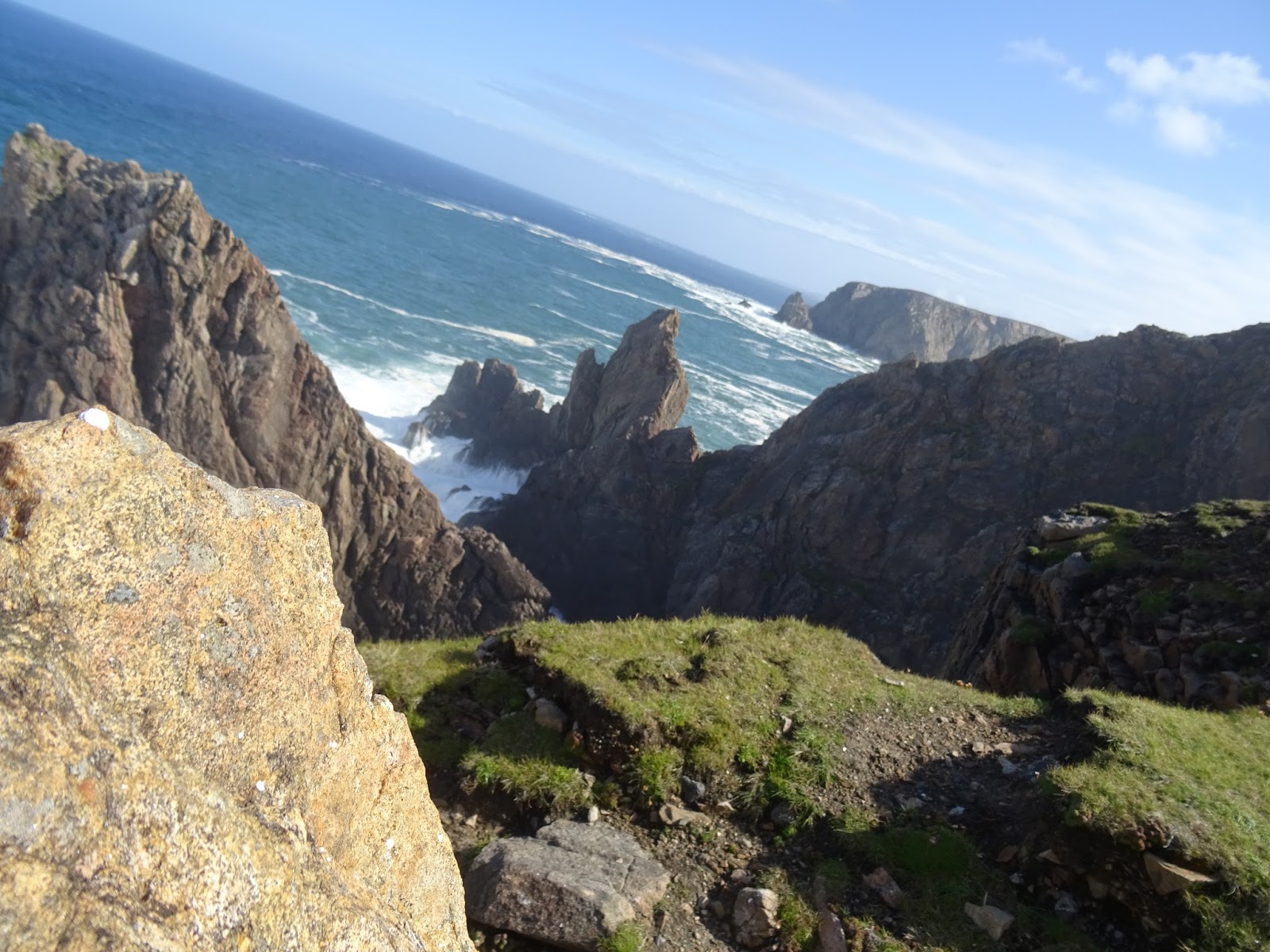
Arranmore Island or Árainn Mhór in Irish is wild and untamed and has a rich and vibrant heritage and culture and has been inhabited since prehistoric times. Probably the most accessible of all the Gaeltacht islands, Árainn Mhór has a resident population of approximately 500. The Gaelic traditions are still thriving on the island. Cliffs, beaches, rocky outcrops, sea stacks, sea caves provide stunning views in all directions. Highlights include Arranmore Lighthouse, dramatic sea caves and golden sandy beaches.

------------------------------------------------------------------------------------------------------------

Glen Hansard - Leave A Light.


Saturday, 14 April 2018

O broken God be with us always

'Give us this day our daily
incentives; fill us with goals though there is
no goal; give us this day our energy.

O broken God be with us always
now, and to the end of time.'

Here is the ending of one of the best poems by John F. Deane featured in his Give Dust a Tongue: A Faith & Poetry Memoir.

Deane was born on Achill Island in 1943. He founded Poetry Ireland – the National Poetry Society – and The Poetry Ireland Review in 1978, and is the founder of The Dedalus Press, of which he was editor from 1985 until 2006. In 2008 he was visiting scholar in the Burns Library of Boston College. John F. Deane’s poetry has been translated and published in France, Bulgaria, Macedonia, Romania, Italy, Slovakia, Sweden and other countries. His poems in Italian won the 2002 Premio Internazionale di Poesia Città di Marineo. His fiction has been published by Blackstaff Press in Befast; his most recent novel Where No Storms Come was published by Blackstaff in 2011. He is the recipient of the O’Shaughnessy Award for Irish Poetry and the Marten Toonder Award for Literature. John F. Deane is a member of Aosdána, the body established by the Arts Council to honour artists ‘whose work had made an outstanding contribution to the arts in Ireland.’ His poetry has been shortlisted for the Irish Times Poetry Now Award and the T.S. Eliot Prize. In 1996 Deane was elected Secretary-General of the European Academy of Poetry. In 2007 he was made Chevalier en l’ordre des arts et des lettres by the French government. He is currently the editor of Poetry Ireland Review.

--------------------------------------------------------------------------------------------------

John F. Deane - Shoemaker.

Friday, 21 August 2015

Letterkenny: St Eunan's Cathedral and Conwal Parish Church


However you approach Letterkenny – from Derry in the east, Gweedore and Glenties in the west, Fanad and Falcarragh in the north or Donegal and Ballybofey in the south – the tall spire of St. Eunan’s Cathedral greets you.

This beautifully-proportioned building was completed, not in the fourteenth century, but in the twentieth and that there were only eleven years between the formation of the Cathedral Building Committee in 1890, by the then Bishop of Raphoe – later Cardinal O’Donnell, whose statue stands just left of the main porch and the dedication and opening of the Cathedral in 1901.

The Cathedral, designed by William Hague F.R.I.A., of Dublin, is built of white Mountcharles stone. The building contractor (for the first five years) was James McClay of Strabane. The carving contractors were Messrs Purdy and Millard of Belfast. Because of geological features of the site it was not possible to orient the church in the traditional manner i.e., with the altar at the east end. The internal measurements are as follows: length 171 feet; width at transepts 100 feet; roof height 72 feet; spire 240 feet.

Opposite the Cathedral is Conwal Parish Church, a Church of Ireland church which dates back to the 17th century. The building is believed to have been constructed when a church located at Conwal, not far from Churchill fell into ruins. The church is rubble built with an ashlar spire. The interior retains its early 19th century cast-iron circular roof, trusses and a short gallery and twisted brass brackets.

-------------------------------------------------------------------------------------------------

Glen Hansard - Astral Weeks.

Árainn Mhór


Árainn Mhór is situated in a Gaeltacht (Irish speaking area) in the Republic of Ireland, approximately three miles from the Donegal mainland.

The island is serviced throughout the year from the fishing village of Burtonport by regular ferries. The journey from Burtonport on the mainland, to the pier in Leabgarrow takes you between a number of small islands, before crossing the stretch of open Atlantic known as Aran Roads.

The narrow channel between Rutland island (Inis Mhic an Doirn) and Inishcoo (Inis Cú/Ederinish) island is known as The Black Hole due to its deep, dark, fast moving waters. The shelter provided by the islands allows the Ferry to run in all but the most severe weather conditions.

Renowned worldwide for their atmosphere and charm, Árainn Mhór boasts six traditional Irish Pubs. Each pub has its own distinct strengths and you will find one to quench the thirst of a thirsty traveller on most quarters of the island. A large store of stories are a prerequisite for the job of Island barmen and they will entertain you long into the night, if you let them.

Árainn Mhór is a haven for wildlife enthusiasts who visit the island at most times of the year. The West of the island gives testament to the Atlantic's fury with many marine caves and stacks carved from solid rock resulting in a spectacular cliff coastline. The island is mountainous (225 meters) with poor land dotted with rocks and small lakes characteristic of the Rosses area of Donegal.

Excellent views of the mainland from Glen Head to Tory Island are to be found while walking the islands 7 square miles. The lighthouse, whose predecessor has warned seafarers from the islands shores since 1798, is situated on Rinrawros Point at the Northwest of the island providing a focal point for exploration of the surrounding area.

-----------------------------------------------------------------------------------------------

Runrig - The Mighty Atlantic.