Wikio - Top Blogs - Religion and belief
Showing posts with label conversations. Show all posts

Saturday, 25 July 2026

International Times: ‘Learning My Language’

My latest interview for International Times is with Jacquiline Creswell, who has worked as a curator with a number of Cathedrals in England and in that time has commissioned, curated and installed more than 80 exhibitions:

'It’s so interesting, as it usually takes about two or three years to do an exhibition, and what’s really amazing and fascinating is how the artist sees their work and themselves differently in that time. Somehow, they’ve actually embraced faith. I don’t necessarily mean in a Christian way but they have a new and different spirituality by that engagement. They talk to the Cathedral’s communities and there’s these backwards and forwards conversations, from which everybody’s learning. Everybody’s getting something from it. It’s bringing light to everybody.'

My reviews of exhibitions curated by Jacquiline Creswell can be read here, here, and here.

My earlier pieces for IT are: an interview with the artist Alexander de Cadenet; an interview with artist, poet, priest Spencer Reece, an interview with the poet Chris Emery, an interview with Jago Cooper, Director of the the Sainsbury Centre for Visual Arts, a profile of singer-songwriter Bill Fay, plus reviews of:
Several of my short stories have been published by IT including three about Nicola Ravenscroft's EarthAngel sculptures (then called mudcubs), which we exhibited at St Andrew's Wickford in 2022. The first story in the series is 'The Mudcubs and the O Zone holes'. The second is 'The Mudcubs and the Clean-Up King', and the third is 'The mudcubs and the Wall'. My other short stories to have been published by International Times are 'The Black Rain', a story about the impact of violence in our media, 'The New Dark Ages', a story about principles and understandings that are gradually fading away from our modern societies, and 'The curious glasses', a story based on the butterfly effect.

IT have also published several of my poems, including 'Spencer Reece at Bemerton' which is based on the visit that I made to Bemerton in 2026 with Spencer Reece, 'The ABC of creativity', which covers attention, beginning and creation, and 'The Edge of Chaos', a state of existence poem. Also published have been three poems from my 'Five Trios' series. 'Barking' is about St Margaret’s Barking and Barking Abbey and draws on my time as a curate at St Margaret's. 'Bradwell' is a celebration of the history of the Chapel of St Peter-on-the-Wall, the Othona Community, and of pilgrimage to those places. Broomfield in Essex became a village of artists following the arrival of Revd John Rutherford in 1930. His daughter, the artist Rosemary Rutherford, also moved with them and made the vicarage a base for her artwork including paintings and stained glass. Then, Gwynneth Holt and Thomas Bayliss Huxley-Jones moved to Broomfield in 1949 where they shared a large studio in their garden and both achieved high personal success. 'Broomfield' reviews their stories, work, legacy and motivations.

To read my poems published by Stride, click here, here, here, here, here, and here. My poems published in Amethyst Review are: 'Runwell', 'Are/Are Not', 'Attend, attend' and 'Maritain, Green, Beckett and Anderson in conversation down through the ages'.

I am among those whose poetry has been included in Thin Places & Sacred Spaces, a recent anthology from Amethyst Press. I also had a poem included in All Shall Be Well: Poems for Julian of Norwich, the first Amethyst Press anthology of new poems.

'Five Trios' is a series of poems on thin places and sacred spaces in the Diocese of Chelmsford. The five poems in the series are:
These poems have been published by Amethyst Review and International Times.

-------------------------------------------------------------------------------------------------------------

Wednesday, 24 June 2026

In Christ Jesus you are all children of God

Here's the sermon that I shared this morning at St Andrew’s Wickford:

Rowan Williams has written that, “all human identity is constructed through conversations, in one way or another.” First, we have to become aware of someone other than ourselves. Jonathan Sacks says, “we must learn to listen and be prepared to be surprised by others … make ourselves open to their stories, which may profoundly conflict with ours … we must learn the art of conversation, from which truth emerges … by the … process of letting our world be enlarged by the presence of others who think, act, and interpret reality in ways radically different from our own.”

Second, by these conversations we become aware of ourselves. As people, we are not autonomous constructions. Instead, our individual identities are gifted to us by the people, events, stories and histories that we encounter as we go through life. If there was no one and nothing outside of ourselves, we would have no reference points in life, no way of knowing what is unique and special about ourselves. In conversations we become aware of how we differ from others and therefore what is unique about ourselves.

Finally, in conversations we also become aware of what we have in common with others. Conversation is something that you can only do with someone else. Therefore, Charles Taylor has argued that, opening a conversation is to inaugurate a common action. A conversation is ‘our’ action, something we are both involved in together. In this way, conversation reminds us of those things that “we can only value or enjoy together” and is, as Rowan Williams has said, “an acknowledgement that someone else’s welfare is actually constitutive of my own.”

Although this is our natural way of learning our identity, there is an inherent danger which we see St Paul address in our New Testament reading today (Galatians 3.23-end). That is, by defining ourselves against others we can come to see ourselves as being so different from them that we either look down on them and consider ourselves as better than them or view them as our enemies. When we get into that mindset, we can ultimately scapegoat and attack others, as is the case currently when political parties blame migration for all the problems experienced in our society.

Jesus gave a good example of this happening when he told the Parable of the Pharisee and the Tax Collector. The Pharisee in Jesus’s parable arrogantly compared himself over and against other people: ‘God, I thank you that I am not like other people: thieves, rogues, adulterers, or even like this tax collector. I fast twice a week; I give a tenth of all my income.’ The fundamental comparison that we make should not be with others, but with God. Jesus challenged us to ‘Be perfect, therefore, as your heavenly Father is perfect.’ On the basis of that comparison, we all fall short. As St Paul writes, ‘for all have sinned and fall short of the glory of God.’

In Galatians 3, Paul says that, once we find our identity in Jesus, there is no need for other comparisons and we can see ourselves as all being children of God: “in Christ Jesus you are all children of God through faith. As many of you as were baptized into Christ have clothed yourselves with Christ. There is no longer Jew or Greek; there is no longer slave or free; there is no longer male and female, for all of you are one in Christ Jesus. And if you belong to Christ, then you are Abraham’s offspring, heirs according to the promise.”

When we find our identity in Jesus, we know that we are loved absolutely and fully as we are and, therefore, have no need to compare ourselves with others, whether we think we are better or worse that others. Then, all the labels that we put on ourselves to identify ourselves – old or young, white or black, gay or straight, Catholic or Protestant, West Ham or Spurs, whatever – cease to matter and we see ourselves as equals, brothers and sisters of Jesus, all together members of God’s family.

This is the route to harmony within society. It is the path to peace between nations and races. It is the kingdom of God on earth as in heaven. May it be so for each one of us. Amen.

-----------------------------------------------------------------------------------------------------------

U2 - COEXIST (I Will Bless The Lord At All Times?)

Saturday, 14 March 2026

International Times: Opportunities for mutual exchange, generating sparks

My latest review for International Times is on Threads of Life by Chiharu Shiota and Heart to Heart by Yin Xiuzhen at the Hayward Gallery:
 
'Shiota’s signature installations engulf ordinary objects – such as shoes, keys, beds, chairs and dresses – within huge weblike structures of red, black or white woollen thread. These floor-to-ceiling immersive works explore the body, memory, consciousness and the fragility of existence, while making visible the intangible connections we make throughout life. Shiota describes the making of her delicately woven structures as painting three dimensionally in a space with string.'

My earlier pieces for IT are: an interview with the artist Alexander de Cadenet; an interview with artist, poet, priest Spencer Reece, an interview with the poet Chris Emery, an interview with Jago Cooper, Director of the the Sainsbury Centre for Visual Arts, a profile of singer-songwriter Bill Fay, plus reviews of: U2's 'Days of Ash', Mumford and Sons' 'Prizefighter' and Moby's 'Future Quiet'; 'Collected Poems' by Kevin Crossley-Holland; 'Lux' by Rosalía; 'Springsteen: Deliver Me from Nowhere'; 'Great Art Explained' by James Payne; 'Down River: In Search of David Ackles' by Mark Brend; 'Headwater' by Rev Simpkins; 'The Invisibility of Religion in Contemporary Art' by Jonathan A. Anderson; 'Breaking Lines' at the Estorick Collection of Modern Italian Art, albums by Deacon Blue, Mumford and Sons, and Andrew Rumsey, also by Joy Oladokun and Michael Kiwanaku; 'Nolan's Africa' by Andrew Turley; Mavis Staples in concert at Union Chapel; T Bone Burnett's 'The Other Side' and Peter Case live in Leytonstone; Helaine Blumenfeld's 'Together' exhibition, 'What Is and Might Be and then Otherwise' by David Miller; 'Giacometti in Paris' by Michael Peppiatt, the first Pissabed Prophet album; and 'Religion and Contemporary Art: A Curious Accord', a book which derives from a 2017 symposium organised by the Association of Scholars of Christianity in the History of Art.

Several of my short stories have been published by IT including three about Nicola Ravenscroft's EarthAngel sculptures (then called mudcubs), which we exhibited at St Andrew's Wickford in 2022. The first story in the series is 'The Mudcubs and the O Zone holes'. The second is 'The Mudcubs and the Clean-Up King', and the third is 'The mudcubs and the Wall'. My other short stories to have been published by International Times are 'The Black Rain', a story about the impact of violence in our media, 'The New Dark Ages', a story about principles and understandings that are gradually fading away from our modern societies, and 'The curious glasses', a story based on the butterfly effect.

IT have also published several of my poems, including 'The ABC of creativity', which covers attention, beginning and creation, and 'The Edge of Chaos', a state of existence poem. Also published have been three poems from my 'Five Trios' series. 'Barking' is about St Margaret’s Barking and Barking Abbey and draws on my time as a curate at St Margaret's. 'Bradwell' is a celebration of the history of the Chapel of St Peter-on-the-Wall, the Othona Community, and of pilgrimage to those places. Broomfield in Essex became a village of artists following the arrival of Revd John Rutherford in 1930. His daughter, the artist Rosemary Rutherford, also moved with them and made the vicarage a base for her artwork including paintings and stained glass. Then, Gwynneth Holt and Thomas Bayliss Huxley-Jones moved to Broomfield in 1949 where they shared a large studio in their garden and both achieved high personal success. 'Broomfield' reviews their stories, work, legacy and motivations.

To read my poems published by Stride, click here, here, here, here, here, and here. My poems published in Amethyst Review are: 'Runwell', 'Are/Are Not', 'Attend, attend' and 'Maritain, Green, Beckett and Anderson in conversation down through the ages'.

I am among those whose poetry has been included in Thin Places & Sacred Spaces, a recent anthology from Amethyst Press. I also had a poem included in All Shall Be Well: Poems for Julian of Norwich, the first Amethyst Press anthology of new poems.

'Five Trios' is a series of poems on thin places and sacred spaces in the Diocese of Chelmsford. The five poems in the series are:
These poems have been published by Amethyst Review and International Times.

-------------------------------------------------------------------------------------------------------------

Shadows Fall - Redemption.

Thursday, 26 June 2025

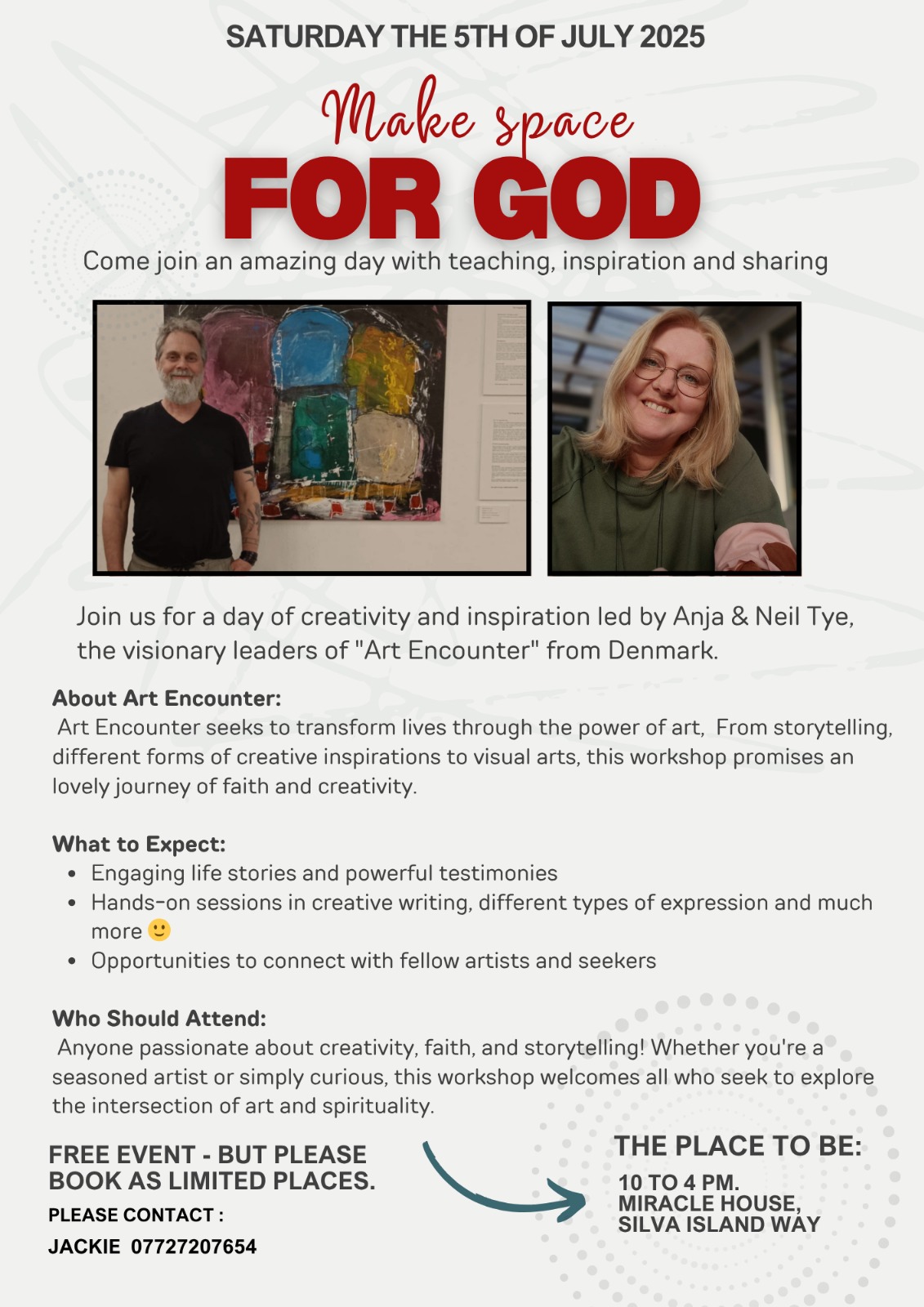
An evening with Neil Tye and Make Space for God


An evening with Neil Tye
Friday 4 July, 7.00 pm
St Andrew’s Church, 11 London Road, Wickford SS12 0AN


For the last 25 years Neil Tye has been working professionally, as a physical visual theatre performer, instructor, teacher, and installation artist, and has taken his performances, and teaching skills around the world. Hear stories about his music, performance, and painting.

Part of ‘Unveiled’, the Friday night arts and performance event at St Andrew’s Church

Artist Statement

Neil’s artistic practice is grounded in an intuitive and process-driven approach, wherein the act of painting itself dictates the final composition. Rather than adhering to predetermined concepts, he engages with the canvas through spontaneous mark-making and gestural forms, allowing the work to evolve organically. While his initial engagement with a piece may be sparked by a particular colour or shape, it is the dynamic interplay of movement, texture, and form that ultimately guides its development.

By embracing spontaneity and fluidity, his work exists at the intersection of abstraction and interpretation, inviting viewers to engage with the imagery in a way that is both personal and open-ended. Through this interplay between process and meaning-making, Neil`s paintings function as both intuitive expressions and conceptual explorations of movement, memory, and transformation.

About the artist

Neil Tye (b. 1963, London UK) is a Denmark-based artist with a background in both visual arts and physical theatre. Initially working as a performer and educator in physical theatre, he transitioned into visual expression 15 years ago. He holds an MA in Professional Practice from Middlesex University, London, and has exhibited, performed, and taught extensively across Europe and beyond. His exhibitions include venues such as the arts and culture centre Spinderihallerne (Denmark), the arts centre Banco de Nordeste (Brazil), and The Post Houston TX (USA), among others. Drawing from his multidisciplinary background, Neil’s work explores movement, form, and storytelling through visual mediums. He continues to create from his studio M10 in the Art zone area here in Spinderihallerene.

'The things we carry'

Following its initial display at Spinderihallerene in April, Neil's latest exhibition 'The things we carry' will be shown at Redbud Arts Center, Houston, from 7 - 28 June. This is a collection of mixed media works that centre around the nature of human connection. To mark the opening, Redbud Arts Center will host a special one-night performance by the internationally acclaimed Ad Deum Dance Company. The performance, inspired by themes from Tye's exhibition, will weave movement, storytelling, and live interaction with the artwork, offering audiences a multidisciplinary experience that bridges visual art and contemporary dance.

Neil says of the exhibition: "The title of this exhibition was inspired by reflections I had while creating my recent body of work. The first thought centres on the fundamental nature of human connection—we are not meant to navigate life alone. We rely on one another for support, understanding, and encouragement, whether through conversation, shared experiences, or emotional upliftment. The second thought arose from one particular painting, which evoked the image of an overloaded truck. This visual metaphor led me to consider how, in life, we accumulate and carry various burdens—emotions, worries, frustrations, memories, secrets, hopes, and dreams. These intangible yet weighty elements can become overwhelming, making it evident that we cannot bear them alone. At times, we must find ways to release or share these burdens, but this raises important questions: Where do we turn for relief? To whom do we entrust our heaviest thoughts? And how can we cultivate a sense of communal support to help lighten the loads we all inevitably carry?"


Make Space for God

Saturday 5 July, 10.00 am - 4.00 pm 

Miracle House, Silva Island Way, Wickford

A day of creativity and inspiration led by Anja and Neil Tye, the visionary leaders of "Art Encounter" from Denmark.

Art Encounter is an international arts ministry under Rescue Team which is run by married couple Neil and Anja Tye who are based in Denmark.

Neil and Anja are trained artists, and have been using their artistic skills as artist missionaries for many years. They have worked with different Christian organisations and churches from around the world such as Creative Mission in Sweden, Creative Arts Europe in Belgium, YWAM Costa Rica, Circus Victory Brazil, Ad Deum Dance Company USA, Iris Ministries Brazil, Acts Academy International Bible College, to Euroclass youth Mission boarding school in Denmark.

Art Encounter communicates the Gospel by using the arts, from dance, theatre, creative writing, and the visual arts and painting in various settings both in Denmark and around the world.

-----------------------------------------------------------------------------------------------------

Glen Hansard - Down On Our Knees.

Monday, 4 November 2024

Artlyst - November Art Diary

My November Art Diary for Artlyst begins with exhibitions by artists with whom I have some former connections, starting with some I have interviewed, such as Michael Petry, Sean Scully and Genesis Tramaine. Then, I highlight some other artists and exhibitions that address aspects of spirituality and mythology. These include Stanley Spencer, Takis and Jonathan Clarke. Finally, I end with exhibitions exploring themes of equality and inclusion, which enable difficult conversations to take place across boundaries:

'Another former interviewee of mine for Artlyst is Paul Chandler, who runs CARAVAN, an international arts NGO. Their latest exhibition, ‘SYMBOLS OF LIFE: BEYOND PERCEPTION: An Artistic Exploration of the Human Soul’, is part of the programming around the Biennale de Dakar, the premiere art event on the African continent. This exhibition features two remarkable artists whose work enhances our experience and understanding of each other and the transcendent. Tidiane Ndongo and Djibril Coulibaly brilliantly embody CARAVAN’s vision of seeing the arts play a strategic role in transforming our world; they touch the spiritual dimension of our human existence. Art is a universal language that can dissolve the differences that divide us. As long as division has torn apart the human family, art has offered a mode of reconciliation and wholeness. As is evident in this exhibition, artistic initiatives by their very nature, are “encounter points,” bringing people together from different backgrounds who might otherwise remain apart, deepening understanding across cultures and spiritual traditions.'

The interviews that I mention in this Art Diary can be found at: Michael Petry; Genesis Tramaine; Sean Scully; and Paul Chandler. I also mention the following reviews: ‘In The Black Fantastic’; ‘Rites of Passage’; and ‘A World In Common’.

Interviews -
Monthly diary articles -

Articles/Reviews -

--------------------------------------------------------------------------------------------------------

David Fanshawe: African Sanctus: 9. The Lord's Prayer (The Offertory).

Wednesday, 2 October 2024

A real relationship and conversation with God

Here's the sermon I shared at St Andrew’s Wickford this morning:

Although he doesn’t deserve it, Job is a man on whom all the troubles of the world have come (Job 9.1-12, 14-16). In rapid succession he loses all his livestock, servants and children. Then sores break out all over his body and his wife tells him to curse God and die. If we think life is hard for us, we might want to look at the story of Job and think again.

The book of Job is told as a series of conversations. It begins with a conversation between God and Satan about Job, continues with a conversation between Job and his friends about God and his response to suffering and ends with a conversation between Job and God himself. 

Job asks in 9.14-16:

“How then can I answer him,
choosing my words with him?
… If I summoned him and he answered me,
I do not believe that he would listen to my voice.”

However, Job’s experience, as the story progresses, is that it is possible for him to discuss and debate with God and what changes Job in this story is not the arguments and words of other human beings but the experience of genuinely meeting and speaking with God himself. Job asks why good people suffer and his friends reply that people suffer because of their wickedness, because they have not helped others and that we are punished in order to repent and be healed. Job knows in his heart and in his conscience that he has helped others and has not done wrong. Job’s friends are only able to tell Job what they think about God what they aren’t able to do is to help him encounter God himself. The story is told as a series of conversation because Job entering in to a conversation with God himself is what the book is all about.

Job’s friends - and, to begin with, Job, himself - think that being in relationship with God is primarily to do with our keeping a set of rules and regulations. If we do the right things then we will have God’s favour. The problem with this view is that we can look around the world and see wicked people who seem to prosper and good people who experience tragedy. This problem is acute for Job because he is one of those good people who experience tragedy. This view is still apparent in many churches today despite our knowledge of God’s grace and forgiveness in Jesus. Yet, when we act like that we are, like Job’s friends, setting up a series of standards which we believe come from God, and saying that if you don’t meet those standards or don’t repent, then you are outside of God’s will and no longer a follower of God.

But at the end of this story, it is Job’s friends with whom God is angry, not Job. In fact, Job himself has to pray for his friends so that they are not disgraced by God. The problem God has with Job’s friends is that they have not spoken the truth about God, as Job did. And yet much of what they had to say about God is standard theology about God. So, what is the difference between Job’s friends and Job? The difference is that Job wants to speak with God while his friends want to speak about God.

Job’s friends have a black and white view of God with no shades of grey and this is actually a way of avoiding encounter with God. In this way of thinking if life is going well then you know you must be keeping the rules because you have God’s favour and if life is not going well then you know you must have done something wrong and need to repent. Life is very simple and when you understand life like that you can keep God at arms length and don’t need to talk with him because you know what you have to do and all that matters is doing it right.

Job, however, knows that life is not as simple as that and, as a result, he wants to ask God about it direct. And when he starts talking to God, God starts talking to him. And what God has to say isn’t about giving Job rules and regulations to follow; it isn’t even about answering Job’s questions. It is simply about allowing Job to experience the magnitude of being in a real relationship and conversation with God. May it be so for each one of us. Amen.

--------------------------------------------------------------------------------------------------

Midnight Oil - World That I See.

Friday, 9 February 2024

Unveiled: Maciej Hoffman


There were fascinating insights into art from Maciej Hoffman at tonight's Unveiled in St Andrew’s Wickford, leading to much engaged discussion after the presentation was over. For a sense of some of the ground covered click here. For my reflections on Maciej's work click here, here, and here.

Maciej Hoffman was born in Wrocław, Poland in 1964, the son of artist parents, growing up under Poland's communist regime; after studying philosophy at the School of Theology in Wrocław, he graduated in Painting and Sculpture from the Academy of Fine Art in 1992. Becoming fascinated with web art and new graphic technologies, he then worked for 15 years in one of Poland's largest advertising agencies until a watershed moment in 2003, when he returned fulltime to the studio and to oil painting. He moved to England in 2012, in search of new artistic and life opportunities, and continues to paint, teach and exhibit in the UK and abroad.

Here he became involved in leading art workshops for school students, encouraging self-expression through art therapy for young people from disadvantaged backgrounds, or coping with mental health issues and trauma. He also contributed artworks to exhibitions dealing with conflict and resolution, including two marking Holocaust Memorial Days in 2012 and 2018 respectively. Maciej Hoffman's work has been exhibited in the UK on numerous occasions, including at Chelmsford Cathedral; Barry Gallery Central; Polish Social and Cultural Association (POSK) Gallery and Willesden Gallery (both London), and at the Warwick Art Centre.

‘Painting begins with a spark, an idea, an impulse. Sometimes it seems as though the painting creates itself, intuition guides me during the process … In trivialities as well as in big events I seek contrasts between imagination and reality. Our expectations and our anticipations are never what we finally meet in real life. This constant collision fascinates me. It’s irrelevant whether it’s beauty and ugliness, order or chaos - the point is, how it’s reflected in the mirror of my interpretation … I am moved by people’s stories with all their misfortunes and moments of happiness. It seems like one is always part of the other.’

https://www.maciej-hoffman.com/ https://www.buru.org.uk/record.php?id=1443

'Who Tells Your Story? Who Tells Your Future? An exhibition of paintings by Maciej Hoffman' is at St Andrew’s Church (11 London Road, Wickford SS12 0AN) until 29 March 2024. 

St Andrew’s is usually open: Sat 9am-12.30pm; Sun 9.30am-12 noon; Mon 2-3.45pm; Tue 1-4.30pm; Wed 10am-12 noon; Fri 10am-1pm. See https://wickfordandrunwellparish.org.uk/whats-on.html for more information.

‘I choose themes that pervade everyday life, our constant battle with problems which we inevitably face. But also issues which haunt us for years, shaping our perspective on the world and building us as humans. I try to capture the moments of tension, the climax, and the spark before ignition.’ Maciej Hoffman

Unveiled – a wide range of artist and performers from Essex and wider, including Open Mic nights (come and have a go!).

Unveiled – view our hidden painting by acclaimed artist David Folley, plus a range of other exhibitions.

Spring Programme 2024

  • 23 February – Tryin’ to throw your arms around the world. Jonathan Evens talks about the spirituality of the rock band U2. This talk sets out the main characteristics of U2’s spirituality, examines their roots, makes links between their spirituality and themes in contemporary theology and, considers three reasons why U2’s spirituality has connected with popular culture.
  • 8 March – Dave Crawford in concert. Popular local musician, Dave Crawford writes engaging/melodic songs in Americana/Alt-Rock/Indie-Folk. He has performed at the Leigh Folk Festival, Pin Drop Sessions, and Music for Mind together with Kev Butler. He was recently included on The Open Mic Show Album, Vol. 1 from SoSlam. We have enjoyed Dave’s powerful vocals and guitar here when he has performed previously at our Open Mic Nights.
  • 22 March – An evening with the Ladygate Scribblers. Hear poetry and prose from a long-established Wickford-based writers group.

These events do not require tickets (just turn up on the night). There will be a retiring collection to cover artist and church costs. See http://wickfordandrunwellparish.org.uk/whats-on.html for fuller information.

------------------------------------------------------------------------------------------------------

Sinéad O'Connor - Trouble Will Soon Be Over.

Sinéad O'Connor

Wednesday, 17 May 2023

A conversation that explores how we shall now live and who it is that is our neighbour

Here's the sermon I shared at St Andrew’s Wickford this morning:

St Paul began a discussion when he stood before the Areopagus and spoke about an altar with the inscription, ‘To an unknown god’ (Acts 17.22-31). The Areopagus was the rock of Ares in Athens, a centre of temples, cultural facilities and high court, and also the name of the council that originally served as the central governing body of Athens, but came to be the court with jurisdiction over cases of homicide and other serious crimes. In speaking to the Areopagus Paul was giving a guest lecture, whilst also being, in some senses, on trial.

Pope John Paul II likened the modern media to the New Areopagus, where Christian ideas needed to be explained and defended anew, against disbelief and the gold and silver idols of consumerism. Understanding how St Paul did so in the original Areopagus can assist in understanding how we might initiate or contribute to debate and dialogue in our own day and time, whether virtually or in person.

Paul began where people were by referring to the altar to an unknown god which was to be found amongst the cluster of temples around him. He didn’t criticize those to whom he was speaking. Instead, he commended the breadth of their engagement with religion. He didn’t tell them they were wrong by suggesting they were pagans worshipping the wrong god or gods. Instead, he overaccepted their religious story fitting it into the larger story of what he believed God was doing with the world. Nor did he dismiss their culture. Instead, he made it clear that he had heard and appreciated their poets by making connections between those poets and the message he had come to share. In these ways, he began a dialogue with them about the nature of faith and its engagement with their lives and culture. We read that some scoffed but others said, ‘We will hear you again about this’, and some joined him and became believers.

Paul was able to be in Athens because he had a trade – tentmaking – which enabled him to be supported financially as he travelled and which opened doors and provided contacts that might not otherwise have been open to him. In each place to which he travelled he formed new congregations led by those who came to faith. In each place that he visited he went to the synagogue and sought to speak with those at the heart of the Jewish community, but also welcomed those who were on the edge, often Gentiles, slaves and servants.

Over the past year we have been making use of the HeartEdge model of mission in this parish. It’s called the 4Cs – compassion, culture, commerce and congregation. It is a pattern for ministry that we share with other churches throughout the UK, and the world, through the movement to renew the church that is called HeartEdge. HeartEdge is about churches developing these 4Cs. Generating finance and impacting communities via social enterprise and commerce. Culture, in the form of art, music, performance, that re-imagines the Christian narrative for the present. Congregations that develop welcoming liturgies, worship, and day-to-day communal life while also addressing social need and community cohesion. Nurturing each of these is essential for renewal of the church.

HeartEdge churches are seeking to begin and develop a conversation with our communities and nations, as Paul sought to do in Athens. As one example, St Mark’s Church in Pennington, within the Diocese of Winchester, used their churchyard hedge as a site for yarn bombing to focus the attention of their community on Holocaust Memorial Day, Holy Week and Easter, and the VE Day anniversary. Organising online community events and services combined with the organisation of knitting and crochet work for the different yarnbombs placed St Mark’s at the heart of their community while connecting many who were isolated because of the Covid-19 lockdown. St Mark’s demonstrated that the boundaries of ‘church’ should be much more porous than they had previously imagined. Rachel Noel, the Vicar of St Mark’s, said she hoped that we will all get so used to worshipping with, and being led by, a variety of people, that we will always seek to find ways to include and value diversity and richness.

As with Paul in Athens and HeartEdge churches like St Mark’s Pennington, we are seeking to connect compassion, culture, commerce and congregation to draw all engaged in those forms of community into a conversation that explores how we shall now live and who it is that is our neighbour.

What we have done over the past year has begun a conversation where the ‘good news’ of community compassion and culture, with church at the heart and on the margins, can be heard and is being valued. We are inviting others to join that conversation, to have their say, so that the margins can speak to the centre that we might encounter God in everyone.

As we do so, we will together find a story which connects a series of otherwise inexplicable circumstances, begin to live in that story and then act our part within it. In this way, like those who joined Paul in Athens, we, too, may discover it is the story of what God is doing with the world that reveals where we are and what we are to do.

-------------------------------------------------------------------------------------------------------

Pissabed Prophet - Waspdrunk.