Wikio - Top Blogs - Religion and belief
Showing posts with label london underground. Show all posts

Sunday, 13 March 2016

Exhibitions update: Jones, Piper, Johnston & Russian portraits

David Jones: Vision & Memory is now at the Djanogly Gallery in Nottingham. This major exhibition has been organised to coincide with the publication of a new monograph and includes some 60 works from throughout Jones’s life in a timely reassessment of one of the most imaginative artists of his era. Exhibits range from sketches made on the Western Front to watercolours of trees, flowers and thorns, as well as drawings of Arthurian subjects and painted inscriptions.

David Jones (1895-1974) was a painter, engraver, poet and maker of inscriptions. A lyrical draughtsman, he responded with delight to the visual world, yet his vision was informed by memory reaching back into the depths of time and history. The celebrated art historian and broadcaster, Kenneth Clark, believed he was the greatest British watercolourist of the 20th century.

In the 1920s, working in the circle of Eric Gill, Jones became an engraver of the first rank. His illustrated books engage with the world of symbol and myth. They will be exhibited alongside his shimmering watercolours of still lives, seascapes and portraits. In later years, as David Jones devoted more time to poetry, he painted inscriptions that are as vital in design as they are allusive in content.

The exhibition has been organised by Pallant House Gallery, Chichester, with the support of Amgueddfa Cymru – National Museum Wales, and features works drawn from both private and public lenders including Kettle’s Yard, Cambridge, Tate and the V&A.

John Piper: The Fabric of Modernism at Pallant House is the first exhibition to focus on John Piper’s textile designs, exploring key motifs in the artist’s work such as historic architecture, abstract and religious imagery, as well as subjects explored in the final years of the artist’s life, such as foliate heads, sunflowers and the church at Long Sutton. Shown alongside related paintings and other studies the exhibition demonstrates how Piper’s designs were intricately connected with his wider work.

John Piper was one of the leading Modern British artists of the 20th century, best known for his paintings of Britain’s romantic heritage including churches, country houses and wartime ruins. In the post-war period Piper was also noted for his work as an accomplished designer of theatre sets, stained glass windows, and textiles. Through over 80 works, this major exhibition is the first to focus on John Piper’s textile designs, exploring key motifs in the artist’s work such as historic architecture, abstract and religious imagery, as well as subjects explored in the final years of the artist’s life, such as foliate heads, sunflowers and the church at Long Sutton. Shown alongside related paintings and other studies the exhibition demonstrates how Piper’s designs were intricately connected with his wider work.

Piper’s textile designs included furnishing fabrics for the post-war home for companies including Arthur Sanderson & Sons Ltd, scarves for Asher, ecclesiastical garments, and tapestries created for cathedrals and other public spaces. Marking the 50th anniversary of the installation of the artist’s celebrated altar tapestry in Chichester Cathedral, many of the studies for this important example of religious art will be shown alongside several of the Foliate Head tapestries woven to Piper’s designs at West Dean Tapestry Studio near Chichester. The exhibition will be accompanied by a new book by Simon Martin, with contributions by Frances Spalding.

Underground: 100 Years of Edward Johnston’s Lettering for London at the Ditchling Museum of Art & Craft marks the centenary of Edward Johnston’s world famous typeface for London Underground. Remarkably, it has barely changed over 100 years, a testament to its success as station way finders.

Hand drawn by Johnston whilst living in Ditchling this alphabet is gloriously simple, but its design is rooted in much earlier lettering since it bears the proportions of Roman capitals. The design was initially proposed in 1913 by Frank Pick, commercial manager of London Underground Railway as a joint project for Edward Johnston and Eric Gill, but Gill was unable to proceed since he had agreed to a major commission of Stations of the Cross stone reliefs for Westminster Cathedral.

Johnston’s typeface is known variously as Underground, or Johnston Sans. It is also known as the basis on which Eric Gill, one of Johnston’s first pupils at Central School of Arts & Crafts, designed his typeface Gill Sans for the Monotype Corporation, released in 1928. With similar proportions to Johnston’s earlier typeface, it was initially criticised for being too similar but both Johnston Sans and Gill Sans have become modern classics.

This exhibition shows Johnston as a true man of letters, resurrecting and redefining calligraphy in the West, and designing an elegant typeface for London Underground. Highlights include Johnston’s calligraphy for W R Lethaby which secured his post as a teacher at Central School of Arts & Crafts; manuscripts showing his development as a calligrapher; rarely seen working drawings of the Underground typeface, and original drawings for Gill Sans.

Russia and the Arts at the National Portrait Gallery is a once-in-a-lifetime opportunity to see masterpieces on loan from the State Tretyakov Gallery in Moscow.

The exhibition will focus on the great writers, artists, composers and patrons, including Tolstoy, Chekhov and Dostoevsky, whose achievements helped develop an extraordinary and rich cultural scene in Russia between 1867 and 1914.

The exhibition will also show how Russian art of the period was developing a new self-confidence, with the penetrating Realism of the 1870s and 1880s later complemented by the brighter hues of Russian Impressionism and the bold, faceted forms of Symbolist painting.

-------------------------------------------------------------------------------------------

Paul Johnson - The Road.

Saturday, 2 March 2013

Ross Ashmore: Cataloguing the mundane


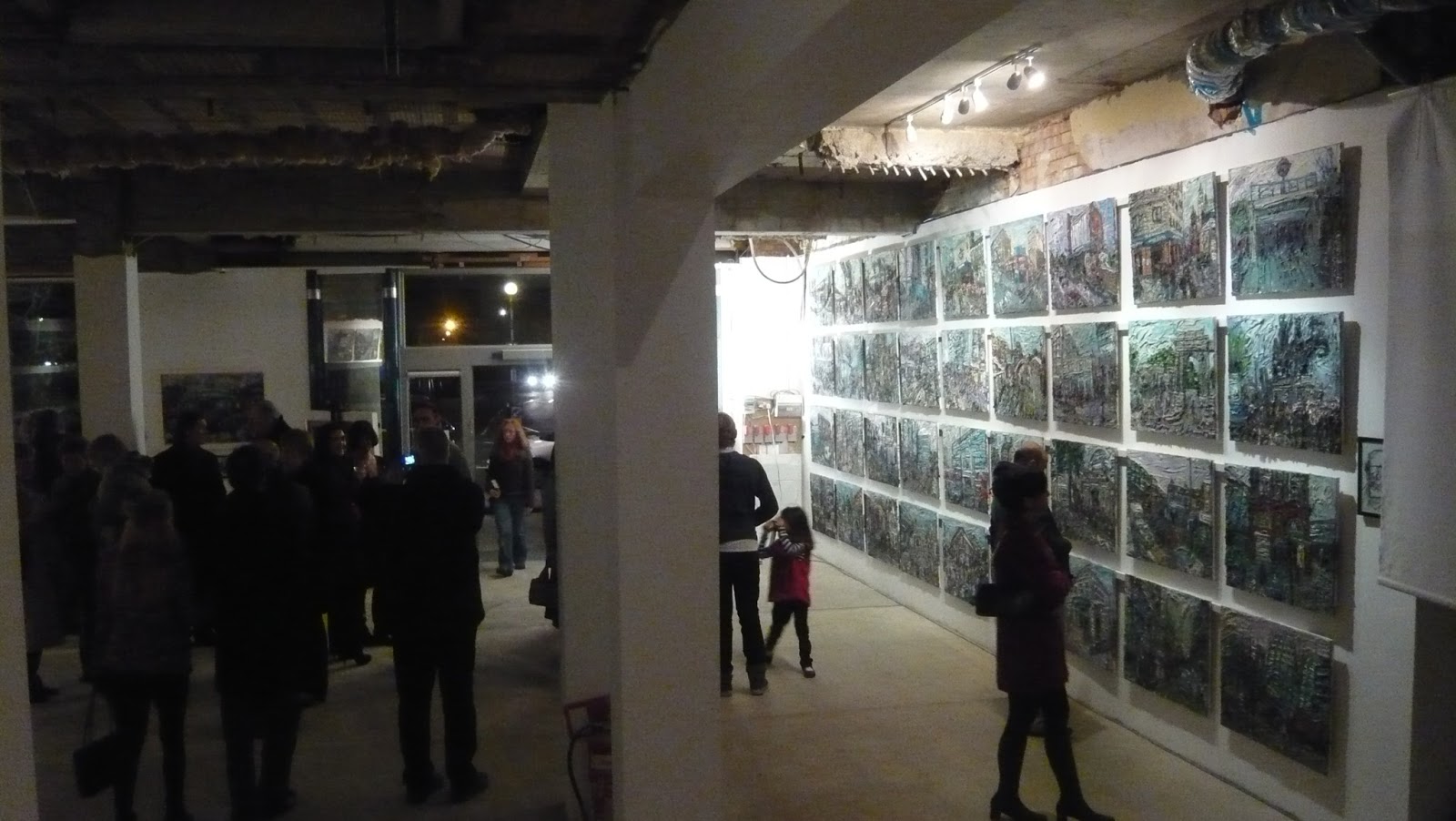
Ross Ashmore has embarked on an ambitious task of painting all the London Transport Underground Stations- of which there are 267. “I realise for me this has to do with my commercial past. I was always under pressure to deliver on time, except this time I had created my own brief and deadline.” To coincide with this year's 150th Anniversary of London Underground, he will finally complete all the paintings, of all the stations, this summer. “I love the Underground. I love the concept of going below ground and resurfacing somewhere else."

“I believe that art is a powerful form of expression. That an artist should be honest, passionate and have conviction about his work – much at odds with the commercial world I had come from and today's obsession with perfection. I didn't want to be chocolate box. The gesture of painting, the process, is just as important to me as the image. Every painting is an action – making the mark in paint creates energy and conveys emotion – it creates the mood – it begins to take on a life of it's own. I love the physicality of painting. Many artists today are so obsessed with perfection and technique they don't look like paintings at all.”

“The mass produced commercial world is so concerned with perfection – 'everything was airbrushed out!' In contrast I began to appreciate being different, embracing individuality – freedom of expression. This view is what drives and inspires me today. It's the ordinary things in life, the mundane that I want to catalogue in my work. With all the relentless change, very soon, we may forget the way things were.”

Ross Ashmore: Going Underground is at SPACE art gallery (141 High St, Southgate N14 6BP) until 5 April. Open: Mon-Fri 17:30-19:30, Sat and Sun 12:00-16:00.

-------------------------------------------------------------------------------------


Tuesday, 26 February 2013

Ross Ashmore: Going Underground


Ross Ashmore is about to finally accomplish his three year mission to paint every station on the London Underground – of which there are 267.

‘SPACE art gallery’ are set to exhibit for the first time together, over 100 of these highly expressive impasto paintings.

As an urban landscape artist, Ross feels compelled to document the ‘beauty in our streets’ before the inevitable changes society forces upon them.

He endeavours to convey emotion in his paintings, revealed by his textural mark making in paint, creating energy – giving each painting a life of its own.

Speaking of his work, Ross said: “I love the physicality of painting…and it’s everyday life that I want to highlight in my work. What better subject could there be than the streets where we find these wonderful stations.”

The exhibition will take place at SPACE art gallery, 141 High St, Southgate N14 6BP and will run until Friday 5 April. The opening night is on Saturday 2nd March from 7.00 - 9.00pm.

For more urban landscapes see the following:

Caroline Nina Phillips is showing work in Start 13: The New Industrialists celebrating the full opening of London’s newest creative hub, The Bermondsey Project, which comprises Crisis Skylight Bermondsey, Bow Arts SE1 Studios, London Sculpture Workshop, London Community Furniture and the Outside Puppets Collective. The urban landscape has been a source of fascination, inspiration and a recurring theme throughout the work of Caroline Nina Phillips. Observational drawings and camera snapshots of the local urban environment are used as starting points for these layered, painterly works. Particularly favoured focal points are construction sites; building works; passageways and stairways. Noticeably, the chosen places are those which could be easily overlooked. It is through experiencing; looking; recording and reflecting upon such particular spaces, that Caroline Nina captures their existence and essence.

Part 2 of CiTiES: All Dimensions, an exhibition celebrating urban-living and virtual-architecture, will open shortly at the Tokarska Gallery:

  • Thursday 7 March 2013 – Private view will be held at Tokarska Gallery, 6pm-8pm
  • Saturday 9 March 2013 – Performance night: 6-9pm. Music provided by Mark Beazley
  • Thur 7 March – Sun 17 March 2013 – Exhibition will be open to the public Thursday to Saturday 12 – 7pm
Cities, like people, have their stories. Loved or deserted, they never fail to provoke a reaction. Silent testaments to human endeavour and social intelligence they form a collective view, which we tend to interpret by focusing on a certain aspect of its being. It may even be acceptable to think that cityscape art is a reflection of oneself within the city-concept. Cities, like people, grow, age and develop. However their lifespan is unrivalled to that of their inhabitants. Driven by social tendencies their transition from generation to generation often perceived as seamless. This facade cannot be further from the truth though, as is explored in “Cities: All Dimensions”.

---------------------------------------------------------------------------------

The Jam - Going Underground.

Saturday, 24 December 2011

What can I do for you?

The story of Santa Claus begins with a man called Nicholas, who was born during the third century in the village of Patara. At the time the area was Greek and is now on the southern coast of Turkey.
His wealthy parents, who raised him to be a devout Christian, died in an epidemic while Nicholas was still young. Obeying Jesus' words to "sell what you own and give the money to the poor," Nicholas used his whole inheritance to assist the needy, the sick, and the suffering. He dedicated his life to serving God and was made Bishop of Myra while still a young man. Bishop Nicholas became known throughout the land for his generosity to those in need, his love for children, and his concern for sailors and ships.
Through the centuries many stories have been told of St. Nicholas' life and deeds. These help us understand his extraordinary character and why he is so beloved and revered as protector and helper of those in need.
One story tells of a poor man with three daughters. In those days a young woman's father had to offer prospective husbands something of value — a dowry. The larger the dowry, the better the chance that a young woman would find a good husband. Without a dowry, a woman was unlikely to marry. This poor man's daughters, without dowries, were therefore destined to be sold into slavery. Mysteriously, on three different occasions, a bag of gold appeared in their home providing the needed dowries. The bags of gold, tossed through an open window, are said to have landed in stockings or shoes left before the fire to dry. This has led to the custom of children hanging stockings or putting out shoes, eagerly awaiting gifts from Saint Nicholas or Santa Claus, as we call him today.
Sometimes the true meaning of Christmas gets hidden by all the festivities. How many of us, for instance, remembered when we saw Father Christmas at stores and bazaars and schools or while we were hanging up our stocking that he is actually a follower of Jesus. How many of us remembered that he is originally St Nicholas who gave away all he had because Jesus had first given him all he had? Jesus gave himself to us by coming into our world as a baby and growing up to die on the cross as our Saviour. This is what is at the heart of Christmas and so we need to remember that Christmas is about giving to others instead of getting for ourselves.
This year, unusually, a Christmas advert has captured this truth in exactly this way. I’m thinking of the John Lewis advert with a little boy and a present. The background music to the ad – ‘Please, please, please, let me get what I want’ a song written by the Smiths – leads us to believe the boy is desperate to open his presents on Christmas morning but the ‘catch in the throat’ moment that is the ad’s punchline is that he’s actually desperate to give his parents their present from him. So, while, like all ad’s, this ad wants us to buy the company’s products, it is also reminding us that the real joy of Christmas is found in giving rather than getting.  

This Christmas, Bible Society is asking everyone to take part in a new campaign called: ‘What can I do for you?’ To celebrate the birth of Christ, they are asking everyone to take a moment of their time, on 25th December, to offer help – however large or small - to one other person by asking them this simple question and then fulfilling their request.
The answer may be: “peel the potatoes” or “call me more” – it really doesn’t matter. It just means that, for a few moments or more, on the 25th of December, people are given the chance to experience what Jesus meant when he said: “It is more blessed to give than to receive”.

Of course, there’s no need to only ask that question of others on Christmas Day and there are lots of initiatives and groups that can help us. Here are just two others:
If you’d like ideas and reminders regularly about ways of giving to others and living more generously then you could join a group like Generous which is building a global community of people who believe in changing the world for good … one step at a time. Generous is about imagining a different way of living, about innovating, trying new things, believing that things can be better, simpler, more beautiful. Every action unknown to everyone else - from unplugging appliances to dumping bottled water, from sharing your car journey to buying Fair Trade - incrementally shifts history in favour of the planet and its people. The more people who go Generous, the greater their impact.

Acts of Kindness is a project by artist Michael Landy celebrating everyday generosity and compassion on the Tube. Landy’s project invites us to notice acts of kindness however simple and small. The artist explains, ‘Sometimes we tend to assume that you have to be superhuman to be kind, rather than just an ordinary person.’ So, to unsettle that idea, Acts of Kindness catches those little exchanges that are almost too fleeting and mundane to be noticed or remembered. Landy has invited passengers and staff to help by sending stories of kindness that have been seen or that people have been part of on London Underground and he has chosen a selection of the stories to place in Central line stations and trains. Acts of kindness between strangers undermine the idea that we should compete and always strive to be independent. Instead, they’re an acknowledgement of our shared humanity. Landy says, ‘That’s what “kindness” means – we’re kin, we’re of one kind.’
Rachel Rounds, Senior Press Secretary at Bible Society, has said: “The act of giving of ourselves reminds us that we are part of a wider community; it reminds us of the practical outworking of the two greatest commandments - to love God first and then our neighbour. Somewhere in the midst of all the noise, that still small voice may ask us all: What matters most to you?’”
May we all hear that still, small voice this Christmas whether it’s through St Nicholas, the John Lewis ad, ‘What can I do for you?’, generous, Acts of Kindness, or the Christmas story itself.

---------------------------------------------------------------------------------------

Valdemar - What Can I Do For You.