Wikio - Top Blogs - Religion and belief
Showing posts with label kossowski. Show all posts

Saturday, 13 February 2021

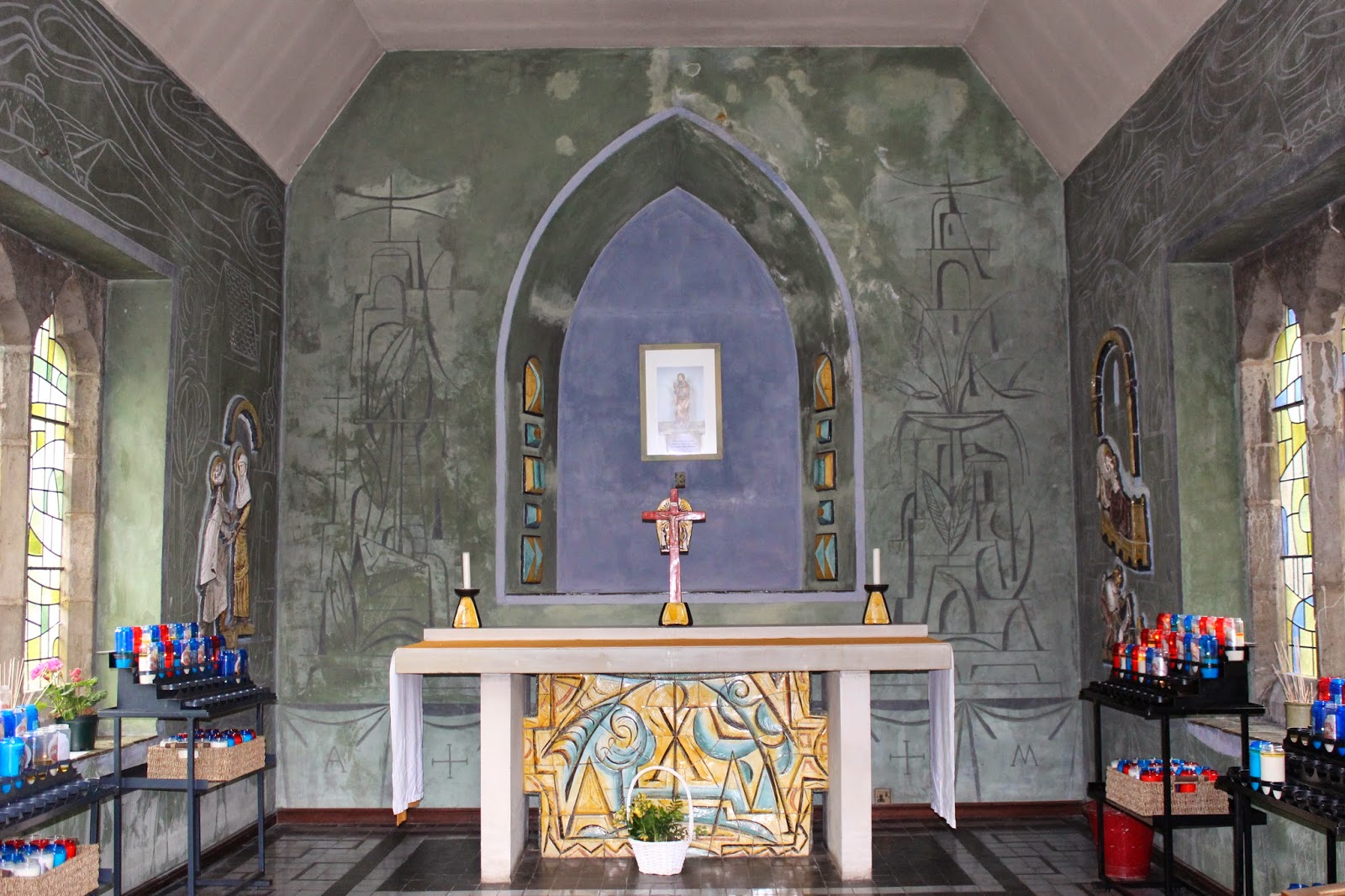
Sabbatical art pilgrimage: St Thomas of Canterbury Rainham


St Thomas of Canterbury Church, Catholic Parish of Rainham
  • St Jude Statue by Michael Clarke, F.R.B.F.
  • St Antony of Padua Statue
  • Children's Memorial Garden
  • Reconciliation Room
  • Blessed Sacrament Chapel
  • Sacred Heart Statue by Michael Clark F.R.B.F.
  • St. Patrick and St. George by Michael Clark F.R.B.F.
  • St. Joseph and the Holy Family by Adam Kossowski
  • The High Altar
  • Chapel of Our Lady
  • The Stations of the Cross by Michael Clarke, F.R.B.F.)

-------------------------------------------------------------------------------------------------------------

Jim White - Wonders Never Cease.

Wednesday, 26 July 2017

"To do something for others for a change instead of just being a selfish bastard"

Here is my reflection from today's lunchtime Eucharist at St Martin-in-the-Fields:

For the last 26 years an annual Pilgrimage has been organised from St Martin-in-the-Fields to Canterbury to raise funds for our work with homeless people here in the centre of London. This memorable and picturesque four day walk from the steps of St Martin’s along the Pilgrims Way covers 74 miles. The journey ends in the cloisters of Canterbury Cathedral with the laying of flowers on the tomb of Revd Dick Sheppard.

On the Saturday of the Pilgrimage the weary Pilgrims are glad to stay overnight at Aylesford Priory. Their programme for the walk is tight, so there may not be much time to explore the Priory – showers and sleep are likely to be the priority – but, were they to do so, they would find marvellous ceramics throughout the Priory by the celebrated Polish artist and ceramicist, Adam Kossowski, who devoted much of his working life to places of Christian worship following his release from Soviet labour camp. He said: ‘…When I was so deep in this calamity and nearly dead I promised myself that if I came out of this subhuman land I would tender my thanks to God.’

At Aylesford Priory, he certainly did that. Kossowski spent the last 20 years of his life, until he died in 1986, narrating important Christian events and the history of the Carmelite Order through his craft. So much so that his work has been described as "a prayer in stone."

Among the Chapels that he decorated at the Priory is St Anne’s Chapel. This is a chapel which reflects the value of our families through walls with ceramics that tell the story of Mary’s parents Joachim and Anne as it is told in the apocryphal gospel of James. As you look around this predominantly green Chapel - green to reflect hope and new life – you see: an angel appear to Joachim in the fields telling him his prayers are answered; Joachim meeting his wife at the city gates and telling him she is pregnant at long last; The birth of Mary; and Anne and Mary going to the temple so Mary can be dedicated to the service of God.

The story of Anne and Joachim appears to be based heavily on that of Hannah, the mother of Samuel. A cult of devotion to Saint Anne is documented in the East in the 6th century, and had spread to the West by the 10th century. Devotion to Saint Joachim developed in the 14th century. The Church maintains their feast day both to emphasise God's plan from the beginning to send his Son, born of a woman, born under the law, to redeem fallen humanity; and also to show God's faithfulness in keeping his covenant with all generations. The feast day is traditionally a time to pray for families.

Families are essentially an incubator in which to learn about the reality of love. The Friars provide a guide to the different Chapels which can be visited at Aylesford Priority and this includes a prayer to say in each Chapel. The prayer for St Anne’s Chapel articulates a realism about our experience of family life that reflects what it would have been like for Mary growing up with her parents. The prayer begins by acknowledging the importance of the family at the heart of faith and the bringing of our own family before God to thank him for their presence in our life. It then continues, ‘You alone know the longings and struggles of each one of us, and you alone know our failures and regrets. Bless us with loving forbearance with one another. Heal any wounds that divide us and bring us together in eternal life with you.’

The reality of learning to love in families is bound up with longings and struggles, failures and regrets, loving forbearance, and the healing of wounds that divide us. If we allow ourselves to learn to love through these experiences, then we are enabled to love not just our own families but others outside our immediate family and friends as well. Some years ago a reporter from The Independent joined the Canterbury Pilgrimage. One of the pilgrims to which he spoke was a barrister and a judge, with a wife and kids and a comfortable life in west London. So what, he asked, had prompted him to leave all this behind for four days of the toughest walking he had ever done? The reply was, "As penance for my sins … and to do something for others for a change instead of just being a selfish bastard."

The reporter and that pilgrim both learnt through the Pilgrimage that while love may begin at home, it isn’t intended to end there. We can potentially learn love in our family, but if our love remains within our family unit then it is limited, restricted, selfish even. The love which Mary learnt from her parents and which Jesus then learnt from Mary and Joseph was a love that encompassed others, even the world itself! Just like that Judge and the Independent reporter we need to learn to look outside of the places where we are currently living comfortable lives to do something for others for a change instead of just being selfish.

----------------------------------------------------------------------------------

Arcade Fire - Creature Comfort.

Sunday, 13 March 2016

10 best places for reflection

In today's Observer Aaron Rosen chooses his 10 best places for reflection. From Reykjavik to Tate Modern, he looks at spaces to inspire contemplation during Lent.

Aaron has some great choices but his choices are clearly intended to prompt reflection among his readers on the choices they would make, so here is my top 10:

l’Abbaye de la Fille Dieu, Romont


Brian Clarke says that stained glass ‘can transform the way you feel when you enter abuilding in a way that nothing else can!’ I would concur, especially after arriving at l’Abbaye de la Fille Dieu in time for a memorable service of Vespers followed by silent contemplation in the still onset of darkness falling.Tomas Mikulas, the architect on the restoration of this Cistercian Abbey, has stated that the overall goal of the restoration was to offer both nuns and visitors an ‘atmosphere conducive to meditation and prayer.’ Mikulas suggests that it is the ‘warm and vibrant atmosphere’ created by Clarke’s windows ‘with the changing light of day’ that ‘makes a decisive contribution’ to the space and to the restoration as a whole.

Chapelle Sainte-Thérèse-de-l'Enfant-Jésus et de laSainte-Face, Hem


Alfred Manessier was a lyrical abstractionist who thought of stained glass less as a design than as “the simultaneous creation of a light-filled architectural unit, thought-out and created by the painter at one go.” In this way he wanted "to express man’s inner prayer.” Chapelle Sainte-Thérèse-de-l'Enfant-Jésus et de laSainte-Face in Hem is an attempt to create spiritual space - a sense of prayer and a glimpse of heaven – through the play of light and colour within the building.


Pleshey was the first Diocesan Retreat House to be established in the country. Amongst the list of Retreat conductors is Evelyn Underhill. Arguably the most distinguished Conductor of that time, it is largely due to Underhill that the Retreat house became so popular. When you come to the Retreat House in Pleshey you sense an atmosphere created by six hundred years of prayer. For me, it is a special place because of ordination and cell group retreats.


Down dimly-lit stairwells / into a cavernous immensity / of curved brick, concrete and darkness / to stand still, transfixed, / in silent expanse / focused on the glow / and gleam / of the white stone table / over which / the crucified Christ hangs / from concrete cross-beams. / Morning light softly infiltrates, / casting shadows, / bringing the dawn ... The space and acoustic / act and appear as /
the inside of a hi-fi speaker; / the lantern, like an industrial chimney, / funnels the aromatic incense /
of prayer and praise / to tease and to please / the senses of God.

St Benet's Chapel


Adam Kossowski's murals at St Benet's Chapel fill the entire wallspace of this circular chapel surrounding and enveloping worshippers with their imagery. When services are held, however, the altar table is located in front of the panel depicting worship in heaven of the lamb that was slain. In this way, worship on earth is conducted in the context of worship in heaven. This work is about rescue, redemption and salvation. Fr. Edward Maguire has written, 'From clay and fire he forged a vision of the past, present and future to lift up and inspire countless others ... May we be inspired by him to use our gifts as he used his."

Notre-Dame du Bon Conseil, Lourtier


Lourtier is to be found among the imposing alpine architecture of snow-capped peaks in the Val de Bagnes, one of Switzerland's largest nature reserves. I arrived at the end of the afternoon to find the mountain sunshine flooding the empty church. Alberto Sartoris’ design for Notre-Dame du Bon Conseil is clean, spare and minimalist. Internally, the church is a simple white rectangle with a sleek arched wooden roof. Both the ceiling’s planks and the grey-painted wooden pews draw the eye to the sanctuary wall containing two large stained glass windows by Albert Gaeng. The triumph of Lourtier is an influential design coupled with a dramatically beautiful building that is well suited to the liturgy and well used by its people.

The Crypt of Colònia Güell


The Crypt of Colònia Güell is a warm, womb-like enclosure; intimate yet archetypal. It is real and usable communal space while also being of great architectural worth, innovation and beauty. Here the ‘heaven in ordinarie’ of the Eucharist is celebrated in the surround of natural forms recreated by man-made means. 'Gaudí based his buildings on a simple premise: If nature is the work of God, and if architectural forms are derived from nature, then the best way to honor God is to design buildings based on his work. As the Barcelona scholar Joan Bassegoda Nonell notes, "Gaudí's famous phrase, 'originality is returning to the origin,' means that the origin of all things is nature, created by God."'

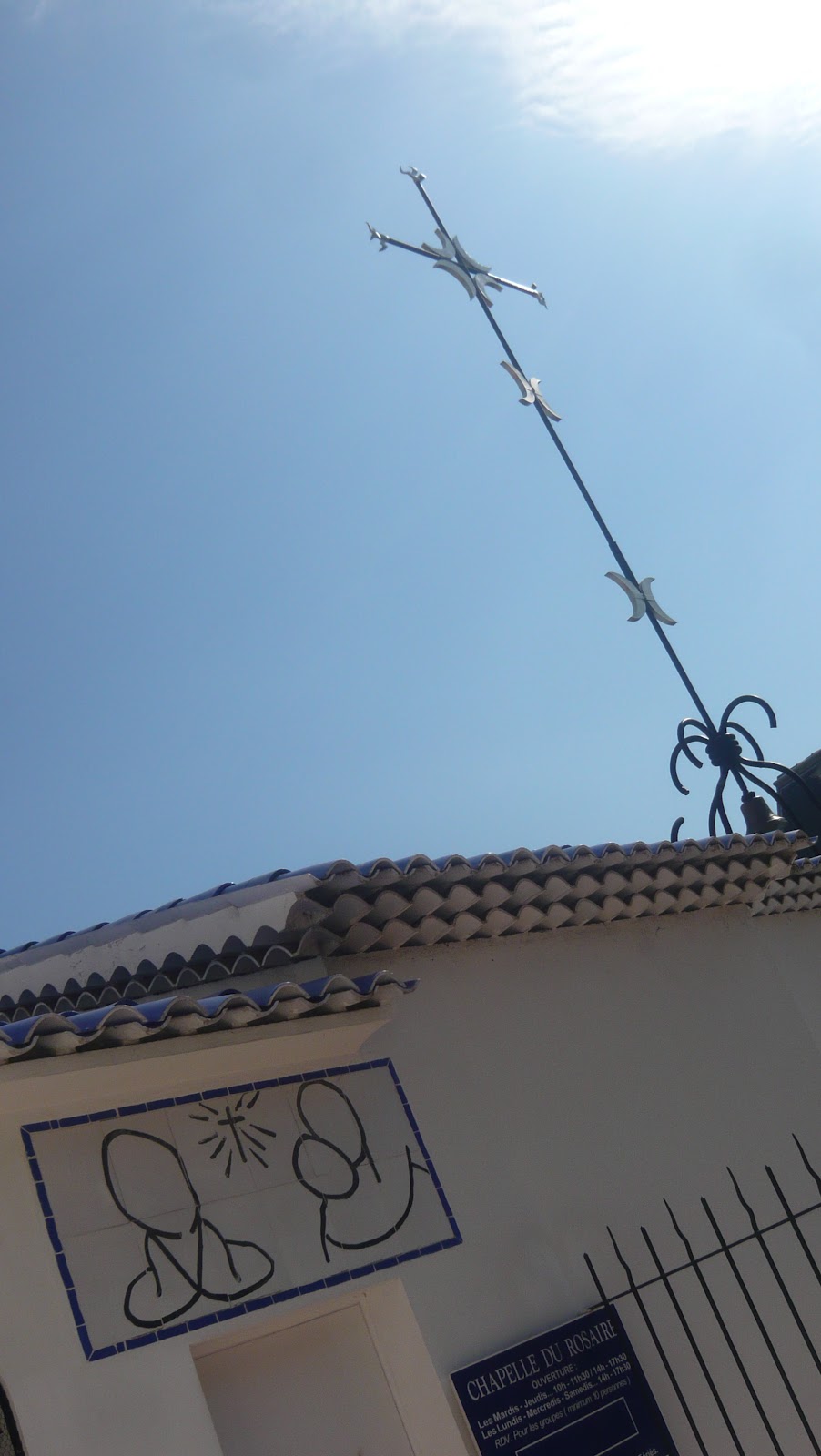
Chapelle du Rosaire, Vence


‘Simple colours,’ Henri Matisse wrote, ‘can affect the innermost feelings, their impact being all the more forceful through their simplicity.’ The spiritual expression of the blues, greens and yellows he used in the stained glass of the chapel struck him as unquestionable. His goal ‘was to find a balance between a light surface and colour with a solid wall of black-on-white line drawing.’ The line drawings on ceramic tiles of both St Dominic and the Virgin and Child he thought to have a ‘tranquil reverent nature all their own,’ while the great drama of Christ in the Stations of the Cross had made ‘his impassioned spirit overflow within the Chapel.’

Musée Chagall, Nice


On entering the rooms of the Message Biblique - first the room of Genesis and Exodus, then the Song of Songs - one is struck by the colours of the works before their content. Chagall viewed painting as the reflection of his inner self and therefore colour contained his character and message. In his museum inauguration speech he said, ‘If all life moves inevitably towards its end, then we must, during our own, colour it with our colours of love and hope.’ These are paintings which seek to dream by their colours and lines an ideal of fraternity and love. To be surrounded by these massive statements demonstrating - through content and construction - the potential of religion for reconciliation, was a wonderful and moving experience.


A stunning blend of old and new art and architecture is to be found at St Stephen Walbrook, Sir Christopher Wren’s masterpiece. Bombed in the Second World War and restored to its present magnificent state in 1981, twentieth century artists and craftsmen have adorned its interior. Henry Moore’s travertine marble altar now stands at the centre under Wren’s dome surrounded by dazzling kneelers from Patrick Heron. Moore’s altar design was intended for people to gather as a community around the altar where God could be found at the centre. Currently contemplation is aided by 'Lamentation for the Forsaken, 2016’, a digital art installation by Michael Takeo Magruder which evokes the memory of Syrians who have passed away in the present conflict by weaving their names and images into a contemporary Shroud of Turin.

What would your 10 choices be?

----------------------------------------------------------------------------------------------

Lavine Hudson - Flesh Of My Flesh.

Wednesday, 9 July 2014

Sabbatical art pilgrimage: latest ArtWay report

ArtWay have just published the latest of my sabbatical art pilgrimage visit reports in their Church of the Month slot. This report concerns Aylesford Priory and the work of Adam Kossowski. The reports which ArtWay are publishing generally contain additional information or reflections from those which I am posting here and, as with the posts here, will gradually build up a partial history of the revival of sacred art in the twentieth century.

The report on Aylesford Priory follows reports on Chelmsford Cathedral and Lumen, as well as earlier reports of visits to sites associated with Marian Bohusz-Szyszko, Marc Chagall, Jean Cocteau, Antoni Gaudi and Henri Matisse.

One of the real pleasures of the European leg of my sabbatical art pilgrimage was the opportunity to meet Marleen Hengelaar-Rookmaaker, who is editor-in-chief of ArtWay. We visited two churches together and talked art, music, popular culture and faith finding many synergies as we did so.

-------------------------------------------------------------------------------

Sufjan Stevens - Impossible Soul.

Sunday, 29 June 2014

Sabbatical art pilgrimage: St Aidan of Lindisfarne East Acton


Basil Spence described Coventry Cathedral as a plain jewel casket filled with many jewels. St Aidan of Lindisfarne East Acton, which has been described as a small echo of Coventry, is designed on a similar basis. In other words the church is architecturally plain - essentially a white rectangle - with the aim that this simplicity and minimalism will show off the artworks to best effect and that the significance and impact of these works will bring the building to life as a place of worship.

St. Aidan's was founded in 1922 but the current building was erected in 1961 by John Newton in brick and concrete with an open bell tower. The artworks, commissioned by then parish priest Fr. James Ethrington, which are the jewels in the casket include: Saints carved in limewood by Arthur JJ Ayres, George Campbell, Philip Lindsey Clark and Kathleen Parbury; Christ Crucified altarpiece by Graham Sutherland; Sacred Heart and Our Lady of Walsingham triptychs by Roy de Maistre; sanctuary and porch stained glass windows by Pierre Fourmaintraux; Stations of the Cross in concrete by Arthur Fleischmann; ceramic wall to baptistery with design by Adam Kossowski.

Benedict Read in his 1998 lecture to the Royal Society of British Sculptors uses St Aidan’s East Acton as an example of the alternative culture of church art that we find in the UK following the Second World War:

“Churches were being repaired. New work was being installed in them. There was an expansion of church buildings with works of art in them … There is an alternative world there of the commissioning of art for specific purposes that, with no disrespect to established art historians, simply doesn't feature in our notion of cultural history in the post-war period.” 

St Aidan’s also illustrates two further trends within this alternative culture. The first is that the Church in Britain frequently used the skills and creativity of émigré artists including Ernst Blensdorf, Marian Bohusz-Szyszko, Ervin Bossanyi, Georg Ehrlich and Hans Feibusch, among others.

Here, there is work by Fleischmann, Fourmaintraux, Kossowski and de Maistre. Arthur Fleischmann was born in Bratislava in 1896, but lived most of his life in London. He studied medicine in Budapest and Prague and qualified as a medical doctor but then turned his attention and energy to sculpture and was awarded a scholarship to the Master School of Sculpture, Vienna. In 1937 he travelled to South Africa, Indonesia and Bali, from where he was forced to flee to Australia as the Japanese invaded. He arrived in Sydney in 1939 where he stayed for 10 years becoming part of the Merioola artist commune. In 1949 he travelled to England with plans to return to Bratislava, but met his wife Joy in London and made it his home for over 40 years. He quickly established himself as a portrait sculptor in London, completing portrait busts of Popes Pius XII, John XXIII, Paul VI and John Paul II from life. Devotion to the Catholic Church was central to his work with a major part of his creative output being of religious themes. He received around 22 church commissions including the Stations of the Cross here which are set against a mosaic freize which surrounds much of the building.

Adam Kossowski quickly made a career in public works of figurative art after arriving in Britain in 1943. His Catholic background brought him large numbers of church commissions many of which, as here, were ceramic bas-reliefs. Working in clay enabled Kossowski to create with a greater sense of 3D animation as well as the expressiveness he was able to achieve by marking or cutting into the clay. As each panel was also painted, these effects were combined with all the variation, shade and harmonies achievable through paint. As stated on the Ecclesiart web pages,  he undertook this work “with exceptional stylistic integrity and a sophisticated theological understanding."

Pierre Fourmaintraux’s stained glass at St Aidan’s is in the dalle de verre style, consisting of abstract designs made of thick, small, dark pieces of glass set in concrete. The jewelled porch windows represent “the growth of the church in England from the missionary struggle of Roman times, through the flowering of the Middle Ages, the Reformation, and the Second Spring up to the struggle today against industrial materialism,” while on either side of the sanctuary various English saints stand guard (http://archive.catholicherald.co.uk/article/28th-july-1961/7/space-and-colour-at-e-acton).

Roy de Maistre explored the relationship between art and music in Australia's first abstract paintings, characterised by high-key colour, large areas of flat paint and simplified forms. De Maistre's theory of colour harmonisation based on analogies between colours of the spectrum and notes of the musical scale also aligned with his search for spiritual meaning through abstraction. As we will consider further in a moment, the relevance of religious themes was magnified by the Second World War and drew the attention of major artists including de Maistre, Graham Sutherland, Henry Moore and Francis Bacon in Britain and Arthur Boyd, SidneyNolan and Ian Fairweather in Australia. “De Maistre had painted major religious works prior to the Second World War such as The Crucifixion 1932-45 (in the collection of the Art Gallery of New South Wales, Sydney) but it was during the immediate post-War years that he produced his most important works including Stations of the Cross for Westminster Cathedral” and the triptychs here (http://www.bonhams.com/auctions/21282/lot/112/).

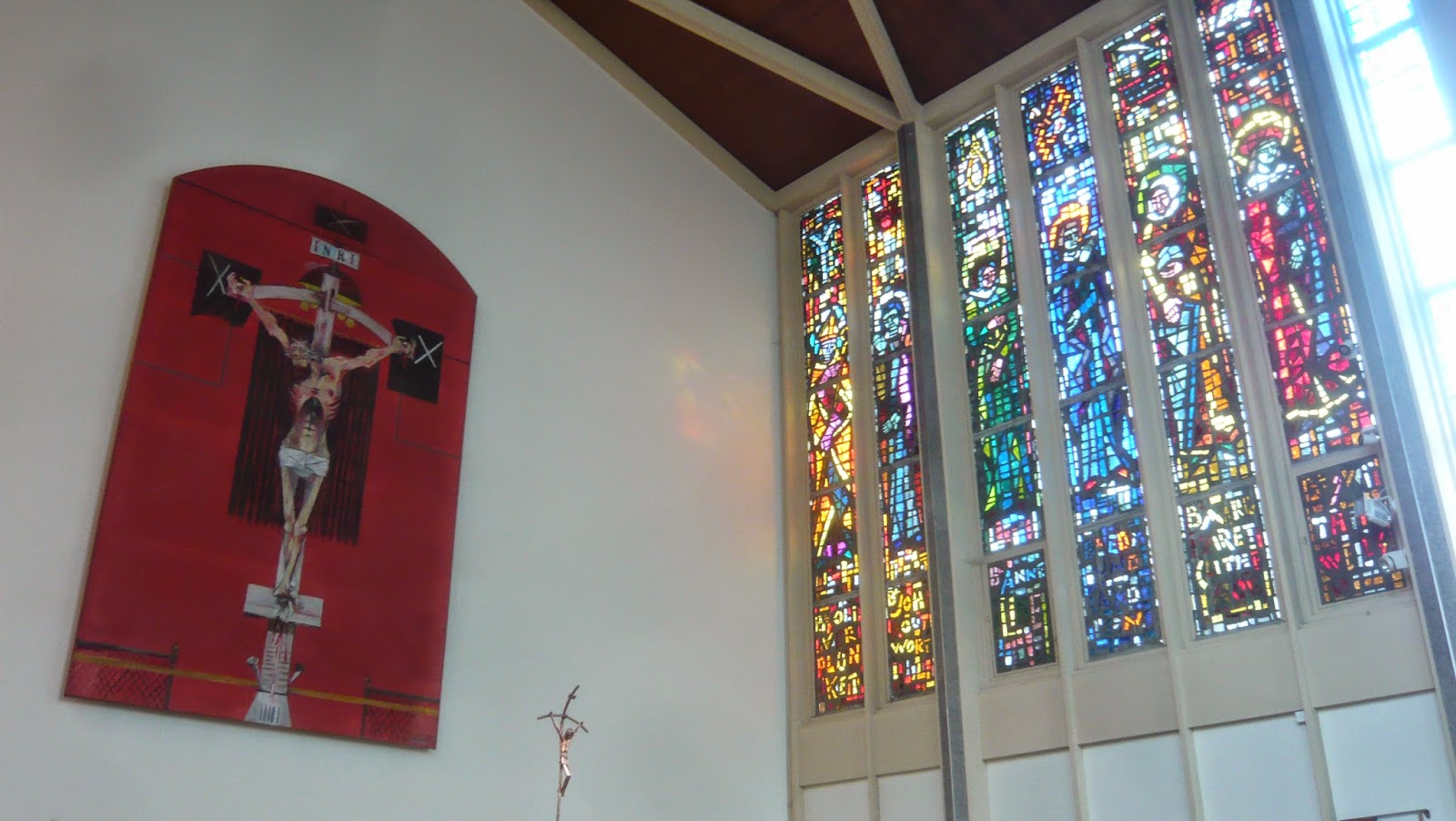
Graham Sutherland's crucifixion, unveiled in 1963, was the third he had created for a church and the first and only commission that he received from a Roman Catholic Church, despite being a Catholic himself. It taps another theme found within the revival of sacred art, a focus on the horror of crucifixion. For Sutherland this derives from reflection on the terror inherent in both Grunewald’s Isenheim altarpiece and the reality of the Holocaust. Tony Kirwan wrote in the Catholic Herald that “Sutherland's taut and terrible Crucifixion: today's Christ against a red brick wall, under an electric light … is a constant reminder to the parishioners of St Aidan's, East Acton, that Christ is crucified today if they care to look." 

When I visited for a mid-week morning Mass led by Associate Priest, Fr. Christopher McAneny, I was kindly invited to stay for refreshments by white-haired Anna who admitted that when she first came into the church, as a result of looking to move into the area, she didn't like the Sutherland painting at all. Now, she told me, she does like it. It seems that often these scandals of modern art, whether the reception of the works themselves or that of their challenging content, with time are resolved as congregations live with the works and learn to value the challenge of what initially can seem to be scandalous. 

----------------------------------------------------------------------------------

James Macmillan - Credo.

Sunday, 8 June 2014

Sabbatical art pilgrimage: Aylesford Priory


When Adam Kossowski was "deep in calamity" as a prisoner of war during the Second World War - "nearly dead" in a Russian labour camp - he made a promise to himself that if he came out of that "subhuman land" he would tender his thanks to God.

On arrival in Britain, post-War, he was "very strangely reminded" by events of this promise, which he had come to think of as an obligation. After winning a prize for a painting of The Annunciation in an international art competition, the sculptor Philip Lindsey Clark invited Kossowski to join the Guild of Catholic Artists. Lindsey Clark also introduced him to Fr. Malachy Lynch, the first Prior of the restored Carmelite Priory at Aylesford in Kent, who quickly set Kossowski to work.

Kossowski was within his comfort zone when his first commission was to paint the scenes from the history of the Aylesford Carmelites which continue to adorn the walls of the Chapter House at Aylesford. He was well outside that zone, however, when Fr. Malachy asked him to create a series of ceramic scenes for a Rosary Way. He questioned whether he was the right person for that task but Fr. Malachy replied, in terms that recalled Kossowski's own promise from the labour camp, 'Adam, I am sure Our Lady has sent you here for that purpose.'

This work was to shape not only Kossowski's future commissions at Aylesford (where, from 1950 to 1972, he decorated most of the shrine's chapels) but also the commissions he received to decorate other Roman Catholic Churches. In both instances these commissions were primarily, but not exclusively, for ceramic bas-reliefs. Working in clay enabled Kossowski to create with a greater sense of 3D animation as well as the expressiveness he was able to achieve by marking or cutting into the clay. As each panel was also painted, these effects were combined with all the variation, shade and harmonies achievable through paint.

Kossowski's obligation to God, the ongoing support of a committed patron in Fr. Malachy and the post-war church rebuilding programme combined to create the opportunity for Kossowski to become one of the greatest and most prolific religious artists in twentieth century Britain; a surprising result for the boy from Nowy Sacz in Poland. Benedict Read notes, in Adam Kossowski:Murals and Paintings, that in Britain after the war the Church was " a vital artistic culture," "the thirty years after 1945 witnessed for the Catholic Church in particular in this country an almost unprecedented campaign of church building and decoration, with the new cathedrals in Liverpool, Cardiff and Bristol just the tip of the proverbial iceberg."

Read quotes Hans Feibusch who, like Kossowski, Ervin Bossanyi and Marian Bohusz Szyzcho, was a refugee for whom Church-related commissions became a major field of endeavour: "You must realise, first of all, how very different the general atmosphere of those days was; that the relief from the dark cloud of war, the exuberance of freedom, the hope of great artistic possibilities, were still strong, and the experience of working together for a common goal had not yet faded away."

Aylesford became Kossowski's great artistic possibility, as Fr. Malachy had confidence in the rightness of Kossowski's ideas and work. With this backing he was able to create with vision, breadth and scale. His work at Aylesford extends from the intimacy of tiny painted Stations of the Cross in the Chapel of St Jude  to the imposing crowds of angels surrounding the Virgin at the exterior Shrine altar. All in a figurative style which, while sophisticated in design and expressive in execution, draws heavily on the naivety of folk art and the forgotten tradition of Romanesque art. This style seems equally suited to the drama of the worshipping angels thronging the exterior altar or Elijah's chariot of fire in St Joseph's Chapel as it is to the delicacy of the Rosary Way bas-reliefs or the Rouault-like Stations in the Cloister Chapel.

For much of the history of Western art, art and the Church were almost synonymous. This was the age of sermons in stone and stories in stained glass when art was the one book that the illiterate majority could read. As modern art actively sought separation from the constraints of Church patronage and the literary focus it had demanded, so a different approach to Church commissions was required and Kossowski's conceptions at Aylesford, both large and small, whether Stations of the Cross, the Rosary Way or sanctuary decorations; all were designed and function as prompts or aids to prayer. As prayer is the main focus of the shrine, the visual aesthetic of Aylesford, its unique atmosphere (memorably described by Fr. Malachy as "prayer in stone"), is primarily Kossowski's creation.

The Friars, to use its traditional name, is now a popular centre for pilgrimage either for large groups attending for one day or for smaller groups or individuals staying in the guesthouses. The setting, with its blend of the medieval and modern, is idyllic whether one comes as a tourist, a pilgrim, a retreatant or a regular worshipper. Some who come spend time in contemplation and prayer with Kossowski’s work, while, for others, they are part of the ambience of the spaces which are a prompt to prayer and worship. As with each denomination, the Roman Catholic Church does not always recognise the value of the artworks it possesses or subordinates that value to the use made of its art in worship. Here, however, in its publicity and online information, Kossowski's work, and that of Michael Clark and Philip Lindsey Clark, is clearly viewed as an attraction for visitors with ways suggested for reflecting on and praying through their work.

The experience of living for a week with Kossowski's work in worship, prayer and contemplation, while using The Friars as a base for the Kent and Sussex phase of my sabbatical art pilgrimage, was one of recognising the love that Kossowski had for the many saints and martyrs of the Church which had supported him in his time of need, of sharing his empathy with the sufferings of Christ, and of sensing the uniqueness of his vision which shows itself in moments of deviation from tradition such as the image of a Carmelite sister without a halo created in order to pay tribute to all the faithful who are not formally beatified but who are truly saints nevertheless. Which is, of course, where Kossowski himself would be found!

---------------------------------------------------------------------------------

Sebastian Szymański - Galilea