Wikio - Top Blogs - Religion and belief
Showing posts with label manessier. Show all posts

Thursday, 23 June 2022

Sandra Bowden and Bowden Collections

One of many joys in attending 'The Artist as Truth-Teller and the Legacy of French Artist Georges Rouault' last week was that of meeting the artist Sandra Bowden.

Sandra Bowden has been interpreting Scripture and her own spiritual walk through mixed media for more than forty years. She has been acclaimed as one of the most unique, impressive and inspiring Christian artists in America. Bowden’s work has been featured in books, magazines and gallery shows across the United States, Canada, Italy and Jerusalem.

Her work fuses the vivid yet traditional imagery of the Old Testament – stone tablets and artifacts, Hebrew inscriptions, architectural depictions – with images of Christ’s passion, important music scores, and God’s natural creations. She has issued several series of artworks over the years: crucifixion scenes, artistic use of text and color, new interpretations of classic religious artwork, even altered books with applied textures and hues. God’s grandeur and creativity shine through in each piece of her art.

“My Christian faith has been the driving force behind my art,” Bowden says. “I look at the making of a piece of art as a kind of doxology, a prayer or conversation with God. I don’t mean this in any mystical way, but my ideas come out of my theology and thoughts about God. I am somewhat of a theologian, but one who translates those interpretations into visual form.”

In addition to being an exceptional artist, Sandra is also a collector who, through Bowden Collections, offers a variety of traveling exhibitions available for rental to museums, churches, colleges, seminaries and similar institutions.

Bowden says:

'I have always wanted to own art by other artists. My first pieces were pottery or works that I could swap with other artists. Then I began to make a greater commitment to strategically collecting. However, the most important reason is that it is enjoyable. What a thrill to “find” a piece, recognize its value and have it become part of my collection.

I feel like a caretaker, so to speak, of each piece in our collection, preserving it for the future. With every new acquisition comes a world of knowledge, a reservoir of information surrounding the piece that adds to the fascination and enjoyment.

The Bowden Collections focuses on religious art for several reasons: first, it is the subject I am most passionately interested in; second, it is a wonderful time to be collecting work with biblical themes because the art market in general is not particularly interested in art with religious content. I also feel that religious art needs exposure within the Christian community, and it is my intent to make these pieces available whenever possible for that purpose. I see my collector's role as a calling—something that is critically important to do at this particular time.'

Click here to see the range of collections available which include work by Marc Chagall, Otto Dix, Alfred Manessier, and Georges Rouault, among others. 

-----------------------------------------------------------------------------------------------------

Morten Lauridsen - Lux Æterna.

Saturday, 13 February 2021

Sabbatical Art Pilgrimage: Église St Michel, Les Bresaux


Église St Michel, Les Breseux (Alfred Manessier)

Église St Michel, Les Breseux, is a church that has really engaged with the artworks it has commissioned and the visitors who therefore come to see those commissions. This church is aware that it now receives visitors who would not otherwise come and therefore takes their needs into account with simple but essential facilities provided and a small exhibition about the commissions, Manessier, and arte sacré more generally. Many larger churches do not do as much and Les Breseux is both an exemplar and an example as to why and how to cater for and minister to those who visit to view wonderful works of art.

-----------------------------------------------------------------------------------------------------

Friday, 15 January 2021

Seeing is Receiving: The art of contemplation (4)

3. Surrender

I began the European leg of my sabbatical art pilgrimage with a mixture of excitement and trepidation. Excitement, because this was the start of a wonderful adventure; trepidation, because I was unsure as to whether my itinerary and the practical arrangements I needed to make as I travelled would work. I had not travelled in this way before and was unsure as to whether the churches I planned to visit would all be open and whether I would find accommodation for my overnight stays. Nevertheless, as this was the beginning of a great adventure, I resolved to surrender myself to the experience come what may.

My journey did not have an auspicious start as, on the approach to Lille, I become part of one of the longest tailbacks it has been my misfortune to encounter with the delay increasing my initial anxieties about the possible difficulties of keeping to my planned itinerary. We did, however, mostly move throughout many kilometres, albeit at a snail’s pace, and eventually reached the cause of the delay – a convoy of tractors filling all the lanes and accompanied by the emergency and highways services. Presumably a protest on behalf of farmers, it served to remind of the rural origins of Hem, which means ‘the dwelling-place’. Originally a hamlet in an agricultural area of northern France, its population grew rapidly after the Second World War with one effect of growth being the consecration in 1958 of the Chapelle Sainte-Thérèse-de-l'Enfant-Jésus et de la Sainte-Face.

An inauspicious and lengthy journey to visit a church that is not included on many tourist sites and which has been described as looking like a barn. As the Chapelle Sainte-Thérèse has external sculptures and a mosaic over its entrance, I reasoned that the journey would not be completely wasted were the church to be locked. It was not and, as I travelled on, it was only when I returned to Calais that I found churches which were not open regularly.

The modest external appearance of the Chapelle Sainte-Thérèse deceives, however, as once within I was in another world, one in in which I was submerged in coloured light. Here there are mosaics and windows by Alfred Manessier, sculptures by Eugène Dodeigne and Jean Roulland, and a tapestry of the Sainte-Face based on a painting by Georges Rouault which was made by the Plasse Le Caisne workshop. The architect was Hermann Bauer and the church has been described as a fine example of art sacré after World War II.

Manessier’s glass sets the tone and creates the spirituality which informs this marvellous space. It does so, not simply through the spirituality of his abstract design and colour harmonies, but also through the concept of stained glass architecture - of a light-filled architectural unit – that I find here. Stained glass here is not windows, but walls. There is no narrative; instead a loose cubist concrete grid holds a great chromatic richness. The play of light and colour created in the space is redolent of the Carmelite spirituality of Thérèse of Lisieux, which was the inspiration for Manessier’s design. Stained glass here creates spiritual space, a sense of prayer and a glimpse of heaven.

When reviewing Manessier’s exhibition at the Venice Biennale in 1962 - for which he was awarded the international prize for painting (to date, the last occasion that a French artist has been awarded this prize) - Jacques Lassaigne wrote of Manessier’s ‘majestic orchestration of vibrant tonalities and pure rhythms.’ Lassaigne also suggested that at various points in Manessier’s very rich career ‘a kind of pause of meditation and inner transformation’ had ‘enabled him to transform the powerful impressions which he had received … into new means of evoking and glorifying secret presences.’[i]

The twentieth century renewal of religious art in Europe, of which this church is a fine example, included a move from storytelling in stained glass by means of narrative figuration to the creation of spiritual space using abstract colour as pioneered by Manessier and Jean Bazaine in France. In the past churches were centres for the drama of the visual - the drama and spectacle of the liturgy combined with the visual narrative of scripture in stained glass. Now people find their visual stimulation elsewhere - through the media primarily – and, as a result, churches have become centres for the opposite of visual stimulation e.g. centres of visual contemplation, where narrative is less essential than ambience and atmosphere.

Slowing down to look on a sustained basis in such a space enables us to surrender ourselves to the work of art in order that we enter the world it creates and immerse ourselves within that place. That was certainly my experience in the Chapelle Sainte-Thérèse-de-l'Enfant-Jésus et de la Sainte-Face. When looking at a painting by Paolo Veronese, John Ruskin wrote of feeling ‘as if I had been plunged into a sea of wine of thought, and must drink to drowning’.[ii] Similarly, the art historian immersed himself in the dimensions and details of Leonardo’s Musician.

James Crockford has described this experience of surrender in relation to Tudeley Parish Church:

‘There’s an overwhelming experience, as you cross the threshold, of having entered a different sort of space. You feel immersed, surrounded, swallowed, which … is a significant part of the effect. The windows have a way of surrounding you and won’t let you go. They weigh heavily on the space. And that’s not simply a weight of colour and design. There’s far more to these windows, as always with Chagall; a density of symbolism and encounter.

What has, for years, spoken to me, and stayed with me, about this scene of Chagall’s, is not the detail of what it all might convey in its parts or its whole, but rather the experience of sitting in that still, small church, immersed in the colour and pain and hope of those windows shining through.’[iii]

As we do the same, we come to appreciate and live within the world to which the artwork introduces us. Joe Moran has described this as being like a swimmer who stops counting the number of pool laps they have done and just enjoys how their body feels and moves in water.[iv]

This is then the point at which we begin enjoying or appreciating an experience for its own sake and not for any other motive. To reach that point is to experience a taste of heaven. The Westminster Shorter Catechism famously says that the chief end of human beings is to glorify God and enjoy God forever. However, if there are instrumental reasons leading to our enjoyment of God that we are not simply enjoying for who God is. Therefore, we pray ‘God of time and eternity, if I love thee for hope of heaven, then deny me heaven; if I love thee for fear of hell, then give me hell; but if I love thee for thyself alone, then give me thyself alone.’

Our experience in heaven will be entirely relational. In heaven there will be nothing to fix, nothing to solve, and therefore no work to be done. In heaven there will be no more death or mourning or crying or pain, for the old order of things will have passed away. In heaven there will be nothing we can do for others, because God will have done everything for us. So, what will there be to do? Heaven is all about our relationships; being with God, with ourselves, with others, and with creation. Heaven is all about enjoying our relationships to the full for what they are. We prepare for life in heaven by anticipating heaven in the here and now; by prioritising relationships which we enjoy simply for who or what the person, creature, artefact or experience is. So, when we surrender to art in the way I experienced in Hem and which I have been describing here, we are experiencing a taste of heaven.

The favourite Christmas story of Stephen Cottrell concerns a two year old called Miriam at a church on the edge of Chichester where he was parish priest. The red brick rectangular church seated about 80 and was full to overflowing for the Christmas Day service. As every space was taken, the crib scene had been placed under the altar. During the service Miriam wandered into the sanctuary and stood for a while observing the nativity scene. It was a large nativity set and so the characters in the scene were about the same size as the two year old. After observing the scene for a while, Miriam carefully climbed in under the altar making her way around the characters to sit in a space within the crib scene where she then remained for the rest of the service.

What she did was essentially an acted parable to the congregation because she immersed herself in the story. That is what we are called to do when we become Christians. It is what is going on when we are baptised. Baptism is our immersion in the Christian story.

When Jesus was baptised he was saying that he would immerse himself in this story and play his special, unique part within it. As he made that commitment, God the Father affirmed him in his identity and purpose by saying, ‘You are my own dear Son. I am pleased with you’ (John 3.17). As we do what Miriam did and immerse ourselves that story, then we are also affirmed by God in just the same way. St Paul writes in Romans 8.14–17 that: ‘Those who are led by God's Spirit are God's children. For the Spirit that God has given you does not make you slaves and cause you to be afraid; instead, the Spirit makes you God's children, and by the Spirit's power we cry out to God, “Father! My Father!” God's Spirit joins himself to our spirits to declare that we are God's children. Since we are his children, we will possess the blessings he keeps for his people, and we will also possess with Christ what God has kept for him; for if we share Christ's suffering, we will also share his glory.’ Paul was saying that, as we enter the story, we are adopted by God as his children and become brothers and sisters of Jesus, co-heirs with him of all he possesses.

How then do we play or pray our part in the story? That all depends on our coming to know the story and what happens within it. We start by looking at what we know of the story to date – the things God has done in and through Israel, Jesus and the Church – and we also look at the hints we have about the way the story will end with the coming in full of the kingdom of God on earth as in heaven. Then we say to ourselves, ‘What is it that people do in this story? How do they act and behave? And then we start to do, say and pray similar things as we have the opportunity. As Christians we are never given a script which has all our lines and actions printed on it. Instead, we have to improvise our part on the basis of what we know of the story so far, on the basis of the example provided by those who have lived in the story before, and on the basis of the opportunities provided in the places where we are and among the people that we know.

Living in the Christian story, therefore, is a challenge – something we should know anyway from looking at the life and death of Jesus – but it comes with the affirmation that we are part of God’s family; his dearly loved children, brothers and sisters of and co-heirs with Jesus himself. When we know this we can relax because whatever happens to us we are accepted, forgiven, loved and gifted by the God who created all things and who will bring all things to their rightful end. When we do that we are like Miriam climbing in under the altar to become part of the crib scene. When we do that we become immersed in God’s story which makes us his children and gives us identity, purpose and meaning.

Explore

All public acts of worship also place or immerse us in the story and therefore enable us to pray the story as we pray the service. As worshippers we are often unaware of that reality, partly because it is often not explained and partly because of our familiarity with liturgies that were curated many years before and which come with warnings that they should not be changed or amended. Those warnings are generally there because we seek to remain in continuity with the great cloud or crowd of witnesses who have gone before and who now cheer us on from their stadium seats in heaven.

However, there is value in being taken out of the familiar and alternative worship curators, having learnt from installation artists, regularly do this to immerse us in new worlds in order that we see the familiar afresh or the new for the first time. Here are two examples of this being done, shared in the hope that you might develop your own initiatives.

Jonny Baker is an alt worship organiser that has adopted the idea of curation - as a role for imagining and overseeing an exhibition or art experience - to use it for different and inventive ways of thinking about how to lead a service or praise event. In this context, rather than simply presiding over liturgy or fronting a band, curation involves negotiating between institutions and artists and making do with what is to hand to create something immersive and brilliant. The hope is that moments of epiphany will be experienced as God is invited to be and breathe in immersive spaces, and people make connections with their own lives and stories.[v]

Baker suggests that ‘worship imagines a world, nothing less’.[vi] He is ‘not content with the world - globally, politically, or indeed the church world or the way worship is played out and imagines the world’, so asks what kind of a world to imagine or make? He suggests this may be ‘the most important question any of us can ask’ and one it will ‘take a lifetime to answer’:

‘Reflecting on alternative worship, which is where the notion of worship curation has come from, I think it has been about imagining new worlds, new relationships, new strategies and tactics, and counter-publics, about saying that other worlds are indeed possible, that business as usual simply will not do.’[vii]

An artwork which enabled people become a part of the installation by viewing themselves in mirrored surfaces featured as an Advent art installation created through churches in the London Borough of Redbridge in 2008. This was comprised of three panels of mirrored perspex mounted on wooden backing panels. The mirrored surfaces were painted to an abstract design using differing textures and densities of paint while leaving unpainted areas forming the shape of a star and the repeated word ‘peace’.

The sombre colours and rectangular voids of this abstract artwork recalled works by Mark Rothko in the Tate collection. Rothko’s later paintings have often been understood as depictions of the absence of God and the darkness of the world; an impression reinforced by Rothko’s suicide on the day that the Tate received those paintings. St Paul wrote that our experience in life is that of seeing in a mirror dimly (1 Corinthians 13.12); we do not see clearly and our understanding of life is clouded, is what he seemed to say. That may also have been the experience of those viewing this installation, where the abstract colour had been applied to mirrored perspex, clouding our ability to see clearly in the mirrored panels of the installation. Yet this may also have depicted the reality of which the poet Martin Wroe has written that God can be seen as ‘the abstract art of paint and poem when our propaganda makes everything clear.’[viii]

In the darkness of the abstract design, viewers could still see reflected, candles, lit within the space where the artwork stood, and, picked out on the panels, forming a star, there were also lines of clear reflection. The light beaming from the star on the right panel was linked by a line to the repeated word ‘Peace’ on the left. Viewers were asked to consider in what ways there might be links between light and peace in the darkness of our world.

What might the blurred and clear mirrored spaces of this installation have shown? Essentially, as in any mirror, we saw ourselves, both blurred and distinct. As a result, we asked ourselves: Are we defined by the darkness or are we one of the many points of light reflected in the darkness of this design? Is the reflection of our light blurred or distinct as we shine in the world? In what ways could we become light bringers and peace makers? After all, we reflected, it is better to light a candle than to curse the darkness.

Those who viewed this work became immersed in it as they saw themselves in its surface. Its reflection enabled their reflection and through reflection something essential was glimpsed. Those who sat in that still, silent space were immersed in the colour and pain and hope of the installation. They entered, experienced and prayed the Advent story.

Wonderings

I wonder if you can recall a time when you were immersed in an activity or environment where you lost all sense of time. I wonder how you felt and what that experience gave to you.

I wonder which stories you have lived by and which you have left behind.

I wonder when was the last time you felt immersed by light, colour or sound.

Prayer

Abundant God, even eternity's too short to extol you. Like a child learning to jump or dive into water, may I no longer teeter on the edge anxious and afraid, but take the step, however faltering, of falling into your arms of love and immersing myself in your abundance. Amen.

Spiritual exercise

Next time it is possible for you to take a shower try to reflect on the experience prayerfully. Think about how it feels to be under (immersed in) the water and of the effect that this immersion has for you. Turn the experience and the effect into prayers.

Art actions

Read the Worship Tricks series at https://jonnybaker.blogs.com/

View A New Jerusalem by Michael Takeo Magruder - http://www.takeo.org/nspace/2014-dta-new-jerusalem/. This is an immersive virtual reality installation that seeks to embody the spirit of the new Jerusalem as described in the Book of Revelation.


[i] J.P. Hodin, Manessier, Praeger Publishers, 1972, p. 78

[ii] J. Evans & J.H. Whitehouse eds., The Diaries of John Ruskin, Oxford, 1956, vol. 2, p. 437

[iii] J. Crockford, ‘Chagall at Tudeley’, Sermon preached at University Church, Oxford, 7th April 2019 - https://www.universitychurch.ox.ac.uk/sermons/chagall-tudeley?fbclid=IwAR3hxj1Lah8A5Uq2yYjggxw1rafwJlxq-4V86olsvwSdpyoLAJ11kKNvKAc

[iv] J. Moran - https://www.theguardian.com/books/2018/sep/14/joe-moran-pleasures-of-slow-reading

[v] J. Baker, Curating Worship, SPCK Publishing, 2010

[vi] https://jonnybaker.blogs.com/jonnybaker/2009/05/worship-curation-2-the-making-of-a-world.html

[vii] https://jonnybaker.blogs.com/jonnybaker/2009/05/worship-curation-2-the-making-of-a-world.html

[viii] http://martinwroe.com/2012/04/dark/

Click here for the other parts of 'Seeing is Receiving'. See also 'And a little child shall lead them' which explores similar themes.

-----------------------------------------------------------------------------------------------------------

Saturday, 23 July 2016

ArtWay meditation & Sabbatical Art Pilgrimage photographs - Audincourt

The latest ArtWay meditation provides an introduction to the Sacré-Coeur in Audincourt, in the north east of France, that was built in 1949-1951. In the 1930’s the French Dominican friar and Catholic priest Marie-Alain Couturier was enabled by his order to devote himself to new art in the Catholic church. His approach was to summon well-known artists and architects to participate in the building of new churches and to also involve the local community. At Audincourt he attracted artists like Fernand Léger and Jean Bazaine to ecclesiastical art.

I visited Audincourt as part of my sabbatical art pilgrimage but have not yet had the opportunity to write up my visit. However, I can post some of the photographs I took on that visit to add to those which illustrate Albert Hengelaar's ArtWay meditation.


The baptistry at Audincourt is an early example of the move from storytelling in stained glass by means of narrative figuration (e.g. Marc Chagall's stained glass) to the creation of spiritual space using abstract colour (as pioneered by Jean Bazaine and Alfred Manessier) has occurred, primarily in France. The concept of stained glass architecture - of a light-filled architectural unit – that we find here or, for example, at the Chapelle Sainte-Thérèse-de-l'Enfant-Jésus et de la Sainte-Face in Hem is an attempt to create spiritual space - a sense of prayer and a glimpse of heaven – through the play of light and colour within the building. In the past churches were centres for the drama of the visual - the drama and spectacle of the liturgy combined with the visual narrative of scripture in stained glass. Now people find their visual stimulation elsewhere - through the media primarily – and, as a result, churches have become centres for the opposite of visual stimulation e.g. centres of visual contemplation, where narrative is less essential than ambience and atmosphere.

-----------------------------------------------------------------------------------------

Van Morrison - Into The Mystic.

Sunday, 13 March 2016

10 best places for reflection

In today's Observer Aaron Rosen chooses his 10 best places for reflection. From Reykjavik to Tate Modern, he looks at spaces to inspire contemplation during Lent.

Aaron has some great choices but his choices are clearly intended to prompt reflection among his readers on the choices they would make, so here is my top 10:

l’Abbaye de la Fille Dieu, Romont


Brian Clarke says that stained glass ‘can transform the way you feel when you enter abuilding in a way that nothing else can!’ I would concur, especially after arriving at l’Abbaye de la Fille Dieu in time for a memorable service of Vespers followed by silent contemplation in the still onset of darkness falling.Tomas Mikulas, the architect on the restoration of this Cistercian Abbey, has stated that the overall goal of the restoration was to offer both nuns and visitors an ‘atmosphere conducive to meditation and prayer.’ Mikulas suggests that it is the ‘warm and vibrant atmosphere’ created by Clarke’s windows ‘with the changing light of day’ that ‘makes a decisive contribution’ to the space and to the restoration as a whole.

Chapelle Sainte-Thérèse-de-l'Enfant-Jésus et de laSainte-Face, Hem


Alfred Manessier was a lyrical abstractionist who thought of stained glass less as a design than as “the simultaneous creation of a light-filled architectural unit, thought-out and created by the painter at one go.” In this way he wanted "to express man’s inner prayer.” Chapelle Sainte-Thérèse-de-l'Enfant-Jésus et de laSainte-Face in Hem is an attempt to create spiritual space - a sense of prayer and a glimpse of heaven – through the play of light and colour within the building.


Pleshey was the first Diocesan Retreat House to be established in the country. Amongst the list of Retreat conductors is Evelyn Underhill. Arguably the most distinguished Conductor of that time, it is largely due to Underhill that the Retreat house became so popular. When you come to the Retreat House in Pleshey you sense an atmosphere created by six hundred years of prayer. For me, it is a special place because of ordination and cell group retreats.


Down dimly-lit stairwells / into a cavernous immensity / of curved brick, concrete and darkness / to stand still, transfixed, / in silent expanse / focused on the glow / and gleam / of the white stone table / over which / the crucified Christ hangs / from concrete cross-beams. / Morning light softly infiltrates, / casting shadows, / bringing the dawn ... The space and acoustic / act and appear as /
the inside of a hi-fi speaker; / the lantern, like an industrial chimney, / funnels the aromatic incense /
of prayer and praise / to tease and to please / the senses of God.

St Benet's Chapel


Adam Kossowski's murals at St Benet's Chapel fill the entire wallspace of this circular chapel surrounding and enveloping worshippers with their imagery. When services are held, however, the altar table is located in front of the panel depicting worship in heaven of the lamb that was slain. In this way, worship on earth is conducted in the context of worship in heaven. This work is about rescue, redemption and salvation. Fr. Edward Maguire has written, 'From clay and fire he forged a vision of the past, present and future to lift up and inspire countless others ... May we be inspired by him to use our gifts as he used his."

Notre-Dame du Bon Conseil, Lourtier


Lourtier is to be found among the imposing alpine architecture of snow-capped peaks in the Val de Bagnes, one of Switzerland's largest nature reserves. I arrived at the end of the afternoon to find the mountain sunshine flooding the empty church. Alberto Sartoris’ design for Notre-Dame du Bon Conseil is clean, spare and minimalist. Internally, the church is a simple white rectangle with a sleek arched wooden roof. Both the ceiling’s planks and the grey-painted wooden pews draw the eye to the sanctuary wall containing two large stained glass windows by Albert Gaeng. The triumph of Lourtier is an influential design coupled with a dramatically beautiful building that is well suited to the liturgy and well used by its people.

The Crypt of Colònia Güell


The Crypt of Colònia Güell is a warm, womb-like enclosure; intimate yet archetypal. It is real and usable communal space while also being of great architectural worth, innovation and beauty. Here the ‘heaven in ordinarie’ of the Eucharist is celebrated in the surround of natural forms recreated by man-made means. 'Gaudí based his buildings on a simple premise: If nature is the work of God, and if architectural forms are derived from nature, then the best way to honor God is to design buildings based on his work. As the Barcelona scholar Joan Bassegoda Nonell notes, "Gaudí's famous phrase, 'originality is returning to the origin,' means that the origin of all things is nature, created by God."'

Chapelle du Rosaire, Vence


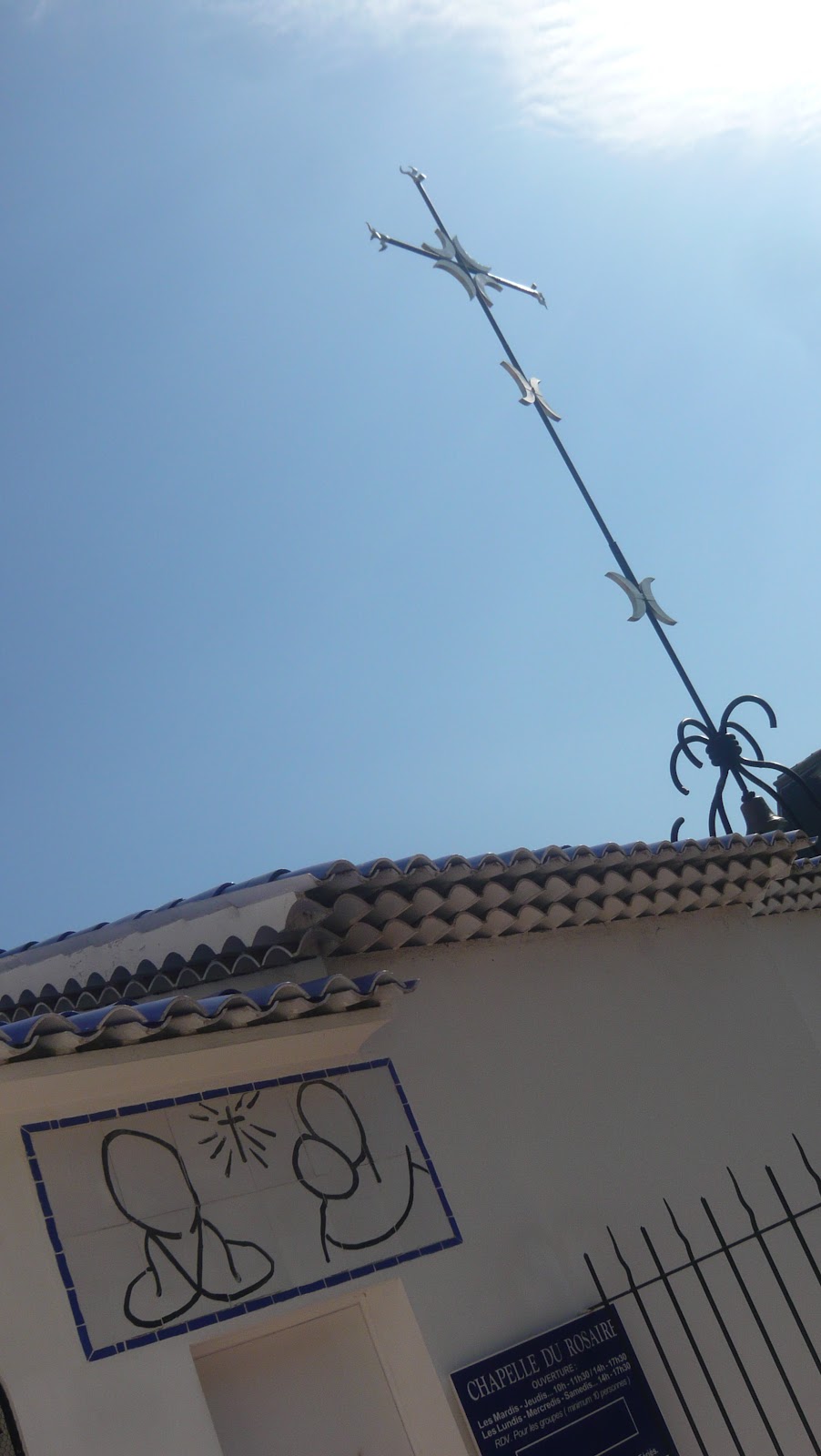
‘Simple colours,’ Henri Matisse wrote, ‘can affect the innermost feelings, their impact being all the more forceful through their simplicity.’ The spiritual expression of the blues, greens and yellows he used in the stained glass of the chapel struck him as unquestionable. His goal ‘was to find a balance between a light surface and colour with a solid wall of black-on-white line drawing.’ The line drawings on ceramic tiles of both St Dominic and the Virgin and Child he thought to have a ‘tranquil reverent nature all their own,’ while the great drama of Christ in the Stations of the Cross had made ‘his impassioned spirit overflow within the Chapel.’

Musée Chagall, Nice


On entering the rooms of the Message Biblique - first the room of Genesis and Exodus, then the Song of Songs - one is struck by the colours of the works before their content. Chagall viewed painting as the reflection of his inner self and therefore colour contained his character and message. In his museum inauguration speech he said, ‘If all life moves inevitably towards its end, then we must, during our own, colour it with our colours of love and hope.’ These are paintings which seek to dream by their colours and lines an ideal of fraternity and love. To be surrounded by these massive statements demonstrating - through content and construction - the potential of religion for reconciliation, was a wonderful and moving experience.


A stunning blend of old and new art and architecture is to be found at St Stephen Walbrook, Sir Christopher Wren’s masterpiece. Bombed in the Second World War and restored to its present magnificent state in 1981, twentieth century artists and craftsmen have adorned its interior. Henry Moore’s travertine marble altar now stands at the centre under Wren’s dome surrounded by dazzling kneelers from Patrick Heron. Moore’s altar design was intended for people to gather as a community around the altar where God could be found at the centre. Currently contemplation is aided by 'Lamentation for the Forsaken, 2016’, a digital art installation by Michael Takeo Magruder which evokes the memory of Syrians who have passed away in the present conflict by weaving their names and images into a contemporary Shroud of Turin.

What would your 10 choices be?

----------------------------------------------------------------------------------------------

Lavine Hudson - Flesh Of My Flesh.

Saturday, 14 March 2015

Sabbatical art pilgrimage: Latest ArtWay report

My latest Church of the Month report for ArtWay focuses on the Chapel of St. Thérèse of the Child Jesus and the Holy Face, Hem. Featuring mosaics and windows by Alfred Manessier, sculptures by Jean Roulland and Eugène Dodeigne, and a tapestry of the Holy Face made by the Plasse Le Caisne studio after a painting by Georges Rouault, the church is a fine example of art sacré after World War II.

This Church of the Month report follows on from others about Aylesford Priory, Canterbury Cathedral, Chelmsford Cathedral, Lumen, Notre Dame du Léman, Romont, Sint Martinuskerk Latem, St Aidan of Lindisfarne and St Mary the Virgin, Downe, as well as earlier reports of visits to sites associated with Marian Bohusz-Szyszko, Marc Chagall, Jean Cocteau, Antoni Gaudi and Henri Matisse.

---------------------------------------------------------------------------------------------

Hildegard von Bingen - Voice of the Living Light.

Thursday, 13 November 2014

Sabbatical art pilgrimage: Report - Part 5

The story of the renaissance in Church commissions is not one which has been well told, either by the Church or the mainstream art world. There are many reasons for this on both sides but my concern in making this story the focus of my sabbatical has been to encourage the Church to tell and to value this story.

As both a parish priest and through commission4mission, the group of artists of which I am part, I have seen the value of promoting and publicising the artworks which churches have commissioned. Through the creation of Art Trails locally and regionally, we have provided churches with a means of publicity which has led to events such as art competitions, exhibitions, festivals and talks, community art workshops, guided and sponsored walks, and Study Days. Each has brought new contacts to the churches involved and has built relationships between these churches and local artists/arts organisations.

The commissions I have seen speak powerfully and movingly of the Christian faith and therefore inform the spirituality of those who see them. It is my contention that to tell more fully the story of the engagement which the Church has had with modern and contemporary art could have similar impact on a wider scale and would also have the effect of providing emerging artists from within the Church and the faith with a greater range of role models and approaches for their own developing inspiration and practice.

During my sabbatical I have visited churches which seem to have little or no regard for the artworks they possess and others which actively utilize them in their mission and ministry. Commissions can often occur at the instigation of a particular individual (e.g. Hingley, Hussey, Judd), so that, on occasion, when that individual is no longer there the impetus for seeing commissions as central to mission and ministry can also be lost. 

In much thinking and teaching on church art the work and the artist(s) are subservient to the liturgy and therefore are not given prominence, as in a gallery or museum with their different functions. In this way of thinking it is what the works signify or communicate of the faith that is important, not what they are or who it was that made them. This view of art wants to screen out the fullness of the interaction that the artwork has with its context on the basis of art for Christ's sake.

In my view this is to diminish the fullness of what the work of art is and can be in its context and, therefore, to restrict or restrain the artwork. Works of art are what they are, a unique entity in their own right, but they are brought to birth by an artist(s) who influence significantly the nature of the artwork itself. The artwork is brought to birth in and often for a particular context with which the artwork is in a dialogue. Additionally, the artwork continues to exist, while displayed, in a continuing context within which it is seen and with which it interacts. We respect and remember the integrity of the work by always remaining in dialogue with it and never privileging one facet or perspective over another in order to say 'this' is what it is.

Église St Michel,Les Breseux, is a church that has really engaged with the artworks it has commissioned and the visitors who therefore come to see those commissions. This church is aware that it now receives visitors who would not otherwise come and therefore takes their needs into account with simple but essential facilities provided and a small exhibition about the commissions, Manessier, and arte sacré more generally. Many larger churches do not do as much and Les Breseux is both an exemplar and an example as to why and how to cater for and minister to those who visit to view wonderful works of art.

Metz and Chichester Cathedrals both have simple but effective leaflets which identify a prayerful route around the spaces taking in the most significant commissions and offering a brief prayer in response to each. Such leaflets encourage all visitors not simply to be tourists but worshippers as well. I know from personal experience, having created a similar leaflet for St Margaret's Barking, how much such simple initiatives are appreciated by parishioners and visitors alike.

An argument can be made that such approaches, like the information provided on wall cards in museum exhibitions, can direct viewers to see the artwork from one perspective alone. However, this does not have to be the case as viewers often take that perspective as a starting point for then seeing others themselves. Additionally, providing no way in to perspectives on artwork, as curators have found, can leave viewers unable to begin to engage with the artwork at all.

Taking the meditative nature of his Julian of Norwich series further, Alan Oldfield created a film of the paintings with Sheila Upjohn reading selected extracts from Julian's shewings. Upjohn would later make a similar use of extracts from Julian in the booklet based on the 'Stations of the Cross' by Irene Ogden which can be found at St Julian's Church in Norwich. Jane Quail's 'Stations of the Cross' based on the Beatitudes were installed in the grounds of the Anglican Shrine at Walsingham in 2001 and are much loved by pilgrims. As with the Stations of the Cross by Ogden, a booklet with meditations based on the images and texts has been published. These are imaginative artworks which make creative textual and visual connections between the events of the 14 Stations and scriptures not normally associated with those events. They integrate scriptures creating a harmonious whole and opening up the scriptures to other interpretations and connections.

Metz Cathedral, like many other Cathedrals and churches, also has an ongoing arts programme centred on music and the visual arts. Exhibitions are hung within the body of the Cathedral with the exhibition at the time I visited, by Eban, being abstract works based on these words from Georges Rouault: “Shape, color, harmony / Oasis or mirage / For the eyes, the heart or the mind.” Similarly and as part of understanding that its commissions (stained glass windows by Chagall) had created for it a new and wider ministry, Tudeley Parish Church organizes an annual music festival. The Tudeley Festival, which specializes in period performance, was established in 1985 and the church also hosts concerts by visiting musicians and choirs at other points throughout the year.

Tudeley also has an excellent website with significant information about its commissions and other initiatives. The range and quality of information on their website remains relatively rare, even among those churches and cathedrals which do feature their artworks, but another which provides a marvelous example of what can be done online is Berwick Parish Church in Sussex under the heading of ‘Bloomsbury at Berwick’.

As a result of its memorial commissions St Andrew Bobola in Shepherds Bush is a significant space for memory and memorial for those remembering Poles who died during World War II, but also, more generally, for the Polish community in the UK as a whole. The Sandham Memorial Chapel at Burghclere with its murals by Stanley Spencer was specifically created as a memorial space. St Andrew Bobola and Berwick Parish Church, by contrast, incorporate a memorial function into their wider ministry by means of their commissions.

Adam Kossowski’s murals at St Benet's Chapel have proved to be an excellent talking point in the Rev. Jenny Petersen's ministry to students of other faiths, with Muslims in particular understanding the themes of judgement found therein, leading to a willingness to use the space for prayer. She has encouraged contemplation of the mural's themes by producing a series of cards exploring the imagery of each panel together with the relevant sections from the Revelation of St John.

At St AlbanRomford their commissions have given the parish a 'beyond-the-parish ministry' in that other parishes considering commissions are regularly recommended to visit St Alban's in order to see what has been achieved, be inspired, gain ideas and be put in touch with artists. Visits also come as a result of the parish participating in borough-based Open House and Art Trail events as well as school visits. As Chairman of Governors and Link-Governor for Art and Design at The Frances Bardsley School for Girls, Fr. Hingley has played a significant role in the development of the School as a centre of excellence for the Arts including the Brentwood Road Gallery and commissions at the School by Reytiens and Cazalet. This engagement, which has led to the School joining the Chelmsford Diocesan Board of Education Affiliated Schools Scheme, enables the School, Parish and Diocese to "support each other in the spirit of Christian fellowship and service" finding "innovative ways of working together and learning from one another." One outcome was the inclusion of artworks by students which featured in the church as part of its Fan the Flame mission week.

In 2009 St Alban's hosted the launch of commission4mission which seeks to encourage churches to commission contemporary art as a mission opportunity. St Alban's exemplifies all that commission4mission suggests that local church engagement with the Arts can provide:

  • works of art which speak eloquently of the Christian faith;
  • a reason to visit a church – something that was tapped with their Art Trail for the Barking Episcopal Area;
  • links between churches and local arts organisations/ initiatives; and
  • a focus for people to come together for a shared activity.
To view the Arts in this way provides a further point of connection with the desire of the French Dominicans for a Christianity that was engaged with the secular world. As a result, they argued that priests should not live in ‘Christian ghettos’ but should join with the citizenry ‘to establish a new, spiritually inspired system of social justice’ - the worker-priest movement – and, with artists, to preach a ‘new gospel of sacred art’ that could help these artists come to ‘Christian awareness.’ These initiatives were representative of ‘a new evangelical spirit’ which was concerned with contextualized mission and which can continue to be replicated today in the current engagement which the Church has with the Arts.

-------------------------------------------------------------------------------------------

Leoš Janáček - Glagolitic Mass.

Monday, 13 October 2014

Manessier and Keifer: Spirituality, revelation and religious affiliation

The latest ArtWay meditation is about Alfred Manessier’s The Passion According to Matthew. Jérôme Cottin writes that ‘During World War II he went through a double conversion: to Christianity and to non-figurative art. Actually it was the first that led to the latter. Manessier came from a non-believing family. He turned to the Christian faith in September 1943, when he heard a choir of monks sing the Salve Regina in the Trappist monastery of Soligny.’  

Cottin notes that Manessier ‘belongs to the rare group of artists who were well-known internationally as well as sincere believers.’ 

Interestingly, Kathleen Soriano writes, in the catalogue for Anselm Keifer’s RA retrospective, that Keifer also had a revelation whilst at a monastery: ‘During a trip in 1966 to La Tourette, the Dominican monastery designed by Le Corbusier near Eveux, in eastern France, Keifer spent three weeks in a cell meditating on the fundamental questions of life. It was at La Tourette that he ‘discovered the spirituality of concrete’.

In contrast to Cottin, Soriano notes that ‘The search for transcendence, the connection between heaven and earth, God and man, lies at the heart of Keifer’s oeuvre, despite the fact that he would not consider himself a religious man.’

While both are, no doubt, factually correct in articulating the personal stances on faith of these two artists, it is interesting to consider why it is important to both writers to mention these specifically.

Tyler Green has written of ‘the art world’s indifference toward religion’, James Elkins of the strange place of religion in contemporary art and Dan Fox has stated that religious art ‘when it’s not kept safely confined within gilt frames in the medieval departments of major museums, is taboo.’  

Rob Colvin writes that:

‘The close relationship that art and religion maintained for several millennia has in recent decades eroded so drastically that it’s difficult to imagine fine arts and contemporary religion having anything in common. Art is, on the whole, a secular enterprise, and religion is frequently more anesthetic than aesthetic in character. The two worlds happily foster vulgar understandings of each other almost to a point of pride. Some might even suggest that adherence to one entails a rejection of, or at least critical distance from, the other.'

Benedict Read in his 1998 lecture to the Royal Society of British Sculptors noted that following the Second World War: “Churches were being repaired. New work was being installed in them. There was an expansion of church buildings with works of art in them … There is an alternative world there of the commissioning of art for specific purposes that, with no disrespect to established art historians, simply doesn't feature in our notion of cultural history in the post-war period.”

 Fox suggests that art about religion is totally kosher however; as are: “modernist dalliances with spiritualism;” the “obsessive cosmologies and prophecies” of ‘visionary’ or ‘outsider’ artists; and “a little dusting of Buddhism or Eastern philosophy.” But, “contemporary artists who openly declare affiliation to Judaeo-Christian or Islamic religions are usually regarded with the kind of suspicion reserved for Mormon polygamists and celebrity Scientologists.” David Morgan has explained this phenomonen by suggesting that, "Moving through the discourse of Modernism in art was a dominant conception of the sacred, one which distanced art from institutional religion, most importantly Christianity, in order to secure the freedom of art as an autonomous cultural force that was sacralized in its own right."

Why is the art world wary of religion? Fox gives five reasons:

1. “For most of the 20th century, art aligned itself with progressive rationalist secularity and radical subjectivity; the ideas that have fed into art come from modern philosophy, liberal or radical politics, sociology and pop culture rather than theology.”

2. “It’s also a question of finance: the money that funds art doesn’t come from churches or religious orders like it did hundreds of years ago.”

3. “Religion is broadly seen by many progressive thinkers to be a cause of intolerance and war.”

4. “The early 21st century has been characterised by a dangerous return to faith-based political conviction, be it radical Islam or neo-conservative fundamentalist Christianity, neither of which has much sympathy for cutting-edge art or ideas.”

5. “Also, religious organisations aren’t, of course, exactly known for their forward thinking attitudes to women or sexuality: the moral teachings of many religious denominations can be at odds with the ways artists want to live their lives.”

Keifer fits this thesis well and Soriano is also thinking within it when she writes that he ‘would not consider himself a religious man.’ In his 2011 Guardian article A Life in Art: Anselm Keifer Nicholas Wroe wrote:

‘Although his move to France coincided with an intensified investigation of myth and religion in his work, Kiefer is no longer a practising Catholic, but acknowledges that "even people who seem not to be spiritual still long for something; I'm sure this is the reason we have art and poetry. I think without spirituality we cannot live, and in this respect the best religion is Hinduism, which teaches that each religion can contain some little truth. Art is an attempt to get to the very centre of truth. It never can, but it can get quite close. It is the dogmatism of the church, the idea that words can express a single truth over hundreds of years, that is complete nonsense. The world changes. Language changes, everything changes. Paintings certainly change.’

Cottin, however, has studied the relationship of modern art to Christianity in the French-speaking world, writes regularly about Christianity and art, edits the website www.protestantismeetimages.com, and is ‘a Calvinist who is at pains to justify the importance of visual theology to the Protestant world.’ As a result, his focus is on those who either belong ‘to the rare group of artists who were well-known internationally as well as sincere believers’ or have produced significant examples of modern religious art. His book La mystique de l’art: Art et christianisme de 1900 à nos jours accordingly features in-depth studies of the work of individual artists such as Gauguin, Ensor, Arnulf Rainer, Picasso, Schmidt-Rottluff, Rouault, Chagall, Bacon, Jawlensky, Manessier, Nolde, Richier.

Both are correct but from different perspectives. Soriano writes of religious affiliation from within the viewpoint of the mainstream art world, while Cottin, from his perspective outside that world, focuses attention on those artists who have expressed religious affiliation within the mainstream art world. The story of religious art in the twentieth century is but one story among many in modernism. However the historical accuracy of the history of modernism can be enhanced through the telling of that tale in a way that refuses to see the predominant separation between art and institutional religion (Christianity, in particular) as being the only game in town.


--------------------------------------------------------------------------------

Van Morrison - In The Garden.

Monday, 22 September 2014

Sabbatical art pilgrimage: Art as worship

In 1919 the French artist Maurice Denis wrote, 'We hardly see any contemporary work in visual arts that matches the vision of a Leon Bloy, a Paul Claudel, a Peguy or a Sertillanges. The indisputable worthiness of the writers I am citing here is proved by their conversions. Their distinctive characteristics and their literary originality served their way of thinking well. Do we have any religious art that endorses the prestige of Catholicism with as much strength and freshness?'

One of those writers Paul Claudel published a famous letter in which he described the contemporary churches against which Maurice Denis and his colleague, Swiss artist, Alexandre Cingria were reacting, as ‘heavily laden confessions.’ Their ugliness, Claudel insisted, was the ‘demonstration to all the world of sins and shortcomings, weakness, poverty, timidity of faith and feeling, disgust with the supernatural, dominations by conventions and formulae ... worldly luxury, avarice, boasting, sulkiness, Pharisaism and bombast.’

Running alongside that situation in the Churches, was a discourse in modern art that distanced art from Christianity. David Morgan has written that, "Moving through the discourse of Modernism in art was a dominant conception of the sacred, one which distanced art from institutional religion, most importantly Christianity, in order to secure the freedom of art as an autonomous cultural force that was sacralized in its own right."

As a result, there was the need for a reconciliation of the Artist and the Church. This is what George Bell, Bishop of Chichester, sought to bring about through his ministry:

‘Whether it be music or painting or drama, sculpture or architecture or any other form of art, there is an instinctive sympathy between all of these and the worship of God. Nor should the church be afraid to thank the artists for their help, or to offer its blessing to the works so pure and lovely in which they seek to express the Eternal Spirit. Therefore I earnestly hope that in this diocese (and in others) we may seek ways and means for a reconciliation of the Artist and the Church — learning from him as well as giving to him and considering with his help our conception alike of the character of Christian worship and of the forms in which the Christian teaching may be proclaimed.’

Bell believed that pictures could bring home to us ‘the real truth of the Bible story’ and ‘help the pages of the New Testament to speak’ to us – ‘not as sacred personages living in a far-off land and time, but as human beings ...with the same kind of human troubles, and faults, and goodness, and dangers, that we know ... today.’

Bell seemed to have had a deep personal need for things that made him feel ‘human’ in a world of increasing mechanisation. His God was a ‘humanising’ God, expressed most clearly in the life and ministry of Jesus. Art was a vehicle that helped him to feel human and to feel that God was close to him. He was aware of how the church could become a dehumanising system and of how the creativity of the artist could help to rectify this and redeem both individuals and the religion itself.

Bell’s colleague Walter Hussey wrote, in preparation for his final commission that it had been the great enthusiasm of his life and work ‘to commission for the Church the very best artists I could, in painting, in sculpture, in music and in literature.’ He was guided by the principle that, ‘Whenever anything new was required in the first seven hundred years of the history of the cathedral, it was put in the contemporary style.’ Like Bell, Hussey believed that ‘True artists of all sorts, as creators of some of the most worthwhile of man’s work, are well adapted to express man’s worship of God.’ When this is done consciously, he suggested, ‘the beauty and strength of their work can draw others to share to some extent their vision.’

As a result, his aims and work were very similar to that of the Dominican Friars Marie-Alain Couturier and Pie-Raymond Régamey who argued in ‘L’Art sacré’, the journal that they edited that ‘each generation must appeal to the masters of living art, and today those masters come first from secular art.’ Bell, Hussey, Couturier and Régamey took forward the work begun by Denis and Cingria, which by 1933 had improved so much that Denis could write, 'Catholicism is in the vanguard of the modern movement, it has its place in the forefront of arts and sciences alike ... The characteristics of the new religious art are freedom and sincerity.'

Denis, in his work, has been described ‘as a mystic of daily life.' Marc Chagall, one of the great twentieth century stained glass artists, spoke of colouring life ‘with our colours of love and hope.’ He wrote of ‘seeing life’s happenings, as well as works of art, through the wisdom of the Bible’ and of trying to express this sense in works ‘shot through with its spirit and harmony.’

The light which creates stained glass ‘is natural,’ he noted, ‘and all nature is religious.’ Therefore, ‘every colour ought to stimulate prayer’ and, whether in cathedral or synagogue, ‘the phenomenon is the same: something mystical comes through the window.’

Similarly, Alfred Manessier, another great modern stained glass artist, wrote of wanting to ‘express man’s inner prayer’ through his art. ‘The further I penetrated into non-figuration,” he said, “the more I approached the inwardness of things.’ His goal was not to ‘portray a man in his state of suffering’ but to portray ‘suffering itself.’ Similarly, paintings of the Crucifixion by artists like Albert Servaes and Graham Sutherland convey ‘a pure vertigo of grief.’

In these ways, as another stained glass artist Ervin Bossanyi said of his windows at Canterbury Cathedral, the endeavour of these artists was to give their fellow people ‘a visual and a spiritual presence which, by the force of the impact it exercises will long remain with them, just as this Cathedral's views accompany the people and remain in their memory as ever active components of a great living event.’

Basil Spence, the architect for Coventry Cathedral stated that artists create “understandable beauty to help the ordinary man to worship with sincerity.” Bishop Bell also extolled the work of artists, their imagination and their painting, a work of praise. He wrote:

‘With their hearts they are saying it - with their colour and their brushes - ‘We praise Thee, O God: we acknowledge Thee to be the Lord’. The very walls with this new glory on them are singing their praises - and we in the congregation - clergy and people - with our hearts attuned with the subject painted and that the artist created, are stirred afresh and exalted to new heights of adoration as we take our place in the great chorus of praise lifted to the Creator by all creation - man and nature - all that is noblest, strongest, wisest, and swiftest, in heaven and on earth. ‘Every created thing which is in the heaven and on the earth and under the earth and in the sea - all things that are in them - heard we saying ‘Unto Him that sitteth upon the Throne and unto the Lamb be blessing, and honour, and glory, and power, for ever and ever.’

----------------------------------------------------------------------------------------

Henryck Górecki' - Totus Tuus.