Wikio - Top Blogs - Religion and belief
Showing posts with label installation. Show all posts

Sunday, 10 May 2026

Peace be with you, receive the Holy Spirit

Here's the sermon that I shared at St Mary’s Runwell and St John’s Langdon Hills this morning:

There are two occasions on which we are told Jesus’ disciples received the Holy Spirit. The second was at Pentecost but the first was one of the Resurrection appearances, in which Jesus appeared to his disciples and said, “Peace be with you. As the Father has sent me, so I send you.” When he had said this, he breathed on them and said to them, “Receive the Holy Spirit (John 20. 21 & 22). On this occasion the Holy Spirit came as the breath of God and as words of peace.

The Spirit’s coming in this way was promised by Jesus who, as we heard in today’s Gospel Reading (John 14. 15 - 31), said, “I will ask the Father, and he will give you another Advocate, to be with you forever. This is the Spirit of truth … he abides with you, and he will be in you” (John 14. 15 – 17). “The Holy Spirit … will remind you of all that I have said to you. Peace I leave with you; my peace I give to you. I do not give to you as the world gives. Do not let your hearts be troubled, and do not let them be afraid” (John 14. 26 & 27).

By giving them the Spirit he was giving them his peace and doing so in a similar way to that in which he had received it; as, when he was baptised, the Spirit descended upon him in the bodily form of a dove. The dove being a Biblical symbol of peace; a symbol that derived from the dove which brought news to Noah of the flood having receded, enabling life to begin again on earth.

When I was at St Martin-in-the-Fields we had an art installation which saw two thousand white paper doves hanging in the nave of the church forming a 15-metre-long paper sculpture called Les Colombes – The White Doves. Following successful installations with over 300,000 visitors in Jerusalem and Munich, these origami doves bore hopes and greetings from people who came into the church, from passers-by, from night revellers in the bar around the corner, from locals and strangers, people from all over the world. Catholic and Protestant, Muslim, Jewish, Buddhist, poor and rich, anyone could fold them and should fold them. In the flock each individual, separately folded dove became one of many.

The German artist, Michael Pendry, said: “Folded by different people, the doves in their unity stand for such a fundamental human right. The time has come to admonish and to stand up for this – for the right to peace and freedom! So that that the flock of doves might grow, from place to place, from country to country, across all borders.”

In this way, the flock was a symbol of a collective spirit of peace; one which is particularly needed at this time when terror has revisited our streets and leisure activities. The flock of doves headed from the entrance of the church towards the sanctuary, where lies the answer to all the questions of our spiritual potential – who am I, where do I come from, where am I going? In answer to these questions, the descent of the Spirit in the bodily form of a dove told us that we are the beloved sons and daughters of our Father God and that we are here to use our God-given abilities to do work for him that only we can do.

The Vicar of St Martin-in-the-Fields, Sam Wells, said that: “When at his baptism the Holy Spirit descended on Jesus like a dove Jesus wasn’t blown away – he was touched more deeply that words can say or eyes can perceive. That’s what this exhibition is about – and what’s more, it affirms that the Holy Spirit works through the humble hands of you and me.” Jesus gives us his peace, in the form of the Holy Spirit, so that we can then be peacemakers ourselves.

Sam has explained that “The Holy Spirit is the part of God that gives us here and now and forever and always those things that Jesus brought us once and for all. Jesus has shown us and brought us peace, but we need the Spirit to continue to make peace in and among us. The one Spirit proclaims “peace to you who were far off and peace to those who were near” (2:17). One of the most difficult things in life is to balance your care for those who are near – your regular circle of friends, family, neighbours, and colleagues – with your responsibility for those who are far off – distant friends, family, fellow citizens, and people of other nations and faiths … how easy it is to become so wrapped up with a small circle of intimates that we can’t register the need of those outside our own tiny world … It’s hard to be at peace with those who are far and at peace with those who are near … Jesus is our peace because he gives us the Holy Spirit to reconcile those from whom we are far off and those to whom we are near. Jesus is our peace because he gives us the Holy Spirit to reconcile the parts of ourselves that are far from God with the parts of ourselves that are near.”

Sharing the Peace is the climax to which the first half of our service moves. We are used to it and probably imagine that it has always been part of Anglican worship. However, it was the liturgical reform of the later 20th Century that rediscovered the Kiss of Peace of the early church, and it was introduced in the Church of England’s experimental Series 3 liturgy in about 1971. Holy Communion is celebrated by the whole people of God gathered for worship and at the sharing of the Peace we are reminded that we are together unified as the body of Christ.

This is the moment when we are reminded that Jesus said Blessed are the peacemakers: they shall be called children of God. We are to let the peace of Christ rule in our hearts, since as members of one body we are called to peace, and we are reminded that the fruit of the Spirit is love, joy, peace. If we live in the Spirit of peace, we are to walk in the Spirit of peace.

This is the moment in our service when Christ breathes on us so that we receive his Spirit and live in his peace. His promise was, Peace I leave with you; my peace I give to you. The Peace is the moment in our Service when we are reminded of that promise and encouraged to receive it.

Many of us shake hands or hug on Sunday mornings without thinking about what the symbol means. Sometimes, we “cross our fingers” as we say “peace!” with people we don’t like, and keep bland, expressionless faces as we shake hands with someone we haven’t yet forgiven. The Peace calls us to go deeper than that.

“Before you offer your gift at the altar,” Jesus says, “be reconciled.” In our Service, the Peace always comes after the Prayers of the People and the Confession and Absolution. We are called to prepare ourselves to go to the altar: to pray for those we’ve hurt, and those who have hurt us; to confess the sins we need to confess, and to receive God’s forgiveness; and then to be reconciled, one with another, as a symbol of our new life in Christ.

Then, we can truly go to the Altar with clean hands and a ready heart, and receive truly the gift Christ makes available to us all: his body and blood given in love for us.

When others spread war, anxiety, division and strife, those led by the Spirit make peace. Sharing the Peace is the time in our service when we can make peace amongst ourselves. Then, at the end of our Service we are told to go in peace to love and serve the Lord in the rest of the week because those who are led into peace by the Holy Spirit become peacemakers in the world and in their local communities. May it be so for each one of us. Amen.

--------------------------------------------------------------------------------------------------------

Adrian Snell - Peace Be With You.

Sunday, 14 December 2025

Look at what my people do in my name

Here's the sermon that I shared this morning at St Gabriel’s Pitsea at a Parade Service that included a Toy Service and a Baptism:

A major new art installation at Canterbury Cathedral in which ordinary people pose questions to God split public opinion ahead of its official launch, with visitors reporting visceral reactions to the bold graffiti-style graphics and thought-provoking questions displayed on the ancient walls. Whilst many reported their delight and intrigue, others have been discomforted by encountering the artworks.

Featuring questions including “Are you there?”, “Why did you create hate when love is by far more powerful?” and “Does everything have a soul?”, the “Hear Us” installation is the culmination of poet Alex Vellis and curator Jacquiline Creswell’s collaboration with marginalised communities and a team of skilled artists to create vibrant handwritten literature responding to the question “What would you ask God?”.

“Surely we have all wondered about the mysteries of the universe, the meaning of life, or in times of uncertainty, sought advice?” Jacquiline Creswell says. “Within a theological context, posing a question to God is viewed as a form of prayer, meditation, or contemplation, in return receiving guidance and solace from a source believed to be all-knowing and compassionate. By reaching out to the Divine with personal inquiries, individuals may find comfort, clarity, and direction amidst life’s uncertainties.”

I wonder what questions you would like to ask of God as we gather here today. Rather than responding to questions with intellectual answers, Jesus often asked those with questions to look and see what God is doing in their lives and times. That’s what we see him do in today’s Gospel reading (Matthew 11.2-11) in response to the questions brought to him by the disciples of John the Baptist.

Jesus says to John’s disciples: “Go and tell John what you hear and see: the blind receive their sight, the lame walk, the lepers are cleansed, the deaf hear, the dead are raised, and the poor have good news brought to them.” Then he says to the crowd, “Look at John the Baptist, at what he has done and said, and see a true prophet from God”.

When we have questions, God still directs to look around us and see what He is doing through his people. When we question whether God is there and whether He is loving or not, He continues to say look at what my people are doing in my name. If we do so in this Deanery, we will see churches organising food banks, supporting those who are homeless or migrants, working intergenerationally with people of all ages to enhance wellbeing and encourage creativity, reducing their carbon footprint and setting up environmental initiatives that show care for creation, going into schools and care homes to minister to people at the beginning and end of their lives, coming alongside people at key moments in their lives including birth, marriage and death.

God continues to answer our questions by saying look at what my people do in my name. That is why when children or adults come to baptism into the family of God supported, in the case of children by parents or godparents, we talk to them in the service about their actions.

We ask those who are baptised to: continue in the apostles’ teaching and fellowship, in the breaking of bread, and in the prayers; persevere in resisting evil, and, whenever we fall into sin, repent and return to the Lord; proclaim by word and example the good news of God in Christ; seek and serve Christ in all people, loving our neighbour as ourself; acknowledge Christ’s authority over human society, by prayer for the world and its leaders, by defending the weak, and by seeking peace and justice; so that Christ may dwell in our hearts through faith, that we may be rooted and grounded in love and bring forth the fruit of the Spirit. We ask this because, as Jesus said, it is by their fruits (their deeds) that true Christians will be known.

In baptism, God touches us with his love and gives us a place among his people. God promises to be with us in joy and sorrow, to be our guide in life, and to bring us safely to heaven. In baptism God invites us on a life-long journey. Together with all God’s people we then explore the way of Jesus and grow in friendship with God, in love for his people, and in serving others. That is the invitation made to James, his parents and godparents today, as to all who have been baptised, and not simply for ourselves and our benefit, but that we might reveal to love of God and the reality of God’s love to others through our lives and example. May it be so for each one of us. Amen.

---------------------------------------------------------------------------------------------------------

Wednesday, 16 July 2025

Do you and I walk on holy ground all the time?

Here's the sermon on Exodus 3.1-15 that I shared at St Andrew’s Wickford this morning:

"A man named Moses is tending his sheep in the land of Midian when he comes across a burning bush. He moves closer to see more and hears the voice of God, speaking to him about his people and their need to be delivered from the land of Egypt. God tells Moses to take off his sandals, for the ground he is standing on is holy.” (R. Bell, Velvet Elvis, Zondervan, 2005)

Holy Ground is an art installation by Paul Hobbs which includes a collection of shoes and stories from Christians all around the world. The stories are short statements about what it means for each person to believe in Christ in their particular situation. Among those represented are: a thief, a refugee, the despised, the rejected – people who Jesus specially sought out – as well as those who have known great opportunity, wealth and success. There are those who are beautiful, those who are disabled, those struggling to make a living and raise a family, those who have known great loss and tragedy, and those asking the deep questions of life. All have encountered the living God, arriving at a place of holy ground; where they must, metaphorically at least, remove their shoes in acknowledgement of God’s holiness.

For some the idea of giving up their shoes for this project seemed amusing and culturally odd. For others it was costly to give their only pair of shoes in exchange for another. For some it was an honour to be featured in this way, to have their story told to represent others from their situation. For many, it was an expression of thankfulness to be able to share their stories with others.

At the burning bush, God said to Moses, “Take off your sandals, for the place where you are standing is holy ground” (Exodus 3/2-5). Similarly, acknowledging God’s holiness is the beginning of life as a Christian. What, I wonder, would your story be of metaphorically taking off your sandals in acknowledgement of God’s holiness?

Here is a very different figure; this time a sculpture by the Canadian artist David Robinson. “Dressed in his finest uniform (suit, tie, pants perfectly pressed) the bronze figure would blend in well with the teeming businessmen of the city. He is tidy. His hair is groomed. Not too young, not too old, he is in his prime, at the top of his game. One expects his head to be held high and it is. Is he, like everyone else, focused on the horizon of his ambition?

Thousands might note in passing that this is no hero, no grand general and no great statesman; in fact the crowds of the morning rush might not find him notable at all. Yet, though in business there is never a minute to spare, allowing him even a moment’s notice would pay off a hundredfold. Would some turn aside and see that he is not rushing as they are? Would anyone take time to look at his hands, to look at his feet?

Bare feet. What has caused this perfectly dressed businessman to humbly remove his shoes? In the stillness of the erect figure, face looking upward, we do not see what he sees but we can perceive a heavenly and personal encounter. Perhaps it is a gesture of repentance that he holds his shoes so lightly?”

These details should bring to mind that “man of another era who similarly, while busy at his workday job, had an encounter which changed his life forever.” As we have heard, “while minding his father-in-law’s sheep in the desert, this man came upon a contradiction: a green bush aflame but not consumed. He could have hastened on his way but for some reason did not.”

“As the story goes, when the Lord saw that he turned aside to see, he called to him from out of the bush by name, saying, “Do not come near; take your sandals off your feet, for the place on which you are standing is holy ground.” David Robinson’s sculpture says that, under the bare feet of this everyday man, there is holy ground.

Reflecting on this sculpture Irena Tippett concludes, “So here is the truth: There is no time or place immune to the intrusion (if you will) of the living God. Even in a city strident with buying and selling, God is able to reveal himself to people.” 

American Pastor Rob Bell makes a similar point: "Moses has been tending his sheep in this region for forty years. How many times has he passed by this spot? How many times has he stood in this exact place? And now God tells him the ground is holy?

Has the ground been holy the whole time and Moses is just becoming aware of it for the first time?

Do you and I walk on holy ground all the time, but we are moving so fast and returning so many calls and writing so many emails and having such long lists to get done that we miss it?" (R. Bell, Velvet Elvis, Zondervan, 2005)

So, in the words of Woody Guthrie:

“Take off, take off your shoes
This place you’re standing, it’s holy ground
Take off, take off your shoes
The spot you’re standing, its holy ground

Amen

Sunday, 25 May 2025

The Holy Spirit as the breath and peace of God

Here's the sermon that I shared at St Andrew’s Wickford this morning:

There are two occasions on which we are told Jesus’ disciples received the Holy Spirit. The second was at Pentecost but the first was one of the Resurrection appearances, in which Jesus appeared to his disciples and said, “Peace be with you. As the Father has sent me, so I send you.” When he had said this, he breathed on them and said to them, “Receive the Holy Spirit (John 20. 21 & 22). On this occasion the Holy Spirit came as the breath of God and as words of peace.

The Spirit’s coming in this way was promised by Jesus who, as we heard in today’s Gospel Reading (John 14. 15 - 31), said, “I will ask the Father, and he will give you another Advocate, to be with you forever. This is the Spirit of truth … he abides with you, and he will be in you” (John 14. 15 – 17). “The Holy Spirit … will remind you of all that I have said to you. Peace I leave with you; my peace I give to you. I do not give to you as the world gives. Do not let your hearts be troubled, and do not let them be afraid” (John 14. 26 & 27).

By giving them the Spirit he was giving them his peace and doing so in a similar way to that in which he had received it; as, when he was baptised, the Spirit descended upon him in the bodily form of a dove. The dove being a Biblical symbol of peace; a symbol that derived from the dove which brought news to Noah of the flood having receded, enabling life to begin again on earth.

When I was at St Martin-in-the-Fields we had an art installation which saw two thousand white paper doves hanging in the nave of the church forming a 15-metre-long paper sculpture called Les Colombes – The White Doves. Following successful installations with over 300,000 visitors in Jerusalem and Munich, these origami doves bore hopes and greetings from people who came into the church, from passers-by, from night revellers in the bar around the corner, from locals and strangers, people from all over the world. Catholic and Protestant, Muslim, Jewish, Buddhist, poor and rich, anyone could fold them and should fold them. In the flock each individual, separately folded dove became one of many. The German artist, Michael Pendry, said: “Folded by different people, the doves in their unity stand for such a fundamental human right. The time has come to admonish and to stand up for this – for the right to peace and freedom! So that that the flock of doves might grow, from place to place, from country to country, across all borders.”

In this way, the flock was a symbol of a collective spirit of peace; one which is particularly needed at this time when terror has revisited our streets and leisure activities. The flock of doves headed from the entrance of the church towards the sanctuary, where lies the answer to all the questions of our spiritual potential – who am I, where do I come from, where am I going? In answer to these questions, the descent of the Spirit in the bodily form of a dove told us that we are the beloved sons and daughters of our Father God and that we are here to use our God-given abilities to do work for him that only we can do.

Vicar of St Martin-in-the-Fields, Sam Wells, said that: “When at his baptism the Holy Spirit descended on Jesus like a dove Jesus wasn’t blown away – he was touched more deeply that words can say or eyes can perceive. That’s what this exhibition is about – and what’s more, it affirms that the Holy Spirit works through the humble hands of you and me.” Jesus gives us his peace, in the form of the Holy Spirit, so that we can then be peacemakers ourselves.

Sam has explained that “The Holy Spirit is the part of God that gives us here and now and forever and always those things that Jesus brought us once and for all. Jesus has shown us and brought us peace, but we need the Spirit to continue to make peace in and among us. The one Spirit proclaims “peace to you who were far off and peace to those who were near” (2:17). One of the most difficult things in life is to balance your care for those who are near – your regular circle of friends, family, neighbours, and colleagues – with your responsibility for those who are far off – distant friends, family, fellow citizens, and people of other nations and faiths … how easy it is to become so wrapped up with a small circle of intimates that we can’t register the need of those outside our own tiny world … It’s hard to be at peace with those who are far and at peace with those who are near … Jesus is our peace because he gives us the Holy Spirit to reconcile those from whom we are far off and those to whom we are near. Jesus is our peace because he gives us the Holy Spirit to reconcile the parts of ourselves that are far from God with the parts of ourselves that are near.”

Sharing the Peace is the climax to which the first half of our service moves. We are used to it and probably imagine that it has always been part of Anglican worship. However, it was the liturgical reform of the later 20th Century that rediscovered the Kiss of Peace of the early church, and it was introduced in the Church of England’s experimental Series 3 liturgy in about 1971. Holy Communion is celebrated by the whole people of God gathered for worship and at the sharing of the Peace we are reminded that we are together unified as the body of Christ.

This is the moment when we are reminded that Jesus said Blessed are the peacemakers: they shall be called children of God. We are to let the peace of Christ rule in our hearts, since as members of one body we are called to peace, and we are reminded that the fruit of the Spirit is love, joy, peace. If we live in the Spirit of peace, we are to walk in the Spirit of peace.

This is the moment in our service when Christ breathes on us so that we receive his Spirit and live in his peace. His promise was, Peace I leave with you; my peace I give to you. The Peace is the moment in our Service when we are reminded of that promise and encouraged to receive it.

Many of us shake hands or hug on Sunday mornings without thinking about what the symbol means. Sometimes, we “cross our fingers” as we say “peace!” with people we don’t like, and keep bland, expressionless faces as we shake hands with someone we haven’t yet forgiven. The Peace calls us to go deeper than that.

“Before you offer your gift at the altar,” Jesus says, “be reconciled.” In our Service, the Peace always comes after the Prayers of the People and the Confession and Absolution. We are called to prepare ourselves to go to the altar: to pray for those we’ve hurt, and those who have hurt us; to confess the sins we need to confess, and to receive God’s forgiveness; and then to be reconciled, one with another, as a symbol of our new life in Christ.

Then, we can truly go to the Altar with clean hands and a ready heart, and receive truly the gift Christ makes available to us all: his body and blood given in love for us.

When others spread war, anxiety, division and strife, those led by the Spirit make peace. Sharing the Peace is the time in our service when we can make peace amongst ourselves. Then, at the end of our Service we are told to go in peace to love and serve the Lord in the rest of the week because those who are led into peace by the Holy Spirit become peacemakers in the world and in their local communities. May it be so for each one of us. Amen.

--------------------------------------------------------------------------------------------------------

Sunday, 3 November 2024

Bring us to life - transforming society

Here's the sermon that I shared at St Catherine’s Wickford this morning:

Imagine a bed surrounded by the debris of a week’s illness, soiled sheets and slashed pillows, pills and vodka bottles, used condoms and tissues. This is ‘My Bed’ an installation by Tracy Emin was first exhibited in 1999. You’ll probably remember reading about it in the press at the time as it prompted the usual “call that art, my two-year old could have done better” kind of articles. A bed is a powerful symbol of birth and death, sex and intimacy but this controversial installation was perhaps an image of our culture’s sickness and dis-ease surrounded by the remnants of those things through which we seek a cure; sex, alcohol, drugs, tears, aggression. And the bed, like many lives, was empty. The morning after the cure that never came.

Sometimes our lives feel like that installation. Our relationships may have broken down, we may have been abused, we may be anxious, stressed or worried, our work might be under threat or have ended. For all these reasons and many others we can feel as though our lives have closed down becoming barren or dry or dead. Our communities and culture can feel like that too. Many years ago now, at the end of the 1970’s, The Sex Pistols sang about there being no future in England’s dreaming. And many people still think that our society is changing for the worse. When I had a holiday in Spain a few years ago I stayed on a street that was mainly occupied by British people who had left because they didn’t like the changes that they saw in British society. Such people think of Britain as being diseased and dead with no future for them. Being in the Church it is also easy to feel the same. We are regularly told in the press that the Church is in decline and the Church of England continues to deal with major conflicts that threaten to pull it apart. Again, it is easy to feel as though the Church is washed up, dried out and dying.

Whatever we think of those issues and views, the God that we worship is in the resurrection business. And that is where we need to be too. In our Gospel reading (John 11: 1-45) Jesus said that he is the resurrection and the life and demonstrated this by bringing Lazarus back to life. Through his ministry, Jesus resurrected a society and culture transforming the entire world as he did so. He calls us to follow in his footsteps by looking for the places where our society and culture is dried up or dying and working for its transformation and resurrection. Each of us can do the same as Jesus through our work and community involvements and we need to be asking ourselves how God wants to use us, through those involvements, to transform parts of our society and culture.

Raising Lazarus from death was a sign of what would happen after Jesus’ own death on the cross. By rising from death himself, Jesus conquered death for all people enabling us to enter in to eternal life after our physical death. This is good news for us to share with other people around us wherever we are - in our families and among our friends, neighbours and work colleagues.

Jesus also resurrected lives before physical death came. Look for a moment at John 11 with me. In the first section of that chapter from verses 1 to 16 we see the disciples struggling to understand what Jesus was saying and doing. He wanted them to see how God was at work in Lazarus’ illness and death. They kept looking only at their physical and material circumstances - if Jesus went back to Judea then he would be killed, if Lazarus was asleep then he would get better, and so on. Jesus wanted them to see that God can work even through death and in verse 16 he drew out of them the commitment to go with him even though they might die with him.

Then in verses 17 to 27, Jesus helped Martha move beyond her theoretical belief in the resurrection to a belief that Jesus himself is the promised Messiah. Finally, in verses 38 to 45, he helped all those present to move beyond their focus on physical realities to believe in God’s ability to do the supernatural. Throughout, Jesus was challenging all the people he encountered to move beyond their comfort zones, to step out in faith, to encounter and trust God in new ways. He wants to do the same with each one of us. Wherever our lives have got stuck, have become dried up or closed down or have died he wants to challenge and encourage us to move out of our comfort zones and to encounter him and other people in new and risky ways. He wants us to come alive to God, to the world, to other people and to life itself in new ways.

Jesus is in the resurrection business. Whether it is transforming society, sharing the good news of eternal life or encouraging us to step out in faith, Jesus wants to bring us to life. How will you respond to Jesus this afternoon? Is there an area of your life that he can bring back to life? Will you commit yourself to join in sharing the good news of eternal life with others and transforming society where you are? 

As you think about that challenge let us pray together briefly, using the words of a song by Evanescence: Lord Jesus, we are frozen inside without your touch, without your love. You are the life among the dead, so wake us up inside. Call our names and save us from the dark. Bid our blood to run before we come undone, save us from the nothing we’ve become. Bring us to life. Amen.

------------------------------------------------------------------------------------------------------

Evanescence - Bring Me To Life.

Thursday, 10 August 2023

Exhibitions by artists from Wickford and Billericay

'ADHD HYPER FIXATION and Why it looks like I love Pedro Pascal' is an exhibition by Wickford artist Heidi Gentle Burrell. 3 June - 1 September at The Rhodes Gallery in Upmargate, The Centre in Margate.

Whether it be her Kryptonite or her super power, ADHD hyper fixation certainly makes for an interesting life. This exhibition is a sneak peek into Heidi’s brain and what it looks like to have ADHD and how it effects her life and art. The exhibition has been visited by Hollywood star Pedro Pascal.

'George Morl: Electrum Spektrum', 17 August 2023 to 14 January 2024, Chelmsford Museum.

‘Electrum Spektrum’ is an installation by Basildon born artist George Morl, who lives in Wickford. The installation has grown from a series of projects and evolving conversations with students in Cornwall and Essex. It features artworks by Morl and the students, and features work from their collaborative collection of art. The works trace the evolution of social and technological networks and reflect on conversations about their experiences of online spaces.

'Theatrical Ceramics' by David Millidge, 18-26 August 2023, Hyde Hall.

This summer at RHS Garden Hyde Hall, immerse yourself in the second solo exhibition of ceramic art created by artist David Millidge. Head to The Hilltop Lodge to discover a carefully curated exhibition of stunning pieces inspired by architecture, films, fashion and culture. This diverse collection draws you into a fantasy world and includes vessels, modular abstract sculpture and figurative work, which brings mannequins to life.

----------------------------------------------------------------------------------------------------------

Robbie Robertson - Somewhere Down The Crazy River.

Friday, 17 February 2023

Art review: Zadie Xa: House Gods, Animal Guides and Five Ways 2 Forgiveness at the Whitechapel Gallery

My latest review for Church Times is of Zadie Xa: House Gods, Animal Guides and Five Ways 2 Forgiveness at Whitechapel Gallery:

'Central to this installation is a vision of reconciliation, harmony, and unity across generations, between humanity and the natural world, and within the material and the spiritual. Though rooted in Korean heritage and religion, this is a vision that transcends its sources, fascinating as they are, to welcome all who come to reflect in this temporary immersive and meditative space.'

Other of my pieces for Church Times can be found here. My writing for ArtWay can be found here. My pieces for Artlyst are here and those for Art+Christianity are here. See also Modern religious art: airbrushed from art history?

-----------------------------------------------------------------------------------------------------------

Al Green - People Get Ready.

Friday, 18 June 2021

Church Times: ‘Call to Holy Ground’ at St Andrew’s, Leytonstone

My latest review for Church Times is about Call to Holy Ground, an exploration of nature, sanctuary and belief, comprising installations in a church and temple, a sound pilgrimage through the fringes of Epping Forest, and a video work:

'Within the works, there is a subtle and sensitive interweaving of symbols and rituals, not a merging or blurring of faith and practice. This is art as meeting place, and as estuary, becoming a breeding ground for ideas and improvisation. The project has formed a bridge (built on existing relations between the communities) between faiths, generations, and spiritual and ecological practices for those involved, and now creates a pilgrimage for those who come through the elements, with participants and artists, exploring the sacred essence of ground that is both common and holy together with its connection to our inner landscape.'

Other of my pieces for Church Times can be found here.

------------------------------------------------------------------------------------------------------

George Harrison - What Is Life?

Saturday, 13 February 2021

Sabbatical Art Pilgrimage: Saint Jean de Baptiste Bourbourg


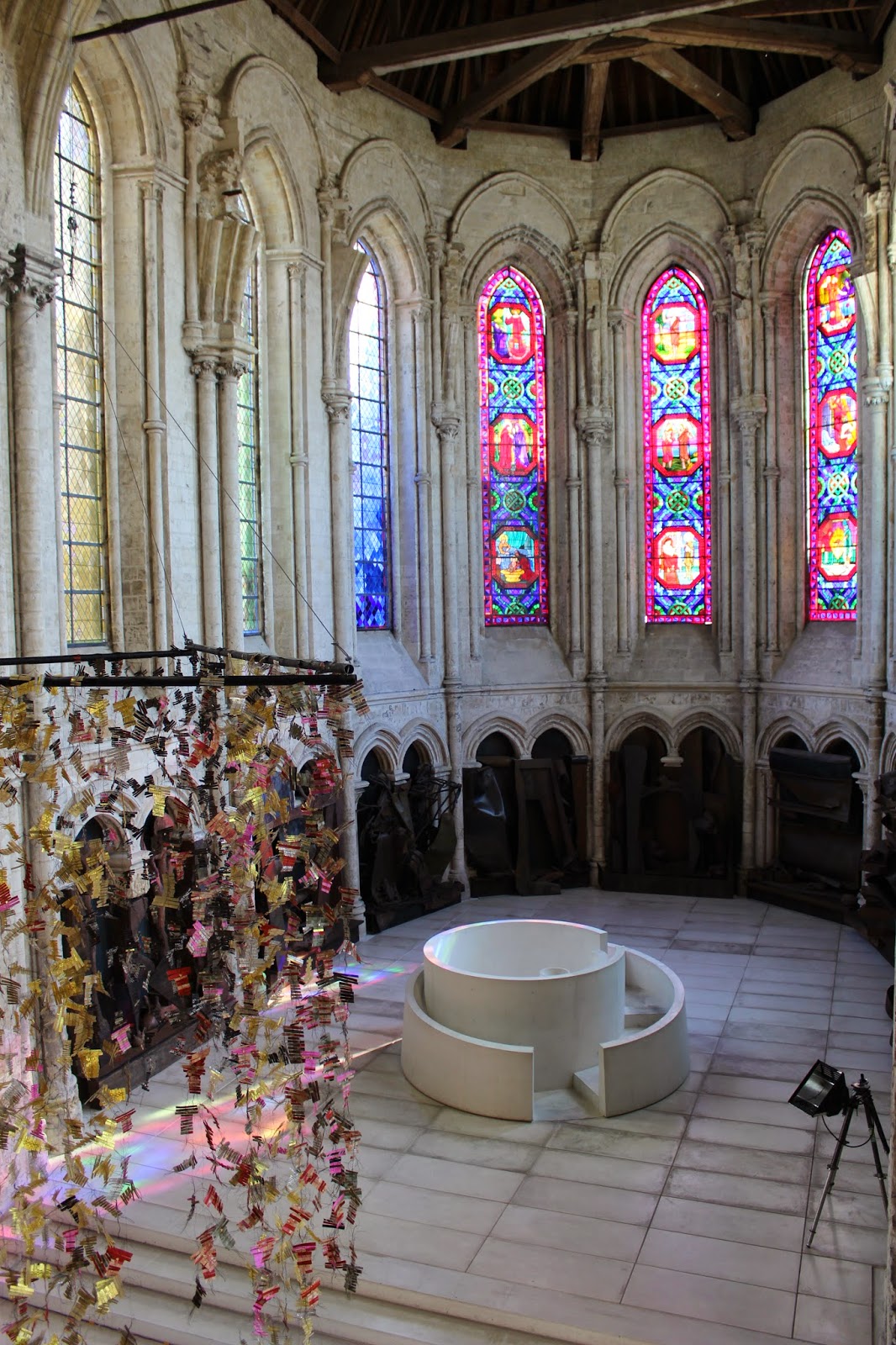
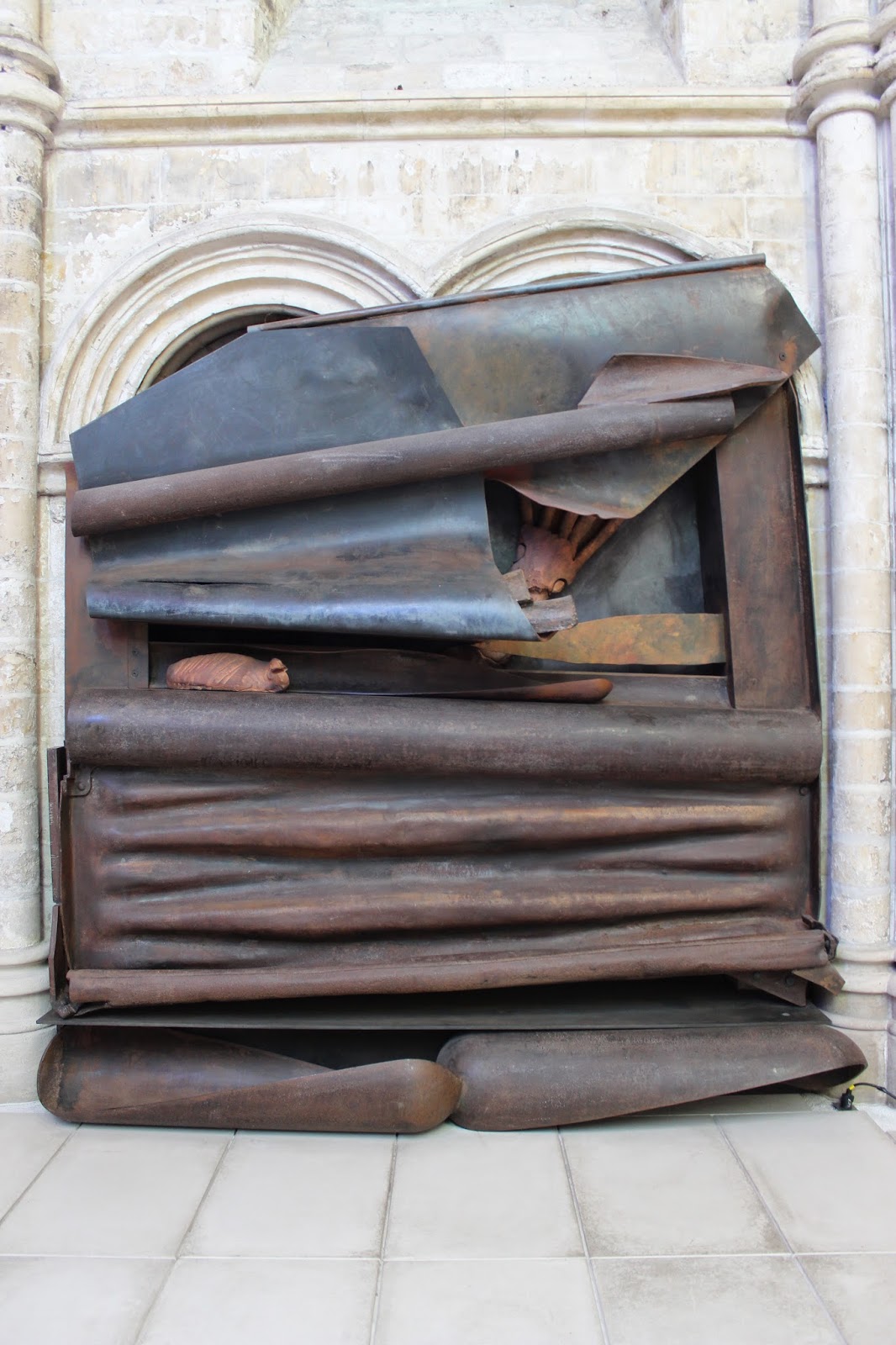
On the final day on the European stage of my Sabbatical art pilgrimage I was at Saint Jean de Baptiste Bourbourg (see http://www.bourbourg.fr/index.php?option=com_content&view=category&layout=blog&id=131&Itemid=167) to see Anthony Caro's Chapel of Light. The Chapel of Light is situated in the choir of the Church of St Jean Baptiste. During World War II, a damaged English aircraft crash-landed on the roof of the church in order to avoid the houses in the town, and set it on fire. The church itself was restored, but the choir was separated by a wall from the body of the church and left in ruins until ten years ago. Caro was commissioned by the French Ministry for Culture and Communication to make a sculptural installation that would bring new life to the redundant choir. See http://www.anthonycaro.org/news-chapel.htm.

------------------------------------------------------------------------------------------------------------

Van Morrison - Take Me Back.

Saturday, 9 January 2021

ArtWay Visual Meditation: 'With the Heart of a Child' by Nicola Ravenscroft

My latest visual meditation for ArtWay is a meditation on With the Heart of a Child, a sculpture installation by Nicola Ravenscroft:

'Nicola Ravenscroft intuitively understands these truths and, as a maternal sculptor, creates children that through their connection to nature grant us a vision of the peaceable kingdom toward which they wish to lead us. Her sculpture installation With the Heart of a Child sees seven life-size bronze children, one from every continent on earth, simply dressed in soft silk tulle, hesitate in time, leaning forward, hopeful, poised to dive, eyes closed, dreaming into their future, anticipating things unseen.

Nicola writes that “as an artist, I am visionary, sculptor, mother to many, and grandmother to even more.” She adds that she breathes life into life taking “clay, dirt and stardust, shaped and twisted torn smoothed and broken lost, found and moulded wax and singing molten bronze through white-hot crucible-refining fire, Earth’s own core breathing life into revealing-truth, a giving-birth to energy.” The result is this installation of eco-earthling-warrior-mudcubs – children intimately connected to the earth – reminding us of our duty of care to life, to love, to planet earth.'

In December 2020 I had an interview with Nicola Ravenscroft published in Artlyst. The interview can be read by clicking here. I also used Nicola's installation as an illustration for my sermon at Midnight Mass in 2020. Click here to read that sermon.

My visual meditations for ArtWay include work by María Inés Aguirre, Giampaolo Babetto, Marian Bohusz-Szyszko, Alexander de Cadenet, Christopher Clack, Marlene Dumas, Terry Ffyffe, Antoni Gaudi, Nicola Green, Maciej Hoffman, Lakwena Maciver, S. Billie Mandle, Giacomo Manzù, Michael Pendry, Maurice Novarina, Regan O'Callaghan, Ana Maria Pacheco, John Piper, Albert Servaes, Henry Shelton, Anna Sikorska and Edmund de Waal.

My Church of the Month reports include: Aylesford Priory, Canterbury Cathedral, Chapel of St. Thérèse of the Child Jesus and the Holy Face, Hem, Chelmsford Cathedral, Churches in Little Walsingham, Coventry Cathedral, Église de Saint-Paul à Grange-Canal, Eton College Chapel, Lumen, Metz Cathedral, Notre Dame du Léman, Notre-Dame de Toute Grâce, Plateau d’Assy,Romont, Sint Martinuskerk Latem, St Aidan of Lindisfarne, St Alban Romford, St. Andrew Bobola Polish RC Church, St. Margaret’s Church, Ditchling, and Ditchling Museum of Art + Craft, St Mary the Virgin, Downe, St Michael and All Angels Berwick, and St Paul Goodmayes, as well as earlier reports of visits to sites associated with Marian Bohusz-Szyszko, Marc Chagall, Jean Cocteau, Antoni Gaudi and Henri Matisse.

Interviews for ArtWay include: Sophie Hacker and Peter Koenig. I also interviewed ArtWay founder Marleen Hengelaar Rookmaaker for Artlyst.

I have reviewed: Art and the Church: A Fractious Embrace, Kempe: The Life, Art and Legacy of Charles Eamer Kempe, and Jazz, Blues, and Spirituals.

Other of my writings for ArtWay can be found here. My pieces for Church Times can be found here. Those for Artlyst are here and those for Art+Christianity are here.

----------------------------------------------------------------------------------------------------------

Raphael Ravenscroft - "... and a little child shall lead ..." Isaiah 11:6. 

Friday, 25 December 2020

And a little child shall lead them

Here's my sermon for Midnight Mass at St Martin-in-the-Fields: 

This will be a sign for you: you will find a child wrapped in bands of cloth and lying in a manger.

What does Christmas look like today? Artist Nicola Ravenscroft has given us a vivid portrayal in her installation ‘With the Heart of a Child.’ It's on display below us in our crypt. The crypt is currently closed, so I'm going to describe the sculpture to you. It shows us seven life-size bronze children - one from every continent on Earth. Each one is simply dressed in soft silk. Each is leaning forward hopefully as if poised to dive into the future. Their eyes are closed as if they are dreaming into their future, anticipating things unseen.

Nicola writes that, as mother, and artist, she has agonised at the sight of our fractured society, our impending climate catastrophe, and our collective fear. She sees a desperate need for creativity and togetherness to arrest this. Her belief is that children can quietly lead us into recognising the truth of our ‘universal ONENESS, our oneness with each other and our oneness with the Earth’. So, her response to the challenges we currently face, especially this Christmas, has been to create this international group of little leaders pointing us towards understanding and TOGETHERNESS. They are an encouragement ‘to do whatever it takes to find solutions, to heal our broken planet, and so, to save our future.’

The prophet Isaiah promised a child born for us who would establish endless peace upheld with justice and righteousness: ‘For a child has been born for us, a son given to us; authority rests upon his shoulders; and he is named Wonderful Counsellor, Mighty God, Everlasting Father, Prince of Peace.’ Isaiah also told of a little child who shall lead. He described a time when the wolf shall live with the lamb, the leopard lie down with the kid, the calf and the lion and the fatling together, and a little child shall lead them.

Isaiah's vision of the peaceable kingdom was centred on a child born to be the Prince of Peace. When that promised child came among us, he said: ‘Let the little children come to me, and do not stop them; for it is to such as these that the kingdom of God belongs’, ‘Unless you change and become like children, you will never enter the kingdom of heaven’, ‘Whoever becomes humble like this child is the greatest in the kingdom of heaven’ and ‘Whoever welcomes one such child in my name welcomes me.’

So, the child born for us in Bethlehem leads us to become like children. Why is this so? I want to suggest two reasons. The first is about a vulnerability revealing the interdependence of which Nicola speaks and the second, a way of looking revealing our connection with creation.

First, vulnerability. The Christmas story is that the God we think of as an all-powerful protector chose to become wholly dependent on human beings for his own protection. As a human baby God was wholly dependent on other human beings, primarily Mary and Joseph, for his protection and, as we hear regularly on the news, human beings don’t actually have a very good track record when it comes to treating children well. God was willing to take the risk of coming into our world; a world in which genocides occur and in which innocent children are abused and die - as happened with the massacre of the innocents in Bethlehem and beyond, a world in which he, though innocent, was tortured as a criminal and strung up on a cross to die:

“And the word became … / Wordless / Flesh / A baby with no words / And the voice of the maker became a hungry voice / A cry for food / A cry for milk / The voice that made gravity cried out for fear of falling / The voice that made women cries for a woman’s breast and screams with disappointment when it is denied …

Then now God is this small thing / Is a baby / Is a baby that can be dropped or hurt or left unfed, left unchanged, left wet and smelly / Or be child-abused.” (‘Image of the Invisible,’ Late, Late Service)

That was the reality of the incarnation and of the Christmas story. That is what it meant for Jesus to be born. It is the ultimate identification. God became flesh and blood and moved into our neighbourhood with all that that involves, not just at the beginning of his life but throughout. Why does this matter? It is when we are vulnerable that we are most aware of our need of others; that intrinsic interdependence that Nicola suggests is revealed to us by our experience of birth and childhood.

The sense of vulnerability engendered by the pandemic originally brought us a sense of community like never before as neighbours left notes offering help to those in their streets, as food banks supplied those in need, as we stood on our streets to applaud NHS and care workers, and as those same workers give sacrificially to care for those in need. If we follow the little child who leads we will see more community connection because, if we develop the heart of a child, our sense of vulnerability will reveal our interdependence and need one of another.

The second path to connection through childlikeness is about looking. As a baby Jesus was wholly dependent on others, as a child he began to explore the world around him using his sight, because sight precedes speech. We know from his parables and teaching that his learning was firmly rooted in the natural cycles of sowing, growing and reaping combined with deep appreciation for the beauty of the natural world, including the lilies of the field, and the value of each creature, including sparrows that cannot fall without God knowing. This understanding and appreciation derived from the attention he paid as a child to the natural world around him.

Artist and nun Sister Corita Kent once described a child’s journey from the front of the house to the back to illustrate the way children see the world, the attention they pay to it, and the wonder that they find. That short journey would ‘be full of pauses, circling, touching and picking up in order to smell, shake, taste, rub, and scrape’, ‘every object along the path will be a new discovery’ because ‘the child treats the situation with the open curiosity and attention that it deserves.’

Sister Corita went on to argue that through practice adults can learn once again to see as children do. She suggested that the kind slow looking practised by children, like prayer and art, enables us to view life without being distracted and allows us to put all our attention on a special area for a time. As would have been the case for the child Jesus, when we slow ourselves and focus our attention in this way we begin to receive what the world around has to show us; we notice things that others don’t and come to see that ordinary things are wondrous. The art historian John Ruskin claimed that the power of seeing in this way is ‘the teaching of all things,’ and that ‘To see clearly is poetry, prophecy, and religion – all in one.’

This is a form of prayer taking us to a place and space full of delight and wonder; prayer, poetry and prophecy. In this prayerful space and attitude we see the peaceable kingdom into which the child born in Bethlehem wishes to lead us. For many of us that was part of our original lockdown experience, as we walked in green spaces and, in the silence, heard the birds sing like never before.

Children naturally see that peaceable kingdom through the attention that they pay to the world around them, until we, as adults, teach them otherwise. That is why the children are our future and can lead the way into a better future. Like the poet Thomas Traherne, we need to unlearn the dirty devices of this world in order to become, as it were, a little child again that we may enter into the Kingdom of God.

Nicola Ravenscroft intuitively understands these truths and, as a maternal sculptor, creates children that through their connection to nature grant us a vision of the peaceable kingdom toward which they wish to lead us. In words taken from the novelist Joseph Conrad, her urgent prayer is that the children she has sculpted, ‘shall awaken in the hearts of the beholders, that feeling of unavoidable solidarity: of the solidarity in mysterious origin, in toil, in joy, in hope, in uncertain fate, which binds all to each other, and all humankind to the visible world.’

These are the children the adult Jesus called us to welcome, the children we are to become, the children to whom the peaceable kingdom belongs. They stand together peacefully in our Crypt as friends, vulnerable and strong, silently singing out their call to change. These little bronze children lead with trusting feet, plump and bare. The Prince of Peace is with them and calls us to let them lead the way saying the kingdom of heaven belongs to children, and anyone who will not receive the kingdom of God like a little child will never enter it. 

Our world with its current catastrophes, fractures in society, and collective fears is crying out for change and hope. The baby born at Bethlehem remains the sign that we, too, need to be born again if our world is to know new life and fresh hope. That is the Christmas we need today and so, together with Nicola, my prayer is that we let the baby wrapped in bands of cloth and lying in a manger lead us to become like children ourselves; open to vulnerability, embracing interdependence, paying prayerful attention to the world and thereby entering Christ’s peaceable kingdom.


I will be continuing to explore the themes of the sermon in a new series of posts called 'Seeing is receiving: The art of contemplation', the first of which will follow this post. Click here to read the first post in this new series.

------------------------------------------------------------------------------------------------------

Randall Thompson - The Peaceable Kingdom.

Friday, 18 December 2020

Church Times review - Edmund de Waal: Library of Exile

My latest review for Church Times is of Edmund de Waal's Library of Exile at the British Museum:

THE wisdom of the world is found in words and images and held in containers of space and containers of thought. Edmund de Waal’s Library of Exile gives us architecture, art, and literature combined in one habitable installation, where the inside and outside provide different responses to human learning and creativity ...

Outside this temporary structure, we see destruction recorded; inside, we view, review, and remember; and, when removed, the memories contained in covers will revitalise and renew the rebuilding of a restored thought container.

In the Psalms, in de Waal’s “Psalm”, in this library, in all libraries, we still ourselves and “navigate the space between the silence of things and the silence of people”.'

Other of my pieces for Church Times can be found here.

--------------------------------------------------------------------------------------------------------

My Morning Jacket - Librarian.

Sunday, 6 December 2020

Artlyst: Nicola Ravenscroft - Sculpture With A Peaceful Stillness

My latest interview for Artlyst is with Nicola Ravenscroft, who has recently been commissioned to create a memorial to honour the bravery of front-line NHS and care workers in the fight against Covid and whose installation 'With the Heart of a Child' is currently displayed at St Martin-in-the-Fields:

'My installations are contemplations, silent, tender pleadings: they plead for you, for me, for us all to work together: they cry out for us to recognise the loving signature connecting us all – the Divine – in nature, in human diversity, in the universe, and in the heart of a little child.

I trust that in this beautiful and powerful realisation, we can imagine, create and achieve in ‘oneness’, that which we can’t achieve alone.'

My other Artlyst pieces are:

Interviews:
Articles:
-----------------------------------------------------------------------------------------------------