Wikio - Top Blogs - Religion and belief
Showing posts with label myth. Show all posts

Friday, 24 February 2017

Chaim Stephenson: Between Myth and Reality

Between Myth and Reality


Wednesday 1 March –Wednesday 10 May
Chaim Stephenson
Between Myth and Reality


A sculpture exhibition in the Foyer of St Martin-in-the-Fields.

Chaim Stephenson worked for over sixty years to produce a wide range of sculpture, of which this exhibition shows but a small part – pieces inspired by the stories in the Old Testament, and those that came out of his lifelong concern for people driven from their homes. Among the former, every sculpture tells a story, familiar and built into our culture and traditions. The refugee statues speak of a universal and contemporary reality that not only mattered profoundly to the artist but affects us all.

Chaim Stephenson was born in Liverpool to Russian Jewish immigrant parents. He served in the mines as a ‘Bevin boy’ before joining a group of young Jews who emigrated to Palestine. After fighting through the first Arab-Israeli war of 1948 he joined a kibbutz in western Galilee where he worked as a shepherd, sculpting in his limited free time. After a year in England studying and sculpting, he went back to Israel, and married writer Lynne Reid Banks. They returned to the UK in 1971 with their three sons. He spent the rest of his life as a working artist, dying last year aged 89.

The Living South Africa Memorial by Chaim Stephenson is on permanent display in church and St Martin’s is pleased to display a full exhibition of the work of this remarkable artist.

----------------------------------------------------------------------------------------------------

Peter Gabriel - Solsbury Hill.

Saturday, 20 August 2016

Making Beauty & The Third Paradise


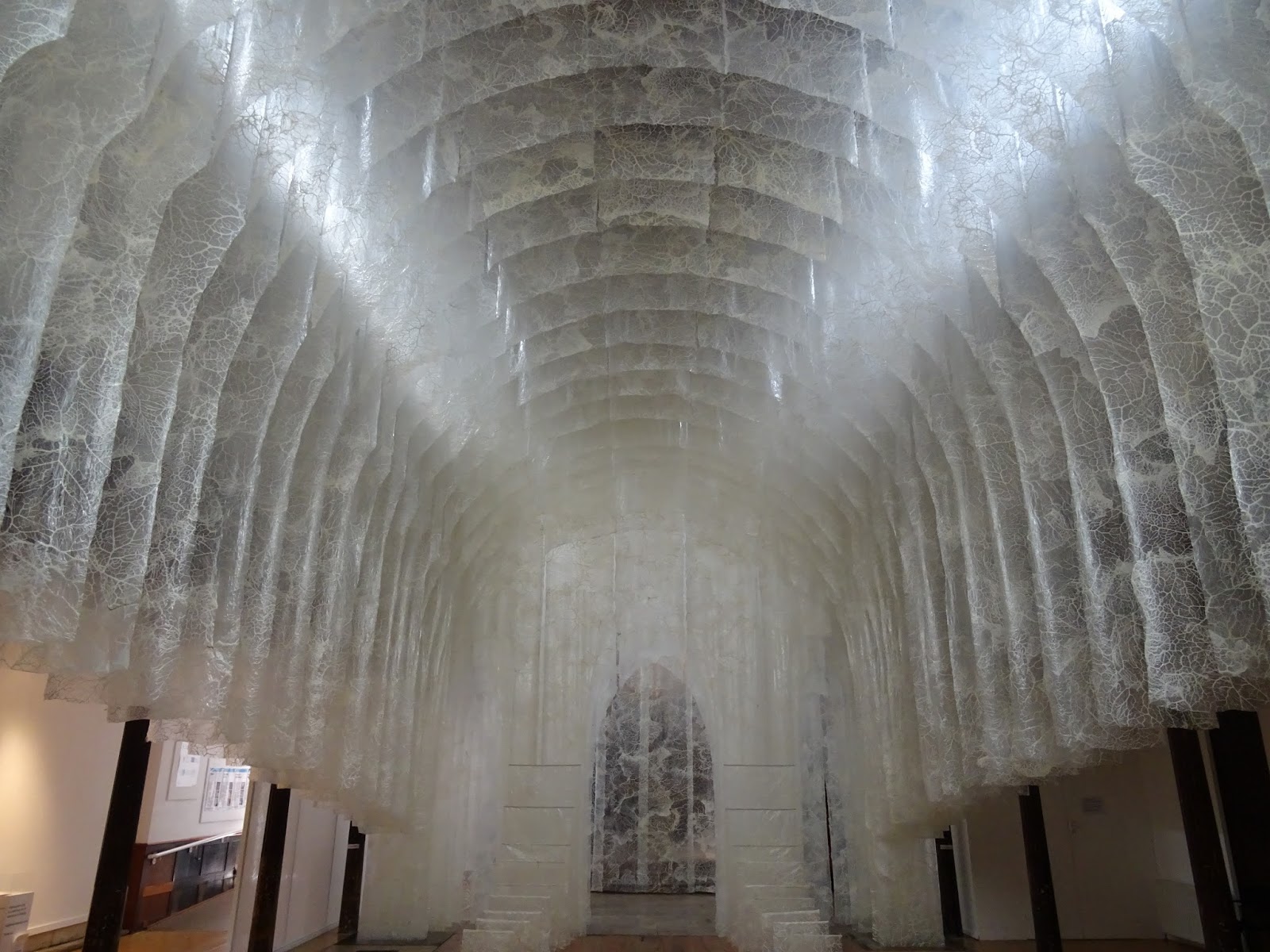
Last year I saw Elpida Hadzi-Vasileva's 'Fragility' for Fabrica Gallery, Brighton. This installation forms the breathtaking entrance to her first major UK show at the Djanogly Gallery Nottingham. The exhibition entitled Making Beauty also includes the first UK showing of ‘Haruspex’ commissioned by the Vatican for the Venice Biennale, 2015.

Elpida Hadzi-Vasileva is a site-specific installation artist working across the varied media of sculpture, installation, video and sound, photography and architectural interventions. Her materials range from the unusual to the ordinary, from the ephemeral to the precious; they include organic materials, foodstuffs and precious metals.

Making Beauty is a new body of work made in collaboration with academics in medical departments of the universities of Nottingham, East Anglia and London, introducing highly regarded medical research activity to a wider public. Her work has been informed by their work on nutrition, healthy diet, our gut, and the development of highly specialised - invisible to the eye - manufactured parts providing solutions to medical problems. The sculptures reveal the fragility of our bodies and reflect the delicate nature of these medical components. The work has been supported by a research grant from the Wellcome Trust.

For summer 2016, Fabrica is presenting a work by internationally-renowned Italian artist Michelangelo Pistoletto, a leading light of the Arte Povera movement of the 1960s. The work features a labyrinth constructed from cardboard which leads to a mirror with a symbol laid out in coins.

The symbol, the infinity sign altered to add a central loop represents The Third Paradise. According to Pistoletto’s manifesto written in 2003, The Third Paradise seeks to reconcile the conflict between the first and second paradises of nature and human artifice. This conflict is leading toward global destruction but the third paradise offers a solution, a resolution that will save the planet and humanity.

The Third Paradise is the new myth that leads everyone to take personal responsibility at this momentous juncture. The idea of the Third Paradise is to lead artifice—that is, science, technology, art, culture and political life—back to the Earth, while engaging in the reestablishment of common principles and ethical behaviour.

----------------------------------------------------------------------------------------

Moby - Everything That Rises / The Last Day (Poordream Remix).

Monday, 4 April 2016

Easter: Where do you stand?

Here is my reflection for the current Parish Newsletter at St Martin-in-the-Fields:

Alister McGrath has described the conversion of C.S. Lewis as being ‘like a scientist who, confronted with many seemingly unconnected observations, wakes up in the middle of the night having discovered a theory which accounts for them ... like a literary detective, confronted with a series of clues, who realises how things must have happened, allowing every clue to be positioned within a greater narrative … a realisation that, if this was true, everything else falls into place naturally, without being forced or strained.’ Lewis came to see the story of Christ as a true myth which, once believed, made sense of everything else.

As a Cambridge physicist Professor John Polkinghorne might be expected to disbelieve such an extraordinary miracle as resurrection, which appears to contravene the laws of nature. But in fact, it is the cornerstone of his faith. Reflecting on the remarkable rise of the early Church, he has concluded: ‘Something happened to bring it about. Whatever it was it must have been of a magnitude commensurate with the effect it produced. I believe that was the resurrection of Jesus from the dead.’

“Sherlock Holmes once remarked to Dr Watson that, ‘When you have eliminated the impossible, whatever remains, however improbable, must be the truth.’

An Easter advertising campaign has recently launched which allows you to investigate the story of the Passion yourself in the style of the television sci-fi series The X-Files. The advert “Easter: Where do you stand” — on television, radio, posters, and online — has been released by the ecumenical network ChurchAds.Net to coincide with the finale of the new series of The X-Files. It encourages us to “reopen the case on Jesus Christ”, and vote on the question: “Jesus: man, myth, or messiah?” Your investigation can be made and your vote cast at http://www.wheredoyoustand.co.uk/.

-------------------------------------------------------------------------------------

Thursday, 18 February 2016

Exhibitions update

Zi Ling's watercolour entitled 'Tea' is in Figurative Art Now, the Columbia Threadneedle Prize exhibition, at Mall Galleries which showcases the very best in new figurative and representational art. This year many of the works selected for this exhibition will go on tour to Palazzo Strozzi in Florence, the city’s largest temporary exhibition space, for a special four-week exhibition opening in July 2016. Ling's watercolour work 'Cigarette Break' (2015) has been selected for the Lynn Painter-Stainers Prize 2016. This exhibition will take place at the Mall Galleries from 7th to 13th March. Ling creates portraits or explorations of relationships by working from photographs with which she feels an intuitive connection.

Working in collaboration with Counterpoints Arts, Ben Uri’s latest exhibition, Unexpected, continues their exploration of the themes of identity and migration, emphasising a wide-ranging contemporary response. Following on from their centenary exhibition, Out of Chaos, held last autumn at Somerset House, the exhibition returns them to their principal location at Boundary Road, NW8. 

Works by Ben Uri artists including Frank Auerbach, Eva Frankfurther, Julie Held and Josef Herman will be shown alongside those by invited artists – all from migrant backgrounds – across a range of disciplines and media. This includes paintings by Tam Joseph and Eugene Palmer; drawings by Behjat Omer Abdulla; sculpture and installations by Ana Cvorovic, Joyce Kalema, Jasleen Kaur, Fokowan George Kelly and Zory Shahrokhi; photography by Güler Ates, James Russell Cant, Juan del Gado and former Community Partners Oxford House; textiles by Salah ud Din; an audio-visual piece by Jessica Marlowe and an HLF commissioned film responding to Out of Chaos by Edwin Mingard. 

Both individually and collectively, the featured works touch on themes of journeys, displacement, loss, memory and identity, evoking powerful and sometimes unexpected juxtapositions and responses.

CNB is presenting Britannic Myths, the gallery’s second solo show by the acclaimed British artist Joe Machine. The twelve paintings that make up the exhibition have been created in collaboration with the academic and writer Dr Steven O’Brien, and are based on a dialogue around his soon to be published book, Britannia Stories.

Britannia Stories explores twenty myths. While all of these are commonly associated with the British Isles, many originate from other civilisations, countries and cultures, and were adopted – and adapted – as a consequence of invasion and conquest. The two men worked closely in examining the origins of all the stories, and on determining the relevance of each to the 21st century, with Machine’s paintings influencing O’Brien’s writings, and vice versa.

Says Machine: ‘The power of the stories lies not so much as folk tales from isolated islands, but in their universal connection to ancient cultures. These dialogues with the divine, and struggles of the human spirit are timeless, and show us how myths are as important today as they ever were.’ 

Joe Machine's next exhibition will be at St Stephen Walbrook in May.

----------------------------------------------------------------------------------------

Kate Bush - The Sensual World.

Saturday, 22 August 2015

Airbrushed from Art History: Ben Shahn and American Expressionism

In Common Man Mythic Vision Stephen Polcari compares and contrasts the work of Ben Shahn with his postwar American art peers:

'During and after World War II, whether one was a Social realist like Ben Shahn and the WPA artists, a Regionalist like Thomas Hart Benson, an Expressionist like Rico Lebrun, Hyman Bloom, or Abraham Rattner, or an Abstract Expressionist like Mark Rothko, Jackson Pollock, and Willem de Kooning, most American artists engaged the principal crisis of their time: the survival of the nation and of humane civilisation.'

'Shahn ... reshaped his style with new subject matter, a more universal outlook, and a new artistic language of symbolic emotion ... his adoption of a new mythic and allegorical language was only one of the ways he contributed to a new American approach to art; particular expressive themes were another ... With works such as Sound in the Mulberry Tree, 1948, with its Hebrew lettering and biblical verse, Maimonides, 1954, which evoked the medieval Jewish sage, Third Allegory, 1955, with its shofar and prayer shawl, and The Parable, 1958, with its drowning or emerging patriarch, Shahn sought to express universal truths. Yet, these works undoubtedly reflect Shahn's new appreciation for the heritage that he had restrained in his early work. The Holocaust brought forth a renewed identification with, and need for reaffirmation of, Shahn's Jewishness ...

fellow radical painter Philip Evergood was also moved to depict the effects of the war in mythic and symbolic language. Evergood's The New Lazarus, 1927 - 54, conflates his typical Social Realist edginess with a mythic biblical image of the evils of war and death, and the hope that these horrors will be redeemed by resurrection ...

Benton Murdoch ... Spruance's Souvenir of Lidice ... depicts three men nailed to crosses - in other words, a modern Calvary. This contemporary crucifixion was inspired by the Nazi slaughter slaughter of the citizens of Lidice, Czechoslovakia ... Spruance followed his war work with a further use of this symbolic language. it is reflected in works of 1943 such as Riders of the Apocalypse with its air war; Pietà - From the Sea showing Christ as a dead seaman; and Epiphany, in which the stars of social reconstruction imagery ... appear in a new context ...

With America's entry into the war, Benton altered his approach, now using biblical imagery to address America's political needs. In 1942, he produced a suite of paintings called the Year of Peril ... the series narrated the war in terms of biblical images and themes ...

The expressionist Abraham Rattner ... painted the subject of lamentation several times. In his Lamentation, 1944, and Pietàs, 1945 and 1949, Rattner created a compact emblem of sorrow ... Although the war is not explicitly represented, it was implicitly understood in the frequent depictions of the crucifixion by Rattner and other artists ...

Lamentation was the formative idea of the Entombment paintings, the largest series in the early work of the Abstract Expressionist Mark Rothko ...

Rico Lebrun employed bestial imagery when he represented the dumb soldiers surrounding Christ as horned and armored animals in The Crucifixion, 1950 ...

Although a Jew from the Baltic like Shahn, the expressionist Bloom was a Boston artist and much more devoted than Shahn to visionary, nightmarish imagery, born of the study of Dürer's allegories, and to the work of Rouault (like Rattner and Spruance), Bresdin and Soutine ...

During the 1940s and 1950s, many artists were engaged in representing their personal responses to history ... Shahn joined these artists in coming to terms with history through allegory, myth and tradition.'

-------------------------------------------------------------------------------------------

Joanne Hogg -  I Heard The Voice Of Jesus Say.

Tuesday, 24 February 2015

Ana Maria Pacheo: Art shows how vulnerable we are

Ana Maria Pacheco is a painter, sculptor and printmaker who was born in Brazil in 1943 and has lived in England since 1973. Her work exhibits a compelling yet disturbing merging of Brazilian folklore, classical myth, mystical Catholicism and political satire. "Mythical and religious themes, usually given a dark edge, figure in much of her work" and she "deals with issues of control and the exercise of power, drawing upon the tensions between the old world of Europe and the new world of her Brazilian birth."

"The variety of Pacheco’s sculptural work is remarkable and with its tough humanist core, her project constantly provokes us to seriously question the true extent of our own humanity, and of our uses and abuses of power. Ana has said that her 'art shows how vulnerable we are'. Large and enduring themes; violence, journeys, death, love, transformation and metamorphosis reflect her high seriousness, but at the same time her work is neither pompous nor devoid of humour. With a cast of characters that are betrayed, tortured, ecstatic, seductive, grotesque, bestial or divine, her work can arouse extreme emotions, a process that some concluded art no longer has the power to elicit."

Four separate but simultaneous exhibitions, in four different Norwich locations, will bring major sculptural work from Pacheco to Norwich for the first time.

Ana Maria Pacheco Exhibitions | Norwich 2015
17 March to 6 September
Norwich Cathedral
Shadows of the Wanderer (Sculpture)

Cathedral of St John the Baptist
Study for Requiem, John the Baptist I (Sculpture)
Study of Head, John the Baptist III (Sculpture)*
*to Sunday 31st May

17 March to 31 August
Norwich Castle Museum & Art Gallery
Enchanted Garden (Reliefs)

17 March to 25 April
The Gallery at Norwich University of the Arts
The Banquet (Sculpture) and Prints

Event at Norwich Castle
Friday 27 March | 5.30 – 7.30pm
Norfolk Contemporary Art Society and
Norwich Castle Museum & Art Gallery present
Ana Maria Pacheco and Colin Wiggins in conversation
5.30 – 6.15pm – exhibition viewing
6.15 – 7.15pm – conversation in the Town Close Auditorium
Seating is limited so pre-booking is essential
To reserve tickets please email norfolkart@googlemail.com
NCAS members | £5.00 – Non-members | £7.00 (payment at door)

------------------------------------------------------------------------------------------------

Victoria Williams, Emmylou Harris et al - In My Hour Of Darkness.

Thursday, 5 February 2015

Unresolved yet beautiful mysteries: Paul Thek and Basil Alkazzi

I've recently come across the work of Paul Thek and Basil Alkazzi, two artists who at points in their careers have had a New York base and, while very different in their styles and practices, have engaged with themes of faith and belief:

'A sculptor, painter, and one of the first artists to create environments or installations, Paul Thek came to recognition showing his sculpture in New York galleries in the 1960s ... At the end of the sixties, Thek left for Europe, where he created extraordinary environments, incorporating elements from art, literature, theater, and religion, often employing fragile and ephemeral substances, including wax and latex ... With his frequent use of highly perishable materials, Thek accepted the ephemeral nature of his art works—and was aware, as writer Gary Indiana has noted, of “a sense of our own transience and that of everything around us.”'

Thek's spatial installations 'brought the viewer into a world full of declarations of faith and Thek’s private mythologies': 'The experience of an environment was shaped by a processional progression through different stops, as well as the opportunity to linger in various resting-places. Thek saw this as ‘human’ art, because ‘the first thing to do was to humanize the environment; then you can look at a work of art. And, of course, you do that by turning down the lights, giving people some chairs to sit on, and not having the art restricted in any way.’ (Flood 1981, p. 54-55).'

'In the winter of 1973/74, Paul Thek (1933–1988) was a guest of the Lehmbruck Museum in Duisburg, where he installed the room-filling environment "Ark, Pyramid – Christmas" ("The Manger")--a development of the legendary "Pyramid" installation realized at Documenta 5 in 1972. This exhibition, organized by the director of the museum at the time, Siegfried Salzmann, was the fourth in Thek’s large-scale projects in Europe, all of which engaged with individualized religious symbols (or what Harald Szeemann termed "Individual Mythologies"). The Christmas season provided Thek with the occasion to present, for the first time, a self-written theater piece in the form of a nativity play featuring children from Duisburg.'

'Thek’s “96 Sacraments” were written in one of his notebooks (#75, 1975). Thek wrote in a journal daily in the 1970s and 80s. Upon his death he had filled almost 100 journals, most of which were black and white composition books.

In the catalogue for Paul Thek: Diver, A Retrospective, Tina Kukielski writes: “Like most journals, they reveal deeply personal thoughts about friends, relationships, and sex, as well as Thek’s private shames and insecurities, and his efforts—like prayers—to be better in every way, especially as an artist.”'

'A prolific and compulsive painter, Basil Alkazzi has exhibited regularly in London, and in the United States. His long and distinguished career spans five decades. His work is in the collections of a great many museums in the USA and in Europe.

Basil Alkazzi's painting is characterized by Spiritual and Metaphysical components which at once make it of deep significance to the beholder. The unresolved yet beautiful mysteries, alive with suspended drama, throb in the air and permeate the paintings ..."His paintings represent the materialization of poems in visual terms unwritten yet redolent of many remembered. Time and growth are instrumental in motivating his imagery." ...

In his recent paintings Basil Alkazzi continues the quest to pursue an intensely felt vision. There is a deep meditation on the flora inducing a strange spiritual calm to the viewer, yet making one look deeper, reaching towards the core of celebration let loose in a sensory world of nature’s own sensual and mysterious Life-force. Here everything connects within the harmony of the Universe at once both mystical and with an overwhelming sense of awe ...

In 2010 he established The Basil H. Alkazzi Award For Excellence, two triennial awards, at the New York Foundation for the Arts. "We live in a fast moving culture that grows increasingly more abstract, away from the physical touch, away from the physical ground of being- away from the act of creation by hand. I want, in my own way, to encourage the glorious expression of pencil, brush and paint, and to nurture the kind of artist and the kind of art that I like and respect."'

'Alkazzi has established the award in order to recognize and encourage the work of all painters, because as he says: “Created works of art are in fact the tangible manifestations of man’s highest aspirations - to create a sort of ultimate beauty and to visually express all intangible and elusive elements.”'

----------------------------------------------------------------------------------------

Lou Reed - Goodbye Mass (In A Chapel Bodily).

Saturday, 13 December 2014

The Hobbit: The Battle of the Five Armies

The last film in The Hobbit trilogy is by far the best because it shares the elegiac mythic qualities of The Lord of the Rings trilogy. After watching the first film in the trilogy, I criticised Peter Jackson for his decision to tell the story of The Hobbit as a prelude to The Lord of the Rings rather than as a story in its own right. That decision gave an uncertain quality to the first film with the film makers unsure as to whether to emphasise the lighter nature of The Hobbit itself or to continue the mythic feel of The Lord of the Rings. In this final film, there is no such uncertainty and the elegiac nature of the film fits the content closely with its theme of the seductions of wealth and power.

As Peter Bradshaw wrote in The Guardian:

'Peter Jackson has pulled it off. He has successfully concluded his outrageously steroidal inflation of Tolkien’s Hobbit into a triple-decker Middle Earth saga equivalent to the Rings trilogy, and made it something terrifically exciting and spectacular, genial and rousing, with all the cheerful spirit of Saturday morning pictures. And if poor, bemused little Bilbo Baggins now looks a bit lost on this newly enlarged action-fantasy canvas – well, he raises his game as well, leavening the mix with some unexpectedly engaging and likable drama. The Battle of the Five Armies is at least as weighty as The Return of the King. It packs a huge chain-mailed punch and lands a resounding mythic stonk. But it’s less conceited, more accessible and it makes do with just the one ending.'

--------------------------------------------------------------------------------------

Billy Boyd - The Last Goodbye.

Wednesday, 24 September 2014

Andrez Kuhn and Dora Holzandler

Goldmark Gallery have announced the death last week of gallery artist, Andrzej Kuhn. They write, 'His paintings, deceptively naive yet highly sophisticated, have brought warmth and comfort to all those who have set eyes on them. He will be greatly missed by all of us at the gallery and all who knew him.'

In the essay 'Kuhn at Eighty' his work is described as follows: 'Flat, mythical scenes, in a rich palette of colours and subtle textures, are always peopled by strange and wonderful characters; weary travellers, resting angels, benevolent moons, lions, lovers, fishermen and musicians. For Kuhn, these are real people, real events, their images arriving, fully formed, in his imagination pulled from the reservoir of human experience.'

The Gallery's current exhibition is Dora Holzhandler A Celebration. Philip Vann writes, 'A mystical note resounds in her vibrant portrayals of lovers emparadised in each other’s arms in opulently patterned bedrooms, of mothers and children in Eden-like gardens, of families endearingly observed as they gather in celebratory attitude, and in ethereal, luminous images that capture everyday life with spontaneous joy and clarity.'

------------------------------------------------------------------------------------------

Jon Foreman - Southbound Train.

Sunday, 21 July 2013

Finding a Myth for the 21st Century

 
In it he tells the story of how he went from "working as a policy wonk, a special adviser in Tony Blair’s government", to "the belief that a 3,000 year old set of myths about covenant, atonement and renewal are actually profoundly relevant to our current moment of crisis and transition – and might even have the potential to succeed where our politics seem to be failing so miserably."
 
He draws on the work of Margaret Barker, in particular, to argue that the eternal covenant’s myths should be read symbolically to "offer remarkably clear explanations of social and ecological breakdown as the result of breaches in the creation covenant, and of atonement as the route towards restoration, in both the social and the environmental sense."

-----------------------------------------------------------------------------------------------

U2 and Daniel Lanois - Falling At Your Feet

Wednesday, 21 March 2012

The myth of greater private-sector efficiency (2)

Seamus Milne is the latest Guardian columnist to take on busting the myth of privatisation - vital action now that the Government has effectively privatised the NHS: 

"Central to the corporate-driven ideology that dominates this government and public debate is a myth: that the risk-taking, entrepreneurial private sector drives technological innovation and industrial advance, while attempts by state bureaucracies to "pick winners" are a recipe for disaster.

That myth is exploded by Sussex University economist Mariana Mazzucato in her book The Entrepreneurial State. Even in the US, heartland of "free enterprise", the public sector has taken the risk to invest in one cutting edge sector after another: from aviation, nuclear energy and computers to the internet, biotechnology and nanotechnology.

The private sector has come in later – and usually reaped the reward. So the algorithms that underpinned Google's success were funded by the public sector. The technology in the Apple iPhone was invented in the public sector. In both the US and Britain it was the state, not big pharma, that funded most groundbreaking "new molecular entity" drugs, with the private sector then developing slight variations. And in Finland, it was the public sector that funded the early development of Nokia – and made a return on its investment.

The lessons should be clear. States such as Germany, South Korea and China are now spending far higher proportions of national income on research and development into green technologies. Even some Tory ministers understand that only state intervention can drive the new motors of growth – but dare not say so publicly.

That's hardly surprising. But the government's economic strategy isn't working. If Britain is going to rebuild a broken economy, its political class is going to have to learn to turn its back on three decades of clapped-out myths and bankrupt ideology."

--------------------------------------------------------------------------------------

Get the Blessing - So It Goes / Yes I Said Yes I Will Yes

Sunday, 18 March 2012

The Dreams of William Golding

Last night's Arena documentary on William Golding was a fascinating study of a fascinating writer:

'In 1954, William Golding's Lord Of The Flies, a terrifying vision of the latent savagery of society and the struggle between good and evil, burst upon the polite world of English fiction. It was originally turned down by more than 20 publishers, but has since sold 20 million copies worldwide.

Golding, an unknown schoolmaster and D-Day veteran, went on to win both the Booker and Nobel Prizes. His dozen novels, awesome in their scope, range from the dawn of humanity to medieval man and maritime epics, and reveal an imagination which is dark and powerfully compelling. Arena has been given unique access to Golding's family and to his extensive personal archive for the first film to be made since his death in 1993. Rooted in the mysterious West Country landscape that Golding made his home, and with testimony from his neighbours including John Le Carré, James Lovelock and Pete Townshend, and his admirers Stephen King and Ian McEwan, it embraces the bewildering range of Golding's genius, and the continuing importance of his vision.' 

The Presentation Speech for his Nobel Prize gives a helpful summary of some of his core themes and approaches as a writer:

'Golding has a very keen sight and sharp pen when it comes to the power of evil and baseness in human beings. He often chooses his themes and the framework for his stories from the world of the sea or from other challenging situations in which odd people are tempted to reach beyond their limits, thereby being bared to the very marrow. His stories usually have a fairly schematic drama, almost an anecdote, as skeleton. He then covers this with a richly varied and spicy flesh of colourful characters and surprising events.

It is the pattern of myth that we find in his manner of writing ...

Golding inveighs against those who think that it is the political or other systems that create evil. Evil springs from the depths of man himself - it is the wickedness in human beings that creates the evil systems or that changes what from the beginning is, or could be, good into something iniquitous and destructive.

There is a mighty religious dimension in William Golding's conception of the world, though hardly Christian in the ordinary sense. He seems to believe in a kind of Fall. Perhaps rather one should say that he works with the myth of a Fall. In some of his stories, chiefly the novel The Inheritors, 1955, we find a dream of an original state of innocence in the history of mankind. The Fall came with the motive power of a new species. The aggressive intelligence, the power-hungry self-assertion and the overweening individualism are the source of evil and violence - individual as well as social violence. But these qualities and incentives are also innate in man as a created being. They are therefore inseparably a part of his character and make themselves felt when he gives full expression to himself and forms his societies and his private destiny.'

In his Nobel Lecture Golding said that:

'Under some critical interrogation I named myself a universal pessimist but a cosmic optimist ... I meant, of course, that when I consider a universe which the scientist constructs by a set of rules which stipulate that this construct must be repeatable and identical, then I am a pessimist and bow down before the great god Entropy. I am optimistic when I consider the spiritual dimension which the scientist's discipline forces him to ignore ... Twenty years ago I tried to put the difference between the two kinds of experience in the mind of one of my characters, and made a mess of it. He was in prison.

"All day long the trains run on rails. Eclipses are predictable. Penicillin cures pneumonia and the atom splits to order. All day long year in year out the daylight explanation drives back the mystery and reveals a reality usable, understandable and detached. The scalpel and the microscope fail. The oscilloscope moves closer to behaviour.

"But then, all day long action is weighed in the balance and found not opportune nor fortunate nor ill-advised but good or evil. For this mode which we call the spirit breathes through the universe and does not touch it: touches only the dark things held prisoner, incommunicado, touches, judges, sentences and passes on. Both worlds are real. There is no bridge."

What amuses me is the thought that of course there is a bridge and that if anything it has been thrust out from the side which least expected it, and thrust out since those words were written. For we know now, that the universe had a beginning. (Indeed, as an aside I might say we always did know. I offer you a simple proof and forbid you to examine it. If there was no beginning then infinite time has already passed and we could never have got to the moment where we are.) We also know or it is at least scientifically respectable to postulate that at the centre of a black hole the laws of nature no longer apply. Since most scientists are just a bit religious and most religious are seldom wholly unscientific we find humanity in a comical position. His scientific intellect believes in the possibility of miracles inside a black hole while his religious intellect believes in them outside it. Both, in fact, now believe in miracles, credimus quia absurdum est. Glory be to God in the highest. You will get no reductive pessimism from me.'

Watch the documentary on i-player by clicking here.

--------------------------------------------------------------------------

Lou Reed - Waves Of Fear.

Sunday, 31 July 2011

Harry Potter and true myth

Three quarters of our family recently watched Part 2 of Harry Potter and the Deathly Hallows and we are now working our way through the films together from the beginning, noticing more of the clues planted in the early stories which point towards the series end as we do so. Like so many others, we’ve thoroughly enjoyed the shared experiences of books, films and dvds from bedtime stories through books passed around to be read one after the other and shared cinema visits followed by shared evenings in with the dvds.

For me, it has all been another demonstration of the power of story; one that has connected with my experiences as a child reading The Chronicles of Narnia, The Hobbit and The Lord of the Rings (also The Books of Earthsea and The Chronicles of Prydain). These are stories which enable us to experience and live in other worlds; through the imagination of the author married to our own, such series enable us to inhabit the story over a sustained period of time. That that is so despite there being real weaknesses to each series - Narnia sails too close to allegory; the action in The Lord of the Rings gets bogged down in the marshy detail of Middle Earth; and J. K. Rowling has a rather flat writing style - speaks volumes about the power of story itself and the skill with which C. S. Lewis, J. R. R. Tolkien and Rowling weave their plots and realise their characters.

I was wondering what happens next for those of us who have lived in the Potterverse (with the exception of Pottermore) as the books and films have overlapped, in contrast to Narnia and The Lord of the Rings where the films have enabled later in life to revisit the books. There is a real sense now in which living in that story will stop with the release of the final dvd. This brought my thinking to the contrast between living imaginatively in an fictional story and living in a story which encompasses and explains our everyday existence. The Greatest Story Ever Told is such a story and this reminded me of the distinction that Lewis and Tolkien made between myth and true myth:

"Myths, Lewis told Tolkien, were "lies and therefore worthless, even though breathed through silver."

"No," Tolkien replied. "They are not lies." Far from being lies they were the best way — sometimes the only way — of conveying truths that would otherwise remain inexpressible. We have come from God, Tolkien argued, and inevitably the myths woven by us, though they contain error, reflect a splintered fragment of the true light, the eternal truth that is with God. Myths may be misguided, but they steer however shakily toward the true harbor, whereas materialistic "progress" leads only to the abyss and the power of evil.

"In expounding this belief in the inherent truth of mythology," wrote Tolkien's biographer, Humphrey Carpenter, "Tolkien had laid bare the center of his philosophy as a writer, the creed that is at the heart of The Silmarillion." It is also the creed at the heart of all his other work. His short novel, Tree and Leaf, is essentially an allegory on the concept of true myth, and his poem, "Mythopoeia," is an exposition in verse of the same concept.

Building on this philosophy of myth, Tolkien explained to Lewis that the story of Christ was the true myth at the very heart of history and at the very root of reality. Whereas the pagan myths were manifestations of God expressing Himself through the minds of poets, using the images of their "mythopoeia" to reveal fragments of His eternal truth, the true myth of Christ was a manifestation of God expressing Himself through Himself, with Himself, and in Himself. God, in the Incarnation, had revealed Himself as the ultimate poet who was creating reality, the true poem or true myth, in His own image. Thus, in a divinely inspired paradox, myth was revealed as the ultimate realism.

Such a revelation changed Lewis' whole conception of Christianity, precipitating his conversion."

Something similar also applies, it seems to me, to the story told within the Bible; a story which is true to life itself and within which one can truly live. This, it seems to me, has been one of the major insights from the writings of Tom Wright where he describes the story of the Bible as a five act play (containing the first four acts in full i.e. 1. Creation, 2. Fall, 3. Israel, 4. Jesus) within which we can understand ourselves to be actors improvising our part on basis of what has gone before and the hints we have of how the play will end:

"The writing of the New Testament ... would then form the first scene in the fifth act, and would simultaneously give hints (Romans 8, 1 Corinthians 15, parts of the Apocalypse) of how the play is supposed to end ... The church would then live under the 'authority' of the extant story, being required to offer an improvisatory performance of the final act as it leads up to and anticipates the intended conclusion ... the task of Act 5 ... is to reflect on, draw out, and implement the significance of the first four Acts, more specifically, of Act 4 in the light of Acts 1-3 ... Faithful improvisation in the present time requires patient and careful puzzling over what has gone before, including the attempt to understand what the nature of the claims made in, and for, the fourth Act really amount to."

Wright concludes that he is proposing "a notion of "authority" which is ... vested ... in the creator god himself, and this god's story with the world, seen as focused on the story of Israel and thence on the story of Jesus, as told and retold in the Old and New Testaments, and as still requiring completion."

The story told in and through the Bible is therefore true myth because it is viable to live real (as opposed to imaginary) lives within it. As Lesslie Newbigin has written, this story is understood "as we are in engaged in the same struggle that we see in scripture"; that "is the struggle to understand and deal with the events of our time in the faith that God creates purpose, sustains all that is and will bring all to its proper end."

To accept the story of the Bible as true myth conversion is required because, to quote Newbigin again, "Western culture is outside of the believing community where the authority of the bible is accepted":

"Here a paradigm shift is required whereby the current framework of thought of the culture can be radically understood from the viewpoint of the new (in this case Christian) framework of thought but which cannot be arrived at from any process of thinking within the current framework."

Having said that, it may be that the experience of living imaginatively within the story of a fictional series can provide a parallel enabling some understanding of the way in which the story of the Bible functions as true myth.

--------------------------------------------------------------------------------------

Regina Spektor - The Call.

Thursday, 14 July 2011

Meeting Eileen Cooper

It was a pleasure to meet Eileen Cooper this morning when she visited the commission4mission exhibition in the Crypt Gallery of St Martin-in-the-Fields, at the invitation of Sergiy Shkanov.
Over three decades Cooper has developed an "evolving imaginative narrative" expressed through a "highly personal style always reflects stages in her own life that readily associate with archetypal themes and mythologies." Her playful, "tender, stylised paintings of women and couples are concerned with the fundamental human processes of birth, growth and nourishment." Her myth-making places her in a line of artists such as Ken Kiff and Albert Herbert, both of whom she knew. We spoke about her experience of working with Herbert, with whom, at one stage, she collaborated on paintings. 

Cooper is one of the major British figurative artists who emerged in the mid 1980's, many of whom featured in The New British Painting exhibition, organized by the Contemporary Arts Center Cincinnati, which consisted of new paintings from a new generation of English and Scottish young artists. I first came across her work through the Benjamin Rhodes Gallery, where she exhibited from the late 1980s, and have appreciated the development of her work since. She became a Royal Academician in 2001 and exhibits regularly in the Summer Exhibition.

Other artists visiting the commission4mission exhibition have included Geoff Tune, Miriam Kendrick, Christopher Clack, and Chandrakumar Sukumaran, with the latter two becoming new commission4mission members.  

-----------------------------------------------------------------------------------------------

Carleen Anderson - Mama Said