Wikio - Top Blogs - Religion and belief
Showing posts with label imagination. Show all posts

Saturday, 17 January 2026

International Times: Setting the Reader Free to Imagine

My latest review for International Times is on Collected Poems by Kevin Crossley-Holland:

'His Collected Poems span a lifetime; a lifetime, as Lucy Newlyn writes, spent ‘mining the resources of elegy, myth, lyric, prayer, and dramatic monologue to form delicately crafted meditations on love and loss, time and memory, spiritual longing and emotional growth’. In them, he harnesses the music of language and uses it beautifully, insightfully, and with depth of meaning to help us to sing. His poems invite us in to the landscape of the creative moment where we are set free to imagine. There, suggestion makes the dream and we are prepared for the possible, whilst becoming aware that anything could happen. There can be no greater goal for poetry and no greater commendation for this transformative collection.'

My earlier pieces for IT are: an interview with the artist Alexander de Cadenet; an interview with artist, poet, priest Spencer Reece, an interview with the poet Chris Emery, an interview with Jago Cooper, Director of the the Sainsbury Centre for Visual Arts, a profile of singer-songwriter Bill Fay, plus reviews of: 'Lux' by RosalĂ­a; 'Springsteen: Deliver Me from Nowhere'; 'Great Art Explained' by James Payne; 'Down River: In Search of David Ackles' by Mark Brend; 'Headwater' by Rev Simpkins; 'The Invisibility of Religion in Contemporary Art' by Jonathan A. Anderson; 'Breaking Lines' at the Estorick Collection of Modern Italian Art, albums by Deacon Blue, Mumford and Sons, and Andrew Rumsey, also by Joy Oladokun and Michael Kiwanaku; 'Nolan's Africa' by Andrew Turley; Mavis Staples in concert at Union Chapel; T Bone Burnett's 'The Other Side' and Peter Case live in Leytonstone; Helaine Blumenfeld's 'Together' exhibition, 'What Is and Might Be and then Otherwise' by David Miller; 'Giacometti in Paris' by Michael Peppiatt, the first Pissabed Prophet album; and 'Religion and Contemporary Art: A Curious Accord', a book which derives from a 2017 symposium organised by the Association of Scholars of Christianity in the History of Art.

Several of my short stories have been published by IT including three about Nicola Ravenscroft's EarthAngel sculptures (then called mudcubs), which we exhibited at St Andrew's Wickford in 2022. The first story in the series is 'The Mudcubs and the O Zone holes'. The second is 'The Mudcubs and the Clean-Up King', and the third is 'The mudcubs and the Wall'. My other short stories to have been published by International Times are 'The Black Rain', a story about the impact of violence in our media, 'The New Dark Ages', a story about principles and understandings that are gradually fading away from our modern societies, and 'The curious glasses', a story based on the butterfly effect.

IT have also published several of my poems, including 'The ABC of creativity', which covers attention, beginning and creation, and 'The Edge of Chaos', a state of existence poem. Also published have been three poems from my 'Five Trios' series. 'Barking' is about St Margaret’s Barking and Barking Abbey and draws on my time as a curate at St Margaret's. 'Bradwell' is a celebration of the history of the Chapel of St Peter-on-the-Wall, the Othona Community, and of pilgrimage to those places. Broomfield in Essex became a village of artists following the arrival of Revd John Rutherford in 1930. His daughter, the artist Rosemary Rutherford, also moved with them and made the vicarage a base for her artwork including paintings and stained glass. Then, Gwynneth Holt and Thomas Bayliss Huxley-Jones moved to Broomfield in 1949 where they shared a large studio in their garden and both achieved high personal success. 'Broomfield' reviews their stories, work, legacy and motivations.

To read my poems published by Stride, click here, here, here, here, here, and here. My poems published in Amethyst Review are: 'Runwell', 'Are/Are Not', 'Attend, attend' and 'Maritain, Green, Beckett and Anderson in conversation down through the ages'.

I am among those whose poetry has been included in Thin Places & Sacred Spaces, a recent anthology from Amethyst Press. I also had a poem included in All Shall Be Well: Poems for Julian of Norwich, the first Amethyst Press anthology of new poems.

'Five Trios' is a series of poems on thin places and sacred spaces in the Diocese of Chelmsford. The five poems in the series are:
These poems have been published by Amethyst Review and International Times.

-------------------------------------------------------------------------------------------------------------

Duvall - I'll Be Around.

Friday, 2 May 2025

Max Blake: Adventures in Joy


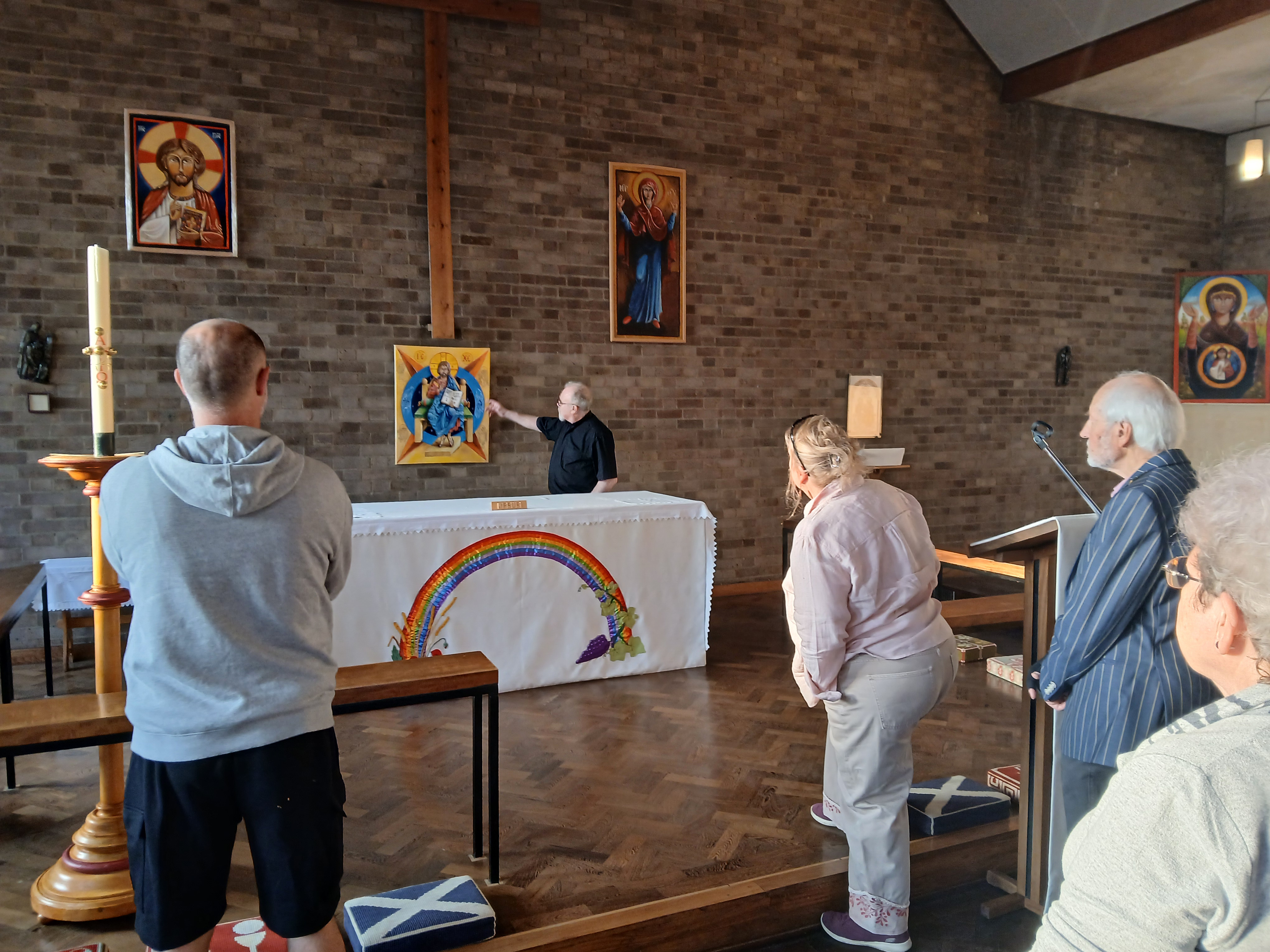
At tonight's Unveiled, our fortnightly Friday night arts & performance event at St Andrew's Wickford, we heard Max Blake talk about his wonderful exhibition 'Adventures in Joy'.

Adventures in Joy: An exhibition by Max Blake
2 May – 25 July 2025
St Andrew’s Church, 11 London Road, Wickford SS12 0AN


St Andrew’s is usually open: Sat 9am-12.30pm; Sun 9.30am-12 noon; Mon 2-3.45pm; Tue 1-4.30pm; Wed 10am-12 noon; Fri 10am-1pm. https://wickfordandrunwellparish.org.uk/whats-on.html

“Adventures in Joy” presents the most recent work produced by artist and cleric Max Blake. It includes some of the work he has developed though his studies of Icons, as well as his experiments in a more abstract and surreal direction. Max explores his own deep imagination, which is fed by his wide knowledge of religion and reflections amongst other things.

As a man of faith, much of his work expresses an exploration of the Christian faith. Over recent years, Max has studied Byzantine and Coptic Iconography and he has used this study to develop his own interpretations of the icon. Much of Max’s work is highly detailed and the viewer can find many hidden details, people, faces and shapes in his work. This creates a joyful adventure for the eye through bright and vivid worlds. Max uses a range of media including oil paints, inks and coloured pencils.

Max Blake was born in East London in the early 50s and then grew up in Basildon. After graduating as a teacher, Max taught art in secondary schools across south Essex. He also worked with children with anxiety and children with special needs. He was ordained deacon followed by priesting in the early 2000s. Although he is now retired, Max still works as a retired priest with Permission to Officiate in the United Benefice of Horndon, Orsett and Bulphan.

As well as artwork Max has also illustrated book covers and books for children. He continues to exhibit his vibrant work in various locations, including the Well House Gallery in Horndon on the Hill and St Catherine’s Church in East Tilbury. https://www.wellhousegallery.co.uk/art/max-blake

--------------------------------------------------------------------------------------------------------

Methuselah - My Poor Mary.

Wednesday, 2 September 2020

Creativity and sacramental sight

In tonight's Bread for the World service at St Martin-in-the-Fields I spoke on the creativity of God and 'seeing sacraments'. Because of a technical difficulty part way through this beautiful service was recorded in two parts and can be viewed here and here.

The reflection I shared was as follows:

At our recent Parish Day the poet-priest Malcolm Guite shared many insights with us about the imagination of God and ways in which we can participate in God’s imaginative work. Some of what he shared began with words from Shakespeare’s A Midsummer Night’s Dream:

‘The poet's eye, in fine frenzy rolling,
Doth glance from heaven to earth, from earth to heaven;
And as imagination bodies forth
The forms of things unknown, the poet's pen
Turns them to shapes and gives to airy nothing
A local habitation and a name.’

This description of the way in which imagination works is about noticing and naming. It begins with the poet's eye, in fine frenzy rolling, glancing from heaven to earth, from earth to heaven and, therefore, noticing aspects of what is in heaven and what is on earth, as well as connections between them both. Grayson Perry has said that his job as an artist is to notice things that other people don’t notice. When we really pay attention to what is around us and notice things that others don’t, we are being artists.

What the eye notices, the poet’s pen then turns to shapes, giving a local habitation and a name. With our eyes we see what no one else has seen and with our words or speech we name what it is that we see. When we do so we are poets. That is how imagination works; by noticing and naming. We can all pay attention, so that we notice, and can all describe and define, so that we name. In other words we can all be artists and poets.

I wanted to explore this further in terms of the creation stories in the Book of Genesis, as these are where we see the imagination of God most clearly at play, and by doing so see the way in which a movement between seeing, speaking and silence enables our noticing and naming.

The Book of Genesis and the Bible as a whole begins in silence. Speech first happens in verse 3 when God says, ‘Let there be light.’ In the beginning there was silence and in the silence God saw that the earth was formless and empty, darkness was over the surface of the deep, and the Spirit of God was hovering over the waters. Before creation began God was there in silence and stillness, the Spirit hovering over and seeing a realm of possibility yet to be realised, a realm of possibilities waiting to bodied forth, shaped and named by imagination.

Silence enables sight because sight precedes speech. The child looks and recognises before it can speak and so it is here, in this description of the time before time. Therefore, we need to regularly return to silence in order to see afresh, as we will also see God doing in this story.

Then God speaks, imaginatively embodying possibilities, shaping and naming possibilities as realised and actualised entities – let there be light, let there be sky, let there be land, let there be seas, let there be vegetation, let there be creatures, let there be human beings, let there be … After the speaking, the shaping, the defining, the naming, after all those things there is rest; the return to silence and stillness in order to see. God saw all that had been made, and indeed, it was very good and God rested on the seventh day from all the work that had been done.

In the time of God’s sabbath rest, we are invited to become sub-creators – co-creators - with God to continue this pattern or process of contemplative creation. The Lord God brought every animal of the field and every bird of the air to humans to see what we would name them; and whatever we called every living creature, that was its name. We gave names to all cattle, and to the birds of the air, and to every animal of the field.

God was no longer creating by bodying forth, shaping and naming, but, as he rested, wished to see how his creativity was shared and replicated within his creation. We were asked to co-create by naming all other creatures. Names in ancient times described the essence of the creature or object so named. That is what we did in this story. We looked for the essence of each creature and then named that essence. 

Naming is a key human speech-act. Describing and defining is a tool for navigating existence and is the basis of scientific discovery, and it all begins with seeing. In order to accurately describe or define or map, we have first to see what is there. That is the sequence within this story. God brought animals to us. We looked at each one and then described or defined each by naming them.

We come to know the essence of a thing by imaginatively exploring its various possibilities. This process of paying attention to an object and using our imagination to explore its possibilities in order to realise its distinctive essence is what the poet Gerard Manley Hopkins called instress. He called the essence that we identify the inscape. Ultimately, ‘the instress of inscape leads one to Christ, for the individual identity of any object is the stamp of divine creation on it.’

Hopkins wrote about this in a poem called ‘Kingfishers catch fire’:

Each mortal thing does one thing and the same:
Deals out that being indoors each one dwells;
Selves — goes itself; myself it speaks and spells,
Crying Whát I dó is me: for that I came.

I say mĂłre: the just man justices;
Keeps grace: thát keeps all his goings graces;
Acts in God's eye what in God's eye he is —
ChrĂ­st — for Christ plays in ten thousand places,
Lovely in limbs, and lovely in eyes not his
To the Father through the features of men's faces.

When we do what Adam did – when we notice and name – we are being creative, we are artists and poets, we are fulfilling the potential God created in us when he made human beings in his image as creative beings. When we notice and name we are seeing sacramentally because we are seeing the divine essence in all things.

This is the purpose for which we were created and for which the creation itself is crying out. James Thwaites has suggested that this is what Paul, in Romans 8, suggests creation is crying out for from us as human beings (Romans 8: 19-22): ‘It must be crying out for its goodness to be fully realised and fully released. The creation cannot be good apart from the sons and daughters because we alone were given the right to name it; we are the image bearers who were made to speak moral value and divine intent into it. We were created to draw forth the attributes, nature and power of God in all things.’

Instead of the selfish and wasteful exploitation of creation’s resources – the domination and abuse – which characterises human engagement with the world, we are intended to creatively realise the inherent possibilities, the essential goodness, of creation through our imaginative ability as those who notice and name. As God did when resting on the seventh day, it is as we return to silence in order to contemplate that we see more clearly and can notice and name once again. So, may we realise our inherent creativity as human beings in order that we learn to care for creation once again.

We end with more from Gerard Manley Hopkins:

The world is charged with the grandeur of God.
It will flame out, like shining from shook foil;
It gathers to a greatness, like the ooze of oil
Crushed. Why do men then now not reck his rod?
Generations have trod, have trod, have trod;
And all is seared with trade; bleared, smeared with toil;
And wears man's smudge and shares man's smell: the soil
Is bare now, nor can foot feel, being shod.

And for all this, nature is never spent;
There lives the dearest freshness deep down things;
And though the last lights off the black West went
Oh, morning, at the brown brink eastward, springs —
Because the Holy Ghost over the bent
World broods with warm breast and with ah! bright wings.

--------------------------------------------------------------------------------------------------------

Gerard Manley Hopkins - God's Grandeur.

Saturday, 15 August 2020

The Imagination of God

'The Imagination of God' was an online Parish Day at St Martin-in-the-Fields today with Guest Speaker, writer and poet, Malcolm Guite.

Malcolm Guite is a much-loved English poet, singer-songwriter, Anglican priest, and academic. Born in Nigeria to British expatriate parents, Guite earned degrees from Cambridge and Durham universities. His research interests include the intersection of religion and the arts, and the examination of the works of Shakespeare, J. R. R. Tolkien, C. S. Lewis, Owen Barfield, and British poets such as Samuel Taylor Coleridge, John Donne and George Herbert. He is currently a Bye-Fellow and chaplain of Girton College, Cambridge and associate chaplain of St Edward King and Martyr in Cambridge. His poetry offers not only deep insight into our Christian faith but also humour and shows his own irrepressible imagination. We hope this day will be will be a day of inspiration for your own imagination and creativity.
  
The day began with Morning Song led by our Choral Scholars and continued with an introduction and talk 'The Imagination Bodies Forth' by the inspirational priest and poet Malcolm Guite. Following Q&A and small group reflections, Great Sacred Music was led by Sam Wells, Andrew Earis and St Martin’s Voices. Malcolm Guite then spoke on 'Finding your own form - how we can use our own imagination'. This was followed by sessions on using our imagination:
  • In poetry: with poet Malcolm Guite
  • In prose: with writers Sam Wells and Douglas Board
  • In art: with artists Jonathan Evens, Andrew Carter, and Vicky Howard
  • In music: with Director of Music, Andrew Earis
Evensong followed with the Choir of St Martin-in-the-Fields and the day ended with the beginning of an art project plus drinks in the courtyard.

For the Art Project participants are asked to construct a geometric star. All of the stars will vary in size and complexity adding to the overall mesmeric and spatial pattern. All the stars will form part of a large wall hanging based on Giotto’s fresco of stars on the ceiling of the Scrovegni Chapel in Padua. Stars are a symbol of truth, spirit and hope and are seen as something beautiful, good and positive. Stars can also be a symbol that embodies the notion of spiritual revelation in each of us. We hope that the finished piece will look beautiful and positive and a sign of hope for us all.

In the session on 'Using our Imagination in Art,’ Andrew Carter, Vicky Howard and myself, shared some of our favourite artworks and discussed why these were important to us. Andrew, Vicky and myself are all part of the artists’ and craftspersons’ group and Andrew has also led on the art project that we are began today.

Our hope was to explore areas such as:
  • what it is that we are primarily responding to in those artworks;
  • the ways they work visually;
  • how ideas and emotions are explored visually;
  • how a sense of the spiritual might have been engendered; and
  • how the imagination of God appears in human creations.
Andrew’s choice was 'Annunciation’ by Duccio. Vicky spoke about a series of prints by Rembrandt, including 'Christ presented the the People' and 'The Three Crosses', while I discussed ‘Life Eternal’ by John Reilly:  

John Reilly’s “ambition has always been to paint a picture which perfectly weds form and content” in order “to express in visible form the oneness and unity of [the] invisible power binding all things into one whole.” I was fortunate enough to meet him at his home on the Isle of Wight, while there on a family holiday. I didn’t know of his work before going on that holiday but found cards and prints of his amazing work in some of the shops there and had to find out more. He was kind enough to invite me into his home and show me his work and works in progress.

He has said: "My paintings are not concerned with the surface appearance of people or things but try to express something of the fundamental spiritual reality behind this surface appearance. I try to express in visible form the oneness and unity of this invisible power, binding all things into one whole. I try to express something of the universal and timeless truths behind the stories of the Bible.”

So, for Reilly, the unseen reality manifests itself both through pattern - “the oneness and unity of this invisible power, binding all things into one whole” - and through story - “the universal and timeless truths behind the stories of the Bible”. He has also used the greater freedom of expression that modern movements in art have given to artists to develop a visual language of forms and colours which he hopes expresses “something of their deeper spiritual significance.” His work draws on cubism, fauvism and orphism in particular.

Reilly has made a profound use of the circle in his work in order to depict the wholeness that he finds in the world and the life that God has created. He frequently bases his works on a central circle (often, the sun) from which facets of colour emanate, like ripples on the surface of a stream. The painting’s imagery is then set within these facets, each figure or object being embedded in the overall patterning of the painting and related to the environmental whole that Reilly creates.

By these means fragments of form and colour (the facets of the painting’s patterning) and the images that they contain are united to circle harmoniously around and within God, the central life and intelligence which is the light of the world. Works such as ‘Life Eternal’ utilise these methods and meanings and both contain and convey huge energy and resolution as a result.

His technique of colour fragments emanating from a central source enables him to suggest that his archetypal images of creation and the landscape are both, filled with the emanating rays and linked by them into a unified circle. His paintings (including 'Life Eternal’) therefore suggest the way in which we are linked both by being the creation of God and by being indwelt by his spirit.

Sister Wendy Beckett compared aspects of twentieth century art to the Way of Affirmation in Western Christianity which approaches God through creatures and imagery. “In Christianity,” she says, “the divine is constantly in process of passing into the human”. This leads, she suggests, to “an unapologetic religious yes to sense-pleasure” shown in the way the painting of the last century is “no longer trying to create an illusion, or to have us looking away from itself … Heaven in a grain of sand; the Sacred in the immediacy of sensuous experience”. In her meditations on art she exemplifies this unapologetic religious yes to sense-pleasure and shares the work of artists that embody it in their work.

Artists like Norman Adams, who unites in his work many of the factors that we have briefly examined - a heightened experience of nature, bright passionate colour penetrating depths and crossing frontiers of understanding beyond ordinary experience, cultivation and order, and ideas drawn from deep down in the unconscious. Margaret Walters has noted how the religious subject matter of Norman Adams' paintings provide him with "a geometry, a structure of lines and circles that allows his complex colours, his masterly and distinctive use of watercolour, to work their magic". For Sister Wendy Beckett this ability of Adams' suggests that a mystical sense of oneness is making itself visible in his work. 

My favourite works of art, therefore, are those that are incarnational - in that they unite heaven and earth, the human and divine - and which also show us the Way of Affirmation.

------------------------------------------------------------------------------------------------------------

Etta Cameron - I Have A Dream.


--------------------------------------------------------------------------------------------------

Malcolm Guite - Your Poetry is Jamming My Machine.

Sunday, 14 April 2019

Artlyst - Visionary Cities: Michael Takeo Magruder – British Library

My latest review for Artlyst is of Michael Takeo Magruder's Imaginary Cities at the British Library:

'Magruder translates his source material – which are precious entities in their own right – into either digitally immersive or physically tangible artefacts that re-present their source in alternative forms. These enthrall and convince in and of themselves, while also enhancing our appreciation for the source itself. To do so requires the paying of attention both to the source map and to the properties of the form in which the re-presentation occurs. The creation of these installations is, therefore, a labour of love.'

My other Artlyst articles and interviews are:
------------------------------------------------------------------------------------------------

Bill Fay - City Of Dreams.

Wednesday, 29 August 2018

St Martin-in-the-Fields & HeartEdge at Greenbelt


The HeartEdge panels at Greenbelt were very well attended, with more coming than could be accommodated within the tent. HeartEdge was in Exchange, Greenbelt’s venue for thinking about business, and how we can make enterprise work better for the common good. Exchange was supported by Midcounties Co-op, Co-op Energy, Phone Co-op, Anthony Collins Solicitors, Co-operatives UK and by New Internationalist magazine. Our thanks to all of them for their organisation and welcome.

Each session provided plenty of ideas, stories and challenges for those attending from the material our stellar selection of panellists prepared and the responses they gave on the day. We had lots of useful conversations with people afterwards interested in HeartEdge and the mission models and theological ideas we are sharing. A good number of HeartEdge members were also present renewing their inspiration and appreciating the experiences and ideas you shared. In the sessions themselves people commented positively on the energy of our panellists, as well as the energy of the dialogue within the panels and with the audience.

In the first panel on re-imagining church and culture, artist Jonathan Kearney argued that art markets and education have been hijacked by capitalism and managerialism squashing imagination. He suggested that gift, generosity and care for culture were all necessary for a cultural renaissance. Giles Goddard of St John's Waterloo spoke about the Waterloo Festival which is part of that church's engagement with their wider community and which speaks of love, hope and transformation. He argued that capitalism has appropriated culture, so it is important for the church to be engaged with delight and light.

Andrew Earis spoke about preparing a BBC service on the Manchester bombing including the importance of using a diversity of local people as well as diverse music. He aims to open hearts and minds to a broad range of music and says that music in concerts and services are all church. Yoghurt, salt and ointment were all used by Anna Sikorska as visual aids to talk about art and culture. Church can be a part of a cultural renaissance, she said, but needs partners as involvement can't be done alone. The church may sometimes be on the edge of the cultural renaissance, but conversations of re-imaging culture may best happen with other partners on the edge. She showed a Stations of the Cross tea towel designed with homeless people at St James Piccadilly as an example of engaging broadly.

Cliff Mills of Anthony Collins Solicitors began the second panel session on re-imagining church and commerce by stating that commerce is not secondary to Church, but is a valid expression of mission. In this session we heard from Ruth Amos who spoke about faith in the business world from an entrepreneur’s point of view. Faith is sustaining in challenging times. Faith within the work-place in a manufacturing sector is expressed in dealing with colleagues, dealers, suppliers, and other third parties. David Alcock of Anthony Collins Solicitors shared the journey of that law firm which is committed to values and has a social purpose. He spoke about faith in the context of: interacting with colleagues and clients; areas of work to focus on or get out of; and strategic direction and planning. Rob Wardle of Cre8 spoke from his own experience, at a micro level, about how ‘work’ within and for church or charity seems like a natural thing for him to do. He spoke about drawing inspiration from the old monastic tradition where the work of our hands is understood to be sacred and described why Cre8’s principles seem to appeal to entrepreneurs.

Mark Kinder shared experience from 11 years of running a church (St Paul's Walsall) which has within it shops, coffee shops, charity offices etc. in a context of significant deprivation (within 3% most deprived parishes). His key points: included addressing misunderstanding/suspicion of commerce as somehow dirty which reflects a Gnosticism within modern Christian thinking; re-imagining commerce as part of Kingdom of God - human flourishing, work as creation gift, etc. to give examples of how jobs and training have been created; re-imagining sustainability for a church in an Urban Priority Area - developing property income to diversify and addressing the shortage of housing in Walsall; re-imagining commerce itself in a way that recreates the relationship between customer and provider which modern commerce has removed.

Sam Wells offered three models of church and commerce and reflected on how to work out which is the best fit for what your congregation is and needs:
  1. Instrumental. Undertake a legitimate trading activity that has no direct social impact, make a profit, and then transfer that profit to other activities that do have direct social impact, whether simply the sustainability of the congregation and its building, or such mission projects as it pursues.
  2. Exemplary. Undertake a trading activity that has no direct social impact, but seek to do so in an exemplary way, paying good wages, having a minimal environmental footprint, using locally generated resources, promoting fair trade practices, and so on, while still transferring profit to the activities mentioned under (1) above.
  3. Social. Undertake a trading activity whose profit return is evidently secondary to the indirect social impact sought.
In the third panel session on re-imagining church and congregation Wale Hudson-Roberts began by suggesting that understanding inclusivity presents those that currently have power and prestige within churches with the challenge of relinquishing that power, in order to give place to those who are less powerful or on the edge. Simon Woodman said that his church, Bloomsbury Central Baptist Church had come to an understanding that to realise that it mattered deeply that ‘everyone’ belongs because everyone absolutely belongs with God, was an old insight newly found. This commitment to inclusion is the beginning and not the end of a journey of belonging.

Philippa Boardman argued that ‘Buildings building community’ and ‘Being a parish for the whole parish’ are keynotes in renewal. Church becomes a place in which bridges are built within the community as people are brought together for the common good. Rosemarie Mallett said that church is not just for those in the pews, but for all those around. Her church, St John’s Angell Town, is a black congregation in a Victorian church building in the middle of four brutalist-style estates. The major asset for churches and communities are their young people. 

In the final panel session on re-imaging church and compassion there was critique of housing policies including the lack of genuinely affordable house, the rhetoric of the 'undeserving poor' and of Brexit. Al Barrett said that he is interested in forming a neighbourhood where generosity is practised. Richard Frazer of Greyfriars Kirk spoke of the need to protect those on the fringe of church from those at the centre.

Pam Orchard of The Connection at St Martin-in-the-Fields shared her thoughts in a letter to a 'stranger' on how we can work together to provide compassion. It gives me a real sense of achievement to see you helping other clients with art projects, she wrote, noting that no one has a monopoly on experience and saying that together we make a great team. Anthony Reddie spoke about the dangers of contractual compassion and the respectability politics that often seem embedded into Mission Christianity. 

Sam Wells also spoke on the theme of 'Who is my Neighbour?', saying that we become human beings by encountering those who are other and that this is an adventure for us.

The beautiful setting of the Colonnades at Boughton Hall provided a perfect setting for the choral music of St Martin's Voices in Great Sacred Music sessions on prayer and love led by Sam Wells and Andrew Earis. St Martin's Voices also sang at a service in Shelter that I led with Andrew Earis entitled 'Tell out my Soul!' exploring the inspiration of hymnwriters and the theology of some of the most popular hymns as included in the Songs of Praise Top 100 Hymns.

-------------------------------------------------------------------------------------------------

St Martin's Voices - I Stood On The River Of Jordan.