Wikio - Top Blogs - Religion and belief
Showing posts with label goya. Show all posts

Saturday, 1 September 2018

Knots, Dust & Epiphany

Exhibitions of multiple drawings are relatively rare, but, like the stereotypical buses, two have come along together at Birmingham’s Ikon Gallery.

Francis Alÿs has created an installation of hundreds of drawings, which are suspended in enclosed space at the centre of the exhibition. The drawings are the stills required to produce three minutes and fourteen seconds of an animation showing a woman repeatedly tying a simple knot in her long hair that then undoes itself. The massive number of drawings required to form this short animation demonstrate the huge disproportion, on which Alÿs regularly reflects, in much human activity between effort and result, work and labour.

Much of that involved and repetitive activity centres on knotty problems – Catch 22 situations or paradoxes – that cannot simply be unravelled and straightened out. In this work, Alÿs activates a game of opposites - joining and unravelling, arranging and disrupting, doing and undoing, drawing and erasing – while also emphasising the human nature of what it is that we are doing, as knots require the work of our hands and untangling knots is one thing a machine is unable to do.

In Big Series (1983-85), Vladimír Kokolia is showing a large number of fragile figurative ink drawings produced during the final years of the Iron Curtain – when the Communist Party reinforced its censorship of the politically subversive arts as part of a programme of ‘Normalisation’. This programme of censorship included a ban on ‘politically subversive’ exhibitions, films, publications and concerts. Kokolia’s drawings are on display for the first time after more than thirty years in storage; synergies, perhaps, with the ‘Unpainted Paintings’ of Emil Nolde.

Kokolia has described the atmosphere of suppression in which these drawing were produced as being ‘a horrible time’ because ‘your enemy was everywhere and nowhere’ meaning that you ‘could never meet him.’ As a result, these early works acquired a sense of political commentary in the depiction of grotesque stories of cruelty and weakness. They show the wretchedness of human endeavour in which human figures struggle for a glimpse of meaning in absurd circumstances. As such, they hold their own against similar series such Goya’s Disasters of War or Rouault’s Miserere.

This first room of Kokolia’s exhibition, with its deliberately subdued lighting, has significant synergy with the notion of turbulence found in Alÿs’ exhibition. In addition to the surreal horrors of the Big Series, we also find Storm Centre (2001) which draws us, helter-skelter, into a deep blue spiralling vortex. Similarly, we enter the Alÿs exhibition through Tornado (2000-2010), a video projection which records Alÿs’ chasing of “dust devils” in attempts to enter their eye with a camera in hand. He then films their windless core, a monochrome of dust that literally abstracts him from the outside world.

The lianas, mazes, or winding footpaths of Kokolia’s paintings – generally depicting the trucks, branches or leaf canopies of trees around Veverské Nnínice, the small Moravian village where he lives – also resemble the knots which form a central image in Alÿs’ exhibition. In Kokolia’s work, his tangled coils of shifting patterns and colours are skeins through which we glimpse the light beyond. In Alÿs’ work they enmesh us in the repetitive and demanding round of human activity from which we cannot emerge.

While there are many synergies between these two exhibitions, the heart of the difference between the two is found in Kokolia’s sense of wonderment with the natural world and Alÿs’ sense of constraint in the human world.

Both touch fleetingly on spiritual language in their work, demonstrating by this not any sense of personal proselytization, more the enduring strength of religious language and concepts even when secularized. Kokolia expresses his sense of wonderment in his exhibition title ‘Epiphany’; ‘a profound {and unexpected) revelation borne out of everyday experience.’ Alÿs entitles his new animation Exodus 3:14, in which God speaking from the burning bush names himself before Moses as, ‘I am who I am’. For Alÿs this is another knotty paradox that we cannot resolve. Even when we run into the eye of the storm, nothing is revealed. For Kokolia, however, there is light at the end of the tunnel.

Francis Alÿs: Knots’n Dust and Vladimír Kokolia: Epiphany are at Ikon Gallery until 9 September 2018

-------------------------------------------------------------------------------------------------

Gungor - Vapour.

Sunday, 9 November 2014

Beyond Airbrushed from Art History: Arnulf Rainer

Jérôme Cottin writes that Arnulf Rainer 'is undoubtedly the most important living Austrian artist. His work is known and valued across the world. In his early years he belonged to the Austrian avant-garde and rebelled against all kinds of institutions in his country from state and school to various cultural institutions. Thanks to his encounter with the Viennese archbishop Otto Mauer he became interested in religion, the Christian faith and mysticism. The clergyman (as organizer) and the artist mounted several illustrious expositions together. In 2004 Rainer received a honorary doctorate from the Catholic Theological Faculty of Münster in Germany. His startling and sometimes provocative work is often exhibited in churches.'

'This year the world celebrates the artist's 85th birthday with exhibitions from London to New York. In his native Austria, the Albertina Museum of Vienna hosts a retrospective exhibit of his key works that looks at the major stages of his multifarious creative activities. The Hungarian National Gallery joins in the international celebration with this display, staged almost concurrently with the Viennese exhibition. The Budapest exhibit presents works from the best-known series of one of Arnulf Rainer's most important periods, the paraphrases of Goya he started to make in the early 1980s.'

------------------------------------------------------------------------------------------------

Fuse ODG - Azonto.

Sunday, 11 August 2013

Barcelona views


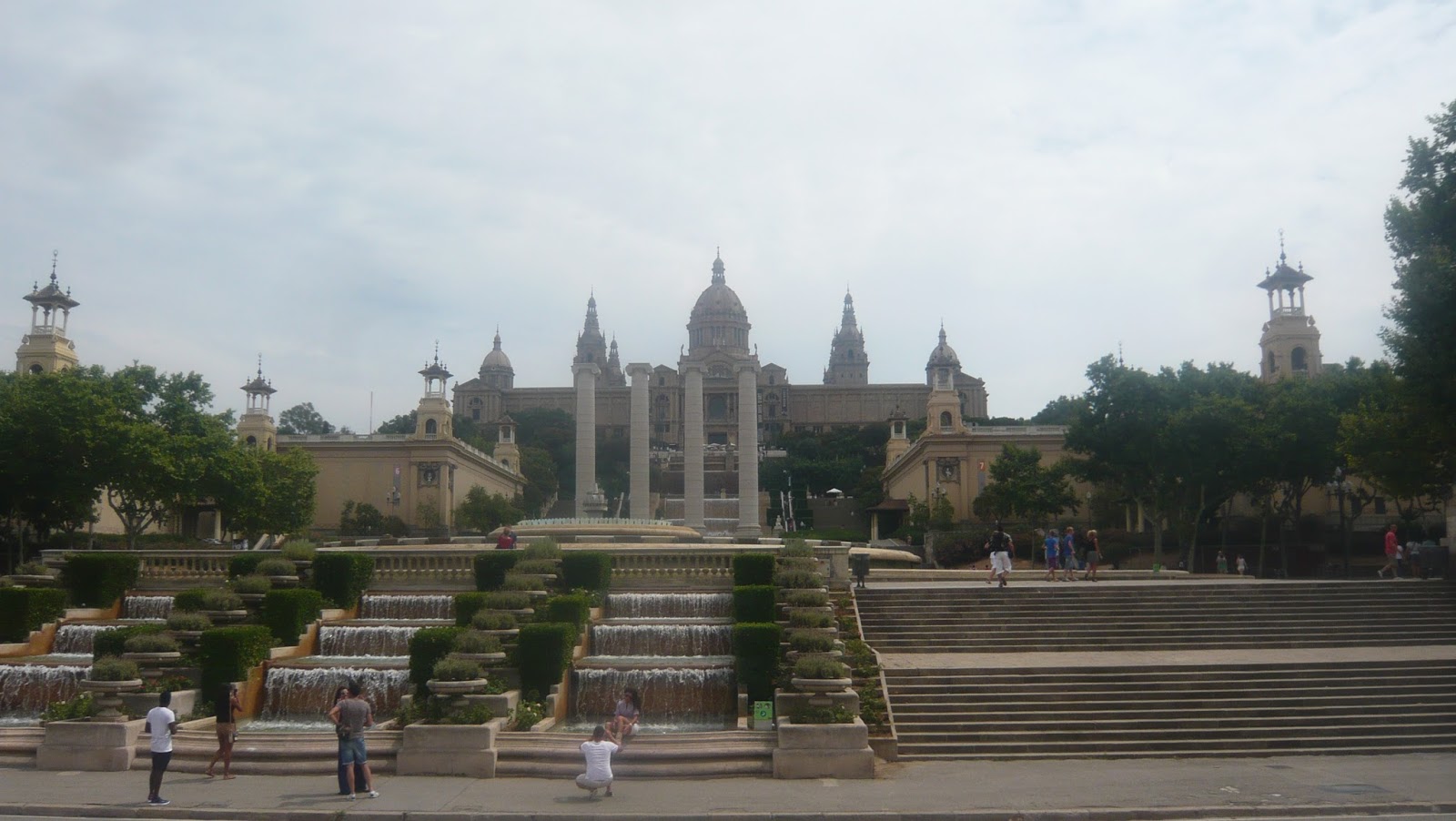
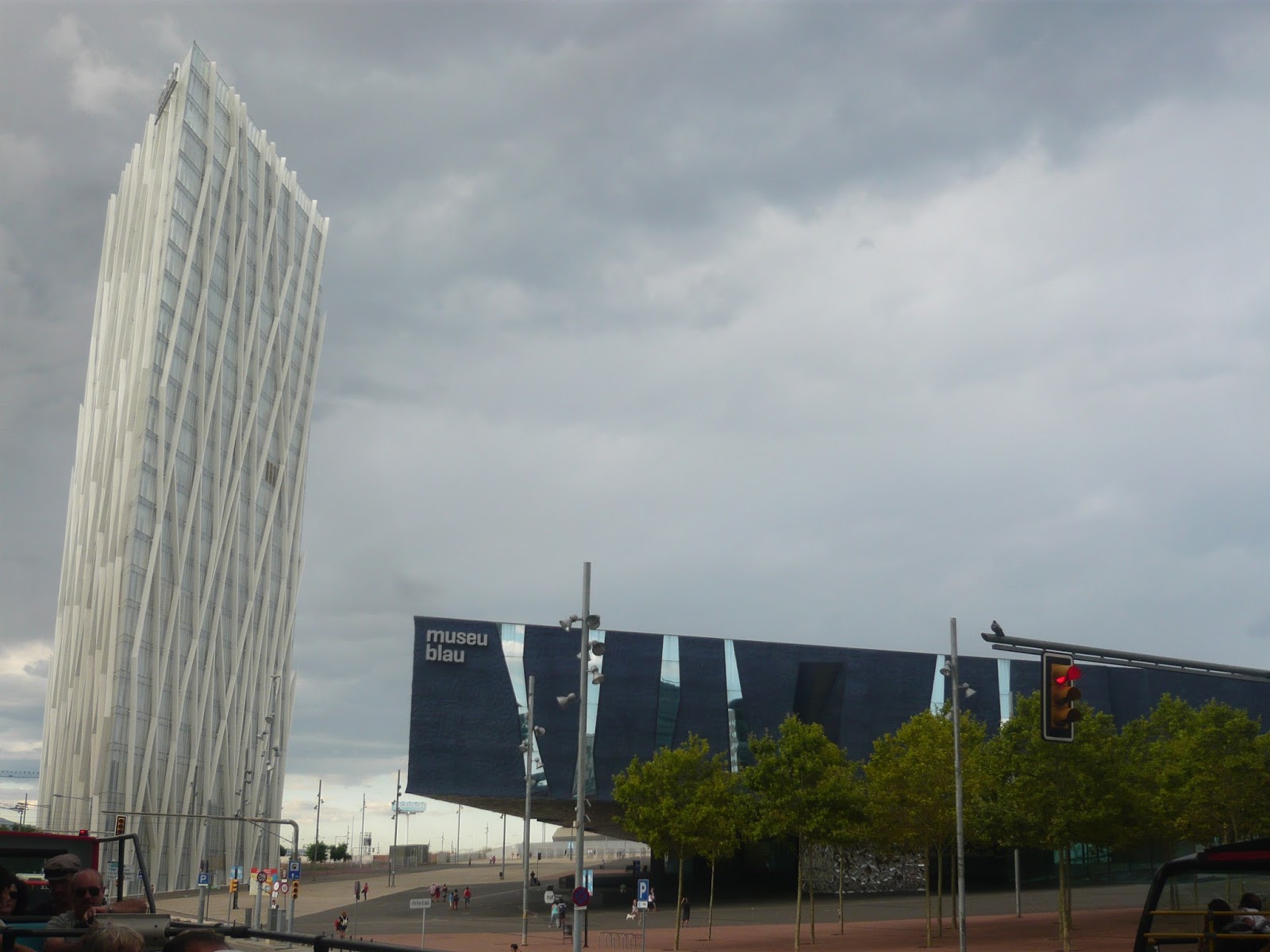
Five days in Barcelona was just what was needed to relax and recharge batteries. Our hotel was just off La Rambla, so close to both Barri Gòtic and Port Vell. We used the tourist buses to get an overview of the city and find our way around while stopping off at some of the Gaudí sites we wished to visit. These included Casa Batlló, Casa Milà, Palau Güell, Park Güell, Plaça Reial and the Sagrada Familia, as well as a day spent visiting Colònia Güell and its Gaudí designed Crypt. We also visited the Cathedral and saw exhibitions at the Diocesan Museum (Goya and his Inheritors. The Follies nowadays) and the Arts Santa Mònica (Pure Views: Transformations of Chinese Contemporary Art).

The Follies was the last important collection engraved by Francisco de Goya between 1819 and 1824. They are among the most difficult of his engravings to interpret, images with nightmarish visions, absurd scenes, personages that are not from this world, hidden obsessions revealed in his old age; mysterious and enigmatic, inscrutable and personal. Taking The Follies as its starting point, this exhibition creates a journey through contemporary art and current engraving linking Goya and 12 of his plates to 21 20th century artists including: José Manuel Broto, Eduardo Arroyo, Günter Grass, Martín Chirino, Luis Feito, Juan Genovés, Manolo Valdés, Luis Caruncho, Andrés Rábago (El Roto), José Beulas, Ricardo Calero, Julio León, Alicia Díaz Rinaldi, Darío Villalba, Luis Gordillo, José Hernández, Rafael Canogar, Jaume Plensa, Víctor Mira, Pascual Blanco and Guinovart.
 
Pure Views. Transformations of Chinese Contemporary Art, curated by Lu Peng, the prestigious Chinese art historian and director of the Chengdu Museum of Contemporary Art, is an attractive and comprehensive survey of Chinese contemporary art. Back in 1995, under the title From the Country of the Centre. Artistic Avant-gardes in China, this same art centre mounted a seminal display of key, innovative Chinese artworks of the day, one of the first exhibitions of its kind in Europe. Since then, Chinese art has evolved significantly.
 
Pure Views corroborates the developments experienced by Chinese art in the last thirty years. Starting from the final days of Socialist Realism, it charts the trend towards a diversity of techniques and styles, responding to the expectations of a new society that, at the same time, is reflecting profoundly on its tradition. The exhibition includes work by
Cao Jingping, Fang Lijun, He Sen, Hong Lei, Jin Jiangbo, Li Chao, Li Qing, Li Rui, Mao Tongqiang, Mao Xuhui, Na Wei, Qiu Anxiong, Shao Wenhuan, Shen Na, Shi Jinsong, They, Tu Hongtao, Wang Guangyi, Xie Fan, Yang Mian, Yang Qian, Yang Xun, Ye Yongqing, Yue Minjun, Zhan Wang, Zhang Jian, Zhang Peili, Zhang Xiaogang, Zhang Xiaotao, and Zhang Ya, Zhou Chunya.
 
-------------------------------------------------------------------------------------------------