Wikio - Top Blogs - Religion and belief
Showing posts with label ikon gallery. Show all posts

Sunday, 13 March 2022

Artlyst: Audrey Flack Carlo Crivelli And Robert Indiana – March Diary

My latest diary piece for Artlyst features Audrey Flack and Carlo Crivelli at Ikon Gallery and Robert Indiana at Yorkshire Sculpture Park:

'Crivelli’s work represents a significant conceptual shift in the understanding of both art and revelation, as well as being both technically and creatively innovative. In this Ikon exhibition, we are invited to consider Crivelli’s imagination and skill in creating illusions of illusionism and to reconsider Crivelli’s sophisticated understanding of the relationship between art and what it represents. The originality of his work, techniques and concepts all blend to create the contemporary influence of which Flack wrote. In her work and that of Indiana, we see the continuing ability of the art of faith to be both source and resource for contemporary art.'

Check out also my earlier Artlyst diary pieces - January and February.

My other pieces for Artlyst are:

Interviews -
Articles -

-----------------------------------------------------------------------------------------------------------

Pedro the Lion - The Longer I Lay Here.

Saturday, 1 September 2018

Knots, Dust & Epiphany

Exhibitions of multiple drawings are relatively rare, but, like the stereotypical buses, two have come along together at Birmingham’s Ikon Gallery.

Francis Alÿs has created an installation of hundreds of drawings, which are suspended in enclosed space at the centre of the exhibition. The drawings are the stills required to produce three minutes and fourteen seconds of an animation showing a woman repeatedly tying a simple knot in her long hair that then undoes itself. The massive number of drawings required to form this short animation demonstrate the huge disproportion, on which Alÿs regularly reflects, in much human activity between effort and result, work and labour.

Much of that involved and repetitive activity centres on knotty problems – Catch 22 situations or paradoxes – that cannot simply be unravelled and straightened out. In this work, Alÿs activates a game of opposites - joining and unravelling, arranging and disrupting, doing and undoing, drawing and erasing – while also emphasising the human nature of what it is that we are doing, as knots require the work of our hands and untangling knots is one thing a machine is unable to do.

In Big Series (1983-85), Vladimír Kokolia is showing a large number of fragile figurative ink drawings produced during the final years of the Iron Curtain – when the Communist Party reinforced its censorship of the politically subversive arts as part of a programme of ‘Normalisation’. This programme of censorship included a ban on ‘politically subversive’ exhibitions, films, publications and concerts. Kokolia’s drawings are on display for the first time after more than thirty years in storage; synergies, perhaps, with the ‘Unpainted Paintings’ of Emil Nolde.

Kokolia has described the atmosphere of suppression in which these drawing were produced as being ‘a horrible time’ because ‘your enemy was everywhere and nowhere’ meaning that you ‘could never meet him.’ As a result, these early works acquired a sense of political commentary in the depiction of grotesque stories of cruelty and weakness. They show the wretchedness of human endeavour in which human figures struggle for a glimpse of meaning in absurd circumstances. As such, they hold their own against similar series such Goya’s Disasters of War or Rouault’s Miserere.

This first room of Kokolia’s exhibition, with its deliberately subdued lighting, has significant synergy with the notion of turbulence found in Alÿs’ exhibition. In addition to the surreal horrors of the Big Series, we also find Storm Centre (2001) which draws us, helter-skelter, into a deep blue spiralling vortex. Similarly, we enter the Alÿs exhibition through Tornado (2000-2010), a video projection which records Alÿs’ chasing of “dust devils” in attempts to enter their eye with a camera in hand. He then films their windless core, a monochrome of dust that literally abstracts him from the outside world.

The lianas, mazes, or winding footpaths of Kokolia’s paintings – generally depicting the trucks, branches or leaf canopies of trees around Veverské Nnínice, the small Moravian village where he lives – also resemble the knots which form a central image in Alÿs’ exhibition. In Kokolia’s work, his tangled coils of shifting patterns and colours are skeins through which we glimpse the light beyond. In Alÿs’ work they enmesh us in the repetitive and demanding round of human activity from which we cannot emerge.

While there are many synergies between these two exhibitions, the heart of the difference between the two is found in Kokolia’s sense of wonderment with the natural world and Alÿs’ sense of constraint in the human world.

Both touch fleetingly on spiritual language in their work, demonstrating by this not any sense of personal proselytization, more the enduring strength of religious language and concepts even when secularized. Kokolia expresses his sense of wonderment in his exhibition title ‘Epiphany’; ‘a profound {and unexpected) revelation borne out of everyday experience.’ Alÿs entitles his new animation Exodus 3:14, in which God speaking from the burning bush names himself before Moses as, ‘I am who I am’. For Alÿs this is another knotty paradox that we cannot resolve. Even when we run into the eye of the storm, nothing is revealed. For Kokolia, however, there is light at the end of the tunnel.

Francis Alÿs: Knots’n Dust and Vladimír Kokolia: Epiphany are at Ikon Gallery until 9 September 2018

-------------------------------------------------------------------------------------------------

Gungor - Vapour.

Friday, 13 January 2017

Subversion in the Cathedral?

My latest exhibition review for Church Times explores some of the reasons for the engagement with religious themes found in the work of Roger Hiorns, as well as paying particular attention to Untitled (a retrospective view of the pathway), 2016, his site-specific work with Birmingham Cathedral in June 2016, when the choir lay on the cathedral floor to sing evensong:

'Hiorns recognises that faith continues to have power and authority in many lives, and he seeks to explore and deconstruct aspects of this in his work. He does something similar in relation to the power of propulsion, symbolised by the jet engine. He has undertaken through his work a sustained assault on jet engines, adding to them brain matter and anti-depressants, having them prayed for by prayer groups, atomising them, mixing the engine with altar dust, and burying the aircraft that carried the engines. His aircraft pieces often become mementi mori for humanity: reminders of the ultimate end of us and our achievements, as in his final project for the Ikon Gallery, the burial of a Boeing 737 in Ladywood, Birmingham. Dust you are, and to dust you shall return.'

-----------------------------------------------------------------------------------------------

Ikon Gallery - Roger Hiorns Interview.

Saturday, 9 April 2016

Dan Flavin: Icons at Ikon

'Ikon presents a major exhibition of fluorescent light works by Dan Flavin (1933–1996), one of the most important post-war American artists.

Taking his statement “It is what it is and it ain’t nothing else” as a departure point, Ikon’s exhibition exemplifies Flavin’s emphasis on the importance of the context of artistic experience, capitalising on the variety of interiors that Ikon Gallery has to offer.'

'Leaving the classical genres of painting and sculpture behind him, from the early 1960s he focused entirely on exploring and realizing the artistic potential of light. Using commercial fluorescent light fixtures, he created installations that offered new dimensions on our perception of space ... his earliest experiments with artificial light: eight wall-mounted pieces created between 1961 and 1964, ... he called Icons. The Icons are wooden crates painted in one colour, onto which Flavin mounted coloured lamp bulbs or fluorescent light fixtures ... explore the interface the Icons ... so virulently forge between the religious mysticism of light, the flickering of the brightly illuminated billboards on Broadway and the neon shrines of popular art.'

'The first hint of Flavin's interest in fluorescent light is found in his 1961 poem that reads:

flourescent

poles

shimmer

shiver

flick

out


dim


monuments


of

on

and

off


art.

That same year he began work on his icons series, in which incandescent and fluorescent bulbs are attached to shallow, boxlike square constructions made from various materials such as wood, Formica, or Masonite. icon V (Coran’s Broadway Flesh) is one of the largest and brightest of the icons, with twenty-eight incandescent "candle" bulbs lining the perimeter of the central square. By using the term "icon" to describe these early light constructions, Flavin evokes the gold-ground religious icons of Byzantine art. But the term “icon” is used ironically, and hints at the artist’s ambivalence toward his Catholic upbringing; icon V lacks the reverence of a sacred object, and instead projects a kitschlike quality, not only in the use of the cheap incandescent bulbs, but also in the reference to the gaudy lights of Broadway.'

-------------------------------------------------------------------------------------------

Tim Hecker - Castrati Stack.

Saturday, 1 June 2013

Metropolis: Reflections on the modern city


The Ikon Gallery, in partnership with Birmingham Museum and Art Gallery and The New Art Gallery Walsall, aim to establish a new and ambitious international collection of contemporary art for Birmingham and the West Midlands region, using the theme ‘Metropolis: reflections on the modern city’.

Metropolis, which is currently on show at the Gas Hall in Birmingham,  presents visions of life in modern cities around the world. With approximately 50 works in various media including digital projection, painting, sculpture, photographic installation and video art, it considers themes such as architecture, movement and consumerism, as well as the marginalised people and places of the metropolis.
 
Metropolis is the largest public exhibition of this nationally significant collection which includes work by 25 major artists from India, China, Europe and the USA such as Miao Xiaochun, Zhang Enli and Grazia Toderi. ARTicle 14 by internationally renowned West African artist Romuald Hazoumè is on display as is Mohamed Bourouissa’s powerful and significant Périphérique series – translated from the French as both ‘peripheral’ and ‘ring road’ – which offers a cast of young, mostly male, characters, each scene reflecting a carefully staged moment of physical or emotional tension set in the bleak housing estates that encircle Paris. In addition, German artist, Christiane Baumgartner has been commissioned to make new work, specifically about the urban landscape of Birmingham.
 
As Emma Crichton-Miller has written in Prospects, "There is a strong emphasis on photography and film, perhaps because these forms are particularly adapted to the fleeting, elusive life of cities, where significant events can erupt in moments and innumerable human interactions take place daily against a backdrop of mute architecture." This is particularly so with Baumgartner’s diptych Ladywood inspired by reflections of a railway bridge onto the canal and Nicolas Provost's hypnotically beautiful Storyteller which scans and merges views of Las Vegas.

----------------------------------------------------------------------------------------------

Kraftwerk - Metropolis.

Wednesday, 29 May 2013

Art in the West Midlands

There is an embarrassment of riches when it comes to art exhibitions in the West Midlands currently:

  • Metropolis: Reflections on the modern city is a major showcase of international contemporary artwork jointly collected by Birmingham Museum and Art Gallery and the New Art Gallery, Walsall and developed in partnership with Ikon Gallery, as part of the £1 million Art Fund International initiative. Now shown together for the first time, these works represent an ambitious and nationally-significant new collection for Birmingham, Walsall and the West Midlands. Visions of the modern global city by some of the world's most exciting artists, Metropolis brings together stunning work by 25 contemporary artists of the highest international standing to Birmingham and includes digital projection, painting, sculpture, photography and mixed media installation.
  • Caught in the Crossfire: Artistic Responses to Conflict, Peace and Reconcilliation. This exhibition at the Herbert Art Gallery takes us on a challenging journey from the home front to the frontline and back again, as seen through the eyes of artists, soldiers and people affected by conflict. Visitors travel through divided lands, debate the role of protest art, explore the aesthetics of violence and machinery of war, and reflect upon the aftermath of war where hope emerges and lives are rebuilt. A section of the exhibition focuses on the work of kennardphillipps made in response to the invasion and occupation of Iraq.
  • Jacob Epstein and Damien Hirst: Birth, Death and Religion. Though Jacob Epstein died in 1959 – six years before Damien Hirst was born – they both deal with the universal themes of life, birth, death and religion which have been the subject matter of artists for many centuries. The work they both produce around these interrelated concerns highlights the way that artistic practices have changed throughout the 20th century along with our social attitudes towards them.
  • Bellini, Botticelli, Titian… 500 years of Italian Art. This spectacular exhibition at Compton Verney comprises forty of the City of Glasgow’s greatest Italian paintings – the finest and most comprehensive civic collection in the UK, and mostly unseen outside Glasgow. The works are of the highest quality and richness and chronicle a remarkable time span from 1400 - 1900, demonstrating the gradual move from religious to secular subjects. This outstanding exhibition includes landscapes, portraits and devotional works from the Renaissance. It will be followed by Flight and the Artistic Imagination - an exhibition exploring the instinctive human desire to fly from the classical era to the modern day. Starting with the imaginations of Leonardo da Vinci and Francisco Goya and ending with space travel, satellite images and everyday air travel, it is an exciting exploration of creative responses to flight.
-------------------------------------------------------------------------------------------

Deacon Blue - The Hipsters.

Thursday, 12 April 2012

Trailing Pugin in Birmingham


Over the last couple of days I've been following part of the Pugin Trail around Birmingham, taking in other sites along the way. 2012 marks the bicentenary of Augustus Welby Pugin (1/3/1812 – 14/9/1852), arguably the greatest British architect, designer and writer of the nineteenth century. A specially designed trail, highlighting the connections of Pugin and his friend John Hardman with Birmingham, is available from Birmingham's tourist information offices, museums and libraries as well as other key venues including St Chad’s Cathedral.

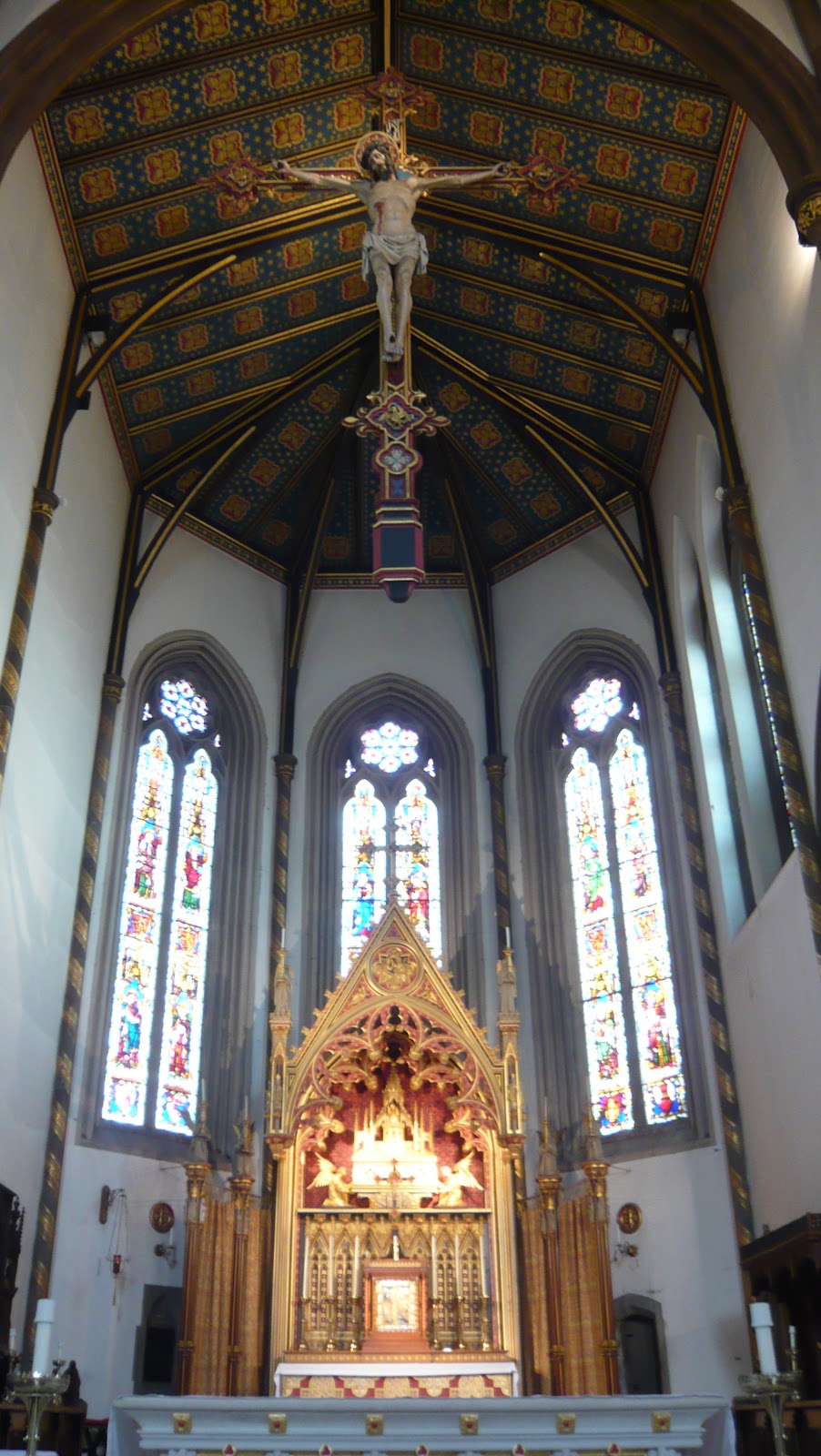
The Cathedral and Bishop’s House (originally opposite), and their interiors, were designed by Pugin. The cathedral is an internationally significant building, being the first Catholic cathedral to be built in the UK since the Reformation. The cathedral was built by George Myers (‘Pugin’s Builder’) and the original internal decorations and fittings were made by craftsmen who re-introduced medieval techniques of production: William Warrington, the chancel windows, 1841; John Hardman junior, the plate and, after 1845, several splendid windows; Herbert Minton, the floor tiles. Pugin’s magnificent rood screen was removed in a re-ordering, in 1967. The vestments were made by Lucy Powell and colleagues, to Pugin’s designs, many surviving to this day. Pugin, a collector of antiquities, also provided the Cathedral with some fine original medieval furnishings, acquired on his continental journeys, including the 15th century German Canons’ stalls and the pulpit. Beneath the Cathedral is a spacious Romanesque-style crypt containing several chantry chapels.

A delightful print display and trail ‘Pugin, Dürer and The Gothic’ runs at the BarberInstitute of Fine Arts until 24 June. Exhibits are from the Barber’s own collection and include a late medieval Brussels wood carving of Joachim and Anna, once owned by John Bernard Hardman; an early Netherlandish triptych of the Deposition, once owned by Pugin; a collection of eight prints and one drawing by Dürer, widely recognised as the greatest German Renaissance artist and a prime inspiration to Pugin, and a Pugin octagonal table on loan from King Edward’s School.

In 1838, Pugin persuaded his friend, John Hardman (1811-1867), to turn his Birmingham button-making business to making metalwork and later stained glass for his new churches.  The Museum of the Jewellery Quarter features a number Hardman pieces in its displays, and most of the techniques and processes demonstrated on the fascinating factory tour are exactly the same as used in the 19th Century by Hardman and similar metalworking firms. For the Pugin Bicentenary the museum is mounting a special exhibition on Pugin and Hardman which runs until January 2013.

Winterbourne House, also on the Pugin Trail is a rare surviving example of an early 20th century suburban villa and garden. The house was built in 1903 for John and Margaret Nettlefold, of Guest, Keen & Nettlefold. Designed as a small country estate the house boasted rustic outbuildings and large gardens. Both the house and garden follow the style of the Arts and Crafts movement with examples of local craftsmanship throughout.

I also visited the Ikon Gallery and was intrigued by Postcards From Japan - A Message From Tohoku Artists, a touring exhibition of A5 works by 22 artists from North East Japan marking the first anniversary of the devastating earthquake and tsunami that hit north east Japan on 11th March 2011. In the aftermath of the disaster, electronic means of communication largely failed, making the use of landlines, mobile phones and the Internet extremely difficult. The post office, however, was quickly up and running and in many cases the first opportunity to report news of survival to loved ones was by postcard. The exhibition is curated by Kate Thomson and Hironori Katagiri, who were working in Tohoku when the earthquake struck. Together the pair have voluntarily organised international exhibitions and projects to support recovery in Tohoku, encouraging local artists and their communities, and developing international cultural links. For more information visit  http://www.postcardproject.org/.

--------------------------------------------------------------------------------------------