Wikio - Top Blogs - Religion and belief
Showing posts with label djanogly gallery. Show all posts

Friday, 23 February 2024

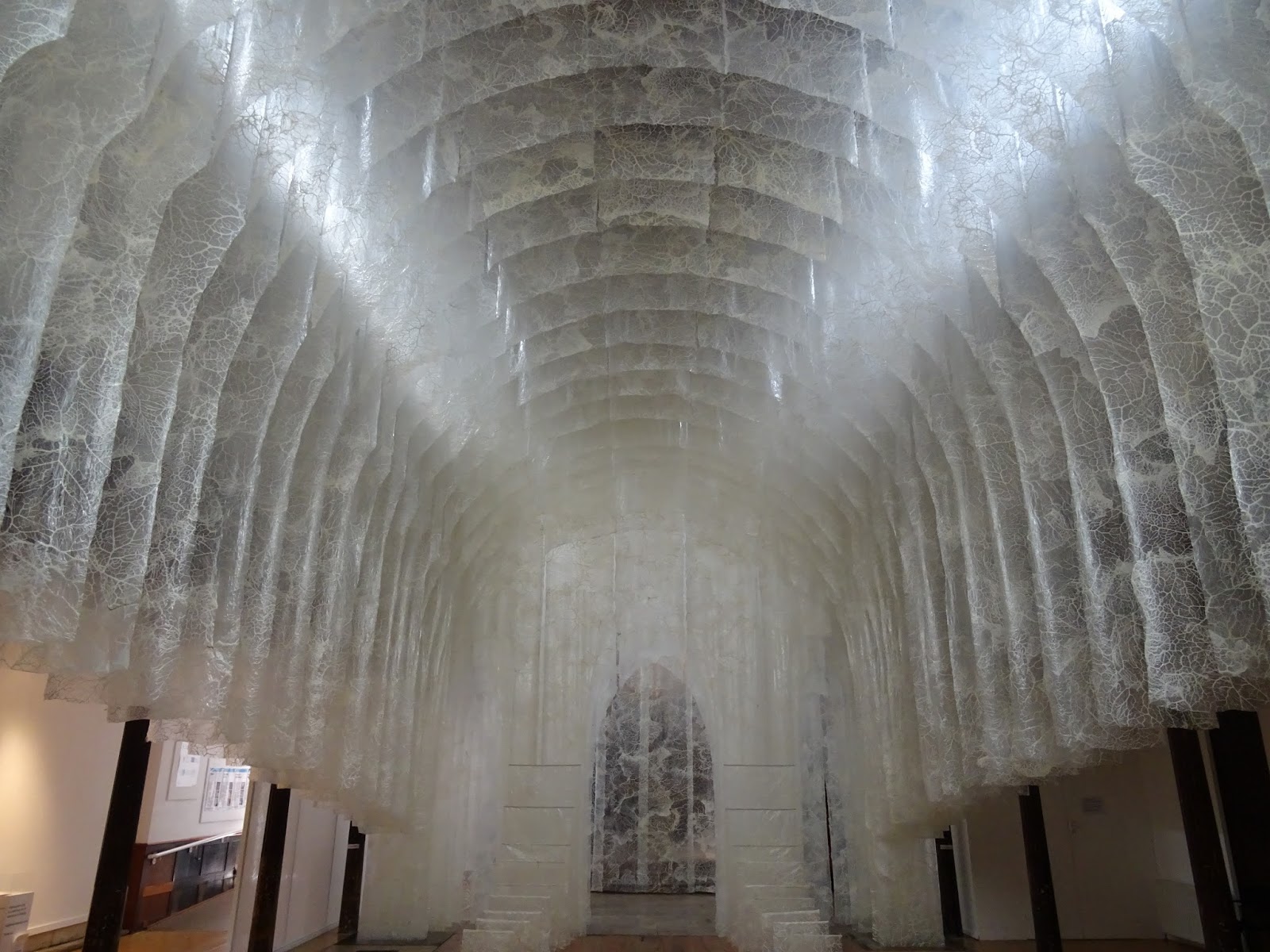
Art review: Saad Qureshi: Conversations before the End of Time at the Djanogly Gallery, Nottingham

My latest exhibition review for Church Times is on Saad Qureshi: Conversations before the End of Time at the Djanogly Gallery, Nottingham:

'IMAGES and ideas of heaven and hell continue to inspire artists and to engage the wider public. Two examples include the opulent and intricate paradisaical enamel paintings of Raqib Shaw and Pablo Bronstein’s Hell in its Heyday series from 2021. With “Conversations before the End Of Time” at the Djanogly Gallery, Saad Qureshi is exploring both ends of the spectrum.'

Click to read my pieces on Raqib Shaw and Pablo Bronstein. See how looking through a rebel angel’s eyes opens up some surprising new angles on faith with my interview with author Nicholas Papadopulos for Seen and Unseen. An earlier review of an exhibition at the Djanogly Gallery can be read here.

Other of my pieces for Church Times can be found here. My writing for ArtWay can be found here. My pieces for Artlyst are here, those for Seen & Unseen are here, and those for Art+Christianity are here.

----------------------------------------------------------------------------------------------------

U2 - The Fly.

Friday, 21 October 2022

Church Times - Art review: Michael Forbes, Blk this & Blk that . . . a state of urgency, at the Djanogly Gallery, Nottingham

My latest review for Church Times is Michael Forbes, Blk this & Blk that . . . a state of urgency, at the Djanogly Gallery, Nottingham:

'ON ENTERING Gallery 1A at the Djanogly Gallery, one sees a series of dismembered torsos — the arms of all the figures being absent — of the crucified Christ in cast Jesmonite, primarily white, but with gold and pink also used, and hung upside down from ropes the ends of which trail across the floor. In this, the largest sculptural installation here, some of the torsos wear life jackets, pointing to recent political and humanitarian events.

Untitled I highlights “how the white European male has dominated the image of Christ” and challenges white viewers with the question how they “reconcile exemplifying Christ whilst reaping unjust benefits from being white”. Forbes has, for many years, questioned this aspect of religion, “believing that it is morally and theologically incumbent upon Christians to realise how whiteness confers privileges that have an impact on the lives of black people and people of colour”. The installation (through the inclusion of life jackets) raises these questions in relation to the legacies of the slave trade and also the current refugee crisis.'

Click here for my Artlyst diary for October which also includes this exhibition.

Other of my pieces for Church Times can be found here. My writing for ArtWay can be found here. My pieces for Artlyst are here and those for Art+Christianity are here. See also Modern religious art: airbrushed from art history?

---------------------------------------------------------------------------------------------------------------

Ben Harper - With My Own Two Hands.

Saturday, 20 August 2016

Making Beauty & The Third Paradise


Last year I saw Elpida Hadzi-Vasileva's 'Fragility' for Fabrica Gallery, Brighton. This installation forms the breathtaking entrance to her first major UK show at the Djanogly Gallery Nottingham. The exhibition entitled Making Beauty also includes the first UK showing of ‘Haruspex’ commissioned by the Vatican for the Venice Biennale, 2015.

Elpida Hadzi-Vasileva is a site-specific installation artist working across the varied media of sculpture, installation, video and sound, photography and architectural interventions. Her materials range from the unusual to the ordinary, from the ephemeral to the precious; they include organic materials, foodstuffs and precious metals.

Making Beauty is a new body of work made in collaboration with academics in medical departments of the universities of Nottingham, East Anglia and London, introducing highly regarded medical research activity to a wider public. Her work has been informed by their work on nutrition, healthy diet, our gut, and the development of highly specialised - invisible to the eye - manufactured parts providing solutions to medical problems. The sculptures reveal the fragility of our bodies and reflect the delicate nature of these medical components. The work has been supported by a research grant from the Wellcome Trust.

For summer 2016, Fabrica is presenting a work by internationally-renowned Italian artist Michelangelo Pistoletto, a leading light of the Arte Povera movement of the 1960s. The work features a labyrinth constructed from cardboard which leads to a mirror with a symbol laid out in coins.

The symbol, the infinity sign altered to add a central loop represents The Third Paradise. According to Pistoletto’s manifesto written in 2003, The Third Paradise seeks to reconcile the conflict between the first and second paradises of nature and human artifice. This conflict is leading toward global destruction but the third paradise offers a solution, a resolution that will save the planet and humanity.

The Third Paradise is the new myth that leads everyone to take personal responsibility at this momentous juncture. The idea of the Third Paradise is to lead artifice—that is, science, technology, art, culture and political life—back to the Earth, while engaging in the reestablishment of common principles and ethical behaviour.

----------------------------------------------------------------------------------------

Moby - Everything That Rises / The Last Day (Poordream Remix).

Sunday, 13 March 2016

Exhibitions update: Jones, Piper, Johnston & Russian portraits

David Jones: Vision & Memory is now at the Djanogly Gallery in Nottingham. This major exhibition has been organised to coincide with the publication of a new monograph and includes some 60 works from throughout Jones’s life in a timely reassessment of one of the most imaginative artists of his era. Exhibits range from sketches made on the Western Front to watercolours of trees, flowers and thorns, as well as drawings of Arthurian subjects and painted inscriptions.

David Jones (1895-1974) was a painter, engraver, poet and maker of inscriptions. A lyrical draughtsman, he responded with delight to the visual world, yet his vision was informed by memory reaching back into the depths of time and history. The celebrated art historian and broadcaster, Kenneth Clark, believed he was the greatest British watercolourist of the 20th century.

In the 1920s, working in the circle of Eric Gill, Jones became an engraver of the first rank. His illustrated books engage with the world of symbol and myth. They will be exhibited alongside his shimmering watercolours of still lives, seascapes and portraits. In later years, as David Jones devoted more time to poetry, he painted inscriptions that are as vital in design as they are allusive in content.

The exhibition has been organised by Pallant House Gallery, Chichester, with the support of Amgueddfa Cymru – National Museum Wales, and features works drawn from both private and public lenders including Kettle’s Yard, Cambridge, Tate and the V&A.

John Piper: The Fabric of Modernism at Pallant House is the first exhibition to focus on John Piper’s textile designs, exploring key motifs in the artist’s work such as historic architecture, abstract and religious imagery, as well as subjects explored in the final years of the artist’s life, such as foliate heads, sunflowers and the church at Long Sutton. Shown alongside related paintings and other studies the exhibition demonstrates how Piper’s designs were intricately connected with his wider work.

John Piper was one of the leading Modern British artists of the 20th century, best known for his paintings of Britain’s romantic heritage including churches, country houses and wartime ruins. In the post-war period Piper was also noted for his work as an accomplished designer of theatre sets, stained glass windows, and textiles. Through over 80 works, this major exhibition is the first to focus on John Piper’s textile designs, exploring key motifs in the artist’s work such as historic architecture, abstract and religious imagery, as well as subjects explored in the final years of the artist’s life, such as foliate heads, sunflowers and the church at Long Sutton. Shown alongside related paintings and other studies the exhibition demonstrates how Piper’s designs were intricately connected with his wider work.

Piper’s textile designs included furnishing fabrics for the post-war home for companies including Arthur Sanderson & Sons Ltd, scarves for Asher, ecclesiastical garments, and tapestries created for cathedrals and other public spaces. Marking the 50th anniversary of the installation of the artist’s celebrated altar tapestry in Chichester Cathedral, many of the studies for this important example of religious art will be shown alongside several of the Foliate Head tapestries woven to Piper’s designs at West Dean Tapestry Studio near Chichester. The exhibition will be accompanied by a new book by Simon Martin, with contributions by Frances Spalding.

Underground: 100 Years of Edward Johnston’s Lettering for London at the Ditchling Museum of Art & Craft marks the centenary of Edward Johnston’s world famous typeface for London Underground. Remarkably, it has barely changed over 100 years, a testament to its success as station way finders.

Hand drawn by Johnston whilst living in Ditchling this alphabet is gloriously simple, but its design is rooted in much earlier lettering since it bears the proportions of Roman capitals. The design was initially proposed in 1913 by Frank Pick, commercial manager of London Underground Railway as a joint project for Edward Johnston and Eric Gill, but Gill was unable to proceed since he had agreed to a major commission of Stations of the Cross stone reliefs for Westminster Cathedral.

Johnston’s typeface is known variously as Underground, or Johnston Sans. It is also known as the basis on which Eric Gill, one of Johnston’s first pupils at Central School of Arts & Crafts, designed his typeface Gill Sans for the Monotype Corporation, released in 1928. With similar proportions to Johnston’s earlier typeface, it was initially criticised for being too similar but both Johnston Sans and Gill Sans have become modern classics.

This exhibition shows Johnston as a true man of letters, resurrecting and redefining calligraphy in the West, and designing an elegant typeface for London Underground. Highlights include Johnston’s calligraphy for W R Lethaby which secured his post as a teacher at Central School of Arts & Crafts; manuscripts showing his development as a calligrapher; rarely seen working drawings of the Underground typeface, and original drawings for Gill Sans.

Russia and the Arts at the National Portrait Gallery is a once-in-a-lifetime opportunity to see masterpieces on loan from the State Tretyakov Gallery in Moscow.

The exhibition will focus on the great writers, artists, composers and patrons, including Tolstoy, Chekhov and Dostoevsky, whose achievements helped develop an extraordinary and rich cultural scene in Russia between 1867 and 1914.

The exhibition will also show how Russian art of the period was developing a new self-confidence, with the penetrating Realism of the 1870s and 1880s later complemented by the brighter hues of Russian Impressionism and the bold, faceted forms of Symbolist painting.

-------------------------------------------------------------------------------------------

Paul Johnson - The Road.

Friday, 1 January 2016

David Jones: The complex Catholicity of Christian modernism

David Jones was a modest man with a modest name who achieved a modest degree of fame. What is there about him and his work that would necessitate a post-Christmas journey to Chichester in the period when engineering works combine with defective trains to lengthen journey times and send passengers through the Sussex countryside on rail replacement buses?

Though modest, Jones was a multi-talented artist, as painter, engraver, poet and maker of inscriptions, who had a powerful influence on many artists and writers, not least the ceramic artist and author Edmund de Waal whose installation of his works at Pallant House includes a new piece inspired by Jones' poem 'The Anathemata'.

Pallant House have curated the first major retrospective of Jones' work for twenty years. The complex Catholicity of his Christian modernism has often limited his appeal, meaning that such a substantive exhibition is unlikely to occur again in my lifetime unless the value of his work and the size of his reputation reverts to the period of his membership of the 7 and 5 Society (works from whose members can also be seen at Pallant House), when his work sold at prices exceeding those of Ben Nicholson.

His faith framed and formed much of his work from the point of joining the Guild of St Joseph and St Dominic, the craft community founded by Eric Gill and Hilary Pepler at Ditchling. Gill, Jones and the Ditchling Community were part of The Third Spring, a flowering of Roman Catholicism among artists and intellectuals which had G.K. Chesterton and Jacques Maritain as its guiding lights and which saw a flourishing of sacred art societies, similar to that at Ditchling, across Europe. Jones developed his thinking and practice, as artist and poet, in ways which deepened the insights he gleaned from Chesterton, Gill and Maritain to create an art and theology which is sacramental and iconic.

'David Jones: Vision and Memory' brings together 80 engravings and watercolours which focus primarily on literary illustration (engravings) and landscapes (watercolours), alongside a smaller number of substantive portraits and inscriptions. Images, for Jones, are never simply the illustration of texts or the copying of nature. Instead, like icons, his images are windows into the divine because his aim is always that his image participates in the reality of what is depicted and therefore is itself sacramental. He described this in terms of the universal in the particular and found visual means to its depiction in a merging of exterior and interior often using doors or windows as framing devices while utilising the transparency of glass.

From seascapes at Portslade to late still lifes at Northwick Park Lodge in Harrow-on-the-Hill, Jones used shallow space as a stage on which to bring together interior and exterior, natural and artificial, past and present in unitive visions suffused and imbued with light.

Jonathan Miles and Derek Shiel write in 'The Maker Unmade' that: 'By rigorous habit, the artist would not only be able to reveal this or that object under the form of paint but also make an epiphany, make the universal shine out from the particular. Thus, what is re-presented also becomes a sign of something else and if that something else is significant of something divine, then the art can claim to have a sacred character or function, a sacramental vitality.'

Similarly, Rowan Williams has argued that what preoccupies Jones from the beginning is 'precisely what so concerns Maritain, the showing of the excess that pervades appearances.' As his work develops, Jones comes to see that you paint ‘excess’ by: 'the delicate superimposing of nets of visual material in a way that teases constantly by simultaneously refusing a third dimension and insisting that there is no way of reading the one surface at once. As in the Byzantine icon, visual depth gives way to the time taken to ‘read’ a surface: you cannot construct a single consistent illusion of depth as you look, and so you are obliged to trace and re-trace the intersecting linear patterns.'

Jones said that he regarded his poem ‘The Anathemata’: "as a series of fragments, fragmented bits, chance scraps really, of records of things, vestiges of sorts and kinds of disciplinae, that have come my way by this channel or that influence. Pieces of stuffs that happen to mean something to me and which I see as perhaps making a kind of coat of many colours, such as belonged to 'that dreamer' in the Hebrew myth."

Jones believed that objects, images and words accrue meanings over the years that are more than the object as object or image as image. Therefore all things are signs re-presenting something else in another form. Recessive signs which re-present multiple signification are what Jones aims to create in works such as ‘The Anathemata’ and 'Aphrodite in Aulis'. Maritain suggested that such multiple signification is what creates joy or delight in a work of art as “the more the work of art is laden with significance … the vaster and the richer and the higher will be the possibility of joy and beauty”.

'Aphrodite in Aulis', to be found in the final rooms of the exhibition, is full of Jones’ preoccupations: “the Grail, the Lamb, the soldiers (Greek and Roman, Tommy and Jerry), Doric, Ionic and Corinthian architecture, the moon, the stars and the dove.” These disparate ideas and images are held together firstly by Jones’ composition with the whole painting revolving around the central figure of Aphrodite and secondly by his line which meanders over the whole composition literally linking every image. By holding these images and what they signify together in this way, Jones is able to create an image that both laments the way in which love is sacrificed by the violence and aggression of macho civilisations and also, through his crucifixion imagery, to hold out the hope that love may overcome that same violence and aggression.

Jones chose to explore aspects of coinherence and relationality at a time when progress was achieved through specialisation and when World Wars were undermining belief in human brotherhood. Relationality, however, was fundamental to his vision enabling him to explore the links between past, present and future within works that aimed at being holistic and reconciliatory. The meandering lines, journeys and passages Jones uses to explore these links fully justified and complemented the somewhat circuitous journey I made to view the exhibition.

'David Jones: Vision & Memory' is at Pallant House, Chichester, until 21 February 2016 before travelling to the Djanogly Gallery in Nottingham from 12 March – 5 June 2016. A concurrent exhibition 'The Animals of David Jones' is on show at Ditchling Museum of Art + Craft.

-------------------------------------------------------------------------------------------
Lifehouse - Flight.