Wikio - Top Blogs - Religion and belief
Showing posts with label nazareth. Show all posts

Wednesday, 5 February 2025

Pressing on and going forward

Here's the reflection that I shared at St Andrew's Wickford this morning:

Both our readings today are to do with responses to difficulties and challenges. Jesus experienced his own people turning against him in the story told in our Gospel reading this morning (Mark 6.1-6). The people in his home synagogue were astounded by him, recognising that he had been given wisdom and was doing deeds of power. But that recognition led them to question where it was that his wisdom and power came from and they became jealous that one of them, someone with whom they have all grown up, should possess wisdom and power beyond that of themselves. The result was that they took offence at him and he could do no deed of power there because of their lack of belief. However, Jesus’ response was to continue his mission by going about among the villages teaching.

In our New Testament reading from the Letter to the Hebrews (Hebrews 12.4-13), the challenges faced maybe on the one hand the threat of persecution and on the other our own fallibilities and failures. Whichever challenge is faced, the encouragement given by the writer of the letter to the Hebrews is to pick ourselves up, brush ourselves down, work to strengthen our areas of weakness, and carry on living our lives as followers of Jesus. When we do so, the difficulties and challenges we face become the things that strengthen us and enable us to cope and be there for the long haul.

It can, perhaps, seem from these passages as though we, or Jesus, are on our own and have to find the willpower or internal strength to overcome the opposition or difficulties that are being encountered. However, Jesus was continually reliant on God the Father and, by this stage, was also travelling with his group of disciples around him. They often didn’t fully understand what he was teaching or doing, but they would, no doubt, have been a source of support to him in this situation at Nazareth. Similarly, the Letter to the Hebrews was written to encourage and support a group of Christians undergoing, or about to undergo, persecution. The fact that the letter was written and sent meant that there were others supporting this group of Christians with advice and prayer.

As a result, in any situation of difficulty we might face, we should look around to see who is also around to help and support. In an age of almost instant communication, it may even be that help has never been closer at hand. For each of us, then, the challenge is not just to coping and coming through difficulties ourselves, but also to looking around in order that we see those who are experiencing difficulty and challenge that we can help.

The reality in a world of conflict and change is that difficulties, challenges and even opposition are inevitable. The key to coping is linked to attitude. Jesus’ decision to continue his mission in the face of the opposition he faced and the encouragement in the passage from Hebrews to find difficulties as a testing ground – an assault course – to build up our strength in order to go on are both encouragements to look for the opportunities in our challenges. If we have a deficit mindset that is focused on all the difficulties we face, then we have lost before we have begun. If we have an abundance mindset that views God as providing resources, support and strength even in the most challenging of circumstances, then we can have hope in the possibility of moving on and overcoming the challenges we face.

When his own people took offence at him, Jesus continued his mission by going about among the other villages teaching. When the Hebrew Christians faced persecution and challenge, the encouragement to them was to lift their drooping hands, strengthen weak knees, and make straight paths for their feet in order to press on and go forward. And God was with them as they did so. May it be so for each one of too.

------------------------------------------------------------------------------------------------------

Sweet Honey In The Rock - Ain't Gonna Let Nobody Turn Me Round.

Wednesday, 31 January 2018

Push on through the obstacles

Here is my reflection from today's Choral Eucharist at St Martin-in-the-Fields:

He was amazed at their unbelief. Then he went about among the villages teaching. (Mark 6. 1 - 6)

I wonder how often you have been in a situation where your work or your mission keeps coming up against barriers or difficulties. That seems to have been the situation that Jesus faced here when he taught in his home town of Nazareth. Elsewhere, at this time, his teaching and his healing ministry were broadly welcomed. In Nazareth, however, he encountered an almost complete block.

Such situations pose a dilemma; do we press on regardless and push on through the obstacles convinced of the need for our work or mission, or should we view the existence of barriers to progress as a reason for reflecting on our approach and altering our plans? In this situation, Jesus modified his immediate activity in Nazareth but pressed on with his wider mission. This is an approach that he later commended to his apostles when he sent them out to preach saying, ‘If anyone will not welcome you or listen to your words, shake off the dust from your feet as you leave that house or town.’

It is advice that those the Church has recognised as saints have often followed as well. Today, the Church remembers John Bosco, Priest and Founder of the Salesians. Born in 1815 to a peasant family, John Bosco spent most of his life in the Turin area of Italy. He had a particular call to help young men and pioneered new educational methods, for example, in rejecting corporal punishment. His work with homeless youth received the admiration even of anticlerical politicians and his promotion of vocational training, including evening classes and industrial schools, became a pattern for others to follow. To extend the work, he founded in 1859 a religious community, the Pious Society of St Francis de Sales, usually known as the Salesians. It grew rapidly and was well-established in several countries by the time of his death on this day in 1888.

What that brief summary of John Bosco’s life fails to reflect is the extent to which his ministry encountered opposition. John's early years were spent as a shepherd, and he received his first instruction from a parish priest. His childhood experiences are thought to have inspired him to become a priest. At the time, being a priest was generally seen as a profession for the privileged classes, rather than farmers, although it was not unknown. Some biographers portray his older brother Antonio as the main obstacle for Bosco's ambition to study, as the brother protested that John was just "a farmer like us!" - a similar response to that which Jesus encountered in Nazareth!

Later, when visiting Turin’s prisons, John Bosco was disturbed to see so many boys from 12 to 18 years of age. He was determined to find a means to prevent them ending up here and began to meet the boys where they worked and gathered in shops and market places. He looked for jobs for the unemployed and provided sleeping quarters for those sleeping rough. As a result, he was turned out of several places in succession. After only two months based in the church of St. Martin, the entire neighbourhood expressed its annoyance with the noise coming from the boys at play. A formal complaint was lodged against them with the municipality. The group was evicted.

Opposition to Bosco and his work came from various quarters. Several attempts were also made on his life, including a near-stabbing, bludgeoning and a shooting. He was also subjected to petty annoyances and obstacles which, at times, seemed to spell the ruin of his undertaking. His perseverance in the face of all difficulties led many to the conclusion that he was insane, and an attempt was even made to confine him in an asylum. He persevered, however, to the point that some of the boys he helped decided to do what he was doing, that is, to work in the service of abandoned boys. And that was the origin of the Salesians, the religious order that would carry on his work.

At the time of John Bosco's death in 1888 there were 250 houses of the Salesian Society in all parts of the world, containing 130,000 children, and from which there annually went out 18,000 finished apprentices. Up to 1888 over six thousand priests had also gone forth from John Bosco's institutions. Today Salesian houses are located far and wide, and include elementary and high schools, colleges, seminaries, hospitals, vocational schools, and foreign missions.

John Bosco’s certainty that, in the face of desperate circumstances, he would nonetheless build a thriving religious community for boys came from a vision received as a dream. In his dream he saw Our Lady directing him in the way he should go; a way that involved walking on thorns. Friends, lay and clergy, were alongside him but declined to also walk on thorns. Finally, a new group of followers arrived who were willing to walk with him. The Mother of God said to him: ‘The thorns on the ground represent the sensitive human affections, sympathies and antipathies that divert a teacher from his true goal, hurt him, hinder his mission and prevent him from forming and reaping wreathes for eternal life. Roses are the symbol of the ardent charity by which you and your associates must distinguish yourselves. The thorns symbolize the obstacles, sufferings and sorrows that await you. But do not lose heart. With charity and mortification you will overcome everything and will have roses without thorns!’

God also calls us to face and overcome obstacles when these are encountered as part of the ministry to which we are called. James, the brother of Jesus, wrote: ‘My brothers and sisters, whenever you face trials of any kind, consider it nothing but joy, because you know that the testing of your faith produces endurance; and let endurance have its full effect, so that you may be mature and complete, lacking in nothing.’ (James 1. 2 - 4)

That is what we see lived out by Jesus, his apostles and John Bosco. Jesus was amazed at the unbelief of those in Nazareth but then he continued his mission by going to other villages to teach there instead. John Bosco’s fellow priests tried to persuade him to abandon or at least limit his thankless work with youth, which had only brought ridicule and suffering. He had become obsessed by hopeless idealism, they told him. “Not at all,” replied Bosco, “I see things plainly as they are. Presently we shall have churches, vast playgrounds, priests, helpers of all kinds and thousands of boys.” Such was his confidence about these goals that he freely and frequently spoke of them as accomplished realities.

The perseverance and endurance of Jesus and John Bosco was, therefore, based on their sense of calling and mission. Are we clear about our call and mission? Then, when we are, do we have a similar degree of commitment to pressing on despite the obstacles we face? Let us pray: O God, who raised up John Bosco as a father and teacher of the young, grant we pray, that, aflame with the same fire of love, we may seek out souls and serve you alone. Amen.

-----------------------------------------------------------------------------------------

Bob Dylan - Pressing On.

Monday, 1 June 2015

A Nazareth Manifesto


'At the interface of critical academic reflection and faithful church theology, we have no better voice than that of Sam Wells. He invites us to rethink, from the ground up, our abiding temptation to condescending “help and service” to others. He compellingly renders a more excellent way toward the transformative “with.”' Walter Brueggemann

Last Friday I was at the launch of Sam's latest book, A Nazareth Manifesto, which is an eloquent and impassioned ecumenical proposal for re-envisioning Christianity’s approach to social engagement away from working “for” the people to being “with” them. The book questions the effectiveness of the current trend of intervention as a means of fixing the problems of people in distressed and disadvantaged circumstances. Sam argues that Jesus spent 90% of his life simply being among the people of Nazareth, sharing their hopes and struggles, therefore Christians should place a similar emphasis on being alongside people in need rather than hastening to impose solutions.

This is a particularly significant book because Sam maintains 'that the word with is the most important word in theology.' The book 'is an enquiry into whether with is the pervading theme that runs through Trinity, creation, incarnation, atonement, the sending of the Spirit, ecclesiology, and eschatology.' Additionally, Sam argues that the human project in the West has been to secure life against limitation in general and mortality in particular, but that such efforts have only deepened the true predicament, which is isolation.' 

A Nazareth Manifesto comes out of Sam's experience of trying to lead influential institutions in ways that bring about empowering and dignifying relationships with people experiencing social disadvantage.

Jean Vanier said in his Templeton Prize acceptance remarks: 'A Nazareth Manifesto reveals that Jesus came to teach us, not just to do things for people who are homeless, but to be with them. Yes, that is the real secret of the church, and the secret of our communities, and hopefully one day it will be the secret of all humanity, to be with.

To be with is to live side by side, it is enter into mutual relationships of friendship and concern. It is to laugh and to cry together, it is to mutually transform each other. Each person becomes a gift for the other, revealing to each other that we are all part of a huge and wonderful family, the family of God.'

-----------------------------------------------------------------------------------------------

Sydney Carter - I Come Like A Beggar.

Sunday, 22 March 2015

Windows on the world (334)


Nazareth, 2014

--------------------------------------------------------------------------------------------

Simple Minds - Let The Day Begin.

Saturday, 14 March 2015

Windows on the world (333)


Nazareth, 2014

---------------------------------------------------------------------------------

Joni Mitchell - Love.

Thursday, 25 December 2014

Borne to be born

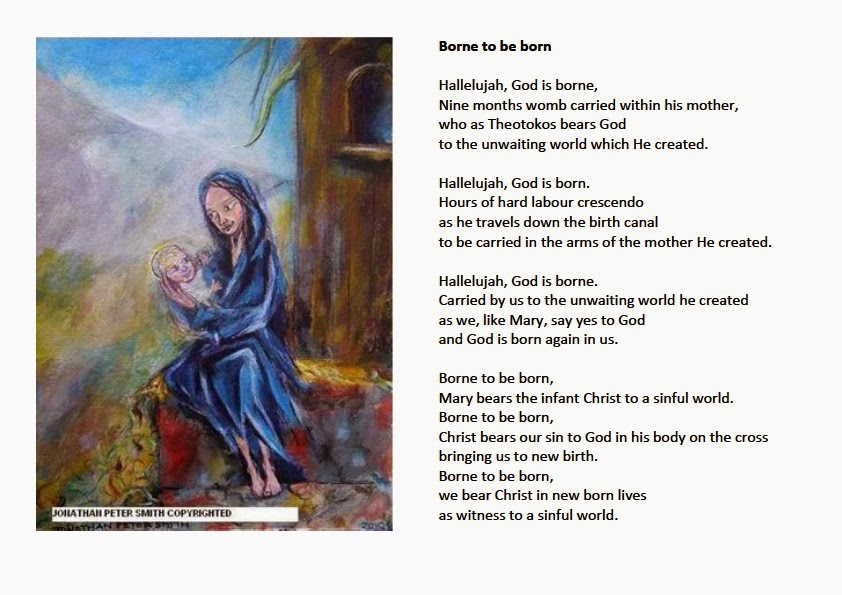
'Borne to be born' handout with 'Mother and Child' by Jonathan Peter Smith - smithpeterjonathan@yahoo.co.uk

Ever since using a poem about Mary by Malcolm Guite while in Nazareth with the East London Three Faiths Forum, I have been reflecting on the first title given by the Church to Mary, ‘Theotokos,’ which means ‘God-bearer’.

Malcolm Guite says of Mary, ‘Mary has been given many titles down the ages and some Christians have disagreed with one another bitterly about her. But equally, in every age and every church she has been, for many Christians, a sign of hope and an inspiration. Her earliest ‘title’, agreed throughout the church in the first centuries of our faith, before the divisions of East and West, Catholic and Protestant, was Theotokos, which means God-Bearer. She is the prime God-Bearer, bearing for us in time the One who was begotten in eternity, and every Christian after her seeks to become in some small way a God-bearer, one whose ‘yes’ to God means that Christ is made alive and fruitful in the world through our flesh and our daily lives, is born and given to another.’

Mary bears or carries Jesus in her womb for nine months and is also borne or carried by her after his birth, as that is what mothers do with their new born children until they can crawl or walk. The idea that he is borne by her holds lots of potential for word play with the two meanings and spellings of the word. ‘Borne,’ as in carried, and ‘Born,’ as in giving birth. I’ve been trying to play with those words in writing a meditation on this theme which I’ll read to you later.

Once he becomes a man and can no longer be borne or carried himself, Jesus bears or carries us to God the Father by means of his sacrificial death on the cross. So, he is born(e) into the world in order to bear us to God.

In turn, we then bear him to others as he is born in each one of us as we open our lives to him and can then bear, carry or take him to others as our daily lives reveal aspects of his character and love to others. As Teresa of Avila said:

‘Christ has no body but yours,
No hands, no feet on earth but yours,
Yours are the eyes with which he looks
Compassion on this world,
Yours are the feet with which he walks to do good,
Yours are the hands, with which he blesses all the world.
Yours are the hands, yours are the feet,
Yours are the eyes, you are his body.
Christ has no body now but yours,
No hands, no feet on earth but yours,
Yours are the eyes with which he looks
compassion on this world.
Christ has no body now on earth but yours.’

In this way, we bear him to others.

So, Christ is carried by Mary, both in her womb and in her arms, in order that he can then carry us to God by means of his death of the cross. Finally, we carry him to others by means of our daily life and witness.

Here are those thoughts expressed in my meditation:

Borne to be born

Hallelujah, God is borne,
Nine months womb carried within his mother,
who as Theotokos bears God
to the unwaiting world which He created.

Hallelujah, God is born.
Hours of hard labour crescendo
as he travels down the birth canal
to be carried in the arms of the mother He created.

Hallelujah, God is borne.
Carried by us to the unwaiting world he created
as we, like Mary, say yes to God
and God is born again in us.

Borne to be born,
Mary bears the infant Christ to a sinful world.
Borne to be born,
Christ bears our sin to God in his body on the cross
bringing us to new birth.
Borne to be born,
we bear Christ in new born lives
as witness to a sinful world.

Are you humbled by the thought that God was born(e) by a human mother? Are you conscious of having been borne by Jesus to God? How are you bearing Christ to others, as his hands, feet, eyes and body in the world today? Are these responses something for which you pray and for which you are thankful today?

------------------------------------------------------------------------------------------

Malcolm Guite - Angels Unawares.

Thursday, 18 December 2014

Christ overlooked at Christmas

This was the homily that I gave at the Service of Nine Lessons and Carols by Candlelight which we held at St John's Seven Kings last Sunday evening:

It may sound an odd thing to say at a service attended by a large number of people, but Jesus has always been overlooked at Christmas. Think about the Christmas story for a moment; Jesus spent his first night sleeping in an animal’s feeding trough because there was no room for him in the guest room of the home in Bethlehem where his family were staying, the Shepherds needed a fanfare of angels before they knew of his birth, while the Wise Men looked for him in a palace when he was actually to be found in an ordinary home. So it is no surprise that today many people still overlook the person at the heart of Christmas in the busyness of life and Christmas preparations and others overlook him by creating supposedly PC festivals like Winterval.

Jesus has always been overlooked at Christmas but one of the reasons for that is that he came to be one of us, God with us, which is what the name Emmanuel means. Born in an obscure village, working in a carpenter’s shop, never writing a book, never holding an office, never having a family or owning a house, never going to college, never travelling two hundred miles from the place where he was born. He did none of the things we usually associate with greatness. He is God become an ordinary person just like us. And therefore he is easy to overlook.

But just as the Shepherds and Wise Men did seek him out and find him, those who genuinely look for Jesus this Christmas will find him. And if you are prepared to seek him out, you will find that Jesus is the greatest gift that any of us can receive, both at Christmas and any other time in our lives.

As you listen to the story of Jesus’ birth tonight, the story will have meaning as you take it to heart. The 17th century German mystic, Angelus Silesius, warns us:

Though Christ a thousand times
In Bethlehem be born
If he’s not born in thee,
Thou art still forlorn.

If Christ is not born in you as you listen and sing, this time together will be pleasant but not life changing. But if Christ is born in you then the whole story will be transformed. It will become your story. You will be able to say:

Christ born in a stable
is born in me.
Christ accepted by shepherds
accepts me.
Christ receiving the wise men
receives me.
Christ revealed to the nations
be revealed in me.
Christ dwelling in Nazareth
You dwell in me.

-----------------------------------------------------------------------------------------

Steve Bell - Magnificat.

Sunday, 30 November 2014

Advent reflection


Israel and Palestine today are lands of contrasts, where past and present are juxtaposed in contrasts which are sometimes incongruous and sometimes profound. This lithograph shows a view of Jerusalem from approximately 1890 and shows the essentially rural nature of the area surrounding the Old City at that time.

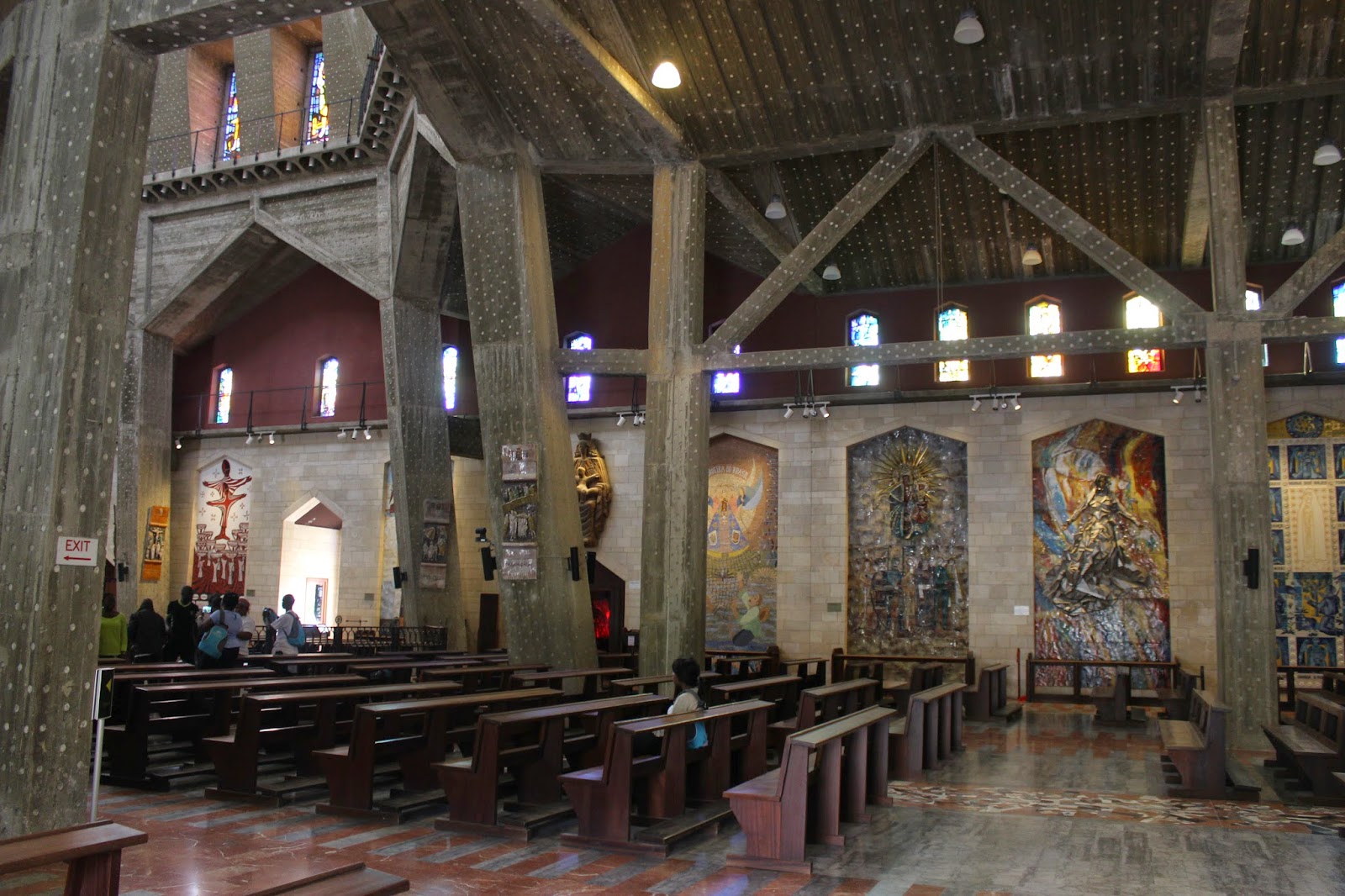
Nazareth is now a large city, where once, at the time of Christ, it was an obscure village. The Basilica of the Annunciation is a modern Roman Catholic church built on the foundations of an earlier Crusader church. The church has been built over the excavated remains of buildings from the settlement of Jesus’ day and incorporates into this modern building the ancient Grotto of the Annunciation.

At Bethlehem the Church of the Nativity stands alongside a busy central square. Bethlehem is a town relient on tourism, where its holy sites are alongside the food outlets, accommodation and souvenir shops which tourists require and which support the local economy.

The Basilica of the Annunciation straddles and shields remains from ancient Nazareth. At the centre of this modern church are remains of earlier churches and the ancient Grotto of the Annunciation which is thought to be the location where the Annunciation occurred. At the heart, therefore, of the tourist trails and visits there is worship, piety and devotion.

The same mix is found in Bethlehem, where tourists and pilgrims can queue for two hours or more to see or to kiss the site that is traditionally thought to be the location of Christ’s birth and the site of the manger. Among the busyness of this crowded space people kneel in devotion to worship Christ.

The humble events of Jesus’ conception and birth have proved inspirational, spreading around the world, bringing millions to the holy sites and leading to the creation of great art and architecture. The Basilica of the Annunciation is a stunning example of modernist architecture which is sensitive to the site and which enhances worship. Artworks in mosaic, stained glass and stone have been collected there from around the world to tell the story of the Annunciation in a truly global fashion.

I was privileged to see these images as part of the East London Three Faiths Forum's recent Tour of the Holy Land. While in Nazareth with this group, I read the following sonnet about Mary as part of our experience of seeing and reflecting on these sacred sites.

The poet, Malcolm Guite, says of Mary: ‘Mary has been given many titles down the ages and some Christians have disagreed with one another bitterly about her. But equally, in every age and every church she has been, for many Christians, a sign of hope and an inspiration. Her earliest ‘title’, agreed throughout the church in the first centuries of our faith, before the divisions of East and West, Catholic and Protestant, was Theotokos, which means God-Bearer. she is the prime God-Bearer, bearing for us in time the One who was begotten in eternity, and every Christian after her seeks to become in some small way a God-bearer, one whose ‘yes’ to God means that Christ is made alive and fruitful in the world through our flesh and our daily lives, is born and given to another.’

You bore for me the One who came to bless
And bear for all and make the broken whole.
You heard His call and in your open ‘yes’
You spoke aloud for every living soul.
Oh gracious Lady, child of your own child,
Whose mother-love still calls the child in me,
Call me again, for I am lost, and wild
Waves surround me now. On this dark sea
Shine as a star and call me to the shore.
Open the door that all my sins would close
And hold me in your garden. Let me share
The prayer that folds the petals of the Rose.
Enfold me too in Love’s last mystery
And bring me to the One you bore for me.

-------------------------------------------------------------------------------------

Malcolm Guite & Steve Bell - The Singing Bowl & Birth Of A Song.

Thursday, 20 November 2014

East London Three Faiths Forum Tour of the Holy Land: Day 5


In Nazareth we had a discussion about the Christian and Muslim understandings of the Annunciation. I began my reflections with the apocryphal story of God asking other women to bear his son before Mary said 'yes'. Though apocryphal, this story highlights the importance and significance of Mary saying 'yes' to God, with all that that involved in terms of difficulty and heartbreak.

Mary was unmarried, young, and poor. The social circumstances of a young, poor, unmarried mother in first-century Palestine would have been difficult. This pregnancy would shape her future. It would have taken tremendous faith and courage to withstand the prejudice of her critics.

Additionally, her saying 'yes' to God led her, as Simeon prophesied (Luke 2. 22 - 38), to the heartbreak of the cross (as captured in this poem from 'The Passion'):

And a sword pierced her heart,
as the whip flayed his back,
as the cross made him fall,
as the nails pierced his wrists and feet,
as the spear pierced his side,
as she held the limp, lifeless adult body
she had once held, as a newborn babe, to her breast.

In my reflections I sought to highlight the human cost and challenge often involved in saying 'yes' to God (understood, in Islamic terms, as the central concept of submission to the will of Allah).

I ended with Malcolm Guite's sonnet entitled 'Theotokos':

You bore for me the One who came to bless
And bear for all and make the broken whole.
You heard His call and in your open ‘yes’
You spoke aloud for every living soul.
Oh gracious Lady, child of your own child,
Whose mother-love still calls the child in me,
Call me again, for I am lost, and wild
Waves suround me now. On this dark sea
Shine as a star and call me to the shore.
Open the door that all my sins would close
And hold me in your garden. Let me share
The prayer that folds the petals of the Rose.
Enfold me too in Love’s last mystery
And bring me to the One you bore for me.

--------------------------------------------------------------------------------------------

Aretha Franklin - Ave Maria.