Wikio - Top Blogs - Religion and belief
Showing posts with label poland. Show all posts

Friday, 9 February 2024

Unveiled: Maciej Hoffman


There were fascinating insights into art from Maciej Hoffman at tonight's Unveiled in St Andrew’s Wickford, leading to much engaged discussion after the presentation was over. For a sense of some of the ground covered click here. For my reflections on Maciej's work click here, here, and here.

Maciej Hoffman was born in Wrocław, Poland in 1964, the son of artist parents, growing up under Poland's communist regime; after studying philosophy at the School of Theology in Wrocław, he graduated in Painting and Sculpture from the Academy of Fine Art in 1992. Becoming fascinated with web art and new graphic technologies, he then worked for 15 years in one of Poland's largest advertising agencies until a watershed moment in 2003, when he returned fulltime to the studio and to oil painting. He moved to England in 2012, in search of new artistic and life opportunities, and continues to paint, teach and exhibit in the UK and abroad.

Here he became involved in leading art workshops for school students, encouraging self-expression through art therapy for young people from disadvantaged backgrounds, or coping with mental health issues and trauma. He also contributed artworks to exhibitions dealing with conflict and resolution, including two marking Holocaust Memorial Days in 2012 and 2018 respectively. Maciej Hoffman's work has been exhibited in the UK on numerous occasions, including at Chelmsford Cathedral; Barry Gallery Central; Polish Social and Cultural Association (POSK) Gallery and Willesden Gallery (both London), and at the Warwick Art Centre.

‘Painting begins with a spark, an idea, an impulse. Sometimes it seems as though the painting creates itself, intuition guides me during the process … In trivialities as well as in big events I seek contrasts between imagination and reality. Our expectations and our anticipations are never what we finally meet in real life. This constant collision fascinates me. It’s irrelevant whether it’s beauty and ugliness, order or chaos - the point is, how it’s reflected in the mirror of my interpretation … I am moved by people’s stories with all their misfortunes and moments of happiness. It seems like one is always part of the other.’

https://www.maciej-hoffman.com/ https://www.buru.org.uk/record.php?id=1443

'Who Tells Your Story? Who Tells Your Future? An exhibition of paintings by Maciej Hoffman' is at St Andrew’s Church (11 London Road, Wickford SS12 0AN) until 29 March 2024. 

St Andrew’s is usually open: Sat 9am-12.30pm; Sun 9.30am-12 noon; Mon 2-3.45pm; Tue 1-4.30pm; Wed 10am-12 noon; Fri 10am-1pm. See https://wickfordandrunwellparish.org.uk/whats-on.html for more information.

‘I choose themes that pervade everyday life, our constant battle with problems which we inevitably face. But also issues which haunt us for years, shaping our perspective on the world and building us as humans. I try to capture the moments of tension, the climax, and the spark before ignition.’ Maciej Hoffman

Unveiled – a wide range of artist and performers from Essex and wider, including Open Mic nights (come and have a go!).

Unveiled – view our hidden painting by acclaimed artist David Folley, plus a range of other exhibitions.

Spring Programme 2024

  • 23 February – Tryin’ to throw your arms around the world. Jonathan Evens talks about the spirituality of the rock band U2. This talk sets out the main characteristics of U2’s spirituality, examines their roots, makes links between their spirituality and themes in contemporary theology and, considers three reasons why U2’s spirituality has connected with popular culture.
  • 8 March – Dave Crawford in concert. Popular local musician, Dave Crawford writes engaging/melodic songs in Americana/Alt-Rock/Indie-Folk. He has performed at the Leigh Folk Festival, Pin Drop Sessions, and Music for Mind together with Kev Butler. He was recently included on The Open Mic Show Album, Vol. 1 from SoSlam. We have enjoyed Dave’s powerful vocals and guitar here when he has performed previously at our Open Mic Nights.
  • 22 March – An evening with the Ladygate Scribblers. Hear poetry and prose from a long-established Wickford-based writers group.

These events do not require tickets (just turn up on the night). There will be a retiring collection to cover artist and church costs. See http://wickfordandrunwellparish.org.uk/whats-on.html for fuller information.

------------------------------------------------------------------------------------------------------

Sinéad O'Connor - Trouble Will Soon Be Over.

Sinéad O'Connor

Sunday, 21 January 2024

Who Tells Your Story? Who Tells Your Future? An exhibition of paintings by Maciej Hoffman


Who Tells Your Story? Who Tells Your Future?
An exhibition of paintings by Maciej Hoffman
23 January – 29 March 2024
St Andrew’s Church, 11 London Road, Wickford SS12 0AN


‘I choose themes that pervade everyday life, our constant battle with problems which we inevitably face. But also issues which haunt us for years, shaping our perspective on the world and building us as humans. I try to capture the moments of tension, the climax, and the spark before ignition.’
  • Holocaust Memorial Day reflection – 27 January, 3.00 pm.
  • Hear Maciej speak about his work at ‘Unveiled’ – the arts & performance evening in St Andrew’s Wickford - Friday 9 February, 7.00 pm.
St Andrew’s is usually open: Sat 9am-12.30pm; Sun 9.30am-12 noon; Mon 2-3.45pm; Tue 1-4.30pm; Wed 10am-12 noon; Fri 10am-1pm. See https://wickfordandrunwellparish.org.uk/whats-on.html for more information.

Maciej Hoffman was born in Wrocław, Poland in 1964, the son of artist parents, growing up under Poland's communist regime; after studying philosophy at the School of Theology in Wrocław, he graduated in Painting and Sculpture from the Academy of Fine Art in 1992. Becoming fascinated with web art and new graphic technologies, he then worked for 15 years in one of Poland's largest advertising agencies until a watershed moment in 2003, when he returned fulltime to the studio and to oil painting. He moved to England in 2012, in search of new artistic and life opportunities, and continues to paint, teach and exhibit in the UK and abroad.

Here he became involved in leading art workshops for school students, encouraging self-expression through art therapy for young people from disadvantaged backgrounds, or coping with mental health issues and trauma. He also contributed artworks to exhibitions dealing with conflict and resolution, including two marking Holocaust Memorial Days in 2012 and 2018 respectively. Maciej Hoffman's work has been exhibited in the UK on numerous occasions, including at Chelmsford Cathedral; Barry Gallery Central; Polish Social and Cultural Association (POSK) Gallery and Willesden Gallery (both London), and at the Warwick Art Centre.

‘Painting begins with a spark, an idea, an impulse. Sometimes it seems as though the painting creates itself, intuition guides me during the process … In trivialities as well as in big events I seek contrasts between imagination and reality. Our expectations and our anticipations are never what we finally meet in real life. This constant collision fascinates me. It’s irrelevant whether it’s beauty and ugliness, order or chaos - the point is, how it’s reflected in the mirror of my interpretation … I am moved by people’s stories with all their misfortunes and moments of happiness. It seems like one is always part of the other.’

https://www.maciej-hoffman.com/ https://www.buru.org.uk/record.php?id=1443

-----------------------------------------------------------------------------------------------------------

Wednesday, 20 December 2023

Maciej Hoffman: Who Tells Your Story? Who Tells Your Future?


Who Tells Your Story? Who Tells Your Future?
An exhibition of paintings by Maciej Hoffman
23 January – 29 March 2024
St Andrew’s Church, 11 London Road, Wickford SS12 0AN


‘I choose themes that pervade everyday life, our constant battle with problems which we inevitably face. But also issues which haunt us for years, shaping our perspective on the world and building us as humans. I try to capture the moments of tension, the climax, and the spark before ignition.’ Maciej Hoffman
  • Holocaust Memorial Day reflection – 27 January, 3.00 pm.
  • Hear Maciej speak about his work at ‘Unveiled’ – the arts & performance evening in St Andrew’s Wickford - Friday 9 February, 7.00 pm.
St Andrew’s is usually open: Sat 9am-12.30pm; Sun 9.30am-12 noon; Mon 2-3.45pm; Tue 1-4.30pm; Wed 10am-12 noon; Fri 10am-1pm. https://wickfordandrunwellparish.org.uk/whats-on.html

Maciej Hoffman was born in Wrocław, Poland in 1964, the son of artist parents, growing up under Poland's communist regime; after studying philosophy at the School of Theology in Wrocław, he graduated in Painting and Sculpture from the Academy of Fine Art in 1992. Becoming fascinated with web art and new graphic technologies, he then worked for 15 years in one of Poland's largest advertising agencies until a watershed moment in 2003, when he returned fulltime to the studio and to oil painting. He moved to England in 2012, in search of new artistic and life opportunities, and continues to paint, teach and exhibit in the UK and abroad.

Here he became involved in leading art workshops for school students, encouraging self-expression through art therapy for young people from disadvantaged backgrounds, or coping with mental health issues and trauma. He also contributed artworks to exhibitions dealing with conflict and resolution, including two marking Holocaust Memorial Days in 2012 and 2018 respectively. Maciej Hoffman's work has been exhibited in the UK on numerous occasions, including at Chelmsford Cathedral; Barry Gallery Central; Polish Social and Cultural Association (POSK) Gallery and Willesden Gallery (both London), and at the Warwick Art Centre.

‘Painting begins with a spark, an idea, an impulse. Sometimes it seems as though the painting creates itself, intuition guides me during the process … In trivialities as well as in big events I seek contrasts between imagination and reality. Our expectations and our anticipations are never what we finally meet in real life. This constant collision fascinates me. It’s irrelevant whether it’s beauty and ugliness, order or chaos - the point is, how it’s reflected in the mirror of my interpretation … I am moved by people’s stories with all their misfortunes and moments of happiness. It seems like one is always part of the other.’

https://www.maciej-hoffman.com/

https://www.buru.org.uk/record.php?id=1443

Read my Visual Meditations on the work of Maciej Hoffman here and here, and my review of an earlier exhibition here.

---------------------------------------------------------------------------------------------------------------

Henryk Górecki - Symphony of Sorrowful Songs.

Saturday, 7 May 2022

Czeslaw Milosz, Jerzy Andrzejewski, Oskar Milosz, and Aleksander Wat

'To Begin Where I Am brings together a rich sampling of poet Czeslaw Milosz's prose writings. Spanning more than a half century, from an impassioned essay on human nature, wartime atrocities, and their challenge to ethical beliefs, written in 1942 in the form of a letter to his friend Jerzy Andrzejewski, to brief biographical sketches and poetic prose pieces from the late 1990s, this volume presents Milosz the prose writer in all his multiple, beguiling guises. The incisive, sardonic analyst of the seductive power of communism is also the author of tender, elegiac portraits of friends famous and obscure; the witty commentator on Polish complexes writes lyrically of the California landscape. Two great themes predominate in these essays, several of which have never appeared before in English: Milosz's personal struggle to sustain his religious faith, and his unswerving allegiance to a poetry that is on the side of man.'

'Critics from many countries, as well as contemporary poets, like Joseph Brodsky, for instance, sweep his literary oeuvre with superlatives. His poetry is rich in visual-symbolic metaphor. The idyllic and the apocalyptic go hand-in-hand. The verse sometimes suggests naked philosophical discourse of religious epiphany. Songs and theological treatises alternate, as in the "child-like rhymes" about the German Occupation of Warsaw in The World: Naive Poems (1943) or Six Lectures in Verse from the volume Chronicles (1987). Miłosz transcends genre. As a poet and translator, he moves easily from contemporary American poets to the Bible (portions of which he has rendered anew into Polish).

As a novelist, he won renown with The Seizure of Power (1953), about the installation of communism in Poland. Both Milosz and his readers have a particular liking for the semi-autobiographical The Issa Valley (1955), a tale of growing up and the loss of innocence that abounds in philosophical sub-texts. There are also many personal themes in Milosz's essays, as well as in The Captive Mind (1953), a classic of the literature of totalitarianism. Native Realm (1959) remains one of the best studies of the evolution of the Central European mentality. The Land of Ulro (1977) is a sort of intellectual and literary autobiography. It was followed by books like The Witness of Poetry (1982), The Metaphysical Pause (1995) and Life on Islands (1997) that penetrate to the central issues of life and literature today.'

Bogdana Carpenter and Madeline E. Levine write that: 'Having experienced in his lifetime all the major convulsions of twentieth-century Europe, Milosz has taken upon himself the duty to bear witness to counter the voices that would obscure the historical facts as he knows them, and simultaneously to challenge the omnipotence of death. For Milosz, it would seem, everyone who survives in his memory has a claim on his pen ... Equally important is Milosz's need for teachers and kindred souls: "I met Tiger in the way a river, hollowing out a bed for itself on a plain, meets a second river; it had been inevitable." The image captures the importance of intellectual friendships in Milosz's life and his need for partners against whom he can try out his ideas or with whom he shares common values. These partners can be friends, but they can also be writers or philosophers from other eras. His essays on Simone Weil, Lev Shestov, William Blake, and Oskar Milosz are good examples of dialogues constructed across time and space. Milosz constructs a private pantheon of philosophers, poets, and thinkers who share his preoccupations and come close to his own solutions, whether it be Shestov's protest against necessity and reason, Weil's praise of contradictions and her unorthodox Catholicism, or Blake's vision of the land of Ulro. They are "other voices," but they accord with his own.'

Oskar Milosz was a distant cousin of Czeslaw Milocsz, who wrote that the questions inspired by Oskar Milosz's Ars Magna and Les Arcanes decided his career. In addition to Cszelaw Milosz's essay on Oskar Milosz, it is also instructive to read Christopher Bamford's introduction in Temenos to the work of Oskar Milosz and to read translations of his poetry by such as David Gascoyne and others. 

Jerzy Andrzejewski (the 'Alpha' of Milosz's essay in To Begin Where I Am) 'was a prolific Polish writer. His works confront controversial moral issues such as betrayal, the Jews and Auschwitz in the wartime. His novels, Ashes and Diamonds, and Holy Week, have been made into film adaptations by the Oscar-winning Polish director Andrzej Wajda.'

Finally, 'In My Century the great Polish poet Aleksander Wat provides a spellbinding account of life in Eastern Europe in the midst of the terrible twentieth century. Based on interviews with Nobel Prize winner Czeslaw Milosz, My Century describes the artistic, sexual, and political experimentation―in which Wat was a major participant―that followed the end of World War I: an explosion of talent and ideas which, he argues, in some ways helped to open the door to the destruction that the Nazis and Bolsheviks soon visited upon the world. But Wat's book is at heart a story of spiritual struggle and conversion. He tells of his separation during World War II from his wife and young son, of his confinement in the Soviet prison system, of the night when the sound of far-off laughter brought on a vision of "the devil in history." "It was then," Wat writes, "that I began to be a believer."'

Alissa Z. Leigh-Valles writes that: 'Milosz was a loyal friend to Wat in his last years (though he describes the friendship as "not particularly ardent," more collegial than intimate) and an important ally to Ola for the two decades after Wat's death.33 As an anthologist, historian and ambassador of Polish literature Milosz also largely created the literary-critical framework within which Wat's work could be placed and to some degree reverberate. With his powerful will to rational order and judgment, Milosz was honest enough to admit (paradoxically) to strong personal and intellectual dislikes that played a part in his critical and editorial work. Milosz's presentation of poets he befriended and translated is an integral part of his argument with Polish poetry, a tradition in which he felt strongly his own unusual status as a poet who placed a higher value on intellectual form than on musical form. These factors had a significant impact on the context he created for Wat in English.'

----------------------------------------------------------------------------------------------------------

David Gascoyne - 'H' by Oskar Milosz.

Friday, 31 December 2021

Church Times: Young Poland at the William Morris Gallery

My latest review for Church Times is of the Young Poland exhibition at the William Morris Gallery:

'The French artist Maurice Denis, in an address on “New Directions in Christian Art” published by the Revue des Jeunes in February 1919, referred to “the sumptuous glass windows of the Pole Mehoffer in Fribourg” as one example, among others, giving hope of a post-war revival in Christian art.

Józef Mehoffer was a collaborator with Stanisław Wyspiański in Young Poland (Mloda Polska), an Arts and Crafts movement with strong stylistic and philosophical affinities to the work of William Morris, John Ruskin, and their followers in Britain. These affinities were strong within Europe at the beginning of the 20th century. In addition to their exploration through the “Young Poland” exhibition at the William Morris Gallery, these affinities also feature currently at the Hungarian National Museum in “The Beauty of Utopia. Pre-Raphaelite Influences in the Art of Turn-of-the-Century Hungary”, which focuses on the Gödöllo artists’ colony founded by Aladár Körösfoi-Kriesch. Denis noted a further influence in the conversion of the Belgian art critic Bruno Destrée, in part through the influence of the works of the Pre-Raphaelite artist Edward Burne-Jones.'

Other of my pieces for Church Times can be found here.

--------------------------------------------------------------------------------------------------------------

Henryk Gorecki - O Domina Nostra.

Tuesday, 31 August 2021

Arts and Crafts influences within Britain, Hungary and Poland

Several exhibitions this autumn explore the unexpected example of cultural exchange between Britain, Hungary and Poland through the influence of John Ruskin, the Pre-Raphaelite Brotherhood, William Morris, and the Arts and Crafts Movement.

The Beauty of Utopia. Pre-Raphaelite influences in the Art of Turn-of-the-century Hungary
at the Hungarian National Gallery is a complement to Desired Beauty, their exhibition of Pre-Raphaelite Masterpieces from the Tate Collection. Art in nineteenth-century Hungary was primarily shaped by Austrian, German, and French influences. However, the British-Hungarian relations that developed at the turn of the century facilitated the productive effect of Pre-Raphaelite art, the Arts and Crafts movement and numerous English artists on Hungarian literature, fine and applied arts as well as in architecture. The most notable influence of the Pre-Raphaelites was manifest in the ars poetica of the Gödöllő artists’ colony and the early period of Lajos Gulácsy’s oeuvre, but other Hungarian artists also drew inspiration from their English contemporaries.

The exhibition documents the influence of the Pre-Raphaelites in Hungary in four thematic groups: the works made by the Gödöllő artists’ colony, the paintings of Lajos Gulácsy’s “Pre-Raphaelite period”, the English influences in Hungarian art at the turn of the century, and also Pre-Raphaelite prints and drawings that are of major significance in the history of the museum’s collection, including pieces by Dante Gabriel Rossetti, Edward Burne-Jones and Walter Crane.

Aladár Körösfői-Kriesch founded the Tolstoyan, Symbolist – Art Nouveau artist colony in 1901, after settling in Gödöllő. The art theoretical writings of the art critic John Ruskin, who was of great importance for the Pre-Raphaelites, also fundamentally shaped the ars poetica of Körösfői, and his book on Ruskin and the English Pre-Raphaelites was published in Budapest in 1905. Laura Kriesch (Mrs Sándor Nagy), Leo Belmonte, Rezső Mihály, Árpád Juhász, István Zichy, Ödön Moiret, Jenő Remsey, Tom von Dreger, Ede Wigand Toroczkai, Ferenc Sidló and Mariska Undi were among the members.

The oeuvre of the Gödöllő artists’ colony is also presented with its antecedents harking back to the romantic historicism of the English Pre-Raphaelites, as well as to the work of William Morris, who revived handicraft traditions and initiated the Arts and Crafts movement, and also in the art and activity of Walter Crane. In the spirit of all the artistic aspirations of the period, works were made in many branches of fine and applied arts in Gödöllő: paintings, murals, graphics, sculptures, furniture, embroidery, textiles, tapestries, glass windows, costume designs, book illustrations and art books.

Lajos Gulácsy spent most of his narrow creative years, almost a decade and a half, in Italy. During this time, he lived and worked in numerous Italian cities. Moving away from space and time, he created a unique literary and pictorial atmosphere. The subject of his admiration between 1903 and 1908 was primarily early Renaissance painters; Fra Angelico, Fra Filippo Lippi and Botticelli, and Dante’s writings, artists who previously had a great influence on the English Pre-Raphaelites. In Italy, at the turn of the century, the Pre-Raphaelite artists had been worshipped, so Gulácsy could have been influenced simultaneously by the paintings of Rossetti and Burne-Jones, as well as the original Italian works that inspired the British artists.

The inspiring knowledge, as well as a kinship in style, subjects, and motifs with English art, can be presumed in the case of a great many Hungarian artists. These connections are demonstrated at the exhibition through works by József Rippl-Rónai, Károly Ferenczy, Ferenc Helbing, Ferenc Paczka, Aladár Kacziány, Lajos Kozma and Attila Sassy.

The prints of Rossetti and his pupil, Burne-Jones, were donated to the Museum of Fine Arts in 1934 as outstanding pieces of Pál Majovszky’s large-scale collection of drawings.

By the turn of the century, like in other European countries, the art of the island country had become popular in Hungary. The English connection of the Hungarian art scene is reflected in Walter Crane’s exhibition in 1900 at the Museum of Applied Arts in Budapest. In Hungary, a real cult developed around the artist at that time, for the reason that Crane, like the group of artists organised around Aladár Körösfői-Kriesch, encouraged the discovery of folk art motifs. Numerous works by Crane from this exhibition got into the collection of museums; many of his graphic works have enriched the British material of the Museum of Fine Arts. And of particular interest, our exhibition also includes the masterpiece by the English artist, entitled Abduction of Europa (1881), which entered the collection of the Hungarian National Bank in 2020 from a private collection in Hungary.

Young Poland: An Arts and Crafts Movement (1890 – 1918) at the William Morris Gallery from October is the first major exhibition to explore the decorative arts and architecture of Young Poland (Młoda Polska), an extraordinary cultural movement that flourished in response to Poland’s invasion and occupation by foreign powers.

Originating in Kraków and the nearby village of Zakopane at the foot of the Tatra Mountains, Young Poland sought inspiration in local folk traditions, wildlife and craftsmanship while collapsing the distinction between the fine and applied arts. Developing themes explored in a critically acclaimed book by its curators (Lund Humphries, 2020), the exhibition is the first in the world to position Young Poland as an Arts & Crafts movement, revealing strong stylistic and philosophical affinities with the work of William Morris and John Ruskin.

While the diverse visual language of Young Poland was created autonomously, in search of a distinctive cultural style and identity, it simultaneously looked outwards to the rest of Europe including Britain. The exhibition explores unexpected examples of cultural exchange between both nations: for instance in 1848 the members of the newly-founded Pre-Raphaelite Brotherhood included the Polish fighter for freedom, Tadeusz Kościuszko, on their list of ‘Immortals’ (inspirational heroes). While Stanisław Witkiewicz developed the Zakopane Style—which draws on the vernacular traditions of the Tatras—before he became aware of Ruskin and Morris, he later said that he had unknowingly fulfilled the theories of these British reformers.

From furniture to Christmas decorations, intricate textiles to delicate paper cuttings, this landmark survey spans five galleries and brings together over 150 works, most of which have never travelled outside of Poland. Young Poland: An Arts and Crafts Movement (1890 – 1918) examines the ideas that propelled the movement and introduces the artists, designers and craftspeople whose decorative schemes and objects came to define it.

Artists featured in the exhibition include Józef Czajkowski, Zdzisław Gedliczka, Wojciech Jastrzębowski, Karol Kłosowski, Józefa Kogut, Bonawentura Lenart, Jacek Malczewski, Jan Matejko, Józef Mehoffer, Maria Pawlikowska-Jasnorzewska, Henryk Uziembło, Stanisław Wyspiański and Stanisław Witkiewicz.

Influences between Hungarian and Polish art, as well as that of Austria, Czech, and Croatian painting, were explored in 2017 in The First Golden Age: Painting in the Austro-Hungarian Monarchy and the Műcsarnok, an exhibition for the 120th anniversary of the Műcsarnok in Budapest. The Hungarian Review has an extensive article that also explores these influences in the light of the 2017 exhibition.

------------------------------------------------------------------------------------------------------------

Bela Bartok - Hungarian Sketches.

Saturday, 28 November 2020

Young Poland, Stanisław Wyspiański, Jerzy Nowosielski and Leon Tarasewicz

Young Poland: The Polish Arts and Crafts Movement, 1890–1918 is the first book in any language to explore the Young Poland (Młoda Polska) period in the context of the international Arts and Crafts movements.

The Young Poland movement emerged in the 1890s in response to the country’s non-existence for almost a century. It embraced an unprecedented flourishing of applied arts and the revival of crafts, drawing inspiration from nature, history, peasant traditions and craftsmanship to convey patriotic values.

The lavishly illustrated publication charts the rich history of the artists, designers and craftspeople whose schemes came to define Young Poland, including over 250 illustrations of ceramics, furniture, textiles, paper cuttings, wood carvings, tableware, stained glass, book arts, children’s toys and Christmas decorations, as well as domestic, church and civic interior decoration schemes.

The book is being published ahead of a major exhibition on the subject at William Morris Gallery in Autumn 2021.The book argues that Young Poland shared fundamental parallels with the British Arts and Crafts movement, and that it was specifically this Arts and Crafts ethos which fuelled the movement’s patriotic ideology and the nation’s quest to regain Polish independence. 

While the diverse visual language of Young Poland was created autonomously, in search of a distinctive cultural style and identity, it simultaneously looked outwards to the rest of Europe including British influences, notably the Pre-Raphaelites and the vision of John Ruskin and William Morris. In fact, as the book reveals, there was a cultural exchange between both nations: in 1848 the members of the newly-founded Pre-Raphaelite Brotherhood included the Polish fighter for freedom, Tadeusz Kościuszko, on their list of ‘Immortals’ (inspirational heroes).

As 'Views of Albion' demonstrates there were diverse responses to the Arts and Crafts Movement in Germany, Austria, Poland, Bohemia, Slovakia, Hungary and Southern Slavic countries showing its specific features in the works of artists such as Alfons Mucha, Gustav Klimt and Stanisław Wyspiański.

Artist, designer and writer Wyspiański was the foremost representative of the Young Poland movement and can most closely be considered a counterpart to William Morris. Nature and history were key subjects for both reformers and crucially, they shared firm belief in the equality of fine and decorative arts. Like Morris, Wyspiański was a polymath whose prolific output included wall paintings, decorative patterns, stage sets, textiles, stained glass, book arts, church and domestic interior decoration, as well as achieving acclaim for his writing. Wyspiański was also instrumental in the foundation of the Polish Applied Arts Society in 1901, the equivalent of the Arts and Crafts Exhibition Society which raised the status of the decorative arts in Britain. Both men were also early champions of the preservation of historic buildings.

Drawing on nature and the folk tradition, Wyspiański played a significant part in developing a distinctive national style, characterised by a ‘return to crafts’. His most famous decorative scheme is at the Franciscan Church in Kraków (1895–1904), which invites comparisons with the work of Morris & Co. Wyspiański designed the impressive Art Nouveau polychrome paintings and stained-glass windows. Most of the paintings on the walls of the choir and transept consist of geometrical and vegetal motifs, including common Polish flowers. The windows of the chancel feature the four elements and figures of the Blessed Salomea and St Francis. Dominating the entire church is the monumental stained glass window God the Father – Let There Be! situated above the main entrance to the church.

Kraków is home to a proliferation of magnificent churches, the largest stained glass studio in Poland, and resident artistic geniuses in Wyspiański and Józef Mehoffer. Stained glass as an artform reached its pinnacle during Kraków’s Art Nouveau movement. In 1902 S.G. Żeleński (brother of famous writer Tadeusz Boy-Żeleński) founded a studio specifically for stained glass, and attracted the best artists of the generation to work there, including Wyspiański, Mehoffer and Stefan Matejko - the nephew of renowned painter Jan Matejko. After working together during the restoration of the stained glass in St. Mary’s Basilica in 1899, both Mehoffer and Wyspiański turned the force of their creative energies to stained glass, creating some of their most defining works of art in public buildings around Kraków’s Old Town.

Janusz Bogucki was an important Polish critic and art historian, who noted a tendency towards the spiritual in Polish avant-garde art towards the end of the twentieth century. Work by artists such as Jerzy Tchórzewski, Stefan Gierowski and Jerzy Bereś, arose from a need to achieve transcendence and was characterised by a search for the Absolute. The work of these and other artists was, for Bogucki, confirmation of his idea that art should turn to sacrum and he, therefore, invited them to take part in his church-based projects in the early 1980s. Most significant Polish artists participated in these exhibitions. It was also in this period that the work of Jerzy Nowosielski revealed its full fascination with icon paintings through the publication of "Wokół ikony" / "Around the Icon" (1985) and later "Mój Chrystus" / "My Christ" (1993).

Until December 5th, the Museum of Icons in Supraśl has an exhibition titled “Transfiguration. Jerzy Nowosielski, Leon Tarasewicz”. The exhibition presents the “Transfiguration” on Mount Tabor from 1961 by Nowosielski (collection of the Museum of the Catholic University of Lublin) in relation to the “site-specific” concept prepared by Tarasewicz. The artists met many times in a master-student – friend relationship. The personality and work of Nowosielski influenced the formation of Tarasewicz’s artistic personality. During the opening of the exhibition, Anda Rottenberg noted that both Nowosielski and Tarasewicz, in their art, are constantly looking for evidence for the existence of God. 

Nowosielski was a Kraków-born Polish painter, graphic artist, scenographer, and illustrator. He was well known for his religious compositions (wall paintings, iconostases, polychromies) in the Orthodox Churches in Kraków, Białystok and Jelenia Góra, the Roman Catholic Church of the Holy Cross at Wesoła, the Franciscan Church in the Azory district of Kraków, and the Greek Catholic Church in Lourdes, France. Nowosielski designed and erected the Church of the Birth of the Blessed Virgin Mary in Biały Bór.

Nowosielski was an outstanding painter, draughtsman, set designer, architect and illustrator, the author of writings on art and a bold and controversial thinker who invoked the theology of the Orthodox Church. His work is proof that, irrespective of the range of media available nowadays, he is still an innovatory figure in the world of painting, where he demonstrated that the surface of a painting continues to be a “field” for conveying a way of seeing the world and an area for communicating with the non-material, metaphysical universe.

Nowosielski’s clearly anti-Cartesian interests materialised in the form of hundreds of paintings, drawings, prints, architectural and set designs and polychromes in churches, (Roman Catholic and Orthodox alike), as well as in the numerous writings and interviews which form both a commentary on his own work and a subversive view on the matter of faith in the broad sense. The thematic sweep of his oeuvre, which goes well beyond the widely perceived concept of nudes, portraits, still lifes and landscapes, is also something that cannot be disregarded.

Alongside icons featuring traditionally conceived images of the saints present in Christian worship, he introduced a new category, ‘secular icons’. To him, both the one and the other were, above all, paintings. Time and again, he emphasised that, regardless of the questions or themes which a work of art tackles, if it is to be good, then it has to touch the sphere of the sacrum.

Leon Tarasewicz is one of the most intriguing contemporary painters in Poland. He was born in 1957 in Waliły in the Podlachia region. Tarasewicz is an inventive artist who constantly explores new aspects of the old and seemingly predictable discipline of painting. He is fascinated by the works of Nowosielski.

Tarasewicz has presented his works at the CCA Ujazdowski Castle several times (some of them also belong to the Centre’s permanent collection). One of the most interesting projects he took part in there was the show Jerzy Nowosielski - Leon Tarasewicz - Mikołaj Smoczyński (1997), an encounter of three strong artistic personalities, surprisingly linked by the Eastern Orthodox religion. This in turn inspired Tarasewicz to create a site-specific project at the Lublin’s Holy Trinity Chapel.

---------------------------------------------------------------------------------------------------------

Arvo Pärt - My Heart's in Highlands.

Sunday, 7 July 2019

Maciej Hoffman: Be Free For Art


Maciej Hoffman was born in Wroclaw, Poland. In his third year at the Theological Academy in Wroclaw, his craving for philosophy was no longer as powerful as the vocation to become an artist. In 1988 Hoffman enrolled in the Academy of Fine Arts, having graduated with a dual diploma in sculpture and painting. Hoffman went on to pursue a career in advertising and marketing. In 2003 he began exploring web art and became passionate for it. 

Today Hoffman has returned to exhibiting his artwork. His existential and expressionist work is concerned with the trauma of all individuals and peoples who have suffered - and continue to suffer - worldwide. Hoffman ‘views his art as both a means of self-expression and a way of engaging in public discourse, depicting contrasts, emotions and powerful human experiences.’ He has said that the subjects which interest him are those ‘issues that puzzle us throughout the years, forming our way of looking at the world, changing us.’ Maciej is a Polish Jew. He has frequently organised and contributed to inter-faith exhibitions/events. For more, see www.maciej-hoffman.com.

He says:

'Our creativity, instead of being used to create more freedom, is used to build a more perfect and "magnificent" system of control and manipulation.

The space for what is irrational, imperfect or disordered becomes increasingly narrow. The room for trials and mistakes, for searching and for research, for listening to others and observing what happens around is gone.

Being inquisitive, asking questions is no longer valued in the world of simple and ready-to-go manifestations. Freedom is leaving us, step by step.

What is free of supervision, beyond statistics and classification, is the only real margin of freedom we can exercise – that is creation, that is art.'

Maciej Hoffman paints huge expressionist canvases depicting scenes of trauma. His paintings depict the distress caused through conflict and he seeks to use his art to generate discussion among people of all faiths and none about the causes of conflict. Hoffman has said that the subjects which interest him are those "issues that puzzle us throughout the years, forming our way of looking at the world, changing us."

There is great freedom and improvisation in his gestural brushstrokes overlaid with flecks and drips of paint creating the sensation that the artist has almost physically attacked the canvas, yet concept and composition also clearly underpin his expressionism. The images which emerge from this maelstrom of paint, although often founded in the darkness of existential angst, also exhibit a dynamism and energy which moves towards freedom. 

Be Free for Art: Maciej Hoffman, 9th - 27th July 2019, Willesden Gallery.

-----------------------------------------------------------------------------------------------

Leonard Cohen - Amen.

Friday, 4 August 2017

Church Times: Where Love & Sorrow Meet, A fractious and yet fruitful embrace & From the Polish spirit

This week's edition of Church Times has much that is of interest beginning with its report on the commemorations of the 50th anniversary of the 1967 Sexual Offences Act, which reduced the grounds on which homosexual men could be sent to prison. This includes 'Where Love & Sorrow Meet', a service in St Martin-in-the-Fields, which looked forward as well as back. Click here to read the addresses from that service, including a powerful sermon from Mark Oakley.

Ayla Lepine, an art historian and ordinand, reflects on the idea of the artist-in-residence, and looks at some examples of how it works for churches. Ayla, with Alastair McKay, will also be facilitating taster sessions at Greenbelt from the new online interactive discipleship resource from St Martin-in-the-Fields and the National Gallery, ‘Art and the Bible Story: Inspired to Follow’, which looks at the Biblical story through fine art paintings.

I enter into the world of Polish émigré art, and its link to the hospice pioneer Dame Cicely Saunders, through a review of Art Out of the Bloodlands at Ben Uri Gallery. I have written a wide range of pieces of émigré artists, particularly Polish artists in Britain, and these supplementary articles and posts can be found at: In this review I note that the current exhibition of Polish art at the Ben Uri Gallery, a recent exhibition by Jamaican artists at St Stephen Walbrook, and the current exhibition “I Am” of work by Middle Eastern women artists at St Martin-in-the-Fields (until 20 August) — all opened within days of each other. London is nothing if not cosmopolitan, and the churches continue to contribute to that diversity and our reflection upon it.

--------------------------------------------------------------------------------------------

London Gay Men's Chorus - Bridge Over Troubled Water.

Tuesday, 25 July 2017

Artlyst article: Polish Art In Britain

My latest article for Artlyst focuses on Art Out of the Bloodlands: A Century of Polish Artists in Britain at the Ben Uri Gallery. This exhibition explores the contribution made by the largest migrant community to 20th/21st Century British Art by highlighting the work of Polish artists who have worked and continue to work in Britain. Featured artists include Jankel Adler, Janina Baranowska, Marian Bohusz-Szyszko, Stanislaw Frenkiel, Feliks Topolski and Alfred Wolmark, complemented by contemporary practitioners working in London now. Many of the featured works retain symbols of Polish national identity, from Catholicism and the cavalry, to the dark forests and traditional embroidery.

In the article I say that:

"Exile and rejection are themes with deep biblical roots and as significant numbers of Polish artists, in reaction and response, have been influenced by Roman Catholicism; it comes as no surprise to find such themes among their work and featuring in this exhibition. Bohusz-Szyszko and other exiled Polish artists such as Baranowska, Frenkiel, Adam Kossowski, Henryk Gotlib, Marek Zulawski, and Aleksander Zyw were part of a consistent but under-recognised strand of artists’ employing sacred themes which runs throughout the 20th century in the UK."

My other Artlyst articles are:
-------------------------------------------------------------------------------------------------------

Lal & Mike Waterson - Bright Phoebus.

Saturday, 17 June 2017

Exhibitions update: Image and identity

I've recently enjoyed seeing two exhibition about image and identity:

Grayson Perry: The Most Popular Art Exhibition Ever!: This summer Grayson Perry, one of the most astute commentators on contemporary society and culture, presents a major exhibition of new work at the Serpentine Galleries. The works touch on many themes including popularity and art, masculinity and the current cultural landscape.

Perry’s abiding interest in his audience informs his choice of universally human subjects. Working in a variety of traditional media such as ceramics, cast iron, bronze, printmaking and tapestry, Perry is best known for his ability to combine delicately crafted objects with scenes of contemporary life. His subject matter is drawn from his own childhood and life as a transvestite, as well as wider social issues ranging from class and politics to sex and religion.

The Most Popular Art Exhibition Ever!, tackles one of Perry’s central concerns: how contemporary art can best address a diverse cross section of society. Perry said: “I am in the communication business and I want to communicate to as wide an audience as possible. Nothing pleases me more than meeting someone at one of my exhibitions from what museum people call ‘a non-traditional background.’ The new works I am making all have ideas about popularity hovering around them. What kind of art do people like? What subjects? Why do people like going to art galleries these days? What is the relationship of traditional art to social media?”

A Channel 4 documentary Grayson Perry: Divided Britain followed Perry as he created a new work for the show: his attempt to capture the thoughts of a divided country a year after the EU referendum. Harnessing social media, Perry invited the British public to contribute ideas, images and phrases to cover the surface of two enormous new pots: one for the Brexiteers and one for the Remainers. He also visited the most pro-Brexit and pro-Remain parts of the country for the programme, which is available to watch on All4. 

Saatchi Gallery and Huawei have teamed up to present From Selfie to Self-Expression. This is the world’s first exhibition exploring the history of the selfie from the old masters to the present day, and celebrates the truly creative potential of a form of expression often derided for its inanity.

The show also highlights the emerging role of the mobile phone as an artistic medium for self-expression by commissioning ten exciting young British photographers to create new works using Huawei’s newest breakthrough dual lens smartphones co-engineered with Leica.

I'll also be going to see Art Out of the Bloodlands: A Century of Polish Artists in Britain at the Ben Uri Gallery from 28 June - 17 September 2017. This exhibition focuses on the contribution made by the largest migrant community to 20th/21st Century British Art, this exhibition highlights the work of Polish artists who have worked and continue to work in Britain. Featured artists include: Jankel Adler, Janina Baranowska, Marian Bohusz-Szyszko, Stanislaw Frenkiel, Feliks Topolski and Alfred Wolmark, complemented by contemporary practitioners working in London now. All but a handful of the featured works have been created in England – the new homeland - yet many retain symbols of Polish national identity, from Catholicism and the cavalry, to the dark forests and traditional embroidery.

--------------------------------------------------------------------------------------------------

Pink Floyd - Wish You Were Here.

Wednesday, 16 September 2015

Sabbatical art pilgrimage: Latest ArtWay report

My latest Church of the Month report for ArtWay focuses on St. Andrew Bobola Polish RC Church. 'The Church of St. Andrew Bobola, Shepherd’s Bush, is one of London’s hidden gems. St. Andrew Bobola was a Polish Jesuit missionary and martyr, known as the Apostle of Lithuania, and this Roman Catholic Church dedicated to him opened in 1961 in a former Presbyterian Church building that has been extensively restored as a living memorial to Poles who died during World War II. The church holds the main shrine in Britain to the dead of Katyn, the 1940 massacre of thousands of Polish officers by the Soviet secret police.'

This Church of the Month report follows on from others about Aylesford Priory, Canterbury Cathedral, Chapel of St. Thérèse of the Child Jesus and the Holy Face, Hem, Chelmsford Cathedral, Lumen, Notre Dame du Léman, Notre-Dame de Toute Grâce, Plateau d’Assy, Romont, Sint Martinuskerk Latem, St Aidan of Lindisfarne, St Alban Romford and St Mary the Virgin, Downe, as well as earlier reports of visits to sites associated with Marian Bohusz-Szyszko, Marc Chagall, Jean Cocteau, Antoni Gaudi and Henri Matisse.

----------------------------------------------------------------------------------------------

Morton Harket - Brother.

Monday, 31 August 2015

Czeslaw Milosz, Oscar Milosz and Simone Weil

Czeslaw Milosz was a Polish poet, 'who with uncompromising clear-sightedness voices man's exposed condition in a world of severe conflicts.' He was influenced particularly by his distant cousin Oscar Milosz and also by the writings of Simone Weil. In his Nobel Prize speech he spoke about his relationship with Oscar Milosz:

'... Like all my contemporaries I have felt the pull of despair, of impending doom, and reproached myself for succumbing to a nihilistic temptation. Yet on a deeper level, I believe, my poetry remained sane and, in a dark age, expressed a longing for the Kingdom of Peace and Justice. The name of a man who taught me not to despair should be invoked here. We receive gifts not only from our native land, its lakes and rivers, its traditions, but also from people, especially if we meet a powerful personality in our early youth. It was my good fortune to be treated nearly as a son by my relative Oscar Milosz, a Parisian recluse and a visionary. Why he was a French poet, could be elucidated by the intricate story of a family as well as of a country once called the Grand Duchy of Lithuania. Be that as it may, it was possible to read recently in the Parisian press words of regret that the highest international distinction had not been awarded half a century earlier to a poet bearing the same family name as my own.

I learned much from him. He gave me a deeper insight into the religion of the Old and New Testament and inculcated a need for a strict, ascetic hierarchy in all matters of mind, including everything that pertains to art, where as a major sin he considered putting the second-rate on the same level with the first-rate. Primarily, though, I listened to him as a prophet who loved people, as he says, "with old love worn out by pity, loneliness and anger" and for that reason tried to address a warning to a crazy world rushing towards a catastrophe. That a catastrophe was imminent, I heard from him, but also I heard from him that the great conflagration he predicted would be merely a part of a larger drama to be played to the end.

He saw deeper causes in an erroneous direction taken by science in the Eighteenth Century, a direction which provoked landslide effects. Not unlike William Blake before him, he announced a New Age, a second renaissance of imagination now polluted by a certain type of scientific knowledge, but, as he believed, not by all scientific knowledge, least of all by science that would be discovered by men of the future. And it does not matter to what extent I took his predictions literally: a general orientation was enough.

Oscar Milosz, like William Blake, drew inspirations from the writings of Emanuel Swedenborg, a scientist who, earlier than anyone else, foresaw the defeat of man, hidden in the Newtonian model of the Universe. When, thanks to my relative, I became an attentive reader of Swedenborg, interpreting him not, it is true, as was common in the Romantic era, I did not imagine I would visit his country for the first time on such an occasion as the present one.

Our century draws to its close, and largely thanks to those influences I would not dare to curse it, for it has also been a century of faith and hope. A profound transformation, of which we are hardly aware, because we are a part of it, has been taking place, coming to the surface from time to time in phenomena that provoke general astonishment. That transformation has to do, and I use here words of Oscar Milosz, with "the deepest secret of toiling masses, more than ever alive, vibrant and tormented". Their secret, an unavowed need of true values, finds no language to express itself and here not only the mass media but also intellectuals bear a heavy responsibility. But transformation has been going on, defying short term predictions, and it is probable that in spite of all horrors and perils, our time will be judged as a necessary phase of travail before mankind ascends to a new awareness. Then a new hierarchy of merits will emerge, and I am convinced that Simone Weil and Oscar Milosz, writers in whose school I obediently studied, will receive their due.'

Simon Leys has written about Milosz and Weil:

'For Milosz, the discovery of Simone Weil's writings, as it had for Camus, gave new direction to his inner life. The traces of this revelation are found throughout his essays, his correspondence, and even his teaching (he gave a course on Manichaeism, directly inspired by Simone Weil's thought; and furthermore he edited, and had published in Polish, a thick volume of her selected works).

Milosz's religious posture seems to be both symmetrical with, and the inverse of, Simone Weil's. The latter's reflection on naturally Christian pagans, and on naturally pagan Christians, could be taken to sum up their respective positions quite well. Simone Well, though inhabited by a great desire to enter the Church to be able to partake of the sacraments, nevertheless denied herself that happiness, and deliberately stayed on the threshold, sharing in the destitution of the neo-pagans. Milosz, by contrast, born and educated in the Church, often wished to leave it; he wanted to escape the chauvinist and political Polish Church of his childhood, just as much as he wished to escape the depressing caricature of Protestantism into which he saw Western post-Council Catholicism sinking.

Milosz defined himself as an "ecstatic pessimist," and perhaps it is in this that he is closest to Simone Well. In the face of the mystery of evil, there is little room in their faith for Providence (which would alleviate suffering) or for the communion of saints (which would give it meaning). Is a consoling religion a baser form of religion? "Love is not consolation, it is light"--this phrase of Simone Well's is admirable; but why would light not bring some consolation? In any case, that is what simple souls naturally perceive when they piously go to light a votive candle before an image of the Virgin or some saint.'

---------------------------------------------------------------------------------------------------

Bruce Cockburn - The Light Goes On Forever.

Thursday, 27 November 2014

Be free for art: Maciej Hoffman at Limmud Conference


Maciej Hoffman is a contributor to this year's Limmud Conference, including an exhibition called 'be free for art' at the Mead Gallery.

Limmud Conference is one part of a huge, world-wide community dedicated to Jewish learning in the broadest sense, a community with traditions and values, unique ways of doing things and a real existence outside its formal events. There are sessions to delight and engage, whether you want to study Torah, meet writers, argue with politicians or stay up into the small hours in the company of some of the best performers in the Jewish world.

Maciej Hoffman was born in Wroclaw, Poland. In his third year at the Theological Academy in Wroclaw, his craving for Philosophy was no longer as powerful as the vocation to become an artist. In 1988, Hoffman enrolled in the Academy of Fine Arts, having graduated with a dual diploma in sculpture and painting. After finishing his studies under the guidance of prestigious artists, Hoffman went on to pursue a career in advertising and marketing. In 2003, he began exploring web art and became passionate for it. Today, Hoffman has returned to exhibiting his artwork.

------------------------------------------------------------------------------------------

David Hoffman - Oseh Shalom.

Thursday, 17 July 2014

Sabbatical art pilgrimage: St Andrew Bobola Shepherds Bush


St Andrew Bobola Shepherds Bush is one of London’s hidden gems. St Andrew Bobola was a Polish Jesuit missionary and martyr, known as the Apostle of Lithuania, and this Roman Catholic Church dedicated to him opened in 1961 in a former Presbyterian Church building which has been extensively and beautifully restored as a living memorial to Poles who died during World War II. The church holds the main shrine in Britain to the dead of Katyn, the Second World War massacre of Polish officers by Soviet soldiers.

Alexander Klecki was the architect responsible for the transformation of the building. Klecki, who died earlier in 2014, also undertook architectural projects which included Brighton Marina, Heathrow Airport’s Terminal 3 (with Sir Frederick Gibberd), and Sheik Ali Al Qureishi Palace in Dammam, Saudi Arabia. His sculptural work included a bronze Our Lady of Ostra Brama, Wilno (presented to Pope John Paul II at the Vatican), Katyn Memorial in Clifton, Bristol, an aluminium Christ for an Anglican Church in Newcastle under Lyme, and murals at Putney House, the Curzon Club and in the City of London. He was a member of the Association of Polish Artists in Great Britain.

Klecki's Stations of the Cross at St Andrew Bobola are rectangular bronze reliefs showing stylised figures from the Passion narrative. His sculptures include the large Christ figure forming the altarpiece as well as figures of both St Andrew Bobola and St Maximilian Kolbe. Ten of the stained glass windows at St Andrew Bobola are also his work. Given his involvement with the church it is no surprise to find that he was appointed as its custodian.

A bas-relief icon in the chapel of Our Lady of Kozielsk was carved by a lieutenant in the Polish army, Tadeusz Zielinski, who survived imprisonment in the Soviet camp at Kozielsk. The icon was carved in secret, using for tools fragments of steel lying in the ruins, on a limewood plank from a door of a Russian Orthodox church that had been converted by the Bolsheviks into a prison. Being transported to a camp at Grazowiec, Zielinski hid the carving in the false bottom of his suitcase: there he added colour using paints intended for communist slogans. The icon eventually travelled to England by way of Persia, Palestine, Egypt and Italy, and was installed in the church in 1949. (Extracted from an article by Jan Pieńkowski in the Hammersmith and Fulham Historic Buildings Group Autumn Newsletter)

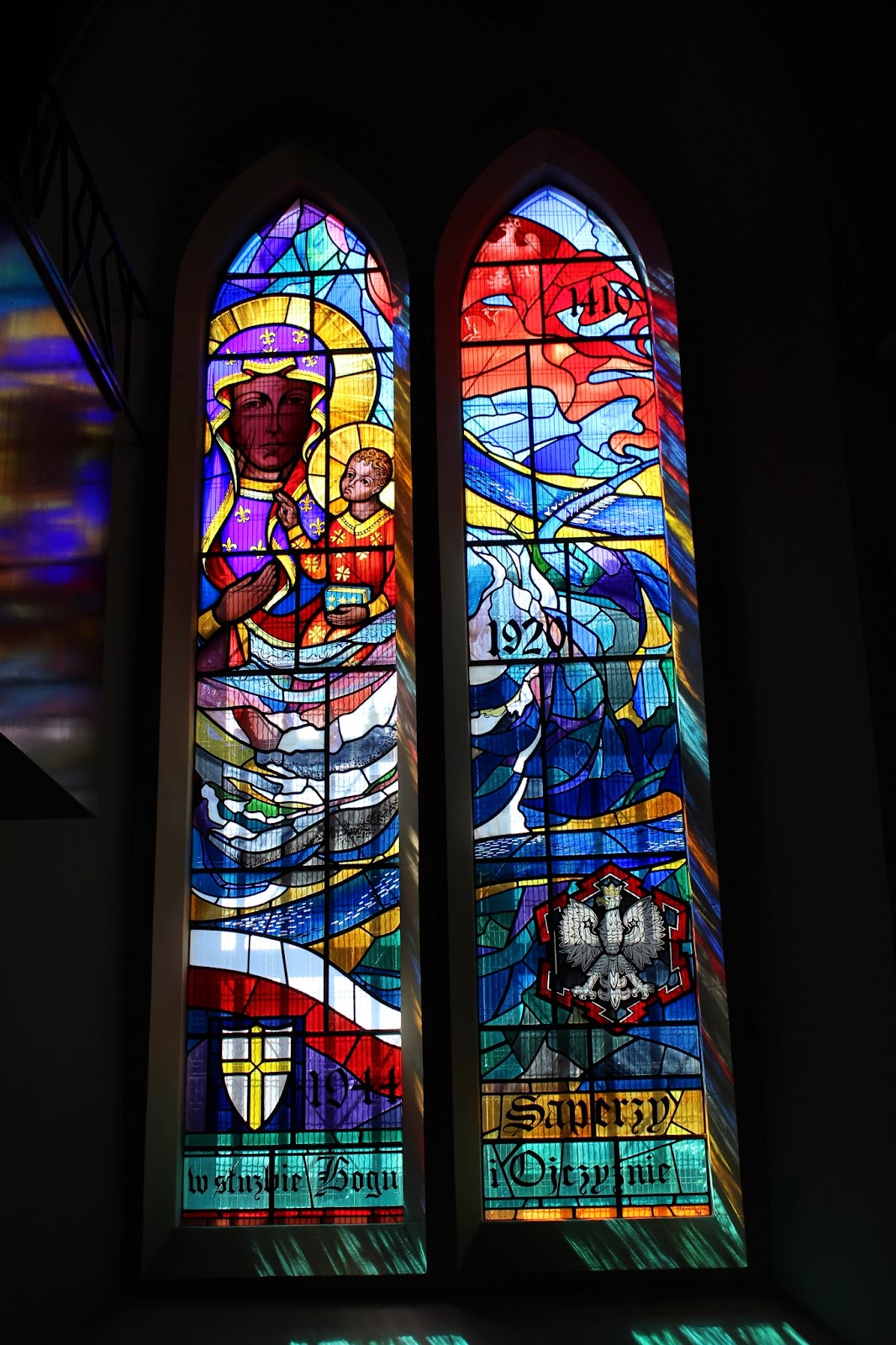
Jan Pieńkowski has also described the stained glass windows which have been skilfully integrated into the church and which relates to the Polish soldiers, sailors and airmen who fought alongside the Allies in World War II:

“Their most distinguished leader was General Wladyslaw Anders, whose memorial fills the triple lancet stained glass window in the south transept. General Anders led the Polish Second Corps in the final push against German troops in Italy, including the heroic assault on Monte Cassino. The window depicts the crucifixion and includes the most revered Polish military decoration, the Virtuti Militari Cross …

The second remarkable window – in the north transept – commemorates Polish airmen who fought in the Battle of Britain. This was designed by the painter Janina Baranowska, who won the competition set by the Union of Polish Airmen in 1979 … The window was made by the firm of Goddard & Gibbs and inaugurated by Cardinal Rubin on 3 April 1980. The three lancet windows cleverly integrate the Cross with two swooping plane trails. The composition is surmounted by the icon of Our Lady of Ostrobrama.

Another interesting window commemorates the Polish secret underground men who were trained at the SOE centre at Audley End and then parachuted into German occupied Poland.”

Janina Baranowska was born in Grodno and remained there until the outbreak of the Second World War. In 1940 she was arrested and deported to Russia. Two years later she was released and joined the Polish Army in its march to the Middle East. In 1946 she moved to London where she studied under Professor David Bomberg at the Borough Polytechnic in 1947-50. For a number of years she was on the Board of the National Society of Painters and Sculptors, and Association of International Arts. In 1980 she became President of the Polish Artists Society in Great Britain, later the Association of Polish Artists in Great Britain and she was a member of the Catholic and Christian Artists group. Baranowska practises painting and graphic art, and designs stained glass windows. She has exhibited in leading galleries in the UK, France, Poland and the United States. Stained glass windows by her can be found at Holy Trinity Church in Wolverhampton, as well as at St Andrew Bobola.

For the last twenty years Baranowska has been working as a Director of the Gallery in the Polish Social and Cultural Centre (POSK) in Hammersmith, in London organising exhibitions and helping artists from Poland and other countries. The mission of POSK is “to promote and encourage access to Polish Culture in all its forms to Poles and non Poles.”

Many Polish artists were forced to flee mainland Europe during the Second World War. Some of these artists journeyed through many countries before settling in the UK, while others were captured and imprisoned before finding their way to British shores. Marian Bohusz-Szyszko was one of the key organisers in this group of artists. Douglas Hall has recounted how Bohusz-Szyszko organised art classes:

“at first in a reception camp, later at various addresses in London and finally at the St Christopher Hospice at Sydenham. The classes became known as the Polish School of Painting, and were eventually taken under the wing of The Polish University Abroad. The relatively younger artists, including [Stanislaw] Frenkiel, founded in 1948 the Young Artists Association … A group calling themselves Group 49 took its place a year later and mainly consisted of pupils of Bohusz-Szyszko … In 1955, with Polish artists beginning to be more successful commercially, a society was formed with the neutral title of The Association of Polish Artists in Great Britain (APA) … Although APA was intended to be a broad church, the pupils of Marian Bohusz were still the most important element.” A former pupil, Halima Nałęcz, was the founder of the Drian Galleries which also regularly hosted “a plethora of personalities from the artistic world of London, both English and Polish.” In addition, Bohusz-Szyszko and other exiled Polish artists (such as Frenkiel, Adam Kossowski, Henryk Gotlib, Marek Zulawski and Alexander Zyw) were part of a consistent but under-recognised strand of artists utilising sacred themes. Bohusz-Szyszko’s work can be found at St Christopher’s Hospice in Sydenham, where he was artist-in-residence.

Many of these artists featured in the recent Pole Position exhibition at the Graves Gallery in Sheffield. Specifically religious paintings in this exhibition, such as Janina Baranowska's Crucifixion and Marian Bohusz-Szyszko's Christ Crowned with Thorns, were “on the anguished side of Christian art” and “agonise in brilliant, almost hellish colour” (Pole Position: Polish Art in Britain 1939 - 1989, Graves Gallery Sheffield, 2014).

As well as organisations like POSK and APA, the Church has been a key source of support for many in the émigré community. Monsignor Bronisław Gostomski was a recent parish priest at the church who was known for working hard to support and unite the Polish community. As parish priest since 2003, he had spearheaded a £1 million renovation project at the church and worked to unite older and younger generations of Poles within his congregation. As the chaplain of  the Polish Ex-Servicemen’s Association (SPK), he cared spiritually for those who had been left in England when the dramatic events of the Second World War and the Cold War took their course.  Moreover, he cared also for those who had come to England in more recent  years in pursuit of a new life and opportunities.  As the Parish Priest he could bring everyone together as one family, regardless of age or personal history. Tragically, he was among 96 victims of a plane crash on April 10 2010, which also claimed the lives of the Polish president Lech Kaczynski, Polish president-in-exile Ryszard Kaczorowski and many of the country's top officials and dignitaries.

With these connections and links St Andrew Bobola is a significant space for memory and memorial, specifically for Poles who died during World War II, but also, more generally, for the Polish community in the UK as a whole.

----------------------------------------------------------------------------------------------

Krzysztof Penderecki - Utrenja I: The Entombment of Christ.