


At St Stephen Walbrook this week, the sound of the Walbrook, Street vendors’ cries and conversations at the Stocks market, Tavern conversations and a Merchant dictating a letter can all be heard as part of the House of Sound. This Sonic Trail sees ‘Mythophones’ – sculptural speakers – placed around Cheapside for listeners to connect to the locations and their previous incarnations.
The river Walbrook played an important role in the Roman settlement of Londinium. Starting in what is now Finsbury, it flowed through the centre of the walled city, bringing a supply of fresh water whilst carrying waste away to the Thames, and dividing Roman London into its eastern and western halves. When St Margaret Lothbury was rebuilt in 1440, the Lord Mayor paid for the lower Walbrook to be covered over. John Stow, the historian of London, wrote in 1598 that the watercourse, having several bridges, was afterwards vaulted over with brick and paved level with the streets and lanes where it passed, and that houses had been built so that the stream was hidden as it is now.
A temple of Mithras dating to the third century AD lay a short distance from St Stephen Walbrook. The remains were found in 1954 during the construction of the Bucklersbury House office block and will be displayed within the new Bloomberg London building.
Prior to the construction of the Mansion House in 1739, the Stocks market lay on the same site, dating to 1282, taking its name from a set of stocks used for punishment. A 1322 decree stipulated that the Stocks market was one of five places where fish and meat were allowed to be sold in London. After Stow's time its character changed, and towards its end was used mostly for selling herbs.
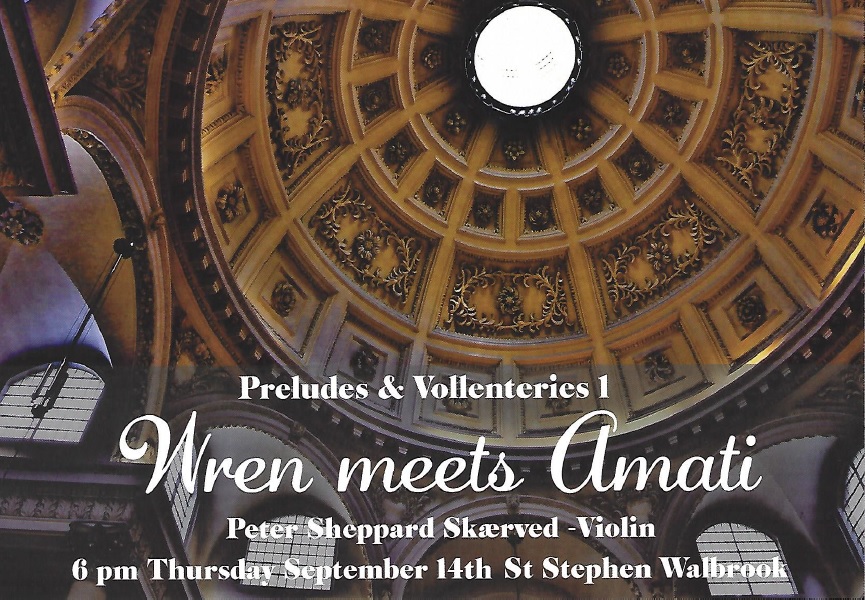

Then, tomorrow at 6.00pm, Peter Sheppard Skærved begins his exploration of the 17th Century violin, inspired by the astonishing churches of the Square Mile. This series of salons will explores the dialogue between the great architecture of Wren, Hawksmoor and Hooke, and the work of the violin makers and composers whose instruments and music flooded in the London in the years after the Restoration.
St Stephen Walbrook is one of the most unashamedly Italianate of Wren’s astonishing City churches. It is the perfect space to hear one of the great early 17th Century Cremonese violins, by Girolamo Amati, in a salon programme focussing on the Northern Italian violin style of the 1600s.
This concert features works for solo violin including:
Heinrich Biber – Passacaglia (Mystery Sonata XVI) ‘Guardian Angel, companion of Mankind’ and others by Tomasso Vitali, Giuseppe Torelli, Nicola Matteis, Biagio Marini. Played on a violin by Girolamo Amati (1628)
Plus world premiere: Peter Sheppard Skærved – ‘voil qe’m digaz cals mais vos plaz’ (Lombarda of Toulouse).
Tickets (limited number) available on Eventbrite and on the door, or reservations from ptrshpprdskrvd@aol.com .
St Stephen Walbrook is one of the most unashamedly Italianate of Wren’s astonishing City churches. It is the perfect space to hear one of the great early 17th Century Cremonese violins, by Girolamo Amati, in a salon programme focussing on the Northern Italian violin style of the 1600s.
This concert features works for solo violin including:
Heinrich Biber – Passacaglia (Mystery Sonata XVI) ‘Guardian Angel, companion of Mankind’ and others by Tomasso Vitali, Giuseppe Torelli, Nicola Matteis, Biagio Marini. Played on a violin by Girolamo Amati (1628)
Plus world premiere: Peter Sheppard Skærved – ‘voil qe’m digaz cals mais vos plaz’ (Lombarda of Toulouse).
Tickets (limited number) available on Eventbrite and on the door, or reservations from ptrshpprdskrvd@aol.com .

Highlights include St Paul in Rome, Constantine, and The Temple of Mithras & St Stephen Walbrook:
25th September - St Paul in Rome
2 October - St Peter in Rome
9 October - The Early Church in Rome
16 October – St Alban
23 October – Constantine
30 October – Christianity in Roman London
6 November – The Temple of Mithras & St Stephen Walbrook
13 November – St Augustine
20 November – St Mellitus
27 November – St Erkenwald & St Ethelburga
Discover & explore has been described as "A really wonderful series of services; intelligent, thought provoking and hopeful - the perfect way to start your working week!"
-------------------------------------------------------------------------------------------------


