Wikio - Top Blogs - Religion and belief
Showing posts with label lake district. Show all posts

Friday, 11 August 2017

Norman Nicholson: Interweaving faith and geography into a theology of place

Vising the Lake District has reminded me of another great Cumbrian poet, Norman Nicholson, who was born on 8 January 1914 in a Victorian terraced house in Millom, where he was to live for most of his life. His writing career stretched from 1940 up until the time of his death. He was awarded the Queen's Gold Medal for Poetry in 1977, and the OBE in 1981.

His poetry is noted for its local flavour, its straightforwardness of language and the use of elements of common speech.Norman Nicholson died on 30 May 1987, leaving behind a rich legacy as the greatest modern day Lake's poet. In St George's Church in Millom, you will find a specially commissioned stained glass window designed and made by Christine Boyce. It is inspired by Norman's poetry and has sections of some of his poems worked into the design.

Martyn Halsall says that with Norman Nicholson we "have a writer whose intense localism proved actually to be liberation, enabling him to interweave faith and geography into a theology of place that stretched beyond global warfare into humanity's war against our fragile globe; a prophetic prophecy with which we need continually to engage."

A post at Vulpes Libris notes that Nicholson "was a man of firm Christian beliefs, and that permeates much of his work – not least the title poem of Sea to the West, which vividly describes the Irish Sea at sunset." "The closing lines of that same poem provided his epitaph – carved on the headstone of his grave at St George’s Church in Millom:

"Let my eyes at the last be blinded
Not by the dark
But by dazzle."

As a result of my visit to the Lakes I'll shortly be reading two anthologies compiled by Nicholson; Anthology of Religious Verse and The Lake District: An Anthology. The latter including Nicholson's wonderful poem about dry-stone walls which is simply entitled 'Wall'.

Kathleen Jones writes in the Introduction to Norman Nicholson: The Whispering Poet that:

"Norman Nicholson detested the ‘cult of the picturesque’. His chosen space was in the edgelands between the Lake District and the sea. He is the celebrant, not of the emotions aroused by landscape, but of man’s relationship with the land, above and below ground, documenting man’s capacity to produce industrial holocausts, exploring geology and its consequences. Norman had great admiration for the poet William Cowper. He wrote a biography of Cowper and praised him for ‘showing the English country scene more as it really was and less as it was imagined to be’. Cowper’s was not a landscape ‘of mountains, torrents and romantic wildness’ but of a more commonplace reality. Cowper ‘celebrated the usual, the everyday, the humdrum’, and this is where Norman chose to place himself, turning his back on the mountains and torrents that formed the north eastern horizon, to focus on everyday life in Millom."

-----------------------------------------------------------------------------------------------

Norman Nicholson - September On The Mosses.

St Martin's Bowness-on-Windermere


I enjoyed visiting St Martin's Bowness-on-Windermere recently. The following comes from their current website:

"Some of the unique features inside St Martin’s Bowness-on-Windermere are the decorative murals, the sixteenth century instructive sayings and the quotations from the Bible on the walls and the roof beams. The only remaining part of the original pattern of decoration is to be found above a window in the south aisle.

The appearance of the present church owes much to the 1870 restoration and enlargement under the architects Paley and Austin of Lancaster. The chancel was extended to the east, as the differing roof beams demonstrate, the tower was heightened and all the seating renewed. Most of the mural decorations (by a Mr Henry Hughes of Frith St, London) including two large paintings in the chancel, date from this time. They serve to relieve the bareness of the smooth re-plastered walls and pillars. The mural on the north wall of the Chancel depicts the Adoration of the Magi, that on the south wall, the Entombment of Christ.

The marble reredos behind the main altar incorporates mosaics, executed by Bell and Almond of London, depicting the symbols of the Gospel writers and the Passion. The reredos, and the whole chancel extension, were designed as part of the Victorian restoration by Paley and Austin.

The outstanding treasure of St Martin’s is the East Window which was so successfully restored in 1870 by Mr Hughes, under the supervision of the Society of Antiquaries, when the new chancel was built. The magnificent East Window contains some very fine stained glass, most of which dates from the 15th century. However, it is not all of this period. Some of the glass at the top is earlier, and the restoration of 1870 made good the damage believed to have been done by Cromwell’s soldiers. This included replacing the faces of the saints.

The history of the window is obscure but it is thought that the glass probably came from Cartmel Priory. The central theme is the crucifixion, flanked by a group of figures including St George (and the dragon), St Barbara, (also an early martyr to the truth) and St Katherine (patroness of learning and theology). In the medieval period, the prayers of these three so-called auxiliary saints were thought to be most effective in aid of the faithful. The supplicants shown kneeling below include Canons of Cartmel as well as various benefactors wearing their coats of arms. The earliest glass is at the top of the third light from the left; a representation of the Virgin and Child believed to date from 1260. In the Middle Ages the Virgin Mary was traditionally depicted in green (later replaced by blue). There is very little glass older than this anywhere in Britain. Surrounding the 15th century coat of arms of a Prince of Wales are many shields relating to north Lancashire families as well as the Prior of Cartmel (strongly suggesting the window’s origin). In the fifth light from the left, one of the seven shields bears what were believed to be arms of that branch of the Washington family (who had lands around the Warton area of Lancashire in the 1400s) and from whom the first president of the United States was descended.

Below the tower, you will see the Curwen Screen, installed in 2000. Magnificent etched glass panels designed by Sally Scott surmount the glass and wood base. The Angels & Music design depicting angels glorifying God through music reflects the theme of the surrounding wall.

At the base of the tower is the statue of St Martin. This carved wooden figure of the Saint shows him on horseback with a beggar, on foot, beside him. The Saint is dividing his cloak with his sword to give half to the beggar illustrating the best-known story of St Martin who became bishop of Tours in France and died in 400 A.D. The statue is probably of foreign origin and dates from the 17th century. It was returned to the church in 1915, having been removed for safekeeping during the 1870 restoration."

-------------------------------------------------------------------------------------------

Thursday, 10 August 2017

John Ruskin: Brantwood and the Ruskin Cross


Today's place of pilgrimage was to Brantwood, home of John Ruskin, and to the Ruskin Cross at St Andrew's Coniston.

Brantwood offers a fascinating insight into the world of John Ruskin and the last 28 years of his life spent at Coniston. Filled with many fine paintings, beautiful furniture and Ruskin’s personal treasures, the house retains the character of its famous resident. Displays and activities in the house, gardens and estate reflect the wealth of cultural associations with Ruskin’s legacy – from the Pre Raphaelites and the Arts and Crafts Movement to the founding of the National Trust and the Welfare State.
"Ruskin was one of the most important art critics and social thinkers of the nineteenth century. He championed the art of J. M. W. Turner and exercised a profound influence on the Pre-Raphaelites. When he came to write his famous architectural history of Venice entitled The Stones of Venice, he began to contrast mediaeval craftsmanship with modern industrial manufacturing."

"Ruskin believed that, to achieve the highest artistic ideals, the artist must understand the God given laws of nature by paying attention to minute details as well as spectacular effects."

"His ideas inspired William Morris and the Arts and Crafts movement but also had profound political implications. When the first Labour Party MPs were elected in 1906, the book that they said had most influenced them was Ruskin’s Unto This Last. Much of the second half of his life was spent defending his ideas that industrialisation and free markets were doing terrible damage to the ability of people to live fulfilling and meaningful lives. Gandhi and Tolstoy are amongst those who found his writing deeply compelling."

Tolstoy said that, ‘Ruskin was one of the most remarkable men, not only of England and our time, but of all countries and all times. He was one of those rare men who think with their hearts, and so he thought and said not only what he himself had seen and felt,but what everyone will think and say in the future.’

"After his death Ruskin’s ideas found expression in the welfare state, the National Health Service, and widening access to education. His analysis of gothic buildings made a direct contribution to the development of modernist architecture."

"Standing by his grave," as W. G. Collingwood wrote, "one cannot but think what we owe him. He was not a mere successful man, but a great pioneer of thought. He led the way to many new fields, which he left for others to cultivate. It is from him chiefly that we, or our teachers, have learnt the
feelings with which we look nowadays at pictures or architecture or scenery, entering more intelligently into their beauty and significance, and providing more consciously for their safe keeping. Nobody for many generations understood so clearly and taught so fearlessly the laws of social justice and brotherly kindness; no one preached councils of perfection so eloquently and so effectively. There are few of us whose lives are not the better, one way or another, for his work."

My appreciation of Ruskin's significance came as a result of the writing of the art critic Peter Fuller. Fuller wrote that:

"When, in the early 1980s, I wrote the essays, later gathered together in Images of God, I felt that I was being tremendously daring and even perverse in reviving the idea that aesthetic experience was greatly diminished if it became divorced from the idea of the spiritual. What I responded to in Ruskin, above all else, was the distinction he made between ‘aesthesis’ and ‘theoria’, the former being a merely sensuous response to beauty, the latter what he described as a response to beauty with ‘our whole moral being’. My book, Theoria, was an attempt to rehabilitate ‘theoria’ over and above mere ‘aesthesis’; I also tried to communicate my feeling that the spiritual dimensions of art had been preserved, in a very special way, within the British traditions."

"I became interested in the links between ‘natural theology’ and the triumphs of British landscape painting. I am still convinced that there is a close correlation between British ‘higher landscape’ and those beliefs about nature as divine handiwork which were held with a peculiar vividness and immediacy in Britain."

Such views seem to have little place in the contemporary art world and, as Jonathan Jones has written, "this fierce defender of figurative painting and enemy of the avant garde has now been almost erased from the history of British art. His legacy has been reduced to the career of his protegee Sister Wendy Beckett and the annual Peter Fuller Lecture ... Even Modern Painters, the magazine he founded in 1987, officially abandoned his editorial policy ... to become broadly sympathetic to conceptual art ... Fuller has disappeared from the story of British art because that story has been mythicised and thinned out."

-------------------------------------------------------------------------------------------------

Creed - With Arms Wide Open.

Tuesday, 8 August 2017

Josefina de Vasconcellos: Kendal Parish Church & Cartmel Priory

Josefina de Vasconcellos was active as a sculptor from the early 1920s. As an artist she followed her own individual path, always believing that sculpture had a role to play as an inspirational force in society. In her extraordinary life she faced many challenges and disappointments, yet, sustained by her sincere Christian beliefs, managed to continue working into great old age. Versions of her best-known work Reconciliation now stand outside Coventry Cathedral, in the Hiroshima Peace Park, at the site of the Berlin Wall and in the grounds of Stormont Castle, Belfast. Many of her other works are in churches, cathedrals and private homes throughout the UK and overseas. More information about her extraordinary life and art can be found in Josefina de Vasconcellos, Her Life and Art.

De Vasconcellos had a lengthy association with Cumbria following her marriage to the artist Delmar Banner. They adopted two boys, and the family settled in a farmhouse at The Bield in Little Langdale at the heart of the Lakes.She carved in an outhouse at the farm while Delmar painted dramatic landscapes from the summits of the Lakeland fells. 

Banner was also an Anglican lay priest, and he led her to be baptised into the Anglican church, a faith that has run through much of her artistic work. Among her works outside Cumbria are ‘Reconciliation’ at Coventry Cathedral and Bradford University, ‘Holy Family’ at Liverpool Cathedral and Gloucester Cathedral, ‘Mary and Child’ at St Paul’s Cathedral, London, ‘Nativity’ (at Christmas) at St Martin-in-the-Fields Church in Trafalgar Square, London (now destroyed), and many more.

In Cumbria she received commissions for 13 different locations, many of which were churches. I have recently seen sculptures by de Vasconcellos at Kendal Parish Church and Cartmel Priory. 


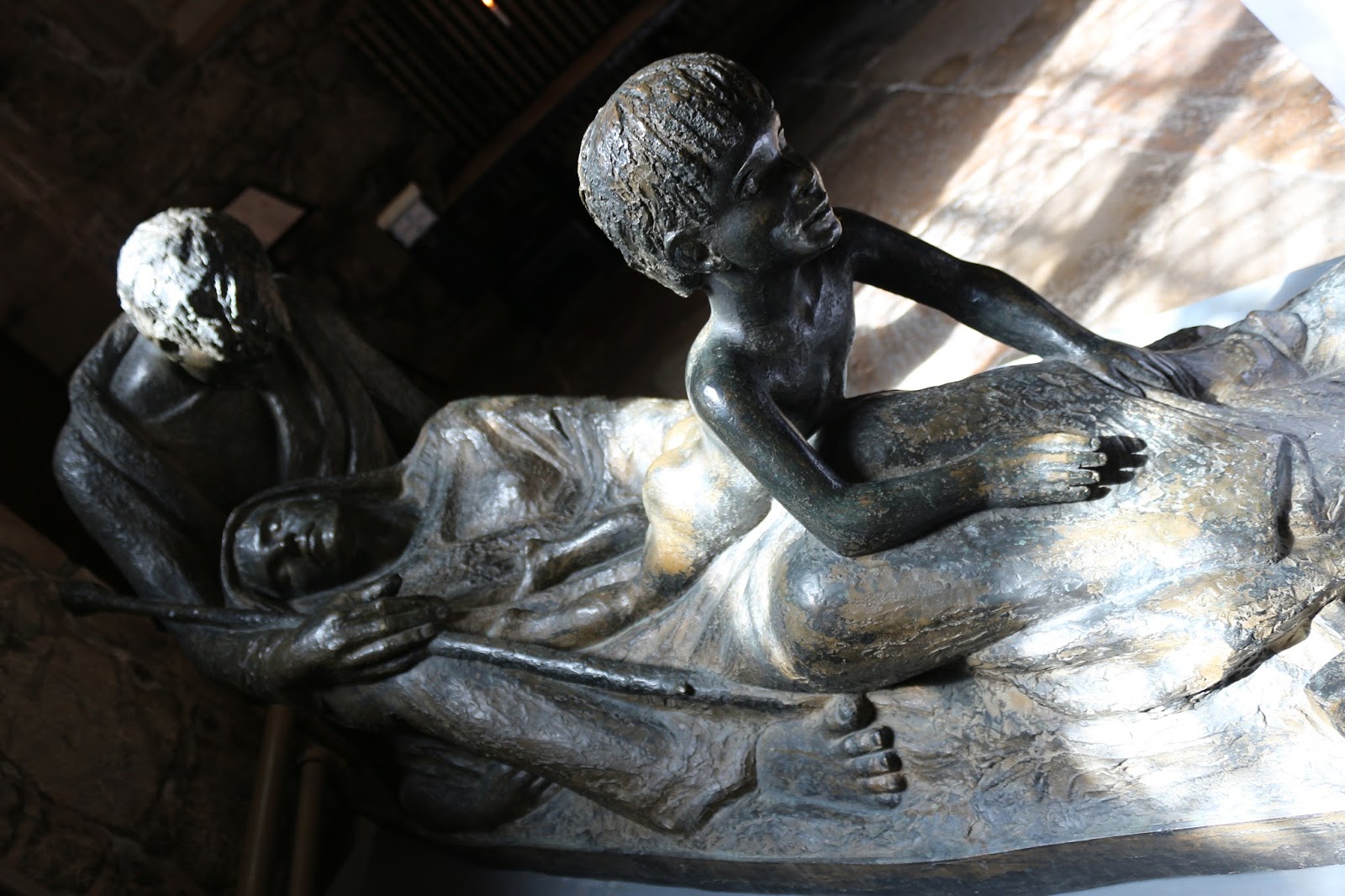
The Family of Man is in the South Aisle at Kendal Parish Church. The setting for this sculpture is a contemporary Refugee Camp in the Middle East. Huddled together, under an old blanket are Mary, Jesus and three children representing the African, European and Oriental peoples of the world. Although it has the appearance of stone the sculpture, like much of de Vasconcellos' work, is made of fibreglass. As a result, it is sometimes moved elsewhere in the church.

At Cartmel Priory, on entering the charming little chapel known as the town choir, de Vasconcellos' sculpture of St Michael the Archangel battling his way through the jaws of the dragon is powerfully evident. In the sedilla in the wall opposite is 'The True Vine' depicting the Virgin Mary and the baby Jesus. 'The Young Martyr' in the North Transept commemorates the four canons and ten laymen executed in 1537 for resisting the closure of Cartmel Priory during the dissolution of the monasteries, and for all martyrs who have died for their faith. On one of the sides the names of the Martyrs of Cartmel from 1537 are carved into the stone. Within the base of a solid stone plinth is a lighted candle in a red glass holder. Topping the sculpture is a head behind solid bars. 'They fled by night – Mary and Joseph and the Holy Child' is a very tactile statue being only a few feet high and made of solid resin bronze so, as many before you have done, you can pass your hands over the work easily without risk of damage. De Vasconcellos has captured a moment when the holy family rested in the desert on their flight into Egypt. St Michael 

-------------------------------------------------------------------------------------------------

Norman Nicholson - Silecroft Shore.

Friday, 27 November 2015

The Lake District: Windemere


A short break in the Lake District began at Broadoaks Country House Hotel 'where the sound of rushing water from the nearby river on its way to Windermere' gives way to the 'secluded, warm and inviting' interior where there are 'ingle nook fireplaces and period furniture.' The hotel is traditionally constructed from Lake District stone and slate with a 'sweeping driveway' and 'seven acres of landscaped grounds' with views across to Windermere and the Langdale Pikes.

'Bowness-on-Windermere is a sprawling tourist town on the shore of Windermere, about halfway along the 12 mile length of the lake between Waterhead at the North end, and Lakeside at the South end. It developed after the opening of the railway line from Oxenholme and Kendal to Windermere in 1847. Bowness was the nearest accessible point on the lake. Now Cumbria’s most popular destination, the town is busy for much of the year. People come to enjoy the lake for sailing and watersports, or just to relax and enjoy the atmosphere of the area and the town’s delightful setting.'

'Situated in the very heart of Bowness on Windermere, the Royal Oak, a small family run Inn, is literally a stones throw from the Bowness bay piers, Lake Windermere and only a few minutes walk from the many traditional craft and gift shops.'

'When the architect MH Baillie Scott built a holiday home overlooking Windermere for his client Sir Edward Holt he created Blackwell, a masterpiece of twentieth-century design; a perfect example of the Arts & Crafts Movement.' Baillie Scott said, “On crossing this threshhold, we pass into a charmed territory where everything shall be in harmony.”

'Blackwell retains many of its original decorative features, including a rare hessian wall-hanging in the Dining Room, leaf-shaped door handles, curious window catches, spectacular plasterwork, stained glass and carved wooden panelling by Simpsons of Kendal. The rooms contain furniture and objects by many of the leading Arts & Crafts designers and studios - metalwork by WAS Benson, ceramics by Pilkingtons and Ruskin Pottery and furniture by Morris & Co., Stanley Webb Davies, Ernest Gimson and Baillie Scott himself.

Recent acquisitions of furniture by Baillie Scott are on display, including an oak and ebony inlaid barrel chair with slatted sides, sideboard and a set of dining chairs. Blackwell offers more than most historic houses with several rooms displaying historical exhibitions that explore different aspects of the Arts & Crafts Movement.'

Work by John Ruskin, Eric Gill and Paul Cezanne can also be seen.

-----------------------------------------------------------------------------------------------

Christina Rossetti - When I Am Dead, My Dearest.