Wikio - Top Blogs - Religion and belief
Showing posts with label shakespeare. Show all posts

Friday, 25 April 2025

Seen and Unseen - How Mumford and friends explore life's instability

My latest article for Seen and Unseen is entitled 'How Mumford and friends explore life's instability' and explores how Mumford and Sons, together with similar bands, commune on fallibility, fear, grace, and love:

'“Serve God, love me, and mend” must rank as one of the more unexpected openings to a hugely popular album in the history of rock ‘n’ roll. A quote from Shakespeare’s Much Ado About Nothing, it introduces us to the potent mix of Shakespearean and Biblical allusion and imagery to be found on Mumford and Sons debut album Sign No More.'

For more on Mumford and Sons see here and here. For more on music and faith see my co-authored book 'The Secret Chord'.

My first article for Seen and Unseen was 'Life is more important than art' which reviews the themes of recent art exhibitions that tackle life’s big questions and the roles creators take.

My second article 'Corinne Bailey Rae’s energised and anguished creative journey' explores inspirations in Detroit, Leeds and Ethiopia for Corinne Bailey Rae’s latest album, Black Rainbows, which is an atlas of capacious faith.

My third article was an interview with musician and priest Rev Simpkins in which we discussed how music is an expression of humanity and his faith.

My fourth article was a guide to the Christmas season’s art, past and present. Traditionally at this time of year “great art comes tumbling through your letterbox” so, in this article, I explore the historic and contemporary art of Christmas.

My fifth article was 'Finding the human amid the wreckage of migration'. In this article I interviewed Shezad Dawood about his multimedia Leviathan exhibition at Salisbury Cathedral where personal objects recovered from ocean depths tell a story of modern and ancient migrations.

My sixth article was 'The visionary artists finding heaven down here' in which I explored a tradition of visionary artists whose works shed light on the material and spiritual worlds.

My seventh article was 'How the incomer’s eye sees identity' in which I explain how curating an exhibition for Ben Uri Online gave me the chance to highlight synergies between ancient texts and current issues.

My eighth article was 'Infernal rebellion and the questions it asks' in which I interview the author Nicholas Papadopulos about his book The Infernal Word: Notes from a Rebel Angel.

My ninth article was 'A day, night and dawn with Nick Cave’s lyrics' in which I review Adam Steiner’s Darker With The Dawn — Nick Cave’s Songs Of Love And Death and explore whether Steiner's rappel into Cave’s art helps us understand its purpose.

My 10th article was 'Theresa Lola's poetical hope' about the death-haunted yet lyrical, joyful and moving poet for a new generation.

My 11th article was 'How to look at our world: Aaron Rosen interview', exploring themes from Rosen's book 'What Would Jesus See: Ways of Looking at a Disorienting World'.

My 12th article was 'Blake, imagination and the insight of God', exploring a new exhibition - 'William Blake's Universe at the Fitzwilliam Museum - which focuses on seekers of spiritual regeneration and national revival.

My 13th article 'Matthew Krishanu: painting childhood' was an interview with Matthew Krishanu on his exhibition 'The Bough Breaks' at Camden Art Centre.

My 14th article was entitled 'Art makes life worth living' and explored why society, and churches, need the Arts.

My 15th article was entitled 'The collective effervescence of sport's congregation' and explored some of the ways in which sport and religion have been intimately entwined throughout history

My 16th article was entitled 'Paradise cottage: Milton reimagin’d' and reviewed the ways in which artist Richard Kenton Webb is conversing with the blind poet in his former home (Milton's Cottage, Chalfont St Giles).

My 17th article was entitled 'Controversial art: how can the critic love their neighbour?'. It makes suggestions of what to do when confronted with contentious culture.

My 18th article was an interview entitled 'Art, AI and apocalypse: Michael Takeo Magruder addresses our fears and questions'. In the interview the digital artist talks about the possibilities and challenges of artificial intelligence.

My 19th article was entitled 'Dark, sweet and subtle: recovered music orientates us'. In the article I highlight alt-folk music seeking inspiration from forgotten hymns.

My 20th article was entitled 'Revisiting Amazing Grace inspires new songs'. In the article I highlight folk musicians capturing both the barbaric and the beautiful in the hymn Amazing Grace and Christianity's entanglement with the transatlantic slave trade more generally.

My 21st article was entitled 'James MacMillan’s music of tranquility and discord'. In the article I noted that the composer’s music contends both the secular and sacred.

My 22nd article was a book review on Nobody's Empire by Stuart Murdoch. 'Nobody's Empire: A Novel is the fictionalised account of how ... Murdoch, lead singer of indie band Belle and Sebastian, transfigured his experience of Myalgic encephalomyelitis/chronic fatigue syndrome (ME) through faith and music.'

My 23rd article was entitled 'Rock ‘n’ roll’s long dance with religion'. The article explores how popular music conjures sacred space.

My 24th article was an interview with Alastair Gordon on the artist’s attention which explores why the overlooked and everyday capture the creative gaze.

My 25th article was about Stanley Spencer’s seen and unseen world and the artist’s child-like sense of wonder as he saw heaven everywhere.

My 26th article was entitled 'The biblical undercurrent that the Bob Dylan biopics missed' and in it I argue that the best of Dylan’s work is a contemporary Pilgrim, Dante or Rimbaud on a compassionate journey.

My 27th article was entitled 'Heading Home: a pilgrimage that breaks out beauty along the way' and focuses on a film called 'Heading Home' which explores how we can learn a new language together as we travel.

My 28th article was entitled 'Annie Caldwell: “My family is my band”' and showcased a force of nature voice that comes from the soul.

My 29th article for Seen and Unseen was entitled 'Why sculpt the face of Christ?' and explored how, in Nic Fiddian Green’s work, we feel pain, strength, fear and wisdom.

-------------------------------------------------------------------------------------------------------

Mumford and Sons - Malibu.

Wednesday, 8 June 2022

Susie Hamilton: Unbound

'Unbound' is a solo exhibition of new painting, prints and works on paper by Susie Hamilton at Paul Stolper Gallery until 11 June. Literature is a constant influence on her work and the new paintings, drawings and prints all have poems or plays as a source. They are also connected by the image of The Rider.

Hamilton says: 

"I have painted The Rider as an ecstatic or combative figure or as a solitary wanderer journeying through wilderness. And it is this last image that inspired my Gawain series where Sir Gawain, King Arthur’s nephew and a Knight of the Round Table, embarks on a desolate winter journey and fights with fantastical creatures on his way to his appointed meeting with the Green Knight. The figure in this sequence is dwarfed, alone and surrounded by cellular forms which represent some of the uncanny aspects of his expedition.

In a second group of works I have fused images of samurai with those of horsemen from Marlowe’s Tamburlaine and Shakespeare’s histories and tragedies. Marlowe elevates his hero in gorgeous language full of reds, golds and cosmic imagery. What Ben Jonson called Marlowe’s ‘mighty line’ enacts the aspiring visions of the conqueror. However the energy and radiance of the blank verse are imbued with extreme violence. And despite the glamour of the warriors, the horror of conflict is an obvious element of my work and is represented visually by mess and blots and smoky layers and rolls of colour which undo form and cohesion. The vitality of the horseman is also counteracted by an appearance of erosion, with areas of the paintings defaced or wiped away as if mutilated by time. The movement of combat is therefore halted and stilled.

My figures are vulnerable to nature, time and to each other but also to the materials of pencil, charcoal, pastel, water and paint. I like to paint people in challenging places and then subject them to an ‘iconoclastic’ method of working which makes and unmakes them. I draw over bodies, obscure them with smears and blurs, dissolve them into fluidity or turn them into semi-abstract forms in order to pull the known towards the unknown.

These equivocal, abstracted shapes, representing figures or surrounding them as part of a landscape, suggest reality changing and expanding. The familiar is morphing into the mysterious as in Sir Gawain and the Green Knight in which supernatural and everyday are interconnected. And, inspired by the stealthy, hidden forces of fate or ‘wyrd’ in this poem, I allow areas of painting to make themselves, since I let paint ooze, creep, flow and curdle into ‘weird’ shapes outside my control. These involuntary marks express for me the unseen motions of the Anglo-Saxon concept of ‘wyrd’, from which our modern word, ‘weird’ is derived.

‘Unbound’ refers therefore to the freedom and energy of horses and riders but also to the way in which my painting is unshackled from realism in order to transform and make strange a recognisable figure, object or landscape."

"My work focuses on figures in wilderness. This wilderness may be literal (the arctic) or metaphorical (the superstore) but both can be arenas for transformation. I paint in thin veils of acrylic which burst boundaries and destroy contours to suggest mutation and deliquescence and show figures as stretched, pulverized, unstable, vulnerable. Such mutation is not just change within the human but beyond it, with figures grotesquely or uncannily turned into humanoid, hybrid things or into blots, cells, messes, silhouettes and, especially, abstract shapes. The representational overtaken by abstraction is important to me, partly because it feels like an extreme way of challenging the figure’s identity but also because it is a way of showing the familiar tipping over into the unfamiliar, of reaching a point where the recognizable gives way to unnamed shapes. Before finding out what an object is, I like the sensation of an obscure but intriguing presence that reminds me of something as yet unlabeled. It dramatizes and contrasts two ways of seeing – in terms of names or of nameless shapes. It is an attempt to get behind the familiar to a sensation of menace or mystery."

Hamilton's works have recently been bought by The British Museum, The Science Museum, Imperial College London and feature in key private collections such as Deutsche Bank and Damien Hirst’s Murderne collection. Her work has received wide media coverage, her Covid-19 series were featured in many outlets including The Art Newspaper and Studio International magazine. She originally studied Fine Art and drawing at St. Martin’s School of Art and Byam Shaw School of Art and she has a first-class degree and a PhD in English literature from the University of London.

Hamilton is the recipient of many awards including the Graham Hamilton Drawing Prize. She is painting three large murals for Hospital Rooms at the new Springfield Hospital, Tooting this spring, a charity that she has worked for since 2018. She lives and works in London.

-----------------------------------------------------------------------------------------------------

C.O.B. - Sheba's Return/Lion Of Judah.

Thursday, 4 August 2016

Seeing More Clearly with the Eyes of Love

Yesterday saw the presentation at St Martin-in-the-Fields of ‘Seeing More Clearly with the Eyes of Love’, a new liturgy for voices based on A Midsummer Night’s Dream, composed to mark the 400th anniversary of William Shakespeare’s death.

A Midsummer Night’s Dream contains two significant references to the New Testament: Bottom’s misquoting of St Paul (‘The eye of man hath not heard, the ear of man hath not seen…’) and Bottom’s declaration taken from the Letter to the Ephesians (‘I assure you: the wall is down that parted their fathers’). In this ‘Liturgy for Voices’ these references are woven together with other excerpts from the play, words from the biblical poem ‘Song of Songs’, and elements from the traditional Christian liturgy to enable those present to explore Shakespeare’s own theme of clarifying the vision which belongs to love. The liturgy also includes five newly commissioned pieces from contemporary poets based on characters in the play: Laurence Sail (Titania), Michael Symmons Roberts (Demetrius), Sinead Morrissey (Puck), Micheal O’ Siadhail (Helena) and Jenny Lewis (Bottom); and the whole is intended to present an aspect of ‘Civic Shakespeare’, reflecting on the potentially transforming effect of love in civil society.

Andy Goodliff has posted a reflection on the experience of being present for this liturgy. He says:

"I like the ambition of the liturgy, the way we journeyed through the play and also the pattern of worship. I loved the music, composed by Myra Blyth (who for her many talents, did not know this was one). The music was suitably Shakespearian in sound, but also had echoes of Karl Jenkins and his The Armed Man: A Mass for Peace. The final piece, which worked as a means of Blessing and Dismissal was wonderful. The intercessions were powerful and brought the themes of love and God into the concerns of our day."

‘Seeing More Clearly with the Eyes of Love’ was a fascinating interweaving of new and old texts, voices, music, responses, symbolic action and performance.

------------------------------------------------------------------------------------------

Friday, 15 July 2016

Seeing more clearly with the eyes of love


As part of the 400th year celebration of William Shakespeare the Oxford Centre for Christianity and Culture will be leading an act of worship at St Martin-in-the-Fields on Wednesday 3 August at 7.00pm entitled: “Seeing more clearly with the eyes of love.” 

The liturgy will weave together excerpts from Shakespeare’s Midsummer Night’s Dream with traditional liturgy and contemporary poetry. It promises to be a very creative and illuminating reflection on the nature of love. This service is open to all and no ticket is required. There will be a retiring collection. All are welcome.

A Midsummer Night’s Dream contains two significant references to the New Testament: Bottom’s misquoting of St Paul (‘The eye of man hath not heard, the ear of man hath not seen…’) and Bottom’s declaration taken from the Letter to the Ephesians (‘I assure you: the wall is down that parted their fathers’). In this ‘Liturgy for Voices’ these references are woven together with other excerpts from the play, words from the biblical poem ‘Song of Songs’, and elements from the traditional Christian liturgy to enable those present to explore Shakespeare’s own theme of clarifying the vision which belongs to love. The liturgy also includes five newly commissioned pieces from contemporary poets based on characters in the play – Laurence Sail (Titania), Michael Symmons Roberts (Demetrius), Sinead Morrissey (Puck), Micheal O’ Siadhail (Helena) and Jenny Lewis (Bottom) – and the whole is intended to present an aspect of ‘Civic Shakespeare’, reflecting on the potentially transforming effect of love in civil society.

------------------------------------------------------------------------------------------

Michael Symmons Roberts - Pelt.

Wednesday, 30 March 2016

Compton Verney: The Shakespeare Gallery & Shakespeare in Art


Compton Verney is an independent national art gallery and ‘Capability’ Brown landscape located nine miles from Stratford-upon-Avon. Its current exhibitions celebrate the 400th anniversary of Shakespeare's death.

'With the legendary actor-manager David Garrick serving as Shakespeare's high priest, bardolatry swept mid-18th-century England to the point that painters, too, reproduced the words and scenes that actors portrayed onstage. The artists' response on canvas, of course, was not entirely devotional. Prints of their paintings also earned them a pretty penny.

In this they were helped by the public's growing familiarity with at least a dozen Shakespeare plays, notably "Hamlet," "King Lear," "Othello," "Romeo and Juliet" and "Richard III."' (Alan Riding, NY Times)

This is where Compton Verney's exhibitions begin. Boydell’s Vision: The Shakespeare Gallery in the 18th Century traces the history of John Boydell’s famous Shakespeare Gallery which opened in 1789 on London’s Pall Mall. The Shakespeare Gallery was the first thematic public exhibition of its time and also the first devoted to the Bard.

Using Shakespeare as a vehicle for the development of a national school of history painting, the print publisher John Boydell commissioned prominent painters, sculptors and printmakers of the day, including George Romney, Henry Fuseli and James Northcote, to produce works depicting scenes from all of Shakespeare’s plays.

Boydell’s Vision is the first exhibition in the UK to explore the formation of this early blockbuster, and includes paintings and prints by the artists commissioned by Boydell, as well as a recent digital reconstruction of The Shakespeare Gallery as it looked in 1796.

The example of Boydell's Shakespeare Gallery provides the inspiration for the theatrical design of Compton Verney's other Shakespeare exhibition. Shakespeare in Art: Tempests, Tyrants and Tragedy offers an opportunity for art and theatre lovers to discover his works through a unique series of theatrical encounters. These include paintings, photography, projection and a sound score and readings by leading Royal Shakespeare Company actors.
Shakespeare was a master of dramatising human emotions in their myriad forms. His plays are as relevant to us today as they were over 400 years ago and they remain a vital source of inspiration to artists. This major new exhibition focuses on pivotal Shakespeare plays, including The Tempest, Hamlet, Macbeth and A Midsummer Night’s Dream, all of which have motivated artists across the ages, from George Romney, Henry Fuseli, Dante Gabriel Rossetti, John Singer Sargent and G.F. Watts to Karl Weschke, Kristin & Davy McGuire and Tom Hunter.

-----------------------------------------------------------------------------------------------

Kate Tempest - What We Came After.

Saturday, 18 April 2015

Why the Bible is box office

The Guardian has a useful summary of twentieth century religious drama as a result of several new productions which suggest that the Bible is currently box office:

'Temple by Steve Waters opens next month at the Donmar Warehouse in London ...  a fictionalised version of the clash between clergy and anti-capitalist protesters during the occupation of the piazza outside St Paul’s in 2011-12.

And, last week, Temple Church in London became a temporary stage for performances of a new production by director James Dacre of Shakespeare’s King John, in which the English monarch faces inquisition and excommunication by a cardinal sent from Pope Innocent III ...

Two recent openings at the National Theatre – a revival of Shaw’s Man and Superman and Tom Stoppard’s new play The Hard Problem – feature debates, Shavian and neo-Shavian respectively, about the likelihood of God. And the West End has just staged a revival of Peter Barnes’s 1969 comedy The Ruling Class, with James McAvoy as an English aristocrat who shocks his Anglican, Tory family by announcing that he is the Risen Christ.'

It is also interesting to compare and contrast this article with a 2012 Guardian article claiming that, 'despite its roots in ritual, religion gets barely a look-in on stage these days.'

-------------------------------------------------------------------------------------------

Pops Staples - Somebody Was Watching.

Saturday, 19 April 2014

There is a need for models of sacrifice in society

Madeleine Bunting highlights the ideas of theologian Sarah Coakley in today's Guardian. Coakley argues that sacrifice needs to be restored as a central biological, ethical and theological principle. Far from sacrifice being an outmoded ritual, it is central to human experience:

'She cites recent evolutionary theory that puts sacrificial co-operation on a par with mutation and selection as a fundamental "principle" of evolution. "Individual evolutionary loss can be group evolutionary gain," she says.

Rather than imagining our genes as selfish, struggling in a race for the survival of the fittest, we can see evolution as requiring ceaseless sacrifices, small and large, to ensure the survival of the group ...

What makes Coakley's ideas so challenging is that, as she suggested in her 2012 Gifford lectures, "there is a need for models of sacrifice in a society" – that the existence of people dedicated to an "altruism beyond calculation" plays a critical role in challenging, inspiring and provoking the social order around them ...

We are living in an age of sacrifice on a near apocalyptic scale: a great extinction is under way with hundreds of species being eliminated as their habitats are destroyed. Looking at another dimension of this age of sacrifice, we have developed a global economy in which people's wellbeing and communities are routinely sacrificed for the sake of economic growth and efficiency – strange gods built on fantasies that allege rationality.

This is the ugly sacrifice that consumer capitalism attempts to conceal with its glamorous illusions and ideology of desire and entitlement, of self-fulfilment and self-expression. Capitalism offers speed, convenience and choice, but behind all of these lies sacrifice, from the poor working conditions of an exhausted workforce to the water-stressed cotton fields.

The urgency of us grasping the importance of sacrifice in human experience must surely be a vital part of any sustainable future.

Any proposal to slow down or reverse our destructive impact on the natural environment leads to talk of sacrifice on the part of consumers in western developed economies. Only when we understand how sacrifice can be a force for good have we any hope of restraining our destructive capabilities.'

Among other excellent Easter-themed coverage is John Dugdale's listing of 10 key Easter scenes to be found in writers ranging from Shakespeare to Yeats and Goethe to Tolstoy.

-----------------------------------------------------------------------------------------

Linda Perhacs - The Soul Of All Natural Things.

Thursday, 3 October 2013

Translating what we hear and read into lives that speak

Today at St John's Seven Kings we hosted a thanksgiving service for the life of John Toll. During the service I said the following:

"The Book of Common Prayer has been and continues to be loved" (as was the case with John) "for its wonderful language, dignified and memorable but always speaking to our human condition. Phrases from it have come into everyday use and have been quoted in literature. 'Till death us do part', 'read, mark, learn and inwardly digest', 'peace in our time'." With the Authorised Version of the Bible, "it has shaped the language of worship both in public services and private prayers." More than that, as Melvyn Bragg has said, "There is no doubt in my mind that the King James Bible not Shakespeare set this language on its path to become a universal language on a scale unprecedented before or since." 
 
John might have disagreed with that because he also loved Shakespeare’s ability "to summarize the range of human emotions in simple yet profoundly eloquent verse which is perhaps the greatest reason for his enduring popularity. If you cannot find words to express how you feel about love or music or growing older, Shakespeare can speak for you. No author in the Western world has penned more beloved passages. Many of the common expressions now thought to be clichés were Shakespeare's creations. Chances are you use Shakespeare's expressions all the time even though you may not know it is the Bard you are quoting."
 
As Bernard Levin said, “... if you have ever refused to budge an inch or suffered from green-eyed jealousy, if you have played fast and loose, if you have been tongue-tied, a tower of strength, hoodwinked or in a pickle, if you have knitted your brows, made a virtue of necessity, insisted on fair play, slept not one wink, stood on ceremony, danced attendance (on your lord and master), laughed yourself into stitches, had short shrift, cold comfort or too much of a good thing, if you have seen better days or lived in a fool's paradise - why, be that as it may, the more fool you, for it is a foregone conclusion that you are (as good luck would have it) quoting Shakespeare ...”

The language of Shakespeare, the King James Bible and the Book of Common Prayer live on when we use their words and phrases in everyday discourse but these words really come alive, as John knew for himself, when we act them out. Shakespeare lives in performance and the King James Bible and Book of Common Prayer become contemporary when we "translate what we hear and read into lives that speak God’s truth afresh in our generation."

That was what John sought to do in every aspect of his full and varied life: in his conscientious work for Plesseys; in his enjoyment of sport and his encouragement of the boys in his football team; in his many friendships and his love of his godchildren; in his care of his mother; in his dedication to the support of live theatre; in the care and commitment shown in his volunteering; and in his enabling of worship through his many years as a server here at St John’s. The words that he loved shaped the man that he became and the man that he became translated what he heard and read into a life that spoke God’s truth in and through all aspects of the full life he lived - in the Arts, the Church, relationships, sport, and work (paid and unpaid).

In bearing God's image John brought light to our lives; for we saw in his friendship reflections of God's compassion, in his integrity demonstrations of God's goodness, in his faithfulness glimpses of God's eternal love. As we pray, may God grant to each of us, beloved and bereft, the grace to follow John's good example so that we, with him, may come to God's everlasting kingdom; through Jesus Christ our Lord.        

O eternal Word of God, limitless and free, yet handed down to us through careful human speech, telling salvation's story in the homely and glorious words of our own mother tongue: translate what we hear and read into lives that speak your truth afresh in this generation, that many may come to love you our Saviour Jesus Christ. Amen.

---------------------------------------------------------------------------------------------

Tomaso Albinoni - Violin Concerto in G Minor.

Sunday, 30 June 2013

The past is not even past

Having been to see Saints Alive by Michael Landy at the National Gallery, Laura Cumming's Observor review seems to me to be the one which captures the significance of this exhibition best:

"It is remarkable that the National Gallery had such faith in Landy, never mind reinforcing the floors for his giants. But the result is a tremendous event that seizes the viewer, involving us in a spectacle of passion, conviction, suffering and belief driven both literally and mechanically by violence. Their true subject, in this respect, is awe. These sculptures take you into the paintings, but above all into the lives of the saints, in the most eye-popping, nerve-touching, heart-wrenching way."

As Cumming notes "Landy has spent the past two years looking hard at paintings of saints and thinking about the complete self-abnegation of their lives." Similarly, Tim Rollins and K.O.S. also regularly create contemporary art based on art of the past. William Faulkner's statement - ‘The past is not dead. In fact, it’s not even past.’ - is a guiding light for their work. Accordingly, they "embrace the idea of the arena of art existing in the fourth dimension of a social imagination beyond space and time, contingency and possibility."

Inspired by the Time Traveller in H.G. Wells’ The Time Machine (1895) the group have endeavoured to explore this idea in their current exhibition at the Maureen Paley Gallery and have made work based on imaginary ‘visitations’ with Shakespeare, Mendelssohn, Haydn, Darwin and Strauss:

"Their journey begins in 1590 at the time when Shakespeare was writing A Midsummer Night’s Dream and simultaneously in 1826 when Mendelssohn at 17 years of age began work on his own score for a production of this play. In their work A Midsummer Night’s Dream (after Shakespeare, 1590-1596 and Mendelssohn 1826–1842) they invited young people to transform into the character of Puck, painting flowers and blossom over sheet music from Mendelssohn’s score that was completed in 1842. Next they imagined the first performance of The Seven Last Words of Christ by Haydn in 1786 and created seven paintings that use black Spinel pigment that they applied onto pages from this score. They then visited Charles Darwin in 1837 as he began sketching out his idea of a ‘Tree of Life’ in one image that would be developed into his theory of evolution described in On the Origin of Species published in 1859.

In 1945 they meet with Richard Strauss in the final days of WWII while he was composing his elegiac and mournful Metamorphosen (in Memorium). This music created a deep desire within the group to reflect on their experiences working in the South Bronx that brought up feelings of tragedy and transformation, destruction and rebirth. They have created a meditation in this new body of work that memorializes, researches and remains hopeful by existing in past, present and future tenses."

-----------------------------------------------------------------------------------

Joseph Haydn - The Seven Last Words Of Our Saviour On The Cross.

Tuesday, 16 April 2013

Windows and gardens: Chigwell and Capel Manor


I went with my Mum and youngest daughter today to see St Mary's Chigwell, as it is the church where my eldest daughter will be getting married this summer. The church has an engraved window of Christ and the Children by Jennifer Conway, who was a pupil of John Hutton. When Hutton's King Lear and Cordelia panel at the entrance to the Shakespeare Birthplace Trust Gallery at Stratford upon Avon was damaged, Conway made a copy. Her engraved windows can be found at St Mary Barcombe and St Nicholas Sandhurst, as well as St Mary Chigwell. St Mary's also have a Christ and the Magi window by Frederick Cole. Afterwards we went to see the interesting show gardens at Capel Manor.

----------------------------------------------------------------------------------------

Larry Norman - She's A Dancer.

Saturday, 3 September 2011

Clerkenwell tour


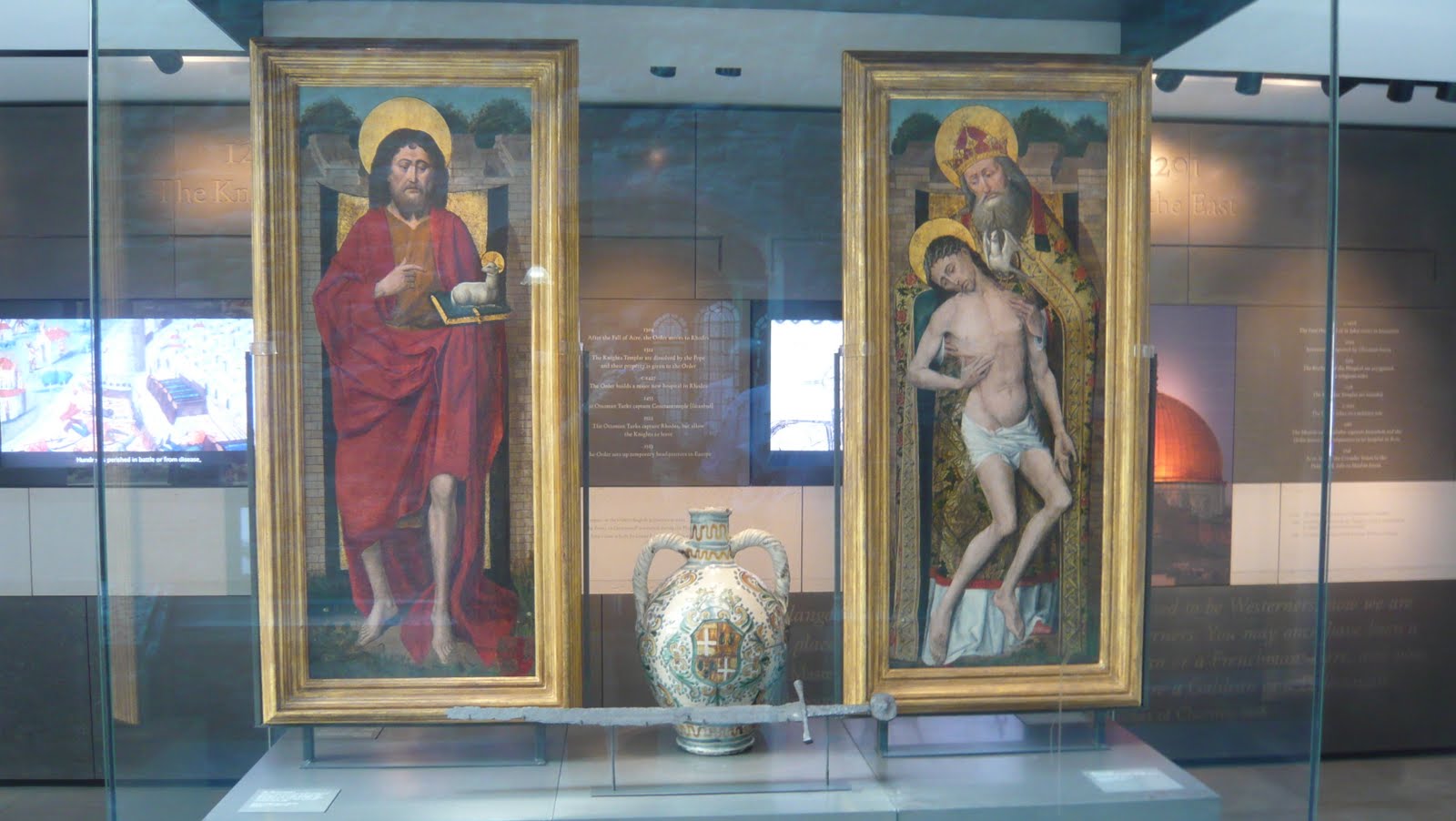
Today I have been on a fascinating tour of Clerkenwell taking in St James Clerkenwell, the Clerk's Well, the Priory Church of St John, St John's Gate, Museum of the Order of St John, and the grave of a possible relative of John Wilkes Booth (who assassinated Abraham Lincoln).

The Museum of the Order of St John is one of the great hidden treasures of London, tracing the continuous history of a charity that dates back over 900 years. The Order of St John, an international charity, has a remit to provide humanitarian aid and medical support worldwide. The Museum tells the story of the Order of St John, from its origins in the 11th century to its role today with St John Ambulance and the St John Eye Hospital in Jerusalem. The Hospitaller brothers both fought, and
nursed the sick, in the Holy Land and on their island fortresses of Rhodes and Malta.

St John’s Gate was the entrance to the former Priory of St John and the Museum buildings
also have a unique history. After the Dissolution of the Monasteries by Henry VIII, the Priory
housed the office of the Master of the Revels, where Shakespeare came to licence his plays. It was also the childhood home of the artist, William Hogarth, and the writer Dr. Samuel Johnson worked in the building when it was a printing press. By the 19th century the building had become the Old Jerusalem Tavern, where Charles Dickens came to drink.

In the Cloister Garden of the Priory Church of St John there is currently a sculpture exhibition by Mystery In Stone, a collective of premiere Zimbabwean artists from the first, second, and third generation of stone sculptors. Mystery In Stone was established in 1995 as the artist's creative vision of themselves, their work and of those who treasure their accomplishment. The foundation of Mystery In Stone is honour and respect for the history, culture, traditions, beliefs, faith, and lives of the artists and the community and families that have conceived and nurtured them. They write that, "In the same way that our artwork is the realization of the spirit that lives within the uncut stone, Mystery In Stone is the creative realization of the spirit and vision that lives within our artists."

----------------------------------------------------------------------------------------------------

Lisa Gungor - Jesus And John.