Wikio - Top Blogs - Religion and belief
Showing posts with label deutsch. Show all posts

Tuesday, 27 January 2015

Holocaust Memorial Day


Here is the speech I gave today at the Holocaust Memorial Day event in Redbridge:

Last year I was fortunate, through my sabbatical visits and through the Tour of the Holy Land organised by the East London Three Faiths Forum, to see a wide variety of artwork in churches and synagogues by the Russian Jewish artist Marc Chagall. Chagall was controversial as a Jewish artist for painting images of Christ’s crucifixion.

Chagall’s church commissions were created, ‘In the name of the freedom of all religions’ while, for him, ‘Christ ... always symbolized the true type of the Jewish martyr.’ He depicted this perception most famously in White Crucifixion painted in 1938 in response to the persecution of Jews by the Nazis, including Kristallnacht. Central to this painting, among scenes of anti-Jewish violence which included the torching of a synagogue, is Jesus on the cross with a tallit, the Jewish prayer shawl, draped around him as a loin cloth. For Chagall, ‘Jesus on the cross represented the painful predicament of all Jews, harried, branded, and violently victimized in an apparently God-forsaken world.’

A similar perception is described by Elie Wiesel, an Auschwitz survivor, in his book Night. There he writes: ‘The SS hanged two Jewish men and a youth in front of the whole camp. The men died quickly, but the death throes of the youth lasted for half an hour. "Where is God? Where is he?" someone asked behind me. As the youth still hung in torment in the noose after a long time, I heard the man call again, "Where is God now?" And I heard a voice in myself answer: "Where is he? He is here. He is hanging there on the gallows.’

Seen by Elie Wiesel in the context of Judaism and of the humiliation of God in going with Israel into exile and suffering, for Christians this moving story has a striking resonance because of the crucifixion. For Jews and Christians alike, the face of desolation wears another aspect, that of the presence and providence of God.

In Christian vocabulary this could be described as the prayer of incarnation. This is a prayer of presence; a prayer which recognizes that God shares our pain, frailty and brokenness. We pray acknowledging that God suffers with us. From Christ’s life, Christians also recognise two other types of prayer: the prayer of resurrection in which we pray for a miracle; and the prayer of transfiguration where, as Samuel Wells has written, ‘we see a whole reality within and beneath and beyond what we thought we understood.’ In times of bewilderment and confusion we pray that God might reshape our reality, to give us a new and right spirit to trust that even in the midst of suffering and hardship, truth can still be experienced and shared.

At Yad Yashem, on the East London Three Faiths Forum Tour of the Holy Land, I saw examples of this prayer in the words of Aharon Appelfeld who said, ‘From among the horror grew another morality, another love, another compassion. These grew wild – no one gave them a name.’ Similarly, on the Yad Vashem website I read of survivors, ‘dazed, emaciated, bereaved beyond measure,’ who ‘gathered the remnants of their vitality and the remaining sparks of their humanity, and rebuilt.’ ‘They never meted out justice to their tormentors – for what justice could ever be achieved after such a crime? Rather, they turned to rebuilding: new families forever under the shadow of those absent; new life stories, forever warped by the wounds; new communities, forever haunted by the loss.’

I also saw pages from the illustrated Bible which self-taught artist Carol Deutsch loving crafted in 1941 in Antwerp, during the turmoil of the Second World War, as a gift for his daughter’s second birthday. Carol Deutsch and his wife Fela were informed upon and murdered in the extermination camps. However, their daughter Ingrid, who was hidden with a Catholic family in the countryside, survived, as did the Bible, which miraculously remained intact. Deutsch, who died in Buchenwald, left behind a vital estate - a stalwart resistance to everything the Nazis had attempted to obliterate.

Finally, for those who are Christians, Karen Sue Smith has noted that ‘Chagall’s genius was to use Jesus’ crucifixion to address Christians, to alert them by means of their own symbol system to the systematic cruelty taking place in the Holocaust.’ For Christians then, our response should, I think, be in line with the words of Pope Francis from an interview in 2013. There he spoke of his admiration for White Crucifixion praising Jews for keeping their faith despite the Holocaust and other “terrible trials” throughout history (by implication, including those for which the Church is cupable), reaffirmed Judaism as the “holy root” of Christianity saying that, where this understood and affirmed, a Christian should not ever be an anti-Semite because “to be a good Christian it is necessary to understand Jewish history and traditions.”

I pray that this will be so for my own faith community and that God might reshape our reality, to give us a new and right spirit to trust that even in the midst of suffering and hardship, truth can still be experienced and shared.

See here and here for reports and photographs from the Redbridge event.

------------------------------------------------------------------------------------

Azamra - Shuvi Nafshi.

Sunday, 16 November 2014

East London Three Faiths Forum Tour of the Holy Land: Art


Tzfat with its 'quaint alleyways, stone buildings, blue painted doorways' and 'tradition as a mystical city', has 'attracted artists from all over Israel and the world' and has created an 'artist colony in the heart of the city's Old City'. As Tzfat is 'known throughout the world as the city of Kabbalah', many of the artists located there 'devote their creative energy towards art influenced by this mystical religious text'. The Hasidic influenced art of Marc Chagall has also provided clear inspiration for some of Tzfat's artists. Chagall himself painted an interior of Tzfat's synagogues, one of which is now in The Israel Museum, Jerusalem.

While in Tzfat I discovered the work of Asia Katz, who was born in Bulgaria. She moved to Israel in 1991 and came directly to Tzfat. 'Although she previously studied and worked exclusively in photography, once in Israel she began to experiment with different styles of drawing and painting which can be seen today in her gallery'. 'Asia combines multiple styles to create modernistic, cubist-styles drawings and paintings. She employs various approaches with her works including traditional, modern, folk and contemporary art styles. Asia’s paintings and drawings concentrate on exploring people and objects and their interaction with each other and the world around them.' 'She paints and draws in a way that encourage the viewer to look at a work in different ways so as to see it from a fresh point of view at each viewing.'

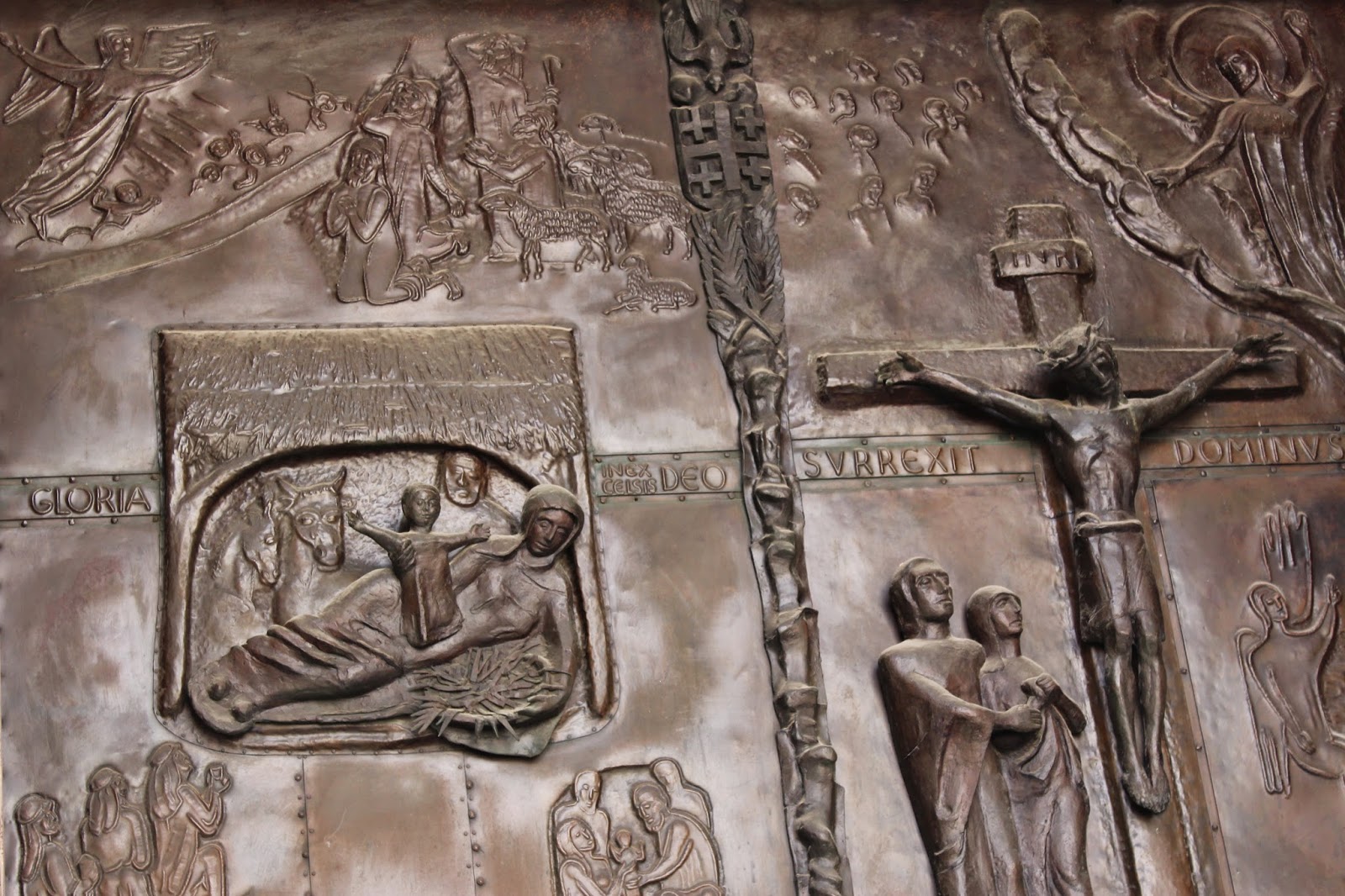
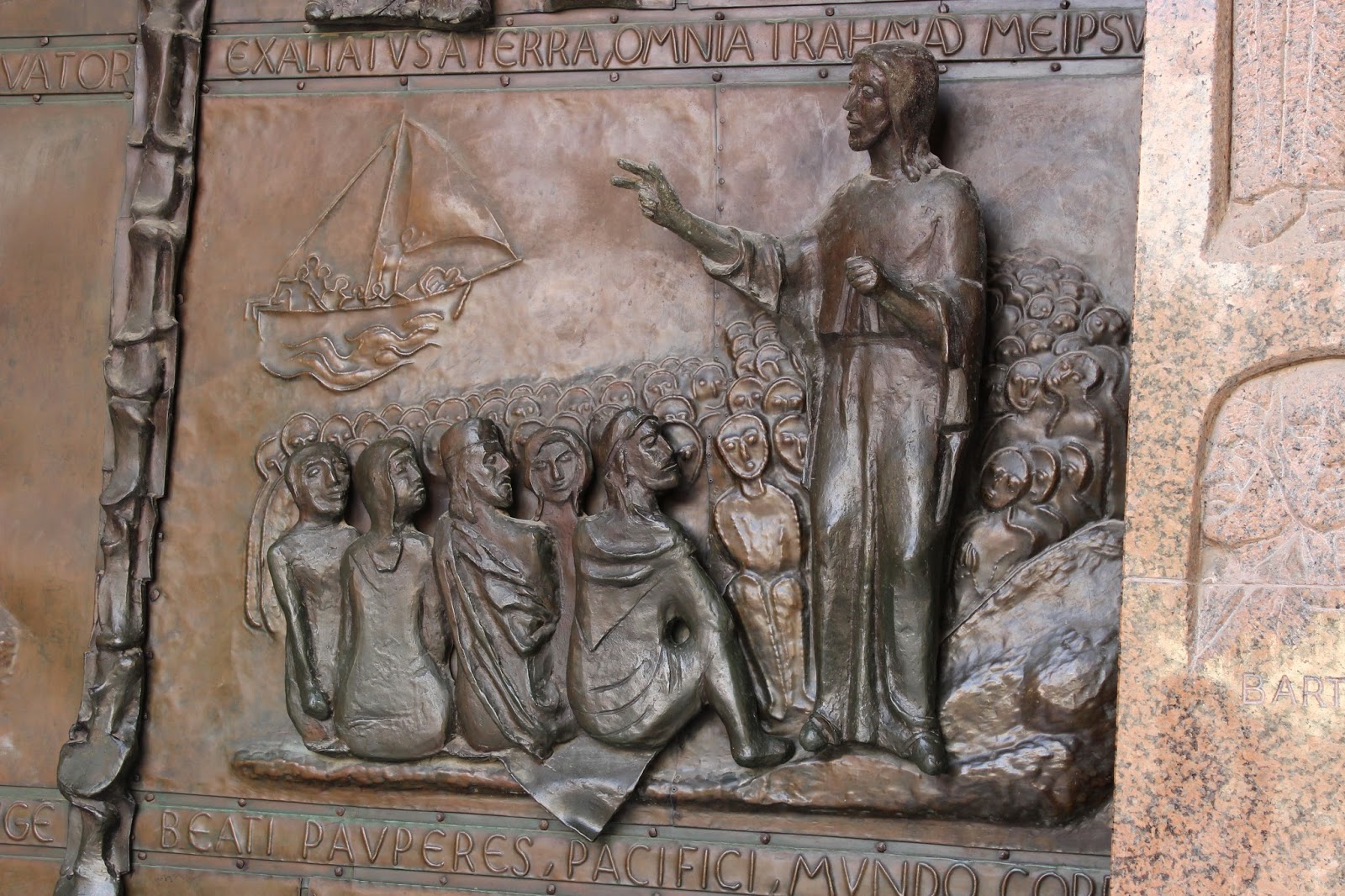
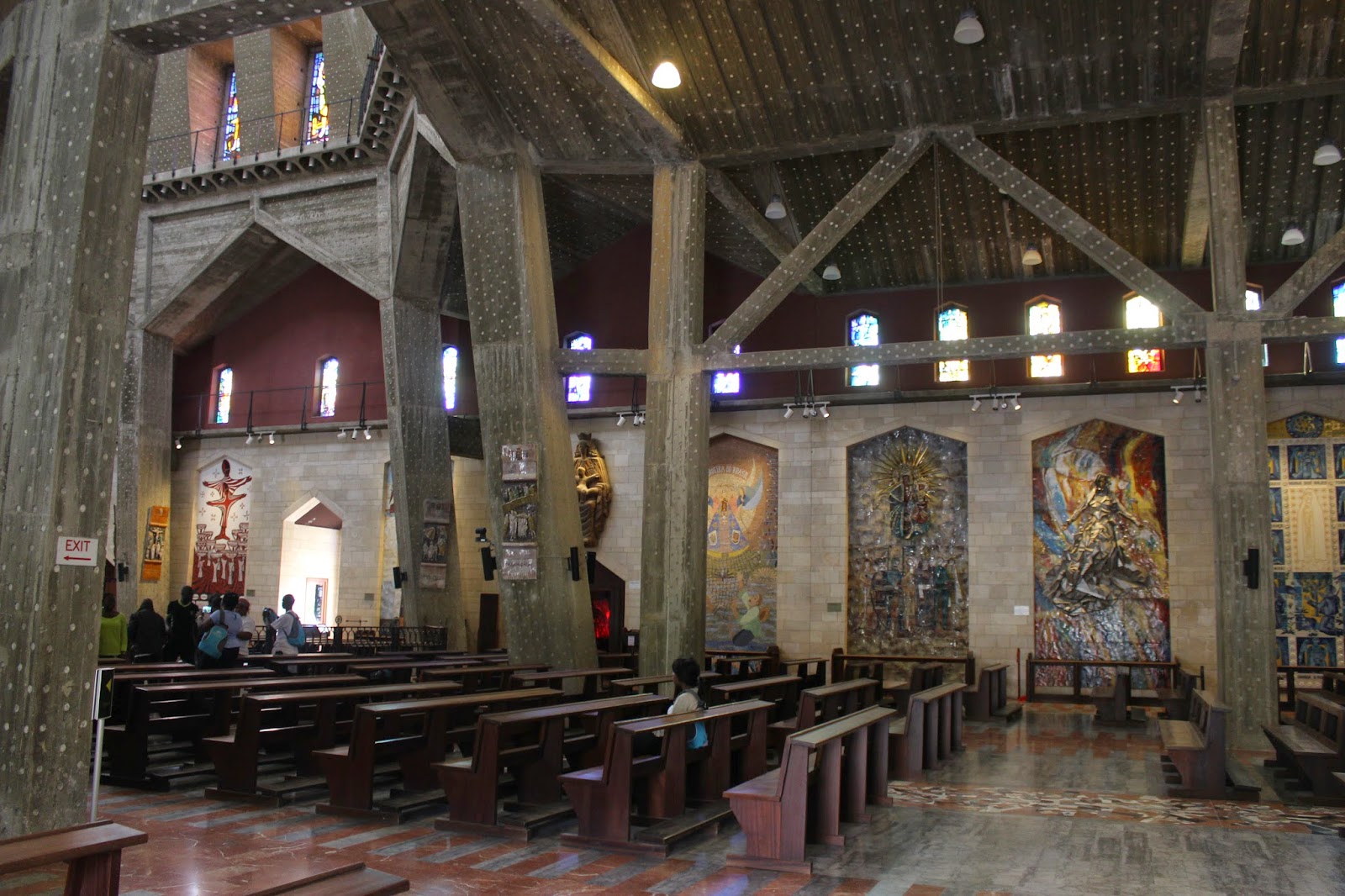
Designed by the architect Giovanni Muzio, the Basilica of the Annunciation in Nazareth is built on two levels. The architect conceived a plan of two churches, one above the other and interconnected: the lower or crypt on the level of the former churches, and the upper church. The lower preserves the Holy Grottos and the remains of the Byzantine and Crusader churches. The roof opens in a starlike lantern in the centre of the upper church to which there is access by a stairway. The upper Church is the Latin Parish Church of Nazareth. This new basilica, the largest Christian sanctuary in the Middle East, was dedicated in 1964 by Pope Paul VI during his historic visit to the Holy Land, and consecrated on 23 March 1969.

Fathers Bellarmino Bagatti, O.F.M., and Emmanuel Testa, O.F.M., worked with Muzio and a group of theologians to plan the artwork in the Basilica. More than 20 countries or regions on five continents accepted an invitation to provide copies of locally honoured images of Mary. Together, these images provide a powerful reminder of the universal, multicultural face of God’s people on whose behalf Jesus suffered, died and rose from the dead. The artwork inside and outside the Basilica of the Annunciation reflects an inculturated universality. Among the artists who contributed work are Justin O'Brien, Fr. Engelbert Mveng and Luke Hasegawa.

The windows of the south and west façades represent various elements of the Annunciation and were realised by the Parisian artist Max Ingrand. The windows in the lower church are the work of Lydia Roppolt and were a gift from Austria. The windows of the dome are made of concrete and coloured glass by the Swiss painter Yoki Aebischer and represent: the Apostles, the Saints Joachim and Anna, Saint Ephrem the Syrian, Saint Bernard of Clairvaux.

The light that emanates from twelve stained glass windows by Marc Chagall bathes the Abbell Synagogue at the Hadassah University Medical Center in a special glow. 'The synagogue's Jerusalem stone floor and walls absorb this beauty and reflect it.' 'The Bible was Chagall's main inspiration, particularly Genesis 49, where Jacob blesses his 12 sons, and Deuteronomy 33, where Moses blesses the Twelve Tribes. The dominant colors used in each window are inspired by those blessings as well as by the description of the breastplate of the High Priest in Exodus 28:15, which was described as gold, blue, purple and scarlet, and contained 12 distinct gems. Each gem was dedicated to a tribe with the tribe's name engraved on it.'

'To fully understand the significance of the Windows they must be viewed against Chagall's deep sense of identification with the whole of the Jewish history, its tragedies and victories, as well as his own personal background in the shtetl of Vitebsk, where he was born and grew up. "All the time I was working," he said, "I felt my father and my mother were looking over my shoulder, and behind them were Jews, millions of other vanished Jews of yesterday and a thousand years ago."' After our visit I spoke to our group about Chagall's background and work highlighting the fact that these windows inspired commissions for stained glass in the UK at Tudeley Parish Church and at Chichester Cathedral.

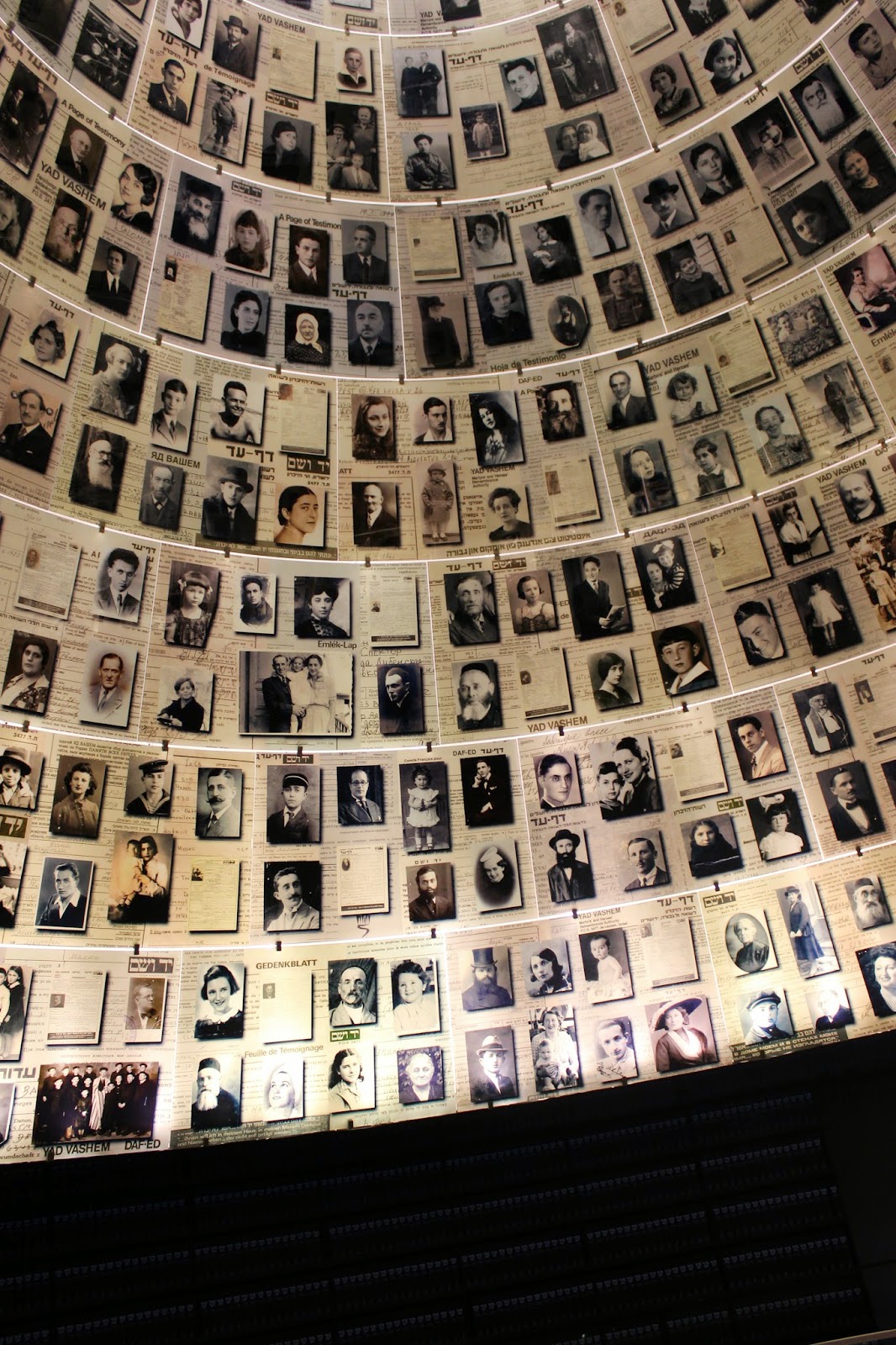
Yad Vashem is one of the world's largest concentrations of peace monuments and sculptures including the Children's Memorial, the Pillar of Heroism, From Holocaust to Rebirth and Hall of NamesYad Vashem’s collection of Holocaust art is the largest and most wide-ranging collection in the world. It comprises some 10,000 works, most of them from the Holocaust period. The new Holocaust Art Museum exhibits the world's largest collection of art created in ghettos, camps, hideouts, and other places where artistic endeavour was nearly impossible. These works reflect the very spirit of the victims and survivors. Creating art during the Holocaust meant risking one’s life at a time when the materials needed were almost non-existent, and many of the artists were on the verge of collapse — physically and mentally — without access to even the most minimal essentials of daily life. In spite of all this, the piece was created, and sometimes managed to survive even when — as was mostly the case — the artist did not. Among those artists whose work features at Yad Vashem are Naftali Bezem, Carol Deutsch, Felix Nussbaum and Bruno Schultz.

--------------------------------------------------------------------------------------

Ofra Haza - Trains Of No Return.