Here is the speech I gave today at the
Holocaust Memorial Day event in Redbridge:
Last year I was fortunate, through my
sabbatical visits and through the
Tour of the Holy Land organised by the
East London Three Faiths Forum, to see a wide variety of artwork in churches and synagogues by the Russian Jewish artist
Marc Chagall. Chagall was controversial as a Jewish artist for painting images of Christ’s crucifixion.
Chagall’s church commissions were created, ‘In the name of the freedom of all religions’ while, for him, ‘Christ ... always symbolized the true type of the Jewish martyr.’ He depicted this perception most famously in
White Crucifixion painted in 1938 in response to the persecution of Jews by the Nazis, including Kristallnacht. Central to this painting, among scenes of anti-Jewish violence which included the torching of a synagogue, is Jesus on the cross with a tallit, the Jewish prayer shawl, draped around him as a loin cloth. For Chagall, ‘Jesus on the cross represented the painful predicament of all Jews, harried, branded, and violently victimized in an apparently God-forsaken world.’
A similar perception is described by
Elie Wiesel, an Auschwitz survivor, in his book
Night. There he writes: ‘The SS hanged two Jewish men and a youth in front of the whole camp. The men died quickly, but the death throes of the youth lasted for half an hour. "Where is God? Where is he?" someone asked behind me. As the youth still hung in torment in the noose after a long time, I heard the man call again, "Where is God now?" And I heard a voice in myself answer: "Where is he? He is here. He is hanging there on the gallows.’
Seen by Elie Wiesel in the context of Judaism and of the humiliation of God in going with Israel into exile and suffering, for Christians this moving story has a striking resonance because of the crucifixion. For Jews and Christians alike, the face of desolation wears another aspect, that of the presence and providence of God.
In Christian vocabulary this could be described as the
prayer of incarnation. This is a prayer of presence; a prayer which recognizes that God shares our pain, frailty and brokenness. We pray acknowledging that God suffers with us. From Christ’s life, Christians also recognise two other types of prayer: the prayer of resurrection in which we pray for a miracle; and the prayer of transfiguration where, as
Samuel Wells has
written, ‘we see a whole reality within and beneath and beyond what we thought we understood.’ In times of bewilderment and confusion we pray that God might reshape our reality, to give us a new and right spirit to trust that even in the midst of suffering and hardship, truth can still be experienced and shared.
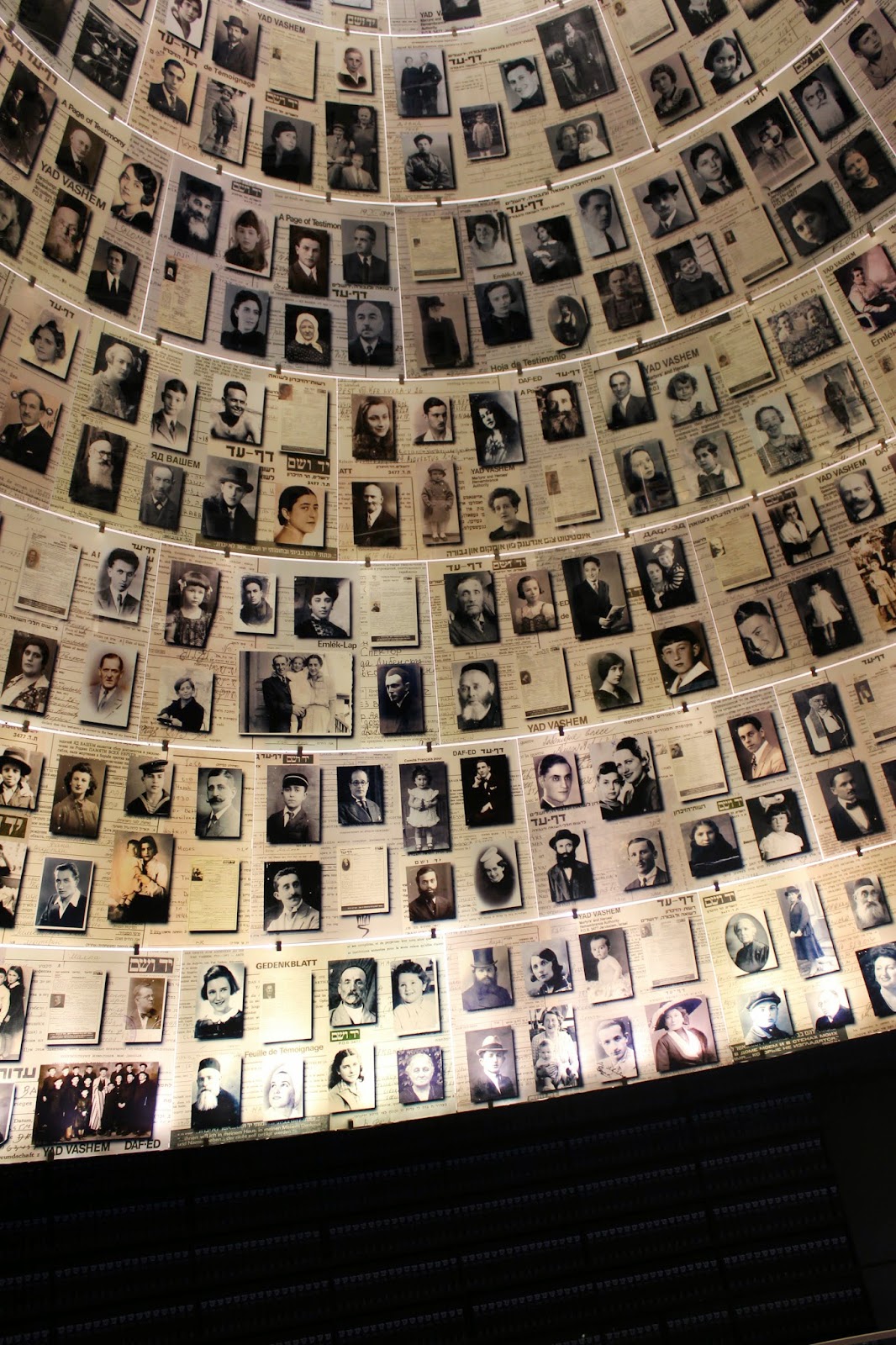
At
Yad Yashem, on the East London Three Faiths Forum Tour of the Holy Land, I saw examples of this prayer in the words of
Aharon Appelfeld who said, ‘From among the horror grew another morality, another love, another compassion. These grew wild – no one gave them a name.’ Similarly, on the
Yad Vashem website I read of survivors, ‘dazed, emaciated, bereaved beyond measure,’ who ‘gathered the remnants of their vitality and the remaining sparks of their humanity, and rebuilt.’ ‘They never meted out justice to their tormentors – for what justice could ever be achieved after such a crime? Rather, they turned to rebuilding: new families forever under the shadow of those absent; new life stories, forever warped by the wounds; new communities, forever haunted by the loss.’
I also saw pages from the illustrated Bible which self-taught artist
Carol Deutsch loving crafted in 1941 in Antwerp, during the turmoil of the Second World War, as a gift for his daughter’s second birthday. Carol Deutsch and his wife Fela were informed upon and murdered in the extermination camps. However, their daughter Ingrid, who was hidden with a Catholic family in the countryside, survived, as did the Bible, which miraculously remained intact. Deutsch, who died in Buchenwald, left behind a vital estate - a stalwart resistance to everything the Nazis had attempted to obliterate.
Finally, for those who are Christians,
Karen Sue Smith has noted that ‘Chagall’s genius was to use Jesus’ crucifixion to address Christians, to alert them by means of their own symbol system to the systematic cruelty taking place in the Holocaust.’ For Christians then, our response should, I think, be in line with the words of
Pope Francis from an
interview in 2013. There he spoke of his admiration for
White Crucifixion praising Jews for keeping their faith despite the Holocaust and other “terrible trials” throughout history (by implication, including those for which the Church is cupable), reaffirmed Judaism as the “holy root” of Christianity saying that, where this understood and affirmed, a Christian should not ever be an anti-Semite because “to be a good Christian it is necessary to understand Jewish history and traditions.”
I pray that this will be so for my own faith community and that God might reshape our reality, to give us a new and right spirit to trust that even in the midst of suffering and hardship, truth can still be experienced and shared.
See
here and
here for reports and photographs from the Redbridge event.
------------------------------------------------------------------------------------